
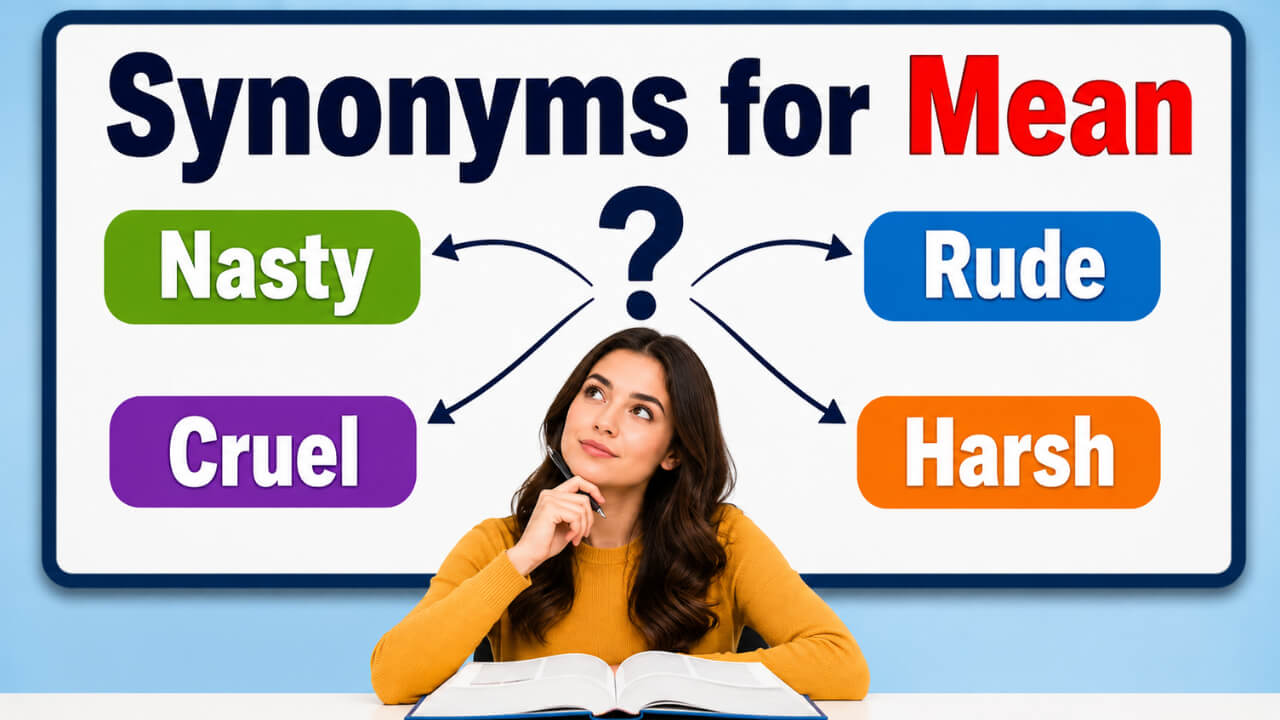
Quick Answer: Synonyms for mean include unkind, cruel, nasty, harsh, rude, stingy, intend, signify, indicate, and average. Use unkind when mean describes hurtful behavior, cruel for stronger emotional harm, rude for impolite speech, stingy for someone unwilling to spend or share, intend when mean refers to purpose, signify when it refers to meaning, and average when it refers to a mathematical value.
Pronunciation and Word Details
Word: Mean.
Pronunciation: /miːn/.
Part of Speech: Adjective, verb, and noun.
Meaning: Mean can describe someone unkind, refer to what a word or action signifies, show intention, or name an average value.
US Pronunciation:
UK Pronunciation:
What Does “Mean” Mean?
Mean means unkind, cruel, or hurtful when used as an adjective, but it can also mean intend, signify, or represent when used as a verb. As a noun, mean can refer to an average value in mathematics or statistics.
The word changes meaning based on sentence context. In “That was a mean comment,” mean describes rude or hurtful behavior. In “What does this word mean?” it asks about meaning or definition. In “I mean to help,” it expresses intention. In “Find the mean of these numbers,” it refers to an average.
Meaning, Tone, and Context of “Mean”
Mean can be casual, neutral, emotional, technical, or academic depending on how it is used. When it describes behavior, it often has a negative and emotional tone. It suggests someone is being unkind, unfair, rude, cruel, or hurtful.
When mean is used as a verb, the tone is usually neutral. It appears in definitions, explanations, conversations, instructions, and questions. For example, “What do you mean?” is common in everyday speech.
In math and statistics, mean is technical and neutral. It refers to the average of a set of numbers. In some informal contexts, mean can also describe something impressive or skillful, as in “He plays a mean guitar,” but this meaning is less direct and depends on tone.
When and How to Use “Mean”
For Hurtful Behavior: Use mean when someone acts unkind, rude, or emotionally hurtful.
Example: It was mean to laugh at his mistake.
For Intention: Use mean when explaining what someone intends or plans to say or do.
Example: I did not mean to upset you.
For Meaning or Definition: Use mean when asking what a word, phrase, sign, or action represents.
Example: What does this symbol mean?
For Mathematical Average: Use mean when describing the average value of numbers.
Example: The mean of the test scores was eighty two.
For Stinginess: Use mean when someone is unwilling to spend, share, or give.
Example: He was mean with his money.
For Skill in Casual Speech: Use mean when describing someone who is impressively good at something in informal language.
Example: She cooks a mean pasta dish.
Best Synonyms for Mean
Synonym: Unkind.
Meaning: Not caring, gentle, or considerate toward others.
Example: His unkind words hurt her feelings.
Synonym: Cruel.
Meaning: Deliberately causing pain, fear, or sadness.
Example: It was cruel to embarrass him in front of everyone.
Synonym: Nasty.
Meaning: Very unpleasant, rude, or offensive.
Example: She made a nasty remark during the argument.
Synonym: Harsh.
Meaning: Severe, rough, or emotionally sharp.
Example: His harsh criticism made the team feel discouraged.
Synonym: Rude.
Meaning: Impolite or disrespectful.
Example: That was a rude way to answer a simple question.
Synonym: Stingy.
Meaning: Unwilling to spend, share, or give.
Example: He is too stingy to leave a fair tip.
Synonym: Intend.
Meaning: To plan or want to do something.
Example: I intend to finish the work today.
Synonym: Signify.
Meaning: To represent or express a meaning.
Example: The red light can signify danger.
Synonym: Indicate.
Meaning: To show, suggest, or point to something.
Example: These results indicate steady progress.
Synonym: Average.
Meaning: A value found by dividing the total by the number of items.
Example: The average score was higher this year.
50 Synonyms for Mean with Short Meanings
- Unkind: Not caring or gentle toward others.
- Cruel: Willing to cause pain or suffering.
- Nasty: Very unpleasant, rude, or offensive.
- Harsh: Severe, rough, or emotionally sharp.
- Rude: Impolite or disrespectful.
- Hurtful: Causing emotional pain.
- Spiteful: Wanting to hurt someone on purpose.
- Malicious: Intending to harm someone.
- Vicious: Extremely cruel or aggressive.
- Heartless: Showing no sympathy or kindness.
- Cold: Emotionally distant or uncaring.
- Unpleasant: Not kind, friendly, or enjoyable.
- Hostile: Unfriendly or aggressive.
- Abusive: Using cruel or harmful language or actions.
- Insulting: Showing disrespect through words.
- Offensive: Causing anger, hurt, or upset.
- Disrespectful: Showing a lack of respect.
- Sharp: Critical, cutting, or severe in tone.
- Severe: Strict, strong, or harsh.
- Bitter: Angry, resentful, or emotionally sharp.
- Stingy: Unwilling to spend or share money.
- Miserly: Extremely unwilling to spend money.
- Cheap: Unwilling to spend fairly.
- Ungenerous: Not willing to give or share.
- Tightfisted: Very unwilling to spend money.
- Petty: Small minded or unfair over minor things.
- Selfish: Caring mainly about oneself.
- Greedy: Wanting more than is fair.
- Intend: To plan or want to do something.
- Plan: To decide to do something.
- Aim: To have a purpose or goal.
- Purpose: To have a specific intention.
- Want: To desire or wish something.
- Signify: To represent or express meaning.
- Indicate: To show or suggest something.
- Represent: To stand for something.
- Denote: To have a direct meaning.
- Imply: To suggest without saying directly.
- Suggest: To give an idea or possible meaning.
- Express: To show a thought, feeling, or meaning.
- Convey: To communicate an idea or message.
- Refer: To point to or relate to something.
- Define: To explain the meaning of something.
- Matter: To be important or significant.
- Average: The usual middle value.
- Median: The middle value in an ordered set.
- Norm: The usual or standard amount.
- Moderate: Average or not extreme.
- Low quality: Poor or not good.
- Inferior: Lower in quality or value.
Read Also:
Synonyms for Cool

Synonyms for Mean by Context
When Mean Means Unkind
Mean often describes rude, hurtful, or cruel behavior. Use these synonyms when talking about comments, actions, attitude, or treatment.
Unkind: Her unkind response made him feel embarrassed.
Cruel: It was cruel to ignore someone who needed help.
Nasty: He made a nasty joke about her work.
Hurtful: Those hurtful words stayed with him for days.
When Mean Means Intend
Mean can refer to intention or purpose. Use these synonyms when explaining what someone planned, wanted, or tried to do.
Intend: I intend to explain the rule clearly.
Plan: She plans to apologize after class.
Aim: The lesson aims to improve vocabulary.
Purpose: He did not purpose to cause any trouble.
When Mean Means Signify
Mean can describe what a word, sign, action, or message represents. Use these synonyms in definitions, explanations, grammar, and interpretation.
Signify: The gesture may signify respect.
Indicate: The marks indicate where to cut.
Represent: The color can represent peace.
Denote: The term denotes a specific grammar function.
When Mean Means Average
Mean can be a noun in math and statistics. It refers to the value found by adding numbers and dividing by how many numbers there are.
Average: The average score improved this month.
Median: The median shows the middle value.
Norm: That result is close to the norm.
Moderate Value: The number shows a moderate value.
When Mean Means Stingy
Mean can describe someone who does not like spending, giving, or sharing. This use often appears in everyday speech.
Stingy: He was stingy with his time and money.
Miserly: The miserly owner refused to repair the chairs.
Ungenerous: Her ungenerous offer surprised everyone.
Tightfisted: He became tightfisted after losing money.
When Mean Means Low Quality
Mean can describe something poor, small, humble, or inferior in quality, though this use is less common in modern everyday speech.
Inferior: The material was inferior and weak.
Poor: They lived in poor conditions.
Low Quality: The low quality tool broke quickly.
Shabby: The room looked shabby and neglected.
Another Word for Mean
Another word for mean is unkind when mean describes hurtful behavior. However, the best replacement depends on context. Use cruel for stronger harm, rude for impolite speech, intend for purpose, signify for meaning, average for math, and stingy for someone unwilling to give or spend.
Original: That was a mean thing to say.
Better Option: That was an unkind thing to say.
Original: I did not mean to interrupt you.
Better Option: I did not intend to interrupt you.
Original: What does this phrase mean?
Better Option: What does this phrase signify?
Original: Find the mean of these numbers.
Better Option: Find the average of these numbers.
When Not to Use “Mean”
Do not use mean when the sentence needs a more exact word. Since mean has several meanings, it can sometimes sound unclear. A reader may not know whether you mean unkind, intend, signify, average, stingy, or low quality.
Weak: His answer was mean.
Better: His answer was rude and hurtful.
Weak: The sign means danger.
Better: The sign indicates danger.
Weak: I mean to apply tomorrow.
Better: I intend to apply tomorrow.
Weak: The results show the mean number.
Better: The results show the average number.
Weak: He is mean with food.
Better: He is stingy with food.
Avoid mean in formal writing when a more precise synonym improves clarity. In essays, reports, and educational content, words like signify, indicate, intend, cruel, unkind, or average often sound clearer.
Words Commonly Confused With Mean
Mean vs Rude: Mean is broader and can describe hurtful behavior. Rude mainly means impolite or disrespectful.
Mean vs Cruel: Mean can be mild or strong. Cruel is stronger and suggests deliberate emotional or physical harm.
Mean vs Nasty: Mean often describes unkind behavior, while nasty can describe words, actions, smells, tastes, or unpleasant situations.
Mean vs Harsh: Mean focuses on unkindness. Harsh focuses on severity, strictness, or roughness.
Mean vs Stingy: Mean can describe unkindness or unwillingness to spend. Stingy specifically means unwilling to give, share, or spend.
Mean vs Intend: Mean can mean intend in sentences like “I mean to help.” Intend is clearer and more formal.
Mean vs Signify: Mean is common in everyday questions about meaning. Signify is more formal and often used for signs, symbols, and abstract ideas.
Mean vs Average: Mean is a technical word in math. Average is easier for general readers and everyday explanations.
Which Synonym Should You Choose?
Choose unkind when describing behavior that lacks care, warmth, or consideration.
Choose cruel when the action causes serious pain, fear, sadness, or humiliation.
Choose rude when the problem is impolite speech, bad manners, or disrespect.
Choose nasty when the tone is offensive, unpleasant, or deliberately hurtful.
Choose harsh when criticism, judgment, weather, sound, or treatment feels severe.
Choose stingy when someone refuses to spend, share, or give fairly.
Choose intend when writing about purpose, plans, or what someone meant to do.
Choose signify when explaining what a symbol, word, gesture, or action represents.
Choose indicate when writing about signs, results, evidence, or data.
Choose average when writing about numbers, scores, measurements, or statistics.
Real Life Examples of “Mean” in Sentences
Original: That was a mean comment.
Better Option: That was an unkind comment.
Original: He was mean to the new student.
Better Option: He was cruel to the new student.
Original: I did not mean to sound angry.
Better Option: I did not intend to sound angry.
Original: What does this sentence mean?
Better Option: What does this sentence signify?
Original: The arrow means you should turn left.
Better Option: The arrow indicates you should turn left.
Original: The mean of the scores was seventy five.
Better Option: The average of the scores was seventy five.
Original: She is mean with her money.
Better Option: She is stingy with her money.
Original: His reply sounded mean.
Better Option: His reply sounded rude.
Original: The teacher gave a mean look.
Better Option: The teacher gave a harsh look.
Original: He plays a mean drum solo.
Better Option: He plays an impressive drum solo.
Synonym Groups and Usage Differences
Unkindness Group
Words like unkind, cruel, nasty, hurtful, and spiteful describe behavior that causes emotional pain. Use this group when mean describes how someone treats another person.
Example: Her hurtful remark made the room quiet.
Rudeness Group
Words like rude, disrespectful, insulting, and offensive focus on poor manners or disrespectful communication. Use this group for speech, tone, replies, and behavior.
Example: His disrespectful answer upset the group.
Intention Group
Words like intend, plan, aim, and purpose explain what someone wants or expects to do. Use this group when mean refers to purpose.
Example: I intend to correct the mistake today.
Meaning Group
Words like signify, indicate, represent, denote, and convey explain what something means or expresses. Use this group for definitions, symbols, words, actions, and messages.
Example: The phrase denotes a formal request.
Money Group
Words like stingy, miserly, cheap, ungenerous, and tightfisted describe someone unwilling to give or spend. Use this group when mean refers to money, sharing, or generosity.
Example: His stingy attitude made the guests uncomfortable.
Average Group
Words like average, norm, median, and moderate value relate to numbers and measurement. Use this group in math, statistics, grades, surveys, and data.
Example: The average result was higher than expected.
Antonyms of Mean
Kind: Gentle, caring, and considerate.
Nice: Pleasant, friendly, and agreeable.
Caring: Showing concern for others.
Compassionate: Feeling and showing sympathy.
Generous: Willing to give, share, or help.
Polite: Respectful and well mannered.
Friendly: Warm, welcoming, and pleasant.
Gentle: Soft, mild, and not harsh.
Fair: Just and reasonable.
Supportive: Helpful and encouraging.
Clear: Easy to understand or interpret.
Meaningless: Having no meaning or importance.
Accidental: Not intended or planned.
Exceptional: Better or greater than average.
Superior: Higher in quality or value.
Comparison: Mean vs Related Words
Mean vs Unkind
Mean is a broad everyday word for hurtful behavior. Unkind is clearer and slightly softer.
Example With Mean: He was mean to his younger brother.
Example With Unkind: He was unkind to his younger brother.
Mean vs Cruel
Mean can be mild or serious. Cruel is stronger and suggests intentional harm.
Example With Mean: That joke was mean.
Example With Cruel: That joke was cruel.
Mean vs Rude
Mean focuses on hurtfulness. Rude focuses on bad manners and disrespect.
Example With Mean: Her words were mean.
Example With Rude: Her words were rude.
Mean vs Nasty
Mean describes unkindness. Nasty suggests something very unpleasant, offensive, or ugly in tone.
Example With Mean: He gave a mean reply.
Example With Nasty: He gave a nasty reply.
Mean vs Intend
Mean can express purpose in everyday language. Intend is more precise and formal.
Example With Mean: I mean to call you later.
Example With Intend: I intend to call you later.
Mean vs Signify
Mean is common and simple. Signify sounds more formal and is useful for symbols, signs, and abstract ideas.
Example With Mean: What does the symbol mean?
Example With Signify: What does the symbol signify?
Mean vs Average
Mean is a math term. Average is easier in general writing, though both can refer to the same basic idea.
Example With Mean: The mean score was ninety.
Example With Average: The average score was ninety.
Common Phrases and Expressions With Mean
Mean Words: Hurtful or unkind language.
Mean Comment: A rude or hurtful statement.
Mean Look: An angry, harsh, or unfriendly expression.
Mean Spirit: A cruel or ungenerous attitude.
Mean to Say: To intend to express something.
Mean Well: To have good intentions.
What Do You Mean: A question asking for explanation or clarification.
Does That Mean: A phrase used to check meaning or result.
Mean Value: The average value in a set of numbers.
No Mean Feat: An achievement that is not easy or small.
Common Mistakes to Avoid
A common mistake is using mean when the context needs a more exact synonym. Mean can refer to unkind behavior, intention, meaning, money habits, or mathematical average. Clear writing often needs a clearer word.
Another mistake is confusing mean with rude. A rude person may simply be impolite, while a mean person may be intentionally hurtful. Cruel is even stronger and should be used when the harm is serious.
Do not use mean as a math word if your readers may not understand technical language. In simple writing, average is often clearer.
Avoid using mean repeatedly in the same paragraph. Replace it with unkind, cruel, rude, intend, signify, indicate, stingy, or average based on meaning.
Also avoid phrases that sound unnatural. For example, “He means angry” is unclear. A better sentence is “He seems angry” or “He means to sound serious,” depending on the idea.
Conclusion
Synonyms for mean should be chosen according to context. Use unkind, cruel, nasty, or rude for hurtful behavior. Choose stingy when mean refers to money or sharing. Use intend for purpose, signify or indicate for meaning, and average for math or data. Because mean has several meanings, the best synonym is the one that makes your sentence clearer, more precise, and easier for readers to understand.
FAQs About Synonyms for Mean
What is the best synonym for mean?
The best synonym for mean is unkind when describing hurtful behavior. For other meanings, use intend, signify, average, or stingy.
What is a stronger word for mean?
A stronger word for mean is cruel. You can also use malicious, vicious, or spiteful when the action is seriously hurtful.
What is a polite synonym for mean?
A polite synonym for mean is unkind. It sounds softer than cruel, nasty, or vicious.
What is another word for mean in math?
Another word for mean in math is average. It refers to the value found by adding numbers and dividing by the number of items.
What is another word for mean as a verb?
Another word for mean as a verb is intend when talking about purpose. Use signify, indicate, or represent when talking about meaning.
Can mean also mean stingy?
Yes, mean can mean stingy when describing someone unwilling to spend, share, or give.
Is mean a formal word?
Mean is common in everyday speech. In formal writing, choose a more specific word such as unkind, intend, signify, indicate, average, or stingy.
