
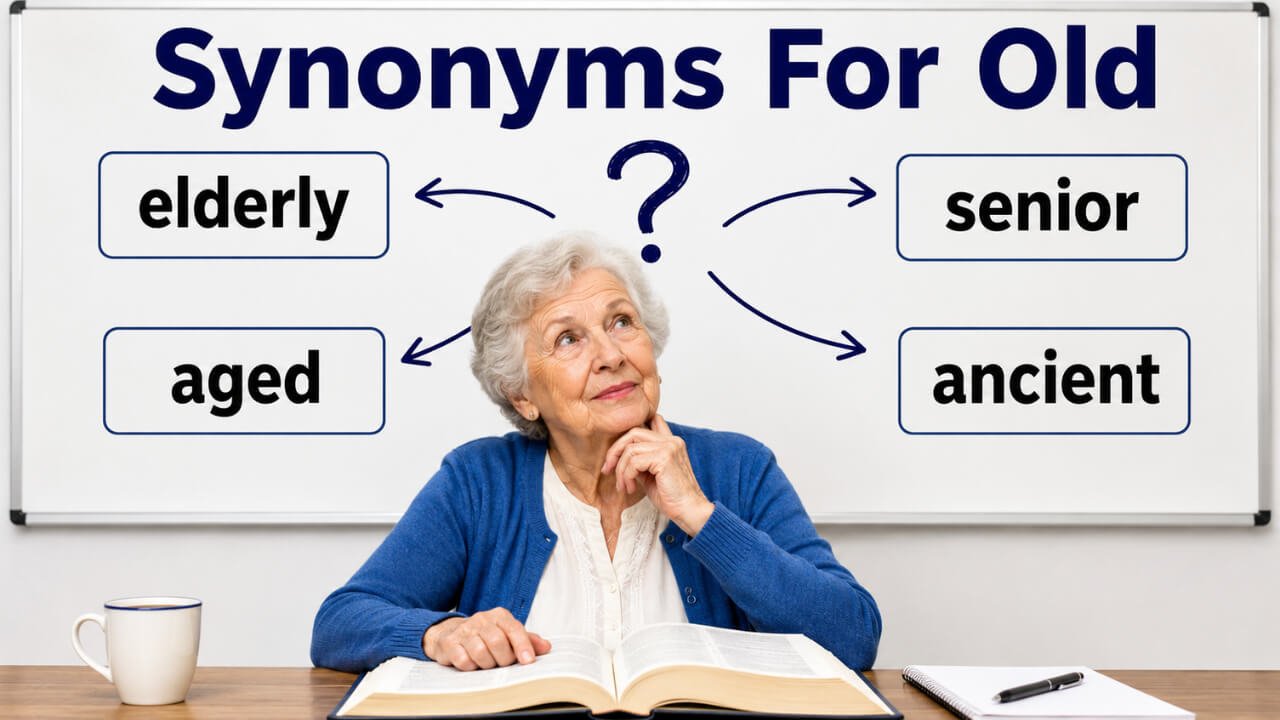
Quick Answer: The best synonyms for old include aged, elderly, ancient, antique, former, previous, worn, outdated, mature, and longstanding. Use elderly for people in a respectful way, ancient for something from the distant past, antique for valuable objects, former for a past role, outdated for ideas or technology, and worn for things damaged by time or use.
Pronunciation and Word Details
Word: Old.
Pronunciation: /oʊld/.
Part of Speech: Adjective.
Meaning: Having existed for a long time, belonging to the past, no longer new, or advanced in age.
US Pronunciation:
UK Pronunciation:
What Does “Old” Mean?
Old means having lived, existed, or been used for a long time. It is most often used as an adjective to describe age, time, condition, history, or past identity.
The word old can describe people, objects, buildings, ideas, habits, memories, documents, traditions, and relationships. It can mean advanced in age, no longer new, from the past, worn by use, or familiar because of long experience.
Examples: An old house, an old friend, an old rule, an old book, and an old habit all use the same word but show different meanings.
Meaning, Tone, and Context of “Old”
Old is a common, neutral, and flexible word. It works in casual speech, formal writing, storytelling, description, grammar examples, and everyday vocabulary.
The tone depends on the subject. When describing an object, old is usually neutral. When describing a person, it can sound direct or impolite if used carelessly. In respectful writing, words like elderly, older, senior, or aged may be better.
Neutral Use: An old table stood near the window.
Respectful Use: The elderly man needed help crossing the road.
Historical Use: Ancient ruins tell us about past civilizations.
Negative Use: Outdated rules can create confusion.
When and How to Use “Old”
For Age: Use old when describing how long someone or something has existed.
Example: The old tree has stood in the garden for decades.
For Past Identity: Use old when referring to something that belonged to an earlier time.
Example: She found her old school notebook in a drawer.
For Condition: Use old when something looks used, worn, faded, or damaged by time.
Example: His old shoes were covered with dust.
For Familiarity: Use old when describing someone or something known for a long time.
Example: We met an old friend at the market.
For History: Use old when something has existed across many years or generations.
Example: The village follows an old tradition every spring.
For Replacement: Use old when comparing something with a newer version.
Example: I replaced my old phone with a newer one.
Best Synonyms for Old
Aged: Having lived or existed for many years.
Example: The aged wooden door creaked in the wind.
Elderly: Advanced in age, usually used respectfully for people.
Example: The elderly woman smiled kindly at the children.
Ancient: Very old and connected with the distant past.
Example: The museum displayed ancient pottery.
Antique: Old and often valuable because of age, style, or history.
Example: She bought an antique mirror for the hallway.
Former: Belonging to an earlier time, role, or position.
Example: His former teacher wrote him a recommendation.
Previous: Coming before the present time or current one.
Example: The previous owner kept the garden in good shape.
Outdated: No longer modern, useful, or suitable.
Example: The office still uses outdated software.
Worn: Damaged or changed because of long use.
Example: The worn carpet showed signs of heavy footsteps.
Mature: Fully developed or no longer young.
Example: Mature trees provide shade throughout the park.
Longstanding: Existing for a long time.
Example: They solved a longstanding problem with patience.
50 Synonyms for Old with Short Meanings
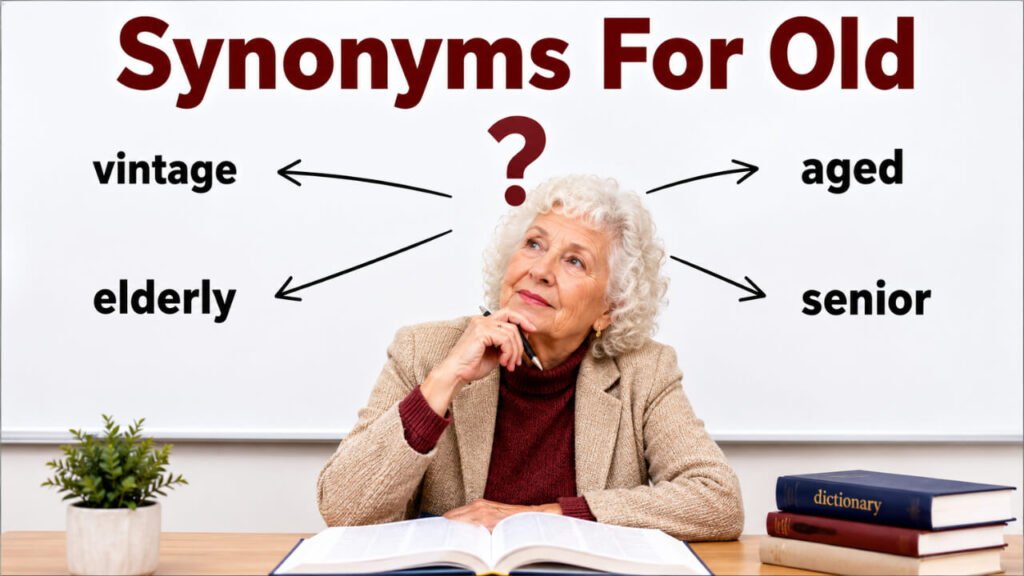
- Aged: Having existed or lived for many years.
- Elderly: Advanced in age, especially for people.
- Ancient: Extremely old or from the distant past.
- Antique: Old and often valuable or collectible.
- Former: Belonging to an earlier time or role.
- Previous: Existing or happening before the present one.
- Past: Connected with an earlier time.
- Earlier: Coming before something else in time.
- Prior: Existing before another thing or event.
- Outdated: No longer modern, useful, or current.
- Obsolete: No longer used because something newer exists.
- Archaic: Very old in style, language, or use.
- Vintage: Old but admired for quality, style, or character.
- Historic: Important because of age or past events.
- Historical: Related to history or the past.
- Traditional: Based on long established customs or practices.
- Timeworn: Affected by age, use, or repetition.
- Worn: Damaged or changed by long use.
- Weathered: Changed by age, weather, or exposure.
- Faded: Less bright, clear, or fresh because of time.
- Tired: No longer fresh, effective, or interesting.
- Stale: No longer fresh, new, or exciting.
- Dated: Clearly from an earlier time or style.
- Old fashioned: No longer modern in style or thinking.
- Old school: Traditional or based on earlier methods.
- Mature: Fully developed or advanced in age.
- Senior: Older in age, rank, or experience.
- Long lived: Having lived or existed for a long time.
- Longstanding: Existing for many years.
- Established: Accepted or known for a long time.
- Veteran: Experienced because of long service or involvement.
- Experienced: Having knowledge gained over time.
- Seasoned: Skilled or mature through long experience.
- Lifelong: Lasting for most or all of a lifetime.
- Ancestral: Connected with earlier generations or ancestors.
- Ancestral era: Related to a much earlier family or cultural past.
- Bygone: Belonging to a time that has passed.
- Forgotten: No longer remembered or commonly used.
- Retired: No longer active in work, service, or use.
- Used: Not new because it has been owned or handled before.
- Secondhand: Previously owned or used by someone else.
- Preowned: Owned by someone before the current user.
- Worn out: Damaged, tired, or no longer effective from use.
- Run down: In poor condition because of age or neglect.
- Decayed: Damaged or weakened over time.
- Crumbling: Breaking down because of age or weakness.
- Ruined: Badly damaged and no longer in good condition.
- Senescent: Growing old, often in biological or technical contexts.
- Superannuated: Too old for active use, work, or service.
- Time tested: Proven reliable through long use or experience.
Read Also:
Synonyms for For Example

Synonyms for Old by Context
When Old Means Advanced in Age
Use these synonyms when talking about people, animals, or living things that have lived for many years.
Elderly: Respectful word for an older person.
Example: The elderly neighbor enjoys walking every morning.
Aged: Formal or descriptive word for someone or something old.
Example: The aged horse moved slowly across the field.
Senior: Often used for age, status, or experience.
Example: Senior members of the group shared helpful advice.
Mature: Fully grown or developed.
Example: The mature tree produced fruit every summer.
When Old Means From the Distant Past
Use these synonyms when writing about history, civilizations, traditions, ruins, or objects from long ago.
Ancient: Very old and from a far earlier period.
Example: Ancient walls surrounded the old city.
Historic: Important because of past events.
Example: The town preserved its historic buildings.
Archaic: Very old in language, style, or custom.
Example: The poem used archaic words.
Bygone: Belonging to a past age.
Example: The painting showed scenes from a bygone era.
When Old Means Not New
Use these synonyms when comparing older things with newer ones.
Previous: Coming before the current one.
Example: My previous laptop was slower than this one.
Former: Belonging to an earlier role or time.
Example: The former manager returned for a visit.
Used: Already owned or handled before.
Example: He bought a used bicycle for daily travel.
Secondhand: Previously owned by someone else.
Example: She found a secondhand jacket in excellent condition.
When Old Means No Longer Useful
Use these synonyms when describing ideas, systems, technology, rules, or methods that are not current.
Outdated: No longer suitable for modern use.
Example: The guide contains outdated advice.
Obsolete: Replaced by something newer or better.
Example: The machine became obsolete after the update.
Dated: Clearly from an earlier period.
Example: The design looks dated now.
Old fashioned: Not modern in style or thinking.
Example: His old fashioned approach did not fit the new process.
When Old Means Damaged by Time or Use
Use these synonyms when describing condition, wear, weakness, or age related damage.
Worn: Changed or damaged through repeated use.
Example: The worn handle felt smooth from years of use.
Weathered: Changed by weather or exposure.
Example: The weathered fence leaned toward the road.
Faded: Less bright or clear because of time.
Example: The faded sign was hard to read.
Run down: In poor condition from age or neglect.
Example: They repaired the run down building.
Another Word for Old
Another word for old is aged, but the best single replacement depends on context. Use elderly for people, ancient for history, antique for valuable objects, outdated for ideas, and worn for damaged items.
Original: The old man sat quietly near the window.
Better Option: The elderly man sat quietly near the window.
Original: They visited an old temple during the trip.
Better Option: They visited an ancient temple during the trip.
Original: My old computer cannot run the program.
Better Option: My outdated computer cannot run the program.
Original: She kept an old necklace in a small box.
Better Option: She kept an antique necklace in a small box.
When Not to Use “Old”
Do not use old when a more exact word gives better meaning. The word can sound too basic, unclear, or insensitive in some contexts.
Weak: The old person needed help.
Better: The elderly person needed help.
Weak: The old law caused problems.
Better: The outdated law caused problems.
Weak: They studied old history.
Better: They studied ancient history.
Weak: He wore an old coat.
Better: He wore a worn coat.
Weak: My old boss called yesterday.
Better: My former boss called yesterday.
Weak: The old method is not useful anymore.
Better: The obsolete method is not useful anymore.
Words Commonly Confused With Old
Old vs Elderly: Old can describe people, objects, ideas, and time, while elderly is mainly a respectful word for older people.
Old vs Ancient: Old can mean any advanced age, while ancient means extremely old or from the distant past.
Old vs Antique: Old simply means not new, while antique often suggests value, history, or collectibility.
Old vs Former: Old can describe age or condition, while former means something belonged to an earlier role, position, or time.
Old vs Previous: Previous means something came before the current one, but it does not always mean aged or worn.
Old vs Outdated: Old can be neutral, while outdated means no longer current, modern, or suitable.
Old vs Worn: Old refers to age, while worn focuses on damage or change caused by use.
Which Synonym Should You Choose?
Choose elderly when writing respectfully about older people.
Choose aged when you want a formal or descriptive word for something advanced in years.
Choose ancient when writing about distant history, ruins, civilizations, or very old objects.
Choose antique when describing old objects that may have value, style, or collectibility.
Choose former when referring to a past job, role, relationship, or identity.
Choose previous when comparing something with what came before the current one.
Choose outdated when writing about old ideas, rules, systems, or technology that no longer work well.
Choose obsolete when something has been replaced and is no longer used.
Choose worn when describing something damaged by repeated use.
Choose longstanding when describing a problem, relationship, tradition, or habit that has existed for many years.
Real Life Examples of “Old” in Sentences
Original: The old bridge needs repairs.
Better Option: The aging bridge needs repairs.
Original: She found an old ring in the drawer.
Better Option: She found an antique ring in the drawer.
Original: My old phone freezes often.
Better Option: My outdated phone freezes often.
Original: The old rule confused new students.
Better Option: The outdated rule confused new students.
Original: He met his old coach after many years.
Better Option: He met his former coach after many years.
Original: The old chair made a loud noise.
Better Option: The worn chair made a loud noise.
Original: They studied old buildings in the city.
Better Option: They studied historic buildings in the city.
Original: Her old ideas no longer fit the situation.
Better Option: Her dated ideas no longer fit the situation.
Original: The old tradition still brings families together.
Better Option: The longstanding tradition still brings families together.
Original: He used an old method to solve the problem.
Better Option: He used a traditional method to solve the problem.
Synonym Groups and Usage Differences
Age Group
Words like elderly, aged, senior, and mature focus on age, development, or later life. They are useful when describing people, animals, or living things.
Example: The elderly gardener still cared for every plant with patience.
History Group
Words like ancient, historic, historical, bygone, and archaic connect old things with the past, culture, records, language, or civilizations.
Example: The ancient manuscript revealed details about early farming.
Condition Group
Words like worn, weathered, faded, decayed, and run down describe how time or use has changed something physically.
Example: The weathered gate opened with a soft creak.
Previous Time Group
Words like former, previous, past, earlier, and prior describe something that came before the present.
Example: The previous plan was simpler but less effective.
No Longer Current Group
Words like outdated, obsolete, dated, and old fashioned describe things that are no longer modern, useful, or suitable.
Example: The outdated policy created unnecessary delays.
Experience Group
Words like seasoned, experienced, veteran, and established suggest knowledge, skill, or reliability gained over time.
Example: The seasoned writer revised the paragraph with care.
Antonyms of Old
New: Recently made, discovered, or created.
Young: Early in life or not advanced in age.
Modern: Connected with the present time or current style.
Recent: Happening or appearing not long ago.
Fresh: New, clean, bright, or not stale.
Current: Belonging to the present time.
Contemporary: Existing or happening in the same modern period.
Latest: Most recent or newest.
Updated: Improved or changed to fit current needs.
Unused: Not used before.
Youthful: Having qualities of youth, energy, or freshness.
Novel: New, unusual, or original.
Comparison: Old vs Related Words
Old vs Aged
Old is general and common. Aged sounds more descriptive or formal and often suggests many years have passed.
Example With Old: The old paper was difficult to read.
Example With Aged: The aged paper had turned yellow.
Old vs Elderly
Old can sound too direct for people. Elderly is usually more respectful and specific.
Example With Old: The old woman waited at the door.
Example With Elderly: The elderly woman waited at the door.
Old vs Ancient
Old can describe anything that is not new. Ancient means extremely old and usually connected with history.
Example With Old: They found an old coin.
Example With Ancient: They found an ancient coin from a lost settlement.
Old vs Antique
Old only describes age. Antique suggests an object may have value, beauty, rarity, or historical interest.
Example With Old: He bought an old clock.
Example With Antique: He bought an antique clock for the study.
Old vs Outdated
Old may be neutral. Outdated means no longer suitable, useful, or modern.
Example With Old: The classroom has old computers.
Example With Outdated: The classroom has outdated computers.
Old vs Former
Old can describe age, condition, or past connection. Former means previous in role, identity, position, or relationship.
Example With Old: My old teacher visited the school.
Example With Former: My former teacher visited the school.
Common Phrases and Expressions With Old
Old Friend: A friend known for a long time.
Old Habit: A repeated behavior from the past.
Old News: Information that is no longer surprising or current.
Old Fashioned: Not modern in style, behavior, or thinking.
Old School: Traditional in method, style, or attitude.
Old Enough: Having enough age or maturity for something.
Old Times: A past period remembered by someone.
Old Story: Something familiar, repeated, or already known.
Old Saying: A traditional phrase or piece of advice.
Old Wounds: Past emotional pain or unresolved problems.
Common Mistakes to Avoid
Using old too often can make writing sound basic or repetitive. Replace it with a clearer synonym when the sentence needs exact meaning.
Avoid using old for people when it may sound rude. In polite writing, elderly, older, or senior may be better.
Do not use ancient for anything that is only slightly old. Ancient suggests a much older historical period.
Do not use antique for every old object. An old plastic cup is not usually antique.
Avoid confusing former with old. A former teacher may not be old in age. The word means the person taught you in the past.
Avoid using outdated when you only mean old in age. An old book may still be useful, but an outdated book contains information that is no longer current.
Avoid vague sentences like “This is old.” Explain whether it is worn, outdated, historic, former, ancient, or antique.
Conclusion
The keyword synonyms for old covers many useful word choices because old has several meanings. For people, use elderly, senior, or aged with care. For history, choose ancient, historic, or bygone. For objects, use antique, worn, or weathered. For ideas and technology, choose outdated, obsolete, or dated. The best synonym depends on whether you mean age, history, condition, past identity, or lack of modern use.
FAQs About Synonyms for Old
What is the best synonym for old?
Answer: The best synonym for old depends on context. Use elderly for people, ancient for history, antique for valuable objects, and outdated for things no longer modern.
What is a polite synonym for old?
Answer: A polite synonym for old is elderly when describing people. Older and senior can also sound respectful in many contexts.
What is another word for old things?
Answer: Another word for old things can be antique, vintage, worn, used, weathered, or aged, depending on condition and value.
What is another word for very old?
Answer: Another word for very old is ancient. You can also use age old, timeworn, historic, or archaic in the right context.
What is a synonym for old ideas?
Answer: Good synonyms for old ideas include outdated, dated, obsolete, old fashioned, and archaic.
Is antique the same as old?
Answer: No. Old simply means not new or advanced in age. Antique usually means old, valuable, collectible, or connected with a past style.
Can old be used for people?
Answer: Yes, but it can sound direct or impolite in some sentences. For respectful writing, use elderly, older, senior, or aged when appropriate.
