
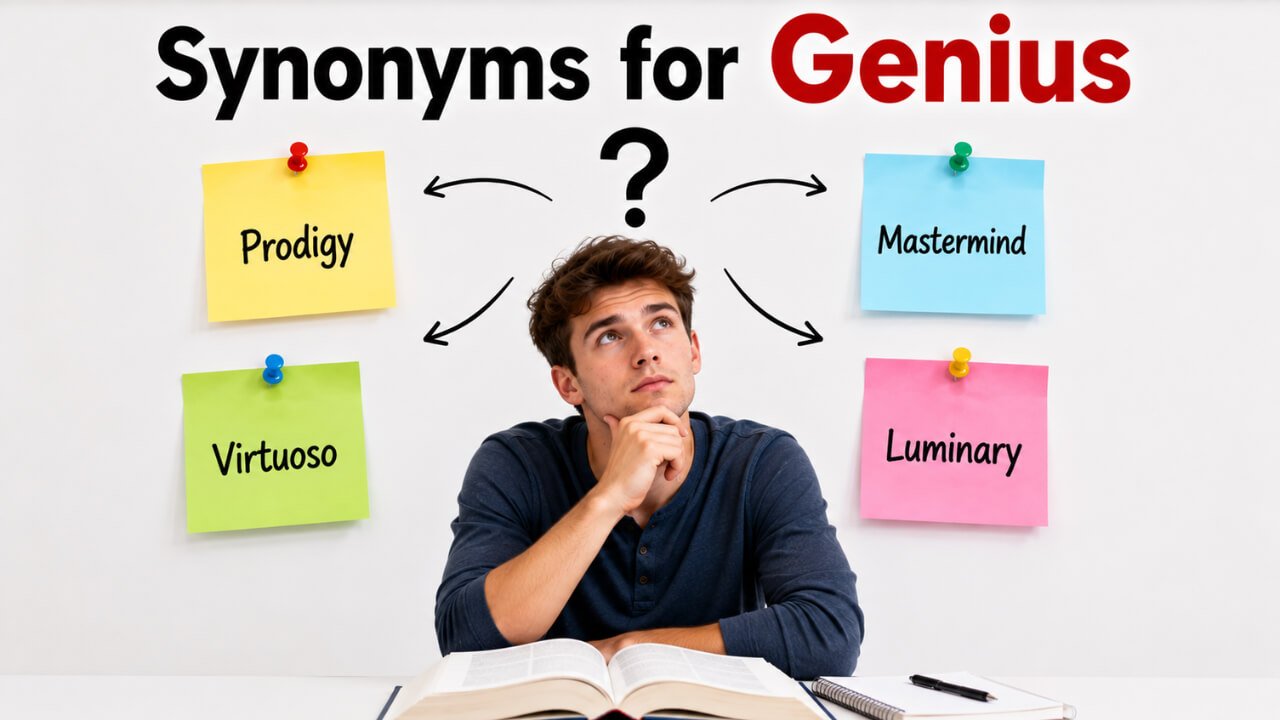
Quick Answer: The best synonyms for genius include brilliance, intellect, mastermind, prodigy, expert, virtuoso, innovator, visionary, savant, and talent. The right choice depends on context. Brilliance works well when describing exceptional intelligence or ability. Mastermind suits someone who develops an impressive plan. Prodigy usually describes a young person with extraordinary talent. Virtuoso is best for exceptional artistic or technical skill. Visionary fits someone with original ideas about the future, while expert is appropriate when emphasizing deep knowledge in a particular subject.
Pronunciation and Word Details
Word: Genius.
Pronunciation: /ˈdʒiːniəs/
Part of Speech: Noun, with informal adjective use.
Meaning: A person with exceptionally high intelligence, creativity, skill, or natural ability.
US Pronunciation:
UK Pronunciation:
What Does “Genius” Mean?
Genius means a person who has exceptional intellectual ability, creativity, talent, or skill. It is most commonly used as a noun.
Someone may be called a genius because of remarkable intelligence, an extraordinary ability to solve problems, unusual creativity, or exceptional achievement in a particular field.
The word can describe both broad intellectual ability and specialized talent.
Intelligence Context: A person may be called a genius because they understand extremely complex ideas quickly.
Creative Context: An artist, writer, designer, or inventor may be described as a genius because of unusually original work.
Technical Context: Someone who solves difficult technical problems with exceptional skill may also be called a genius.
Informal Context: In everyday conversation, genius can simply describe someone who has had a very clever idea.
Example: Whoever thought of organizing the files this way is a genius.
In some informal expressions, genius can also describe an idea, method, or decision that seems exceptionally clever.
Example: That was a genius solution to a difficult problem.
Meaning, Tone, and Context of “Genius”
The word genius usually has a strongly positive tone. It suggests intelligence, creativity, originality, or ability that is significantly above what is ordinary.
Formal Tone: Genius can appear in academic, historical, literary, and professional writing when exceptional intellectual or creative ability is being discussed.
Conversational Tone: In everyday speech, people often use genius more loosely to praise a clever idea or successful solution.
Emotional Tone: The word can express admiration, surprise, or enthusiasm.
Academic Context: Genius may refer to exceptional intellectual capacity or extraordinary creative achievement.
Professional Context: It can describe someone whose knowledge, innovation, or problem solving abilities are unusually strong.
Artistic Context: Genius often describes outstanding creativity in music, literature, painting, design, performance, or other arts.
Technical Context: The word may describe someone with exceptional ability in mathematics, science, engineering, programming, or another specialized subject.
Because genius is a powerful word, it should not always replace simpler terms such as smart, skilled, knowledgeable, talented, or experienced. Those words may be more accurate when the ability being described is impressive but not extraordinary.
When and How to Use “Genius”
For Exceptional Intelligence: Use genius when someone demonstrates extraordinary intellectual ability.
Example: Her ability to understand advanced mathematics at such a young age made many people consider her a genius.
For Creative Ability: Use genius when someone produces exceptionally original or imaginative work.
Example: His creative genius transformed a simple concept into something unforgettable.
For Outstanding Skill: Genius can describe remarkable natural or developed ability in a specialized field.
Example: Her musical genius became obvious whenever she performed.
For Innovation: Use genius when praising an unusually clever invention, method, or solution.
Example: The genius of the design lies in its simplicity.
For Problem Solving: Genius can describe someone who finds an exceptionally clever answer to a difficult problem.
Example: It took a genius to recognize such a simple solution to the complicated issue.
For Informal Praise: In casual conversation, genius can be used playfully for someone who has a clever everyday idea.
Example: Bringing extra batteries was genius.
For Admiration: Use genius when you want to express strong respect for someone’s ability.
Example: Her ability to combine technical knowledge with imagination shows genuine genius.
Best Synonyms for Genius
Brilliance
Synonym: Exceptional intelligence, creativity, or ability.
Example: Her brilliance became clear through the originality of her research.
Mastermind
Synonym: A highly intelligent person who creates or directs a complicated plan.
Example: He was the mastermind behind the successful project.
Prodigy
Synonym: A young person with unusually advanced talent or ability.
Example: The twelve year old pianist was considered a musical prodigy.
Virtuoso
Synonym: A person with outstanding skill, especially in music, art, or another specialized activity.
Example: She became known as a virtuoso because of her remarkable violin performances.
Visionary
Synonym: A person who develops original ideas about what could happen or be created in the future.
Example: The architect was regarded as a visionary for imagining a completely new approach to urban design.
Savant
Synonym: A person with exceptional knowledge or ability in a particular subject.
Example: He became known as a mathematical savant because of his extraordinary ability with numbers.
Expert
Synonym: A person with extensive knowledge or skill in a specific subject.
Example: She is an expert in language development.
Innovator
Synonym: Someone who introduces original ideas, methods, or inventions.
Example: The engineer earned a reputation as an innovator by developing several practical solutions.
Intellect
Synonym: A person with strong intellectual ability or the ability itself.
Example: She was respected as one of the leading intellects in her field.
Talent
Synonym: A person with exceptional natural ability or the ability itself.
Example: Everyone recognized him as an extraordinary artistic talent.
50 Synonyms for Genius with Short Meanings
- Brilliance: Exceptional intelligence or creative ability.
- Mastermind: A highly intelligent planner or creator.
- Prodigy: A young person with extraordinary talent.
- Virtuoso: A person with exceptional artistic or technical skill.
- Visionary: Someone with original and imaginative ideas about the future.
- Savant: A person with remarkable knowledge or specialized ability.
- Expert: Someone with advanced knowledge or skill.
- Innovator: A person who creates new ideas, methods, or solutions.
- Intellect: A person possessing strong intellectual ability.
- Talent: A person with impressive natural ability.
- Brain: An informal term for a highly intelligent person.
- Thinker: Someone skilled at developing or analyzing ideas.
- Scholar: A person with extensive academic knowledge.
- Luminary: A highly respected and influential person in a field.
- Authority: A person recognized for deep knowledge of a subject.
- Specialist: Someone with advanced knowledge in a particular area.
- Whiz: An informal term for someone exceptionally good at something.
- Wizard: An informal term for someone remarkably skilled in a particular activity.
- Ace: Someone who performs an activity extremely well.
- Maestro: A highly accomplished master, especially in music or the arts.
- Master: Someone with exceptional command of a skill or subject.
- Expert Mind: A person with highly developed knowledge and reasoning ability.
- Creative Mind: Someone with exceptional imagination and originality.
- Great Mind: A person known for remarkable intellectual ability.
- Bright Mind: Someone who is especially intelligent and quick to understand.
- Intellectual: A person strongly associated with serious thinking and knowledge.
- Academic: A person involved in advanced study or scholarship.
- Polymath: Someone with extensive knowledge across several subjects.
- Inventor: A person who creates something new.
- Pioneer: Someone who introduces or develops a new approach.
- Originator: A person who creates or begins an idea or method.
- Creator: Someone responsible for producing something original.
- Strategist: A person skilled at developing effective plans.
- Problem Solver: Someone especially skilled at finding solutions.
- Tactician: A person skilled at choosing effective methods for achieving a goal.
- Designer: Someone who plans and creates something with skill and originality.
- Trailblazer: A person who opens a new path through original ideas or achievements.
- Phenomenon: A person whose ability or success is unusually impressive.
- Marvel: A person or thing that causes admiration because of exceptional qualities.
- Wonder: Someone whose ability inspires surprise or admiration.
- Natural: A person who performs an activity easily because of strong natural ability.
- Gifted Person: Someone with unusually high natural ability.
- Exceptional Mind: A person with outstanding intellectual ability.
- Creative Force: A person with unusually strong creative influence.
- Expert Thinker: Someone highly skilled at reasoning and analysis.
- Original Thinker: A person who develops fresh and independent ideas.
- Deep Thinker: Someone who examines ideas carefully and thoughtfully.
- Brilliant Mind: A person with exceptional intelligence or creativity.
- Quick Mind: Someone who understands and responds rapidly.
- Leading Thinker: A respected person whose ideas influence a particular field.
Read Also:
Synonyms for Barrier
Synonyms for Genius by Context
When Genius Means Exceptional Intelligence
When genius refers mainly to extraordinary mental ability, useful alternatives include brilliance, intellect, brilliant mind, exceptional mind, great mind, and bright mind.
Example: She was regarded as a genius in theoretical mathematics.
Alternative: She was regarded as a brilliant mind in theoretical mathematics.
Brilliance emphasizes exceptional intellectual quality, while intellect sounds more formal and academic.
When Genius Means Exceptional Talent
When genius refers to impressive ability in a specific activity, consider virtuoso, master, maestro, talent, natural, or ace.
Example: He is a genius on the piano.
Alternative: He is a virtuoso on the piano.
Virtuoso is especially suitable for music and performance. Master works across a wider range of skills.
When Genius Means a Gifted Young Person
The strongest alternative is usually prodigy.
Example: Everyone described the young chess player as a genius.
Alternative: Everyone described the young chess player as a prodigy.
Prodigy specifically emphasizes exceptional ability appearing at an unusually young age.
When Genius Means an Inventive Person
Useful alternatives include innovator, inventor, pioneer, trailblazer, originator, and visionary.
Example: The inventor was considered a genius because of her unconventional ideas.
Alternative: The inventor was considered a visionary because of her unconventional ideas.
Innovator emphasizes creating new methods, while visionary emphasizes seeing possibilities others may not recognize.
When Genius Means an Expert
Useful choices include expert, authority, specialist, master, and savant.
Example: He is a genius when it comes to solving complex technical problems.
Alternative: He is an expert at solving complex technical problems.
Expert is usually more precise in professional contexts because it emphasizes demonstrated knowledge rather than extraordinary intelligence in general.
When Genius Means a Clever Planner
Useful alternatives include mastermind, strategist, tactician, and problem solver.
Example: She was the genius behind the entire campaign strategy.
Alternative: She was the mastermind behind the entire campaign strategy.
Mastermind is especially effective when a person created or coordinated a complicated plan.
Another Word for Genius
The best single replacement for genius is often brilliant mind when referring to exceptional intelligence. However, the most accurate alternative depends on what type of ability you want to emphasize.
Use prodigy for extraordinary ability in a young person, virtuoso for exceptional artistic skill, expert for specialized knowledge, mastermind for clever planning, and visionary for original future focused thinking.
Original: Maya is a genius at solving difficult mathematical problems.
Better Option: Maya is a brilliant mind with an exceptional ability to solve difficult mathematical problems.
Original: The young musician is a genius.
Better Option: The young musician is a prodigy.
Original: She was the genius behind the new system.
Better Option: She was the mastermind behind the new system.
Original: Everyone admired his genius as a violinist.
Better Option: Everyone admired his virtuosity as a violinist.
When Not to Use “Genius”
Genius is a strong word, so using it for ordinary competence can sound exaggerated.
Weak: Daniel is a genius because he finished the report on time.
Better: Daniel is highly efficient and completed the report on time.
Avoid using genius when expert is more accurate.
Weak: We need a genius who understands tax regulations.
Better: We need an expert who understands tax regulations.
Avoid repeating genius several times when describing the same person.
Weak: She is a genius designer whose genius helps her create genius solutions.
Better: She is a brilliant designer whose creativity helps her develop original solutions.
Avoid calling every clever decision genius in formal writing.
Weak: The manager made a genius decision about the schedule.
Better: The manager made a highly effective decision about the schedule.
Use more specific vocabulary when the exact ability matters.
Weak: He is a computer genius.
Better: He is a highly skilled software specialist.
The second sentence communicates the person’s area of expertise more precisely.
Words Commonly Confused With Genius
Genius vs Intelligent: Intelligent describes someone who understands, learns, or reasons well. Genius suggests intelligence or creativity at an extraordinary level.
Genius vs Gifted: Gifted means having unusually strong natural ability. Genius is stronger and often suggests exceptional intellectual or creative achievement.
Genius vs Expert: Expert refers to advanced knowledge or skill gained through learning and experience. Genius emphasizes exceptional ability and does not necessarily describe professional expertise.
Genius vs Prodigy: Genius can describe a person of any age. Prodigy usually refers to a young person who demonstrates remarkable ability unusually early.
Genius vs Savant: Genius has a broad meaning. Savant usually emphasizes exceptional knowledge or ability in a particular area.
Genius vs Mastermind: Genius describes extraordinary intelligence or creativity. Mastermind specifically describes the person responsible for developing or directing a complicated plan.
Genius vs Visionary: Genius emphasizes exceptional intelligence or creativity. Visionary focuses more strongly on original ideas and the ability to imagine future possibilities.
Genius vs Virtuoso: Genius can relate to almost any area of exceptional ability. Virtuoso usually refers to extraordinary skill in music, performance, art, or another demanding practice.
Which Synonym Should You Choose?
Choose brilliance when emphasizing exceptional intelligence, creativity, or quality of thought.
Choose brilliant mind when referring naturally to a person with extraordinary intellectual ability.
Choose prodigy when describing an exceptionally talented young person.
Choose virtuoso when discussing remarkable skill in music, performance, or another artistic discipline.
Choose mastermind when someone created or directed a clever and complicated plan.
Choose expert when accuracy and professional knowledge matter more than dramatic praise.
Choose authority in formal writing when someone is widely respected for deep subject knowledge.
Choose visionary when discussing innovative ideas, leadership, or an unusual ability to imagine future possibilities.
Choose innovator when someone develops a new method, product, concept, or solution.
Choose savant when emphasizing exceptional knowledge or specialized intellectual ability.
Choose whiz in casual conversation when describing someone who is extremely good at a particular activity.
Choose polymath when someone possesses substantial knowledge across several different fields.
Real Life Examples of “Genius” in Sentences
Original: Lena is a genius at solving complex equations.
Better Option: Lena has a brilliant mind for solving complex equations.
Original: The young pianist was clearly a genius.
Better Option: The young pianist was clearly a prodigy.
Original: Our technician is a genius with complicated equipment.
Better Option: Our technician is an expert with complicated equipment.
Original: She was the genius behind the entire strategy.
Better Option: She was the mastermind behind the entire strategy.
Original: His artistic genius impressed everyone at the exhibition.
Better Option: His extraordinary creative talent impressed everyone at the exhibition.
Original: The scientist was considered a genius by her colleagues.
Better Option: The scientist was considered a brilliant intellect by her colleagues.
Original: Whoever created this system is a genius.
Better Option: Whoever created this system is an exceptional innovator.
Original: He is a genius when it comes to developing unusual ideas.
Better Option: He is an original thinker when it comes to developing unusual ideas.
Original: Her genius helped transform the small project into something remarkable.
Better Option: Her vision and creativity helped transform the small project into something remarkable.
Original: That solution was genius.
Better Option: That solution was remarkably clever.
Synonym Groups and Usage Differences
Intelligence Group
This group includes brilliance, intellect, brilliant mind, exceptional mind, great mind, bright mind, and quick mind.
These alternatives emphasize thinking ability, reasoning, understanding, and intellectual strength.
Example: Her brilliance allowed her to recognize patterns that others had overlooked.
Talent Group
This group includes talent, virtuoso, maestro, master, natural, ace, and gifted person.
These words focus more on ability and performance than intelligence alone.
Example: The young violinist was already considered a virtuoso.
Knowledge Group
This group includes expert, specialist, authority, scholar, intellectual, academic, and savant.
These terms are useful when knowledge and expertise are more important than general intelligence.
Example: She is an authority on historical linguistics.
Innovation Group
This group includes innovator, inventor, pioneer, originator, trailblazer, visionary, and creator.
These alternatives emphasize originality and the creation of new ideas.
Example: He became known as an innovator because he continually developed more efficient methods.
Planning Group
This group includes mastermind, strategist, tactician, and problem solver.
These words describe intelligence applied to planning, organization, or finding solutions.
Example: The strategist developed a practical plan for completing the project ahead of schedule.
Informal Praise Group
This group includes whiz, wizard, brain, ace, natural, wonder, and phenomenon.
These choices are generally more conversational and expressive.
Example: Priya is a whiz at organizing complicated spreadsheets.
Antonyms of Genius
The opposite of genius changes according to whether you are discussing intelligence, ability, creativity, knowledge, or achievement.
Antonym: Fool. A person who behaves or thinks unwisely.
Antonym: Amateur. Someone with limited professional experience or expertise.
Antonym: Novice. A person who is new to an activity or subject.
Antonym: Beginner. Someone at an early stage of learning.
Antonym: Inexpert Person. Someone who lacks skill or specialized knowledge.
Antonym: Unskilled Person. Someone without developed ability in a particular activity.
Antonym: Mediocrity. A person or quality that is ordinary rather than exceptional.
Antonym: Imitator. Someone who copies existing ideas rather than creating original ones.
Antonym: Inexperienced Person. Someone who has not yet developed sufficient practical knowledge.
Antonym: Ordinary Thinker. Someone whose thinking is conventional rather than unusually original or brilliant.
Comparison: Genius vs Related Words
Genius vs Brilliant
Genius is usually a noun describing a person or exceptional intellectual ability. Brilliant is an adjective describing someone or something exceptionally intelligent, impressive, or successful.
Example With Genius: Everyone considered her a mathematical genius.
Example With Brilliant: Everyone considered her a brilliant mathematician.
Genius vs Expert
A genius has exceptional intellectual, creative, or natural ability. An expert has extensive knowledge and skill in a particular subject.
Someone can become an expert through years of education and practice without necessarily being described as a genius.
Example With Genius: He has a genius for finding unexpected solutions.
Example With Expert: He is an expert in network security.
Genius vs Prodigy
Genius can describe exceptional ability at any age. Prodigy generally describes a young person whose talent is unusually advanced.
Example With Genius: The composer was remembered as a musical genius.
Example With Prodigy: She became a piano prodigy before reaching her teenage years.
Genius vs Mastermind
Genius refers broadly to exceptional intelligence or creativity. Mastermind focuses on planning and responsibility for a complicated idea, strategy, or operation.
Example With Genius: Her genius became apparent through her innovative research.
Example With Mastermind: She was the mastermind behind the project strategy.
Genius vs Visionary
Genius emphasizes exceptional intellectual or creative ability. Visionary emphasizes imagination and the ability to see possibilities for the future.
Example With Genius: His mathematical genius was widely recognized.
Example With Visionary: His colleagues viewed him as a visionary who imagined entirely new possibilities.
Genius vs Savant
Genius is a broad term for extraordinary intellectual or creative ability. Savant usually refers to someone possessing remarkable knowledge or skill in a specialized area.
Example With Genius: She was regarded as a scientific genius.
Example With Savant: He was regarded as a numerical savant because of his extraordinary ability with calculations.
Genius vs Virtuoso
Genius can refer to intelligence, creativity, or exceptional ability. Virtuoso emphasizes superior skill and performance, particularly in artistic or technical disciplines.
Example With Genius: Her musical genius influenced an entire generation.
Example With Virtuoso: She was a piano virtuoso known for technically demanding performances.
Common Phrases and Expressions With “Genius”
Creative Genius: Exceptional ability to produce imaginative and original ideas.
Example: Her creative genius is visible in every part of the design.
Pure Genius: Something considered exceptionally clever or impressive.
Example: The simple solution was pure genius.
Stroke of Genius: A sudden idea or action that is exceptionally clever.
Example: Changing the layout at the final stage proved to be a stroke of genius.
Genius Idea: An unusually clever or effective idea.
Example: Creating a separate workspace was a genius idea.
Genius Mind: A mind with extraordinary intellectual or creative ability.
Example: His genius mind approached the problem from an unusual direction.
Mathematical Genius: A person with exceptional ability in mathematics.
Example: She showed signs of being a mathematical genius from an early age.
Musical Genius: A person with extraordinary ability in music.
Example: The composer became recognized as a musical genius.
Creative Genius Behind Something: The person mainly responsible for the original creative concept.
Example: She was the creative genius behind the entire production.
Sheer Genius: Something regarded as extremely clever or impressive.
Example: The way he simplified the process was sheer genius.
Genius at Work: An expression used when someone demonstrates exceptional creativity or skill.
Example: Watching her develop the solution felt like seeing genius at work.
Common Mistakes to Avoid
One common mistake is using genius for any person who is simply intelligent or competent. Because genius suggests an unusually high level of intelligence or creativity, a more moderate word may sometimes be more accurate.
Mistake: Calling every knowledgeable person a genius.
Better Choice: Use expert, specialist, knowledgeable, skilled, or intelligent when those descriptions are sufficient.
Another mistake is treating genius and expert as exact synonyms.
An expert possesses advanced knowledge or skill. A genius is associated with extraordinary intellectual, creative, or natural ability. A person can be an expert without being a genius.
Writers may also confuse genius and prodigy.
A prodigy is normally young and displays exceptional ability at an unusually early age. A genius can be any age.
Repetition is another issue.
Repetitive: The genius inventor created a genius machine through his genius understanding of engineering.
Improved: The brilliant inventor created an innovative machine through his exceptional understanding of engineering.
Avoid choosing synonyms only because they sound impressive. The alternative should reflect the exact meaning.
For example, virtuoso works naturally for remarkable skill, particularly in artistic performance, but may sound strange when referring to ordinary academic knowledge.
Similarly, mastermind should usually involve planning, organization, or intellectual control of a complex idea rather than general intelligence.
Vague wording can also weaken a sentence.
Vague: She is a genius at business things.
Better: She is an exceptional strategist with a talent for identifying new business opportunities.
Specific language usually communicates more information than general praise.
Conclusion
The best synonyms for genius depend on the type of exceptional ability being described. Use brilliance or brilliant mind for extraordinary intelligence, prodigy for remarkable young talent, virtuoso for exceptional artistic skill, mastermind for clever planning, and visionary or innovator for original thinking. Expert and authority are often better when specialized knowledge is the main point. Choosing a synonym according to intelligence, creativity, age, skill, knowledge, or context makes your writing clearer, more accurate, and more natural.
FAQs About Synonyms for Genius
What is the best synonym for genius?
The best general synonym is brilliant mind when referring to a highly intelligent person. However, prodigy, mastermind, virtuoso, visionary, or expert may be more accurate in specific contexts.
What is a formal synonym for genius?
Intellect, luminary, authority, visionary, and brilliant mind can work well in formal contexts. The best choice depends on whether you are discussing intelligence, influence, expertise, or creativity.
What is another word for a very intelligent person?
Useful alternatives include brilliant mind, intellect, great mind, thinker, intellectual, mastermind, and savant. Some are more formal than others.
Is prodigy the same as genius?
Not exactly. A prodigy is usually a young person with exceptional ability, while a genius can be a person of any age with extraordinary intelligence, creativity, or talent.
Is expert a synonym for genius?
Expert can sometimes replace genius, especially when specialized knowledge is being emphasized. However, expert describes advanced knowledge or skill, while genius suggests extraordinary intellectual or creative ability.
What is a synonym for creative genius?
Useful alternatives include visionary, innovator, original thinker, creative mind, creator, pioneer, and trailblazer. Choose according to whether creativity, originality, leadership, or innovation is most important.
What is an informal synonym for genius?
Informal alternatives include whiz, wizard, brain, ace, and natural. These are suitable for casual conversation but may sound too relaxed in academic or highly formal writing.
