
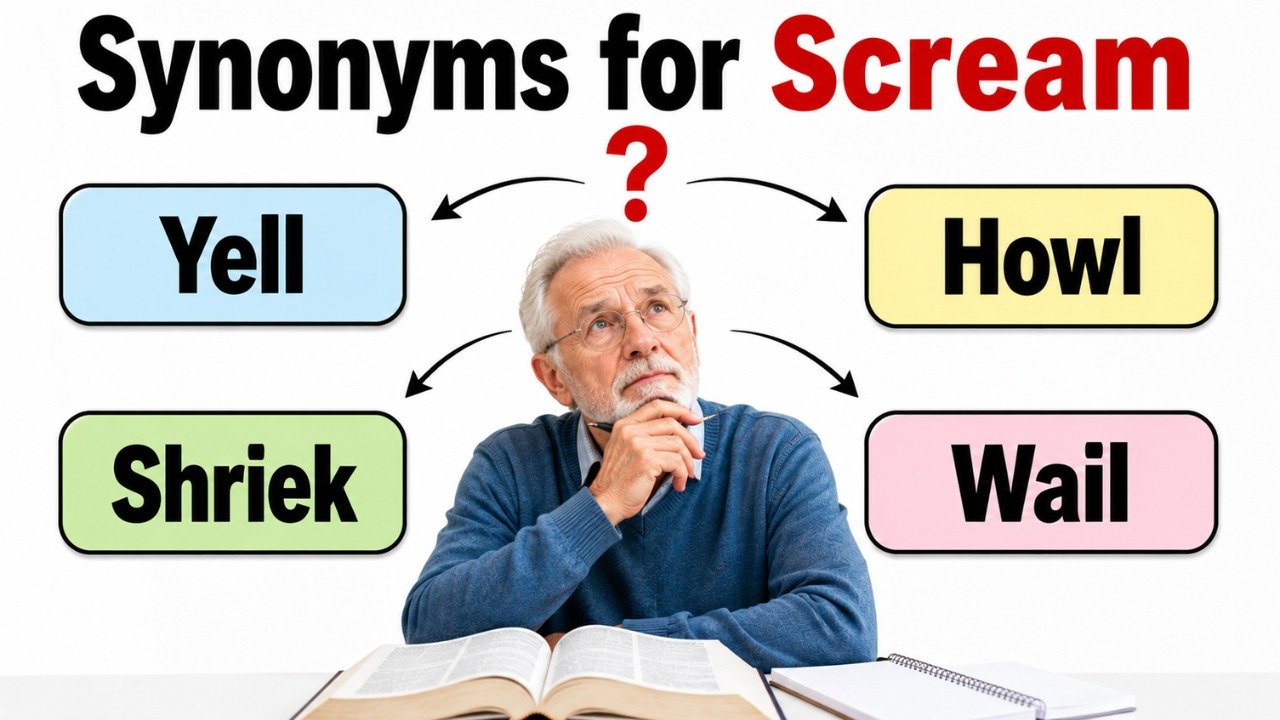
Quick Answer: Common synonyms for scream include shout, yell, shriek, screech, howl, wail, roar, squeal, yelp, and holler. The best synonyms for scream depend on the sound, emotion, and situation. Use shriek for a sharp cry of fear, yell for a loud spoken cry, wail for grief or pain, howl for a long emotional sound, screech for a harsh piercing sound, roar for great force, and holler in casual conversation.
Pronunciation and Word Details
Word: Scream.
Pronunciation: /skriːm/
Part of Speech: Noun and verb.
Meaning: To make a very loud, sharp, or emotional cry, or the loud cry itself.
US Pronunciation:
UK Pronunciation:
What Does “Scream” Mean?
Scream means to make a very loud and often high pitched cry because of fear, pain, excitement, anger, surprise, or another strong emotion.
As a verb, scream describes the action of producing the sound.
Example: She screamed when she saw the snake near the doorway.
As a noun, scream refers to the loud cry itself.
Example: A sudden scream came from the hallway.
The word can also describe loud speech.
Example: He screamed for everyone to leave the building.
In some contexts, scream can describe excitement rather than distress.
Example: The children screamed with delight when the surprise was revealed.
Scream is therefore strongly connected with volume and emotion. The exact meaning depends on whether the person is frightened, hurt, angry, excited, calling for help, or simply speaking extremely loudly.
Meaning, Tone, and Context of “Scream”
Scream is a strong, emotional, and vivid word. It is common in everyday conversation, storytelling, fiction, descriptions of emergencies, emotional scenes, and informal speech.
The tone is usually intense rather than neutral. A person who screams is not simply speaking loudly. The word suggests extreme volume, strong feeling, or sudden reaction.
Fearful Context: She screamed when the lights suddenly went out.
Painful Context: He screamed in pain after touching the hot surface.
Angry Context: She screamed at him to stop.
Excited Context: The crowd screamed with excitement.
Emergency Context: Someone screamed for help from the upper floor.
In formal writing, a more precise term may sometimes work better. Shout can describe loud speech without implying panic. Shriek emphasizes a sharp piercing sound. Wail emphasizes grief or prolonged distress. Screech suggests a harsh and unpleasant sound.
Scream is also common in creative writing because it immediately creates a vivid image of intense emotion.
When and How to Use “Scream”
For Fear: Use scream when someone makes a loud cry because they are frightened or shocked.
Example: She screamed when something moved behind the curtain.
For Pain: Scream works when pain causes an intense vocal reaction.
Example: He screamed in pain when he injured his ankle.
For Anger: Use scream when someone speaks extremely loudly because of anger or frustration.
Example: She screamed at the driver to stop the car.
For Excitement: The word can describe very loud expressions of happiness or enthusiasm.
Example: The children screamed with excitement when the doors opened.
For Surprise: Scream can describe an immediate loud reaction to something unexpected.
Example: He screamed in surprise when the balloon burst beside him.
For Calling for Help: Use scream when someone urgently calls to attract attention.
Example: She screamed for help when she noticed the fire.
For Loud Speech: Scream can mean speaking at an extreme volume.
Example: There is no need to scream across the room.
For Emotional Storytelling: Writers often use scream to create tension, urgency, fear, or emotional intensity.
Example: A scream echoed through the empty corridor.
Best Synonyms for Scream
Shout: To speak or call in a very loud voice.
Example: He shouted for everyone to move away.
Yell: To speak or cry very loudly, often because of anger, excitement, or urgency.
Example: She yelled his name from across the field.
Shriek: To make a sharp and piercing cry, often from fear or surprise.
Example: She shrieked when the spider landed beside her.
Screech: To make a harsh, sharp, and unpleasant sound.
Example: He screeched in alarm when the bird flew toward him.
Howl: To make a long, loud cry expressing pain, grief, excitement, or strong emotion.
Example: The child howled after dropping his ice cream.
Wail: To cry loudly and continuously because of grief, pain, or distress.
Example: She wailed after hearing the terrible news.
Roar: To produce a very loud and powerful sound.
Example: The crowd roared with excitement.
Squeal: To make a high pitched cry, often because of excitement, fear, or surprise.
Example: The children squealed with delight.
Yelp: To make a short, sharp cry, often from sudden pain or surprise.
Example: He yelped when he touched the hot pan.
Holler: To shout loudly, especially in informal conversation.
Example: She hollered for her brother to come inside.
50 Synonyms for Scream with Short Meanings
- Shout: To speak or call very loudly.
- Yell: To cry or speak in a loud voice.
- Shriek: To make a sharp and piercing cry.
- Screech: To produce a harsh and high sound.
- Howl: To make a long and loud emotional cry.
- Wail: To cry loudly because of grief or pain.
- Roar: To make a deep and powerful loud sound.
- Squeal: To make a sharp cry of excitement, fear, or surprise.
- Yelp: To make a short and sudden cry.
- Holler: To shout loudly in an informal way.
- Bellow: To shout in a deep and powerful voice.
- Bawl: To cry or shout very loudly.
- Cry: To make a loud emotional sound.
- Cry Out: To suddenly shout because of emotion or pain.
- Call Out: To speak loudly so someone can hear.
- Shout Out: To call something loudly.
- Yell Out: To suddenly speak or cry very loudly.
- Scream Out: To express something with a scream.
- Screech Out: To cry something in a harsh voice.
- Whoop: To give a loud cry of excitement or celebration.
- Squawk: To make a harsh, loud, and abrupt cry.
- Caterwaul: To make a long, unpleasant, wailing sound.
- Ululate: To produce a long wavering cry.
- Keening: A prolonged mournful cry or wail.
- Outcry: A loud expression of emotion or protest.
- Exclamation: A sudden vocal expression of strong feeling.
- Clamor: A loud mixture of voices or demands.
- Vociferate: To speak or shout loudly and forcefully.
- Raise One’s Voice: To speak more loudly than usual.
- Bark: To speak sharply and loudly.
- Blare: To produce or express a very loud harsh sound.
- Thunder: To speak in a very loud and forceful voice.
- Rant: To speak loudly and angrily for some time.
- Rave: To speak wildly or emotionally.
- Cry of Fear: A loud sound caused by fright.
- Cry of Pain: A loud reaction to physical suffering.
- Cry of Alarm: A loud warning caused by danger.
- Piercing Cry: A very sharp and loud vocal sound.
- Shrill Cry: A high and penetrating cry.
- Loud Cry: A strong vocal expression heard from a distance.
- Anguished Cry: A loud expression of deep pain or distress.
- Alarm Cry: A loud call warning of danger.
- Distress Cry: A cry expressing fear, pain, or trouble.
- Battle Cry: A loud call used to inspire or unite people.
- War Cry: A forceful shout associated with conflict.
- Cheer: A loud expression of approval or excitement.
- Whoop of Joy: A loud cry expressing happiness.
- Squeal of Delight: A high cry caused by excitement.
- Shout of Alarm: A loud warning in a dangerous situation.
- Cry for Help: A loud call asking for assistance.
Read Also:
Synonyms for Listen
Synonyms for Scream by Context
When Scream Means a Loud Cry of Fear
When scream describes fear or shock, useful alternatives include shriek, screech, cry out, yelp, shrill cry, piercing cry, and cry of alarm.
Example With Scream: She screamed when she noticed someone standing outside the window.
Example With Shriek: She shrieked when she noticed someone standing outside the window.
Shriek often creates a stronger sense of sharpness and sudden fear.
Example With Yelp: He yelped when the door suddenly slammed behind him.
Yelp is shorter and less intense than a full scream.
When Scream Means a Cry of Pain
Wail, howl, yelp, cry out, bawl, anguished cry, and cry of pain can replace scream when suffering is involved.
Example With Scream: He screamed when his injured foot touched the ground.
Example With Cry Out: He cried out when his injured foot touched the ground.
Example With Wail: The child wailed after hurting his knee.
Wail usually suggests a longer emotional sound, while yelp often describes one brief reaction.
When Scream Means Shout Loudly
Shout, yell, holler, bellow, call out, and raise one’s voice are useful when scream describes loud speech.
Example With Scream: She screamed his name across the parking area.
Example With Shout: She shouted his name across the parking area.
Shout is more neutral and does not automatically imply extreme fear or emotional loss of control.
When Scream Means Express Anger
Yell, shout, bellow, bark, rant, vociferate, and thunder can describe forceful angry speech.
Example With Scream: He screamed at everyone to leave.
Example With Yell: He yelled at everyone to leave.
Example With Bellow: He bellowed an order across the room.
Bellow suggests a deep and extremely powerful voice.
When Scream Means Express Excitement
Squeal, whoop, cheer, shout, yell, and whoop of joy work when someone screams because they are happy or excited.
Example With Scream: The children screamed when they saw the surprise.
Example With Squeal: The children squealed when they saw the surprise.
Squeal works especially well for a high excited cry.
When Scream Means a Harsh Sound
Screech, squawk, blare, and shriek are strong choices when the sound itself is harsh or piercing.
Example With Scream: The machine seemed to scream as the metal rubbed together.
Example With Screech: The machine screeched as the metal rubbed together.
Screech is more precise for unpleasant mechanical or sharp sounds.
Another Word for Scream
Another word for scream is shout when the meaning is simply to speak very loudly. However, shout is less emotional than scream.
The best replacement depends on what causes the sound. Shriek fits sudden fear, wail fits grief, yell fits loud speech, and squeal often fits excitement.
Original: She screamed his name from the doorway.
Better Option: She shouted his name from the doorway.
Original: She screamed when the shadow moved.
Better Option: She shrieked when the shadow moved.
Original: The child screamed after losing his favorite toy.
Better Option: The child wailed after losing his favorite toy.
Original: The fans screamed with excitement.
Better Option: The fans cheered with excitement.
When Not to Use “Scream”
Scream can be too intense when a person is only speaking loudly.
Weak: The teacher screamed the instructions so everyone could hear.
Better: The teacher shouted the instructions so everyone could hear.
Avoid scream when you need to describe a very specific kind of emotional cry.
Weak: The grieving woman screamed for several minutes.
Better: The grieving woman wailed for several minutes.
Use shriek instead when sharpness and fear matter more than general volume.
Weak: She screamed when the mouse ran across the floor.
Better: She shrieked when the mouse ran across the floor.
Do not use scream automatically for all animal or mechanical sounds.
Weak: The brakes screamed when the driver stopped suddenly.
Better: The brakes screeched when the driver stopped suddenly.
Scream may also sound overly dramatic in professional or neutral writing.
Weak: The manager screamed across the office that the meeting had started.
Better: The manager called out across the office that the meeting had started.
Avoid repeating scream several times in a short passage when different emotions are involved.
Weak: She screamed in fear, then screamed for help, while someone else screamed instructions.
Better: She shrieked in fear, then called for help, while someone else shouted instructions.
Words Commonly Confused With Scream
Scream vs Shout: Scream usually suggests greater emotional intensity or a sharper sound. Shout mainly means speaking loudly.
Scream vs Yell: Both can involve very loud speech, but scream often suggests fear, pain, anger, or extreme emotion. Yell is broader and more conversational.
Scream vs Shriek: Scream is a general loud emotional cry. Shriek is usually sharper, higher, and more piercing.
Scream vs Screech: Scream is mainly associated with human vocal sounds, although it can be figurative. Screech often describes harsh voices, animals, brakes, machinery, or other sharp sounds.
Scream vs Wail: Scream may be sudden and intense. Wail is usually longer and associated with grief, sorrow, or pain.
Scream vs Howl: Scream is often sharp, while howl suggests a longer and more drawn out sound.
Scream vs Squeal: Scream can express many strong emotions. Squeal usually describes a high sound of excitement, fear, or surprise.
Scream vs Yelp: Scream can continue for some time. Yelp is usually brief and sudden.
Scream vs Bellow: Scream tends to suggest a sharp cry, while bellow suggests a deep, forceful, booming voice.
Which Synonym Should You Choose?
Choose shout when someone simply needs to speak loudly.
Choose yell for casual speech involving anger, urgency, excitement, or distance.
Choose shriek for a sharp and piercing cry caused by fear, surprise, or shock.
Choose screech when the sound is harsh, unpleasant, or piercing.
Choose wail for prolonged grief, sadness, distress, or pain.
Choose howl when describing a long emotional cry or extremely loud reaction.
Choose squeal for a high sound of excitement, delight, fear, or surprise.
Choose yelp for a quick reaction to sudden pain or shock.
Choose holler in casual conversation when someone calls loudly.
Choose bellow for a deep and forceful shout.
Choose cry out when the exact emotion is less important than the sudden vocal reaction.
Choose call out when the person is trying to attract someone’s attention rather than expressing extreme emotion.
Choose cheer when a loud sound expresses approval, celebration, or excitement.
Choose outcry in formal writing when describing a strong public expression of anger, protest, or disapproval.
Choose vociferate only in formal or literary writing when emphasizing loud and forceful speech.
Real Life Examples of “Scream” in Sentences
Original: She screamed when the glass suddenly shattered.
Better Option: She shrieked when the glass suddenly shattered.
Original: He screamed for everyone to get outside.
Better Option: He shouted for everyone to get outside.
Original: The child screamed after falling from the chair.
Better Option: The child wailed after falling from the chair.
Original: She screamed his name from the other side of the street.
Better Option: She yelled his name from the other side of the street.
Original: He screamed when the hot water touched his hand.
Better Option: He yelped when the hot water touched his hand.
Original: The crowd screamed when the performance began.
Better Option: The crowd cheered when the performance began.
Original: She screamed with excitement after opening the gift.
Better Option: She squealed with excitement after opening the gift.
Original: The angry man screamed an order across the room.
Better Option: The angry man bellowed an order across the room.
Original: Someone screamed for help from the hallway.
Better Option: Someone cried out for help from the hallway.
Original: The brakes screamed as the vehicle stopped.
Better Option: The brakes screeched as the vehicle stopped.
Synonym Groups and Usage Differences
Fear Group
Shriek, screech, yelp, cry out, piercing cry, shrill cry, and alarm cry are useful for sudden fear, shock, or danger.
Shriek is particularly vivid when the sound is sharp and high.
Example: She shrieked when the insect landed on her shoulder.
Pain and Distress Group
Wail, howl, bawl, cry out, anguished cry, distress cry, and cry of pain describe suffering or emotional distress.
Wail and howl usually suggest a longer sound than yelp.
Example: He cried out when pain suddenly shot through his injured arm.
Loud Speech Group
Shout, yell, holler, call out, shout out, yell out, and raise one’s voice focus more on volume than emotion.
These words work well when someone is trying to be heard.
Example: She shouted across the field to get her friend’s attention.
Anger Group
Yell, bellow, bark, thunder, rant, and vociferate can describe loud or forceful angry speech.
Bark is especially useful for short, sharp commands.
Example: The coach barked instructions from the side of the field.
Excitement Group
Squeal, whoop, cheer, shout, and whoop of joy describe loud expressions of happiness or enthusiasm.
Example: The children squealed when they saw the decorations.
Harsh Sound Group
Screech, squawk, blare, shriek, and caterwaul emphasize unpleasant, harsh, or penetrating sound.
Example: The tires screeched on the wet road.
Public Expression Group
Outcry, clamor, shout, and vociferate can describe loud collective reaction, protest, or demand.
Example: The decision caused a public outcry.
Antonyms of Scream
The opposite of scream changes according to whether scream means making a loud sound, speaking loudly, or expressing intense emotion.
Whisper: To speak very quietly.
Murmur: To speak in a low and soft voice.
Mumble: To speak quietly and unclearly.
Speak Softly: To use a gentle and low voice.
Silence: Complete absence of sound.
Quiet: Little or no noise.
Hush: To become quiet or make someone quiet.
Calm Speech: Speech delivered without intense emotion.
Soft Voice: A voice that is gentle and low in volume.
Stillness: A state without movement or noticeable sound.
Restraint: Control over strong emotional expression.
Composure: Calm control of emotions and behavior.
Comparison: Scream vs Related Words
Scream vs Shout
Scream is usually more emotional and intense. Shout mainly describes loud speech intended to be heard.
Example With Scream: She screamed when she saw smoke coming from the kitchen.
Example With Shout: She shouted to everyone that dinner was ready.
Scream vs Yell
Scream often suggests extreme emotion, while yell is a broader word for loud speech or crying out.
Example With Scream: He screamed in terror when the floor moved beneath him.
Example With Yell: He yelled across the yard to his brother.
Scream vs Shriek
A scream can vary in tone, but a shriek is usually sharp, high, and piercing.
Example With Scream: She screamed after hearing the sudden crash.
Example With Shriek: She shrieked when something touched her neck.
Scream vs Screech
Scream is normally associated with a human emotional cry. Screech often emphasizes a harsh sound and may describe people, animals, vehicles, or machinery.
Example With Scream: The frightened passenger screamed.
Example With Screech: The brakes screeched as the car stopped.
Scream vs Wail
Scream is often sudden and powerful. Wail is typically prolonged and connected with sadness, grief, or pain.
Example With Scream: He screamed when the heavy object hit his foot.
Example With Wail: The child wailed after realizing his toy was broken.
Scream vs Howl
A scream is often sharper, while a howl usually continues for longer and may have a deeper or more drawn out quality.
Example With Scream: She screamed when she was startled.
Example With Howl: He howled in frustration after losing the final round.
Scream vs Squeal
Scream is broader and can express fear, pain, anger, or excitement. Squeal is usually high pitched and often expresses excitement or surprise.
Example With Scream: She screamed when she heard the unexpected noise.
Example With Squeal: She squealed with delight when she saw the puppy.
Scream vs Yelp
A scream can be long or repeated. A yelp is short, sharp, and usually caused by sudden pain or surprise.
Example With Scream: He screamed as the pain became unbearable.
Example With Yelp: He yelped when he accidentally touched the hot tray.
Common Phrases and Expressions With “Scream”
Scream for Help: To cry loudly because assistance is urgently needed.
Scream in Fear: To make a loud cry because of fright.
Scream in Pain: To cry loudly because something hurts severely.
Scream With Delight: To make a loud excited sound because of happiness.
Scream With Excitement: To cry loudly because of strong enthusiasm.
Scream in Terror: To make an intense cry because of extreme fear.
Scream at Someone: To speak to another person extremely loudly, often because of anger.
Scream Out Loud: To produce a clearly audible and forceful scream.
Bloodcurdling Scream: A terrifying scream that strongly suggests fear or horror.
Piercing Scream: A very sharp, loud, and penetrating scream.
Common Mistakes to Avoid
One common mistake is using scream as a synonym for every kind of loud speech.
Unnatural: She screamed the directions because everyone was standing far away.
Better: She shouted the directions because everyone was standing far away.
Use scream when emotion or extreme intensity matters.
Another mistake is treating shriek and scream as completely identical. Shriek usually suggests a sharper and higher sound.
Do not use wail when the sound is brief. Wail normally implies a longer cry connected with grief, pain, or distress.
Avoid using yelp for a long emotional reaction. Yelp describes a quick and sharp sound.
Do not replace a mechanical screech with scream unless you intentionally want figurative language.
Less Precise: The tires screamed against the road.
More Precise: The tires screeched against the road.
Be careful with words such as howl and bellow. Howl often describes a long drawn out sound, while bellow suggests a deep and powerful voice.
Repetition is another common weakness.
Repetitive: She screamed when the door opened, screamed for help, and screamed his name.
Improved: She shrieked when the door opened, cried out for help, and shouted his name.
Avoid choosing an unusual synonym merely to make writing sound sophisticated. A familiar word such as shout, yell, shriek, or wail is usually clearer when it matches the context.
Finally, consider emotion, volume, duration, pitch, and purpose before choosing a replacement. These details determine which synonym sounds most natural.
Conclusion
Synonyms for scream include shout, yell, shriek, screech, howl, wail, roar, squeal, yelp, and holler. Choose shriek for sharp fear, wail for prolonged grief, yelp for sudden pain, squeal for excitement, and shout or yell for loud speech. Screech is especially useful for harsh sounds, while bellow suggests a deep forceful voice. Understanding the emotion, pitch, duration, and purpose behind the sound helps you select the clearest and most natural alternative.
FAQs About Synonyms for Scream
What is the best synonym for scream?
Shout is a broad alternative when the meaning is loud speech. Shriek, wail, yell, screech, and howl are better when a specific emotion or sound quality matters.
What is another word for scream in fear?
Shriek is one of the strongest choices. Screech, cry out, yelp, piercing cry, and alarm cry can also work depending on the situation.
What is a synonym for scream in pain?
Cry out, wail, howl, yelp, anguished cry, and cry of pain are useful alternatives. Yelp is best for a brief reaction, while wail suggests prolonged distress.
What is a synonym for scream in excitement?
Squeal, whoop, cheer, yell, and shout can describe a loud reaction to excitement or happiness.
What is the difference between scream and shout?
Scream usually suggests stronger emotion and a sharper sound. Shout mainly means speaking loudly so that others can hear.
Is shriek a synonym for scream?
Yes. Shriek is a strong synonym for scream when the cry is sharp, high, piercing, and often caused by fear, shock, or surprise.
What is a formal synonym for scream?
Cry out is a neutral alternative, while outcry can work in formal contexts involving public reaction. Vociferate is more formal and refers to speaking or shouting loudly and forcefully.
