
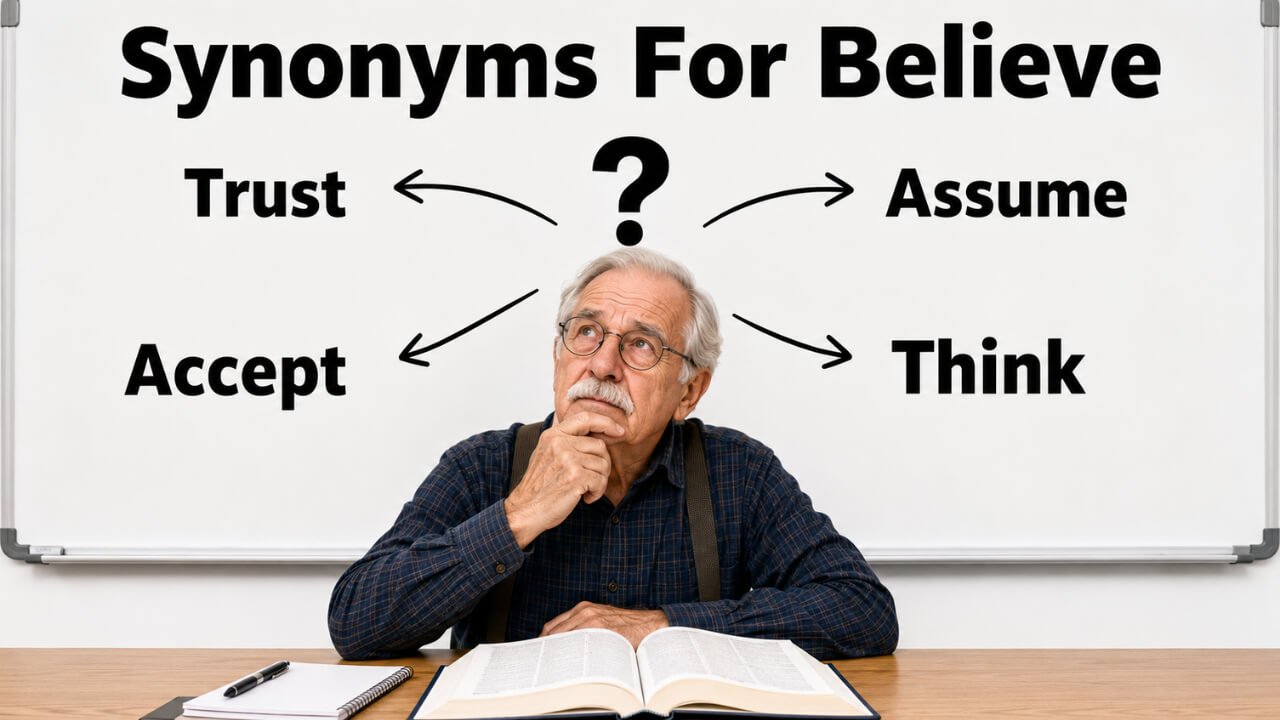
Quick Answer: The best synonyms for believe include think, trust, accept, suppose, assume, consider, feel, deem, conclude, and have faith. Use think for casual opinions, trust for confidence in a person or idea, accept for something considered true, suppose for uncertainty, assume for something taken as likely, and have faith for emotional or spiritual confidence.
Pronunciation and Word Details
Word: Believe.
Pronunciation: /bɪˈliːv/
Part of Speech: Verb.
Meaning: To accept something as true, to think something is real, or to trust someone or something.
US Pronunciation:
UK Pronunciation:
What Does “Believe” Mean?
Believe means to accept that something is true, real, possible, or trustworthy. It is a verb used for opinions, facts, faith, confidence, trust, and personal judgment.
You can believe a statement, believe a person, believe in an idea, or believe that something will happen. In grammar, it often appears before a noun, a pronoun, a clause, or the preposition in.
Example: I believe your explanation.
Example: She believes that hard work leads to progress.
Example: They believe in honesty and patience.
Meaning, Tone, and Context of “Believe”
Believe is usually a neutral and flexible word. It can sound casual in everyday conversation, thoughtful in essays, polite in discussion, emotional in personal writing, and serious in religious, moral, or philosophical contexts.
In conversation, believe often means think or feel. In formal writing, it may mean consider, maintain, or hold the view. In personal contexts, it may mean trust or have faith. In academic or factual writing, stronger alternatives such as conclude, accept, or infer may be more precise.
When and How to Use “Believe”
For Opinion: Use believe when sharing what you think is true.
Example: I believe this plan will help the team improve.
For Trust: Use believe when showing confidence in a person, promise, or statement.
Example: I believe her because she has always been honest.
For Faith: Use believe in when talking about values, hopes, principles, or spiritual ideas.
Example: He believes in kindness, discipline, and forgiveness.
For Uncertainty: Use believe when you are not completely sure but think something is likely.
Example: I believe the meeting starts at noon.
For Polite Disagreement: Use believe to present a different view softly.
Example: I believe there may be a better way to solve this issue.
For Encouragement: Use believe in when showing support for someone’s ability.
Example: We believe in your talent and your future success.
Best Synonyms for Believe
Think: To have an opinion or idea about something.
Example: I think this answer is correct.
Trust: To feel confident that someone is honest, reliable, or right.
Example: I trust his judgment on this matter.
Accept: To regard something as true or valid.
Example: She accepted the explanation after seeing the evidence.
Suppose: To think something is probably true, often without full certainty.
Example: I suppose he forgot to send the message.
Assume: To believe something is true without complete proof.
Example: They assumed the room was already booked.
Consider: To think of someone or something in a particular way.
Example: Many people consider patience a sign of strength.
Feel: To have a personal belief, opinion, or emotional impression.
Example: I feel this choice is better for everyone.
Deem: To judge or regard something in a certain way, often in formal writing.
Example: The rule was deemed necessary for safety.
Conclude: To decide that something is true after thinking about the facts.
Example: We concluded that the report was accurate.
Have Faith: To believe strongly in someone, something, or a future result.
Example: She has faith in her ability to recover.
50 Synonyms for Believe with Short Meanings
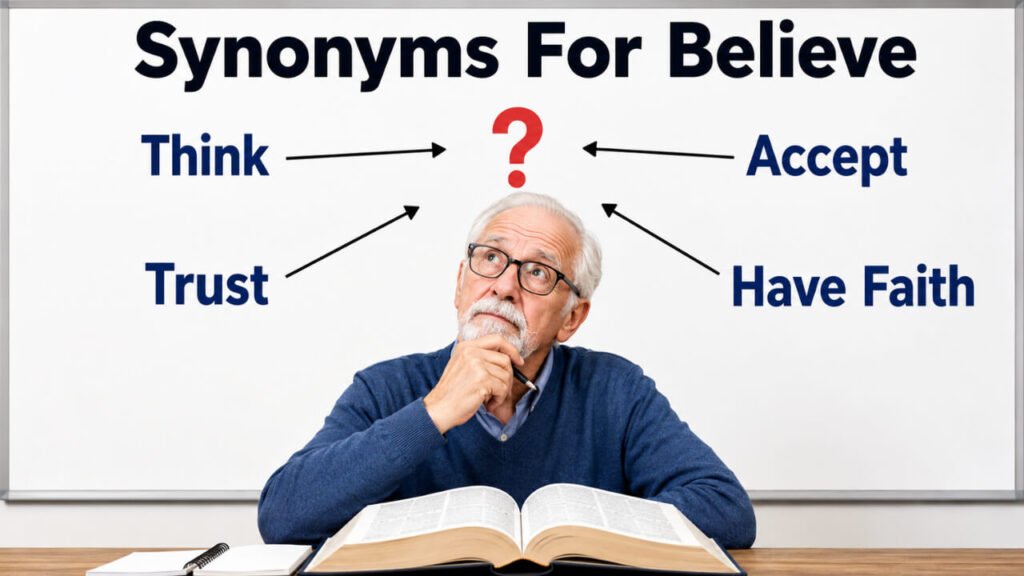
- Think: To have an opinion.
- Trust: To feel confident in someone or something.
- Accept: To regard something as true.
- Suppose: To think something is likely.
- Assume: To take something as true without full proof.
- Consider: To regard in a certain way.
- Feel: To have a personal opinion or impression.
- Deem: To judge or view formally.
- Conclude: To decide after thought or evidence.
- Infer: To understand from clues or facts.
- Presume: To believe something is likely before proof.
- Reckon: To think or suppose in casual speech.
- Hold: To have a belief or opinion.
- Maintain: To state or believe firmly.
- Judge: To form an opinion after thought.
- Credit: To believe or accept as true.
- Acknowledge: To accept that something is true.
- Recognize: To accept the truth or importance of something.
- Regard: To think of someone or something in a certain way.
- View: To see or understand in a particular way.
- See: To understand or interpret something.
- Perceive: To understand or notice in a certain way.
- Imagine: To think something may be true or possible.
- Suspect: To think something may be true, often with doubt.
- Expect: To believe something will happen.
- Agree: To share the same belief or opinion.
- Endorse: To support or approve an idea.
- Support: To agree with or stand behind an idea.
- Affirm: To state strongly that something is true.
- Trust In: To have confidence in someone or something.
- Rely On: To depend on someone with confidence.
- Count On: To trust someone or something to happen.
- Depend On: To rely on with belief or confidence.
- Have Faith: To believe strongly with hope or trust.
- Put Faith In: To place strong trust in someone or something.
- Place Trust In: To give confidence to someone or something.
- Be Convinced: To feel sure that something is true.
- Be Certain: To feel completely sure.
- Be Sure: To have confidence in a fact or idea.
- Be Persuaded: To be convinced by reason or evidence.
- Hold As True: To accept something as true.
- Accept As True: To believe something is factual.
- Consider True: To regard something as correct.
- Regard As True: To view something as factual.
- Be Of The Opinion: To believe or think formally.
- Have Confidence In: To trust someone’s ability or truth.
- Look To: To rely on someone for help or direction.
- Bank On: To depend on something happening.
- Take: To understand or accept in a certain way.
- Buy: To accept an idea in informal speech.
Read Also:
Synonyms for Old

Synonyms for Believe by Context
When Believe Means Think
Use these synonyms when believe means to have an opinion, idea, or personal view.
Think: I think the new schedule is more practical.
Feel: I feel this decision is fair.
Consider: We consider this approach more useful.
View: Many readers view the ending as hopeful.
Be Of The Opinion: I am of the opinion that the policy needs revision.
When Believe Means Trust
Use these synonyms when believe means to have confidence in a person, promise, statement, or ability.
Trust: I trust her advice because she is careful.
Rely On: You can rely on his support.
Count On: We can count on them to arrive on time.
Have Confidence In: The coach has confidence in the players.
Place Trust In: They placed trust in the new leader.
When Believe Means Accept as True
Use these synonyms when believe means to accept a fact, claim, explanation, or statement.
Accept: I accept that the mistake was unintentional.
Credit: Few people credited the rumor.
Acknowledge: She acknowledged that the results were correct.
Recognize: He recognized the value of the warning.
Hold As True: The community held the story as true for years.
When Believe Means Suppose or Assume
Use these synonyms when believe shows uncertainty, probability, or an idea without full proof.
Suppose: I suppose the office is closed today.
Assume: We assumed the file was complete.
Presume: They presumed the answer was correct.
Reckon: I reckon he will call later.
Suspect: I suspect there is another reason.
When Believe Means Have Faith
Use these synonyms when believe shows hope, loyalty, values, confidence, or spiritual feeling.
Have Faith: She has faith that things will improve.
Trust In: He trusts in the process.
Put Faith In: They put faith in careful planning.
Believe In: We believe in fairness and respect.
Have Confidence In: I have confidence in your ability to succeed.
Another Word for Believe
Another word for believe is think when you are sharing a simple opinion. However, the best replacement depends on the meaning. Use trust for confidence, accept for truth, suppose for uncertainty, and have faith for strong personal belief.
Original: I believe this answer is correct.
Better Option: I think this answer is correct.
Original: I believe her story.
Better Option: I trust her story.
Original: We believe the results are accurate.
Better Option: We accept the results as accurate.
Original: I believe the train arrives at six.
Better Option: I suppose the train arrives at six.
When Not to Use “Believe”
Do not use believe when a stronger or clearer word would fit better. In formal reports, conclude, determine, or accept may sound more precise. In emotional writing, trust or have faith may sound warmer. In casual speech, repeating believe too often can make writing feel weak or uncertain.
Weak: I believe the data is correct because I believe the test was done properly.
Better: I conclude that the data is correct because the test was done properly.
Weak: I believe you will help me because I believe you are reliable.
Better: I trust you to help me because you are reliable.
Weak: We believe the answer may possibly be right.
Better: We think the answer may be right.
Weak: She believes in the report.
Better: She accepts the report as accurate.
Words Commonly Confused With Believe
Believe vs Think: Believe can mean to accept something as true or to have faith. Think usually means to have an opinion or idea.
Believe vs Trust: Believe can refer to ideas, facts, people, or statements. Trust focuses more on confidence in honesty, ability, or reliability.
Believe vs Know: Believe allows uncertainty. Know means you have clear information, proof, or direct awareness.
Believe vs Assume: Believe can be based on trust, faith, opinion, or evidence. Assume means you accept something as true without complete proof.
Believe vs Suppose: Believe can sound more confident. Suppose often sounds less certain.
Believe vs Accept: Believe can be personal or emotional. Accept is more direct and often means you agree that something is true.
Believe vs Have Faith: Believe is broad. Have faith is stronger, more emotional, and often connected to hope, loyalty, values, or spiritual confidence.
Which Synonym Should You Choose?
Choose think when giving a casual opinion.
Choose trust when writing about confidence in a person, promise, or source.
Choose accept when something is regarded as true or valid.
Choose suppose when you are unsure but think something is likely.
Choose assume when something is taken as true without full proof.
Choose consider when giving a thoughtful judgment.
Choose deem in formal writing when something is judged in a specific way.
Choose conclude when the belief comes after evidence, reasoning, or analysis.
Choose have faith when writing about hope, values, loyalty, or strong personal confidence.
Choose maintain when someone firmly continues to state or believe something.
Real Life Examples of “Believe” in Sentences
Original: I believe this solution will work.
Better Option: I think this solution will work.
Original: She believes her friend is telling the truth.
Better Option: She trusts her friend is telling the truth.
Original: We believe the information is correct.
Better Option: We accept the information as correct.
Original: They believe the issue started yesterday.
Better Option: They assume the issue started yesterday.
Original: I believe he will arrive soon.
Better Option: I suppose he will arrive soon.
Original: The manager believes the plan is fair.
Better Option: The manager considers the plan fair.
Original: Researchers believe the pattern is meaningful.
Better Option: Researchers conclude the pattern is meaningful.
Original: Many people believe in second chances.
Better Option: Many people have faith in second chances.
Original: I believe you can finish this task.
Better Option: I have confidence in your ability to finish this task.
Original: He believes the rule is necessary.
Better Option: He maintains that the rule is necessary.
Synonym Groups and Usage Differences
Opinion Group
These synonyms show personal thoughts, views, and judgments. Use them when the meaning is close to think.
Example: I think the new design is easier to use.
Trust Group
These synonyms show confidence in someone’s honesty, ability, or reliability. Use them when belief is connected to people or promises.
Example: I trust her advice because she understands the problem.
Truth Acceptance Group
These synonyms show that a fact, claim, or explanation is accepted as true. Use them in factual, formal, or careful writing.
Example: The committee accepted the explanation after reviewing the details.
Uncertainty Group
These synonyms show a belief that is possible or likely but not fully proven. Use them when you want to sound cautious.
Example: I suppose the delay was caused by traffic.
Faith and Confidence Group
These synonyms show strong emotional belief, hope, loyalty, or support. Use them in personal, motivational, moral, or spiritual contexts.
Example: She has faith that better days are coming.
Antonyms of Believe
Doubt: To feel uncertain about something.
Disbelieve: To not accept something as true.
Distrust: To lack confidence in someone or something.
Reject: To refuse to accept an idea, claim, or statement.
Deny: To say that something is not true.
Question: To express uncertainty or ask for proof.
Challenge: To dispute or test the truth of something.
Dismiss: To treat something as unimportant or not believable.
Refute: To prove or argue that something is false.
Suspect: To think something may be wrong or untrue.
Comparison: Believe vs Related Words
Believe vs Think
Believe can mean to accept something as true, while think often means to have an opinion.
Example With Believe: I believe the story is true.
Example With Think: I think the story is interesting.
Believe vs Trust
Believe may focus on truth, while trust focuses on confidence in honesty, character, or ability.
Example With Believe: I believe his explanation.
Example With Trust: I trust him to make the right decision.
Believe vs Know
Believe can include uncertainty, but know suggests stronger certainty or proof.
Example With Believe: I believe the answer is correct.
Example With Know: I know the answer is correct.
Believe vs Assume
Believe may come from opinion, trust, faith, or evidence. Assume means accepting something without full proof.
Example With Believe: I believe she is honest.
Example With Assume: I assume she has already left.
Believe vs Suppose
Believe sounds more confident than suppose. Suppose often sounds tentative or uncertain.
Example With Believe: I believe he will succeed.
Example With Suppose: I suppose he will succeed.
Believe vs Accept
Believe can be personal, emotional, or factual. Accept is more direct and means to agree that something is true or valid.
Example With Believe: I believe the claim is true.
Example With Accept: I accept the claim as true.
Common Phrases and Expressions With Believe
Believe Me: Used to ask someone to trust what you are saying.
Believe It Or Not: Used before something surprising or unexpected.
Believe In Yourself: To have confidence in your own ability.
Believe In Someone: To trust or support someone’s potential.
Believe In Something: To support a value, principle, or idea.
Hard To Believe: Difficult to accept as true.
Make Believe: Pretend or imaginary.
I Believe So: A polite way to say you think something is true.
Cannot Believe: Used to show surprise, shock, or strong emotion.
Lead Someone To Believe: To cause someone to think something is true.
Common Mistakes to Avoid
One common mistake is using believe when know is more accurate. If you have proof, use know, confirm, or determine instead.
Another mistake is using believe too many times in one paragraph. Repetition can make writing sound weak. Replace it with think, trust, accept, consider, or conclude when needed.
Avoid using believe in when the meaning is simply accepting a fact. Say believe the report or accept the report, not believe in the report, unless you mean confidence in its purpose or value.
Do not use a formal synonym in casual writing if it sounds unnatural. Deem and maintain work in formal contexts, but think and trust are better for everyday speech.
Also avoid choosing a synonym that changes the meaning. Assume suggests limited proof, while trust suggests confidence. Conclude suggests reasoning, while have faith suggests hope or deep confidence.
Conclusion
Synonyms for believe help you express opinion, trust, truth, faith, and uncertainty with more accuracy. Use think for casual opinions, trust for confidence, accept for facts, suppose for uncertainty, consider for judgment, and conclude for evidence based reasoning. The best synonym depends on your sentence, tone, and purpose. By choosing the right alternative, your writing becomes clearer, more natural, and more meaningful for readers.
FAQs About Synonyms for Believe
What are the best synonyms for believe?
The best synonyms for believe are think, trust, accept, suppose, assume, consider, conclude, and have faith.
What is another word for believe in casual speech?
In casual speech, think is often the best replacement for believe when sharing an opinion.
What is a formal synonym for believe?
Formal synonyms for believe include consider, deem, maintain, conclude, and hold the view.
What is the difference between believe and trust?
Believe means to accept something as true. Trust means to have confidence in someone’s honesty, ability, or reliability.
Can assume replace believe?
Assume can replace believe when the idea is accepted without complete proof. It is not always suitable because it can sound less certain.
What is the opposite of believe?
Common opposites of believe include doubt, disbelieve, distrust, reject, and deny.
Which synonym should I use for faith?
Use have faith, trust in, or believe in when the meaning involves hope, values, loyalty, or deep confidence.
