
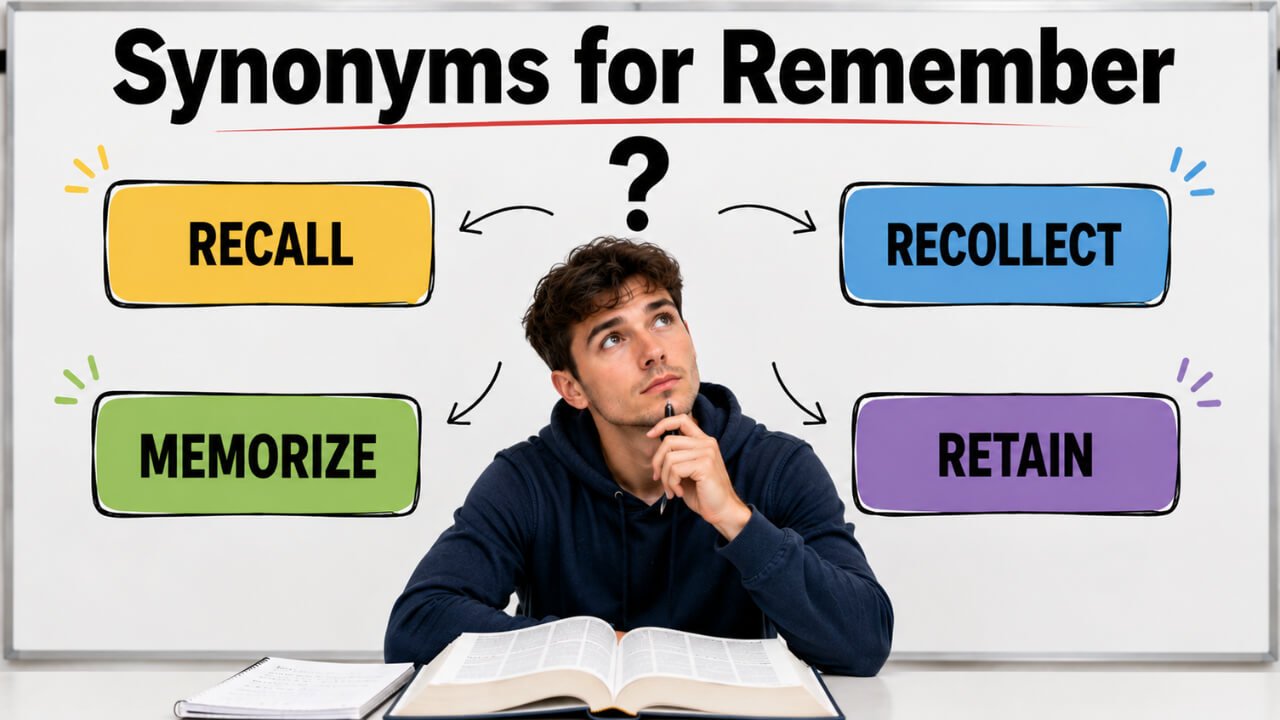
Quick Answer: The best synonyms for remember include recall, recollect, retain, recognize, reminisce, memorize, retrieve, commemorate, honor, and keep in mind. Recall is the strongest general alternative when bringing information back into your thoughts. Recollect is slightly more formal and often suggests making an effort to recover a memory. Retain suits knowledge and information that stays in the mind, while recognize means identifying someone or something previously encountered. Reminisce is best for pleasant memories, commemorate suits important events, and keep in mind works well for advice, instructions, and reminders.
Pronunciation and Word Details
Word: Remember.
Pronunciation: /rɪˈmembər/.
Part of Speech: Verb.
Meaning: To bring a person, fact, experience, or responsibility back into the mind or to avoid forgetting it.
US Pronunciation:
UK Pronunciation:
What Does “Remember” Mean?
Remember means to bring past information, experiences, people, or events back into your mind. It is a verb that can also describe keeping information in your memory, recognizing someone, carrying out a responsibility, or honoring an important person or event.
Remember often refers to recalling information that was learned earlier.
Example: I remember the answer to that question.
It can describe retaining instructions or responsibilities.
Example: Remember to lock the door before leaving.
The word may also refer to recognizing someone from the past.
Example: Do you remember our former teacher?
In emotional contexts, remember can mean thinking affectionately or respectfully about someone.
Example: We will always remember her kindness.
It may also describe publicly honoring a historical event or individual.
Example: The ceremony remembers those who served the community.
The exact meaning depends on whether the sentence focuses on recalling, retaining, recognizing, reminding oneself, or commemorating.
Meaning, Tone, and Context of “Remember”
Remember is a neutral and common word. It appears naturally in casual speech, formal writing, academic explanations, personal stories, instructions, speeches, essays, and professional communication.
In conversation, remember usually sounds direct and natural.
Example: I remember meeting him at the conference.
In instructions, remember politely draws attention to something important.
Example: Remember to attach the document before sending the message.
In formal writing, recall or recollect may sound more precise when discussing memory.
Example: Participants were asked to recall the details of the event.
Remember can carry a warm or emotional tone when it refers to people, relationships, childhood experiences, or meaningful moments.
Example: She remembers her grandparents with great affection.
It can also sound respectful or ceremonial when used for historical events or people who have died.
Example: The community gathered to remember its former leaders.
In educational contexts, remember may refer to storing facts or retrieving learned information. In psychological discussions, it can describe the mental process of accessing memories.
When and How to Use “Remember”
For Recalling Information: Use remember when a fact, name, date, or detail returns to your mind.
Example: I remember the address clearly.
For Past Experiences: Use remember when thinking about something that happened earlier.
Example: She remembers visiting the coast as a child.
For Instructions: Use remember when telling someone not to forget an action.
Example: Remember to submit the form before Friday.
For Responsibilities: Use remember when referring to a duty, promise, or planned task.
Example: He remembered to call the client after lunch.
For Recognizing People: Use remember when identifying someone you have met before.
Example: I remember her from our previous class.
For Retaining Knowledge: Use remember when information remains available in the mind.
Example: Students remember concepts more easily when they understand them.
For Emotional Memories: Use remember when thinking fondly, sadly, or respectfully about the past.
Example: They remember their childhood home with affection.
For Commemoration: Use remember when honoring an important person, event, or sacrifice.
Example: The annual gathering remembers the people who helped rebuild the town.
For Giving Advice: Use remember when drawing attention to a useful point.
Example: Remember that progress often requires patience.
For Emphasis: Use remember to make an idea sound especially important.
Example: Above all, remember that your decision should reflect your goals.
Best Synonyms for Remember
Recall: To bring information or an experience back into the mind.
Example: I cannot recall where I placed the receipt.
Recollect: To make an effort to remember something from the past.
Example: She recollected seeing the vehicle near the entrance.
Retain: To keep information or knowledge in the memory.
Example: Readers retain information better when ideas are clearly organized.
Recognize: To identify someone or something encountered before.
Example: He recognized the building from an old photograph.
Reminisce: To talk or think pleasantly about past experiences.
Example: The friends reminisced about their school years.
Memorize: To learn something so that it can be remembered exactly.
Example: The student memorized the opening lines of the speech.
Retrieve: To bring stored information back into conscious thought.
Example: She struggled to retrieve the name from her memory.
Keep in Mind: To continue thinking about an important fact, instruction, or consideration.
Example: Keep in mind that the office closes early on Friday.
Commemorate: To honor and remember an important person or event.
Example: The monument commemorates an important moment in local history.
Honor: To show respect for the memory or achievements of someone.
Example: The award honors the work of dedicated volunteers.
50 Synonyms for Remember with Short Meanings
- Recall: To bring information back into the mind.
- Recollect: To recover a memory through conscious effort.
- Retain: To keep knowledge or information in memory.
- Recognize: To identify someone or something previously known.
- Reminisce: To think or talk about pleasant past experiences.
- Memorize: To learn something so it can be repeated from memory.
- Retrieve: To recover stored information from the mind.
- Revisit: To think about a past experience or idea again.
- Relive: To experience a past event again through memory.
- Review: To examine information again so it stays clear.
- Think Back: To direct your thoughts toward the past.
- Look Back: To reflect on an earlier time or experience.
- Call to Mind: To cause a memory to return.
- Bring to Mind: To make someone think of something remembered.
- Summon Up: To make an effort to produce a memory.
- Keep in Mind: To continue remembering an important point.
- Bear in Mind: To consider and not forget something important.
- Hold in Memory: To keep a person, fact, or experience remembered.
- Preserve in Memory: To prevent an important memory from being forgotten.
- Store: To keep information in the mind for later use.
- Register: To notice and mentally record information.
- Learn by Heart: To memorize something completely.
- Commit to Memory: To make a deliberate effort to memorize information.
- Keep Track of: To continue remembering changing details or progress.
- Take Note of: To notice and remember an important fact.
- Note: To give attention to something so it is remembered.
- Mind: To pay attention to or remember a warning.
- Heed: To remember and follow advice or a warning.
- Consider: To keep a fact in mind while deciding.
- Be Mindful of: To remain aware of something important.
- Take into Account: To remember a factor when making a judgment.
- Not Forget: To continue holding something in memory.
- Think of: To bring a person, idea, or experience into the mind.
- Picture: To form a mental image of something remembered.
- Visualize: To create a clear mental picture.
- Imagine: To form an image or idea in the mind.
- Identify: To recognize who or what something is.
- Place: To recognize where or how someone is known.
- Know: To recognize something as familiar.
- Acknowledge: To recognize and give attention to something.
- Commemorate: To formally honor an important event or person.
- Memorialize: To preserve the memory of someone or something.
- Honor: To show respect for a person or memory.
- Celebrate: To recognize an important person or event positively.
- Observe: To mark an important occasion with respect.
- Mark: To recognize an event through a special action.
- Pay Tribute to: To express respect for someone being remembered.
- Keep Alive: To prevent a memory or tradition from disappearing.
- Cherish: To hold a memory with affection and care.
- Treasure: To value and preserve a special memory.
Read Also:
Synonyms for Ran

Synonyms for Remember by Context
When Remember Means Recall Information
Recall, recollect, retrieve, call to mind, bring to mind, and summon up describe the process of recovering information from memory.
Recall is the most common direct replacement. It works well in formal writing, conversation, research, and educational contexts.
Example: I cannot recall the exact date of the meeting.
Recollect suggests a more deliberate attempt to recover a memory.
Example: She could not recollect the name of the restaurant.
Retrieve is often used when explaining how the mind accesses stored information.
Example: The question helped him retrieve the forgotten detail.
Call to mind and bring to mind describe something causing a memory to appear.
Example: That familiar scent brought childhood summers to mind.
When Remember Means Retain Information
Retain, store, memorize, commit to memory, learn by heart, hold in memory, and preserve in memory describe keeping information available for later use.
Retain is suitable for educational, academic, and professional contexts.
Example: Clear explanations help learners retain new vocabulary.
Memorize emphasizes deliberately learning exact information.
Example: She memorized the safety instructions before the test.
Commit to memory is more formal and emphasizes a conscious effort.
Example: He committed the access code to memory.
Learn by heart is common when someone can repeat words exactly.
Example: The performers learned their lines by heart.
When Remember Means Keep Something in Mind
Keep in mind, bear in mind, be mindful of, consider, take note of, and take into account are useful when remember introduces advice, instructions, warnings, or important details.
Keep in mind is natural in conversation and general writing.
Example: Keep in mind that prices may change during busy periods.
Bear in mind is slightly more formal.
Example: Bear in mind that the final decision depends on available funding.
Be mindful of often refers to awareness, care, or consideration.
Example: Be mindful of how your words may affect others.
Take into account is best when a fact must influence a decision.
Example: The committee must take local needs into account.
When Remember Means Think About the Past
Reminisce, think back, look back, revisit, relive, reflect, picture, and visualize describe thinking about earlier experiences.
Reminisce usually suggests pleasant or emotional memories.
Example: They reminisced about their first years in the neighborhood.
Think back is informal and direct.
Example: Think back to the first time you tried this activity.
Look back often involves reviewing a longer period of life.
Example: She looked back on her career with pride.
Relive suggests experiencing a past moment again through strong memory.
Example: The photographs allowed them to relive the celebration.
When Remember Means Recognize
Recognize, identify, place, know, and acknowledge can replace remember when someone identifies a familiar face, voice, place, or object.
Recognize is the clearest alternative for identifying something previously encountered.
Example: I recognized his voice immediately.
Place is useful when someone seems familiar but the exact connection is unclear.
Example: I remember her face, but I cannot place where we met.
Identify focuses on correctly determining who or what something is.
Example: She identified the street from an old photograph.
When Remember Means Honor
Commemorate, memorialize, honor, observe, mark, celebrate, and pay tribute to describe remembering an important person, event, achievement, or sacrifice.
Commemorate is suitable for formal ceremonies and historical occasions.
Example: The gathering commemorates the founding of the community.
Honor emphasizes respect.
Example: The scholarship honors a respected teacher.
Memorialize often involves creating a lasting tribute.
Example: The garden memorializes residents who contributed to the town.
Pay tribute to expresses admiration or gratitude.
Example: The speech paid tribute to the volunteers.
Another Word for Remember
Recall is the best general replacement for remember when the sentence refers to bringing information or an experience back into the mind. However, the ideal alternative depends on context. Use retain for keeping information, recognize for identifying someone, reminisce for pleasant past experiences, and commemorate for honoring a person or event.
Original: I remember the conversation clearly.
Better Option: I recall the conversation clearly.
Original: Students must remember the key definitions.
Better Option: Students must retain the key definitions.
Original: I remember that man from the conference.
Better Option: I recognize that man from the conference.
Original: The ceremony remembers the town’s early settlers.
Better Option: The ceremony commemorates the town’s early settlers.
When Not to Use “Remember”
Remember can sound vague when the sentence needs to explain whether someone recalled, recognized, memorized, retained, or honored something.
Use a more precise alternative when the type of memory matters.
Weak: The students remembered the entire poem before the performance.
Better: The students memorized the entire poem before the performance.
Remember may be less accurate when someone identifies a familiar person or object.
Weak: I remembered her as soon as she entered the room.
Better: I recognized her as soon as she entered the room.
Avoid repeating remember several times within one paragraph.
Weak: I remember the trip because I remember the weather and remember every place we visited.
Better: I recall the trip because the weather remains clear in my mind, and I can picture every place we visited.
Remember may sound too casual in formal research or official reports.
Weak: Most participants remembered the first image.
Better: Most participants recalled the first image.
Do not use recall when the sentence means keeping a responsibility in mind.
Weak: Recall to submit your application before Monday.
Better: Remember to submit your application before Monday.
Use commemorate or honor when referring to a formal act of respectful remembrance.
Weak: The monument remembers the workers who built the bridge.
Better: The monument commemorates the workers who built the bridge.
Words Commonly Confused With Remember
Remember vs Recall: Remember is broader and can refer to retaining information, completing a responsibility, recognizing someone, or thinking about the past. Recall mainly means bringing stored information back into the mind.
Remember vs Remind: Remember describes what happens in a person’s own mind. Remind means causing another person to remember something.
Remember vs Memorize: Remember means keeping or retrieving information. Memorize means deliberately learning information so it can be repeated later.
Remember vs Recollect: Remember is common and neutral. Recollect is slightly more formal and often suggests making an effort to recover a memory.
Remember vs Recognize: Remember refers to memory in general. Recognize means identifying someone or something as familiar.
Remember vs Reminisce: Remember can refer to any memory. Reminisce means thinking or talking about past experiences, usually with pleasure or affection.
Remember vs Commemorate: Remember may be personal and informal. Commemorate means formally honoring a significant person or event.
Remember vs Retain: Remember can mean either storing or retrieving information. Retain specifically emphasizes keeping information in the mind.
Remember vs Reflect: Remember brings past information to mind. Reflect involves thinking carefully about the meaning or importance of an experience.
Which Synonym Should You Choose?
Choose recall: Use recall for general memory, formal writing, reports, interviews, research, and factual information.
Choose recollect: Use recollect when someone makes a conscious effort to recover a past detail.
Choose retain: Use retain for knowledge, instructions, lessons, facts, and information that stays in memory.
Choose memorize: Use memorize when deliberately learning exact wording, numbers, rules, or facts.
Choose recognize: Use recognize when identifying a familiar face, voice, place, object, or pattern.
Choose reminisce: Use reminisce for warm conversations or writing about pleasant memories.
Choose retrieve: Use retrieve in academic, technical, or psychological explanations of memory.
Choose keep in mind: Use keep in mind for casual advice, instructions, warnings, and useful reminders.
Choose bear in mind: Use bear in mind for slightly more formal advice or professional communication.
Choose commemorate: Use commemorate for ceremonies, historical events, anniversaries, and public remembrance.
Choose honor: Use honor when emphasizing respect for a person, achievement, or sacrifice.
Choose cherish: Use cherish for emotional memories that remain personally valuable.
Choose think back: Use think back in casual conversation when asking someone to consider a past experience.
Choose take into account: Use take into account when a remembered fact should influence a decision or judgment.
Real Life Examples of “Remember” in Sentences
Original: I remember meeting her at a workshop.
Better Option: I recall meeting her at a workshop.
Original: She remembers every important date.
Better Option: She keeps track of every important date.
Original: Please remember the new office rules.
Better Option: Please keep the new office rules in mind.
Original: He remembered the entire speech.
Better Option: He memorized the entire speech.
Original: I remember his face from somewhere.
Better Option: I recognize his face from somewhere.
Original: They remembered their childhood summers together.
Better Option: They reminisced about their childhood summers together.
Original: The event remembers the work of local volunteers.
Better Option: The event honors the work of local volunteers.
Original: Students often remember information presented through stories.
Better Option: Students often retain information presented through stories.
Original: She tried to remember the missing password.
Better Option: She tried to retrieve the missing password from memory.
Original: Remember that the entrance closes at six.
Better Option: Bear in mind that the entrance closes at six.
Synonym Groups and Usage Differences
Recall Group
Recall, recollect, retrieve, summon up, call to mind, and bring to mind describe recovering information from memory.
Recall is the most flexible choice. Recollect suggests greater effort, while retrieve sounds more technical or academic.
Example: She finally recalled where she had stored the document.
Retention Group
Retain, memorize, store, commit to memory, learn by heart, and hold in memory describe keeping information available.
Retain focuses on continued knowledge. Memorize emphasizes deliberate learning, while store describes placing information in memory.
Example: Regular practice helps learners retain unfamiliar words.
Reflection Group
Reminisce, think back, look back, revisit, relive, and reflect describe returning mentally to past experiences.
Reminisce often has a warm tone. Revisit can be neutral, while relive suggests strong emotion or vivid detail.
Example: The old photographs encouraged everyone to reminisce.
Awareness Group
Keep in mind, bear in mind, be mindful of, heed, consider, and take into account describe remembering advice, warnings, or important factors.
Keep in mind is conversational. Bear in mind is more formal, while heed suggests following a warning or recommendation.
Example: Bear in mind that the schedule may change.
Recognition Group
Recognize, identify, place, know, and acknowledge relate to identifying something as familiar.
Recognize is the strongest general choice. Place suggests knowing someone is familiar without immediately recalling the connection.
Example: She recognized the melody after hearing only a few notes.
Commemoration Group
Commemorate, memorialize, honor, observe, mark, celebrate, and pay tribute to describe respectful remembrance.
Commemorate suits formal occasions. Memorialize suggests creating a lasting reminder, while honor emphasizes respect.
Example: The annual ceremony honors those who supported the community.
Emotional Memory Group
Cherish, treasure, preserve in memory, keep alive, and hold in memory describe memories that carry personal value.
Cherish and treasure suggest affection. Keep alive emphasizes preventing a memory or tradition from disappearing.
Example: He treasures the memories of family gatherings.
Antonyms of Remember
The opposite of remember depends on whether the word means recalling information, keeping something in mind, recognizing someone, or honoring an event.
Forget: To fail to remember information, a person, or a responsibility.
Overlook: To fail to notice or consider something important.
Ignore: To deliberately give no attention to something.
Disregard: To treat advice, information, or warnings as unimportant.
Neglect: To fail to give proper attention to a duty or responsibility.
Misremember: To remember something incorrectly.
Lose Track of: To stop remembering changing details, time, or progress.
Dismiss: To remove an idea or concern from consideration.
Erase: To remove information or memories completely.
Suppress: To prevent a memory from entering conscious thought.
Abandon: To stop supporting or preserving an idea, tradition, or memory.
Omit: To leave out information that should have been included.
Fail to Recall: To be unable to bring information back into the mind.
Fail to Recognize: To be unable to identify someone or something familiar.
Remain Unaware: To have no memory or knowledge of something.
Comparison: Remember vs Related Words
Remember vs Recall
Remember is broad and works in most contexts. Recall mainly refers to bringing information back into conscious thought.
Example With Remember: I remember visiting that museum as a child.
Example With Recall: I recall seeing a large painting near the entrance.
Remember vs Recollect
Remember is natural in both speech and writing. Recollect is more formal and suggests deliberate effort.
Example With Remember: Do you remember what she said?
Example With Recollect: I cannot recollect her exact words.
Remember vs Remind
Remember describes retrieving or retaining information yourself. Remind means helping another person recall something.
Example With Remember: I remembered to bring the documents.
Example With Remind: Please remind me to bring the documents.
Remember vs Memorize
Remember means retaining or recalling information. Memorize means deliberately learning something until it can be repeated.
Example With Remember: I remember the main idea of the lesson.
Example With Memorize: I memorized the key definitions for the test.
Remember vs Recognize
Remember concerns memory generally. Recognize means identifying something as familiar.
Example With Remember: I remember meeting her several years ago.
Example With Recognize: I recognized her voice immediately.
Remember vs Retain
Remember can refer to both keeping and retrieving information. Retain focuses specifically on keeping information over time.
Example With Remember: I remember the instructions clearly.
Example With Retain: Visual examples help students retain the instructions.
Remember vs Reminisce
Remember may refer to any fact or experience. Reminisce usually involves pleasant or meaningful memories.
Example With Remember: I remember our first day at school.
Example With Reminisce: We often reminisce about our school years.
Remember vs Commemorate
Remember may be private, casual, or emotional. Commemorate describes formal or public remembrance.
Example With Remember: We remember her kindness and patience.
Example With Commemorate: The ceremony commemorates her contribution to education.
Common Phrases and Expressions With Remember
Remember Clearly: To have a strong and detailed memory of something.
Example: I remember clearly where the conversation took place.
Remember Correctly: To recall information without making an error.
Example: If I remember correctly, the appointment is on Thursday.
Remember Fondly: To think about someone or something with affection.
Example: She remembers her first teacher fondly.
Remember Forever: To keep an experience or person in memory permanently.
Example: We will remember that generous act forever.
Remember the Past: To think about earlier events or experiences.
Example: The photographs help families remember the past.
Remember to Do Something: To avoid forgetting a planned action.
Example: Remember to check the final page before submitting the form.
Remember Doing Something: To recall an action that happened earlier.
Example: I remember visiting that library during my childhood.
Remember Someone By Something: To associate a person with a particular quality or action.
Example: People remember her by the kindness she showed others.
Remember Where: To recall the location of a person or object.
Example: Do you remember where you placed the keys?
Remember When: To introduce or discuss a past experience.
Example: Do you remember when we first visited the village?
Common Mistakes to Avoid
A common mistake is confusing remember with remind. A person remembers something independently, while another person or object reminds that person of it.
Incorrect: Please remember me about the appointment.
Correct: Please remind me about the appointment.
Another mistake is confusing remember to do with remember doing. Remember to do refers to an action that must happen. Remember doing refers to a memory of an action that already happened.
Future Responsibility: Remember to turn off the lights.
Past Memory: I remember turning off the lights.
Do not replace remember with recall before an infinitive.
Incorrect: Recall to send the report before noon.
Correct: Remember to send the report before noon.
Avoid using remember when memorize is more precise.
Unclear: Students must remember the entire poem tonight.
Clearer: Students must memorize the entire poem tonight.
Do not use recognize when discussing stored facts or instructions.
Incorrect: I recognize the answer to the question.
Correct: I remember the answer to the question.
Avoid unnecessary repetition in a paragraph.
Repetitive: I remember the house, remember the garden, and remember every room.
Improved: I recall the house, can picture the garden, and still remember every room.
Use remember directly with an object when possible. Remember about may sound vague or unnatural in many sentences.
Weak: Remember about the meeting tomorrow.
Better: Remember the meeting tomorrow.
Best for an Action: Remember to attend the meeting tomorrow.
Choose a synonym that matches the intended tone. Recollect may sound too formal in simple conversation, while think back may be too casual for a research report.
Too Formal: I recollect where I left my shoes.
Natural: I remember where I left my shoes.
Conclusion
Synonyms for remember include recall, recollect, retain, recognize, reminisce, memorize, and commemorate. Recall is the best general option for bringing information back into the mind. Retain describes keeping knowledge, while recognize suits familiar people, voices, and places. Reminisce works for pleasant memories, and commemorate is appropriate for formal remembrance. Keep in mind and bear in mind are useful for advice and instructions. Selecting the right alternative makes writing clearer, more precise, and better suited to its purpose.
FAQs About Synonyms for Remember
What Is the Best Synonym for Remember?
Recall is the strongest general synonym when remember means bringing information or an experience back into the mind.
What Is a Formal Synonym for Remember?
Recollect is a formal alternative for recalling a memory. Commemorate is formal when remember means honoring an event or person.
What Is Another Word for Remembering the Past?
Reminisce, reflect, think back, look back, revisit, and relive can describe remembering past experiences.
What Is the Difference Between Remember and Recall?
Remember has several meanings, including retaining information and completing responsibilities. Recall mainly means retrieving stored information from memory.
Can Memorize Replace Remember?
Memorize can replace remember only when someone deliberately learns information. It does not work when recognizing a person or recalling an experience.
What Synonym Should Be Used for Remembering a Person?
Recall suits thinking about a person, recognize suits identifying someone, cherish suits affectionate memories, and honor suits respectful remembrance.
What Is the Opposite of Remember?
Forget is the most direct opposite. Other useful opposites include overlook, ignore, disregard, neglect, and fail to recall.
