
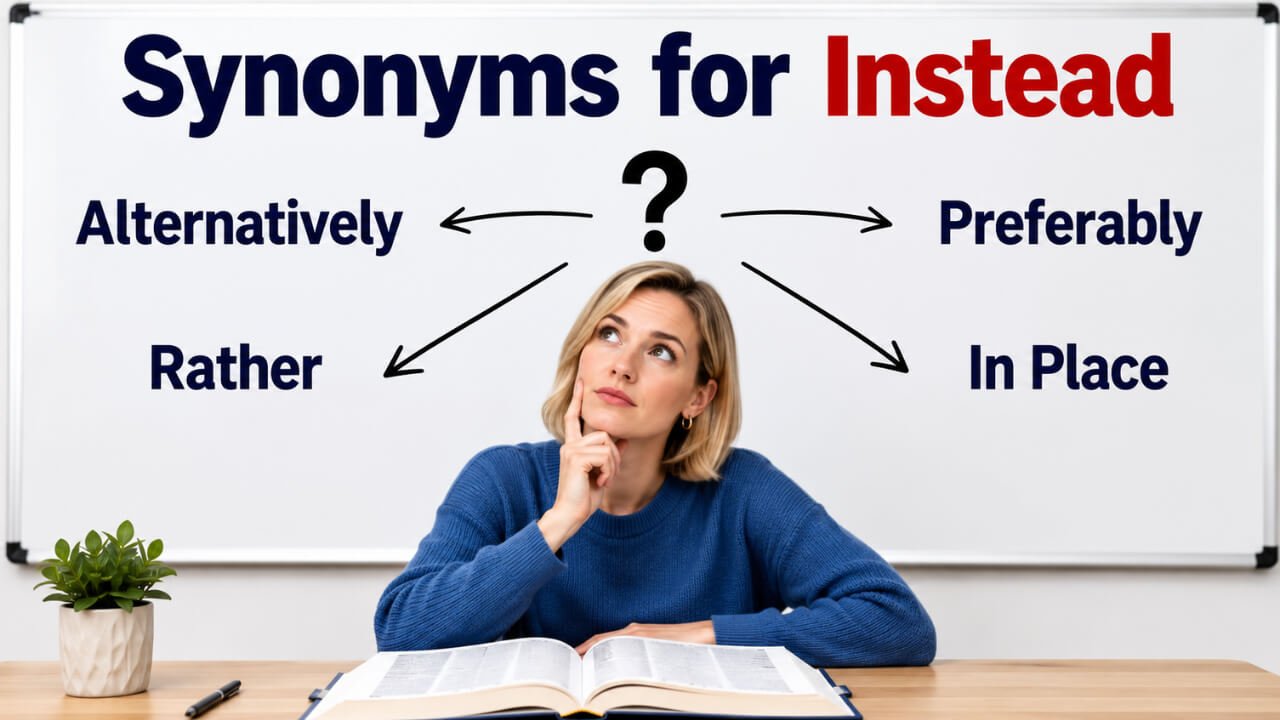
Quick Answer: The best synonyms for instead include alternatively, rather, in place of, as a substitute, in lieu of, preferably, otherwise, conversely, as an alternative, and in someone’s stead. Use alternatively when presenting another option in formal or neutral writing. Use rather for preferences and corrections. In place of and as a substitute work when one person or thing replaces another. Otherwise introduces a different possible result, while conversely presents an opposing idea.
Pronunciation and Word Details
Word: Instead
Pronunciation: /ɪnˈsted/
Part of Speech: Adverb
Meaning: As a replacement, alternative, or different choice from what was previously mentioned.
US Pronunciation:
UK Pronunciation:
What Does “Instead” Mean?
Instead means as an alternative, replacement, or different choice. It is an adverb used when one action, person, object, or idea takes the place of another.
For example, “We stayed home instead” means that staying home replaced another planned activity. In the sentence “Use water instead of juice,” water is presented as the replacement for juice.
Instead can appear alone, usually at the beginning or end of a clause. It can also form the expression “instead of,” which is followed by a noun, pronoun, or verb ending in ing.
The word is commonly used to express preference, substitution, correction, contrast, or a change of plan.
Meaning, Tone, and Context of “Instead”
Instead is a neutral and widely used word. It is appropriate for casual conversation, professional communication, academic writing, instructions, essays, reports, and everyday descriptions.
The word usually carries no strong emotion. However, its tone can change with the sentence. It may sound helpful when suggesting an alternative, firm when correcting someone, or disappointed when describing a changed plan.
In formal writing, alternatively, in place of, in lieu of, or as a substitute may provide a more specific tone. In casual speech, rather, instead of that, or why not do this instead often sounds more natural.
Instead is especially useful when a writer wants to show that one option has replaced another rather than simply being added to it.
When and How to Use “Instead”
For Replacement: Use instead when one person, object, or action takes the place of another.
Example: We used a smaller table instead.
For Preference: Use instead when someone chooses one option over another.
Example: She ordered tea instead of coffee.
For a Change of Plan: Use instead when the original plan is cancelled or changed.
Example: We planned to walk, but we took the bus instead.
For Suggestions: Use instead to introduce a better or more suitable option.
Example: Try speaking calmly instead.
For Contrast: Use instead when the result is different from what was expected.
Example: He did not complain. Instead, he offered to help.
For Correction: Use instead when replacing an incorrect idea, word, or action.
Example: Do not press the red button. Press the green one instead.
For Formal Substitution: Use instead of when identifying exactly what is being replaced.
Example: The manager attended instead of the director.
For Avoiding an Action: Use instead of before a verb ending in ing.
Example: Instead of arguing, they discussed the problem calmly.
Best Synonyms for Instead
Alternatively: As another possible choice or course of action.
Example: Alternatively, you may submit the form in person.
Rather: As a preferred or more accurate choice.
Example: I would rather stay home this evening.
In Place Of: As a replacement for someone or something.
Example: Use plain paper in place of the printed sheet.
As a Substitute: As something used to replace another thing.
Example: Yogurt can be used as a substitute for cream.
In Lieu Of: Instead of something expected or normally provided.
Example: Employees received additional leave in lieu of payment.
Preferably: Ideally or by preference.
Example: Please arrive early, preferably before nine.
Otherwise: In a different way or under different circumstances.
Example: Follow the instructions carefully. Otherwise, the result may be incorrect.
Conversely: In an opposite or contrasting way.
Example: Some people enjoy busy places. Conversely, others prefer quiet surroundings.
As an Alternative: As another available option.
Example: You can use the side entrance as an alternative.
In Someone’s Stead: In place of another person.
Example: Her assistant attended the meeting in her stead.
50 Synonyms for Instead with Short Meanings
- Alternatively: As another possible choice.
- Rather: As a preferred option.
- Rather Than: In preference to something else.
- In Place Of: As a replacement for someone or something.
- As a Substitute: As something that replaces another.
- As an Alternative: As another available choice.
- By Preference: Because one option is preferred.
- In Preference To: With one choice favored over another.
- Preferably: Ideally or according to preference.
- By Choice: As a deliberate selection.
- In Lieu Of: In place of something expected.
- In Substitution For: As a direct replacement for something.
- As a Replacement For: As something used instead of another.
- As Another Option: As an additional possible choice.
- As Another Choice: As a different selection.
- In Someone’s Stead: In place of another person.
- In Its Stead: In place of a particular thing.
- In Their Stead: In place of other people.
- In Exchange For: As something given or received in return.
- In Return For: As a replacement or response to something given.
- Instead of That: As a replacement for the previously mentioned option.
- Instead of This: As a replacement for the present option.
- Rather Than That: In preference to the previously mentioned choice.
- Rather Than This: In preference to the current choice.
- Not That but This: Used to correct or replace one choice with another.
- Not This but That: Used to reject one option and select another.
- Or Else: As another possibility or consequence.
- Otherwise: In a different way or under different conditions.
- Failing That: Used when the preferred choice is unavailable.
- If Not: Used to introduce another possible option.
- Conversely: In an opposite or contrasting way.
- On the Contrary: Used to present an opposing fact or idea.
- On the Other Hand: Used to introduce a contrasting option.
- In Contrast: In a noticeably different way.
- By Another Method: Through a different process.
- In Another Way: Using a different approach.
- Through Another Means: By using a different method or resource.
- Using Another Option: Choosing a different available possibility.
- Choosing Another Course: Taking a different course of action.
- Taking Another Route: Following a different path or approach.
- Selecting the Alternative: Choosing the available replacement.
- Choosing the Substitute: Selecting something that replaces another.
- Using the Replacement: Applying the item or option provided as a substitute.
- Replacing It With: Putting another thing in its position.
- Substituting It With: Exchanging it for another option.
- Preferred Over: Chosen because it is more desirable.
- Chosen Over: Selected instead of another option.
- Selected Over: Picked in preference to something else.
- Used in Place Of: Applied as a replacement.
- Rather Than Doing So: Choosing a different action from the one mentioned.
Read Also:
Synonyms for Remember

Synonyms for Instead by Context
When Instead Means as an Alternative
Alternatively, as an alternative, as another option, as another choice, and otherwise can introduce a different possibility.
Alternatively works especially well in formal instructions, reports, and professional communication. As another option sounds more conversational and direct.
Example With Alternatively: Alternatively, applicants may complete the interview remotely.
Example With Another Option: As another option, you can travel early in the morning.
Example With Otherwise: We can meet today. Otherwise, we will arrange another date.
When Instead Means in Place Of
In place of, as a substitute, as a replacement for, in substitution for, and in lieu of describe direct replacement.
In place of is neutral and works in most contexts. As a substitute is useful for ingredients, materials, objects, and people. In lieu of is more formal and often appears in official or professional writing.
Example With In Place Of: She used a cushion in place of a chair.
Example With As a Substitute: Almond milk was used as a substitute for regular milk.
Example With In Lieu Of: The company offered extra leave in lieu of a financial reward.
When Instead Expresses Preference
Rather, rather than, preferably, by preference, and in preference to show that one option is favored over another.
Rather than directly compares two choices. Preferably introduces the option considered most desirable.
Example With Rather Than: We decided to cook at home rather than eat outside.
Example With Preferably: Send the document today, preferably before noon.
Example With By Preference: By preference, she works in a quiet room.
When Instead Corrects an Idea
Not that but this, not this but that, rather, and on the contrary can correct a misunderstanding or replace an inaccurate statement.
Rather often introduces a more accurate description. On the contrary strongly rejects a previous claim and presents the opposite.
Example With Rather: The task was not difficult. Rather, it required careful attention.
Example With On the Contrary: He was not unwilling to help. On the contrary, he volunteered immediately.
When Instead Introduces Contrast
Conversely, in contrast, on the other hand, and on the contrary connect opposing or noticeably different ideas.
Conversely usually presents a reversed relationship. On the other hand presents another side of a subject without completely rejecting the first point.
Example With Conversely: A warmer room may increase comfort. Conversely, excessive heat may reduce concentration.
Example With On the Other Hand: The first plan is cheaper. On the other hand, the second plan is more reliable.
When Instead Describes Another Method
In another way, by another method, through another means, taking another route, and choosing another course describe a different way of reaching a result.
Example With Another Method: The calculation can be completed by another method.
Example With Another Route: The road was closed, so we reached the village by taking another route.
Example With Another Course: The first approach failed, so the team chose another course.
When Instead Refers to a Person
In someone’s stead, in their stead, and in place of are useful when one person performs another person’s duty or attends on their behalf.
Example With In Her Stead: The director was unavailable, so her deputy spoke in her stead.
Example With In Their Stead: The parents could not attend, so a guardian signed in their stead.
Example With In Place Of: Maria presented the report in place of her colleague.
Another Word for Instead
Alternatively is one of the best single word replacements for instead when presenting another option. However, the strongest alternative depends on sentence structure and meaning. Rather works for preference, in place of works for replacement, and conversely works for an opposing idea.
Original: You can call the office instead.
Better Option: Alternatively, you can call the office.
Original: We chose the smaller room instead of the main hall.
Better Option: We chose the smaller room in place of the main hall.
Original: He stayed home instead of attending the event.
Better Option: He stayed home rather than attend the event.
Original: The northern region became colder. The south became warmer instead.
Better Option: The northern region became colder. Conversely, the south became warmer.
When Not to Use “Instead”
Do not use instead when the sentence describes addition rather than replacement. Instead normally means one choice replaces another. Words such as also, additionally, or as well are better when both things are included.
Weak: She brought a notebook and instead a pen.
Better: She brought a notebook and also a pen.
Avoid using instead when the exact replacement is unclear.
Weak: The manager changed the plan and selected something else instead.
Better: The manager replaced the outdoor event with an indoor meeting.
Do not use instead repeatedly in a short paragraph because the writing may sound mechanical.
Weak: We stayed home instead. We cooked instead. We watched a film instead.
Better: We stayed home, prepared dinner, and chose a film rather than going outside.
Avoid using alternatively when the sentence does not introduce a genuine option.
Weak: He missed the bus. Alternatively, he arrived late.
Better: He missed the bus. As a result, he arrived late.
Do not use on the contrary as a general replacement for instead. It is suitable only when strongly rejecting or reversing a previous statement.
Weak: We could order food. On the contrary, we could cook.
Better: We could order food. Alternatively, we could cook.
Words Commonly Confused With Instead
Instead vs Instead Of: Instead is an adverb that can stand alone. Instead of is a phrase followed by a noun, pronoun, or verb ending in ing. “We stayed home instead” is correct. “We stayed home instead of travelling” is also correct.
Instead vs Rather: Instead introduces a replacement or changed action. Rather often expresses preference or corrects a description. “She chose water instead” emphasizes replacement. “She would rather drink water” emphasizes preference.
Instead vs Alternatively: Instead commonly appears after an option has been rejected or replaced. Alternatively introduces another possible choice, often before a complete sentence.
Instead vs Otherwise: Instead presents a replacement. Otherwise may mean in different circumstances or may introduce a consequence. “Take the train instead” offers a replacement. “Leave now, otherwise you will be late” presents a consequence.
Instead vs Conversely: Instead replaces an action or option. Conversely introduces an opposing relationship or reversed comparison.
Instead vs In Place Of: Instead can stand alone, while in place of must be followed by the person or thing being replaced.
Instead vs On the Contrary: Instead introduces a different choice. On the contrary rejects a previous statement and presents the opposite as true.
Instead vs Also: Instead means one thing replaces another. Also means another thing is added without replacing the first.
Which Synonym Should You Choose?
Choose alternatively when introducing another option in formal writing, reports, instructions, or professional communication.
Choose rather when expressing a preference or replacing an inaccurate description with a more accurate one.
Choose rather than when directly comparing two actions, objects, or possibilities.
Choose in place of when one object, person, or action directly replaces another.
Choose as a substitute when discussing replacement ingredients, materials, products, workers, or methods.
Choose in lieu of for formal statements involving payment, benefits, duties, or official arrangements.
Choose preferably when identifying the option that is most desirable.
Choose otherwise when explaining what may happen under different conditions or when instructions are not followed.
Choose conversely when presenting an opposite or reversed relationship in an essay, analysis, or report.
Choose on the other hand when discussing another side of an issue or comparing advantages and disadvantages.
Choose on the contrary when directly rejecting a previous claim.
Choose in someone’s stead when one person acts, speaks, or attends on behalf of another.
Choose by another method when explaining a different process in technical, academic, or instructional writing.
Choose taking another route when describing a literal path or a different approach to a problem.
Real Life Examples of “Instead” in Sentences
Original: We walked to the market instead.
Better Option: Alternatively, we walked to the market.
Original: She drank water instead of soda.
Better Option: She drank water rather than soda.
Original: The assistant attended instead of the manager.
Better Option: The assistant attended in place of the manager.
Original: Use fresh fruit instead of processed sugar.
Better Option: Use fresh fruit as a substitute for processed sugar.
Original: They received an additional holiday instead of payment.
Better Option: They received an additional holiday in lieu of payment.
Original: Do not restart the entire process. Check the settings instead.
Better Option: Do not restart the entire process. Alternatively, check the settings.
Original: The task did not become easier. Instead, it became more complicated.
Better Option: The task did not become easier. On the contrary, it became more complicated.
Original: Some plants grow well in sunlight. Others need shade instead.
Better Option: Some plants grow well in sunlight. Conversely, others need shade.
Original: He did not answer immediately. He considered the question instead.
Better Option: Rather than answering immediately, he considered the question.
Original: We could not use the usual entrance, so we entered through the side door instead.
Better Option: We could not use the usual entrance, so we took another route through the side door.
Synonym Groups and Usage Differences
Replacement Group
In place of, as a substitute, as a replacement for, in lieu of, and in someone’s stead describe direct substitution.
In place of is the most flexible option. In lieu of sounds formal, while in someone’s stead applies specifically to people.
Example: The deputy attended in the director’s stead.
Preference Group
Rather, rather than, preferably, by preference, and in preference to show that one option is more desirable.
Rather than directly compares choices. Preferably communicates the ideal choice without always rejecting other possibilities.
Example: We travelled early rather than risk missing the appointment.
Alternative Group
Alternatively, as an alternative, as another option, otherwise, and failing that introduce another possibility.
Alternatively is suitable for formal writing. Failing that introduces a backup option that should be used only when the first option is unavailable.
Example: Call the main office or, failing that, send a written request.
Contrast Group
Conversely, on the other hand, in contrast, and on the contrary introduce differences between ideas.
Conversely shows a reversed relationship. On the contrary strongly rejects a statement, while on the other hand presents another perspective.
Example: Small classes may encourage discussion. Conversely, large classes may provide greater diversity.
Method Group
In another way, by another method, through another means, taking another route, and choosing another course describe a different approach.
These expressions are useful when the result remains the same but the process changes.
Example: The problem can be solved by another method.
Correction Group
Rather, not that but this, not this but that, and on the contrary correct inaccurate wording or assumptions.
Rather is usually the smoothest option in formal explanations.
Example: The change was not accidental. Rather, it was carefully planned.
Backup Choice Group
Failing that, if not, or else, and otherwise introduce a secondary plan or possible result.
Failing that usually introduces a backup plan. Otherwise often presents a consequence.
Example: Submit the original document or, failing that, provide a certified copy.
Antonyms of Instead
Instead does not have one exact antonym because its opposite depends on the sentence. Since instead expresses replacement, its contextual opposites often express addition, combination, continuation, or inclusion.
Also: Adds another person, object, action, or idea.
Additionally: Introduces extra information without replacing anything.
As Well: Shows that something is included together with another thing.
Too: Adds someone or something to what was already mentioned.
Together: Shows that people or things are included as a group.
Along With: Indicates addition or accompaniment.
In Addition: Introduces another point, object, or action.
Likewise: Shows similarity rather than replacement.
Both: Includes two choices rather than selecting only one.
Simultaneously: Describes actions happening at the same time rather than one replacing another.
Comparison: Instead vs Related Words
Instead vs Rather
Instead focuses on replacement or a changed action. Rather commonly expresses preference or introduces a more accurate statement.
Example With Instead: We decided to stay home instead.
Example With Rather: We would rather stay home.
Instead vs Instead Of
Instead usually stands alone as an adverb. Instead of introduces the thing or action being replaced.
Example With Instead: The shop was closed, so we returned home instead.
Example With Instead Of: We returned home instead of waiting outside.
Instead vs Alternatively
Instead often follows the rejection or replacement of an earlier option. Alternatively clearly introduces another available choice.
Example With Instead: Do not send the form by post. Submit it in person instead.
Example With Alternatively: Alternatively, you may submit the form in person.
Instead vs Otherwise
Instead presents a replacement. Otherwise often presents a consequence or a different condition.
Example With Instead: Take the earlier train instead.
Example With Otherwise: Take the earlier train. Otherwise, you may miss the meeting.
Instead vs Conversely
Instead describes substitution. Conversely connects two ideas that have an opposite or reversed relationship.
Example With Instead: We did not travel north. We went south instead.
Example With Conversely: Northern areas became cooler. Conversely, southern areas became warmer.
Instead vs In Place Of
Instead can appear without naming the rejected option. In place of directly identifies what is being replaced.
Example With Instead: A substitute teacher led the class instead.
Example With In Place Of: A substitute teacher led the class in place of the regular teacher.
Instead vs On the Other Hand
Instead selects or performs a different option. On the other hand introduces another perspective, advantage, disadvantage, or contrast.
Example With Instead: We cancelled the trip and stayed home instead.
Example With On the Other Hand: The trip is expensive. On the other hand, it could be a valuable experience.
Instead vs On the Contrary
Instead introduces an alternative. On the contrary directly rejects a statement and asserts the opposite.
Example With Instead: He did not complain. He offered assistance instead.
Example With On the Contrary: He was not unhelpful. On the contrary, he offered immediate assistance.
Common Phrases and Expressions With “Instead”
Instead Of: In place of another person, thing, or action.
Instead of That: As a replacement for something previously mentioned.
Instead of This: As a replacement for the present choice.
But Instead: Introduces what happened or was chosen after another possibility was rejected.
Or Instead: Introduces another possible choice.
Do This Instead: Directs someone toward a different action.
Use This Instead: Recommends a replacement object, method, or option.
Choose Instead: Select a different option.
Go Instead: Attend or travel in another person’s place, or choose a different destination.
Instead of Doing So: Introduces a different action from the one previously mentioned.
Common Mistakes to Avoid
Using Instead Without a Clear Alternative: Readers should understand what action, person, or object is being replaced.
Unclear: She changed her mind and selected it instead.
Clear: She changed her mind and selected the blue design instead of the red one.
Putting a Base Verb After Instead Of: Instead of should be followed by a noun, pronoun, or verb ending in ing.
Incorrect: Instead of drive, we walked.
Correct: Instead of driving, we walked.
Confusing Instead With Also: Instead indicates replacement, while also indicates addition.
Incorrect: He brought a notebook and instead a folder.
Correct: He brought a notebook and also a folder.
Overusing Instead: Repeating the word can make a paragraph sound dull or mechanical.
Repetitive: We stayed inside instead. We cooked instead. We read instead.
Improved: We stayed inside, prepared dinner, and chose reading over going out.
Using On the Contrary for a Simple Alternative: On the contrary should reject or reverse a claim, not merely introduce another option.
Incorrect: We can walk. On the contrary, we can take the bus.
Correct: We can walk. Alternatively, we can take the bus.
Using Alternatively for a Consequence: Alternatively presents a choice, while otherwise often introduces a consequence.
Incorrect: Complete the form carefully. Alternatively, it may be rejected.
Correct: Complete the form carefully. Otherwise, it may be rejected.
Using In Lieu Of in Casual Sentences: In lieu of may sound unnecessarily formal in ordinary conversation.
Unnatural: I had tea in lieu of coffee this morning.
Natural: I had tea instead of coffee this morning.
Choosing a Synonym Without Checking Grammar: Not every synonym fits the same sentence structure. Alternatively often begins a new clause, while rather than directly connects two choices.
Incorrect: We alternatively the train.
Correct: Alternatively, we can take the train.
Correct: We can take the train rather than drive.
Conclusion
Synonyms for instead help express replacement, preference, contrast, correction, and alternative choices more precisely. Use alternatively to introduce another option, rather for preference, and in place of for direct substitution. In lieu of suits formal arrangements, while conversely connects opposing ideas. Otherwise often introduces a consequence, and in someone’s stead describes one person replacing another. Before selecting a synonym, check both the intended meaning and sentence structure. The right alternative will make your writing clearer, smoother, and more accurate.
FAQs About Synonyms for Instead
What Is the Best Synonym for Instead?
Alternatively is a strong general synonym when introducing another choice. Rather, in place of, and as a substitute may be better in specific contexts.
Is Rather a Synonym for Instead?
Yes. Rather can replace instead when expressing preference or correcting a previous statement, although the sentence structure may need to change.
What Is a Formal Synonym for Instead?
Alternatively, in lieu of, in place of, in substitution for, and conversely are suitable formal alternatives, depending on the meaning.
What Is Another Way to Say Instead Of?
You can use rather than, in place of, as a substitute for, in lieu of, or as a replacement for.
Can Alternatively Replace Instead?
Alternatively can replace instead when introducing another possible option. It usually appears at the beginning of a sentence or clause.
What Is the Difference Between Instead and Otherwise?
Instead presents a replacement or different choice. Otherwise commonly describes a different condition or a consequence.
Is Instead an Adverb?
Yes. Instead is an adverb. In the phrase instead of, it works with of to introduce the person, object, or action being replaced.
