
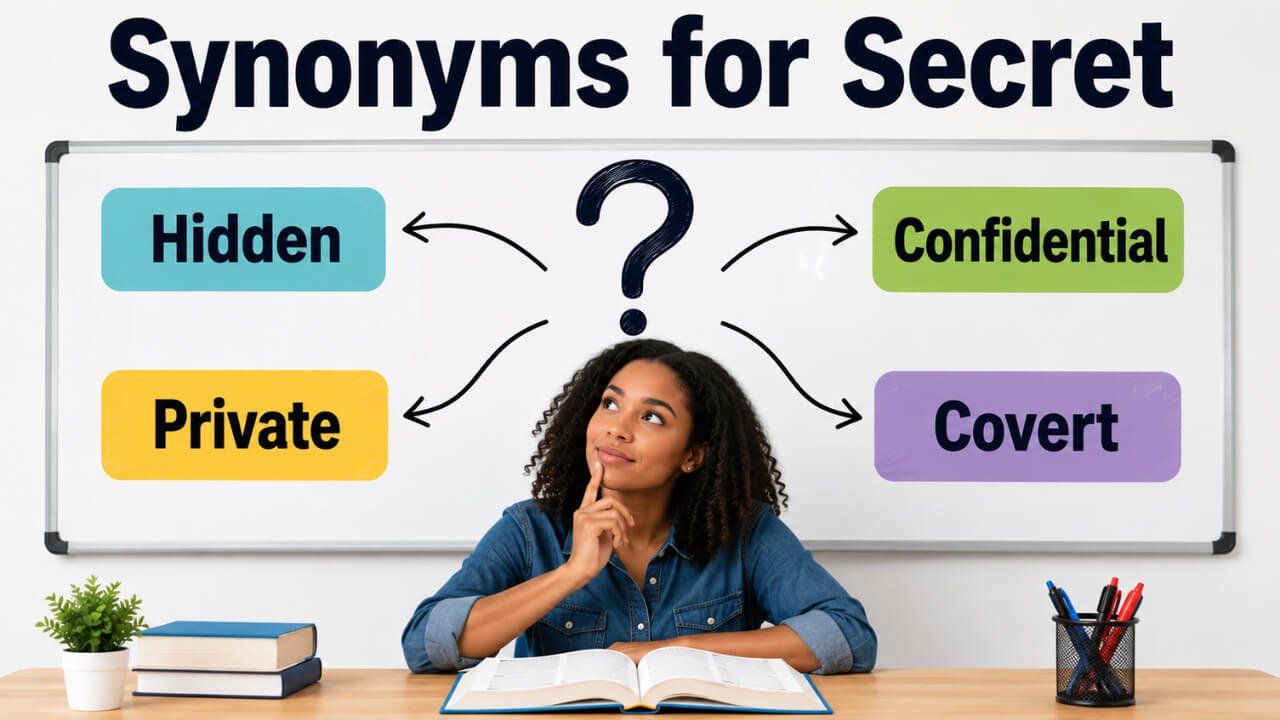
Quick Answer: Common synonyms for secret include confidential, private, hidden, classified, undisclosed, concealed, covert, clandestine, mystery, and confidence. Use confidential for protected professional information, private for personal matters, classified for officially restricted material, hidden or concealed for something kept out of sight, and covert or clandestine for activities performed without public knowledge. Mystery is best for something unexplained, while confidence can describe private information entrusted to another person.
Pronunciation and Word Details
Word: Secret
Pronunciation: /ˈsiː.krət/
Part of Speech: Noun and adjective
Meaning: Information, knowledge, an object, or an activity that is intentionally kept hidden from other people.
US Pronunciation:
UK Pronunciation:
What Does “Secret” Mean?
Secret means something that is intentionally hidden, unknown, or kept from public knowledge. As a noun, it can refer to private information, an unexplained fact, or a special method.
Noun Example: She trusted him with an important secret.
As an adjective, secret describes information, places, actions, plans, or relationships that are deliberately concealed.
Adjective Example: They arranged a secret meeting after work.
The word can also describe the cause of success or a special technique.
Method Example: Patience is the secret of improving this skill.
Its meaning changes slightly according to whether the sentence concerns privacy, concealment, mystery, restricted information, or a successful method.
Meaning, Tone, and Context of “Secret”
Secret is generally a neutral word, but its tone depends on the situation. In everyday conversation, it often refers to personal information that someone does not want others to know.
Personal Context: She told her closest friend a secret.
In professional communication, confidential is usually more precise because it suggests that information must be protected.
Professional Context: The report contains confidential employee information.
In official or security related contexts, classified describes information that can be accessed only by authorized people.
Official Context: The document contains classified material.
Secret can also create a mysterious, exciting, suspicious, or emotional tone. A secret gift may sound pleasant, while a secret agreement may suggest dishonesty or hidden intentions.
When and How to Use “Secret”
For Private Information
Use secret when someone shares information that should not be repeated.
Example: Please keep the surprise party a secret.
For Hidden Plans
Use secret for plans or arrangements that are deliberately kept from others.
Example: The group developed a secret plan for the celebration.
For Personal Feelings
The word can describe feelings, wishes, or admiration that someone has not openly expressed.
Example: He had a secret hope of becoming a writer.
For Restricted Information
Secret may describe information that only selected people are permitted to know.
Example: The researchers kept the results secret until the study was complete.
For Hidden Places
Use secret to describe a location that is difficult to find or known to very few people.
Example: The children discovered a secret room behind the bookshelf.
For Special Methods
Secret can refer to a technique, habit, or principle that produces a desired result.
Example: Regular practice is the secret to steady progress.
For Mysterious Facts
The word may describe something whose explanation remains unknown.
Example: The origin of the ancient object remains a secret.
Best Synonyms for Secret
Confidential: Intended to be known only by authorized or trusted people.
Example: The manager discussed the confidential report privately.
Private: Belonging to one person or a limited group rather than the public.
Example: Their conversation concerned a private family matter.
Hidden: Placed or kept where it cannot easily be seen or discovered.
Example: The key was hidden beneath a loose floorboard.
Concealed: Deliberately covered, disguised, or prevented from being noticed.
Example: The message was concealed inside the ordinary looking letter.
Classified: Officially restricted because the information is sensitive.
Example: Only approved staff could examine the classified document.
Undisclosed: Not revealed, announced, or made publicly known.
Example: The agreement was reached for an undisclosed amount.
Covert: Performed secretly to avoid attention or detection.
Example: The team conducted a covert investigation.
Clandestine: Carefully hidden because an action may be unauthorized or improper.
Example: They held a clandestine meeting outside the city.
Mystery: Something that is unknown, unexplained, or difficult to understand.
Example: The reason for the sudden change remains a mystery.
Confidence: Private information shared with a trusted person.
Example: She told me in confidence that she planned to resign.
50 Synonyms for Secret with Short Meanings
- Confidential: Intended to remain within a trusted or authorized group.
- Private: Not intended for public knowledge or attention.
- Hidden: Kept where it cannot easily be seen or found.
- Concealed: Deliberately covered or prevented from being discovered.
- Classified: Officially restricted because of its sensitive nature.
- Undisclosed: Not revealed or publicly identified.
- Covert: Conducted secretly to avoid notice.
- Clandestine: Carefully hidden, often because an action is unauthorized.
- Undercover: Operating with a concealed identity or purpose.
- Unrevealed: Not yet made known.
- Unspoken: Understood or felt without being openly expressed.
- Unpublicized: Not announced or promoted publicly.
- Unpublished: Not formally released for public reading.
- Unannounced: Done or occurring without prior public notice.
- Unreported: Not communicated, recorded, or publicly disclosed.
- Veiled: Partly hidden or expressed indirectly.
- Masked: Disguised so the true nature is difficult to recognize.
- Obscure: Not clearly known, seen, or understood.
- Mysterious: Difficult to explain or understand.
- Cryptic: Expressed in a puzzling or hidden way.
- Furtive: Done secretly because of fear of being noticed.
- Stealthy: Quiet and careful to avoid detection.
- Surreptitious: Performed secretly without permission or awareness.
- Discreet: Careful about protecting private information.
- Privileged: Available only to people with special permission.
- Restricted: Limited to particular people or purposes.
- Sensitive: Requiring careful handling because disclosure may cause harm.
- Personal: Related to an individual’s private life or feelings.
- Intimate: Closely personal and not normally shared publicly.
- Hush hush: Informal language for something deliberately kept quiet.
- Confidence: Private information entrusted to someone.
- Mystery: Something that remains unknown or unexplained.
- Enigma: A person, object, or situation that is difficult to understand.
- Puzzle: A confusing matter that requires an explanation.
- Riddle: A difficult question or mystery that must be solved.
- Unknown: A fact or matter that has not been discovered.
- Key: The central fact or method that explains success.
- Trick: A useful technique known by experienced people.
- Formula: A particular method for achieving a result.
- Method: A planned way of doing something successfully.
- Recipe: A combination of actions or qualities producing a result.
- Answer: The information that explains a difficult question.
- Explanation: The reason that makes a mystery understandable.
- Inside information: Knowledge available only to a limited group.
- Confidential matter: A subject that must be protected from disclosure.
- Private matter: A personal issue not intended for public discussion.
- Hidden truth: A fact that has been concealed or overlooked.
- Concealed fact: Information deliberately prevented from becoming known.
- Classified information: Official material with restricted access.
- Privileged information: Protected knowledge available only to authorized people.
Read Also:
Synonyms for Sassy
Synonyms for Secret by Context
When Secret Means Private Information
Confidential, private, personal, intimate, sensitive, confidence, and privileged are useful when discussing information shared with a limited group.
Example: The doctor protected the patient’s confidential information.
Private is natural for personal matters, while confidential is better for professional records, reports, contracts, and workplace communication.
When Secret Means Hidden From View
Hidden, concealed, masked, veiled, and obscure describe something that cannot easily be seen or recognized.
Example: The entrance was concealed behind thick plants.
Hidden is broad and natural. Concealed more strongly suggests a deliberate attempt to prevent discovery.
When Secret Means an Undisclosed Activity
Covert, clandestine, undercover, furtive, stealthy, and surreptitious describe actions performed without public awareness.
Example: The investigators began a covert operation.
Covert is common in formal descriptions. Clandestine often suggests that an activity is unauthorized, suspicious, or improper.
When Secret Means an Unexplained Matter
Mystery, enigma, puzzle, riddle, unknown, and hidden truth describe something whose answer has not been discovered.
Example: The disappearance of the document remains a mystery.
Mystery is the most natural general alternative. Enigma suggests something especially difficult to understand.
When Secret Means a Successful Method
Key, formula, trick, recipe, method, and answer can replace secret when discussing how a result is achieved.
Example: Careful preparation is the key to a confident presentation.
Key sounds natural and direct. Formula suggests a repeatable combination of steps, while trick is more casual.
Another Word for Secret
Confidential is often the best single replacement for secret when describing protected information. However, the most accurate choice depends on whether the sentence refers to personal privacy, official restrictions, hidden activity, mystery, or a successful technique.
Original: The folder contains secret financial information.
Better Option: The folder contains confidential financial information.
Original: They organized a secret investigation.
Better Option: They organized a covert investigation.
Original: The reason for the error is still a secret.
Better Option: The reason for the error is still a mystery.
Original: Consistency is the secret to improving your writing.
Better Option: Consistency is the key to improving your writing.
When Not to Use “Secret”
Avoid secret when a more precise word can explain the type of privacy or concealment involved. In formal writing, secret may sound vague if the information is specifically confidential, classified, restricted, or undisclosed.
Weak: The company has secret information about its employees.
Better: The company holds confidential information about its employees.
Secret may also sound suspicious when the intended meaning is simply personal or private.
Weak: She attended a secret medical appointment.
Better: She attended a private medical appointment.
Do not use secret for something that is merely difficult to notice unless it was deliberately hidden.
Weak: The small error was secret in the final paragraph.
Better: The small error was difficult to notice in the final paragraph.
Avoid repeating secret several times in one passage.
Weak: They planned a secret event in a secret location and used a secret entrance.
Better: They planned a private event in a hidden location and used a concealed entrance.
Words Commonly Confused With Secret
Secret vs Private: Secret means deliberately kept unknown, while private means limited to an individual or selected group. A private conversation is not necessarily secret.
Secret vs Confidential: Confidential information is protected by trust, professional duty, or policy. Secret is broader and may refer to any hidden information.
Secret vs Classified: Classified describes official information with legally or administratively restricted access. Not every secret is classified.
Secret vs Hidden: Hidden usually describes something placed out of sight. Secret can describe information, plans, feelings, locations, or methods.
Secret vs Covert: Secret can describe a thing or fact, while covert usually describes an action, operation, or organized activity.
Secret vs Discreet: Secret describes what is hidden. Discreet describes a person or action that carefully avoids embarrassment or disclosure.
Secret vs Secretive: Secret means hidden information or activity. Secretive describes a person who habitually avoids sharing information.
Secret vs Mystery: A secret is often known by someone but deliberately withheld. A mystery may be unknown to everyone.
Which Synonym Should You Choose?
Choose confidential for protected workplace information, professional records, contracts, reports, and formal communication.
Choose private for personal conversations, family matters, feelings, property, or events limited to selected people.
Choose classified for officially restricted documents, government material, or information requiring authorization.
Choose hidden when an object, detail, place, or fact cannot easily be seen or discovered.
Choose concealed when someone has deliberately covered or disguised something.
Choose undisclosed when information has not been publicly announced, such as a name, amount, location, or reason.
Choose covert for secret operations, investigations, surveillance, or organized activity.
Choose clandestine when an activity is hidden because it may be unauthorized, improper, or prohibited.
Choose mystery when a fact, cause, event, or explanation remains unknown.
Choose confidence when referring to private information entrusted to another person.
Choose key when secret means the most important method, cause, or principle behind success.
Choose trick for informal conversation about a helpful technique or practical skill.
Real Life Examples of “Secret” in Sentences
Original: She shared a secret with her closest friend.
Better Option: She shared a confidence with her closest friend.
Original: The company kept the new design secret.
Better Option: The company kept the new design confidential.
Original: They discovered a secret door in the old house.
Better Option: They discovered a hidden door in the old house.
Original: The team carried out a secret investigation.
Better Option: The team carried out a covert investigation.
Original: His reason for leaving remains a secret.
Better Option: His reason for leaving remains a mystery.
Original: The secret message was placed inside the book.
Better Option: The concealed message was placed inside the book.
Original: The document contained secret information.
Better Option: The document contained classified information.
Original: Daily reading is the secret to a stronger vocabulary.
Better Option: Daily reading is the key to a stronger vocabulary.
Original: They arranged a secret meeting before the announcement.
Better Option: They arranged a private meeting before the announcement.
Original: The final price was kept secret.
Better Option: The final price remained undisclosed.
Synonym Groups and Usage Differences
Privacy Group
Private, confidential, personal, intimate, sensitive, and privileged describe information that should be limited to particular people. Confidential is strongest in professional settings, while personal and intimate are more suitable for individual feelings and relationships.
Example: The counselor treated every personal detail as confidential.
Concealment Group
Hidden, concealed, masked, veiled, obscure, and unrevealed suggest that something cannot easily be seen, recognized, or understood. Concealed and masked imply deliberate action, while obscure may result from a lack of clarity.
Example: The true purpose of the message was veiled by polite language.
Secret Activity Group
Covert, clandestine, undercover, furtive, stealthy, and surreptitious describe behavior intended to escape notice. Covert sounds formal and organized, while furtive often suggests nervous or suspicious behavior.
Example: His furtive movements attracted the guard’s attention.
Mystery Group
Mystery, enigma, puzzle, riddle, and unknown describe something without a clear explanation. Mystery is broad, while enigma emphasizes unusual complexity.
Example: Her sudden decision remained an enigma to her colleagues.
Method Group
Key, formula, trick, recipe, method, and answer describe a way to produce a result. Key identifies the most important factor, while formula suggests a repeatable combination of actions.
Example: Clear communication is the key to successful teamwork.
Antonyms of Secret
The opposite of secret depends on whether the word refers to hidden information, private activity, an unknown fact, or restricted access.
Public: Open or available to everyone.
Open: Not hidden, restricted, or concealed.
Disclosed: Officially or intentionally revealed.
Revealed: Made known after being hidden.
Known: Recognized or understood by people.
Obvious: Easy to notice or understand.
Transparent: Open, clear, and honest about actions or information.
Overt: Performed openly rather than secretly.
Announced: Formally communicated to the public.
Published: Made available for people to read or examine.
Accessible: Available to people who wish to use or examine it.
Exposed: Uncovered or brought into public view.
Comparison: Secret vs Related Words
Secret vs Confidential
Secret is a broad word for anything deliberately hidden. Confidential specifically refers to information protected by trust, professional responsibility, or limited access.
Example With Secret: They planned a secret celebration for their teacher.
Example With Confidential: The adviser reviewed the confidential financial report.
Secret vs Private
Secret emphasizes concealment. Private emphasizes personal ownership, limited participation, or freedom from public attention.
Example With Secret: She kept the plan secret from her family.
Example With Private: She requested a private conversation with her manager.
Secret vs Hidden
Secret commonly describes information, plans, methods, or feelings. Hidden often describes an object or detail placed out of sight.
Example With Secret: He refused to reveal the secret.
Example With Hidden: The letter was hidden inside a drawer.
Secret vs Covert
Secret can function as a noun or adjective in many contexts. Covert is mainly an adjective describing organized actions intended to avoid detection.
Example With Secret: The location of the event was secret.
Example With Covert: The officers conducted a covert inquiry.
Secret vs Mystery
A secret may be known by one person or a small group. A mystery is something that may not yet be understood by anyone.
Example With Secret: She knew the secret but refused to reveal it.
Example With Mystery: The cause of the unusual sound remained a mystery.
Secret vs Classified
Secret may describe any hidden information. Classified refers to official material protected according to a formal access level.
Example With Secret: The recipe was a family secret.
Example With Classified: The employee was not permitted to view the classified file.
Common Phrases and Expressions With “Secret”
Keep a Secret: Avoid revealing private information to others.
Tell a Secret: Share information that was previously hidden.
Secret Admirer: Someone who expresses admiration without revealing their identity.
Secret Ingredient: A special ingredient that improves a dish or product.
Secret Weapon: A hidden skill, resource, or advantage.
Secret Identity: A concealed name or personal identity.
Secret Plan: An arrangement deliberately kept from others.
Secret Meeting: A gathering held without public knowledge.
Secret Passage: A concealed route through or between buildings.
Secret Code: A system of symbols or words understood only by selected people.
Open Secret: A fact that is widely known even though it is not officially acknowledged.
Family Secret: Private information known only within a family.
Common Mistakes to Avoid
One common mistake is using secret when the intended meaning is confidential. In professional writing, confidential is more precise for protected reports, records, messages, and personal data.
Writers also confuse secret with secretive. Secret describes hidden information or activity, while secretive describes a person who avoids sharing information.
Another mistake is treating discreet as a direct replacement in every sentence. Discreet means careful and tactful about privacy. It does not directly mean hidden.
Avoid using mystery when someone already knows the information but refuses to reveal it. That information is a secret. A mystery usually involves something that remains unexplained.
Do not overuse secret in the same paragraph. Replace repeated uses with private, hidden, confidential, undisclosed, or covert when those words match the intended meaning.
Use the correct preposition in common expressions. A person keeps a secret from someone, tells a secret to someone, and discovers the secret to or secret of achieving a result.
Conclusion
Understanding synonyms for secret helps you describe privacy, concealment, mystery, and restricted information more accurately. Use confidential for protected professional details, private for personal matters, classified for officially restricted material, and hidden or concealed for things kept out of sight. Covert and clandestine are strongest for secret activities, while mystery and enigma describe unexplained matters. When secret refers to a successful technique, key, formula, method, or trick may provide a clearer and more natural alternative.
FAQs About Synonyms for Secret
What Is the Best Synonym for Secret?
Confidential is often the best formal synonym, while private is the most natural choice for personal matters. The correct option depends on the context.
What Is a Formal Word for Secret?
Confidential, classified, undisclosed, covert, and restricted are useful formal alternatives. Classified is appropriate only for officially protected information.
What Is Another Word for a Hidden Secret?
Concealed fact, hidden truth, unrevealed information, or undisclosed detail may fit. Hidden secret can sound repetitive because a secret is already concealed.
Is Private the Same as Secret?
Not completely. Private means limited to an individual or selected group, while secret means intentionally kept unknown. Something can be private without being secret.
What Is a Synonym for a Secret Plan?
Covert plan, clandestine plan, hidden scheme, undisclosed strategy, or private arrangement may work depending on the tone and purpose.
What Word Describes Someone Who Keeps Secrets?
Secretive describes someone who avoids sharing information. Discreet describes someone who can be trusted to handle private information carefully.
What Is Another Word for the Secret of Success?
Key, formula, method, recipe, principle, or answer can replace secret. Key is usually the clearest and most natural alternative.
