
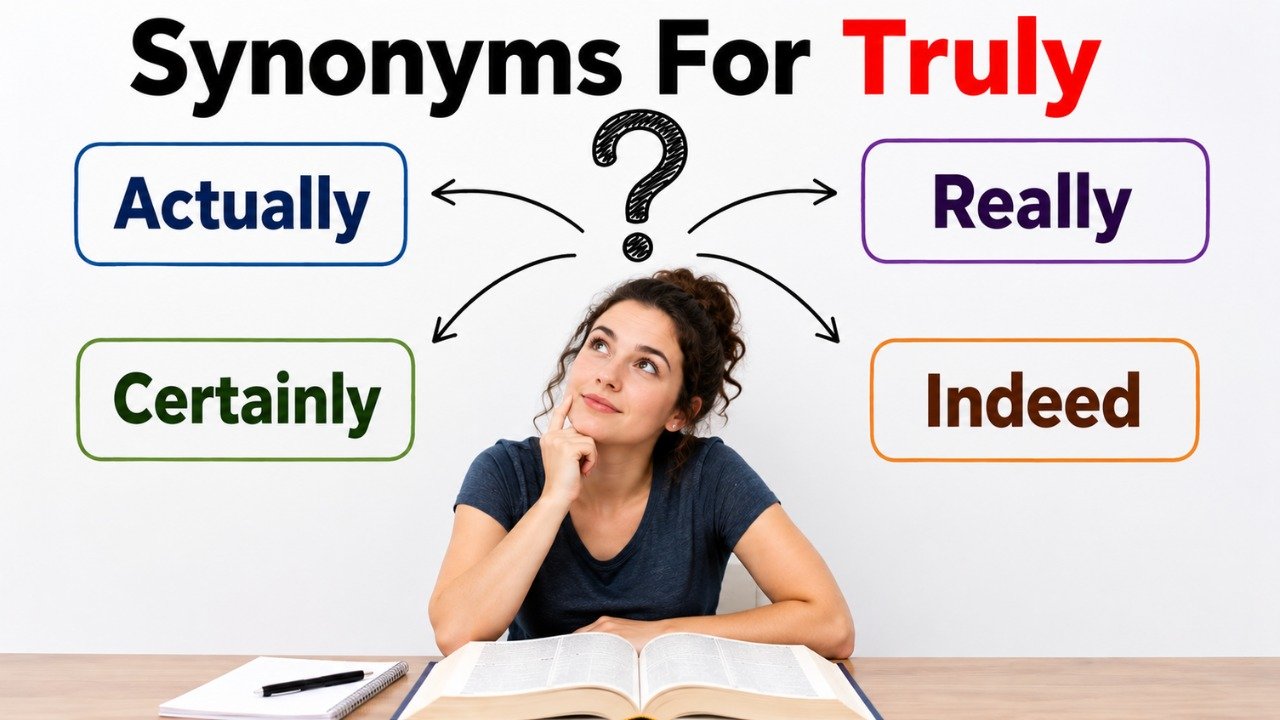
Quick Answer: The best synonyms for truly include genuinely, really, honestly, sincerely, actually, indeed, certainly, authentically, unquestionably, and absolutely. Genuinely is best when describing authentic feelings or qualities. Honestly and truthfully suit statements about truth, while actually clarifies facts or corrects assumptions. Indeed works well in formal writing, really sounds natural in casual conversation, and absolutely adds strong emphasis. The most suitable choice among the synonyms for truly depends on whether you mean truthfully, sincerely, certainly, completely, or in reality.
Pronunciation and Word Details
Word: Truly.
Pronunciation: /ˈtruːli/.
Part of Speech: Adverb.
Meaning: In an honest, genuine, accurate, complete, or unquestionable way.
US Pronunciation:
UK Pronunciation:
What Does “Truly” Mean?
Truly means in a truthful, genuine, sincere, real, or complete way.
Truly is an adverb. It modifies verbs, adjectives, other adverbs, and sometimes entire statements. Its exact meaning changes according to the sentence in which it appears.
When truly describes a feeling, it means sincerely or genuinely.
Example: I am truly grateful for your support.
When it confirms that something is real, it means actually or genuinely.
Example: This is a truly valuable opportunity.
When it introduces an honest statement, it means truthfully or honestly.
Example: She truly believed that the plan would succeed.
Truly can also strengthen an adjective by showing that a quality exists to a high degree.
Example: The performance was truly remarkable.
In formal or literary writing, truly may express certainty, authenticity, moral truth, or deep conviction. In everyday conversation, really is often used as a more casual replacement.
Meaning, Tone, and Context of “Truly”
Truly usually has a positive, sincere, and slightly emphatic tone. It can sound neutral, emotional, formal, or conversational depending on its position and purpose.
Neutral Tone: Truly can simply confirm that something is real or accurate.
Example: The account truly reflects what happened.
Sincere Tone: It often emphasizes that a feeling or statement is honest.
Example: I am truly sorry for the misunderstanding.
Emotional Tone: Truly can strengthen gratitude, happiness, admiration, love, regret, or concern.
Example: She was truly delighted by the thoughtful gesture.
Formal Tone: Truly works naturally in speeches, essays, professional messages, reports, and thoughtful explanations.
Example: The results are truly significant for future research.
Conversational Tone: The word appears in everyday speech, although really is often more casual.
Example: I truly enjoyed our conversation.
Literary Tone: In reflective or expressive writing, truly can suggest deep truth, authenticity, or personal conviction.
Example: He finally understood what it meant to be truly free.
Truly is not normally technical, but it may appear in academic or professional writing when the writer wants to emphasize authenticity, certainty, or importance. It should be used carefully because frequent repetition can make the emphasis feel weak.
When and How to Use “Truly”
For Genuine Feelings
Use truly to show that an emotion is real, sincere, and deeply felt.
Example: I am truly thankful for everything you have done.
For Honest Beliefs
Truly can show that someone sincerely accepts an idea as true.
Example: She truly believes that patience leads to better decisions.
For Authentic Qualities
Use truly when something genuinely possesses a particular quality rather than merely appearing to possess it.
Example: He is a truly compassionate person.
For Strong Emphasis
Truly can strengthen an adjective such as remarkable, beautiful, impressive, valuable, or extraordinary.
Example: The final design was truly impressive.
For Factual Reality
Use truly when confirming that something exists, happened, or is correct.
Example: The experience truly changed his perspective.
For Certainty
Truly may express confidence that a statement is correct.
Example: This is truly the most practical solution available.
For Sincere Apologies
Truly commonly appears with sorry to communicate genuine regret.
Example: I am truly sorry for causing unnecessary confusion.
For Gratitude
Use truly to make appreciation sound warmer and more sincere.
Example: We truly appreciate your patience and understanding.
For Deep Understanding
Truly can suggest complete or meaningful understanding rather than superficial awareness.
Example: Few people truly understand the difficulty of the task.
For Personal Conviction
The word can emphasize that a person sincerely holds a belief, hope, or opinion.
Example: I truly hope the situation improves soon.
Best Synonyms for Truly
Genuinely
Synonym: Genuinely means in an authentic, honest, or sincere way.
Example: She was genuinely pleased with the final result.
Really
Synonym: Really means actually or to a strong degree and is common in casual speech.
Example: I really enjoyed the discussion.
Honestly
Synonym: Honestly means in a truthful, open, or sincere manner.
Example: He honestly explained why the project was delayed.
Sincerely
Synonym: Sincerely means with genuine feelings, intentions, or respect.
Example: We sincerely appreciate your assistance.
Actually
Synonym: Actually means in reality or according to the real facts.
Example: The assignment was actually easier than expected.
Indeed
Synonym: Indeed confirms a statement or adds formal emphasis.
Example: The evidence is indeed convincing.
Authentically
Synonym: Authentically means in a way that is real, natural, and faithful to one’s identity or character.
Example: She communicates authentically with her audience.
Certainly
Synonym: Certainly means without serious doubt or hesitation.
Example: The proposal certainly deserves careful consideration.
Unquestionably
Synonym: Unquestionably means in a way that cannot reasonably be doubted.
Example: She is unquestionably qualified for the role.
Absolutely
Synonym: Absolutely means completely, definitely, or without any doubt.
Example: The explanation was absolutely correct.
50 Synonyms for Truly with Short Meanings
- Genuinely: In an authentic or sincere way.
- Really: In reality or to a strong degree.
- Honestly: In a truthful and open manner.
- Sincerely: With genuine feelings or intentions.
- Actually: In reality or according to the facts.
- Indeed: Used to confirm or emphasize a statement.
- Authentically: In a real and natural way.
- Truthfully: In a manner that states the truth.
- Certainly: Without serious doubt.
- Definitely: In a clear and certain way.
- Absolutely: Completely or without doubt.
- Undoubtedly: In a way that is almost impossible to question.
- Unquestionably: In a way that cannot reasonably be doubted.
- Indisputably: In a way that cannot be successfully challenged.
- Veritably: In a true or very real sense.
- Factually: According to established facts.
- Accurately: In a correct and precise manner.
- Correctly: Without error or misunderstanding.
- Faithfully: In a loyal, accurate, or dependable way.
- Candidly: In an honest and direct manner.
- Frankly: In an open and straightforward way.
- Openly: Without hiding thoughts, facts, or feelings.
- Earnestly: With serious and sincere intention.
- Wholeheartedly: With complete sincerity and enthusiasm.
- Deeply: To a strong emotional or meaningful degree.
- Seriously: In a sincere, important, or thoughtful way.
- Profoundly: To a deep and powerful degree.
- Completely: To the fullest possible extent.
- Entirely: Wholly and without exception.
- Fully: Completely or to the greatest degree.
- Thoroughly: Completely and with careful attention.
- Perfectly: Completely or exactly as required.
- Wholly: Completely and without division.
- Totally: Completely or in every respect.
- Surely: With confidence or certainty.
- Clearly: In an obvious or unmistakable way.
- Obviously: In a manner that is easy to recognize as true.
- Evidently: According to what can clearly be seen or understood.
- Manifestly: In an obvious and unmistakable manner.
- In Truth: According to what is actually true.
- In Reality: According to the real situation.
- In Fact: Used to confirm or clarify what is true.
- As a Matter of Fact: Used to introduce a factual correction or confirmation.
- Without Doubt: With complete certainty.
- Beyond Doubt: So certain that reasonable doubt is impossible.
- For Certain: Definitely and without uncertainty.
- For Real: Genuinely or actually, especially in casual speech.
- In All Honesty: Used to introduce a sincere opinion or admission.
- To Be Honest: Used to express a truthful personal view.
- By All Accounts: According to the available descriptions or reports.
Read Also:
Synonyms for Sneaky

Synonyms for Truly by Context
When Truly Means Genuinely
When truly describes authentic qualities, emotions, intentions, or experiences, genuinely is usually the strongest replacement.
Other helpful synonyms include authentically, sincerely, wholeheartedly, earnestly, and honestly.
Example With Truly: She was truly interested in helping the new students.
Example With Genuinely: She was genuinely interested in helping the new students.
Example With Authentically: He expressed his opinions authentically and respectfully.
When Truly Means Honestly
When truly introduces a truthful statement or emphasizes personal honesty, honestly or truthfully may be more precise.
Candidly and frankly are suitable when the statement is direct and possibly difficult to hear.
Example With Truly: I truly do not know why the decision was changed.
Example With Honestly: I honestly do not know why the decision was changed.
Example With Candidly: Candidly, the current proposal needs further development.
When Truly Means Actually
When truly confirms reality or corrects an assumption, actually, in reality, or in fact may be better.
Example With Truly: The task was truly more complicated than it appeared.
Example With Actually: The task was actually more complicated than it appeared.
Example With In Fact: The task was, in fact, more complicated than it appeared.
When Truly Adds Emphasis
When truly strengthens an adjective, really, absolutely, profoundly, or thoroughly may fit the sentence.
Really is conversational. Absolutely is stronger. Profoundly works with deep emotional or intellectual effects.
Example With Truly: The final presentation was truly impressive.
Example With Really: The final presentation was really impressive.
Example With Absolutely: The final presentation was absolutely impressive.
When Truly Means Completely
When truly suggests full realization, complete understanding, or total possession of a quality, completely, fully, entirely, or wholly may be clearer.
Example With Truly: She never truly understood the consequences.
Example With Fully: She never fully understood the consequences.
Example With Completely: She never completely understood the consequences.
When Truly Expresses Certainty
When truly confirms that something is unquestionably correct, certainly, undoubtedly, definitely, or unquestionably may be stronger.
Example With Truly: This is truly an important development.
Example With Certainly: This is certainly an important development.
Example With Unquestionably: This is unquestionably an important development.
When Truly Describes Deep Emotion
When truly strengthens gratitude, regret, love, sadness, admiration, or happiness, deeply, sincerely, genuinely, or profoundly may provide more emotional precision.
Example With Truly: I am truly grateful for your guidance.
Example With Deeply: I am deeply grateful for your guidance.
Example With Sincerely: I sincerely appreciate your guidance.
When Truly Describes Accuracy
When the intended meaning is correctness rather than sincerity, accurately, correctly, factually, or faithfully may be more suitable.
Example With Truly: The summary truly represents the main argument.
Example With Accurately: The summary accurately represents the main argument.
Example With Faithfully: The summary faithfully represents the main argument.
Another Word for Truly
Genuinely is often the best single replacement for truly because it naturally expresses authenticity, honesty, and sincerity. However, the ideal alternative depends on the sentence.
Use really for casual emphasis, actually for factual reality, sincerely for emotional honesty, certainly for confidence, and fully for completeness.
Original: She was truly pleased with the response.
Better Option: She was genuinely pleased with the response.
Original: The experience truly changed the way he viewed success.
Better Option: The experience profoundly changed the way he viewed success.
Original: I truly appreciate your thoughtful advice.
Better Option: I sincerely appreciate your thoughtful advice.
Original: The situation was truly different from what we expected.
Better Option: The situation was actually different from what we expected.
When Not to Use “Truly”
Truly is flexible, but it may sound repetitive, vague, overly emotional, or less precise than another word in certain sentences.
When You Mean Factual Correction
Use actually or in fact when correcting a misunderstanding.
Weak: The meeting truly begins at nine.
Better: The meeting actually begins at nine.
When You Mean Accurate Representation
Use accurately or faithfully when discussing reports, descriptions, measurements, or data.
Weak: The chart truly shows the increase in demand.
Better: The chart accurately shows the increase in demand.
When You Mean Complete Understanding
Use fully or completely when the sentence concerns the degree of understanding.
Weak: She did not truly understand the instructions.
Better: She did not fully understand the instructions.
When You Need Casual Emphasis
Truly may sound slightly formal in a relaxed conversation. Really can feel more natural.
Weak: I truly liked that meal.
Better: I really liked that meal.
When Stronger Certainty Is Needed
Use unquestionably, undoubtedly, or definitely when the main idea is certainty rather than sincerity.
Weak: She is truly the best qualified candidate.
Better: She is unquestionably the best qualified candidate.
When the Word Adds No Meaning
Remove truly when the sentence is already strong and clear without it.
Weak: The result was truly complete and final.
Better: The result was complete and final.
When It Becomes Repetitive
Avoid using truly several times in the same paragraph.
Weak: I truly appreciate your help because it was truly valuable and truly necessary.
Better: I sincerely appreciate your help because it was valuable and necessary.
When You Mean Literal Accuracy
Do not automatically use truly as a replacement for literally. Literally means that the words should be understood in their exact, nonfigurative sense.
Weak: The box was truly too heavy to lift.
Better: The box was literally too heavy for one person to lift.
Words Commonly Confused With Truly
Truly vs Really: Truly often emphasizes sincerity or authenticity. Really is broader and more conversational, and it commonly strengthens adjectives.
Truly vs Genuinely: Truly can express truth, certainty, or emphasis. Genuinely focuses more specifically on authenticity and sincere feeling.
Truly vs Honestly: Truly may describe a quality or strengthen a statement. Honestly emphasizes truthfulness, openness, or personal opinion.
Truly vs Sincerely: Truly has several meanings, including actually and completely. Sincerely mainly describes honest feelings, respectful intentions, or genuine emotion.
Truly vs Actually: Truly may emphasize sincerity or importance. Actually clarifies reality, corrects an assumption, or introduces an unexpected fact.
Truly vs Indeed: Truly often sounds personal or emotional. Indeed is commonly used to confirm a statement or add formal emphasis.
Truly vs Certainly: Truly may express authenticity or sincerity. Certainly mainly communicates confidence and lack of doubt.
Truly vs Truthfully: Truly can modify qualities, emotions, and statements. Truthfully specifically means in a way that communicates the truth.
Truly vs Literally: Truly means genuinely, honestly, or completely. Literally means according to the exact meaning of the words, without metaphor or exaggeration.
Truly vs Fully: Truly may describe authenticity or sincerity. Fully describes completeness, extent, or total understanding.
Which Synonym Should You Choose?
Choose genuinely when describing authentic feelings, reactions, qualities, or intentions.
Choose really for natural emphasis in casual speech and everyday conversation.
Choose honestly when expressing a truthful opinion, admission, or explanation.
Choose sincerely when communicating gratitude, regret, respect, sympathy, or good intentions.
Choose actually when correcting assumptions, clarifying reality, or introducing unexpected facts.
Choose indeed when confirming a statement or adding emphasis in formal writing.
Choose certainly when expressing confidence without sounding overly forceful.
Choose definitely when giving a clear decision, promise, or confident answer.
Choose unquestionably when something cannot reasonably be doubted.
Choose absolutely when expressing complete agreement, certainty, or strong emphasis.
Choose accurately when discussing facts, reports, figures, descriptions, or results.
Choose faithfully when something closely represents an original source, idea, promise, or duty.
Choose fully when discussing complete understanding, awareness, development, or participation.
Choose profoundly when describing a deep intellectual or emotional effect.
Choose wholeheartedly when expressing complete support, agreement, or enthusiasm.
For Formal Writing: Indeed, genuinely, certainly, unquestionably, and factually are strong options.
For Casual Speech: Really, actually, honestly, and for real sound more natural.
For Emotional Writing: Sincerely, deeply, genuinely, profoundly, and wholeheartedly are effective.
For Reports: Accurately, factually, correctly, faithfully, and clearly provide precision.
For Essays: Genuinely, indeed, certainly, authentically, and undoubtedly work well.
For Professional Emails: Sincerely, genuinely, certainly, and truly are polite and appropriate.
For Agreement: Absolutely, certainly, definitely, and unquestionably communicate confidence.
For Factual Correction: Actually, in fact, and as a matter of fact are the clearest choices.
For Complete Understanding: Fully, completely, entirely, and thoroughly are more precise.
For Conversation: Really, honestly, actually, and definitely are usually the most natural.
Real Life Examples of “Truly” in Sentences
Original: I am truly grateful for your patience.
Better Option: I am sincerely grateful for your patience.
Original: She was truly excited about the opportunity.
Better Option: She was genuinely excited about the opportunity.
Original: The experience truly changed his priorities.
Better Option: The experience profoundly changed his priorities.
Original: He truly believed that the plan would work.
Better Option: He honestly believed that the plan would work.
Original: The final result was truly impressive.
Better Option: The final result was absolutely impressive.
Original: Few people truly understand the amount of preparation required.
Better Option: Few people fully understand the amount of preparation required.
Original: The report truly reflects the current situation.
Better Option: The report accurately reflects the current situation.
Original: She is truly the right person for the position.
Better Option: She is unquestionably the right person for the position.
Original: The problem was truly different from what we had expected.
Better Option: The problem was actually different from what we had expected.
Original: We truly support the proposed improvements.
Better Option: We wholeheartedly support the proposed improvements.
Synonym Groups and Usage Differences
Authenticity Group
This group includes genuinely, authentically, really, sincerely, and veritably. These words indicate that something is real rather than artificial, false, or pretended.
Genuinely is the most common choice for authentic emotions and qualities. Authentically emphasizes natural identity or character. Veritably is formal and less common.
Example: She was genuinely interested in understanding the problem.
Truthfulness Group
This group includes honestly, truthfully, candidly, frankly, openly, and in all honesty. These alternatives focus on truthful communication.
Honestly is broad and conversational. Truthfully directly emphasizes factual honesty. Candidly suggests openness about a potentially uncomfortable issue. Frankly often introduces a direct opinion.
Example: He honestly explained why the work had not been completed.
Factual Reality Group
This group includes actually, in reality, in fact, factually, and as a matter of fact. These expressions clarify what is real or correct.
Actually often corrects an assumption. In fact confirms or strengthens a factual point. Factually is especially useful when evaluating accuracy.
Example: The process was actually simpler than the instructions suggested.
Certainty Group
This group includes certainly, definitely, undoubtedly, unquestionably, indisputably, and surely. These words show different levels of confidence.
Certainly is polite and confident. Definitely is direct and common in speech. Unquestionably and indisputably express very strong certainty.
Example: The new system will certainly improve efficiency.
Emphasis Group
This group includes really, indeed, absolutely, clearly, obviously, and manifestly. These words strengthen a statement or quality.
Really is informal and versatile. Indeed is more formal. Absolutely expresses complete agreement or strong intensity.
Example: The final chapter was indeed the strongest part of the book.
Completeness Group
This group includes completely, entirely, fully, thoroughly, wholly, and totally. These alternatives are useful when truly means to the fullest extent.
Fully often describes understanding or development. Thoroughly suggests completeness with careful attention. Totally is common in informal speech.
Example: She fully understood the risks before making her decision.
Deep Feeling Group
This group includes deeply, profoundly, sincerely, earnestly, and wholeheartedly. These words express strong emotion or serious intention.
Deeply works well with gratitude, regret, concern, and emotion. Profoundly describes a powerful effect. Wholeheartedly expresses complete support or enthusiasm.
Example: We deeply regret the confusion caused by the announcement.
Accuracy Group
This group includes accurately, correctly, factually, and faithfully. These alternatives apply when truly refers to correct representation.
Accurately emphasizes freedom from error. Correctly shows that something was done properly. Faithfully suggests close representation of an original idea, event, or source.
Example: The summary accurately presents the main findings.
Antonyms of Truly
The opposite of truly depends on whether the word means honestly, genuinely, accurately, certainly, or completely.
Falsely: In a way that is not true.
Dishonestly: In a deceptive or untruthful manner.
Insincerely: Without genuine emotion or intention.
Artificially: In a manufactured or unnatural way.
Deceptively: In a manner intended to mislead.
Inaccurately: With mistakes or incorrect details.
Incorrectly: In a way that is not right or accurate.
Superficially: Without depth, completeness, or genuine understanding.
Partially: Only to a limited extent.
Doubtfully: With uncertainty or lack of confidence.
Apparently: According to appearance rather than confirmed reality.
Supposedly: According to a claim that may not be proven.
Mistakenly: As a result of an incorrect belief.
Pretentiously: In a way that tries to appear more impressive than is genuine.
Halfheartedly: Without complete sincerity, energy, or enthusiasm.
Comparison: Truly vs Related Words
Truly vs Genuinely
Truly can express sincerity, truth, certainty, or emphasis. Genuinely focuses more directly on authenticity and honest feeling.
Example With Truly: She was truly pleased with the feedback.
Example With Genuinely: She was genuinely pleased with the feedback.
Genuinely is usually more precise when the emotion is authentic.
Truly vs Really
Truly often sounds more sincere or thoughtful. Really is more casual and frequently serves as a general intensifier.
Example With Truly: I truly appreciate your support.
Example With Really: I really appreciate your support.
Both are correct, but truly sounds slightly more formal and emotional.
Truly vs Honestly
Truly may describe a real quality or sincere feeling. Honestly emphasizes truthful speech, belief, or opinion.
Example With Truly: He was truly concerned about the outcome.
Example With Honestly: He honestly believed that the outcome would improve.
Truly vs Sincerely
Truly has a broad range of meanings. Sincerely mainly communicates genuine emotion, respect, regret, or intention.
Example With Truly: I am truly sorry for the mistake.
Example With Sincerely: I sincerely apologize for the mistake.
Sincerely is often more polished in formal apologies and expressions of gratitude.
Truly vs Actually
Truly emphasizes authenticity or sincerity, while actually refers to factual reality or corrects an assumption.
Example With Truly: She was truly happy with the decision.
Example With Actually: She was actually surprised by the decision.
Truly vs Indeed
Truly can sound personal and emotional. Indeed often confirms a claim or strengthens a formal statement.
Example With Truly: The experience was truly unforgettable.
Example With Indeed: The experience was indeed unforgettable.
Truly vs Absolutely
Truly expresses sincerity or authenticity. Absolutely expresses complete certainty, agreement, or intensity.
Example With Truly: I truly agree with your conclusion.
Example With Absolutely: I absolutely agree with your conclusion.
Absolutely sounds stronger and more decisive.
Truly vs Fully
Truly can mean genuinely or sincerely. Fully refers to completeness or total extent.
Example With Truly: He truly values your opinion.
Example With Fully: He fully understands your opinion.
Truly vs Truthfully
Truly has several uses, while truthfully specifically concerns honest communication.
Example With Truly: She truly wanted to help.
Example With Truthfully: She answered the question truthfully.
Truly vs Literally
Truly means genuinely, honestly, or to a high degree. Literally means according to the exact meaning of the words.
Example With Truly: The view was truly breathtaking.
Example With Literally: The room was literally empty.
Common Phrases and Expressions With “Truly”
Truly Grateful: Deeply and sincerely thankful.
Truly Sorry: Genuinely regretful about an action or situation.
Truly Amazing: Genuinely impressive or extraordinary.
Truly Remarkable: Deserving sincere admiration or attention.
Truly Believe: Sincerely accept an idea as correct or possible.
Truly Understand: Understand fully rather than superficially.
Truly Appreciate: Feel sincere gratitude or recognize real value.
Truly Happy: Genuinely pleased or emotionally satisfied.
Truly Matters: Has real importance or significance.
Truly Unique: Genuinely different or distinctive.
Yours Truly: A traditional closing used in messages or a humorous way of referring to oneself.
Truly Yours: An expression suggesting sincere affection, loyalty, or personal commitment.
Common Mistakes to Avoid
Repeating Truly Too Often
Repeated use weakens its emotional and emphatic effect.
Incorrect: I truly believe this is truly useful and truly important.
Better: I genuinely believe this is useful and highly important.
Using Truly When Actually Is Clearer
Use actually when correcting a mistaken belief or explaining reality.
Less Precise: The office truly closes at six, not five.
Better: The office actually closes at six, not five.
Using Truly for Numerical Accuracy
Truly is not normally the best word for measurements, calculations, or data.
Less Precise: The machine truly measured the distance.
Better: The machine accurately measured the distance.
Confusing Truly With Literally
Truly adds sincerity or emphasis. Literally indicates an exact, nonfigurative meaning.
Incorrect: I was truly frozen to the chair.
Better: I was completely unable to move from the chair.
Using an Overly Formal Alternative in Casual Speech
Veritably and indisputably may sound unnatural in ordinary conversation.
Unnatural: The meal was veritably delicious.
Better: The meal was really delicious.
Choosing Really in Formal Writing
Really can sound vague or conversational in reports and essays.
Weak: The findings are really important.
Better: The findings are genuinely significant.
Misplacing Truly
Place truly close to the word it modifies so the meaning remains clear.
Unclear: She said she appreciated the support truly.
Better: She said she truly appreciated the support.
Using Truly Without a Clear Purpose
Do not add truly merely to make a sentence sound stronger.
Weak: The committee made a truly final decision.
Better: The committee made a final decision.
Confusing Sincerity With Certainty
Use sincerely for genuine emotion and certainly for confidence.
Less Precise: She certainly regrets the mistake.
Better: She sincerely regrets the mistake.
Using a Weak Synonym for Deep Emotion
Really may not communicate enough emotional depth in a serious message.
Weak: We really regret your loss.
Better: We deeply regret your loss.
Conclusion
The best synonyms for truly depend on the intended meaning. Genuinely and authentically express real qualities, while honestly and truthfully emphasize honesty. Actually and in fact clarify reality, and certainly or unquestionably communicate confidence. Sincerely and deeply suit emotional messages, while fully and completely describe total understanding or extent. Really is natural in casual conversation, whereas indeed works well in formal writing. Choosing a precise alternative makes each sentence clearer, more natural, and better matched to its context.
FAQs About Synonyms for Truly
What Is the Best Synonym for Truly?
Genuinely is the best general synonym when truly means authentically or sincerely. The ideal choice still depends on the sentence.
Is Really a Synonym for Truly?
Yes. Really can replace truly when adding emphasis or describing reality, especially in casual conversation.
What Is a Formal Synonym for Truly?
Indeed, genuinely, unquestionably, authentically, and undoubtedly are useful formal alternatives.
What Is Another Word for Truly Grateful?
Sincerely grateful, deeply grateful, genuinely thankful, and profoundly appreciative are natural alternatives.
What Is the Difference Between Truly and Honestly?
Truly can express sincerity, authenticity, certainty, or emphasis. Honestly mainly refers to truthful speech, opinions, beliefs, or intentions.
Can Actually Replace Truly?
Actually can replace truly when the meaning concerns factual reality or correcting an assumption. It does not always express the same sincerity or emotion.
What Is the Opposite of Truly?
Common opposites include falsely, dishonestly, insincerely, artificially, inaccurately, superficially, and doubtfully.
