
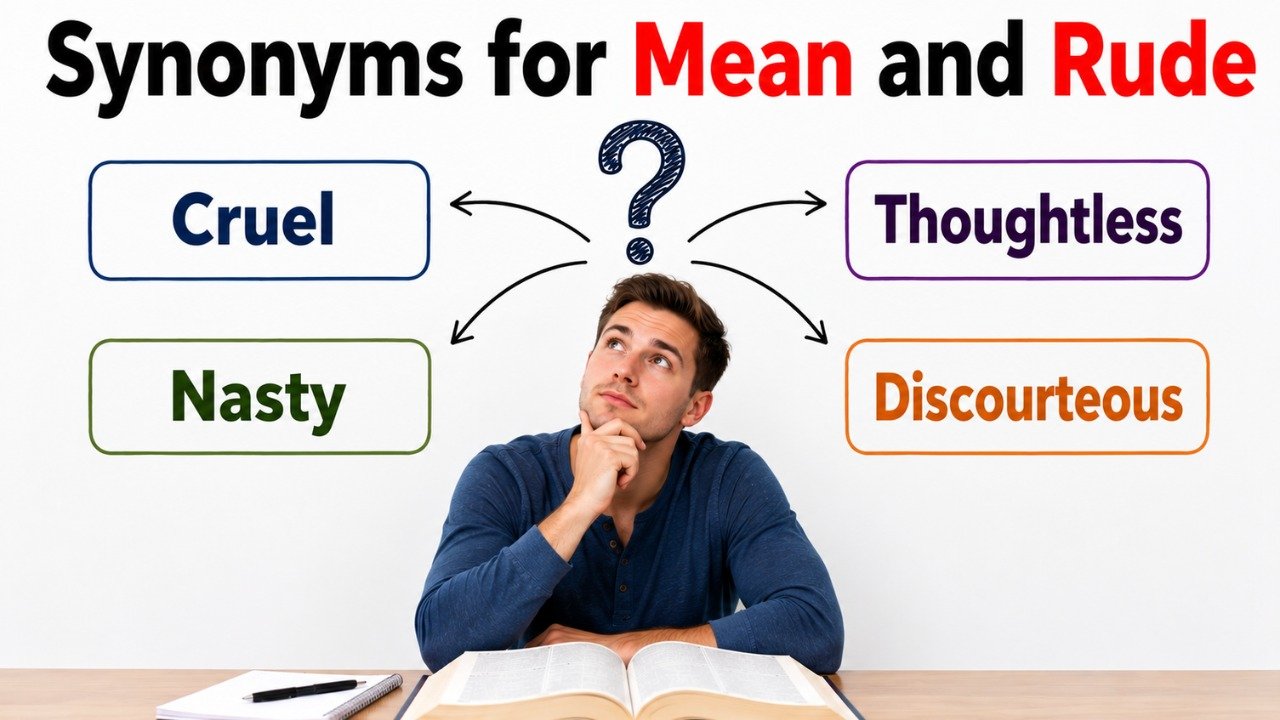
Quick Answer: The best synonyms for mean and rude include unkind, disrespectful, cruel, impolite, harsh, insulting, inconsiderate, offensive, spiteful, and abrasive. Use unkind for generally hurtful behavior, disrespectful for a lack of respect, impolite for poor manners, cruel for deliberate emotional harm, harsh for severe language, and insulting for words that attack someone. In formal writing, discourteous, contemptuous, or abusive may be more precise. In casual conversation, nasty, rude, or mean often sound more natural.
Pronunciation and Word Details
Word: Mean and rude.
Pronunciation: /miːn ænd ruːd/.
Part of Speech: Adjective phrase.
Meaning: Unkind, disrespectful, offensive, or unpleasant in words, attitude, or behavior.
US Pronunciation:
UK Pronunciation:
What Does “Mean and Rude” Mean?
Mean and rude describes behavior that is unkind, disrespectful, offensive, or lacking in consideration for other people.
Both mean and rude are adjectives, but they do not have exactly the same meaning. Mean focuses more on cruelty, unkindness, or a desire to hurt someone. Rude focuses more on disrespect, poor manners, or socially unacceptable behavior.
A person can be rude without intending to cause emotional pain. For example, interrupting someone may be rude even when it is accidental. A mean action usually causes hurt and may be intentional.
The phrase mean and rude combines both ideas. It describes someone who behaves without kindness and without respect.
Person Context: A mean and rude person may insult, mock, ignore, embarrass, or mistreat others.
Speech Context: Mean and rude language may include insults, cruel jokes, harsh criticism, or disrespectful comments.
Behavior Context: Mean and rude behavior may involve interrupting, excluding, humiliating, shouting, or refusing to consider another person’s feelings.
Tone Context: A mean and rude tone can sound hostile, mocking, impatient, dismissive, or condescending.
Social Context: The phrase is often used when someone breaks social expectations while also causing emotional harm.
Meaning, Tone, and Context of “Mean and Rude”
Mean and rude is a strongly negative and emotional phrase. It expresses disapproval of someone’s words, attitude, or behavior.
The phrase is common in everyday conversation, personal writing, informal complaints, stories, and discussions about relationships. It can also appear in workplace, educational, or family situations when describing disrespectful conduct.
Conversational Tone: Mean and rude sounds natural in ordinary speech and informal writing.
Emotional Tone: The phrase often communicates hurt, anger, disappointment, or frustration.
Critical Tone: It directly judges someone’s behavior as unacceptable.
Informal Tone: In essays, reports, or professional communication, a more precise word may be better.
Formal Context: Use disrespectful, discourteous, abusive, contemptuous, or inappropriate when describing behavior in formal documents.
Social Context: Rude often refers to broken rules of politeness, such as interrupting, staring, or ignoring a greeting.
Emotional Context: Mean usually refers to behavior that causes emotional pain, such as mocking someone’s appearance or deliberately excluding them.
Professional Context: In a workplace report, describe the exact behavior instead of simply calling someone mean and rude.
Strong Context: Cruel, abusive, malicious, and bullying are stronger than mean and rude. Use them only when the situation truly involves serious harm.
When and How to Use “Mean and Rude”
Use mean and rude when someone’s behavior is both unkind and disrespectful. The phrase is most useful in casual communication, personal descriptions, and discussions of social behavior.
For Hurtful Comments
Use the phrase when someone says something intended to embarrass, insult, or upset another person.
Example: His comments about her appearance were mean and rude.
For Disrespectful Behavior
Use it when someone ignores basic standards of respect or politeness.
Example: Talking over every speaker was mean and rude.
For Personal Attacks
Use it when criticism targets a person rather than addressing an action or idea.
Example: Calling him useless was mean and rude.
For Deliberate Exclusion
Use it when someone purposely leaves another person out to make that person feel unwelcome.
Example: Refusing to invite her while discussing the event in front of her was mean and rude.
For Mocking or Teasing
Use it when humor is designed to humiliate rather than entertain.
Example: Their joke about his accent was mean and rude.
For Hostile Communication
Use it when a speaker uses an aggressive, impatient, or contemptuous tone.
Example: Her response to the simple question was mean and rude.
For Poor Manners
Use it when someone behaves impolitely and shows little concern for others.
Example: Leaving without thanking the host seemed mean and rude.
For Online or Written Messages
Use it when a message contains unnecessary insults or personal attacks.
Example: The anonymous message was mean and rude.
For Repeated Mistreatment
Use it when unkind and disrespectful behavior becomes a pattern.
Example: His repeated attempts to embarrass new students were mean and rude.
Best Synonyms for Mean and Rude
Unkind: Lacking kindness, sympathy, or concern for another person.
Example: Her unkind comment made him feel unwelcome.
Disrespectful: Showing little respect for another person, rule, position, or boundary.
Example: Interrupting the speaker repeatedly was disrespectful.
Cruel: Intentionally causing emotional or physical pain.
Example: It was cruel to make fun of his private struggle.
Impolite: Failing to follow accepted standards of good manners.
Example: Leaving without acknowledging the host was impolite.
Harsh: Severe, critical, or unpleasant in language or treatment.
Example: The manager’s harsh response discouraged the entire team.
Insulting: Expressing disrespect through offensive or hurtful language.
Example: Her insulting remark ended the conversation.
Inconsiderate: Failing to think about another person’s needs, comfort, or feelings.
Example: Playing loud music throughout the night was inconsiderate.
Offensive: Causing anger, hurt, or strong disapproval.
Example: The audience found the comment offensive.
Spiteful: Intended to hurt, annoy, or upset someone because of anger or resentment.
Example: He made a spiteful remark after losing the argument.
Abrasive: Unpleasantly direct, rough, or unfriendly in manner.
Example: Her abrasive communication style made cooperation difficult.
50 Synonyms for Mean and Rude with Short Meanings
- Unkind: Lacking kindness or sympathy.
- Cruel: Intentionally causing pain or distress.
- Harsh: Severe or unpleasant in speech or treatment.
- Nasty: Very unpleasant, unkind, or offensive.
- Disrespectful: Showing a lack of respect.
- Impolite: Not following accepted standards of manners.
- Insulting: Expressing disrespect through hurtful words.
- Offensive: Likely to cause anger, hurt, or disgust.
- Discourteous: Lacking politeness or consideration.
- Inconsiderate: Ignoring the needs or feelings of others.
- Thoughtless: Acting without considering the effect on others.
- Tactless: Saying something without sensitivity or care.
- Blunt: Speaking directly without softening the message.
- Abrasive: Rough, unfriendly, or unpleasant in manner.
- Hostile: Openly unfriendly or aggressive.
- Spiteful: Intending to hurt someone because of resentment.
- Malicious: Deliberately intending to cause harm.
- Contemptuous: Showing that someone is considered unworthy of respect.
- Scornful: Expressing strong disrespect or mockery.
- Dismissive: Treating someone’s thoughts or feelings as unimportant.
- Arrogant: Acting as though one is better than others.
- Condescending: Speaking as though another person is less intelligent.
- Patronizing: Appearing kind while actually showing superiority.
- Insolent: Boldly and offensively disrespectful.
- Impertinent: Improperly disrespectful or overly familiar.
- Uncivil: Not polite, respectful, or socially considerate.
- Boorish: Rough and socially insensitive.
- Churlish: Rude, unfriendly, and difficult to deal with.
- Ill mannered: Behaving without good social manners.
- Bad mannered: Regularly behaving in an impolite way.
- Callous: Emotionally insensitive to another person’s pain.
- Cold: Lacking warmth, sympathy, or friendliness.
- Heartless: Showing no compassion for another person’s suffering.
- Insensitive: Failing to understand or respect feelings.
- Sarcastic: Using sharp humor to mock or criticize.
- Mocking: Making fun of someone in a hurtful way.
- Derisive: Showing ridicule or contempt.
- Abusive: Using harmful, insulting, or threatening language or behavior.
- Belligerent: Aggressive and eager to argue or fight.
- Aggressive: Forceful, hostile, or threatening in manner.
- Intimidating: Making someone feel afraid, nervous, or powerless.
- Bullying: Repeatedly using power to frighten or harm someone.
- Snappish: Speaking in a sharply impatient way.
- Curt: Rudely brief in speech.
- Brusque: Abrupt and unfriendly in manner.
- Crude: Lacking politeness, sensitivity, or refinement.
- Vulgar: Offensive, socially unacceptable, or lacking good taste.
- Obnoxious: Extremely unpleasant, offensive, or annoying.
- Antagonistic: Openly opposing or showing hostility.
- Unpleasant: Not friendly, enjoyable, or considerate.
Read Also:
Synonyms for Truly

Synonyms for Mean and Rude by Context
When Mean and Rude Means Unkind
Use unkind, cruel, heartless, callous, insensitive, or thoughtless when someone ignores or hurts another person’s feelings.
Unkind is the broadest and most neutral option. Cruel is stronger because it suggests serious or deliberate pain. Thoughtless may describe accidental hurt, while heartless suggests a complete lack of compassion.
Example With Mean and Rude: It was mean and rude to laugh when she became upset.
Example With Unkind: It was unkind to laugh when she became upset.
Example With Cruel: It was cruel to laugh when she became upset.
When Mean and Rude Means Disrespectful
Use disrespectful, insolent, impertinent, contemptuous, dismissive, or uncivil when someone shows little respect.
Disrespectful works in most situations. Insolent is stronger and often describes open defiance. Contemptuous suggests that someone believes another person is unworthy.
Example With Mean and Rude: His response to the teacher was mean and rude.
Example With Disrespectful: His response to the teacher was disrespectful.
Example With Insolent: His response to the teacher was insolent.
When Mean and Rude Means Impolite
Use impolite, discourteous, ill mannered, boorish, churlish, or uncivil when the main issue is poor manners.
Impolite is common and neutral. Discourteous sounds more formal. Boorish describes rough social behavior, while churlish suggests rude unwillingness to cooperate.
Example With Mean and Rude: Leaving without thanking anyone was mean and rude.
Example With Impolite: Leaving without thanking anyone was impolite.
Example With Discourteous: Leaving without thanking anyone was discourteous.
When Mean and Rude Means Hurtful in Speech
Use insulting, offensive, harsh, sarcastic, mocking, derisive, or abusive when the behavior involves language.
Insulting describes direct attacks. Offensive describes language that causes strong discomfort or anger. Sarcastic and mocking may involve humor, while abusive is appropriate for severe or repeated verbal harm.
Example With Mean and Rude: His comments during the meeting were mean and rude.
Example With Insulting: His comments during the meeting were insulting.
Example With Abusive: His repeated comments during the meeting were abusive.
When Mean and Rude Means Arrogant
Use arrogant, condescending, patronizing, contemptuous, or dismissive when someone acts superior.
Arrogant describes excessive pride. Condescending describes speech that treats others as less intelligent. Patronizing can sound falsely helpful while expressing superiority.
Example With Mean and Rude: Her explanation sounded mean and rude.
Example With Condescending: Her explanation sounded condescending.
Example With Patronizing: Her explanation sounded patronizing.
When Mean and Rude Means Hostile
Use hostile, antagonistic, belligerent, aggressive, abrasive, or intimidating when someone behaves in a confrontational way.
Hostile is a broad word for open unfriendliness. Belligerent suggests a desire to argue or fight. Intimidating focuses on how the behavior makes others feel.
Example With Mean and Rude: His attitude became mean and rude after the disagreement.
Example With Hostile: His attitude became hostile after the disagreement.
Example With Belligerent: His attitude became belligerent after the disagreement.
When Mean and Rude Means Spiteful
Use spiteful, malicious, nasty, cruel, or antagonistic when someone deliberately tries to hurt another person because of anger or resentment.
Spiteful often describes small but intentional acts of revenge. Malicious is stronger and suggests a serious desire to cause harm.
Example With Mean and Rude: She shared the secret to be mean and rude.
Example With Spiteful: She shared the secret to be spiteful.
Example With Malicious: She shared the secret with malicious intent.
When Mean and Rude Means Socially Unpleasant
Use obnoxious, abrasive, unpleasant, crude, vulgar, boorish, or churlish when describing an unpleasant personality or manner.
Obnoxious is strong and conversational. Abrasive describes a rough communication style. Crude and vulgar often refer to offensive language or behavior.
Example With Mean and Rude: The guest was mean and rude throughout dinner.
Example With Obnoxious: The guest was obnoxious throughout dinner.
Example With Boorish: The guest behaved in a boorish manner throughout dinner.
Another Word for Mean and Rude
Disrespectful is one of the best general replacements for mean and rude because it describes behavior that lacks respect and may also cause emotional harm.
However, the best alternative depends on the exact situation. Use unkind when the main issue is a lack of kindness. Use impolite when the problem involves poor manners. Use cruel when the action deliberately causes pain. Use insulting when hurtful words are involved.
Original: He was mean and rude to the new employee.
Better Option: He was disrespectful to the new employee.
Original: Her joke was mean and rude.
Better Option: Her joke was cruel and insulting.
Original: It was mean and rude to ignore the host.
Better Option: It was impolite to ignore the host.
Original: His reply sounded mean and rude.
Better Option: His reply sounded harsh and dismissive.
When Not to Use “Mean and Rude”
Mean and rude is useful in casual speech, but it may be too broad, emotional, repetitive, or informal in some situations.
When You Need to Describe Exact Behavior
The phrase does not explain what the person actually said or did.
Weak: The employee was mean and rude.
Better: The employee repeatedly interrupted colleagues and insulted their ideas.
When Writing a Formal Report
Mean and rude may sound too personal or subjective in professional documents.
Weak: The customer was mean and rude to the staff.
Better: The customer used insulting language and refused to follow staff instructions.
When the Behavior Was Only Impolite
Calling someone mean may unfairly suggest intentional cruelty.
Weak: He was mean and rude because he forgot to say thank you.
Better: He was impolite because he forgot to say thank you.
When the Person Did Not Intend Harm
Thoughtless or tactless may be more accurate when the hurt was accidental.
Weak: Her question was mean and rude.
Better: Her question was tactless and made him uncomfortable.
When the Behavior Was Seriously Harmful
Mean and rude may sound too mild for repeated threats, humiliation, or intimidation.
Weak: The repeated threats were mean and rude.
Better: The repeated threats were abusive and intimidating.
When Describing Direct Communication
Being direct is not automatically rude. Blunt may be more accurate when the speaker lacks tact but does not intend harm.
Weak: His honest answer was mean and rude.
Better: His honest answer was blunt and insensitive.
When the Phrase Becomes Repetitive
Repeating mean and rude can weaken the writing.
Weak: She made a mean and rude comment in a mean and rude tone.
Better: She made an insulting comment in a contemptuous tone.
When Discussing Different Types of Conduct
Mean and rude combines two ideas that may need to be separated.
Weak: His behavior was mean and rude.
Better: His joke was cruel, and his interruption was disrespectful.
Words Commonly Confused With Mean and Rude
Mean vs Rude: Mean describes unkindness or an intention to hurt. Rude describes poor manners or a lack of respect.
Mean vs Cruel: Mean can describe mild or serious unkindness. Cruel is stronger and suggests deliberate or severe suffering.
Rude vs Impolite: Both refer to poor manners. Rude is stronger and often carries more emotional criticism, while impolite can describe a simple social mistake.
Rude vs Disrespectful: Rude refers to impolite behavior. Disrespectful focuses on failing to show proper respect for a person, position, rule, or boundary.
Blunt vs Rude: Blunt means very direct. A blunt statement may sound rude, but it is not always intended to offend.
Tactless vs Mean: Tactless behavior shows poor judgment or sensitivity. Mean behavior more often involves unkindness or a desire to hurt.
Sarcastic vs Rude: Sarcasm uses sharp or ironic language. It can be funny, critical, or rude depending on the situation.
Assertive vs Aggressive: Assertive communication clearly expresses needs while respecting others. Aggressive communication pressures, threatens, or disrespects them.
Confident vs Arrogant: Confidence is a healthy belief in one’s ability. Arrogance involves acting superior to others.
Critical vs Insulting: Constructive criticism addresses an action or result. An insult attacks the person.
Mean as Unkind vs Mean as Average: Mean can describe unkind behavior, but it can also refer to a mathematical average. Context determines the intended meaning.
Mean as Unkind vs Mean as Intend: Mean can also mean to intend something, as in “I mean to help.” That meaning is unrelated to rudeness.
Which Synonym Should You Choose?
Choose unkind when you need a broad and clear word for behavior that lacks kindness.
Choose disrespectful when someone fails to respect another person, position, rule, or boundary.
Choose impolite when the problem involves poor manners, such as interrupting or failing to greet someone.
Choose cruel when someone intentionally causes serious emotional or physical pain.
Choose harsh when language, criticism, treatment, or conditions are severe.
Choose insulting when someone uses words that attack another person’s dignity.
Choose offensive when a comment, joke, image, or action causes strong anger or discomfort.
Choose inconsiderate when someone ignores how an action affects other people.
Choose tactless when a person says something insensitive without necessarily intending harm.
Choose blunt when someone communicates too directly without softening the message.
Choose abrasive when a person has a consistently rough or unpleasant communication style.
Choose spiteful when the behavior is motivated by resentment or a desire for revenge.
Choose malicious when someone deliberately intends to cause serious harm.
Choose contemptuous when someone openly treats another person as unworthy of respect.
Choose condescending when someone speaks as though the listener is less intelligent.
Choose patronizing when someone appears helpful but communicates superiority.
Choose hostile when the behavior is openly unfriendly or aggressive.
Choose abusive when the language or treatment is severe, harmful, threatening, or repeated.
Choose discourteous in formal writing about a lack of politeness.
Choose inappropriate in reports or professional emails when you want to describe unacceptable conduct without making an emotional judgment.
Real Life Examples of “Mean and Rude” in Sentences
Original: The customer was mean and rude to the cashier.
Better Option: The customer was disrespectful and abusive toward the cashier.
Original: Her comment about his clothes was mean and rude.
Better Option: Her comment about his clothes was insulting.
Original: It was mean and rude to laugh at his mistake.
Better Option: It was cruel to laugh at his mistake.
Original: He sounded mean and rude during the meeting.
Better Option: He sounded abrasive and dismissive during the meeting.
Original: The children were mean and rude to the new student.
Better Option: The children were unkind and disrespectful to the new student.
Original: Ignoring the invitation was mean and rude.
Better Option: Ignoring the invitation was inconsiderate.
Original: Her reply to the question was mean and rude.
Better Option: Her reply to the question was curt and condescending.
Original: The joke was mean and rude.
Better Option: The joke was offensive and hurtful.
Original: He became mean and rude after receiving criticism.
Better Option: He became hostile and belligerent after receiving criticism.
Original: The message was unnecessarily mean and rude.
Better Option: The message was unnecessarily harsh and insulting.
Synonym Groups and Usage Differences
Kindness and Compassion Group
Unkind, cruel, callous, cold, heartless, insensitive, and thoughtless describe a lack of kindness or concern.
Unkind is broad and works in most situations. Cruel suggests intentional pain. Callous and heartless emphasize a lack of compassion. Thoughtless may describe harm caused without careful consideration.
Example: Her thoughtless remark embarrassed him in front of the group.
Manners and Courtesy Group
Impolite, discourteous, uncivil, ill mannered, bad mannered, boorish, and churlish describe poor social behavior.
Impolite is the most common choice. Discourteous sounds more formal. Boorish suggests rough social behavior, while churlish describes someone who is rude and unwilling to cooperate.
Example: Refusing to acknowledge the host was discourteous.
Disrespect Group
Disrespectful, insolent, impertinent, contemptuous, scornful, and dismissive describe behavior that denies another person proper respect.
Disrespectful is broad. Insolent describes bold disrespect, often toward authority. Contemptuous and scornful express strong feelings of superiority or disgust.
Example: His dismissive response made her feel that her concerns did not matter.
Hurtful Speech Group
Insulting, offensive, harsh, sarcastic, mocking, derisive, crude, and vulgar describe language that causes hurt or discomfort.
Insulting directly attacks someone. Mocking and derisive involve ridicule. Crude and vulgar describe language that breaks standards of politeness or good taste.
Example: The speaker made a mocking comment about the student’s answer.
Superiority Group
Arrogant, condescending, patronizing, contemptuous, and dismissive describe people who act as though they are better or more intelligent than others.
Arrogant focuses on excessive pride. Condescending and patronizing describe superior ways of speaking. Dismissive involves treating another person’s ideas as unimportant.
Example: Her patronizing explanation annoyed the experienced employees.
Hostility Group
Hostile, belligerent, aggressive, antagonistic, abrasive, and intimidating describe openly unfriendly or confrontational behavior.
Hostile is general. Belligerent suggests eagerness to argue. Aggressive can involve pressure or threats. Intimidating focuses on creating fear.
Example: His belligerent response turned a small disagreement into a serious argument.
Deliberate Harm Group
Spiteful, malicious, cruel, abusive, and bullying describe behavior intended to cause pain, fear, or humiliation.
Spiteful behavior often comes from resentment. Malicious behavior involves a deliberate wish to harm. Bullying usually involves repeated mistreatment and an imbalance of power.
Example: Sharing the private message was a spiteful attempt to embarrass her.
Directness Group
Blunt, curt, brusque, snappish, and tactless describe communication that lacks warmth or sensitivity.
Blunt may still be honest and useful. Curt means rudely brief. Brusque suggests an abrupt manner. Snappish describes sharp impatience. Tactless describes a failure to communicate sensitively.
Example: His curt reply made the visitor feel unwelcome.
General Unpleasantness Group
Nasty, obnoxious, unpleasant, abrasive, crude, and churlish describe behavior that is broadly difficult or offensive.
Nasty is common and strongly negative. Obnoxious describes extremely annoying conduct. Abrasive often refers to a consistently rough personality.
Example: His obnoxious behavior disturbed everyone at the gathering.
Antonyms of Mean and Rude
The opposite of mean and rude may involve kindness, respect, politeness, compassion, or friendliness.
Kind: Caring and willing to help others.
Polite: Showing good manners and social consideration.
Respectful: Treating people, rules, and boundaries with proper regard.
Courteous: Consistently polite and considerate.
Compassionate: Showing concern for another person’s suffering.
Thoughtful: Carefully considering the needs and feelings of others.
Considerate: Avoiding actions that may inconvenience or hurt people.
Tactful: Communicating difficult ideas with sensitivity.
Friendly: Warm, pleasant, and welcoming.
Gentle: Calm and careful in words or actions.
Civil: Polite and respectful, even during disagreement.
Gracious: Kind, courteous, and pleasant toward others.
Supportive: Providing help, encouragement, or understanding.
Patient: Remaining calm when facing difficulty or delay.
Humble: Not acting superior to other people.
Sincere: Honest and genuine in words and behavior.
Warm: Showing affection, friendliness, or enthusiasm.
Empathetic: Understanding and sharing another person’s feelings.
Diplomatic: Handling sensitive situations carefully and respectfully.
Well mannered: Behaving according to accepted standards of politeness.
Comparison Between “Mean and Rude” and Related Words
Mean and Rude vs Unkind
Mean and rude combines hurtful behavior with disrespect. Unkind focuses mainly on the absence of kindness.
Example With Mean and Rude: Her public insult was mean and rude.
Example With Unkind: Her refusal to offer support was unkind.
Mean and Rude vs Disrespectful
Mean and rude is emotional and conversational. Disrespectful is more precise when someone fails to respect another person or boundary.
Example With Mean and Rude: His comments about the teacher were mean and rude.
Example With Disrespectful: His comments about the teacher were disrespectful.
Mean and Rude vs Impolite
Mean and rude suggests both emotional harm and poor manners. Impolite usually describes a failure to follow social rules.
Example With Mean and Rude: She mocked the host’s cooking.
Example With Impolite: She left without thanking the host.
Mean and Rude vs Cruel
Mean and rude may describe mild or serious behavior. Cruel is stronger and suggests deliberate suffering.
Example With Mean and Rude: He made an unnecessary comment about her mistake.
Example With Cruel: He repeatedly used her painful experience to humiliate her.
Mean and Rude vs Harsh
Mean and rude describes an attitude or behavior. Harsh often describes severe language, criticism, treatment, or conditions.
Example With Mean and Rude: He insulted the employee personally.
Example With Harsh: He delivered harsh criticism of the employee’s performance.
Mean and Rude vs Blunt
Blunt communication is direct and may lack tact. It is not always intended to hurt. Mean and rude behavior is more clearly unkind or disrespectful.
Example With Mean and Rude: She called his idea worthless.
Example With Blunt: She said the idea was unlikely to succeed.
Mean and Rude vs Tactless
Tactless describes insensitive communication, often without deliberate cruelty. Mean and rude can suggest intentional hurt.
Example With Mean and Rude: He mocked her after learning about the problem.
Example With Tactless: He asked about the problem in front of everyone.
Mean and Rude vs Offensive
Mean and rude describes the person or behavior. Offensive describes something that causes strong anger, hurt, or discomfort.
Example With Mean and Rude: The speaker was mean and rude to the audience.
Example With Offensive: The speaker made an offensive remark.
Mean and Rude vs Abusive
Mean and rude can refer to ordinary unkindness or poor manners. Abusive is much stronger and describes harmful, threatening, controlling, or repeated mistreatment.
Example With Mean and Rude: He spoke impatiently to his colleague.
Example With Abusive: He repeatedly threatened and humiliated his colleague.
Mean and Rude vs Assertive
Mean and rude behavior ignores another person’s dignity. Assertive communication clearly expresses needs while remaining respectful.
Example With Mean and Rude: Stop talking because your opinion is useless.
Example With Assertive: I disagree and would like an opportunity to explain my concern.
Common Phrases and Expressions With Mean and Rude
Mean Comment: A statement intended to hurt or embarrass someone.
Rude Remark: An impolite or disrespectful statement.
Mean Words: Language that causes emotional pain.
Rude Tone: A voice or writing style that sounds disrespectful.
Mean Joke: Humor that targets or humiliates someone.
Rude Response: An impolite or hostile reply.
Mean Behavior: Conduct that lacks kindness or causes hurt.
Rude Gesture: A movement or sign that communicates disrespect.
Mean Person: Someone who regularly treats others unkindly.
Rude Manner: An unfriendly or discourteous way of behaving.
Common Mistakes to Avoid
Treating Mean and Rude as Identical
Mean and rude overlap, but they describe different qualities. Mean concerns unkindness, while rude concerns disrespect or poor manners.
A person may accidentally behave rudely without intending to be mean. A person may also act meanly through quiet exclusion without breaking an obvious rule of manners.
Using the Phrase Without Evidence
Calling someone mean and rude is a judgment. In formal writing, describe the exact behavior.
Instead of saying a colleague was mean and rude, explain that the colleague interrupted others, used insulting language, or ignored a stated boundary.
Choosing a Word That Is Too Strong
Cruel, malicious, abusive, and bullying describe more serious conduct than ordinary impoliteness.
Do not call a forgotten greeting abusive. Do not call repeated threats merely impolite.
Choosing a Word That Is Too Weak
Mean and rude may understate severe behavior involving threats, intimidation, repeated humiliation, or control.
Use abusive, intimidating, malicious, or bullying when those terms accurately describe the conduct.
Confusing Bluntness With Rudeness
Blunt speech is direct and may lack tact. It is not automatically disrespectful.
Consider the speaker’s intention, wording, tone, and the effect on the listener.
Confusing Assertiveness With Aggression
Assertive communication protects personal boundaries while respecting other people. Aggressive communication pressures, threatens, or attacks them.
Clear disagreement is not rude when it is expressed respectfully.
Overusing General Synonyms
Words such as nasty, bad, and unpleasant are broad. They may not tell the reader whether the behavior was cruel, insulting, dismissive, or impolite.
Choose the word that identifies the exact problem.
Repeating the Same Sentence Pattern
Repeatedly writing “He was rude” or “She was mean” makes the paragraph monotonous.
Vary the wording by identifying the action, tone, effect, or motivation.
Using Mean in the Wrong Sense
Mean can describe unkindness, intention, significance, or a mathematical average.
Make sure the sentence provides enough context to show which meaning is intended.
Using Unnatural Combinations
Not every synonym combines naturally with every noun.
A comment may be insulting, offensive, harsh, or tactless. A person may be arrogant, disrespectful, or spiteful. A tone may be dismissive, abrasive, or condescending.
Conclusion
The most accurate synonyms for mean and rude depend on the type and seriousness of the behavior. Use unkind for a lack of kindness, disrespectful for poor treatment, impolite for bad manners, insulting for hurtful words, and cruel for deliberate pain. Harsh suits severe language, while condescending describes a superior tone. Spiteful and malicious are stronger choices for intentional harm. Selecting a precise alternative makes your writing clearer and helps readers understand whether the problem involves manners, hostility, arrogance, or cruelty.
FAQs About Synonyms for Mean and Rude
What Is the Best Synonym for Mean and Rude?
Disrespectful is a strong general synonym. Unkind, impolite, cruel, insulting, and offensive may be more accurate in specific situations.
What Is a Polite Way to Say Someone Is Mean and Rude?
You can describe the person as unkind, discourteous, inconsiderate, or disrespectful. In professional writing, describe the exact behavior rather than judging the person.
What Is a Formal Synonym for Mean and Rude?
Discourteous, disrespectful, contemptuous, abusive, and uncivil are useful formal alternatives. The correct choice depends on the seriousness and type of behavior.
What Is the Difference Between Mean and Rude?
Mean describes unkind or hurtful behavior. Rude describes disrespectful behavior or poor manners. A person can be rude accidentally, while mean behavior more often suggests emotional harm.
What Is a Stronger Word Than Mean and Rude?
Cruel, malicious, abusive, spiteful, and bullying are stronger words. Use them only when the behavior involves deliberate, serious, or repeated harm.
What Word Describes a Rude Tone?
A rude tone may be described as abrasive, condescending, dismissive, hostile, curt, brusque, or snappish.
Is Blunt the Same as Mean and Rude?
No. Blunt means very direct and lacking softness. A blunt person may sound rude, but direct communication is not necessarily unkind or disrespectful.
