
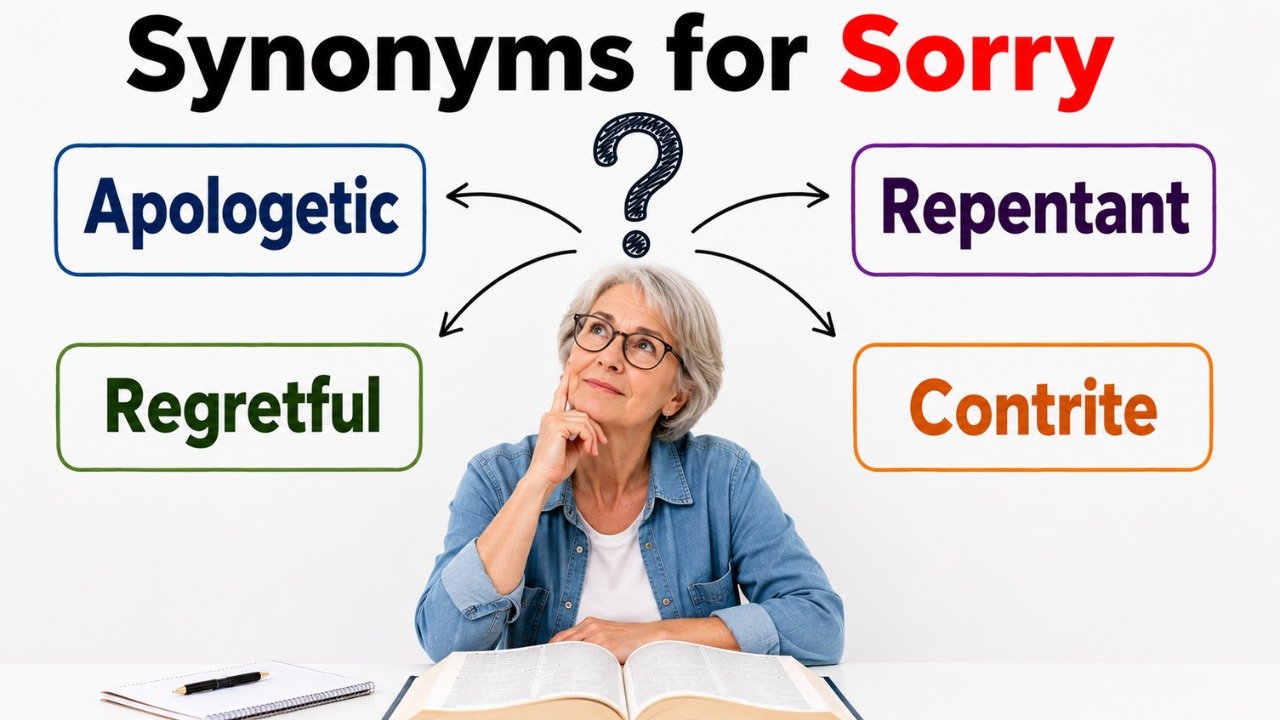
Quick Answer: The best synonyms for sorry include apologetic, regretful, remorseful, contrite, repentant, ashamed, sympathetic, saddened, unfortunate, and regrettable. Apologetic is the best general choice when someone accepts that they made a mistake. Remorseful and contrite suit serious wrongdoing, while regretful expresses disappointment about a decision or outcome. Sympathetic and saddened are better when responding to another person’s pain. Unfortunate and regrettable describe unpleasant situations, while inadequate or unsatisfactory may replace sorry when it means poor in quality.
Pronunciation and Word Details
Word: Sorry.
Pronunciation: /ˈsɑːri/ or /ˈsɒri/.
Part of Speech: Adjective and interjection.
Meaning: Feeling regret, expressing an apology, showing sympathy, or describing something disappointing or poor.
US Pronunciation:
UK Pronunciation:
What Does “Sorry” Mean?
Sorry means feeling regret about a mistake, expressing sympathy for someone, or describing something unfortunate or unsatisfactory.
Sorry is mainly an adjective, but it also functions like an interjection in everyday communication. People commonly use it to apologize, acknowledge a mistake, express sadness, ask someone to repeat something, or politely interrupt.
When sorry expresses personal regret, it means apologetic or remorseful.
Example: I am sorry that I forgot your appointment.
When it expresses sympathy, it means saddened or concerned about another person’s difficulty.
Example: I am sorry to hear about your loss.
Sorry can also describe an unpleasant or unfortunate situation.
Example: It was a sorry ending to an otherwise successful project.
In some contexts, sorry means poor, weak, disappointing, or deserving pity.
Example: The damaged room was in a sorry condition.
The exact meaning depends on whether the speaker is apologizing, expressing regret, showing sympathy, asking for clarification, or criticizing a disappointing condition.
Meaning, Tone, and Context of “Sorry”
Sorry is usually polite, emotional, and conversational. Its tone can range from casual regret to deep remorse.
The word is common in speech, personal messages, workplace communication, formal apologies, expressions of sympathy, and polite requests. However, the strength of sorry depends heavily on the surrounding words and situation.
Casual Tone: Sorry can acknowledge a small mistake or interruption.
Example: Sorry, I did not see you standing there.
Polite Tone: It can soften a request, correction, interruption, or disagreement.
Example: Sorry, could you repeat the last sentence?
Emotional Tone: Sorry can communicate sadness, guilt, concern, or compassion.
Example: I am deeply sorry for the pain my decision caused.
Formal Tone: In professional writing, I apologize or I regret may sound more precise and responsible.
Example: I apologize for the delay in completing the report.
Sympathetic Tone: Sorry often expresses care when another person experiences difficulty or loss.
Example: I am sorry that you are going through such a difficult time.
Critical Tone: When sorry describes a condition, performance, or excuse, it can mean poor, weak, or unacceptable.
Example: That was a sorry excuse for ignoring the instructions.
Sorry is not an academic or technical term, but it may appear in essays, reports, and formal communication when discussing apology, regret, remorse, sympathy, or responsibility.
When and How to Use “Sorry”
For a Minor Mistake
Use sorry when acknowledging a small accident, oversight, or misunderstanding.
Example: Sorry, I sent the message to the wrong person.
For a Serious Apology
Use sorry with clear responsibility and an explanation when the mistake caused real harm.
Example: I am sincerely sorry for sharing information that should have remained private.
For Personal Regret
Sorry can express regret about something that happened, even when the speaker was not entirely responsible.
Example: I am sorry that I did not accept the opportunity when it was available.
For Expressing Sympathy
Use sorry when acknowledging another person’s sadness, loss, disappointment, or difficulty.
Example: I am sorry to hear that your plans had to be cancelled.
For Offering Condolences
Sorry can express sympathy after a death or serious loss, although a more personal message is often better.
Example: I am deeply sorry for your loss and am thinking of your family.
For Interrupting Politely
Use sorry before interrupting or requesting someone’s attention.
Example: Sorry, may I ask a quick question?
For Asking Someone to Repeat Something
Sorry can function as a polite request for repetition.
Example: Sorry, what time did you say the meeting begins?
For Correcting Yourself
Use sorry when immediately correcting a mistake in speech.
Example: The event is on Thursday, sorry, I meant Friday.
For Declining a Request
Sorry can soften a refusal, especially in conversation.
Example: I am sorry, but I cannot attend the workshop.
For Describing Poor Quality
Use sorry before a noun when something is disappointing, weak, or inadequate.
Example: The unfinished report was a sorry piece of work.
Best Synonyms for Sorry
Apologetic
Synonym: Apologetic means showing that you are sorry for a mistake or offence.
Example: He sounded apologetic after realizing that he had interrupted the discussion.
Regretful
Synonym: Regretful means feeling sad or disappointed about an action, decision, or event.
Example: She was regretful about rejecting the earlier offer.
Remorseful
Synonym: Remorseful means feeling deep guilt and sorrow for causing harm.
Example: He appeared genuinely remorseful after learning how his actions had affected others.
Contrite
Synonym: Contrite means sincerely ashamed and deeply sorry for wrongdoing.
Example: The employee gave a contrite apology for ignoring the safety instructions.
Repentant
Synonym: Repentant means feeling sorry for wrongdoing and wanting to change.
Example: She was repentant and promised not to repeat the mistake.
Ashamed
Synonym: Ashamed means feeling guilt, embarrassment, or distress about something wrong.
Example: He felt ashamed of the way he had spoken to his colleague.
Sympathetic
Synonym: Sympathetic means showing care and understanding for another person’s suffering.
Example: Her sympathetic response helped him feel less alone.
Saddened
Synonym: Saddened means made unhappy by another person’s pain or an unfortunate event.
Example: We were saddened to hear that the community event had been cancelled.
Unfortunate
Synonym: Unfortunate means unpleasant, regrettable, or unlucky.
Example: The misunderstanding was unfortunate, but it was quickly resolved.
Regrettable
Synonym: Regrettable means causing disappointment, concern, or regret.
Example: The failure to communicate the change was regrettable.
50 Synonyms for Sorry with Short Meanings
- Apologetic: Showing regret for a mistake or offence.
- Regretful: Feeling disappointed about an action or outcome.
- Remorseful: Feeling deep guilt for causing harm.
- Contrite: Sincerely ashamed and sorry for wrongdoing.
- Repentant: Regretting wrongdoing and wanting to improve.
- Penitent: Feeling sorrow and seeking forgiveness.
- Ashamed: Feeling guilt or embarrassment about an action.
- Rueful: Showing regret in a slightly sad or thoughtful way.
- Guilty: Feeling responsible for doing something wrong.
- Sorrowful: Feeling or expressing deep sadness.
- Saddened: Made unhappy by an event or situation.
- Distressed: Deeply upset or worried.
- Troubled: Concerned, worried, or emotionally affected.
- Grieved: Deeply saddened by pain or loss.
- Heartbroken: Experiencing extreme emotional sadness.
- Sympathetic: Showing concern for another person’s difficulty.
- Compassionate: Feeling and expressing care for suffering.
- Concerned: Worried about someone or something.
- Empathetic: Understanding another person’s feelings.
- Understanding: Patient and aware of another person’s situation.
- Unfortunate: Unpleasant, unlucky, or disappointing.
- Regrettable: Causing sadness, concern, or disappointment.
- Lamentable: Deserving regret or criticism.
- Deplorable: Shockingly poor or deserving strong disapproval.
- Pitiful: Deserving pity or showing serious weakness.
- Pitiable: Deserving sympathy because of suffering or weakness.
- Pathetic: Extremely poor, weak, or deserving pity.
- Miserable: Very unhappy, uncomfortable, or unpleasant.
- Wretched: Extremely unhappy, poor, or unpleasant.
- Poor: Below an acceptable standard.
- Inadequate: Not good or sufficient enough.
- Unsatisfactory: Failing to meet expectations or requirements.
- Disappointing: Not as good as expected.
- Inferior: Lower in quality or value.
- Unacceptable: Not suitable or good enough to approve.
- My Apologies: A polite expression of regret.
- I Apologize: A direct and formal acceptance of fault.
- Forgive Me: A request to be pardoned for a mistake.
- Pardon Me: A polite apology or request for repetition.
- Excuse Me: A polite phrase for interruption or minor inconvenience.
- Please Forgive Me: A sincere request for forgiveness.
- I Regret That: A formal expression of sadness or disappointment.
- I Beg Your Pardon: A formal apology or request for clarification.
- My Fault: An admission that the speaker caused the problem.
- My Mistake: A direct acknowledgment of an error.
- My Bad: A very casual admission of a minor mistake.
- I Take Responsibility: A clear acceptance of personal fault.
- I Feel Terrible: An emotional expression of guilt or regret.
- I Did Not Mean To: An explanation that the harm was unintentional.
- I Should Have Known Better: An admission that the mistake could have been avoided.
Read Also:
Synonyms for Mean And Rude
Synonyms for Sorry by Context
When Sorry Means Apologetic
When sorry acknowledges a mistake, apologetic is the closest adjective. In direct communication, I apologize, my apologies, and please forgive me are often more effective.
Apologetic describes the person’s attitude, while I apologize performs the act of apologizing.
Example With Sorry: I am sorry for sending the incorrect document.
Example With I Apologize: I apologize for sending the incorrect document.
Example With Apologetic: She sounded apologetic when she explained the error.
When Sorry Means Deeply Remorseful
Use remorseful, contrite, repentant, or penitent when the mistake is serious and the speaker feels deep guilt.
Remorseful focuses on painful guilt. Contrite suggests sincere humility. Repentant also suggests a desire to change.
Example With Sorry: He was deeply sorry for betraying their trust.
Example With Remorseful: He was deeply remorseful for betraying their trust.
Example With Contrite: He offered a contrite apology and accepted responsibility.
When Sorry Means Regretful
Use regretful when someone feels disappointed about a decision, missed opportunity, or result.
Unlike remorseful, regretful does not always mean that someone committed a moral wrong.
Example With Sorry: She was sorry that she had declined the invitation.
Example With Regretful: She was regretful that she had declined the invitation.
When Sorry Expresses Sympathy
When responding to another person’s pain, sympathetic, saddened, concerned, compassionate, or empathetic may be more precise.
These words show care without suggesting that the speaker caused the problem.
Example With Sorry: I am sorry that you are facing such a difficult situation.
Example With Sympathetic: I am sympathetic to the difficulties you are facing.
Example With Saddened: I was saddened to hear about your recent loss.
When Sorry Means Unfortunate
When sorry describes an unpleasant event rather than a personal apology, unfortunate or regrettable is usually better.
Example With Sorry: It was a sorry misunderstanding that damaged their relationship.
Example With Unfortunate: It was an unfortunate misunderstanding that damaged their relationship.
Example With Regrettable: The lack of communication was regrettable.
When Sorry Means Poor or Unsatisfactory
When sorry criticizes quality, use poor, inadequate, unsatisfactory, disappointing, inferior, or unacceptable.
Example With Sorry: The equipment was in a sorry condition.
Example With Poor: The equipment was in poor condition.
Example With Unsatisfactory: The equipment was in an unsatisfactory condition.
When Sorry Is Used for a Polite Interruption
Use excuse me when asking for attention or moving past someone. Use pardon me when apologizing formally or asking someone to repeat a statement.
Example With Sorry: Sorry, may I pass through?
Example With Excuse Me: Excuse me, may I pass through?
Example With Pardon Me: Pardon me, could you repeat the final number?
When Sorry Softens a Refusal
Sorry often makes a refusal sound more polite. Regrettably or unfortunately may sound more formal.
Example With Sorry: I am sorry, but I cannot approve the request.
Example With Regrettably: Regrettably, I cannot approve the request.
Example With Unfortunately: Unfortunately, the request cannot be approved.
Another Word for Sorry
Apologetic is the best single adjective for sorry when someone regrets a mistake. However, I apologize is usually the strongest direct replacement in a complete apology.
The best alternative depends on whether you are accepting fault, expressing sympathy, describing regret, asking for repetition, or criticizing poor quality.
Original: I am sorry for missing the deadline.
Better Option: I apologize for missing the deadline.
Original: She felt sorry about the decision she had made.
Better Option: She felt regretful about the decision she had made.
Original: I am sorry to hear about your difficult experience.
Better Option: I am deeply saddened to hear about your difficult experience.
Original: The building was in a sorry condition.
Better Option: The building was in poor condition.
When Not to Use “Sorry”
Sorry is useful, but it may sound weak, unclear, repetitive, or inappropriate when a more precise expression is needed.
When Accepting Serious Responsibility
A single sorry may sound insufficient after a serious mistake. State what happened and accept responsibility.
Weak: Sorry about everything.
Better: I apologize for sharing the confidential information. I take full responsibility for my decision.
When Writing a Formal Apology
I apologize or I regret is often more professional than sorry in formal correspondence.
Weak: Sorry for the delay in replying.
Better: I apologize for the delay in replying.
When You Did Not Cause the Problem
Sorry may accidentally sound like an admission of responsibility. Use saddened, concerned, or sympathetic when you are expressing care.
Weak: I am sorry that the storm damaged your home.
Better: I was deeply saddened to hear that the storm damaged your home.
When Expressing Condolences
A short sorry can feel incomplete after a serious loss. Add warmth and personal support.
Weak: Sorry for your loss.
Better: I am deeply sorry for your loss. Your family is in my thoughts during this difficult time.
When Asking for Repetition Formally
Pardon me or could you repeat that may be clearer in a formal setting.
Weak: Sorry?
Better: Pardon me, could you repeat the final point?
When Describing Poor Quality
Use an exact adjective instead of sorry.
Weak: The report was in a sorry state.
Better: The report was incomplete and poorly organized.
When Sorry Becomes Repetitive
Repeating sorry can make an apology sound automatic or insincere.
Weak: I am sorry I was late, sorry I missed the call, and sorry I caused confusion.
Better: I apologize for arriving late and missing the call. I understand that this caused unnecessary confusion.
When You Need to Show Action
A strong apology should include correction, not only regret.
Weak: I am sorry that the order was incorrect.
Better: I apologize for the incorrect order. I have arranged for the correct items to be sent.
Words Commonly Confused With Sorry
Sorry vs Apologetic: Sorry describes regret or sympathy. Apologetic specifically describes a person, expression, or tone that shows regret for a mistake.
Sorry vs Regretful: Sorry can communicate apology, sympathy, or poor quality. Regretful focuses on disappointment about a decision, action, or outcome.
Sorry vs Remorseful: Sorry can describe mild or serious regret. Remorseful expresses deep guilt about causing harm.
Sorry vs Contrite: Sorry is broad and common. Contrite is more formal and suggests sincere shame, humility, and repentance.
Sorry vs Ashamed: Sorry focuses on regret for an action or situation. Ashamed describes painful embarrassment or guilt about behavior, failure, or identity.
Sorry vs Sympathetic: Sorry may express sympathy, but sympathetic more clearly shows concern for another person without suggesting personal responsibility.
Sorry vs Excuse Me: Sorry commonly apologizes for a mistake. Excuse me is often used to interrupt, attract attention, pass someone, or acknowledge a minor inconvenience.
Sorry vs Pardon Me: Sorry is conversational and broad. Pardon me is more formal and is often used after a minor offence or when asking someone to repeat something.
Sorry vs Unfortunately: Sorry expresses personal emotion or regret. Unfortunately introduces an unpleasant fact or outcome.
Sorry vs Regrettable: Sorry may describe a feeling. Regrettable describes an event, action, or condition that deserves regret.
Which Synonym Should You Choose?
Choose apologetic when describing a person, voice, expression, or message that shows regret.
Choose I apologize for a clear and professional apology.
Choose my apologies for a polite but slightly less personal acknowledgment of a mistake.
Choose regretful when discussing disappointment about a past decision or missed opportunity.
Choose remorseful when the person feels deep guilt for causing serious harm.
Choose contrite when writing formally about sincere shame and humility.
Choose repentant when the person regrets wrongdoing and intends to change.
Choose ashamed when embarrassment and guilt are central to the emotion.
Choose sympathetic when expressing understanding of another person’s pain.
Choose saddened when responding emotionally to unfortunate news.
Choose compassionate when the response includes warmth, concern, and a desire to help.
Choose unfortunate when describing an unpleasant event without assigning blame.
Choose regrettable when formally criticizing a decision, failure, or outcome.
Choose excuse me for polite interruptions, passing someone, or attracting attention.
Choose pardon me when asking for repetition or apologizing in a formal manner.
Choose poor, inadequate, or unsatisfactory when sorry describes low quality.
Choose my bad only for very minor mistakes in relaxed conversation.
Choose I take responsibility when accountability is more important than emotion.
For Formal Writing: Apologetic, regretful, remorseful, contrite, regrettable, and unfortunate work well.
For Casual Speech: Sorry, my mistake, my fault, and my bad are natural choices.
For Professional Emails: I apologize, my apologies, and I regret are clear and respectful.
For Serious Wrongdoing: Remorseful, contrite, repentant, and deeply apologetic show stronger regret.
For Sympathy: Saddened, sympathetic, compassionate, concerned, and empathetic are suitable.
For Minor Interruptions: Excuse me, pardon me, and sorry are polite options.
For Essays: Regretful, remorseful, apologetic, unfortunate, and regrettable provide useful precision.
For Poor Quality: Poor, inadequate, unsatisfactory, disappointing, and unacceptable are clearer.
Real Life Examples of “Sorry” in Sentences
Original: I am sorry that I arrived late.
Better Option: I apologize for arriving late.
Original: She was sorry about rejecting the opportunity.
Better Option: She was regretful about rejecting the opportunity.
Original: He was truly sorry for the pain he had caused.
Better Option: He was deeply remorseful for the pain he had caused.
Original: I am sorry to hear that your application was unsuccessful.
Better Option: I am saddened to hear that your application was unsuccessful.
Original: She looked sorry after speaking so harshly.
Better Option: She looked apologetic after speaking so harshly.
Original: It was a sorry result after months of preparation.
Better Option: It was a disappointing result after months of preparation.
Original: The house was in a sorry condition.
Better Option: The house was in poor condition.
Original: Sorry, could you say your name again?
Better Option: Pardon me, could you say your name again?
Original: I am sorry, but I cannot attend the meeting.
Better Option: Unfortunately, I cannot attend the meeting.
Original: He said sorry and promised to correct the mistake.
Better Option: He accepted responsibility and promised to correct the mistake.
Synonym Groups and Usage Differences
Apology Group
This group includes apologetic, my apologies, I apologize, forgive me, pardon me, excuse me, and please forgive me.
I apologize is direct and professional. My apologies is polite and slightly formal. Forgive me is more personal and emotional. Excuse me works best for minor interruptions.
Example: I apologize for providing the incorrect information.
Regret Group
This group includes regretful, rueful, sorrowful, ashamed, guilty, and I regret that.
Regretful describes disappointment about an action or outcome. Rueful often combines regret with thoughtful embarrassment. Ashamed and guilty focus more strongly on personal responsibility.
Example: She felt regretful after declining the invitation.
Remorse Group
This group includes remorseful, contrite, repentant, and penitent.
These words express stronger moral regret than sorry. Remorseful focuses on painful guilt. Contrite emphasizes humility. Repentant and penitent suggest a desire for forgiveness and change.
Example: He was remorseful after realizing how deeply his words had hurt her.
Sympathy Group
This group includes sympathetic, compassionate, empathetic, concerned, understanding, and saddened.
Sympathetic expresses care for someone’s difficulty. Compassionate suggests deeper concern and a desire to help. Empathetic emphasizes understanding the person’s feelings.
Example: Her compassionate response made the difficult conversation easier.
Sadness Group
This group includes sorrowful, distressed, troubled, grieved, heartbroken, and miserable.
These words describe different levels of sadness. Troubled suggests worry, while grieved and heartbroken communicate much deeper emotional pain.
Example: The entire group was saddened by the unexpected announcement.
Unfortunate Event Group
This group includes unfortunate, regrettable, lamentable, and deplorable.
Unfortunate is neutral and common. Regrettable sounds formal. Lamentable expresses strong disappointment. Deplorable adds moral criticism or serious disapproval.
Example: The failure to warn residents was regrettable.
Poor Quality Group
This group includes poor, inadequate, unsatisfactory, disappointing, inferior, and unacceptable.
Poor is broad and neutral. Inadequate means insufficient. Unsatisfactory means that expectations were not met. Unacceptable communicates stronger disapproval.
Example: The final explanation was inadequate and lacked supporting detail.
Responsibility Group
This group includes my fault, my mistake, I take responsibility, I should have known better, and I did not mean to.
My fault directly accepts blame. My mistake acknowledges error. I take responsibility sounds serious and professional. I did not mean to explains intention but should not replace accountability.
Example: This was my mistake, and I will correct it immediately.
Antonyms of Sorry
The opposite of sorry depends on whether sorry refers to regret, sympathy, sadness, or poor quality.
Unapologetic: Not sorry or ashamed about an action.
Remorseless: Showing no guilt or regret.
Unrepentant: Unwilling to admit wrongdoing or change.
Shameless: Showing no embarrassment about improper behavior.
Proud: Feeling satisfaction rather than shame or regret.
Glad: Feeling pleased rather than sorry or saddened.
Delighted: Feeling very happy about an event or result.
Pleased: Feeling satisfied or happy.
Indifferent: Showing no concern or sympathy.
Unsympathetic: Unwilling to understand another person’s suffering.
Compassionless: Showing no care for another person’s pain.
Fortunate: Having a positive or lucky outcome.
Favorable: Producing a good or helpful result.
Excellent: Extremely good in quality.
Satisfactory: Meeting expectations or requirements.
Acceptable: Good enough to be approved.
Impressive: Deserving admiration because of high quality.
Successful: Achieving the intended result.
Comparison: Sorry vs Related Words
Sorry vs Apologetic
Sorry describes regret, sympathy, or poor quality. Apologetic specifically describes someone who shows regret for a mistake.
Example With Sorry: I am sorry that I interrupted you.
Example With Apologetic: He gave an apologetic smile after interrupting the speaker.
Sorry vs Regretful
Sorry is broad and may express apology or sympathy. Regretful focuses on disappointment about a past choice or result.
Example With Sorry: She was sorry that she could not attend.
Example With Regretful: She was regretful that she had rejected the invitation.
Sorry vs Remorseful
Sorry may refer to a minor mistake. Remorseful expresses deep guilt about serious harm.
Example With Sorry: He was sorry for forgetting the appointment.
Example With Remorseful: He was remorseful for betraying his friend’s confidence.
Sorry vs Contrite
Sorry is common and conversational. Contrite is formal and suggests sincere shame and humility.
Example With Sorry: She said she was sorry for the rude comment.
Example With Contrite: She offered a contrite apology for the rude comment.
Sorry vs Ashamed
Sorry focuses on regret about an action or situation. Ashamed describes personal embarrassment, guilt, or humiliation.
Example With Sorry: I am sorry that I spoke without thinking.
Example With Ashamed: I am ashamed of the disrespectful way I spoke.
Sorry vs Sympathetic
Sorry can express sympathy in a complete statement. Sympathetic directly describes care and understanding.
Example With Sorry: I am sorry that you are facing this difficulty.
Example With Sympathetic: Her manager was sympathetic to her difficult circumstances.
Sorry vs Unfortunately
Sorry expresses a personal feeling. Unfortunately introduces an unpleasant fact or outcome.
Example With Sorry: I am sorry that the event has been cancelled.
Example With Unfortunately: Unfortunately, the event has been cancelled.
Sorry vs Regrettable
Sorry can describe a person’s emotional state. Regrettable describes an action or event that deserves regret.
Example With Sorry: The manager was sorry about the misunderstanding.
Example With Regrettable: The misunderstanding was regrettable.
Sorry vs Excuse Me
Sorry normally acknowledges a mistake. Excuse me is commonly used to interrupt, attract attention, or move past someone.
Example With Sorry: Sorry, I stepped on your foot.
Example With Excuse Me: Excuse me, may I get past you?
Sorry vs Pardon Me
Sorry is more common and conversational. Pardon me sounds more formal and is often used when asking for repetition.
Example With Sorry: Sorry, what did you say?
Example With Pardon Me: Pardon me, could you repeat the question?
Common Phrases and Expressions With “Sorry”
I Am Sorry: A direct expression of regret or sympathy.
I Am So Sorry: A stronger and more emotional apology.
Truly Sorry: Genuinely regretful about an action or situation.
Deeply Sorry: Experiencing serious regret, sadness, or sympathy.
Terribly Sorry: Very apologetic or regretful.
Sorry for Your Loss: An expression of sympathy after a death.
Sorry to Hear That: A response showing sympathy about unfortunate news.
Sorry About That: A casual apology for a minor mistake or problem.
Sorry to Bother You: A polite phrase used before making a request.
Sorry to Interrupt: A polite acknowledgment before interrupting someone.
Better Safe Than Sorry: It is wiser to take precautions than risk regret later.
A Sorry State: A very poor, damaged, or disappointing condition.
Common Mistakes to Avoid
Using Sorry Without Accepting Responsibility
A vague apology may sound insincere when the speaker caused the problem.
Weak: Sorry if you were upset.
Better: I apologize for speaking disrespectfully. My words were inappropriate.
Saying Sorry Too Often
Frequent apologies for ordinary actions can make communication sound uncertain.
Weak: Sorry, can I ask a question? Sorry, I need clarification.
Better: Could I ask a question? I need clarification about the final requirement.
Using Sorry Instead of Thank You
In some situations, gratitude creates a more positive message than unnecessary apology.
Weak: Sorry for taking so much of your time.
Better: Thank you for taking the time to help me.
Giving an Excuse Instead of an Apology
An explanation should not remove personal responsibility.
Weak: Sorry, but I was busy and forgot.
Better: I apologize for forgetting. I should have recorded the deadline properly.
Using Sorry for Sympathy Without Warmth
A short phrase may sound impersonal when someone is experiencing serious pain.
Weak: Sorry to hear that.
Better: I am deeply sorry that you are going through this. Please know that I am here to support you.
Confusing Regret With Remorse
Regret may concern an unfortunate choice. Remorse involves serious guilt for wrongdoing.
Incorrect: She was remorseful that she missed the discount.
Better: She was regretful that she missed the discount.
Using Formal Words in Casual Situations
Contrite and penitent can sound excessive for small everyday mistakes.
Unnatural: I am deeply contrite for taking your chair.
Better: I am sorry for taking your chair.
Using My Bad in Formal Communication
My bad is casual and should not appear in professional apologies.
Weak: My bad for missing the deadline.
Better: I apologize for missing the deadline.
Describing Quality Vaguely
When sorry means poor, explain what is wrong.
Vague: The final submission was sorry.
Better: The final submission was incomplete and poorly organized.
Apologizing Without Offering a Solution
A useful apology should explain what will happen next.
Weak: Sorry for the incorrect information.
Better: I apologize for the incorrect information. I have attached the corrected version.
Conclusion
The best synonyms for sorry depend on the speaker’s purpose. Apologetic and I apologize suit general apologies, while remorseful and contrite express serious guilt. Regretful describes disappointment about a decision, and sympathetic or saddened communicates concern for another person. Unfortunate and regrettable describe unpleasant events, while poor and inadequate refer to disappointing quality. Understanding these different meanings helps you choose language that sounds sincere, precise, and appropriate for formal writing, personal messages, professional communication, and everyday conversation.
FAQs About Synonyms for Sorry
What Is the Best Synonym for Sorry?
Apologetic is the best general adjective when sorry means regretting a mistake. I apologize is often the clearest phrase for a direct apology.
What Is a Formal Synonym for Sorry?
Apologetic, regretful, remorseful, contrite, and repentant are formal alternatives. I apologize and I regret are useful in professional communication.
What Is a Stronger Word Than Sorry?
Remorseful, contrite, and deeply regretful are stronger when someone feels serious guilt for causing harm.
What Can I Say Instead of Sorry for Your Loss?
You can say I am deeply saddened by your loss, please accept my sincere condolences, or I am thinking of you during this difficult time.
Is Regretful the Same as Sorry?
Regretful is similar, but it mainly describes disappointment about an action, choice, or outcome. Sorry has broader meanings, including apology and sympathy.
What Is Another Word for Sorry in a Professional Email?
I apologize, my apologies, I regret, and regrettably are suitable choices, depending on whether you are accepting responsibility or communicating an unfortunate outcome.
What Is the Opposite of Sorry?
Common opposites include unapologetic, remorseless, unrepentant, glad, pleased, indifferent, fortunate, satisfactory, and excellent.
