
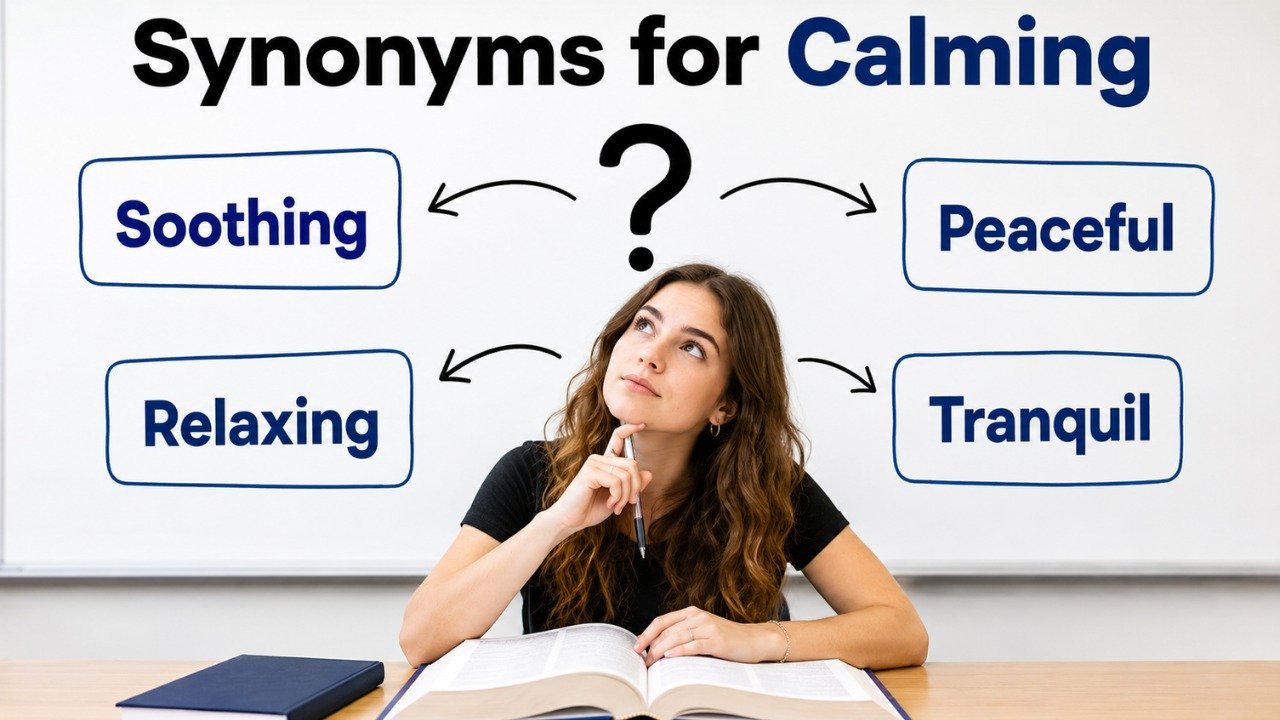
Quick Answer: The best synonyms for calming include soothing, relaxing, peaceful, tranquil, reassuring, comforting, settling, quieting, gentle, and serene. Use soothing for something that reduces discomfort, relaxing for something that releases physical or mental tension, and reassuring for words or actions that reduce fear. Tranquil and serene work well for peaceful places, while comforting is best for emotional support. Settling, pacifying, and deescalating are useful when describing the reduction of conflict, excitement, or nervousness.
Pronunciation and Word Details
Word: Calming.
Pronunciation: /ˈkɑː.mɪŋ/
Part of Speech: Adjective, present participle, and gerund.
Meaning: Making someone or something feel less worried, excited, tense, or disturbed.
US Pronunciation:
UK Pronunciation:
What Does “Calming” Mean?
Calming means making a person, situation, feeling, or environment more peaceful and less tense.
The word is often used as an adjective to describe something that creates a sense of comfort or relaxation. A calming voice, for example, may help someone feel safer or less nervous.
Calming can also be the present participle of the verb calm. In this form, it describes the action of reducing fear, anger, excitement, or movement.
Adjective Use: The room had a calming atmosphere.
Verb Form: She is calming the frightened child.
Gerund Use: Calming an upset customer requires patience.
The exact meaning depends on the sentence. Calming may describe emotional reassurance, physical relaxation, peaceful surroundings, conflict reduction, or mental balance.
Meaning, Tone, and Context of “Calming”
Calming usually has a positive, gentle, and reassuring tone. It suggests that stress, fear, excitement, or tension is becoming weaker.
The word is neutral enough for both formal and casual communication. It appears naturally in conversations, essays, reports, descriptions, instructions, and professional messages.
Emotional Context: Calming can describe words, people, or actions that reduce worry or fear.
Physical Context: It can describe activities or sensations that help the body release tension.
Environmental Context: It often describes peaceful colors, sounds, rooms, gardens, or natural scenes.
Conflict Context: Calming may refer to actions that reduce anger, disagreement, or panic.
Formal Context: Words such as stabilizing, deescalating, restorative, and reassuring may be more precise in professional writing.
Conversational Context: Soothing, relaxing, comforting, and peaceful are common in everyday speech.
Calming is not normally a strong or dramatic word. It communicates a gradual movement toward peace, control, comfort, or emotional steadiness.
When and How to Use “Calming”
For Emotional Comfort
Use calming when something reduces fear, sadness, nervousness, or emotional distress.
Example: Her calming words helped him feel less worried about the interview.
For Physical Relaxation
Use calming for an activity, sensation, or environment that helps the body release tension.
Example: A warm bath can have a calming effect after a demanding day.
For a Peaceful Atmosphere
Use calming to describe places, colors, sounds, or surroundings that feel quiet and comfortable.
Example: The soft lighting created a calming atmosphere in the room.
For Reducing Conflict
Use calming when a person or action lowers anger, panic, or disagreement.
Example: The manager used a calming tone during the difficult discussion.
For Mental Focus
Use calming for something that helps thoughts feel more controlled and less scattered.
Example: Slow breathing was a calming practice before the presentation.
For Reassurance
Use calming when information or support makes a person feel safer or more confident.
Example: The clear explanation was calming for everyone involved.
Best Synonyms for Calming
Soothing
Synonym: Soothing means reducing pain, worry, irritation, or emotional discomfort.
Example: Her soothing voice helped the child fall asleep.
Relaxing
Synonym: Relaxing means helping the mind or body release tension.
Example: The quiet walk was relaxing after a busy afternoon.
Peaceful
Synonym: Peaceful means free from noise, conflict, worry, or disturbance.
Example: They spent the evening in a peaceful garden.
Tranquil
Synonym: Tranquil means pleasantly quiet, still, and undisturbed.
Example: The lake looked tranquil in the early morning.
Reassuring
Synonym: Reassuring means reducing fear or doubt by giving confidence.
Example: The teacher gave the students a reassuring smile.
Comforting
Synonym: Comforting means making someone feel emotionally supported and less distressed.
Example: His comforting words helped her through the difficult moment.
Settling
Synonym: Settling means helping excitement, discomfort, or nervousness decrease.
Example: The familiar routine had a settling effect on the children.
Quieting
Synonym: Quieting means reducing noise, movement, worry, or emotional activity.
Example: The gentle music had a quieting influence on the room.
Gentle
Synonym: Gentle means soft, mild, and unlikely to cause distress.
Example: She used a gentle tone when explaining the mistake.
Serene
Synonym: Serene means calm, clear, and free from disturbance.
Example: The painting showed a serene coastal landscape.
50 Synonyms for Calming with Short Meanings
- Soothing: Reducing pain, irritation, worry, or tension.
- Relaxing: Helping the mind or body release stress.
- Peaceful: Free from disturbance, conflict, or anxiety.
- Tranquil: Quiet, still, and pleasantly undisturbed.
- Reassuring: Making someone feel safer or more confident.
- Comforting: Providing emotional relief or support.
- Settling: Reducing excitement, nervousness, or discomfort.
- Quieting: Making thoughts, sounds, or emotions less active.
- Gentle: Soft, mild, and emotionally considerate.
- Serene: Calm, peaceful, and clear.
- Restful: Helping someone recover energy and feel relaxed.
- Placid: Calm and not easily disturbed.
- Mellow: Pleasantly soft, relaxed, and easygoing.
- Pacifying: Reducing anger, conflict, or resistance.
- Appeasing: Making someone less angry or dissatisfied.
- Consoling: Offering comfort during sadness or disappointment.
- Stabilizing: Bringing emotions or conditions under control.
- Grounding: Helping someone feel mentally steady and present.
- Centering: Restoring emotional balance and focus.
- Easing: Making discomfort, worry, or tension less severe.
- Relieving: Reducing pressure, pain, or emotional distress.
- Unwinding: Gradually becoming less tense or mentally busy.
- Restorative: Helping strength, peace, or energy return.
- Harmonious: Pleasantly balanced and free from conflict.
- Soft: Mild, quiet, and not emotionally harsh.
- Mild: Gentle in effect, manner, or intensity.
- Hushed: Very quiet and still.
- Still: Free from movement, noise, or disturbance.
- Lulling: Gently encouraging rest or reduced alertness.
- Sedative: Producing physical or mental quietness.
- Meditative: Encouraging deep thought, awareness, or inner peace.
- Mindful: Focused calmly on the present moment.
- Steadying: Helping emotions or actions become controlled.
- Balancing: Restoring a stable emotional or mental condition.
- Moderating: Making an intense reaction less extreme.
- Tempering: Reducing the strength of anger or excitement.
- Subduing: Making feelings, noise, or activity less intense.
- Cooling: Reducing emotional heat, anger, or conflict.
- Deescalating: Preventing tension or conflict from becoming worse.
- Conciliatory: Intended to restore peace or cooperation.
- Consolatory: Providing comfort after loss or disappointment.
- Supportive: Giving emotional strength, encouragement, or security.
- Nurturing: Creating a safe, caring, and supportive feeling.
- Tender: Gentle, caring, and sensitive.
- Unhurried: Slow, relaxed, and free from pressure.
- Stress relieving: Helping reduce mental or physical pressure.
- Tension easing: Making nervousness or strain less intense.
- Nerve soothing: Helping reduce nervousness or emotional discomfort.
- Calm inducing: Producing a peaceful or controlled state.
- Peace giving: Creating comfort, quietness, or emotional harmony.
Read Also:
Synonyms for Girl

Synonyms for Calming by Context
When Calming Means Reducing Emotional Distress
Soothing, comforting, consoling, reassuring, and supportive are useful when someone feels afraid, worried, sad, or uncertain.
Soothing Example: Her soothing words reduced his anxiety.
Comforting Example: The familiar voice was comforting during the emergency.
Consoling Example: His consoling message helped her handle the disappointment.
Reassuring Example: The doctor gave a reassuring explanation of the next steps.
When Calming Means Creating a Peaceful Atmosphere
Peaceful, tranquil, serene, restful, placid, and harmonious describe places or surroundings that feel quiet and undisturbed.
Peaceful Example: The peaceful room was ideal for reading.
Tranquil Example: They enjoyed the tranquil view from the window.
Serene Example: The garden looked serene after the rain.
Restful Example: The simple decoration gave the bedroom a restful feeling.
When Calming Means Reducing Conflict
Pacifying, appeasing, moderating, tempering, conciliatory, cooling, and deescalating are useful when anger or disagreement needs to be controlled.
Pacifying Example: His pacifying response prevented another argument.
Appeasing Example: The offer was intended to be appeasing.
Conciliatory Example: She made a conciliatory statement during the meeting.
Deescalating Example: The officer used a deescalating approach.
When Calming Means Restoring Mental Balance
Grounding, centering, stabilizing, balancing, mindful, and meditative describe actions that support emotional control and clear thinking.
Grounding Example: Focusing on her surroundings was grounding.
Centering Example: A few quiet moments felt centering before the speech.
Stabilizing Example: The routine provided a stabilizing influence.
Mindful Example: Mindful breathing helped him remain focused.
When Calming Means Releasing Physical Tension
Relaxing, easing, relieving, unwinding, restorative, and stress relieving describe activities or experiences that help the body feel less tense.
Relaxing Example: Stretching was relaxing after the long journey.
Easing Example: The warm compress had an easing effect.
Unwinding Example: Reading helped her begin unwinding.
Restorative Example: The quiet weekend felt restorative.
Another Word for Calming
Soothing is often the best single replacement for calming because it can describe voices, words, sounds, actions, sensations, and environments. However, the best alternative always depends on what is becoming calmer.
Use relaxing for physical or mental tension, reassuring for fear or uncertainty, peaceful for an environment, and deescalating for conflict.
Original: She spoke in a calming voice.
Better Option: She spoke in a soothing voice.
Original: The room had a calming atmosphere.
Better Option: The room had a peaceful atmosphere.
Original: His explanation was calming.
Better Option: His explanation was reassuring.
Original: The activity was calming after work.
Better Option: The activity was relaxing after work.
When Not to Use “Calming”
Calming can sound vague when the sentence does not explain what kind of tension or discomfort is being reduced. A more precise synonym may make the meaning clearer.
When Describing Physical Rest
Relaxing is usually more natural when an activity helps the body release tension.
Weak: The massage was calming for my muscles.
Better: The massage was relaxing for my muscles.
When Describing Reassurance
Reassuring is more precise when words or information reduce fear or uncertainty.
Weak: The test results were calming.
Better: The test results were reassuring.
When Describing a Peaceful Place
Tranquil, serene, or peaceful may create a clearer image than calming.
Weak: It was a calming village.
Better: It was a tranquil village.
When Describing Conflict Management
Deescalating or pacifying may be more accurate when tension between people is being reduced.
Weak: She used a calming strategy during the argument.
Better: She used a deescalating strategy during the argument.
When Describing a Person’s Current State
Use calm rather than calming when the person is already peaceful.
Weak: He remained calming throughout the emergency.
Better: He remained calm throughout the emergency.
Words Commonly Confused With Calming
Calming vs Calm: Calming describes something that creates calmness, while calm describes someone or something already free from tension or disturbance.
Example: Her calming voice helped everyone remain calm.
Calming vs Soothing: Calming has a broad meaning, while soothing often suggests relief from discomfort, irritation, pain, or emotional distress.
Example: The calming room included soothing sounds.
Calming vs Relaxing: Calming reduces worry, excitement, or tension, while relaxing more directly describes the release of mental or physical strain.
Example: The breathing exercise was calming, while the warm bath was relaxing.
Calming vs Reassuring: Calming may involve any reduction in tension, while reassuring specifically reduces fear, uncertainty, or doubt.
Example: His calm manner was calming, but his clear explanation was reassuring.
Calming vs Peaceful: Calming describes an effect, while peaceful describes a condition without conflict or disturbance.
Example: The peaceful garden had a calming effect.
Calming vs Sedative: Calming is a general and gentle word, while sedative often suggests a stronger physical effect that reduces alertness or activity.
Example: The music was calming, but it was not sedative.
Calming vs Pacifying: Calming may apply to stress, surroundings, or emotions, while pacifying usually involves reducing anger, conflict, or resistance.
Example: Her voice was calming, and her compromise was pacifying.
Which Synonym Should You Choose?
Choose soothing when describing voices, words, sounds, sensations, or actions that reduce discomfort.
Choose relaxing when an activity helps the body or mind release tension.
Choose reassuring when facts, explanations, or support reduce fear and uncertainty.
Choose peaceful when describing a place without noise, worry, or conflict.
Choose tranquil when describing an especially quiet and undisturbed environment.
Choose serene when emphasizing beauty, emotional stillness, or graceful peace.
Choose comforting when someone receives emotional care during sadness or difficulty.
Choose grounding when an activity helps someone feel mentally present and stable.
Choose stabilizing in reports, formal writing, or professional discussions about returning a situation to control.
Choose deescalating when describing the reduction of conflict, hostility, anger, or risk.
Choose pacifying when someone actively reduces anger or resistance.
Choose restorative when an experience helps energy, strength, or emotional balance return.
Choose gentle in casual speech when describing a soft tone, movement, manner, or effect.
Choose conciliatory in formal writing when a statement or action is intended to restore cooperation.
Real Life Examples of “Calming” in Sentences
Original: Her calming voice helped the nervous student.
Better Option: Her reassuring voice helped the nervous student.
Original: The bedroom had a calming atmosphere.
Better Option: The bedroom had a peaceful atmosphere.
Original: Walking near the water was calming.
Better Option: Walking near the water was relaxing.
Original: He gave a calming response during the disagreement.
Better Option: He gave a conciliatory response during the disagreement.
Original: The teacher’s presence was calming for the class.
Better Option: The teacher’s presence was stabilizing for the class.
Original: She found the simple routine calming.
Better Option: She found the simple routine grounding.
Original: The soft sound had a calming effect.
Better Option: The soft sound had a soothing effect.
Original: His explanation was calming for the family.
Better Option: His explanation was reassuring for the family.
Original: The quiet break was calming after the busy meeting.
Better Option: The quiet break was restorative after the busy meeting.
Original: Her calming approach prevented the situation from becoming worse.
Better Option: Her deescalating approach prevented the situation from becoming worse.
Synonym Groups and Usage Differences
Emotional Comfort Group
Comforting, consoling, reassuring, supportive, nurturing, and tender describe emotional care.
Comforting reduces sadness or distress. Reassuring reduces fear or doubt. Consoling is especially useful after disappointment or loss.
Example: His reassuring words gave her confidence before the appointment.
Physical Relaxation Group
Relaxing, easing, relieving, unwinding, restful, and stress relieving describe the reduction of bodily or mental tension.
Relaxing is the broadest option. Restful suggests recovery, while unwinding describes a gradual release of pressure.
Example: The quiet evening helped her unwind after work.
Peaceful Atmosphere Group
Peaceful, tranquil, serene, placid, harmonious, hushed, and still describe undisturbed places or conditions.
Tranquil emphasizes quietness. Serene often suggests beautiful or graceful peace. Hushed focuses on very low sound.
Example: The library remained hushed throughout the afternoon.
Conflict Control Group
Pacifying, appeasing, conciliatory, moderating, tempering, cooling, subduing, and deescalating describe the reduction of conflict or strong reactions.
Deescalating focuses on preventing tension from increasing. Conciliatory suggests restoring cooperation. Appeasing often involves satisfying someone who is angry.
Example: The mediator used conciliatory language to restore cooperation.
Mental Balance Group
Grounding, centering, stabilizing, steadying, balancing, mindful, and meditative describe emotional control and focused awareness.
Grounding brings attention back to the present. Centering restores inner balance. Stabilizing suggests returning to a controlled condition.
Example: The familiar routine was grounding during a stressful week.
Antonyms of Calming
The opposite of calming depends on whether the word refers to emotions, physical tension, an environment, or conflict.
Agitating: Causing nervousness, anger, or emotional disturbance.
Alarming: Creating fear or concern.
Disturbing: Interrupting peace or causing discomfort.
Stressful: Producing mental or physical pressure.
Unsettling: Making someone feel uncertain or uneasy.
Irritating: Causing annoyance or discomfort.
Provoking: Producing anger or a strong reaction.
Inflaming: Making conflict, anger, or tension more intense.
Stimulating: Increasing alertness, interest, or activity.
Exciting: Creating strong enthusiasm or emotional energy.
Chaotic: Lacking control, order, or stability.
Harsh: Unpleasantly severe, rough, or intense.
Tense: Filled with nervousness, pressure, or conflict.
Disruptive: Interrupting peace, order, or normal activity.
Overwhelming: Producing more emotion or pressure than someone can easily manage.
Comparison of Calming and Related Words
Calming vs Soothing
Calming describes anything that reduces tension, worry, excitement, or disturbance. Soothing more strongly suggests relief from discomfort, irritation, sadness, or pain.
Example With Calming: Her calming manner helped the group remain focused.
Example With Soothing: Her soothing voice comforted the crying child.
Calming vs Relaxing
Calming focuses on reducing emotional or mental intensity. Relaxing focuses on releasing physical or mental tension.
Example With Calming: The explanation was calming during the emergency.
Example With Relaxing: The warm bath was relaxing after the journey.
Calming vs Reassuring
Calming has a broad meaning, while reassuring specifically removes fear, doubt, or uncertainty.
Example With Calming: His calm behavior had a calming effect.
Example With Reassuring: His promise to help was reassuring.
Calming vs Tranquil
Calming usually describes an effect. Tranquil usually describes a quiet and undisturbed condition.
Example With Calming: The garden had a calming influence on visitors.
Example With Tranquil: The garden was tranquil in the early morning.
Calming vs Comforting
Calming reduces emotional intensity, while comforting provides support during sadness, fear, or difficulty.
Example With Calming: Her slow instructions were calming.
Example With Comforting: Her kind message was comforting.
Calming vs Peaceful
Calming means producing calmness. Peaceful means already free from conflict, noise, or disturbance.
Example With Calming: The peaceful view was calming.
Example With Peaceful: The village remained peaceful throughout the weekend.
Calming vs Pacifying
Calming can refer to any reduction in stress or excitement. Pacifying more specifically refers to reducing anger, hostility, or resistance.
Example With Calming: The music was calming for the audience.
Example With Pacifying: The apology was pacifying for the angry customer.
Calming vs Sedative
Calming usually suggests a gentle emotional or mental effect. Sedative suggests a stronger reduction in physical activity or alertness.
Example With Calming: The quiet environment was calming.
Example With Sedative: The treatment had a sedative effect.
Common Phrases and Expressions With Calming
Calming Effect: A result that reduces stress, fear, excitement, or tension.
Calming Influence: A person or thing that helps others become more peaceful.
Calming Presence: A person whose behavior makes others feel secure and controlled.
Calming Voice: A soft or reassuring way of speaking.
Calming Atmosphere: An environment that feels quiet, comfortable, and peaceful.
Calming Routine: A repeated activity that supports relaxation or emotional balance.
Calming Exercise: An activity intended to reduce tension or nervousness.
Calming Technique: A method used to manage stress, fear, anger, or excitement.
Calming Color: A color that creates a soft, peaceful, or comfortable impression.
Calming Sound: A sound that helps reduce mental or emotional tension.
Common Mistakes to Avoid
Confusing Calm and Calming
Calm describes a peaceful state. Calming describes something that produces that state.
Incorrect: She remained calming during the discussion.
Correct: She remained calm during the discussion.
Repeating Calming Too Often
Using calming in every sentence can make writing sound repetitive. Replace it with a more precise synonym.
Repetitive: The calming room had calming colors and calming sounds.
Improved: The peaceful room had gentle colors and soothing sounds.
Choosing an Unnatural Synonym
Not every synonym works in every sentence. Pacifying is appropriate for anger or conflict, but it may sound unnatural when describing a bedroom.
Unnatural: The bedroom had a pacifying design.
Natural: The bedroom had a tranquil design.
Using Relaxing for Reassurance
Relaxing usually describes tension release, while reassuring describes reduced fear or uncertainty.
Less Accurate: The positive test result was relaxing.
More Accurate: The positive test result was reassuring.
Using Serene for an Action
Serene normally describes a person, expression, scene, or condition. It does not usually describe an action that creates peace.
Unnatural: She gave him a serene explanation.
Natural: She gave him a calming explanation.
Making Vague Claims
Explain what is being calmed whenever the meaning could be unclear.
Vague: The activity was calming.
Clear: The activity helped calm her nervous thoughts before the interview.
Overstating the Effect
Calming does not always mean that stress or discomfort disappears completely. It often means that the feeling becomes less intense.
Overstated: The music removed all anxiety.
Balanced: The music had a calming effect and helped reduce her nervousness.
Conclusion
The best synonyms for calming depend on what is becoming more peaceful. Soothing works well for voices, sensations, and emotional discomfort. Relaxing is best for releasing physical or mental tension, while reassuring fits information that reduces fear or doubt. Peaceful, tranquil, and serene describe quiet environments. Comforting supports someone emotionally, while grounding and centering suggest mental balance. For conflict, pacifying, conciliatory, and deescalating provide more precise choices. Understanding these differences will help you use synonyms for calming naturally and accurately.
FAQs About Synonyms for Calming
What Is the Best Synonym for Calming?
Soothing is the best general synonym because it can describe voices, actions, sounds, environments, and sensations that reduce discomfort or tension.
What Is a Stronger Word for Calming?
Tranquilizing, pacifying, stabilizing, or deescalating may sound stronger, depending on whether the context involves physical tension, emotional control, or conflict.
Is Relaxing the Same as Calming?
Not completely. Relaxing mainly refers to releasing physical or mental tension, while calming can also refer to reducing fear, anger, excitement, noise, or conflict.
What Is Another Word for a Calming Person?
A calming person may be described as reassuring, comforting, steadying, supportive, composed, or grounding.
What Word Describes a Calming Place?
Peaceful, tranquil, serene, restful, placid, and quiet can describe a calming place.
Can Calming Be Used as a Verb?
Yes. Calming can be the present participle of calm, as in “She is calming the nervous child.”
What Is the Difference Between Calm and Calming?
Calm describes a peaceful state, while calming describes something that creates or encourages that peaceful state.
