
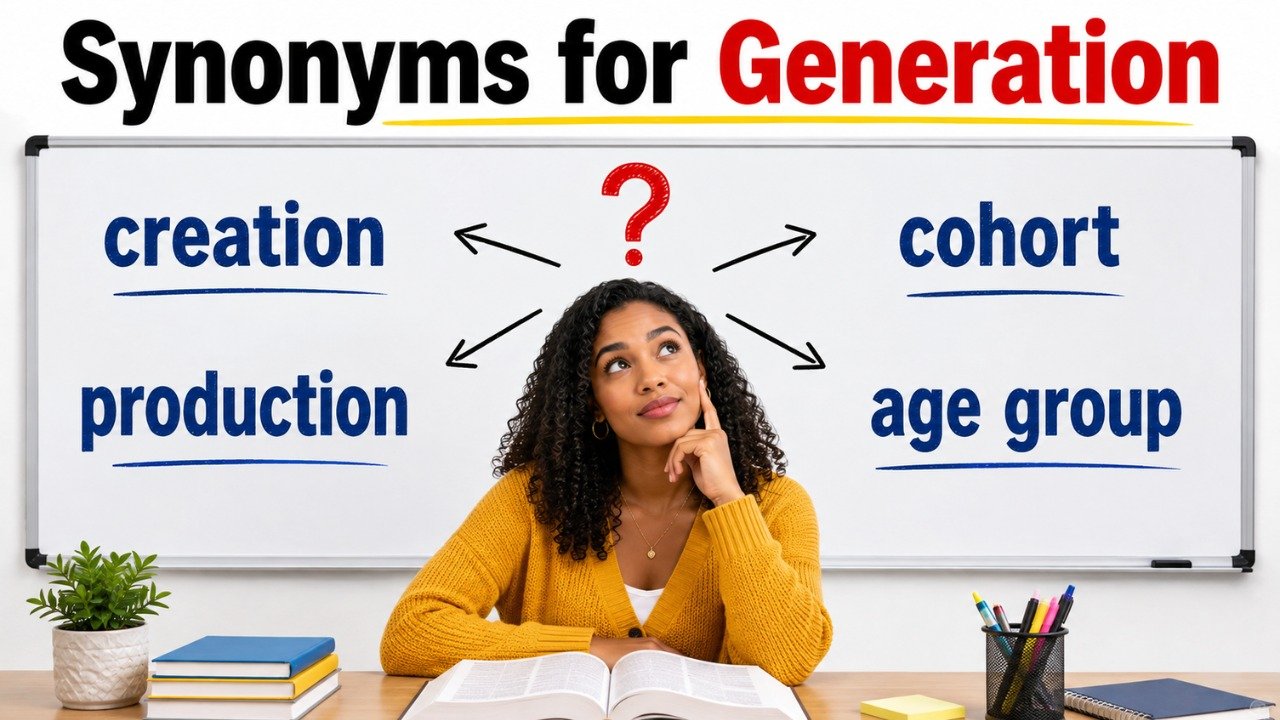
Quick Answer: The best synonyms for generation are age group, cohort, era, descendants, offspring, posterity, production, creation, version, and wave. Use age group or cohort for people born around the same period, era for a historical period, descendants or offspring for family lineage, and production or creation for the act of making something. Version is best for a stage of technology or design, while wave describes a newly arriving group, trend, or movement. These synonyms for generation should be selected according to the intended meaning.
Pronunciation and Word Details
Word: Generation.
Pronunciation: /ˌdʒenəˈreɪʃən/.
Part of Speech: Noun.
Meaning: A group of people born during a similar period, or the process of producing, creating, or developing something.
US Pronunciation:
UK Pronunciation:
What Does “Generation” Mean?
Generation means a group of people born and living during approximately the same period. It can also refer to descendants in a family, the production of something, or a particular stage in the development of a product, idea, or technology.
Generation is a noun with several closely connected meanings.
In a social context, it describes people of a similar age who share certain historical experiences.
Example: Her generation experienced major changes in education.
In a family context, it refers to one level in a line of descent.
Example: Three generations of the family lived in the same town.
In a production context, generation means the creation or production of something.
Example: The system supports the generation of detailed reports.
In a technical context, it describes a stage or version in a continuing series of development.
Example: The latest generation of the device is more efficient.
In an energy context, generation refers to the production of electricity, heat, or power.
Example: Wind contributed to electricity generation in the region.
The correct interpretation depends on whether generation refers to people, ancestry, production, development, technology, or energy.
Meaning, Tone, and Context of “Generation”
Generation has a neutral and flexible tone. It appears in casual conversation, formal reports, academic writing, historical discussions, scientific explanations, technical documents, and family descriptions.
The word is often conversational when discussing age groups or family relationships.
Example: The younger generation has different expectations about work.
It becomes more academic when used in sociology, history, culture, or population studies.
Example: Each generation responds differently to economic and cultural change.
Generation can also have a technical tone when referring to products, systems, machines, energy, or data.
Example: The new generation of equipment uses less power.
In scientific or professional writing, it may describe the production of results, signals, electricity, heat, waste, or ideas.
Example: Automatic report generation saves considerable time.
The word itself is usually neutral. However, descriptions such as older generation or younger generation can sound overly broad when they are used to make unsupported assumptions about people.
When and How to Use “Generation”
For People Born During the Same Period
Use generation to describe people who were born around the same time and may share similar social or historical experiences.
Example: That generation witnessed major changes in transportation.
For Family Lineage
Use generation to identify a level within a family line.
Example: The recipe has been passed down through four generations.
For Children and Descendants
Use generation when discussing the people who come after an earlier family or social group.
Example: The next generation will inherit the family business.
For Historical Periods
Use generation to connect a group of people with the period in which they lived.
Example: A generation of writers challenged traditional literary ideas.
For Product Development
Use generation to describe a particular stage in the development of a product, machine, or system.
Example: The second generation of the design corrected several earlier problems.
For Production
Use generation for the act of producing energy, data, income, ideas, or other results.
Example: The project focuses on renewable power generation.
For Ideas and Solutions
Use generation to describe the process of creating suggestions, plans, or possibilities.
Example: The session encouraged the generation of original ideas.
For Successive Groups
Use generation when one group follows another in a continuing sequence.
Example: A new generation of researchers is entering the field.
For Biological Reproduction
Use generation in scientific contexts for the production of offspring or the stages of biological descent.
Example: The trait appeared again in the following generation.
Best Synonyms for Generation
Age Group
Synonym: Age group means people who are within a similar range of ages.
Example: This program is designed for a younger age group.
Cohort
Synonym: Cohort means a group of people who share an age, experience, characteristic, or period of entry.
Example: The study followed a cohort of students for five years.
Era
Synonym: Era means a distinct period in history marked by particular events or qualities.
Example: That invention introduced a new era of communication.
Descendants
Synonym: Descendants are people related to someone from an earlier family generation.
Example: His descendants continued the family tradition.
Offspring
Synonym: Offspring means the children or young produced by a person, animal, or plant.
Example: The animals protect their offspring from danger.
Posterity
Synonym: Posterity means future generations of people.
Example: The documents were preserved for posterity.
Production
Synonym: Production means the process of making, creating, or supplying something.
Example: The company increased energy production during winter.
Creation
Synonym: Creation means the act or process of bringing something into existence.
Example: The workshop supported the creation of new ideas.
Version
Synonym: Version means a particular form or stage of something that has been developed or revised.
Example: The newest version includes several improvements.
Wave
Synonym: Wave means a new group, movement, trend, or series arriving in a noticeable way.
Example: A new wave of designers introduced simpler styles.
50 Synonyms for Generation with Short Meanings
- Age group: People within a similar range of ages.
- Cohort: People sharing an age, experience, or characteristic.
- Peer group: People of similar age or social position.
- Contemporaries: People living during the same period.
- Age set: A socially recognized group of similar age.
- Demographic group: A section of the population with shared features.
- Population group: A defined category within a population.
- Era: A distinct period in history.
- Age: A particular historical period.
- Period: A length of time with recognizable features.
- Epoch: A notable or important period of history.
- Time: A particular stage or period in history.
- Day: A period associated with a person or culture.
- Descendants: People who come from an earlier family line.
- Offspring: Children or young produced by a parent.
- Children: Sons, daughters, or younger descendants.
- Heirs: People who inherit property, position, or tradition.
- Successors: People or things that follow earlier ones.
- Posterity: People who will live in the future.
- Progeny: Children, descendants, or products of something.
- Lineage: A line of descent from an ancestor.
- Family line: A sequence of related family members.
- Bloodline: An ancestral line within a family.
- Descent: Family origin or succession from ancestors.
- Issue: Children or direct descendants in formal usage.
- Production: The process of making or supplying something.
- Creation: The act of bringing something into existence.
- Formation: The process of forming or developing something.
- Development: The process of growth or improvement.
- Manufacture: The process of producing goods.
- Output: The amount or result produced.
- Yield: The quantity produced by a process.
- Origination: The act of beginning or creating something.
- Fabrication: The process of constructing or producing something.
- Making: The act of creating or producing something.
- Construction: The process of building or forming something.
- Creation process: A method of producing something new.
- Idea production: The process of developing ideas.
- Power production: The creation of usable energy.
- Energy production: The process of creating energy.
- Version: A particular developed form of something.
- Model: A particular design or type in a series.
- Series: A sequence of related types or stages.
- Stage: A point in a process of development.
- Iteration: A revised or repeated form of something.
- Edition: A particular form or release of a product.
- Wave: A newly arriving group or movement.
- Crop: A group produced or appearing at one time.
- Class: A group sharing a period, level, or quality.
- Breed: A type or group with shared characteristics.
Read Also:
Synonyms for On Time

Synonyms for Generation by Context
When Generation Means an Age Group
Generation often refers to people born during a similar period. Useful alternatives include age group, cohort, peer group, contemporaries, and demographic group.
Age Group: Best for general writing about people within a certain age range.
Example: The survey compared the opinions of each age group.
Cohort: Best for formal research, education, sociology, and population studies.
Example: The first cohort completed the training program in June.
Peer Group: Best when people share a similar age and social position.
Example: Teenagers are often influenced by their peer group.
Contemporaries: Best for people who lived during the same historical period.
Example: The poet was respected by many of her contemporaries.
Demographic Group: Best when discussing a section of the population defined by age or another feature.
Example: The campaign was designed for a specific demographic group.
When Generation Means Descendants
Generation can refer to family members who come after an earlier group. Useful alternatives include descendants, offspring, progeny, heirs, successors, and posterity.
Descendants: Refers to people related through a family line.
Example: The founder’s descendants still live in the region.
Offspring: Refers to children or young, especially in biological contexts.
Example: The birds return each year with their offspring.
Progeny: A formal word for children, descendants, or products.
Example: The horse and its progeny became widely admired.
Heirs: Refers to people who inherit property, rights, or responsibilities.
Example: The estate was divided among the legal heirs.
Posterity: Refers to all future generations.
Example: The building was protected for posterity.
When Generation Means a Historical Period
Generation may describe an era shaped by common events, beliefs, or experiences. Suitable synonyms include era, age, epoch, period, and time.
Era: Describes a distinct historical period.
Example: The discovery began a new era in medicine.
Age: Describes a broad period known for certain developments or values.
Example: The invention transformed the modern age.
Epoch: Describes a major or highly significant period.
Example: The event marked the beginning of a new epoch.
Period: A general word for a particular span of time.
Example: The building was restored to reflect its original period.
Time: A natural alternative in casual or historical descriptions.
Example: People of that time faced very different challenges.
When Generation Means Production
Generation can describe the act of creating energy, income, data, ideas, or results. Useful alternatives include production, creation, formation, output, manufacture, and origination.
Production: Best for energy, goods, resources, or measurable results.
Example: Solar power production increased during the summer.
Creation: Best for ideas, content, plans, and original work.
Example: The activity encouraged the creation of practical solutions.
Formation: Best for structures, patterns, groups, or natural processes.
Example: The conditions supported cloud formation.
Output: Best for the amount or result produced by a person, machine, or system.
Example: The factory increased its daily output.
Origination: Best for the beginning or creation of something.
Example: The document explains the origination of the policy.
When Generation Means a Product Stage
Generation can describe a stage in a series of products, machines, technologies, or designs. Suitable alternatives include version, model, iteration, edition, stage, and series.
Version: Refers to a particular form that may include revisions or improvements.
Example: The current version is easier to operate.
Model: Refers to a particular design or type of product.
Example: The newer model requires less maintenance.
Iteration: Refers to a revised form created through repeated development.
Example: The third iteration solved the original design problem.
Edition: Refers to a particular release or published form.
Example: The latest edition contains updated examples.
Stage: Refers to a point in a continuing development process.
Example: The project has reached an advanced stage.
When Generation Means a New Group or Movement
Generation can describe a newly appearing group of people, creators, leaders, or ideas. Useful alternatives include wave, class, crop, breed, and group.
Wave: Describes a noticeable arrival of new people, ideas, or activity.
Example: A new wave of writers began exploring the subject.
Class: Refers to a group connected by a shared period, level, or experience.
Example: A talented class of young researchers entered the field.
Crop: Describes a group that appears or is produced at one time.
Example: This year brought a strong crop of new performers.
Breed: Describes a type of person with distinctive qualities.
Example: The program produced a new breed of skilled managers.
Another Word for Generation
The best general replacement for generation is group when the sentence refers to people. However, the most accurate synonym depends on meaning.
Use cohort for a formally studied group, descendants for a family line, production for the act of creating something, and version for a stage of product development.
Original: This generation has grown up with rapid technological change.
Better Option: This age group has grown up with rapid technological change.
Original: The study followed one generation of students.
Better Option: The study followed one cohort of students.
Original: The generation of electricity increased last month.
Better Option: The production of electricity increased last month.
Original: The newest generation of the machine is more reliable.
Better Option: The newest version of the machine is more reliable.
When Not to Use “Generation”
Generation should not be used when a more precise word would make the meaning clearer.
When Referring to an Exact Age Range
Generation may be too broad when the group has a defined age range.
Weak: The product is designed for a young generation.
Better: The product is designed for people between the ages of eighteen and twenty five.
When Discussing a Research Group
Use cohort when the group is formally selected or studied.
Weak: The researchers observed a generation of first year students.
Better: The researchers observed a cohort of first year students.
When Describing Direct Children
Generation may sound vague when children or offspring is more specific.
Weak: The animals protected the next generation.
Better: The animals protected their offspring.
When Referring to Product Updates
Use version, model, or edition if the stages are not officially described as generations.
Weak: We installed a new generation of the program.
Better: We installed a new version of the program.
When Referring to Manufacturing
Generation may be less clear than production or manufacture when discussing physical goods.
Weak: The generation of furniture takes place in this building.
Better: The production of furniture takes place in this building.
When Making Broad Assumptions
Avoid treating every member of an age group as though they share identical beliefs or behavior.
Weak: The younger generation dislikes traditional communication.
Better: Some younger adults prefer newer forms of communication.
When Repetition Reduces Clarity
Replace repeated uses with context specific terms.
Weak: One generation taught the next generation, and that generation educated another generation.
Better: One age group taught its descendants, who later educated their own children.
Words Commonly Confused With Generation
Generation vs Age Group: Generation usually refers to people born during a broad period, while age group refers to people within a specific age range.
Generation vs Cohort: Generation is a broad social group, while cohort is a defined group sharing a particular experience, starting point, or characteristic.
Generation vs Era: Generation refers primarily to people, while era refers to the historical period in which they live.
Generation vs Descendants: Generation can describe one level of a family line, while descendants refers to all people who come from a particular ancestor.
Generation vs Offspring: Generation may refer to a broad group of descendants, while offspring means the direct young or children of a parent.
Generation vs Production: Generation can mean creation, but production is usually clearer when discussing goods, energy, or measurable output.
Generation vs Creation: Generation often suggests an ongoing process that produces results, while creation emphasizes bringing something new into existence.
Generation vs Version: Generation describes a broad stage in development, while version is a specific form or revision.
Generation vs Model: Generation may contain several related models, while a model is one particular product design.
Generation vs Iteration: Generation suggests a major stage of development, while iteration is a repeated or revised attempt within a process.
Which Synonym Should You Choose?
Choose age group for general writing about people of similar ages.
Choose cohort for research, education, sociology, surveys, and formally defined groups.
Choose contemporaries for people who lived at the same time, especially in historical or biographical writing.
Choose era when the sentence focuses on a historical period rather than the people living in it.
Choose descendants when discussing people who come from an earlier ancestor.
Choose offspring for direct children or young in biological contexts.
Choose posterity when referring broadly to people who will live in the future.
Choose production for energy, goods, income, or measurable results.
Choose creation when discussing ideas, art, plans, content, or something newly made.
Choose formation for the development of structures, groups, patterns, or natural features.
Choose output for the amount produced by a system, worker, machine, or process.
Choose version for a revised form of software, writing, equipment, or design.
Choose model for a specific product design.
Choose iteration for a repeated and improved attempt during development.
Choose wave for a newly appearing group, trend, or movement.
Choose generation in general conversation when its intended meaning is already clear.
Real Life Examples of “Generation” in Sentences
Original: The younger generation uses technology confidently.
Better Option: The younger age group uses technology confidently.
Original: A generation of students entered the new program.
Better Option: A cohort of students entered the new program.
Original: Her generation experienced major social change.
Better Option: Her contemporaries experienced major social change.
Original: The tradition continued for several generations.
Better Option: The tradition continued through several levels of the family line.
Original: Future generations will benefit from the decision.
Better Option: Posterity will benefit from the decision.
Original: Electricity generation increased during the summer.
Better Option: Electricity production increased during the summer.
Original: The meeting encouraged the generation of new ideas.
Better Option: The meeting encouraged the creation of new ideas.
Original: The latest generation of the machine is quieter.
Better Option: The latest model of the machine is quieter.
Original: A new generation of leaders is gaining influence.
Better Option: A new wave of leaders is gaining influence.
Original: The second generation of the design corrected earlier weaknesses.
Better Option: The second iteration of the design corrected earlier weaknesses.
Synonym Groups and Usage Differences
Age and Society Group
This group includes age group, cohort, peer group, contemporaries, and demographic group. These words describe people connected by age, time, or shared experience.
Age group is broad and accessible. Cohort is more formal and precise. Peer group emphasizes social influence, while contemporaries emphasizes living during the same period.
Example: The study compared one cohort with an older age group.
Family and Descent Group
This group includes descendants, offspring, progeny, heirs, posterity, lineage, and family line. These words relate to ancestry and people who come after others.
Descendants covers later family members. Offspring usually means direct children or young. Posterity refers to future people in general, while lineage describes the complete line of descent.
Example: Her descendants preserved the records for posterity.
Time and History Group
This group includes era, age, epoch, period, time, and day. These words describe historical spans rather than groups of people.
Era and age are common in general writing. Epoch is stronger and more formal, while period is the most neutral.
Example: The discovery marked the beginning of a new era.
Production and Creation Group
This group includes production, creation, formation, manufacture, output, yield, making, and origination. These alternatives describe the act or result of producing something.
Production suits goods and energy. Creation suits ideas and original work. Output emphasizes quantity, while formation describes gradual development.
Example: Efficient energy production increased the system’s total output.
Product Development Group
This group includes version, model, edition, iteration, stage, and series. These words describe forms or levels within an ongoing process.
Version is broad and useful. Model is common for machines and products. Edition suits published works, while iteration emphasizes repeated improvement.
Example: The latest iteration is more reliable than the previous version.
New Arrival Group
This group includes wave, crop, class, group, and breed. These words describe a newly appearing set of people, ideas, or activities.
Wave emphasizes movement or change. Crop refers to a group produced during one period. Breed describes a type of person with distinctive qualities.
Example: A new wave of entrepreneurs introduced practical ideas.
Antonyms of Generation
The opposite of generation depends on whether the word means creation, continuation, development, or a group of descendants.
Destruction: The act of damaging or ending something rather than creating it.
Elimination: The removal of something completely.
Extinction: The complete ending of a species, family line, or group.
Termination: The act of bringing a process to an end.
Cessation: The stopping of an activity or process.
Suppression: The prevention of something from forming or developing.
Consumption: The use of energy or resources rather than their production.
Waste: Material or energy that is lost rather than productively created.
Decline: A reduction in strength, number, or importance.
Deterioration: A process of becoming worse rather than developing positively.
Disappearance: The process of no longer being present or visible.
Dissolution: The breaking apart or ending of a group or structure.
Ancestry: Earlier family members rather than later descendants.
Predecessors: People or things that came before rather than after.
Forebears: Ancestors from earlier generations.
Comparison: Generation vs Related Words
Generation vs Age Group
Generation refers to people born during a broad historical period. Age group refers to people within a defined range of ages and does not require shared historical experiences.
Example With Generation: Her generation grew up during a period of rapid change.
Example With Age Group: This activity is suitable for the twelve to sixteen age group.
Generation vs Cohort
Generation is broad and socially defined. Cohort is more precise and often refers to people who entered a study, institution, program, or life stage at the same time.
Example With Generation: That generation experienced major economic changes.
Example With Cohort: The research cohort completed annual health surveys.
Generation vs Era
Generation describes people, while era describes a period of history.
Example With Generation: A generation of artists rejected traditional rules.
Example With Era: The movement began a new era of artistic expression.
Generation vs Descendants
Generation may refer to one level within a family. Descendants includes all later family members related to a particular ancestor.
Example With Generation: The third generation now manages the farm.
Example With Descendants: The founder’s descendants still own the farm.
Generation vs Offspring
Generation can describe a broad set of children or descendants. Offspring refers more directly to the young produced by a parent.
Example With Generation: The next generation inherited the unusual trait.
Example With Offspring: The animal cared for its offspring.
Generation vs Production
Generation often describes the creation of energy, data, income, or ideas. Production is broader and commonly describes organized manufacturing or measurable creation.
Example With Generation: Electricity generation increased after the upgrade.
Example With Production: Furniture production increased after the factory expanded.
Generation vs Creation
Generation often suggests a process that produces something. Creation emphasizes the act of bringing something new into existence.
Example With Generation: Automatic report generation reduced manual work.
Example With Creation: The creation of the first report required careful planning.
Generation vs Version
Generation describes a broad developmental stage that may include several products. Version describes one specific form or revision.
Example With Generation: The new generation of equipment is more efficient.
Example With Version: This version of the equipment includes a larger display.
Generation vs Model
A generation is a family or stage of related products. A model is one specific design within that stage.
Example With Generation: The current generation introduced several major improvements.
Example With Model: This model has a smaller screen and a lighter frame.
Generation vs Iteration
Generation usually indicates a major step in development. Iteration refers to a repeated attempt or revision, which may involve a smaller change.
Example With Generation: The next generation will use a completely new system.
Example With Iteration: The latest iteration improves the existing layout.
Common Phrases and Expressions With “Generation”
Younger Generation: People who are younger than another group being discussed.
Older Generation: People from an earlier age group.
Next Generation: People, products, or systems that will follow the current ones.
Future Generations: People who will live in the future.
Previous Generation: The age group or product stage that came before the current one.
First Generation: The earliest family, product, or developmental stage in a sequence.
Second Generation: The stage or descendants directly following the first.
Generation Gap: A difference in values, attitudes, knowledge, or behavior between age groups.
Generation After Generation: Continuing repeatedly through many family or social groups.
Passed Down Through Generations: Transferred from older family members to younger ones over time.
Common Mistakes to Avoid
Using Generation Without Clarifying Its Meaning
Because generation has several meanings, an unclear sentence can confuse readers.
Unclear: The generation increased last year.
Better: Electricity generation increased last year.
Treating a Generation as an Exact Age Range
A generation is usually a broad social category, not a precise measurement.
Unclear: Everyone between twenty and thirty belongs to one generation.
Better: People between twenty and thirty form a defined age group for this survey.
Using Generation Instead of Cohort in Research
Cohort is often more accurate for a formally selected study group.
Less Precise: The study followed a generation of patients.
Better: The study followed a cohort of patients.
Confusing Generation With Era
Generation refers to people, while era refers to time.
Incorrect: The industrial generation lasted for many decades.
Better: The industrial era lasted for many decades.
Confusing Descendants With Ancestors
Descendants come after a person in a family line. Ancestors came before that person.
Incorrect: Her grandparents were her descendants.
Correct: Her grandparents were her ancestors.
Using Production Synonyms in Social Contexts
Production and manufacture cannot naturally replace generation when referring to people.
Incorrect: The younger production has different priorities.
Correct: The younger generation has different priorities.
Using Age Group for Product Development
Age group applies to people, not versions of products.
Incorrect: The latest age group of the machine is more efficient.
Correct: The latest generation of the machine is more efficient.
Repeating Generation Too Often
Use context specific synonyms to improve clarity and rhythm.
Repetitive: One generation taught the next generation to prepare the next generation.
Improved: One age group taught its children to prepare their own descendants.
Making Unsupported Generalizations
Do not assume all members of a generation behave in the same way.
Weak: The older generation refuses to accept change.
Better: Some older adults may be cautious about particular changes.
Using an Unnatural Plural Form
The correct plural is generations.
Incorrect: Several generation lived in the house.
Correct: Several generations lived in the house.
Conclusion
The best synonyms for generation depend on whether the word refers to people, family descent, production, history, or product development. Choose age group for people of similar ages, cohort for formal research, descendants for a family line, and era for a historical period. Production and creation suit processes, while version, model, and iteration describe stages of development. Understanding these meanings helps you use synonyms for generation naturally and accurately in essays, reports, technical writing, family discussions, and everyday conversation.
FAQs About Synonyms for Generation
What Is the Best Synonym for Generation?
Age group is the best general synonym when generation refers to people. Production is better for creating energy or results, while version suits product development.
What Is a Formal Synonym for Generation?
Cohort is a formal alternative for a defined group of people. Progeny, posterity, production, origination, and iteration are formal options in other contexts.
What Is Another Word for the Younger Generation?
Younger age group, young people, younger cohort, rising generation, and youth are useful alternatives. The best choice depends on the sentence.
What Is Another Word for Future Generations?
Posterity, descendants, future people, those who come after us, and generations to come are natural alternatives.
Can Cohort Replace Generation?
Cohort can replace generation when describing a clearly defined group that shares an age, event, experience, or starting point. It is especially useful in research and education.
What Is a Synonym for Energy Generation?
Energy production, power production, electricity production, power creation, and energy output are suitable alternatives.
What Is a Synonym for a New Generation of Products?
New version, updated model, next stage, latest iteration, and new series are useful replacements, depending on the type of product.
