
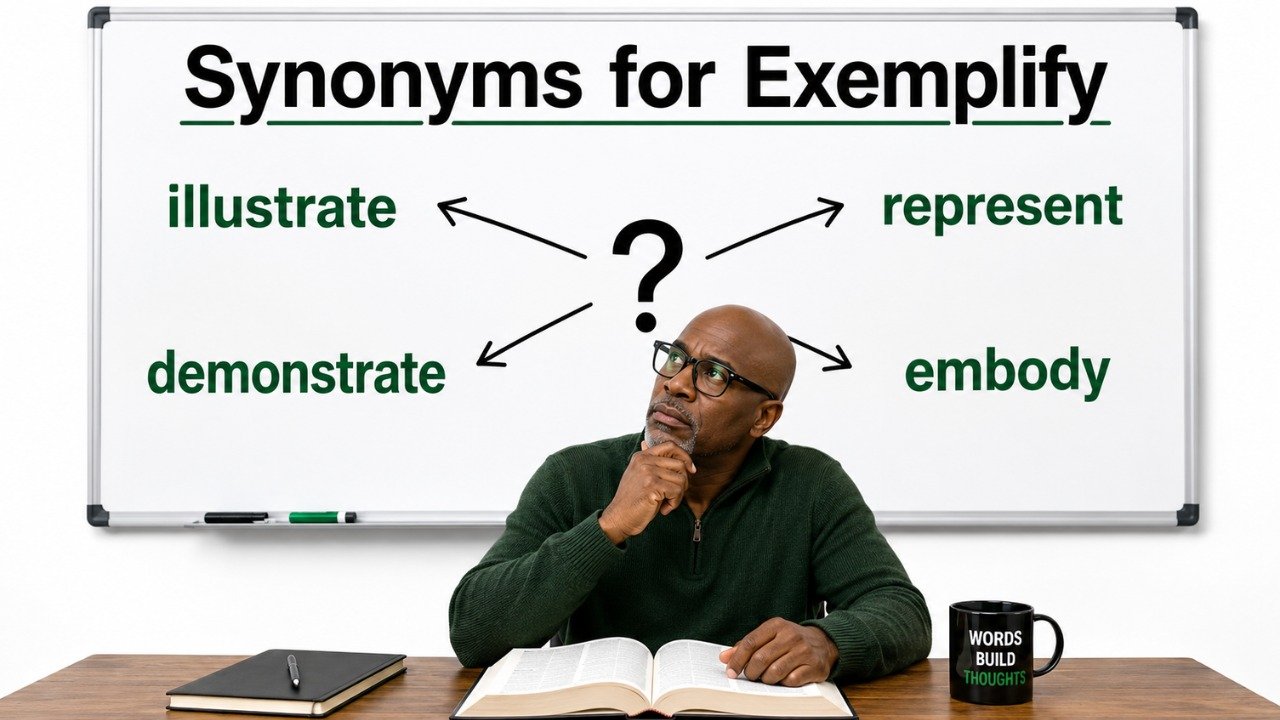
Quick Answer: The best synonyms for exemplify include illustrate, demonstrate, embody, represent, typify, epitomize, personify, symbolize, show, and manifest. Use illustrate when an example helps explain an idea, demonstrate when something provides clear evidence, embody when a person or thing expresses a quality, typify when something is characteristic of a group, and epitomize when something is an especially strong or perfect example. In formal writing, demonstrate, illustrate, and represent are usually the most flexible choices.
Pronunciation and Word Details
Word: Exemplify.
Pronunciation: /ɪɡˈzem.plɪ.faɪ/
Part of Speech: Verb.
Meaning: To serve as a clear example of something or to show an idea, quality, rule, or pattern through an example.
US Pronunciation:
UK Pronunciation:
What Does “Exemplify” Mean?
Exemplify means to be a clear example of something or to make an idea easier to understand by providing an example.
As a verb, exemplify can describe a person, action, situation, object, result, or event that clearly represents a particular quality, principle, behavior, or pattern.
Personal Use: A person may exemplify kindness through generous and thoughtful behavior.
Professional Use: An employee may exemplify strong leadership by communicating clearly and supporting a team.
Academic Use: A case study may exemplify a theory discussed in an essay or research paper.
Descriptive Use: A building may exemplify a particular architectural style.
Behavioral Use: Someone’s actions may exemplify courage, patience, honesty, or responsibility.
Exemplify can therefore mean both showing something through an example and being the example itself.
Meaning, Tone, and Context of “Exemplify”
Exemplify has a neutral to formal tone. It is especially common in academic writing, professional communication, analysis, reports, essays, descriptions, and discussions of qualities or principles.
The word often sounds more precise than simply saying show.
Formal Context: Exemplify works well when describing how something represents a principle, quality, standard, or pattern.
Academic Context: Writers use exemplify when connecting an example to a broader idea, argument, theory, or concept.
Professional Context: The word can describe behavior that represents desirable values, standards, or leadership qualities.
Descriptive Context: Exemplify can identify a person, object, event, or situation as a representative example of a larger category.
Conversational Context: Although correct in conversation, exemplify can sometimes sound more formal than necessary. Show, represent, or demonstrate may sound more natural in casual speech.
The exact replacement depends on whether you mean explain through an example, represent a quality, provide evidence, or act as a perfect example.
When and How to Use “Exemplify”
When Showing a Quality
Use exemplify when a person, action, or object clearly displays a particular quality.
Example: Her calm response exemplifies patience under pressure.
When Explaining an Idea
Use exemplify when a specific example makes a broader idea easier to understand.
Example: This case exemplifies how small decisions can influence long term results.
When Describing a Representative Example
Use exemplify when one person or thing represents the typical features of a group, style, period, or category.
Example: The design exemplifies the simplicity of the movement.
When Describing High Standards
Use exemplify when someone strongly represents a valued principle or standard.
Example: His conduct exemplifies professional integrity.
When Discussing Patterns
Use exemplify when an event or situation clearly reflects a wider trend or repeated pattern.
Example: The incident exemplifies a common communication problem.
When Supporting an Argument
Use exemplify in essays and reports when evidence or an example supports a larger point.
Example: These results exemplify the importance of careful preparation.
Best Synonyms for Exemplify
Illustrate: To make an idea clearer by giving an example or showing how it works.
Example: The story illustrates the importance of persistence.
Demonstrate: To show something clearly through evidence, action, or example.
Example: Her results demonstrate the value of consistent practice.
Embody: To express or possess a quality in a clear and complete way.
Example: She embodies confidence and professionalism.
Represent: To stand for or serve as an example of something.
Example: The painting represents the artistic values of its period.
Typify: To be a typical or characteristic example of something.
Example: His approach typifies the company’s traditional management style.
Epitomize: To be an especially strong or perfect example of a quality or type.
Example: Her performance epitomizes dedication and discipline.
Personify: To be a strong human example of an abstract quality.
Example: He personifies patience and generosity.
Symbolize: To represent an idea, quality, value, or concept symbolically.
Example: The open doorway symbolizes opportunity.
Show: To make a quality, fact, idea, or condition visible or understandable.
Example: Her actions show genuine concern for others.
Manifest: To display or reveal a quality, feeling, condition, or characteristic clearly.
Example: The problem manifested itself through repeated delays.
50 Synonyms for Exemplify with Short Meanings
- Illustrate: To explain or clarify through an example.
- Demonstrate: To show clearly through evidence or action.
- Embody: To express a quality in a visible or complete form.
- Represent: To stand for or serve as an example of something.
- Typify: To show the typical qualities of a group or type.
- Epitomize: To be a perfect or especially strong example.
- Personify: To represent an abstract quality through a person.
- Symbolize: To stand for an idea or quality.
- Show: To make something clear or noticeable.
- Manifest: To reveal or display a quality clearly.
- Display: To make a quality or characteristic visible.
- Exhibit: To show a quality, behavior, or characteristic.
- Portray: To present or describe something in a particular way.
- Depict: To represent something through description or imagery.
- Express: To communicate or reveal a quality or idea.
- Reflect: To show the nature, character, or influence of something.
- Reveal: To make a quality, fact, or characteristic apparent.
- Indicate: To point toward or provide evidence of something.
- Evidence: To show or support something through proof.
- Prove: To establish something as true through evidence.
- Confirm: To provide support for the truth of something.
- Validate: To show that something is reasonable, accurate, or justified.
- Model: To provide an example that others can follow.
- Characterize: To show the distinctive qualities of something.
- Define: To clearly represent an important quality or feature.
- Capture: To express the essential nature of something.
- Convey: To communicate an idea, feeling, or quality.
- Present: To show or introduce something for consideration.
- Feature: To display a noticeable characteristic.
- Highlight: To draw attention to an important quality or example.
- Underline: To emphasize the importance of an idea or quality.
- Emphasize: To make a point or characteristic especially noticeable.
- Reinforce: To strengthen an idea by providing supporting evidence or examples.
- Clarify: To make an idea easier to understand.
- Explain: To make the meaning of something clear.
- Representatively Show: To display qualities typical of a larger group.
- Serve as an Example: To function as a clear example of something.
- Serve as a Model: To provide a pattern worthy of imitation.
- Stand For: To represent a quality, idea, or principle.
- Stand as an Example: To provide a recognizable example of something.
- Give an Example of: To show what an idea looks like in practice.
- Provide an Example of: To supply a specific case that explains a broader idea.
- Be Characteristic of: To display qualities normally associated with something.
- Be Representative of: To show features common to a larger group.
- Be Typical of: To show the usual qualities of a type or category.
- Be a Model of: To represent an especially good example.
- Serve to Illustrate: To help explain something through an example.
- Bring to Life: To make an idea clearer and easier to imagine.
- Make Clear: To help an idea become easier to understand.
- Showcase: To display a quality or feature prominently.
Read Also:
Synonyms for Encouragement

Synonyms for Exemplify by Context
When Exemplify Means Illustrate an Idea
Illustrate, demonstrate, clarify, explain, show, and provide an example of work well when a specific case helps readers understand a larger concept.
Example: The experiment illustrates how temperature affects the reaction.
Illustrate is especially useful in essays and explanations because it emphasizes clarity rather than simply representation.
When Exemplify Means Embody a Quality
Embody, personify, epitomize, express, display, and manifest work well when a person or thing strongly possesses a quality.
Example: Her willingness to help others embodies generosity.
Epitomize is stronger than embody when you mean an especially perfect or outstanding example.
When Exemplify Means Represent a Type
Represent, typify, characterize, reflect, be typical of, and be representative of are useful when something shows the usual features of a group.
Example: The building typifies the architecture of the period.
Typify emphasizes typical characteristics, while represent is broader and more neutral.
When Exemplify Means Demonstrate Evidence
Demonstrate, show, evidence, confirm, indicate, validate, and prove can work when the sentence focuses on evidence.
Example: The results demonstrate the effectiveness of the new method.
Demonstrate is usually safer than prove because evidence may strongly support a conclusion without establishing it beyond all doubt.
When Exemplify Means Set a Model
Model, embody, serve as a model, be a model of, and epitomize are useful when someone represents behavior others may want to imitate.
Example: Her leadership serves as a model for new managers.
Another Word for Exemplify
The best single replacement for exemplify is often illustrate because it is clear, flexible, and natural in both formal and general writing. However, the best alternative depends on the intended meaning.
Use demonstrate when evidence is involved, embody when describing qualities, typify when something is a typical example, and epitomize when it is an exceptionally strong example.
Original: Her actions exemplify responsible leadership.
Better Option: Her actions demonstrate responsible leadership.
Original: The character exemplifies courage.
Better Option: The character embodies courage.
Original: This building exemplifies Victorian architecture.
Better Option: This building typifies Victorian architecture.
Original: His commitment exemplifies professional dedication.
Better Option: His commitment epitomizes professional dedication.
When Not to Use “Exemplify”
Exemplify is useful, but it can sound overly formal when a simpler verb communicates the idea more naturally.
Avoid it when the sentence merely means show and no idea of representation or example is involved.
Weak: Please exemplify me where the entrance is.
Better: Please show me where the entrance is.
Do not use exemplify when you actually mean explain something in detail.
Weak: The teacher exemplified the entire process step by step.
Better: The teacher explained the entire process step by step.
Avoid using exemplify repeatedly in nearby sentences.
Weak: The first case exemplifies the problem, while the second example also exemplifies the same issue.
Better: The first case illustrates the problem, while the second demonstrates the same issue.
Do not use exemplify when you mean prove unless the example genuinely provides sufficient evidence.
Weak: One successful result exemplifies that the method always works.
Better: One successful result suggests that the method can work.
Exemplify is also less suitable for casual conversation when show, represent, or demonstrate would sound more natural.
Words Commonly Confused With Exemplify
Exemplify vs Illustrate: Exemplify means to serve as an example or to show through an example. Illustrate places greater emphasis on making an idea easier to understand.
Exemplify vs Demonstrate: Exemplify focuses on being or providing an example. Demonstrate often emphasizes showing evidence, proving a point, or making something observable.
Exemplify vs Embody: Exemplify can apply to examples, cases, qualities, and patterns. Embody usually means possessing or expressing a quality in a particularly clear way.
Exemplify vs Typify: Exemplify means to serve as an example, while typify specifically means to represent the typical characteristics of a class or group.
Exemplify vs Epitomize: Exemplify can describe any clear example. Epitomize usually describes an especially complete, ideal, or outstanding example.
Exemplify vs Personify: Personify is most appropriate when a person seems to represent an abstract quality such as courage, kindness, or ambition.
Exemplify vs Represent: Represent is broader. Something can represent an idea symbolically without necessarily serving as a practical example of it.
Which Synonym Should You Choose?
Choose illustrate when an example helps explain an idea, argument, principle, or concept.
Choose demonstrate when evidence, results, actions, or observable facts clearly support a point.
Choose embody when a person or thing visibly expresses an important quality.
Choose represent when something stands for a broader group, idea, category, or value.
Choose typify when something shows characteristics that are typical of a larger group.
Choose epitomize when something is an especially strong or nearly perfect example.
Choose personify when a person strongly represents an abstract quality.
Choose symbolize when the relationship is symbolic rather than based on direct characteristics.
Choose show in casual speech when formality and precision are unnecessary.
Choose manifest when a quality, condition, or characteristic becomes clearly visible through behavior or effects.
For essays and academic writing, illustrate, demonstrate, represent, and typify are usually strong choices.
For reports, demonstrate and indicate work well when discussing evidence or results.
For professional writing, embody and exemplify are useful for values, standards, conduct, and leadership.
For casual conversation, show and represent usually sound more natural.
Real Life Examples of “Exemplify” in Sentences
Original: Her willingness to listen exemplifies excellent leadership.
Better Option: Her willingness to listen demonstrates excellent leadership.
Original: The small village exemplifies traditional rural life.
Better Option: The small village represents traditional rural life.
Original: His behavior exemplifies genuine kindness.
Better Option: His behavior embodies genuine kindness.
Original: This case exemplifies the problem described in the report.
Better Option: This case illustrates the problem described in the report.
Original: The architecture exemplifies the style of the period.
Better Option: The architecture typifies the style of the period.
Original: Her dedication exemplifies professional excellence.
Better Option: Her dedication epitomizes professional excellence.
Original: These results exemplify the benefits of careful planning.
Better Option: These results demonstrate the benefits of careful planning.
Original: His calm manner exemplifies patience.
Better Option: His calm manner personifies patience.
Original: The incident exemplifies a larger pattern of poor communication.
Better Option: The incident reflects a larger pattern of poor communication.
Original: The project exemplifies what effective teamwork can achieve.
Better Option: The project showcases what effective teamwork can achieve.
Synonym Groups and Usage Differences
Illustration Group
Illustrate, clarify, explain, demonstrate, and show belong to this group.
These words are useful when the purpose is to make an idea understandable through a specific example.
Example: The case study illustrates how customer needs can change over time.
Illustrate is especially useful when the example explains something. Demonstrate is stronger when evidence is involved.
Representation Group
Represent, typify, characterize, reflect, and symbolize belong to this group.
These words describe something that stands for or shows qualities associated with a larger idea, category, or group.
Example: The design typifies the artistic style of the period.
Typify suggests typical features, while symbolize suggests an indirect or symbolic connection.
Quality Group
Embody, personify, epitomize, manifest, and express are useful when discussing qualities or values.
Example: Her thoughtful decisions embody responsible leadership.
Epitomize suggests an especially strong example. Personify is particularly natural when the subject is a person.
Evidence Group
Demonstrate, indicate, evidence, confirm, validate, and prove belong to the evidence group.
They are useful when facts, results, or observations support a conclusion.
Example: The data demonstrate a clear improvement in performance.
Prove is the strongest option and should be used only when the evidence genuinely establishes the conclusion.
Model Group
Model, serve as a model, be a model of, embody, and exemplify describe people, actions, or standards that provide an example to follow.
Example: Her conduct serves as a model for new employees.
Antonyms of Exemplify
The opposite of exemplify depends on whether the word means represent, demonstrate, or serve as a good example.
Contradict: To conflict with an idea, claim, quality, or principle.
Misrepresent: To present something inaccurately or misleadingly.
Conceal: To prevent a quality or fact from becoming visible.
Obscure: To make something difficult to understand or recognize.
Hide: To keep something from being seen or understood.
Defy: To behave in a way that goes against an expected pattern.
Oppose: To act or exist in contrast to something.
Deviate: To move away from a typical pattern or standard.
Conflict: To be inconsistent with an idea, quality, or expectation.
Belie: To create an impression that conflicts with the true nature of something.
Comparison Exemplify vs Related Words
Exemplify vs Illustrate
Exemplify emphasizes serving as an example. Illustrate emphasizes making an idea clearer through an example.
Example With Exemplify: Her decisions exemplify careful leadership.
Example With Illustrate: Her decisions illustrate why careful leadership matters.
Exemplify vs Demonstrate
Exemplify focuses on representation, while demonstrate often focuses on evidence or visible proof.
Example With Exemplify: The project exemplifies effective teamwork.
Example With Demonstrate: The project’s results demonstrate the value of effective teamwork.
Exemplify vs Embody
Exemplify means to serve as an example of a quality. Embody suggests that the quality is strongly expressed in the person or thing itself.
Example With Exemplify: Her behavior exemplifies compassion.
Example With Embody: She embodies compassion.
Exemplify vs Typify
Exemplify can describe any meaningful example. Typify suggests that something is representative because it has the usual characteristics of its type.
Example With Exemplify: This house exemplifies traditional design.
Example With Typify: This house typifies traditional homes in the region.
Exemplify vs Epitomize
Exemplify is neutral and can describe an ordinary clear example. Epitomize is stronger and often means to be the ideal or most complete example.
Example With Exemplify: His work exemplifies professionalism.
Example With Epitomize: His work epitomizes professional excellence.
Exemplify vs Personify
Exemplify can apply to people, objects, situations, or events. Personify is especially useful when a person seems to represent an abstract quality.
Example With Exemplify: Her actions exemplify determination.
Example With Personify: She personifies determination.
Common Phrases and Expressions With Exemplify
Exemplify Excellence: To represent an especially high standard of quality.
Exemplify Leadership: To display behavior associated with strong leadership.
Exemplify the Qualities of: To clearly show particular characteristics.
Exemplify a Principle: To provide a clear example of an idea or rule.
Exemplify a Trend: To serve as a clear example of a wider pattern or development.
Exemplify Best Practice: To demonstrate a particularly effective way of doing something.
Exemplify the Problem: To clearly show the nature of a particular difficulty.
Exemplify a Pattern: To provide a recognizable example of repeated behavior or events.
Exemplify the Difference: To make a distinction clearer through an example.
Exemplify the Idea: To show clearly how a concept appears in practice.
Common Mistakes to Avoid
One common mistake is using exemplify as a general replacement for show in every sentence. Exemplify normally carries the stronger idea of serving as an example or representing a quality.
Incorrect: She exemplified me the document.
Correct: She showed me the document.
Another mistake is confusing exemplify with explain. An example may help explain an idea, but the two verbs do not have the same meaning.
Incorrect: The instructor exemplified all the rules in detail.
Correct: The instructor explained all the rules in detail.
Avoid choosing epitomize when the subject is only an ordinary example. Epitomize suggests a particularly strong or complete example.
Be careful with prove. A single example may illustrate or demonstrate a point without proving that the claim is always true.
Repetition can also weaken writing. If exemplify appears several times in the same paragraph, use context appropriate alternatives such as illustrate, demonstrate, embody, represent, or typify.
Avoid vague usage where the reader cannot tell what quality or principle is being exemplified.
Vague: His actions exemplified many things.
Clear: His actions exemplified patience, responsibility, and respect.
Finally, choose synonyms according to meaning rather than simply replacing every occurrence of exemplify with the same alternative.
Conclusion
The most useful synonyms for exemplify include illustrate, demonstrate, embody, represent, typify, epitomize, personify, and show. The best choice depends on what you want to express. Use illustrate for explanatory examples, demonstrate for evidence, embody for qualities, typify for typical characteristics, and epitomize for an especially strong example. Understanding these differences helps you choose more precise vocabulary and makes sentences clearer, more natural, and better suited to academic, professional, descriptive, and everyday writing.
FAQs About Synonyms for Exemplify
What Is the Best Synonym for Exemplify?
Illustrate is one of the most flexible synonyms when an example is used to explain an idea. Demonstrate, embody, represent, and typify may be better in other contexts.
What Is Another Word for Exemplify in an Essay?
Illustrate, demonstrate, represent, and typify are strong choices for essays. Choose the word according to whether you are explaining an idea, presenting evidence, or describing a representative example.
Does Exemplify Mean Demonstrate?
The meanings overlap, but they are not always identical. Exemplify focuses on serving as an example, while demonstrate often emphasizes showing evidence or making something clearly observable.
Can Embody Replace Exemplify?
Yes, when the sentence describes a person or thing strongly expressing a quality.
Example: She exemplifies courage can become She embodies courage.
What Is a Stronger Word Than Exemplify?
Epitomize can be stronger when something is an exceptionally clear or ideal example. Personify can also be stronger when a person represents a particular quality.
Is Exemplify a Formal Word?
Yes. Exemplify has a neutral to formal tone and is common in academic, professional, analytical, and descriptive writing. In casual conversation, show or represent may sound more natural.
What Is the Difference Between Exemplify and Typify?
Exemplify means to serve as an example of something. Typify specifically means to display characteristics that are typical or representative of a group, style, or category.
