
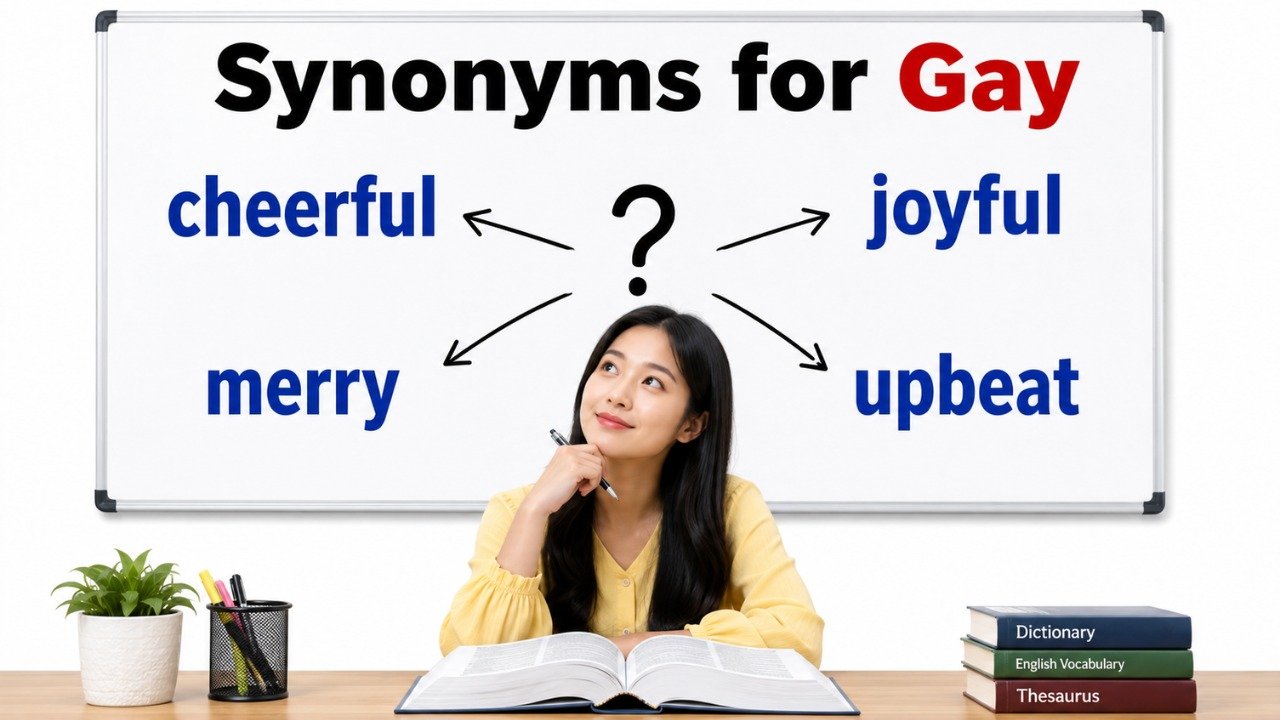
Quick Answer: The best synonyms for gay depend strongly on meaning and context. For sexual orientation, useful alternatives and related terms include homosexual, same sex attracted, same gender attracted, queer, lesbian, nonheterosexual, and same sex loving, although these terms are not always interchangeable. Homosexual is more formal and can sound clinical, queer is broader and should generally be used when a person chooses that label, and lesbian specifically refers to women attracted to women. In the older meaning of gay, strong synonyms include cheerful, merry, joyful, bright, carefree, and lively.
Pronunciation and Word Details
Word: Gay.
Pronunciation: /ɡeɪ/
Part of Speech: Adjective and noun.
Meaning: Most commonly, gay describes a person who is romantically or sexually attracted to people of the same sex or gender. In older usage, it can also mean cheerful, carefree, lively, bright, or colorful.
US Pronunciation:
UK Pronunciation:
What Does “Gay” Mean?
Gay most commonly describes a person who experiences romantic or sexual attraction toward people of the same sex or gender.
As an adjective, gay can describe someone’s sexual orientation. It is especially common when referring to men, although people of other genders may also use gay as their preferred identity label.
Identity Use: A gay man may be romantically attracted to other men.
Personal Use: Some women prefer the word gay, while others prefer lesbian.
General Use: Gay can refer broadly to people with same sex attraction when that is how they identify.
The word also has older meanings that are still found in literature and traditional expressions.
Cheerful Meaning: Gay can mean happy, merry, or lighthearted.
Bright Meaning: It can describe something colorful, lively, or visually cheerful.
Carefree Meaning: Older writing sometimes uses gay for someone who is carefree or spirited.
Because these meanings differ greatly, context is essential when choosing a synonym.
Meaning, Tone, and Context of “Gay”
Gay is generally a neutral and widely understood word when describing sexual orientation.
In modern conversation, it is often more natural than homosexual because homosexual may sound formal, technical, medical, or impersonal when used to describe a person.
Neutral Tone: Gay is usually straightforward and respectful when used as a person’s chosen identity.
Conversational Tone: It works naturally in everyday discussion about relationships, identity, culture, and personal experience.
Formal Tone: Gay is also appropriate in essays, reports, educational writing, and professional communication.
Personal Context: When describing a specific person, their preferred identity term is usually the most accurate choice.
Historical Context: Gay meaning cheerful or carefree is much less common in everyday modern English.
Literary Context: Older novels, poems, songs, and historical writing may use gay to mean merry, lively, or bright.
Visual Context: Older expressions may use gay to describe colorful clothing, decorations, or celebrations.
Writers should therefore consider both the time period and intended meaning before replacing gay with another word.
When and How to Use “Gay”
For Sexual Orientation
Use gay when describing a person who identifies with same sex or same gender attraction.
Example: Daniel describes himself as gay.
For Gay Men
Gay is especially common when referring to men who are romantically or sexually attracted to men.
Example: The character is an openly gay man.
For Women Who Prefer the Term
Some women use gay rather than lesbian to describe themselves.
Example: She prefers to describe herself as gay.
For General Discussion
Gay can be used naturally when discussing sexual orientation without unnecessary technical language.
Example: The essay discusses the experiences of gay adults.
For Historical Cheerfulness
In older or literary English, gay can mean cheerful or merry.
Example: The children were in a gay and cheerful mood.
For Bright Appearance
Older writing may use gay to describe colorful or lively decoration.
Example: The hall looked gay with colorful flowers and ribbons.
For Carefree Behavior
Gay can historically describe a lively and carefree way of behaving.
Example: They spent a gay afternoon laughing in the garden.
This older use can sound dated today, so cheerful, merry, lively, or carefree is usually clearer.
Best Synonyms for Gay
Homosexual: A formal term for a person attracted to people of the same sex. It can sound clinical when applied directly to a person.
Example: The study discussed homosexual and heterosexual patterns of attraction.
Same Sex Attracted: Describes attraction toward people of the same sex without necessarily stating a personal identity label.
Example: The discussion included people who described themselves as same sex attracted.
Same Gender Attracted: Describes attraction toward people of the same gender.
Example: The survey included participants who identified as same gender attracted.
Queer: A broader identity term that some people personally choose, although it is not an exact synonym for gay and has a history of offensive use.
Example: Alex describes himself as queer rather than gay.
Lesbian: A woman who is romantically or sexually attracted to women, when that is her chosen identity.
Example: Maria identifies as lesbian.
Nonheterosexual: A broad formal description for orientations other than heterosexual, not an exact replacement for gay.
Example: The research included heterosexual and nonheterosexual participants.
Cheerful: Happy and positive in mood, matching an older meaning of gay.
Example: The cheerful gathering continued throughout the afternoon.
Merry: Happy, lively, and full of enjoyment.
Example: Everyone appeared merry during the celebration.
Carefree: Free from worry or serious concern.
Example: They enjoyed a carefree afternoon by the lake.
Bright: Colorful, lively, or visually cheerful.
Example: Bright decorations filled the hall.
50 Synonyms for Gay with Short Meanings
Because gay has several distinct meanings, this list includes direct alternatives, closely related identity descriptions, and synonyms for its older meanings of cheerful, lively, and colorful.
- Homosexual: Attracted to people of the same sex.
- Same Sex Attracted: Experiencing attraction toward the same sex.
- Same Gender Attracted: Experiencing attraction toward the same gender.
- Same Sex Loving: Describing romantic or emotional love toward the same sex.
- Same Gender Loving: Describing romantic affection toward the same gender.
- Nonheterosexual: Having an orientation other than heterosexual.
- Queer: A broad identity label chosen by some people.
- Lesbian: A woman attracted to women.
- Homoromantic: Romantically attracted to people of the same gender.
- Same Sex Oriented: Oriented romantically or sexually toward the same sex.
- Cheerful: Noticeably happy and positive.
- Merry: Full of happiness and enjoyment.
- Joyful: Feeling or expressing great happiness.
- Happy: Feeling pleasure or contentment.
- Jolly: Cheerful and friendly in manner.
- Lighthearted: Cheerful and free from serious worry.
- Carefree: Free from anxiety or concern.
- Gleeful: Showing lively happiness.
- Buoyant: Cheerful, hopeful, and energetic.
- Lively: Full of energy and activity.
- Festive: Cheerful and suited to celebration.
- Jovial: Friendly, cheerful, and good humored.
- Mirthful: Full of laughter and amusement.
- Sprightly: Energetic, lively, and cheerful.
- Sunny: Cheerful and optimistic in personality or mood.
- Upbeat: Positive and hopeful.
- Exuberant: Full of excitement and energetic happiness.
- Animated: Lively and full of expression.
- Vivacious: Attractively lively and energetic.
- Playful: Cheerful and full of fun.
- Blithe: Cheerful and unconcerned.
- Frolicsome: Playful and full of lively energy.
- High Spirited: Energetic, cheerful, and enthusiastic.
- Delighted: Extremely pleased or happy.
- Elated: Extremely happy and excited.
- Jubilant: Showing great happiness or triumph.
- Radiant: Showing happiness or glowing brightness.
- Bright: Full of light, color, or cheerfulness.
- Colorful: Rich in noticeable colors.
- Vivid: Bright, strong, and visually striking.
- Brilliant: Very bright or impressive in appearance.
- Vibrant: Full of strong color, energy, or life.
- Showy: Designed to attract attention through appearance.
- Flamboyant: Very noticeable, colorful, or elaborate in style.
- Ornate: Highly decorated or elaborate.
- Decorative: Intended to make something more attractive.
- Flashy: Very bright or attention attracting.
- Striking: Visually noticeable or impressive.
- Gaudy: Extremely bright or decorated, often excessively.
- Effervescent: Lively, enthusiastic, and cheerful.
Read Also:
Synonyms for Exemplify

Synonyms for Gay by Context
When Gay Refers to Sexual Orientation
The closest formal alternative is homosexual, although it often sounds more clinical than gay.
Same sex attracted and same gender attracted describe attraction without necessarily claiming a particular identity.
Example: He describes himself as gay.
Alternative: He describes himself as a man who is attracted to men.
Personal identity terms should not automatically be substituted for one another because people may prefer different labels.
When Gay Refers Specifically to Women
Lesbian can be more specific when a woman identifies with that term.
Example: She describes herself as gay.
Alternative: She describes herself as lesbian.
The second version is appropriate only when lesbian is the person’s preferred identity.
When Gay Means Cheerful
Older English sometimes uses gay to mean cheerful, happy, merry, or joyful.
Example: They were in a gay mood throughout the celebration.
Alternative: They were in a cheerful mood throughout the celebration.
Cheerful is much clearer in modern everyday English.
When Gay Means Carefree
Gay can historically suggest lighthearted or carefree behavior.
Example: They enjoyed a gay afternoon in the countryside.
Alternative: They enjoyed a carefree afternoon in the countryside.
Carefree removes the modern ambiguity of gay.
When Gay Means Bright or Colorful
Older writing can use gay for colorful clothing, decorations, flowers, or surroundings.
Example: The garden looked gay with spring flowers.
Alternative: The garden looked vibrant with spring flowers.
Vibrant, colorful, and bright are usually more natural choices today.
When Gay Means Lively
Gay may describe a lively atmosphere in older writing.
Example: The street had a gay atmosphere during the festival.
Alternative: The street had a lively atmosphere during the festival.
Lively is clearer for contemporary readers.
Another Word for Gay
The best single alternative for gay depends entirely on what gay means in the sentence.
For sexual orientation, homosexual is the closest traditional dictionary alternative, but it is often more formal and clinical. When describing an individual, gay itself may actually be the clearest and most natural choice.
For older meanings, cheerful is usually the strongest general replacement.
Original: The old story describes the group as gay and merry.
Better Option: The old story describes the group as cheerful and merry.
Original: The room was gay with flowers.
Better Option: The room was bright with flowers.
Original: They lived a gay and carefree life.
Better Option: They lived a lively and carefree life.
Original: The article describes him as a homosexual man.
Better Option: The article describes him as a gay man.
The final example shows why a synonym is not automatically an improvement. Naturalness, personal preference, and context matter.
When Not to Use “Gay”
Do not use gay when its intended meaning could easily be misunderstood.
The older meanings of cheerful, bright, or carefree can sound confusing in contemporary writing because readers are likely to interpret gay as referring to sexual orientation first.
Weak: The children enjoyed a gay afternoon at the park.
Better: The children enjoyed a cheerful afternoon at the park.
Avoid using gay as a negative description for something disappointing, strange, embarrassing, weak, or undesirable. That usage can be disrespectful because it turns an identity term into an insult.
Weak: That idea is gay.
Better: That idea is impractical.
Do not substitute a broader identity term when you mean something more specific.
Weak: Everyone who is queer is gay.
Better: Queer is a broader identity term and is not identical in meaning to gay.
Avoid using homosexual automatically when ordinary language would sound more natural.
Weak: He introduced himself as a homosexual man.
Better: He introduced himself as a gay man.
The first sentence is grammatically possible, but the second often sounds more natural when gay is the person’s chosen term.
Words Commonly Confused With Gay
Gay vs Homosexual: Gay is usually more natural in everyday language. Homosexual describes same sex attraction but often has a more formal or clinical tone.
Gay vs Lesbian: Gay can refer broadly to people with same sex attraction and is especially common for men. Lesbian specifically refers to women who are attracted to women and choose that identity.
Gay vs Queer: Gay describes a more specific sexual orientation. Queer can be a broader term involving sexuality, gender, or both. It should generally be used for people who use the term for themselves.
Gay vs Bisexual: Gay generally refers to attraction toward the same sex or gender. Bisexual refers to attraction involving more than one gender.
Gay vs Straight: Gay refers to same sex or same gender attraction, while straight commonly refers to heterosexual attraction.
Gay vs Transgender: Gay concerns sexual orientation. Transgender concerns gender identity. A transgender person can be gay, straight, bisexual, or have another sexual orientation.
Gay vs Asexual: Gay concerns the direction of romantic or sexual attraction. Asexual generally refers to experiencing little or no sexual attraction. These concepts are not interchangeable.
Which Synonym Should You Choose?
Choose gay when referring to a person who personally uses that identity. It is usually clear, neutral, and natural.
Choose homosexual when a formal or technical discussion specifically concerns patterns of same sex sexual attraction. Consider whether gay would sound more natural when describing individuals.
Choose lesbian when referring specifically to a woman who identifies as lesbian.
Choose same sex attracted when the purpose is to describe attraction without assigning a personal identity label.
Choose same gender attracted when gender rather than biological sex is the relevant distinction.
Choose queer only when the broader meaning is intended or when referring to people who use the label for themselves.
Choose cheerful when gay has its older meaning of happy or pleasant.
Choose carefree when the intended meaning is relaxed and free from worry.
Choose lively when describing an energetic atmosphere, event, or personality.
Choose bright, colorful, vivid, or vibrant when describing decorations, clothing, flowers, or visual appearance.
Choose merry or joyful in literary writing where a warm, celebratory tone is desired.
Real Life Examples of “Gay” in Sentences
Original: Marcus describes himself as gay.
Better Option: Marcus describes himself as a gay man when greater specificity is useful.
Original: The report discussed homosexual adults.
Better Option: The report discussed gay adults where a less clinical expression was appropriate.
Original: Elena described herself as gay.
Better Option: Elena described herself as lesbian because that is the identity term she personally prefers.
Original: The old novel describes a gay celebration.
Better Option: The old novel describes a merry celebration.
Original: They spent a gay afternoon beside the river.
Better Option: They spent a carefree afternoon beside the river.
Original: The hall looked gay with flowers and ribbons.
Better Option: The hall looked colorful with flowers and ribbons.
Original: Everyone seemed gay and energetic.
Better Option: Everyone seemed cheerful and energetic.
Original: The village square had a gay atmosphere.
Better Option: The village square had a lively atmosphere.
Original: She wore a gay collection of colors.
Better Option: She wore a vibrant collection of colors.
Original: His gay manner made everyone smile.
Better Option: His jovial manner made everyone smile.
Synonym Groups and Usage Differences
Sexual Orientation Group
Words and phrases in this group concern same sex or same gender attraction.
Useful choices include homosexual, same sex attracted, same gender attracted, same sex loving, and homoromantic.
These expressions have different shades of meaning and should not automatically replace someone’s chosen identity label.
Example: The discussion considered different ways people describe same sex attraction.
Identity Specific Group
Gay, lesbian, and queer can function as identity labels, but they are not identical.
Lesbian is more specific to women who identify that way. Queer is broader and can include identities beyond gay.
Example: Different people may choose different words to describe similar experiences of attraction.
Cheerfulness Group
Cheerful, merry, joyful, jolly, mirthful, and buoyant match the older meaning of gay associated with happiness.
Example: The cheerful guests filled the room with laughter.
Carefree Group
Carefree, lighthearted, blithe, playful, and high spirited suggest freedom from worry or seriousness.
Example: Their lighthearted conversation continued throughout the afternoon.
Energy Group
Lively, animated, vivacious, exuberant, sprightly, and effervescent emphasize energy and enthusiasm.
Example: The lively celebration continued into the evening.
Brightness Group
Bright, colorful, vivid, vibrant, brilliant, radiant, and striking describe strong visual color or brightness.
Example: Vibrant flowers surrounded the entrance.
Decorative Group
Ornate, decorative, showy, flashy, and flamboyant describe noticeable decoration or style.
Example: The hall was filled with ornate decorations.
Antonyms of Gay
The appropriate opposite depends on which meaning of gay is intended.
For sexual orientation, straight or heterosexual can function as contrasting terms, although sexual orientations are better understood as different categories rather than simple opposites.
Straight: Common term for heterosexual orientation.
Heterosexual: Attracted primarily to people of another sex or gender.
For the older cheerful meaning, several clearer antonyms are available.
Sad: Feeling unhappiness.
Gloomy: Dark, unhappy, or pessimistic in mood.
Miserable: Extremely unhappy or uncomfortable.
Solemn: Serious and lacking cheerfulness.
Melancholy: Quietly or deeply sad.
Downcast: Feeling discouraged or unhappy.
For the bright or colorful meaning, useful contrasts include the following.
Dull: Lacking brightness or excitement.
Drab: Lacking color or visual interest.
Colorless: Having little or no noticeable color.
Subdued: Soft, restrained, or less visually intense.
Comparison Gay vs Related Words
Gay vs Homosexual
Gay is usually the more natural identity term in modern conversation. Homosexual is technically descriptive but can sound clinical or impersonal when used as a noun or direct personal label.
Example With Gay: He describes himself as gay.
Example With Homosexual: The research examined homosexual attraction as one category of sexual orientation.
Gay vs Lesbian
Gay can apply broadly, although it is especially common for men. Lesbian specifically describes women who are romantically or sexually attracted to women and identify with the term.
Example With Gay: She says that gay is the label that feels most comfortable to her.
Example With Lesbian: Her sister identifies as lesbian.
Gay vs Queer
Gay is a more specific orientation label. Queer is broader and can describe different experiences of sexuality or gender.
Example With Gay: He has identified as gay since college.
Example With Queer: Their friend personally prefers the broader label queer.
Gay vs Bisexual
Gay usually describes attraction toward the same sex or gender. Bisexual refers to attraction that can involve more than one gender.
Example With Gay: The character describes himself as gay.
Example With Bisexual: Another character describes herself as bisexual.
Gay vs Straight
Gay and straight commonly describe different patterns of sexual orientation.
Example With Gay: He is gay and has a husband.
Example With Straight: His brother is straight and has a wife.
Neither term describes someone’s personality, character, or values.
Gay vs Cheerful
Gay meaning cheerful is an older use and may be misunderstood in modern writing.
Example With Gay: The novel describes a gay gathering.
Example With Cheerful: A modern writer would probably describe it as a cheerful gathering.
Gay vs Merry
Merry specifically expresses happiness and celebration.
Example With Gay: They enjoyed a gay evening of music and laughter.
Example With Merry: They enjoyed a merry evening of music and laughter.
Gay vs Carefree
Carefree emphasizes freedom from worry rather than happiness alone.
Example With Gay: The story describes their gay youth.
Example With Carefree: The story describes their carefree youth.
Gay vs Colorful
Gay can mean colorful in older descriptions, but colorful is much clearer today.
Example With Gay: The streets were gay with decorations.
Example With Colorful: The streets were colorful with decorations.
Common Phrases and Expressions With Gay
Gay Man: A man who is romantically or sexually attracted to men and identifies as gay.
Gay Woman: A woman who uses gay as her sexual orientation identity.
Gay Couple: A couple whose partners are of the same sex or gender and identify as gay.
Gay Community: A general expression referring to gay people as a social or cultural group.
Gay Identity: A person’s identification with the term gay.
Gay Rights: Rights and legal protections concerning gay people.
Gay Pride: Positive affirmation, dignity, and acceptance connected with gay identity.
Openly Gay: Publicly identifying oneself as gay rather than keeping that identity private.
Gay Relationship: A romantic relationship involving partners who identify as gay.
Gay and Lesbian: A phrase referring specifically to gay men and lesbian women.
Common Mistakes to Avoid
One common mistake is assuming every word associated with sexual diversity is a synonym for gay.
Bisexual, transgender, asexual, queer, lesbian, and gay describe different concepts or overlapping identities. They should not be treated as interchangeable.
Another mistake is using homosexual as though it is always a more sophisticated version of gay. In many contexts, gay sounds more natural and personal, while homosexual can sound clinical.
Avoid calling someone lesbian, queer, gay, or another identity term unless that description is known, relevant, or self identified.
Writers should also avoid the outdated use of gay when cheerful, bright, or carefree would communicate the intended meaning more clearly.
Unclear: We had a gay afternoon at the beach.
Clearer: We had a carefree afternoon at the beach.
Do not use gay as a synonym for bad, foolish, embarrassing, weak, strange, or undesirable.
Incorrect: The movie was gay.
Better: The movie was disappointing.
Be careful with queer as a replacement. Some people proudly use it as an identity, while others do not want the term applied to them.
Avoid turning identity adjectives into unnecessary nouns when a more natural phrase is available.
Less Natural: The homosexuals attended the meeting.
Better: Gay people attended the meeting.
Finally, remember that synonym choice should improve accuracy rather than simply make wording different. A person’s preferred identity term is often more important than finding a technically similar word.
Conclusion
The best synonyms for gay vary according to meaning. For sexual orientation, homosexual, same sex attracted, same gender attracted, lesbian, queer, and non hetero sexual may be relevant, but they are not completely interchangeable. Gay itself is often the clearest choice when it reflects a person’s preferred identity. In older writing, gay may instead mean cheerful, merry, carefree, lively, bright, or colorful. Understanding the context helps you choose language that is accurate, natural, respectful, and easy for readers to understand.
FAQs About Synonyms for Gay
What Is the Best Synonym for Gay?
For sexual orientation, homosexual is the closest traditional alternative, although gay is often more natural. For the older meaning, cheerful is usually the clearest synonym.
Is Homosexual the Same as Gay?
The meanings overlap, but their tone differs. Homosexual is more formal and can sound clinical, while gay is generally more natural as an identity term.
Can Lesbian Be a Synonym for Gay?
Sometimes. Lesbian specifically refers to a woman attracted to women who identifies with that term. Some women use gay instead, but the terms should not automatically be substituted for each other.
Is Queer Another Word for Gay?
Not exactly. Queer is a broader identity term and can include people with different sexualities or gender identities. It is best used when people choose the term for themselves.
What Does Gay Mean in Older English?
In older English, gay can mean cheerful, merry, carefree, lively, bright, or colorful.
What Is a Better Word Than Gay for Cheerful?
Cheerful, merry, joyful, lively, carefree, or lighthearted is usually clearer when happiness rather than sexual orientation is intended.
What Is the Opposite of Gay?
For sexual orientation, straight or heterosexual can be used as contrasting terms rather than strict antonyms. For the older meaning of cheerful, antonyms include sad, gloomy, solemn, and miserable.
