
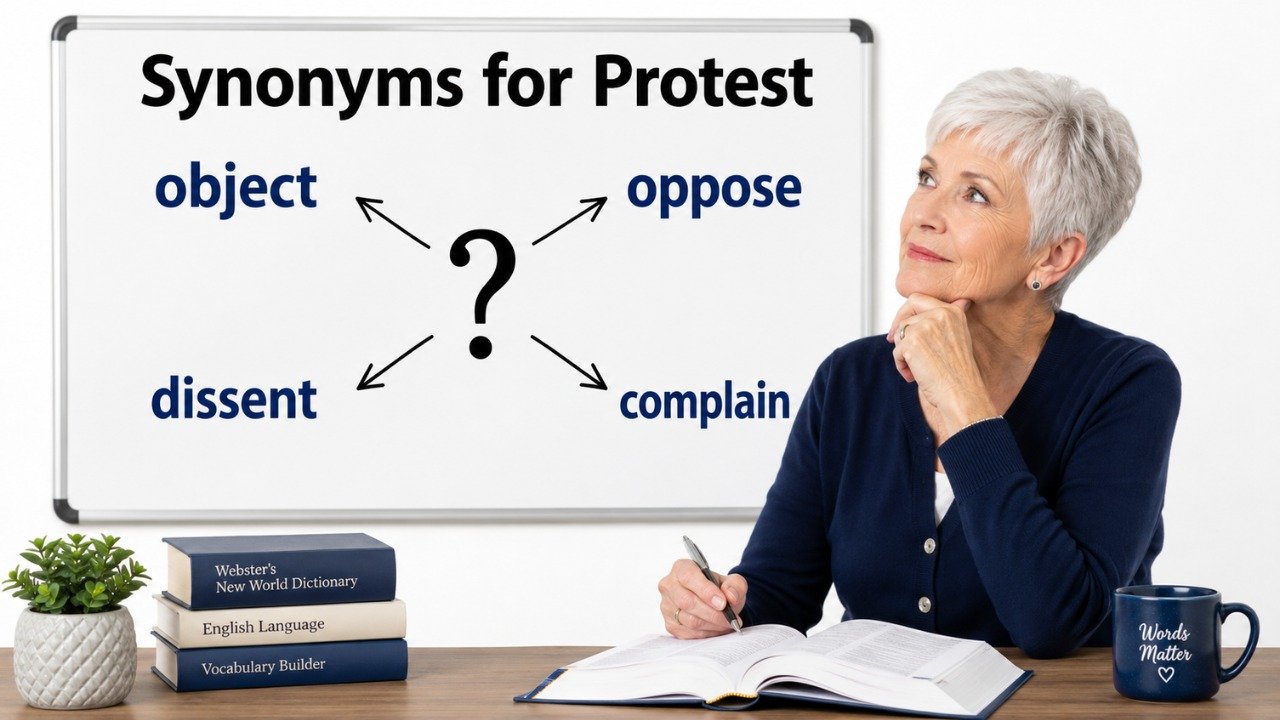
Quick Answer: The best synonyms for protest include objection, demonstration, dissent, opposition, resistance, complaint, outcry, remonstrance, rally, and disapproval. Among these synonyms for protest, objection is a strong general choice when expressing disagreement, while demonstration works best for an organized public action. Use dissent in formal or political writing, opposition when describing resistance to an idea or policy, complaint for dissatisfaction, outcry for a strong public reaction, and remonstrance for a formal expression of objection.
Pronunciation and Word Details
Word: Protest.
Pronunciation: /ˈproʊ.test/ as a noun and /prəˈtest/ as a verb.
Part of Speech: Noun and verb.
Meaning: An expression or action showing disagreement, objection, disapproval, or opposition to something.
US Pronunciation:
UK Pronunciation:
What Does “Protest” Mean?
Protest means to express disagreement, objection, disapproval, or opposition to an action, decision, rule, idea, or situation.
As a noun, protest can describe a statement of objection or an organized public action in which people express their disagreement.
As a verb, protest means to openly object to something or state strongly that something is wrong, unfair, or unacceptable.
Public Use: A protest may involve a group gathering to oppose a decision or demand change.
Personal Use: Someone may protest a decision they believe is unfair.
Formal Use: A written protest can communicate an official objection to a policy, ruling, or action.
Political Use: Citizens may protest laws, government decisions, or public policies.
Workplace Use: Employees may protest changes they consider unreasonable.
The exact meaning depends on whether protest refers to spoken disagreement, formal objection, public demonstration, organized resistance, or strong disapproval.
Meaning, Tone, and Context of “Protest”
Protest usually has a strong and active tone. It communicates more than simple disagreement because it often suggests that a person or group is openly expressing opposition.
The word can be neutral when describing an event objectively, but it may sound emotional or forceful when describing intense disagreement.
In formal writing, protest can refer to an official objection, public response, or organized expression of opposition.
In everyday conversation, it may describe someone strongly objecting to a decision.
In political, social, legal, and historical contexts, protest often refers to public action intended to challenge a policy, decision, practice, or authority.
In personal situations, protest may simply mean speaking against something.
The best synonym depends on whether the intended meaning involves disagreement, public action, criticism, resistance, complaint, or formal objection.
When and How to Use “Protest”
For Public Opposition: Use protest when people publicly express disagreement with a decision, policy, or situation.
Example: Thousands gathered to protest the proposed changes.
For Formal Objection: Use protest when someone clearly states that a decision or action is unacceptable.
Example: The committee submitted a protest against the ruling.
For Personal Disagreement: Protest can describe a strong spoken objection.
Example: She protested when the schedule was changed without notice.
For Political Action: Protest is common when discussing opposition to laws, policies, leadership decisions, or public institutions.
Example: Citizens protested the new restrictions.
For Social Concerns: Use protest when people publicly challenge conditions they consider harmful or unfair.
Example: Residents organized a protest over unsafe conditions.
For Strong Denial: The verb protest can sometimes mean strongly insisting that an accusation or claim is untrue.
Example: He protested that he had followed every instruction.
Best Synonyms for Protest
Objection: A statement or feeling of disagreement with something.
Example: She raised an objection to the proposed rule.
Demonstration: An organized public gathering used to express an opinion or demand change.
Example: The peaceful demonstration attracted hundreds of participants.
Dissent: Formal or openly expressed disagreement with a commonly accepted view or decision.
Example: Several members expressed dissent over the proposal.
Opposition: Resistance or disagreement directed toward an idea, action, policy, or group.
Example: The plan faced strong opposition from local residents.
Resistance: Refusal to accept, support, or cooperate with something.
Example: The changes met considerable resistance from employees.
Complaint: An expression of dissatisfaction about a situation, service, action, or decision.
Example: The residents submitted a complaint about the disruption.
Outcry: A strong and widespread expression of anger, shock, or disapproval.
Example: The announcement caused a public outcry.
Remonstrance: A formal and serious expression of objection or protest.
Example: The organization issued a written remonstrance against the decision.
Rally: A public gathering organized to support or oppose a particular cause.
Example: The group held a rally to demand reform.
Disapproval: A negative judgment or feeling about something considered wrong or unacceptable.
Example: The decision was met with widespread disapproval.
50 Synonyms for Protest with Short Meanings
- Objection: A clear expression of disagreement.
- Demonstration: An organized public expression of opinion.
- Dissent: Open disagreement with a prevailing view.
- Opposition: Active disagreement or resistance.
- Resistance: Refusal to accept or cooperate.
- Complaint: An expression of dissatisfaction.
- Outcry: A strong public expression of anger or disapproval.
- Remonstrance: A formal statement of objection.
- Rally: A public gathering supporting or opposing a cause.
- Disapproval: A negative judgment about something.
- Objection: A reason for opposing something.
- Criticism: Expression of faults or disapproval.
- Disagreement: Lack of agreement about an issue.
- Denunciation: Strong public condemnation.
- Condemnation: Strong expression that something is wrong.
- Resistance: Active refusal to accept something.
- Defiance: Open resistance to authority or expectations.
- Rejection: Refusal to accept an idea or decision.
- Refusal: A decision not to accept or comply.
- Challenge: An action questioning a decision or authority.
- Complaint: A statement expressing dissatisfaction.
- Grievance: A complaint about unfair treatment or conditions.
- Objection: Opposition expressed against a proposal or action.
- Rebuke: Strong criticism or disapproval.
- Reproach: Expression of criticism or disappointment.
- Censure: Formal criticism or condemnation.
- Dispute: An argument or disagreement over an issue.
- Contestation: Formal opposition to a claim or decision.
- Resistance Movement: Organized opposition to authority or control.
- March: An organized public walk expressing a cause or demand.
- Picket: An organized presence outside a place to express opposition.
- Assembly: A gathering of people for a common public purpose.
- Gathering: A group meeting to express shared concerns.
- Vigil: A peaceful gathering showing concern, remembrance, or opposition.
- Appeal: A request for reconsideration or change.
- Petition: A formal written request expressing public concern or demand.
- Objection Statement: A direct statement opposing an action or decision.
- Public Dissent: Open disagreement expressed before others.
- Public Opposition: Collective disagreement with a policy or action.
- Public Complaint: A complaint expressed openly to attract attention.
- Resistance Campaign: Organized action opposing a policy or practice.
- Boycott: Refusal to buy, use, or participate as an act of opposition.
- Walkout: Organized departure used to express disagreement.
- Strike: Organized refusal to work in support of demands or objections.
- Sit In: A form of protest involving remaining in a place to express opposition.
- Revolt: Strong resistance against authority or control.
- Rebellion: Organized resistance to authority or established control.
- Uproar: Loud or widespread expression of anger or objection.
- Backlash: Strong negative reaction to a decision or development.
- Objection Campaign: Coordinated effort expressing opposition to a decision or policy.
Read Also:
Synonyms for Magnificent:

Synonyms for Protest by Context
When Protest Means Public Demonstration
When protest describes an organized public action, demonstration, rally, march, assembly, vigil, and sit in are useful alternatives.
Demonstration: Best for an organized public event expressing opposition or support.
Example: The demonstration remained peaceful throughout the afternoon.
Rally: Best for a gathering focused around a shared cause.
Example: Supporters attended a rally calling for change.
March: Best when participants move through a public area as part of their action.
Example: Residents joined a march against the proposed development.
Assembly: Best when the emphasis is on people gathering together.
Example: A public assembly was organized outside the building.
When Protest Means Objection
When protest means stating that something is wrong or unacceptable, objection, complaint, remonstrance, grievance, and dissent are stronger alternatives.
Objection: A direct and flexible replacement for protest in professional and everyday writing.
Example: The manager noted her objection to the revised policy.
Remonstrance: A formal and serious statement of opposition.
Example: The committee submitted a remonstrance concerning the new requirement.
Complaint: Best when dissatisfaction is the main idea.
Example: The customer filed a complaint about the unexpected charge.
Grievance: Best for a specific complaint involving unfair treatment.
Example: Employees submitted a grievance regarding working conditions.
When Protest Means Political or Social Opposition
Dissent, opposition, resistance, defiance, and challenge work well when protest refers to resistance against policies, institutions, or authority.
Dissent: Best for formal disagreement with an established position.
Example: The proposal generated significant dissent within the group.
Opposition: Best for broad resistance to an idea, policy, or decision.
Example: The measure faced strong opposition.
Resistance: Best when people actively refuse to accept or cooperate with something.
Example: The policy encountered resistance from several communities.
Defiance: Best when resistance is open, bold, and deliberate.
Example: Their actions were viewed as an expression of defiance.
When Protest Means Strong Public Reaction
Outcry, backlash, uproar, condemnation, and denunciation describe particularly strong reactions.
Outcry: A widespread expression of public anger or concern.
Example: The announcement triggered an immediate outcry.
Backlash: A strong negative reaction that develops in response to an action or change.
Example: The proposal created considerable public backlash.
Condemnation: A forceful declaration that something is wrong or unacceptable.
Example: The decision received widespread condemnation.
Denunciation: A strong public statement criticizing an action, belief, or policy.
Example: The announcement prompted a formal denunciation.
Another Word for Protest
Another word for protest is objection when the meaning involves clearly expressing disagreement. However, the best replacement depends on context.
Use demonstration when referring to organized public action, dissent for formal disagreement, opposition for broad resistance, complaint for dissatisfaction, and outcry for a strong public reaction.
Original: The residents made a protest against the new rule.
Better Option: The residents raised an objection to the new rule.
Original: Hundreds attended the protest downtown.
Better Option: Hundreds attended the demonstration downtown.
Original: Several members voiced their protest during the meeting.
Better Option: Several members expressed their dissent during the meeting.
Original: The announcement caused widespread protest.
Better Option: The announcement caused widespread public opposition.
When Not to Use “Protest”
Protest is useful, but another word may communicate the intended meaning more precisely.
Avoid protest when you simply mean mild disagreement, a customer complaint, formal criticism, or general dissatisfaction.
Weak: She made a protest about the incorrect bill.
Better: She made a complaint about the incorrect bill.
Complaint is more natural because the issue concerns dissatisfaction with a specific service or charge.
Weak: The researcher included a protest against the conclusion.
Better: The researcher included an objection to the conclusion.
Objection is more precise in analytical or academic writing.
Weak: The board expressed a protest about the proposal.
Better: The board expressed opposition to the proposal.
Opposition sounds more natural when describing a general position against a proposal.
Weak: The audience showed protest after the announcement.
Better: The audience expressed strong disapproval after the announcement.
Disapproval works better when no organized public action occurred.
Words Commonly Confused With Protest
Protest vs Demonstration: Protest is a broad term for expressing opposition, while demonstration usually refers specifically to an organized public event.
Protest vs Objection: Protest can involve public action or strong disagreement, while objection usually refers to a specific statement or reason for disagreeing.
Protest vs Dissent: Protest may involve action as well as speech, while dissent often describes disagreement with an accepted opinion, policy, or authority.
Protest vs Opposition: Protest describes an expression or act of resistance, while opposition describes the broader state of being against something.
Protest vs Complaint: Protest usually involves disagreement with a decision, condition, or principle, while complaint often focuses on dissatisfaction with a particular problem.
Protest vs Resistance: Protest expresses opposition, while resistance may involve actively refusing to comply, cooperate, or accept something.
Protest vs Riot: A protest is an expression of opposition and can be peaceful. A riot involves violent or destructive public disorder, so the terms should not be treated as interchangeable.
Which Synonym Should You Choose?
Choose objection when you need a clear and general word for disagreement.
Choose demonstration when describing an organized public event.
Choose dissent when writing formally about disagreement with an accepted view, policy, or authority.
Choose opposition when describing a broad position against an idea, proposal, policy, or decision.
Choose resistance when the emphasis is on refusing to accept, follow, or cooperate.
Choose complaint when the issue involves dissatisfaction with a particular service, condition, or experience.
Choose outcry when describing a widespread and emotional public reaction.
Choose remonstrance when formal or literary writing requires a serious expression of objection.
Choose rally when referring to a public gathering centered on a particular cause.
Choose disapproval when the meaning is negative judgment rather than organized action.
Choose condemnation when the reaction is strongly critical.
Choose grievance when describing a formal complaint about unfair treatment or conditions.
Real Life Examples of “Protest” in Sentences
Original: Residents organized a protest against the proposed construction.
Better Option: Residents organized a demonstration against the proposed construction.
Original: She voiced her protest during the meeting.
Better Option: She voiced her objection during the meeting.
Original: Several members protested the committee’s decision.
Better Option: Several members opposed the committee’s decision.
Original: The announcement caused immediate protest from residents.
Better Option: The announcement caused immediate public outcry from residents.
Original: Employees protested the sudden change in working conditions.
Better Option: Employees resisted the sudden change in working conditions.
Original: The proposal was met with protest from several organizations.
Better Option: The proposal was met with opposition from several organizations.
Original: His protest against the decision was included in the report.
Better Option: His objection to the decision was included in the report.
Original: The members continued to protest the policy.
Better Option: The members continued to challenge the policy.
Original: The decision led to widespread protest.
Better Option: The decision led to widespread dissent.
Original: The residents protested the lack of consultation.
Better Option: The residents complained about the lack of consultation.
Synonym Groups and Usage Differences
Public Action Group
Demonstration, rally, march, assembly, vigil, and sit in belong to the public action group.
These words describe organized events where people gather or act publicly to express a position.
Example: The demonstration attracted people from several neighborhoods.
Disagreement Group
Objection, dissent, disagreement, opposition, and dispute focus on expressing a different position.
Objection is often specific, while opposition is broader. Dissent is especially useful in formal, political, academic, and organizational contexts.
Example: Several committee members expressed dissent over the final recommendation.
Resistance Group
Resistance, defiance, refusal, rejection, revolt, and rebellion involve refusing to accept or submit to something.
Resistance can be moderate or organized, while rebellion and revolt suggest much stronger action against authority.
Example: The proposal encountered strong resistance from employees.
Complaint Group
Complaint, grievance, remonstrance, and reproach focus on dissatisfaction or criticism.
Complaint is the most common general word, while grievance often describes perceived unfairness.
Example: Workers submitted a formal grievance concerning the new conditions.
Strong Reaction Group
Outcry, uproar, backlash, condemnation, and denunciation describe powerful negative responses.
Outcry emphasizes a broad public reaction, while condemnation expresses a strong judgment that something is wrong.
Example: The decision caused an immediate public outcry.
Formal Criticism Group
Censure, condemnation, denunciation, remonstrance, and objection work well when opposition is expressed through formal language.
These terms are especially useful in reports, official statements, essays, and serious discussions.
Example: The committee issued a formal censure of the conduct.
Antonyms of Protest
The opposite of protest depends on whether protest means disagreement, resistance, or public opposition.
Agreement: Acceptance of the same opinion or position.
Approval: A positive judgment or acceptance of something.
Acceptance: Willingness to receive or agree to something.
Consent: Permission or voluntary agreement.
Support: Approval or assistance given to an idea, person, or cause.
Compliance: Acting according to a rule, request, or instruction.
Cooperation: Working willingly with others.
Endorsement: Public or formal approval of something.
Acquiescence: Acceptance without active opposition.
Assent: Formal expression of agreement.
Comparison: Protest vs Related Words
Protest vs Objection
Protest is broader and may involve public action, while objection usually refers to a specific expression of disagreement.
Example With Protest: Residents organized a protest against the decision.
Example With Objection: One resident raised an objection during the meeting.
Protest vs Demonstration
Protest can describe almost any expression of opposition. Demonstration usually describes an organized public gathering or action.
Example With Protest: The new policy led to widespread protest.
Example With Demonstration: A demonstration was held outside the building.
Protest vs Dissent
Protest often involves visible or active opposition. Dissent focuses more specifically on holding or expressing a different opinion.
Example With Protest: Workers protested the proposed changes.
Example With Dissent: Several workers expressed dissent during the discussion.
Protest vs Opposition
Protest describes an expression or action against something. Opposition describes the broader state or position of being against it.
Example With Protest: Students organized a protest against the proposal.
Example With Opposition: The proposal faced strong opposition from students.
Protest vs Resistance
Protest involves expressing opposition, while resistance emphasizes actively refusing to accept or cooperate with something.
Example With Protest: Residents protested the restriction.
Example With Resistance: Residents continued their resistance to the restriction.
Protest vs Complaint
A protest usually concerns disagreement with a decision, policy, condition, or principle. A complaint usually expresses dissatisfaction about a specific problem.
Example With Protest: The group issued a protest against the policy.
Example With Complaint: The customer submitted a complaint about the service.
Protest vs Outcry
Protest can be organized or individual. Outcry usually refers to a sudden and widespread public reaction.
Example With Protest: The decision sparked a protest outside the office.
Example With Outcry: The decision caused a nationwide outcry.
Common Phrases and Expressions With Protest
Public Protest: An open expression of opposition involving members of the public.
Peaceful Protest: An organized expression of disagreement conducted without violence.
Formal Protest: An official statement expressing objection or disagreement.
Mass Protest: A protest involving a large number of participants.
Street Protest: A public protest held in streets or other outdoor areas.
Organized Protest: A planned action intended to express opposition.
Protest Movement: A coordinated effort involving repeated actions seeking change.
Protest March: An organized public procession expressing a particular position.
Protest Against Something: To openly express opposition to an action, policy, or decision.
Voice a Protest: To state an objection or disagreement clearly.
Common Mistakes to Avoid
One common mistake is assuming every synonym for protest can be used in every context.
Demonstration, complaint, objection, dissent, and resistance all have different meanings even though they overlap with protest.
Another mistake is using protest when the situation involves only a minor complaint.
Unnatural: She protested about the incorrect delivery time.
Better: She complained about the incorrect delivery time.
Do not automatically replace protest with demonstration. A demonstration is generally a public organized action, while protest has a wider meaning.
Avoid confusing protest with riot. A protest does not necessarily involve disorder or violence.
Be careful with revolt and rebellion. These words are much stronger than protest and usually suggest active resistance against authority.
Do not overuse protest repeatedly within the same paragraph.
Repetitive: The protest began after protesters decided to protest the new rule.
Better: The demonstration began after participants decided to oppose the new rule.
Consider whether objection, dissent, opposition, complaint, demonstration, resistance, or outcry communicates the exact intended meaning before choosing a synonym.
Conclusion
The best synonyms for protest depend on whether you mean public action, disagreement, resistance, dissatisfaction, or strong criticism. Objection works well for direct disagreement, demonstration for organized public action, dissent for formal disagreement, opposition for broad resistance, and complaint for dissatisfaction. Outcry describes a powerful public reaction, while resistance emphasizes refusal to accept something. Understanding these differences makes synonyms for protest easier to use naturally and helps you choose more precise words in conversation, essays, reports, and professional writing.
FAQs About Synonyms for Protest
What is the best synonym for protest?
Objection is one of the best general synonyms when protest means expressing disagreement. Demonstration is usually better when referring to an organized public action.
What is another word for a public protest?
Demonstration, rally, march, assembly, and public demonstration are useful alternatives depending on the type of event.
Is dissent a synonym for protest?
Yes. Dissent is a useful synonym when protest refers to disagreement with an established opinion, policy, decision, or authority. It is especially common in formal contexts.
What is a formal synonym for protest?
Remonstrance, objection, dissent, opposition, and censure can work in formal contexts. The correct choice depends on whether the intended meaning is objection, disagreement, or criticism.
Is opposition the same as protest?
Not exactly. Opposition describes being against something, while protest usually describes an action or expression showing that opposition.
Can complaint replace protest?
Complaint can replace protest when the meaning involves dissatisfaction with a specific problem. It is less suitable when discussing organized public action or political opposition.
What is a stronger word than protest?
Resistance, defiance, condemnation, denunciation, revolt, or rebellion may sound stronger, but each carries a different meaning. The most accurate choice depends on the situation.
