
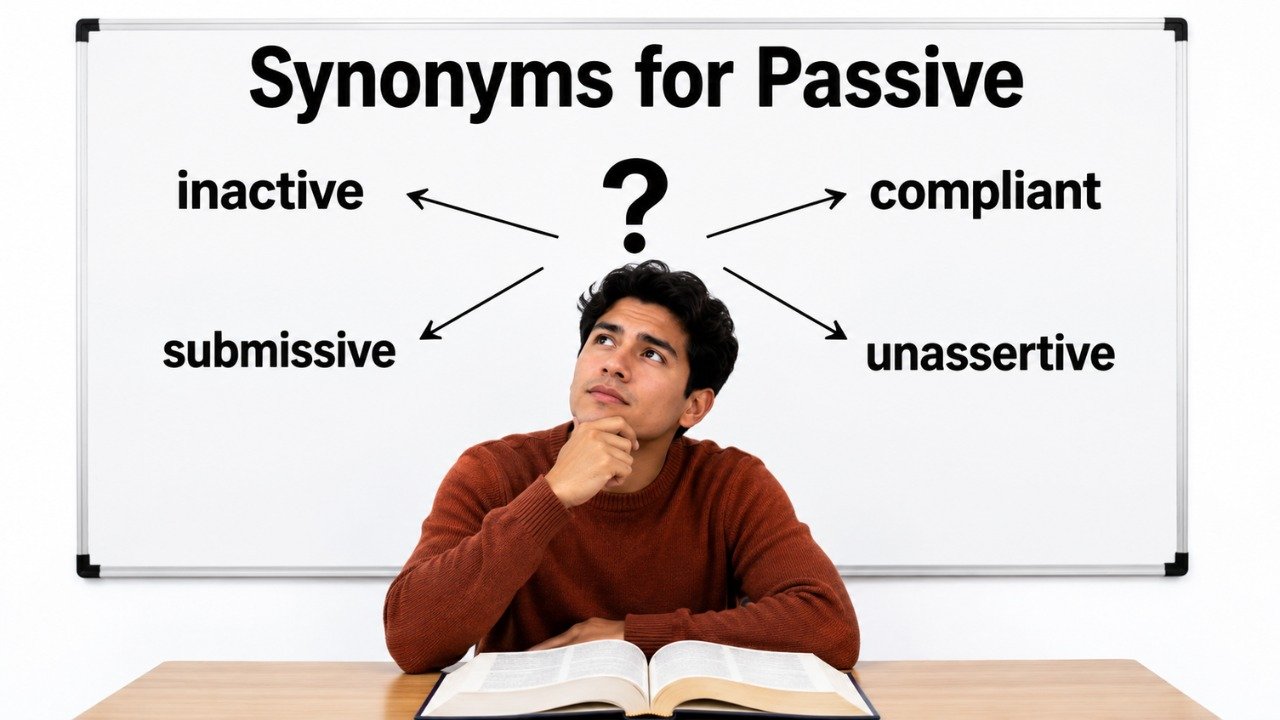
Quick Answer: The best synonyms for passive include inactive, submissive, unassertive, compliant, docile, receptive, indifferent, detached, yielding, and nonresistant. Among these synonyms for passive, inactive is best when describing a lack of action, unassertive fits behavior and communication, compliant or docile describes someone who readily accepts direction, receptive works when something receives rather than produces an effect, and detached or indifferent fits limited emotional involvement. The best choice always depends on the exact meaning and context.
Pronunciation and Word Details
Word: Passive.
Pronunciation: /ˈpæs.ɪv/
Part of Speech: Adjective and noun in grammatical contexts.
Meaning: Not actively participating, resisting, influencing, or taking action, or receiving an action rather than performing it.
US Pronunciation:
UK Pronunciation:
What Does “Passive” Mean?
Passive means not actively taking action, participating, resisting, or influencing what happens.
As an adjective, passive can describe a person who allows events to happen without taking much initiative. It can also describe behavior that avoids confrontation or direct expression.
A passive person may remain quiet instead of expressing an opinion, while a passive role involves receiving or accepting rather than actively directing an event.
In grammar, passive describes a sentence construction in which the subject receives the action rather than performs it.
Behavioral Meaning: Not taking initiative or expressing strong opinions.
Activity Meaning: Not actively functioning, participating, or producing change.
Emotional Meaning: Showing limited involvement, reaction, or interest.
Resistance Meaning: Accepting something without strong opposition.
Grammar Meaning: Receiving the action expressed by the verb.
The exact meaning of passive therefore depends on whether the sentence concerns personality, behavior, activity, resistance, emotion, technology, or grammar.
Meaning, Tone, and Context of “Passive”
Passive is generally a neutral descriptive word, although it can carry a negative tone when used about someone’s behavior or personality.
When describing a person, passive often suggests that the person does not take enough initiative, express opinions clearly, or resist unwanted influence.
In professional communication, passive may describe someone who waits for instructions rather than acting independently.
In emotional contexts, passive can suggest detachment, indifference, or limited involvement.
In academic and technical writing, the word can be neutral. A passive process may simply receive an effect rather than actively produce one.
In grammar, passive is a technical and neutral term referring to passive voice.
Formal Tone: Common in academic, professional, psychological, technical, and grammatical discussions.
Conversational Tone: Natural when describing behavior, involvement, or attitude.
Negative Tone: Possible when passive suggests weakness, lack of initiative, or excessive submission.
Neutral Tone: Appropriate when describing grammatical structures, systems, processes, or roles.
Technical Tone: Often used when something receives energy, action, information, or influence rather than generating it.
When and How to Use “Passive”
For Lack of Action
Use passive when someone or something does not actively participate or take initiative.
Example: He remained passive while the rest of the group searched for a solution.
For Unassertive Behavior
Use passive when someone avoids expressing needs, opinions, or disagreements directly.
Example: Her passive communication style made it difficult for others to understand what she wanted.
For Accepting Control
Use passive when someone readily accepts decisions or instructions without resistance.
Example: The employee took a passive role during the discussion and accepted every suggestion.
For Limited Emotional Involvement
Use passive when a person appears detached or does not react strongly.
Example: His passive response surprised everyone in the room.
For Nonresistance
Use passive when something is accepted without active opposition.
Example: The proposal received passive acceptance from several members.
For Grammar
Use passive when the subject of a sentence receives the action.
Example: In the sentence “The window was opened,” the verb is in the passive voice.
For Technical Processes
Use passive when a system, component, or process works without actively generating or controlling the main action.
Example: The device uses a passive cooling method to release heat.
Best Synonyms for Passive
Inactive: Not taking action or not currently functioning.
Example: The account remained inactive for several months.
Unassertive: Unwilling or unable to express opinions, needs, or preferences confidently.
Example: His unassertive approach allowed others to make every decision.
Submissive: Willing to accept another person’s authority or control.
Example: The character appeared submissive whenever the leader entered the room.
Compliant: Willing to follow instructions, requests, or rules.
Example: The patient was cooperative and compliant throughout the procedure.
Docile: Easily controlled, managed, or directed.
Example: The animal was calm and docile around its handler.
Receptive: Ready to receive ideas, influence, information, or action.
Example: She remained receptive to suggestions from the entire team.
Indifferent: Showing little interest, concern, or emotional involvement.
Example: He seemed indifferent to the outcome of the discussion.
Detached: Emotionally uninvolved or separate from a situation.
Example: She remained detached while everyone else became emotional.
Yielding: Willing to give way rather than resist.
Example: His yielding attitude made compromise easier.
Nonresistant: Not opposing or fighting against something.
Example: The group remained largely nonresistant to the proposed changes.
50 Synonyms for Passive with Short Meanings
- Inactive: Not taking action or functioning actively.
- Unassertive: Not expressing opinions or needs confidently.
- Submissive: Willing to accept another person’s control.
- Compliant: Willing to follow instructions or requests.
- Docile: Easily managed or controlled.
- Receptive: Ready to receive ideas, influence, or action.
- Indifferent: Showing little interest or concern.
- Detached: Emotionally uninvolved or distant.
- Yielding: Willing to give way rather than resist.
- Nonresistant: Not actively opposing something.
- Acquiescent: Willing to accept something without protest.
- Obedient: Willing to follow commands or instructions.
- Meek: Quiet and unwilling to challenge others strongly.
- Timid: Lacking confidence or courage in action.
- Reserved: Restrained in expressing feelings or opinions.
- Quiet: Not highly expressive, active, or forceful.
- Still: Not moving or showing activity.
- Dormant: Temporarily inactive but capable of becoming active.
- Idle: Not currently being used or active.
- Inert: Lacking movement, action, or responsiveness.
- Motionless: Not moving physically.
- Static: Remaining unchanged or inactive.
- Quiescent: Temporarily inactive or at rest.
- Latent: Present but not currently active or visible.
- Unresponsive: Not reacting noticeably to an action or situation.
- Uninvolved: Not actively participating in something.
- Disengaged: Not actively involved or interested.
- Apathetic: Showing little interest, enthusiasm, or concern.
- Uninterested: Lacking interest or active attention.
- Unmotivated: Lacking a strong desire to act.
- Listless: Lacking energy, enthusiasm, or activity.
- Lethargic: Slow and lacking energy or activity.
- Easygoing: Relaxed and unlikely to resist strongly.
- Mild: Gentle and not forceful in manner.
- Pliant: Easily influenced, controlled, or directed.
- Amenable: Willing to accept suggestions or direction.
- Agreeable: Willing to cooperate or accept a proposal.
- Cooperative: Willing to work with others rather than resist.
- Accepting: Willing to receive or tolerate something.
- Tolerant: Willing to allow something without opposition.
- Permissive: Allowing behavior without strong restriction.
- Resigned: Accepting an unwanted situation without further resistance.
- Surrendering: Giving up resistance or control.
- Deferring: Allowing another person to decide or lead.
- Dependent: Relying on others rather than acting independently.
- Observant: Watching rather than directly participating.
- Spectatorial: Relating to watching rather than taking part.
- Responsive: Receiving and reacting rather than initiating action.
- Receiving: Taking in an action, effect, or influence.
- Unauthoritative: Lacking a forceful or commanding manner.
Read Also:
Synonyms for Protest
Synonyms for Passive by Context
When Passive Means Inactive
Useful synonyms include inactive, idle, dormant, inert, static, quiescent, and still.
These words fit situations involving limited physical action, reduced activity, or something that is currently not operating.
Example: The machine remained inactive throughout the weekend.
Example: The volcano had been dormant for a long period.
Example: The system stayed idle until a new request arrived.
When Passive Means Unassertive
Useful synonyms include unassertive, timid, meek, reserved, mild, and quiet.
Use these alternatives when describing someone who does not confidently express needs, opinions, boundaries, or preferences.
Example: His unassertive communication allowed stronger personalities to dominate the meeting.
Example: She was too timid to challenge the decision openly.
When Passive Means Submissive
Useful synonyms include submissive, compliant, docile, acquiescent, obedient, yielding, and pliant.
These words describe someone who accepts control, direction, or authority instead of resisting.
Example: The character became increasingly submissive around the powerful leader.
Example: The committee was surprisingly acquiescent when the proposal was introduced.
When Passive Means Emotionally Uninvolved
Useful synonyms include detached, indifferent, apathetic, uninvolved, disengaged, and uninterested.
Choose these words when passive refers to limited emotional reaction or personal involvement.
Example: His detached response made it difficult to know what he was feeling.
Example: Several participants appeared disengaged during the discussion.
When Passive Means Nonresistant
Useful alternatives include nonresistant, accepting, tolerant, yielding, resigned, and acquiescent.
These terms work when someone allows something to happen rather than actively opposing it.
Example: The residents were largely accepting of the new arrangement.
Example: She became resigned to the decision after several unsuccessful objections.
When Passive Means Receiving an Action
In grammatical or technical contexts, useful related terms include receiving, receptive, affected, and acted upon.
These alternatives emphasize that something receives an action or effect rather than initiating it.
Example: In a passive sentence, the grammatical subject receives the action.
Example: The material acts as a receptive surface rather than an active source.
Another Word for Passive
The best single replacement for passive is often inactive when the meaning involves a lack of action. However, passive has several distinct senses, so another synonym may be more precise.
Use unassertive for communication, submissive for accepting control, detached for limited emotional involvement, receptive for receiving influence, and nonresistant for lack of opposition.
Original: He remained passive during the discussion.
Better Option: He remained unassertive during the discussion.
Original: The organization took a passive approach to the problem.
Better Option: The organization took an inactive approach to the problem.
Original: She gave a passive response to the criticism.
Better Option: She gave a detached response to the criticism.
Original: The group was passive toward the new rules.
Better Option: The group was nonresistant toward the new rules.
When Not to Use “Passive”
Passive can become vague when the sentence does not make clear what kind of inactivity or lack of resistance is intended.
If a person simply lacks confidence when speaking, unassertive may be more accurate.
Weak: She was passive when discussing her salary.
Better: She was unassertive when discussing her salary.
If someone shows no emotional concern, indifferent may communicate the meaning more clearly.
Weak: He seemed passive about the disappointing result.
Better: He seemed indifferent to the disappointing result.
If an object or system is temporarily not operating, inactive or dormant may be more precise.
Weak: The machine has been passive since Monday.
Better: The machine has been inactive since Monday.
Avoid using passive as a general criticism without explaining the behavior involved.
Weak: He is too passive.
Better: He rarely expresses disagreement or takes initiative.
Passive should also not automatically be replaced with submissive. Submissive suggests acceptance of control, which is stronger and more specific than simply being inactive.
Words Commonly Confused With Passive
Passive vs Inactive: Passive often means not taking initiative or actively influencing events. Inactive means not functioning, operating, or participating.
Passive vs Submissive: Passive describes limited action or resistance. Submissive specifically means accepting another person’s authority or control.
Passive vs Unassertive: Passive is broader. Unassertive specifically describes difficulty expressing opinions, needs, or boundaries confidently.
Passive vs Indifferent: Passive describes limited participation or action. Indifferent means lacking interest, concern, or preference.
Passive vs Receptive: Passive can mean receiving rather than initiating action. Receptive has a more positive meaning and suggests openness to ideas, influence, or information.
Passive vs Compliant: Passive suggests limited initiative or resistance. Compliant means willingly following rules, instructions, or requests.
Passive vs Docile: Passive can describe any lack of action. Docile specifically suggests being easily controlled or managed.
Passive vs Apathetic: Passive describes behavior, while apathetic describes a lack of interest, feeling, enthusiasm, or concern.
Passive vs Dormant: Passive may describe behavior, processes, or grammar. Dormant usually describes something temporarily inactive that could become active again.
Which Synonym Should You Choose?
Choose inactive when describing a person, system, account, organization, or process that is not currently taking action.
Choose unassertive when discussing communication, boundaries, workplace behavior, negotiations, or personal interactions.
Choose submissive when someone accepts another person’s authority or control.
Choose compliant when a person willingly follows rules, instructions, standards, or requests.
Choose docile when describing someone or something that is calm and easily controlled.
Choose receptive when passive means open to receiving ideas, information, influence, or an effect.
Choose indifferent when the meaning involves limited emotional interest or concern.
Choose detached when someone remains emotionally separate from a situation.
Choose nonresistant in formal writing when emphasizing the absence of opposition.
Choose dormant when describing something that is temporarily inactive but may become active later.
For essays and reports, inactive, nonresistant, receptive, dormant, and unassertive often provide more precise meanings.
For professional emails, unassertive, receptive, inactive, cooperative, or compliant may be clearer depending on the intended message.
For casual conversation, quiet, inactive, laid back, or unassertive may sound more natural, although each carries a slightly different meaning.
Real Life Examples of “Passive” in Sentences
Original: He remained passive during the entire discussion.
Better Option: He remained unassertive during the entire discussion.
Original: The company took a passive approach to the growing problem.
Better Option: The company took an inactive approach to the growing problem.
Original: She was passive whenever her supervisor made a decision.
Better Option: She was submissive whenever her supervisor made a decision.
Original: The audience appeared passive throughout the presentation.
Better Option: The audience appeared disengaged throughout the presentation.
Original: His passive reaction surprised his friends.
Better Option: His detached reaction surprised his friends.
Original: The system remained passive until it received a signal.
Better Option: The system remained inactive until it received a signal.
Original: The members were passive about the proposed changes.
Better Option: The members were nonresistant to the proposed changes.
Original: Her passive communication made negotiation difficult.
Better Option: Her unassertive communication made negotiation difficult.
Original: The animal was unusually passive around strangers.
Better Option: The animal was unusually docile around strangers.
Original: He became passive after repeated disappointment.
Better Option: He became resigned after repeated disappointment.
Synonym Groups and Usage Differences
Inactivity Group
Inactive, idle, dormant, inert, static, and quiescent describe limited activity.
Inactive is the broadest choice. Idle often means temporarily unused. Dormant suggests the possibility of future activity. Inert emphasizes an inability or lack of tendency to act.
Example: The equipment remained inactive until repairs were completed.
Unassertive Behavior Group
Unassertive, timid, meek, reserved, quiet, and mild describe behavior that lacks forcefulness.
Unassertive is especially useful when discussing communication. Timid suggests fear or lack of courage, while reserved may simply describe a naturally restrained personality.
Example: His unassertive style prevented him from expressing his concerns clearly.
Submission Group
Submissive, compliant, docile, obedient, yielding, acquiescent, and pliant describe acceptance of control or direction.
Submissive emphasizes giving authority to another person. Compliant emphasizes following requirements. Docile suggests being easy to manage.
Example: The normally independent character suddenly became submissive.
Emotional Distance Group
Detached, indifferent, apathetic, uninvolved, disengaged, and uninterested describe reduced emotional or personal involvement.
Detached may be deliberate and neutral. Indifferent suggests not caring about the outcome. Apathetic suggests a deeper lack of interest or enthusiasm.
Example: He sounded detached while discussing the difficult situation.
Acceptance Group
Accepting, nonresistant, yielding, resigned, tolerant, and amenable describe limited opposition.
Accepting can be neutral or positive. Resigned usually suggests accepting something unpleasant because resistance seems useless.
Example: After several discussions, the team became more accepting of the new process.
Receptive Group
Receptive, receiving, responsive, and amenable describe a role focused on receiving ideas, actions, or influence.
Receptive is often more positive than passive because it suggests openness rather than weakness.
Example: The audience was receptive to the speaker’s suggestions.
Antonyms of Passive
The opposite of passive changes according to whether the word refers to activity, confidence, resistance, or grammar.
Active: Taking action or participating directly.
Assertive: Expressing opinions, needs, and boundaries confidently.
Forceful: Showing strong energy, influence, or determination.
Dominant: Exercising control or influence over others.
Energetic: Showing considerable activity or enthusiasm.
Dynamic: Characterized by activity, movement, or change.
Engaged: Actively involved and interested.
Proactive: Taking action before a problem or need requires a response.
Initiative Taking: Willing to begin action without waiting for direction.
Resistant: Actively opposing pressure, influence, or change.
Defiant: Openly resisting authority or expectations.
Independent: Acting without excessive reliance on others.
Expressive: Openly communicating thoughts or feelings.
Responsive: Reacting actively and appropriately to a situation.
Agentive: Acting as the performer or initiator of an action.
Comparison: Passive vs Related Words
Passive vs Inactive
Passive describes a lack of active participation, initiative, or resistance. Inactive specifically means not functioning, operating, or taking part.
Example With Passive: He remained passive while others debated the proposal.
Example With Inactive: His account has been inactive for six months.
Passive vs Unassertive
Passive is broad and can refer to inactivity, acceptance, or receiving an action. Unassertive specifically refers to difficulty expressing opinions, needs, or boundaries confidently.
Example With Passive: She took a passive role in the negotiation.
Example With Unassertive: She was unassertive when explaining what she wanted.
Passive vs Submissive
Passive means not actively resisting or taking initiative. Submissive more strongly suggests allowing someone else to exercise authority or control.
Example With Passive: He remained passive during the disagreement.
Example With Submissive: He became submissive whenever the supervisor challenged him.
Passive vs Compliant
Passive suggests limited action or opposition. Compliant means willing to follow a request, rule, or instruction.
Example With Passive: The group was passive during the policy discussion.
Example With Compliant: The group was compliant with the new safety requirements.
Passive vs Indifferent
Passive describes a lack of action. Indifferent describes a lack of interest, preference, or emotional concern.
Example With Passive: She remained passive as the debate continued.
Example With Indifferent: She was indifferent to which proposal was selected.
Passive vs Receptive
Passive can suggest inactivity or lack of initiative. Receptive means open and willing to receive ideas or information and generally carries a more positive tone.
Example With Passive: The audience played a passive role in the session.
Example With Receptive: The audience was receptive to the new ideas.
Passive vs Docile
Passive describes a broad lack of resistance or initiative. Docile means easily controlled, guided, or managed.
Example With Passive: The participant remained passive throughout the exercise.
Example With Docile: The animal was calm and docile around its caretaker.
Passive vs Apathetic
Passive relates mainly to action or behavior. Apathetic describes a lack of feeling, enthusiasm, or concern.
Example With Passive: He took a passive approach to solving the issue.
Example With Apathetic: He seemed apathetic about whether the issue was ever solved.
Common Phrases and Expressions With Passive
Passive Behavior: Behavior characterized by limited initiative, resistance, or self expression.
Passive Role: A position in which someone receives or observes rather than leads or acts.
Passive Approach: A method involving little direct action or intervention.
Passive Attitude: A mindset that avoids initiative or active involvement.
Passive Response: A reaction that shows little action, resistance, or emotional force.
Passive Acceptance: Allowing something to happen without openly resisting it.
Passive Participation: Limited involvement without taking an active role.
Passive Observer: Someone who watches events without directly participating.
Passive Voice: A grammatical construction in which the subject receives the action.
Passive Resistance: Opposition expressed without direct or forceful confrontation.
Common Mistakes to Avoid
One common mistake is treating passive as identical to lazy. A passive person may avoid initiative or resistance without being unwilling to work. Lazy specifically suggests avoiding effort.
Another mistake is using submissive as an automatic replacement. Submissive is stronger because it implies accepting another person’s control or authority.
Do not confuse passive with indifferent. A person may care deeply about an issue but still behave passively.
Avoid replacing passive with inactive in every context. Inactive works well for systems, accounts, organizations, and activities, but it may not capture unassertive behavior.
Be careful when discussing grammar. Passive voice is a grammatical structure, not simply weak or unclear writing.
Repetition can also reduce clarity.
Repetitive: His passive attitude created a passive response from a passive group.
Improved: His unassertive attitude produced little resistance from an otherwise disengaged group.
Avoid vague statements such as “She is passive” when a more exact description is available.
Vague: She is passive at work.
Clearer: She rarely expresses disagreement or volunteers to lead projects at work.
Choosing the synonym that matches the intended meaning makes writing more accurate and prevents unfair or unclear descriptions.
Conclusion
Synonyms for passive include inactive, unassertive, submissive, compliant, docile, receptive, indifferent, detached, yielding, and nonresistant. Use inactive for lack of activity, unassertive for hesitant communication, submissive for accepting control, detached or indifferent for emotional distance, and receptive when someone or something receives ideas or influence. Because passive has several meanings, the strongest replacement depends on the sentence. Choosing a precise synonym makes descriptions clearer, more natural, and more accurate in conversation, essays, reports, and professional writing.
FAQs About Synonyms for Passive
What Is the Best Synonym for Passive?
Inactive is one of the best general synonyms when passive means not taking action. For behavior, unassertive may be more accurate.
What Is Another Word for Passive?
Another word for passive can be inactive, submissive, compliant, unassertive, receptive, detached, or nonresistant, depending on context.
What Is a Stronger Word for Passive?
Submissive is stronger when someone accepts another person’s control. Apathetic is stronger when the meaning involves a serious lack of interest or concern.
What Is a Professional Synonym for Passive?
Inactive, unassertive, receptive, nonresistant, disengaged, and compliant can work in professional writing when their meanings fit the situation.
What Is a Synonym for a Passive Person?
Unassertive, submissive, quiet, meek, yielding, or reserved may describe a passive person, although each word emphasizes a different behavior.
Is Passive the Same as Inactive?
Not always. Inactive means not operating or participating, while passive can also describe someone who does not take initiative, resist, or express opinions strongly.
What Is the Opposite of Passive?
Common opposites include active, assertive, proactive, dynamic, engaged, forceful, resistant, and independent.
