
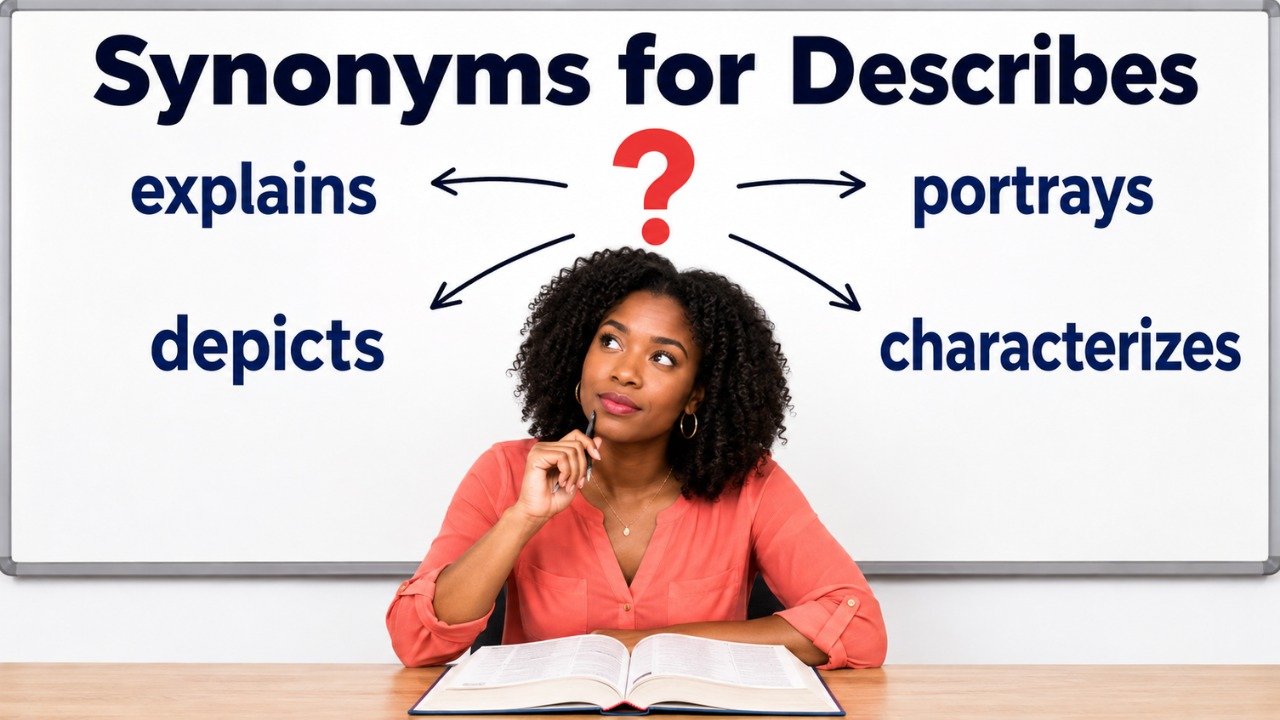
Quick Answer: The best synonyms for describes include depicts, portrays, explains, outlines, details, defines, characterizes, illustrates, represents, and recounts. The best choice depends on context. Use depicts or portrays for appearance, scenes, people, or creative writing. Use explains when making an idea easier to understand. Use outlines for a brief summary, details for precise information, defines for meaning, characterizes for distinctive qualities, illustrates for examples, represents for symbolic meaning, and recounts for events or experiences.
Pronunciation and Word Details
Word: Describes
Pronunciation: /dɪˈskraɪbz/
Part of Speech: Verb, third person singular present form of describe
Meaning: Tells, explains, or gives details about the qualities, appearance, nature, events, or features of someone or something.
US Pronunciation:
UK Pronunciation:
What Does “Describes” Mean?
Describes means gives information about what someone or something is like.
The word is a verb and is the third person singular present form of describe. It is commonly used when a person, text, report, story, image, or statement communicates details about an object, event, experience, person, process, or idea.
For example, a writer describes a landscape by mentioning its colors, shapes, atmosphere, and surroundings. A teacher describes a process by explaining its steps. A report describes an event by presenting relevant facts.
The meaning can therefore change slightly according to context. It may mean portrays something visually, explains something clearly, defines a concept, lists characteristics, or recounts an experience.
Example: The guide describes the route through the forest.
Here, describes means gives information about the route.
Example: The novel describes the character as patient and thoughtful.
Here, describes means presents the character’s qualities.
Example: The report describes how the system operates.
In this sentence, describes means explains.
Meaning, Tone, and Context of “Describes”
Describes is usually a neutral and widely appropriate word. It appears naturally in everyday conversation, academic writing, professional communication, literature, reports, instructions, reviews, and educational material.
The word itself is neither strongly emotional nor highly formal. Its tone depends largely on the subject and surrounding language.
In academic writing, describes often introduces information about a theory, method, finding, process, or condition.
Example: The study describes the stages of language development.
In descriptive writing, it can refer to sensory or visual detail.
Example: The author describes the valley as peaceful and green.
In professional writing, it may introduce duties, processes, policies, or situations.
Example: The document describes the responsibilities of each team member.
In conversation, it can simply mean telling someone what a person, place, event, or object is like.
Example: She describes her new neighborhood as quiet and welcoming.
Because describes is broad, a more precise synonym can sometimes make a sentence clearer. Portrays emphasizes representation, explains emphasizes understanding, outlines emphasizes main points, and details emphasizes specific information.
When and How to Use “Describes”
For Appearance: Use describes when giving information about how someone or something looks.
Example: The witness describes the vehicle as small and dark.
For Characteristics: Use it when identifying important qualities or traits.
Example: The teacher describes Maya as curious and dependable.
For Processes: Use describes when explaining what happens or how something works.
Example: The manual describes how the device operates.
For Events: Use it when telling what happened during an experience or situation.
Example: His journal describes the journey across the mountains.
For Academic Information: Use describes when presenting facts, findings, methods, or concepts without necessarily analyzing them.
Example: The first section describes the research method.
For Creative Writing: Use describes when a writer creates a clear picture through words.
Example: The story describes a silent town surrounded by snow.
For Definitions: Describes can introduce the nature or meaning of an idea, although defines may be more precise when giving an exact meaning.
Example: The chapter describes courage as the willingness to act despite fear.
For Reports: Use it when a document gives factual information about a condition, event, problem, or result.
Example: The report describes several changes in customer behavior.
Best Synonyms for Describes
Depicts: Shows or represents someone or something through words, pictures, or another form of expression.
Example: The painting depicts a busy market at sunrise.
Portrays: Presents a person, situation, or idea in a particular way.
Example: The novel portrays its hero as intelligent but impatient.
Explains: Makes an idea, process, or situation easier to understand.
Example: The guide explains how the registration process works.
Outlines: Gives the main points without extensive detail.
Example: The introduction outlines the purpose of the project.
Details: Gives precise or complete information about something.
Example: The report details every stage of the investigation.
Defines: States the exact meaning, nature, or limits of something.
Example: The glossary defines each technical term clearly.
Characterizes: Identifies the typical or distinctive qualities of someone or something.
Example: The researcher characterizes the period as one of rapid change.
Illustrates: Explains or clarifies something through an example, image, or comparison.
Example: The diagram illustrates how water moves through the system.
Represents: Shows, stands for, or expresses something in a particular form.
Example: The symbol represents peace and cooperation.
Recounts: Tells about events or experiences, usually in the order they happened.
Example: The memoir recounts her experiences during childhood.
50 Synonyms for Describes with Short Meanings
- Depicts: Shows something through words or images.
- Portrays: Presents someone or something in a particular way.
- Explains: Makes something understandable.
- Outlines: Presents the main points briefly.
- Details: Gives specific information.
- Defines: States the meaning or nature of something.
- Characterizes: Identifies distinctive qualities.
- Illustrates: Makes something clearer through examples or images.
- Represents: Shows or stands for something.
- Recounts: Tells about events or experiences.
- Presents: Introduces or shows information in a particular way.
- Pictures: Creates a mental or visual image.
- Narrates: Tells a story or sequence of events.
- Relates: Tells or communicates an event or experience.
- Reports: Gives factual information about something.
- States: Expresses information clearly in words.
- Expresses: Communicates an idea, feeling, or quality.
- Specifies: States something precisely.
- Identifies: Names or recognizes particular qualities or features.
- Lists: Gives information as a series of items.
- Enumerates: Mentions items individually and systematically.
- Summarizes: Gives the main information briefly.
- Elaborates: Provides additional explanation or detail.
- Expounds: Explains an idea thoroughly.
- Clarifies: Makes meaning easier to understand.
- Interprets: Explains the meaning or significance of something.
- Accounts For: Gives an explanation or description of something.
- Chronicles: Records events over a period of time.
- Documents: Records information or events carefully.
- Records: Preserves information in written or another lasting form.
- Profiles: Gives a detailed description of a person or subject.
- Sketches: Gives a brief general description.
- Traces: Describes development or movement over time.
- Maps: Shows the structure, course, or arrangement of something.
- Captures: Represents an important quality or impression effectively.
- Conveys: Communicates an idea, impression, or feeling.
- Communicates: Makes information or meaning known.
- Articulates: Expresses something clearly in words.
- Formulates: Expresses an idea carefully and systematically.
- Frames: Presents information from a particular perspective.
- Designates: Identifies or names something for a particular purpose.
- Labels: Gives a descriptive name or category.
- Classifies: Places something into a category based on its qualities.
- Qualifies: Describes something more precisely by adding limits or details.
- Evaluates: Describes and judges qualities or value.
- Observes: Notes and communicates something noticed.
- Mentions: Refers to something briefly.
- Indicates: Shows or points to a particular fact or quality.
- Shows: Makes a quality, fact, or condition clear.
- Conveys the Nature of: Communicates what something is essentially like.
Read Also:
Synonyms for Meticulous
Synonyms for Describes by Context
When Describes Means Gives a Visual Picture
Depicts, portrays, pictures, captures, and illustrates work well when language or imagery creates a clear impression of appearance, scenery, or action.
Depicts: Best when something is shown visually or vividly.
Example: The mural depicts families gathering near the river.
Portrays: Useful when presenting a person or situation in a particular way.
Example: The biography portrays the scientist as intensely curious.
Pictures: Suggests creating a mental image.
Example: The poem pictures the countryside in early spring.
Captures: Emphasizes successfully communicating an atmosphere, appearance, or quality.
Example: The photograph captures the calm mood of the morning.
When Describes Means Explains
Explains, clarifies, expounds, elaborates, interprets, and articulates are stronger when the goal is understanding rather than simple description.
Explains: Best for making a process or idea easier to understand.
Example: The instructor explains why the reaction occurs.
Clarifies: Best when removing confusion.
Example: The final paragraph clarifies the writer’s main argument.
Elaborates: Best when adding more information.
Example: The speaker elaborates on the reasons for the change.
Interprets: Best when explaining meaning or significance.
Example: The critic interprets the scene as a symbol of freedom.
When Describes Means Gives Main Points
Outlines, summarizes, sketches, and presents are useful when only the essential information is needed.
Outlines: Gives the major points or structure.
Example: The proposal outlines the planned improvements.
Summarizes: Reduces information to its most important parts.
Example: The conclusion summarizes the main findings.
Sketches: Gives a brief general description.
Example: The opening chapter sketches the historical background.
When Describes Means Gives Precise Details
Details, specifies, identifies, enumerates, and documents work well when accuracy and specific information matter.
Details: Gives thorough information.
Example: The report details the costs associated with the project.
Specifies: States an exact requirement, fact, or feature.
Example: The contract specifies the date on which payment is due.
Identifies: Points out a particular person, feature, cause, or quality.
Example: The analysis identifies three major concerns.
Enumerates: Lists individual points systematically.
Example: The document enumerates the responsibilities of each department.
When Describes Means Tells About Events
Recounts, narrates, chronicles, relates, and reports are useful for actions, experiences, and events.
Recounts: Tells what happened, often from personal experience.
Example: She recounts her first experience of living abroad.
Narrates: Tells a connected sequence of events.
Example: The narrator describes, or narrates, the events from the child’s perspective.
Chronicles: Records developments over time.
Example: The book chronicles the growth of the town.
Reports: Gives factual information about an event.
Example: The article reports the results of the meeting.
When Describes Means Identifies Qualities
Characterizes, defines, classifies, labels, and qualifies are useful when focusing on traits, categories, or defining features.
Characterizes: Highlights typical qualities.
Example: The author characterizes the movement as energetic and experimental.
Defines: Establishes exact meaning or nature.
Example: The policy defines acceptable conduct.
Classifies: Places something into a group according to shared features.
Example: The system classifies the material as recyclable.
Another Word for Describes
A strong general replacement for describes is explains, but it is not appropriate in every sentence. The best alternative depends on whether the sentence focuses on appearance, information, characteristics, events, meaning, or detail.
Use portrays for representation, details for precise information, outlines for main points, and recounts for events.
Original: The report describes the causes of the problem.
Better Option: The report explains the causes of the problem.
Original: The story describes the king as generous but cautious.
Better Option: The story portrays the king as generous but cautious.
Original: The document describes each stage of the process.
Better Option: The document details each stage of the process.
Original: The introduction describes the main goals of the program.
Better Option: The introduction outlines the main goals of the program.
When Not to Use “Describes”
Describes is useful, but it can become repetitive or too general when a more precise verb would communicate the intended meaning better.
If the sentence explains why or how something happens, explains may be more accurate.
Weak: The teacher describes why the seasons change.
Better: The teacher explains why the seasons change.
When only the main points are given, outlines may be more precise.
Weak: The opening section describes the three goals of the project.
Better: The opening section outlines the three goals of the project.
When a text gives extensive factual information, details can sound stronger.
Weak: The report describes every expense from the previous month.
Better: The report details every expense from the previous month.
When a creative work presents someone in a certain way, portrays can improve precision.
Weak: The film describes the main character as lonely and uncertain.
Better: The film portrays the main character as lonely and uncertain.
When events are told as a story, recounts or narrates may fit better.
Weak: The memoir describes what happened during her journey.
Better: The memoir recounts what happened during her journey.
Avoid replacing describes automatically. A synonym should match the exact relationship between the subject and the information being communicated.
Words Commonly Confused With Describes
Describes vs Explains: Describes tells what something is like, while explains usually tells how or why something happens.
Example: The article describes the machine’s appearance but explains how the machine works.
Describes vs Defines: Describes gives characteristics or details, while defines states an exact meaning or establishes what something is.
Example: The paragraph describes leadership, while the glossary defines the term leadership.
Describes vs Depicts: Describes usually communicates information through words, while depicts often suggests a visual, artistic, or vivid representation.
Example: The author describes the village, while the illustration depicts it.
Describes vs Portrays: Describes gives information about someone or something, while portrays emphasizes how that subject is presented.
Example: The biography describes his early life and portrays him as highly determined.
Describes vs Outlines: Describes can include many details, while outlines focuses mainly on essential points or structure.
Example: The report describes the project in depth, while the summary outlines its major stages.
Describes vs Details: Describes is broad, while details specifically suggests providing thorough and precise information.
Example: The introduction describes the plan, while the appendix details its costs.
Describes vs Illustrates: Describes communicates qualities through words, while illustrates often clarifies an idea using an example, image, or comparison.
Example: The text describes the principle, and the diagram illustrates how it works.
Which Synonym Should You Choose?
Choose depicts when referring to an image, scene, artwork, or vivid representation.
Choose portrays when explaining how a person, character, situation, or group is presented.
Choose explains when helping readers understand how or why something happens.
Choose outlines when giving only the main ideas, stages, goals, or points.
Choose details when providing complete or specific information.
Choose defines when stating the exact meaning or nature of a term.
Choose characterizes when identifying distinctive qualities or typical features.
Choose illustrates when an example, comparison, diagram, or image makes an idea clearer.
Choose recounts when telling about an event or personal experience.
Choose narrates when telling a sequence of connected events as a story.
Choose reports for factual or professional communication about events, findings, or conditions.
Choose summarizes when presenting only the most important information.
For essays and academic writing, explains, outlines, characterizes, illustrates, defines, and details often provide greater precision.
For reports, use details, reports, documents, specifies, or identifies depending on the information.
For creative writing, depicts, portrays, captures, pictures, and narrates can create stronger imagery.
For everyday conversation, describes, explains, tells, and portrays are usually natural choices.
Real Life Examples of “Describes” in Sentences
Original: The brochure describes the hotel as peaceful and comfortable.
Better Option: The brochure portrays the hotel as peaceful and comfortable.
Original: The teacher describes how the digestive system works.
Better Option: The teacher explains how the digestive system works.
Original: The report describes all the expenses from the project.
Better Option: The report details all the expenses from the project.
Original: The introduction describes the main topics covered in the book.
Better Option: The introduction outlines the main topics covered in the book.
Original: The story describes the city as crowded and energetic.
Better Option: The story depicts the city as crowded and energetic.
Original: The biography describes the leader as patient and disciplined.
Better Option: The biography characterizes the leader as patient and disciplined.
Original: The memoir describes his experiences during the long journey.
Better Option: The memoir recounts his experiences during the long journey.
Original: The diagram describes the movement of air through the system.
Better Option: The diagram illustrates the movement of air through the system.
Original: The policy describes acceptable workplace behavior.
Better Option: The policy defines acceptable workplace behavior.
Original: The article describes the events that occurred during the evening.
Better Option: The article reports the events that occurred during the evening.
Synonym Groups and Usage Differences
Visual Description Group
Depicts, portrays, pictures, captures, and represents belong to this group.
These words are useful when the focus is on how something looks, appears, or is presented.
Portrays is especially common for characters or people. Depicts works well for scenes and visual representations. Captures suggests successfully communicating an important quality or atmosphere.
Example: The portrait captures the confidence in her expression.
Explanation Group
Explains, clarifies, elaborates, expounds, interprets, and articulates focus on meaning and understanding.
Explains is the broadest option. Clarifies removes uncertainty. Elaborates adds more detail. Interprets gives meaning to information, language, art, or events.
Example: The final section clarifies why the change was necessary.
Summary Group
Outlines, summarizes, sketches, and presents are useful for condensed information.
Outlines emphasizes structure and main points. Summarizes reduces a longer discussion to its essential information. Sketches suggests a brief general description.
Example: The opening paragraph outlines the argument.
Detailed Information Group
Details, specifies, enumerates, documents, records, and identifies focus on precision.
Details suggests thorough information. Specifies gives exact requirements or facts. Enumerates presents individual items. Documents suggests careful recording.
Example: The agreement specifies the responsibilities of both parties.
Storytelling Group
Recounts, narrates, chronicles, relates, and reports can all communicate events, but their purposes differ.
Recounts often refers to past experiences. Narrates emphasizes storytelling. Chronicles records events over time. Reports emphasizes factual communication.
Example: The historian chronicles the region’s development over several generations.
Characteristics Group
Characterizes, defines, classifies, labels, and qualifies focus on what something is or what qualities it possesses.
Characterizes emphasizes distinctive features. Defines gives exact meaning. Classifies places something within a category.
Example: The researcher characterizes the behavior as unusually cautious.
Antonyms of Describes
The opposite of describes depends on the intended meaning. A person can describe by providing information, revealing features, explaining details, or making something clear. Opposite words therefore often involve hiding, confusing, omitting, or misrepresenting information.
Conceals: Keeps information or characteristics hidden.
Hides: Prevents something from being seen or known.
Omits: Leaves out information that could have been included.
Withholds: Deliberately does not provide information.
Obscures: Makes information difficult to understand or recognize.
Confuses: Makes meaning less clear.
Misrepresents: Presents someone or something inaccurately.
Distorts: Changes information so that it gives a misleading impression.
Disguises: Makes the true nature of something difficult to recognize.
Suppresses: Prevents information from being expressed or revealed.
Comparison: Describes vs Related Words
Describes vs Depicts
Describes is broad and usually refers to giving information about qualities, appearance, events, or features. Depicts emphasizes representation and is particularly natural for images, scenes, art, and vivid writing.
Example With Describes: The article describes life in the coastal village.
Example With Depicts: The painting depicts life in the coastal village.
Describes vs Portrays
Describes communicates information about something. Portrays emphasizes the way a person, character, group, or situation is presented.
Example With Describes: The biography describes the politician’s early career.
Example With Portrays: The biography portrays the politician as ambitious and disciplined.
Describes vs Explains
Describes answers questions such as what is it like or what happened. Explains more often answers how or why.
Example With Describes: The manual describes the control panel.
Example With Explains: The manual explains how to operate the control panel.
Describes vs Details
Describes can contain either general or specific information. Details strongly suggests precise, extensive, or complete information.
Example With Describes: The report describes the company’s plan.
Example With Details: The report details every stage of the company’s plan.
Describes vs Outlines
Describes may include extensive information, while outlines gives the major points or basic structure.
Example With Describes: The chapter describes the development of the program.
Example With Outlines: The introduction outlines the program’s main objectives.
Describes vs Defines
Describes tells what something is like. Defines establishes exactly what a word, concept, rule, or category means.
Example With Describes: The passage describes effective teamwork.
Example With Defines: The handbook defines teamwork as cooperative effort toward a shared goal.
Describes vs Illustrates
Describes communicates information directly, usually through language. Illustrates makes an idea clearer through an example, comparison, diagram, or image.
Example With Describes: The text describes the effect of pressure on the material.
Example With Illustrates: The chart illustrates the effect of pressure on the material.
Common Phrases and Expressions With Describes
Describes a Person: Gives information about someone’s appearance, personality, behavior, or qualities.
Describes a Situation: Explains what circumstances are like.
Describes a Process: Gives information about how a series of actions occurs.
Describes an Experience: Tells what an event or personal experience was like.
Describes the Problem: Gives information about the nature, causes, or features of a difficulty.
Describes the Relationship: Explains how two or more things or people are connected.
Describes the Difference: Explains how two things are not the same.
Describes the Appearance: Gives information about how something looks.
Describes the Results: Communicates what an investigation, test, experiment, or activity produced.
Describes the Character: Explains a person’s or fictional figure’s traits, personality, or behavior.
Common Mistakes to Avoid
One common mistake is using describes repeatedly when several sentences discuss different kinds of communication. Replacing it with a more precise word can improve clarity and vocabulary variety.
Repetitive: The introduction describes the issue. The next section describes the causes. The final section describes possible solutions.
Improved: The introduction presents the issue. The next section explains the causes. The final section outlines possible solutions.
Another mistake is treating every synonym as interchangeable. Depicts, explains, defines, outlines, and recounts all overlap with describes, but they express different relationships.
Use depicts for representation, explains for understanding, defines for exact meaning, outlines for main points, and recounts for events.
Avoid using portrays when the subject is simply explaining a technical procedure.
Unnatural: The manual portrays how the engine operates.
Better: The manual explains how the engine operates.
Do not use details when only a brief summary is given.
Unclear: The introduction details the report’s purpose in one short sentence.
Better: The introduction states the report’s purpose in one short sentence.
Be careful with describe and describes. Describes is used with a third person singular subject in the present tense.
Correct: The article describes the problem.
Correct: The articles describe the problem.
Incorrect: The articles describes the problem.
Avoid vague description when readers need exact information. If the subject specifies a date, amount, requirement, rule, or condition, specifies may communicate greater precision.
Vague: The agreement describes when payment is required.
Better: The agreement specifies when payment is required.
Finally, choose synonyms according to meaning rather than simply to avoid repetition. Vocabulary variety is useful only when the replacement accurately communicates the intended idea.
Conclusion
Synonyms for describes help writers communicate different kinds of description with greater accuracy. Use depicts or portrays for visual or creative representation, explains for ideas and processes, outlines for main points, details for precise information, defines for exact meanings, characterizes for distinctive qualities, illustrates for examples or visuals, and recounts for events. Because describes has a broad meaning, choosing a more specific synonym can make essays, reports, stories, instructions, and everyday communication clearer and more natural.
FAQs About Synonyms for Describes
What Is the Best Synonym for Describes?
The best general synonyms include depicts, portrays, explains, outlines, details, and characterizes. The strongest choice depends on what is being described.
What Is Another Word for Describes in an Essay?
Explains, presents, outlines, illustrates, characterizes, and details are useful choices in essays. Select the word that accurately reflects what the source or writer is doing.
What Is a Formal Synonym for Describes?
Characterizes, delineates, specifies, articulates, documents, and illustrates can work in formal contexts, depending on the intended meaning.
Is Explains a Synonym for Describes?
Yes, in some contexts. Explains is better when the purpose is to make something understandable, especially when discussing how or why something happens.
What Is a Synonym for Describes a Person?
Portrays and characterizes are strong choices. Portrays focuses on how the person is presented, while characterizes focuses on distinctive qualities or personality traits.
What Is a Synonym for Describes an Event?
Recounts, narrates, reports, chronicles, and relates can replace describes when discussing events. Recounts and narrates are especially useful for storytelling.
What Is the Difference Between Describes and Depicts?
Describes usually means giving information about something, often through words. Depicts emphasizes showing or representing something, especially through an image, artwork, scene, or vivid written description.
