
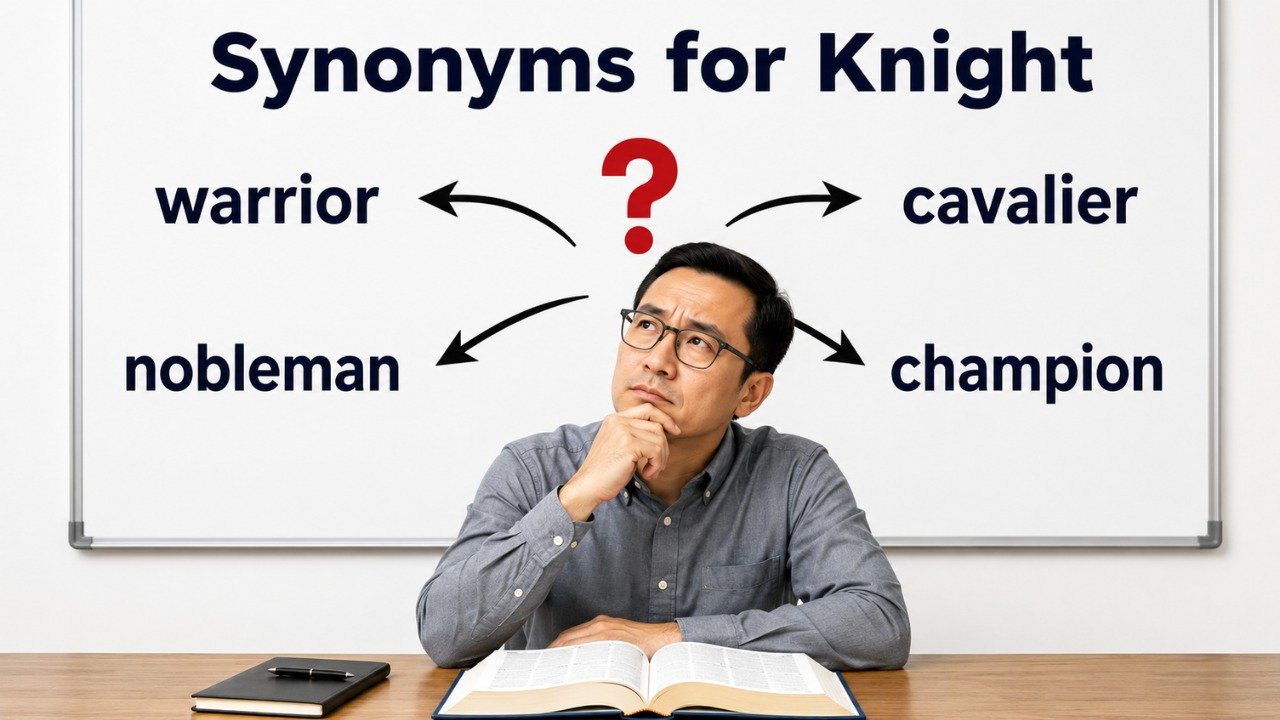
Quick Answer: The best synonyms for knight include warrior, horseman, cavalryman, champion, defender, protector, guardian, paladin, cavalier, and swordsman. Use warrior for a broad fighter, horseman or cavalryman for a mounted soldier, champion for someone who fights for a person or cause, defender or protector for someone who guards others, and paladin for a heroic or chivalrous warrior. In historical writing, knight should often remain unchanged because it refers to a specific social and military rank.
Pronunciation and Word Details
Word: Knight
Pronunciation: /naɪt/
Part of Speech: Noun
Meaning: A knight is traditionally a mounted warrior of noble rank, especially in medieval society, and can also mean a person honored with the title of knight or a chess piece shaped like a horse.
US Pronunciation:
UK Pronunciation:
What Does “Knight” Mean?
A knight is traditionally a warrior who served a ruler or noble person, often fighting on horseback and following ideals connected with courage, loyalty, and chivalry.
Part of Speech: Knight is mainly used as a noun. It can also function as a verb when someone is formally given the rank or title of knight.
In historical contexts, the word usually refers to a trained medieval fighter who belonged to a recognized military and social class.
In descriptions of character, knight can suggest a brave protector, defender, champion, or heroic figure.
In chess, the knight is the piece that moves in an L shaped pattern and can jump over other pieces.
In modern figurative language, someone may be described as a knight when that person behaves courageously, protects others, or comes to someone’s aid.
Historical Use: The knight rode into battle with the other warriors.
Figurative Use: She saw him as a knight who defended people who had no voice.
Chess Use: He moved his knight toward the center of the board.
Meaning, Tone, and Context of “Knight”
The word knight has a mainly historical and formal tone when it refers to medieval society.
Historical Tone: Knight is precise when discussing medieval warfare, nobility, castles, rulers, military service, or chivalry.
Heroic Tone: In stories and figurative descriptions, knight can sound noble, courageous, romantic, or heroic.
Literary Tone: Writers often use knight when creating settings involving quests, kingdoms, battles, honor, or legendary heroes.
Formal Tone: The word may refer to an officially recognized title granted to a person.
Conversational Tone: Knight is less common in ordinary speech unless someone is discussing history, chess, fantasy stories, or using the word figuratively.
Technical Context: In chess, knight has a precise meaning and should not normally be replaced with warrior, horseman, or another synonym.
Because knight has several distinct meanings, the most accurate synonym depends heavily on context.
When and How to Use “Knight”
For Medieval Warriors
Use knight when referring to a historical warrior belonging to the knightly class.
Example: The knight guarded the entrance to the castle.
For Mounted Fighters
Use knight when the emphasis is on a trained warrior who traditionally fought on horseback.
Example: The knight rode across the battlefield in armor.
For Chivalrous Heroes
Use knight when describing someone associated with courage, loyalty, honor, or heroic service.
Example: The young knight promised to protect the village.
For Protectors
Knight can be used figuratively for someone who comes to another person’s defense.
Example: He became her knight during the difficult dispute.
For Formal Titles
Use knight when referring to a person who has received the official title.
Example: The respected public figure was made a knight.
For Chess
Use knight for the chess piece represented by a horse shaped figure.
Example: She moved her knight to attack the opposing queen.
Best Synonyms for Knight
Warrior
Synonym: A person trained or experienced in fighting.
Example: The warrior defended the kingdom from invading forces.
Horseman
Synonym: A person skilled at riding a horse, especially in a historical military context.
Example: The horseman rode quickly toward the fortress.
Cavalryman
Synonym: A soldier who fights as part of a mounted military force.
Example: The cavalryman crossed the field with his unit.
Champion
Synonym: A person who fights for, represents, or strongly supports someone or something.
Example: The champion defended the people against injustice.
Defender
Synonym: Someone who protects a person, place, principle, or group.
Example: The defender stood at the gate throughout the night.
Protector
Synonym: A person who keeps someone or something safe.
Example: The protector remained close to the royal family.
Guardian
Synonym: Someone responsible for protecting or watching over another person or place.
Example: The guardian watched over the ancient fortress.
Paladin
Synonym: A heroic warrior known for courage, honor, and devotion to a cause.
Example: The paladin fought bravely for the kingdom.
Cavalier
Synonym: A mounted fighter or gentleman associated with military skill and confident behavior.
Example: The cavalier rode confidently into the courtyard.
Swordsman
Synonym: A person skilled in fighting with a sword.
Example: The swordsman defeated his opponent in combat.
50 Synonyms for Knight with Short Meanings
Not every word below is an exact historical replacement for knight. Some are close alternatives for particular meanings such as warrior, mounted fighter, protector, noble hero, or champion.
- Warrior: A person who fights in battles or conflicts.
- Horseman: A person skilled in riding horses.
- Cavalryman: A soldier belonging to a mounted fighting force.
- Champion: A fighter or strong supporter of a person or cause.
- Defender: Someone who protects against attack or harm.
- Protector: A person who keeps others safe.
- Guardian: Someone who watches over or protects others.
- Paladin: A heroic and honorable warrior.
- Cavalier: A mounted warrior or gentleman soldier.
- Swordsman: A fighter skilled with a sword.
- Fighter: A person who takes part in combat.
- Soldier: A trained member of an armed force.
- Combatant: A person actively involved in fighting.
- Man at Arms: A trained medieval fighting man.
- Lancer: A mounted soldier armed with a lance.
- Spearman: A warrior who fights with a spear.
- Rider: A person who travels or fights on horseback.
- Mounted Warrior: A fighter who battles while riding a horse.
- Mounted Soldier: A soldier trained to fight on horseback.
- Armored Warrior: A fighter protected by battle armor.
- Noble Warrior: A warrior associated with noble rank or conduct.
- Royal Warrior: A fighter serving a ruler or royal household.
- Retainer: A person serving a noble household or ruler.
- Vassal: A person who historically served a lord in return for protection or land.
- Liegeman: A loyal follower owing service to a lord.
- Servitor: A person who serves another, especially in an older context.
- Man of Arms: A person trained for military service.
- Guardian Warrior: A fighter whose main role is protection.
- Royal Guard: A protector serving a ruler or royal household.
- Bodyguard: A person assigned to protect someone from danger.
- Sentinel: A person stationed to watch and guard.
- Watchman: Someone responsible for guarding a place.
- Warden: A person responsible for protecting or supervising a place.
- Custodian: Someone responsible for guarding or caring for something.
- Hero: A courageous person admired for brave actions.
- Rescuer: A person who saves others from danger.
- Savior: Someone who rescues another person from serious danger.
- Advocate: A person who strongly supports or defends a cause.
- Supporter: Someone who gives help or backing.
- Ally: A person who supports another in conflict or difficulty.
- Standard Bearer: A person who carries a military standard or represents a cause.
- Crusader: A determined fighter or campaigner for a cause.
- Gallant: A brave and honorable person.
- Heroic Fighter: A courageous person engaged in battle.
- Chivalrous Warrior: A fighter associated with courtesy and honor.
- Noble Defender: A protector characterized by honor or high status.
- Sworn Defender: Someone committed by duty or promise to protection.
- Royal Champion: A fighter representing or defending a ruler.
- Armed Retainer: A trained fighter serving a noble household.
- Battle Companion: A trusted companion who fights alongside others.
Read Also:
Synonyms for Describes
Synonyms for Knight by Context
When Knight Means a Medieval Warrior
The strongest alternatives emphasize military training, combat, weapons, and historical service.
Warrior: Best for a broad historical fighter.
Man at Arms: Useful for a trained medieval soldier.
Swordsman: Best when sword fighting is important.
Lancer: Best when the fighter uses a lance.
Example: The knight defended the castle walls.
Alternative: The warrior defended the castle walls.
When Knight Means a Mounted Fighter
These alternatives emphasize horseback fighting.
Horseman: Focuses on riding skill.
Cavalryman: Refers to a member of mounted military forces.
Mounted Warrior: Clearly describes a fighter on horseback.
Mounted Soldier: Useful in military descriptions.
Example: The knight charged across the open field.
Alternative: The mounted warrior charged across the open field.
When Knight Means a Heroic Protector
When knight is being used figuratively, protector based words are often stronger.
Protector: Someone who keeps another person safe.
Guardian: Someone who watches over another person or place.
Defender: Someone who resists danger or attack.
Champion: Someone who fights for another person or cause.
Example: He acted like a knight when the family needed protection.
Alternative: He acted like a protector when the family needed help.
When Knight Suggests Honor and Chivalry
These alternatives emphasize bravery, nobility, courage, or devotion.
Paladin: A heroic warrior strongly associated with honor.
Champion: Someone who fights for a noble purpose.
Gallant: A courageous and honorable person.
Noble Warrior: A descriptive alternative emphasizing dignity.
Example: The knight remained loyal despite the danger.
Alternative: The paladin remained loyal despite the danger.
When Knight Refers to Chess
There is no natural general synonym for the chess meaning of knight.
Best Choice: Keep knight.
Example: Move the knight before advancing the pawn.
Calling a chess knight a warrior, horseman, or cavalryman would usually sound incorrect because knight is the established name of the chess piece.
Another Word for Knight
The best single replacement for knight is often warrior, but the ideal alternative depends on what knight means in the sentence.
Warrior works well when the main idea is combat. Protector is better when the focus is safety. Champion is stronger when the person fights for a cause, while horseman or cavalryman fits mounted military contexts.
Original: The knight rode toward the enemy.
Better Option: The mounted warrior rode toward the enemy.
Original: The knight protected the villagers.
Better Option: The defender protected the villagers.
Original: He became a knight for those who needed help.
Better Option: He became a champion for those who needed help.
Original: The knight fought skillfully with his sword.
Better Option: The swordsman fought skillfully with his blade.
When Not to Use “Knight”
Knight is a precise historical term, so replacing every fighter or soldier with knight can create inaccurate writing.
When the Person Is Not Actually a Knight
Do not use knight for every medieval soldier.
Weak: Every soldier in the army was a knight.
Better: The army included soldiers, archers, horsemen, and knights.
When General Fighting Ability Matters More
Warrior or fighter may be clearer if social rank is irrelevant.
Weak: He was a powerful knight from a distant tribal community.
Better: He was a powerful warrior from a distant tribal community.
When Protection Is the Main Idea
Protector or defender may communicate the meaning more directly.
Weak: She became a knight for vulnerable families.
Better: She became a defender of vulnerable families.
When Discussing Modern Military Personnel
Knight usually sounds historical or figurative.
Weak: The modern knight completed his military training.
Better: The modern soldier completed his military training.
When Referring to Chess
Do not replace knight with a general synonym.
Weak: Move your horseman to the center of the chessboard.
Better: Move your knight to the center of the chessboard.
Words Commonly Confused With Knight
Knight vs Warrior: A knight is a specific historical type of warrior, while warrior is a broader term for anyone who fights.
Knight vs Soldier: A soldier is a member of an organized military force. A knight historically had a particular military and social status.
Knight vs Cavalryman: A cavalryman is specifically a mounted soldier. Knights often fought on horseback, but knight also carries social, historical, and chivalric meanings.
Knight vs Horseman: A horseman is simply someone skilled at riding horses. A knight was historically a warrior with a recognized rank or position.
Knight vs Paladin: Knight is a broader historical term. Paladin usually suggests an exceptionally heroic, loyal, or honorable warrior.
Knight vs Swordsman: A swordsman is defined by skill with a sword. A knight could use several weapons and had a social role beyond sword fighting.
Knight vs Champion: A knight can be a warrior of rank, while a champion is someone who fights for or strongly supports a person, group, or cause.
Knight vs Guardian: Knight refers primarily to a particular warrior or title. Guardian focuses mainly on protection.
Which Synonym Should You Choose?
Choose warrior when you need a broad word for someone who fights bravely.
Choose horseman when horseback riding is the central idea.
Choose cavalryman when discussing a mounted military soldier.
Choose champion when the person represents or fights for a cause.
Choose defender when resisting attack or protecting others is the main idea.
Choose protector when safety and care matter more than combat.
Choose guardian when someone watches over a person, place, or valuable object.
Choose paladin in heroic, legendary, or literary descriptions emphasizing honor.
Choose swordsman when skill with a sword is the focus.
Choose knight itself in precise historical discussions and when referring to the chess piece.
For Historical Essays: Knight, warrior, cavalryman, or man at arms may be appropriate depending on the facts.
For Creative Writing: Paladin, champion, gallant, noble warrior, and swordsman can create different moods.
For Formal Writing: Defender, protector, champion, warrior, and cavalryman are generally clear choices.
For Conversation: Warrior, hero, protector, and defender are easy to understand.
For Chess: Keep knight because it is the correct technical term.
Real Life Examples of “Knight” in Sentences
Original: The knight protected the gates throughout the night.
Better Option: The defender protected the gates throughout the night.
Original: The knight rode toward the approaching army.
Better Option: The mounted warrior rode toward the approaching army.
Original: The knight fought bravely beside the king.
Better Option: The warrior fought bravely beside the king.
Original: The knight raised his sword before the battle.
Better Option: The swordsman raised his weapon before the battle.
Original: The knight devoted himself to protecting the village.
Better Option: The guardian devoted himself to protecting the village.
Original: Everyone viewed the knight as a symbol of courage.
Better Option: Everyone viewed the champion as a symbol of courage.
Original: The knight arrived on horseback before sunset.
Better Option: The horseman arrived before sunset.
Original: The knight promised to defend the innocent.
Better Option: The protector promised to defend the innocent.
Original: The knight remained loyal to his ruler.
Better Option: The liegeman remained loyal to his ruler.
Original: The knight became famous for his courage and honor.
Better Option: The paladin became famous for his courage and honor.
Synonym Groups and Usage Differences
Warrior Group
Words in this group emphasize fighting skill and participation in combat.
Words: Warrior, fighter, combatant, soldier, swordsman, spearman.
Usage: Choose these words when military action or personal fighting ability is more important than social status.
Example: The warrior remained calm as the battle began.
Mounted Fighter Group
These words focus on horseback fighting or riding.
Words: Horseman, cavalryman, lancer, rider, mounted warrior, mounted soldier.
Usage: These are useful when movement, horses, cavalry, or battlefield charges are central to the sentence.
Example: The cavalryman rode quickly across the field.
Protection Group
These alternatives focus on defending people, places, or causes.
Words: Defender, protector, guardian, sentinel, warden, bodyguard.
Usage: Choose them when protection matters more than historical rank.
Example: The guardian stood outside the entrance.
Heroic Group
These words suggest bravery, honor, courage, or noble behavior.
Words: Paladin, champion, hero, gallant, noble warrior.
Usage: These choices work particularly well in storytelling and figurative descriptions.
Example: The paladin refused to abandon the people he had promised to protect.
Service and Loyalty Group
These terms focus on duty to a ruler or noble person.
Words: Vassal, liegeman, retainer, armed retainer, royal warrior.
Usage: Use these terms carefully because each describes a particular kind of relationship or service and is not automatically identical to knight.
Example: The liegeman remained loyal to his lord.
Antonyms of Knight
Knight does not have one perfect antonym because its meanings involve military rank, courage, protection, nobility, and service. Opposite words depend on the intended idea.
Coward: A person who lacks courage in dangerous situations.
Attacker: Someone who initiates an attack rather than defending.
Aggressor: A person who begins hostile action.
Enemy: A person or force acting against another.
Opponent: Someone competing or fighting against another.
Traitor: Someone who betrays a person, group, or cause.
Deserter: A person who abandons a duty or military position.
Villain: A person associated with harmful or dishonorable behavior.
Invader: Someone who enters a place by force.
Civilian: A person who is not serving as a member of the military.
Comparison: Knight vs Related Words
Knight vs Warrior
Knight is historically more specific than warrior.
A warrior can come from almost any culture, period, or social class. A knight traditionally refers to a warrior connected with medieval military service and recognized status.
Example With Knight: The knight served the ruler for many years.
Example With Warrior: The warrior became famous for his courage in battle.
Knight vs Soldier
Soldier is a broad military term, while knight refers to a more specific historical role.
Example With Knight: The knight rode into the castle courtyard.
Example With Soldier: The soldier reported to his commander.
Knight vs Cavalryman
Both may fight on horseback, but cavalryman describes military function more directly.
Example With Knight: The knight pledged loyalty to his lord.
Example With Cavalryman: The cavalryman rode with the mounted unit.
Knight vs Horseman
Horseman emphasizes riding skill. Knight includes military, social, and historical meaning.
Example With Knight: The knight prepared his armor before battle.
Example With Horseman: The horseman controlled the animal with confidence.
Knight vs Paladin
Paladin carries a stronger sense of heroic virtue or devotion.
Example With Knight: The knight guarded the road leading to the fortress.
Example With Paladin: The paladin dedicated his life to defending the innocent.
Knight vs Champion
Champion focuses on representing, supporting, or defending someone or something.
Example With Knight: The knight fought for his ruler.
Example With Champion: The champion fought for the rights of ordinary people.
Knight vs Protector
Protector describes function rather than historical rank.
Example With Knight: The knight stood beside the castle gate.
Example With Protector: The protector stayed close to the family.
Knight vs Swordsman
Swordsman emphasizes weapon skill, while knight identifies a broader social and military role.
Example With Knight: The knight rode toward the battlefield.
Example With Swordsman: The swordsman trained for hours each morning.
Common Phrases and Expressions With “Knight”
Knight in Shining Armor: A heroic rescuer or protector, often used figuratively.
Medieval Knight: A warrior associated with medieval society.
Brave Knight: A knight known for courage.
Noble Knight: A knight portrayed as honorable or high ranking.
Royal Knight: A knight serving a ruler or royal household.
Mounted Knight: A knight riding or fighting on horseback.
Armored Knight: A knight wearing protective armor.
Young Knight: A knight described as relatively young or inexperienced.
Black Knight: A phrase often used in stories for a mysterious or threatening armored warrior.
Chess Knight: The horse shaped chess piece that moves in a distinctive pattern.
Common Mistakes to Avoid
Treating Every Medieval Fighter as a Knight
Not every medieval soldier or warrior was a knight. Use the term only when the historical role fits.
Mistake: The entire army consisted of knights.
Better Choice: The army included knights, soldiers, archers, and other fighters.
Assuming Warrior and Knight Are Identical
Warrior is broader than knight.
Mistake: Every warrior throughout history was a knight.
Better Choice: A knight was one particular type of historical warrior.
Replacing Knight in Chess
The chess meaning is specific.
Mistake: Move your warrior beside the bishop.
Better Choice: Move your knight beside the bishop.
Overusing Knight in Figurative Writing
Calling every helpful person a knight can sound exaggerated.
Mistake: The cashier was my knight because she found my receipt.
Better Choice: The cashier was extremely helpful because she found my receipt.
Choosing Horseman When Combat Is Important
Horseman describes a rider but does not necessarily imply a warrior.
Mistake: The horseman defended the fortress with his sword.
Better Choice: The mounted warrior defended the fortress with his sword.
Choosing Soldier When Historical Rank Matters
Soldier may be too broad when discussing a specific knightly role.
Mistake: The soldier received lands from his lord as part of his knightly service.
Better Choice: The knight received lands from his lord as part of his service.
Using Hero as a Literal Historical Synonym
Hero describes admirable behavior, not a particular social rank.
Mistake: The document recorded twenty heroes serving the noble household.
Better Choice: The document recorded twenty knights serving the noble household.
Conclusion
The most useful synonyms for knight depend on the meaning you want to express. Warrior is the strongest general alternative, while horseman and cavalryman emphasize mounted fighting. Defender, protector, and guardian work when protection is the central idea. Champion and paladin add a stronger sense of heroism, loyalty, or honor. Swordsman is useful when weapon skill matters. For precise medieval history or chess terminology, however, knight is often the clearest and most accurate word to keep.
FAQs About Synonyms for Knight
What Is the Best Synonym for Knight?
The best general synonym is warrior. It communicates the idea of a fighter clearly, although it does not carry the exact historical rank associated with a knight.
What Is Another Word for a Medieval Knight?
Warrior, mounted warrior, man at arms, and cavalryman can work depending on the historical context. Knight remains the most precise term when the person actually belonged to the knightly class.
What Is a Synonym for a Brave Knight?
Paladin, champion, hero, and gallant can describe a courageous or honorable knight.
Is Warrior the Same as Knight?
No. Warrior is a broad term for someone who fights, while knight traditionally refers to a specific type of historical warrior with a recognized military and social position.
Is Cavalryman a Synonym for Knight?
Cavalryman is a close alternative when the sentence focuses on mounted military service. It does not include all of the social and historical meanings carried by knight.
What Word Can Replace Knight When Someone Protects Others?
Protector, defender, guardian, and champion are strong choices when protection is more important than historical status.
Can Knight Be Replaced With Another Word in Chess?
Usually no. Knight is the established name of the chess piece, so replacing it with warrior, horseman, or another general synonym would normally be inaccurate.
