
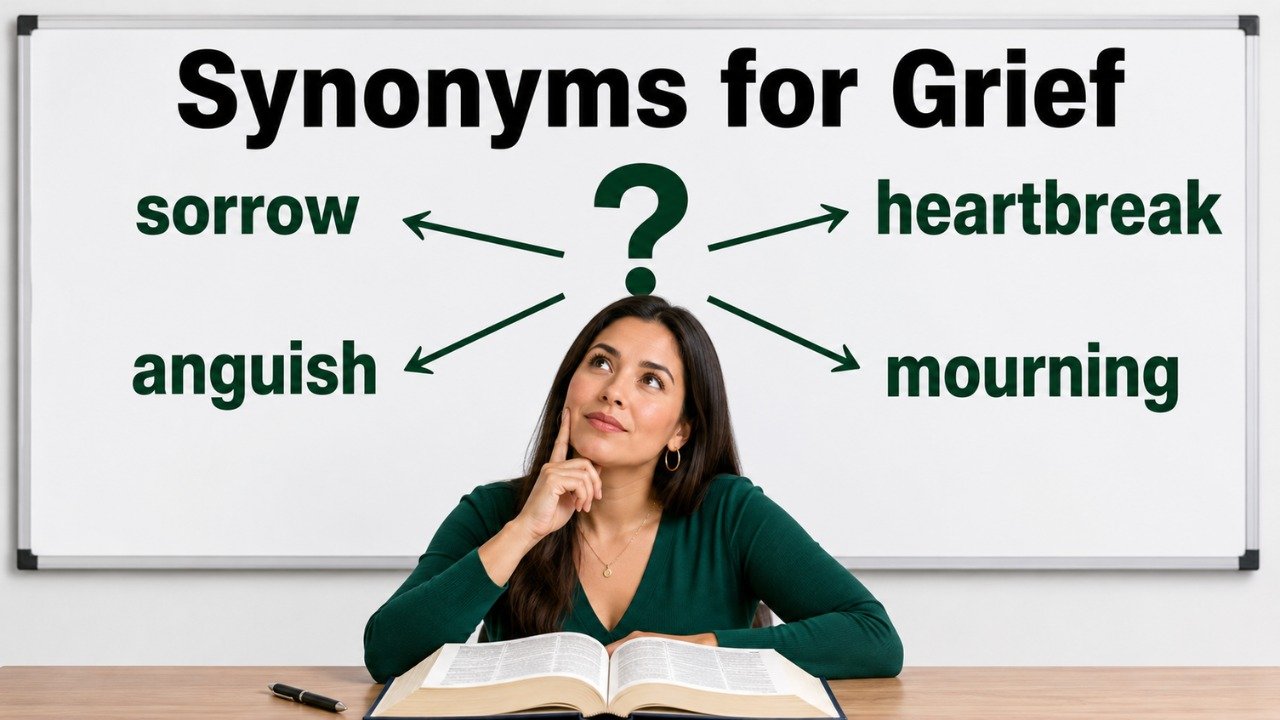
Quick Answer: The best synonyms for grief include sorrow, sadness, anguish, heartache, misery, mourning, distress, despair, bereavement, and woe. Sorrow is a broad and natural replacement in most writing. Mourning works best when grief follows a death or major loss. Anguish expresses intense emotional suffering, while heartache feels more personal and conversational. Bereavement is especially suitable in formal contexts involving the death of someone close. Despair emphasizes a loss of hope, while distress can describe emotional suffering caused by many difficult situations.
Pronunciation and Word Details
Word: Grief.
Pronunciation: /ɡriːf/
Part of Speech: Noun.
Meaning: Deep emotional sorrow or suffering, especially after a loss, death, disappointment, or painful experience.
US Pronunciation:
UK Pronunciation:
What Does “Grief” Mean?
Grief means deep emotional pain or sorrow caused by losing someone or something important.
As a noun, grief commonly describes the emotional response to death, separation, disappointment, serious change, or another painful loss. It can involve sadness, longing, loneliness, anger, confusion, or emotional distress.
Grief is often associated with death, but its meaning is broader. Someone may experience grief after the end of a relationship, the loss of a job, the collapse of a dream, a major personal change, or separation from something deeply valued.
Personal loss: She struggled with grief after losing her father.
Relationship loss: He felt profound grief when the relationship ended.
Major disappointment: The failure of the project caused her unexpected grief.
Emotional suffering: Years later, traces of grief remained.
The exact synonym for grief depends on how intense the emotion is, what caused it, and whether the context is personal, formal, literary, or conversational.
Meaning, Tone, and Context of “Grief”
Grief is a strong and emotionally serious word. It is usually neutral in formality but powerful in emotional meaning.
Tone: Serious, emotional, compassionate, and often solemn.
Formal use: Grief appears naturally in professional, academic, medical, psychological, and ceremonial writing when discussing loss and emotional suffering.
Conversational use: People commonly use grief when discussing the death of a loved one or another deeply painful loss.
Literary use: Writers may use grief to create emotional depth, describe personal suffering, or explore themes of love, death, memory, and loss.
Emotional strength: Grief is generally stronger than ordinary sadness because it often results from a meaningful or lasting loss.
Common context: She was overwhelmed by grief after the unexpected loss.
Broader context: The disappearance of the family home filled him with grief.
The word does not automatically describe every sad feeling. A small disappointment may produce sadness, while grief usually suggests a deeper emotional response.
When and How to Use “Grief”
Use grief when you want to describe serious emotional sorrow connected with loss or suffering.
For Death and Bereavement: Grief is especially common when someone has died.
Example: The family supported one another through their grief.
For Personal Loss: It can describe emotional pain after losing a relationship, opportunity, home, dream, or important part of life.
Example: She experienced grief after leaving the community she had loved for decades.
For Deep Emotional Sorrow: Use grief when ordinary sadness does not express the depth of the feeling.
Example: His grief was visible even when he tried to smile.
For Mourning: Grief can refer to the internal emotional experience that accompanies mourning.
Example: Everyone expressed grief in a different way.
For Literary Writing: Grief is useful for creating a serious and emotional atmosphere.
Example: Grief followed him like a quiet shadow through the empty house.
For Formal Discussion: Grief is appropriate when discussing emotional responses to significant loss.
Example: The counselor explained that grief may affect people in different ways.
Best Synonyms for Grief
The strongest alternatives depend on the type and intensity of emotional pain being described.
Sorrow: Deep sadness, especially because of loss or suffering.
Example: Her voice carried unmistakable sorrow.
Sadness: A general feeling of unhappiness.
Example: A quiet sadness filled the room after the announcement.
Anguish: Extremely intense emotional or mental suffering.
Example: His face showed the anguish he could no longer hide.
Heartache: Deep personal sadness, often connected with love, separation, or loss.
Example: Saying goodbye brought more heartache than she expected.
Mourning: The experience or expression of sorrow after a death or significant loss.
Example: The family entered a period of mourning.
Misery: Severe unhappiness or emotional suffering.
Example: Months of uncertainty brought him considerable misery.
Distress: Emotional suffering caused by difficulty, fear, pain, or loss.
Example: The news caused considerable distress among the family.
Despair: Deep suffering accompanied by a loss of hope.
Example: She refused to surrender to despair.
Bereavement: The condition of having lost someone through death.
Example: Employees were offered support during bereavement.
Woe: Deep sorrow or trouble, often used in literary or expressive language.
Example: The poem tells a story of love and woe.
50 Synonyms for Grief with Short Meanings
- Sorrow: Deep sadness caused by loss or suffering.
- Sadness: A general feeling of unhappiness.
- Anguish: Extreme emotional or mental pain.
- Heartache: Deep personal sadness and emotional pain.
- Mourning: Sorrow connected with death or significant loss.
- Misery: Severe unhappiness or suffering.
- Distress: Emotional pain caused by difficulty or loss.
- Despair: Deep sorrow combined with loss of hope.
- Bereavement: The experience of losing someone through death.
- Woe: Deep sorrow or serious trouble.
- Heartbreak: Intense sadness caused by emotional loss.
- Melancholy: Quiet, thoughtful, and lasting sadness.
- Desolation: Profound sadness combined with loneliness or emptiness.
- Agony: Extremely severe emotional or physical suffering.
- Pain: Emotional or physical suffering.
- Suffering: The experience of severe emotional or physical difficulty.
- Unhappiness: A general state of being unhappy.
- Dejection: Low spirits caused by disappointment or sadness.
- Despondency: Deep discouragement and lack of hope.
- Gloom: A dark or depressed emotional state.
- Dismay: Distress caused by something unexpected or troubling.
- Regret: Sadness about something done, lost, or missed.
- Remorse: Painful regret about one’s actions.
- Lamentation: The expression of deep sorrow.
- Lament: An expression of sadness or mourning.
- Dolor: Deep sorrow or emotional pain.
- Tribulation: Great suffering caused by serious difficulties.
- Affliction: A condition of pain, suffering, or distress.
- Torment: Severe emotional or physical suffering.
- Ache: A persistent feeling of emotional pain.
- Despondence: A state of deep discouragement.
- Forlornness: Lonely and abandoned sadness.
- Somberness: A serious and gloomy emotional quality.
- Melancholia: A profound state of sadness or gloom.
- Woefulness: A state of deep sadness or misery.
- Mournfulness: The quality of expressing sadness or grief.
- Suffering of Heart: Deep emotional pain caused by personal loss.
- Emotional Pain: Mental suffering caused by hurt or loss.
- Emotional Distress: Serious mental or emotional suffering.
- Deep Sadness: Strong and lasting unhappiness.
- Deep Sorrow: Intense sadness connected with loss.
- Heart Sorrow: Deep emotional sadness felt personally.
- Mental Anguish: Severe emotional or psychological pain.
- Emotional Agony: Extremely intense emotional suffering.
- Sense of Loss: Sadness caused by something important being gone.
- Despondent Sadness: Deep unhappiness accompanied by discouragement.
- Heavy Heartedness: A feeling of deep sadness and emotional weight.
- Sorrowfulness: The state or quality of being sorrowful.
- Emotional Suffering: Pain experienced through difficult emotions.
- Profound Sadness: Exceptionally deep emotional sorrow.
Read Also:
Synonyms for Knight

Synonyms for Grief by Context
When Grief Means Deep Sadness
Sorrow, sadness, melancholy, gloom, dejection, sorrowfulness, and profound sadness work well when grief refers mainly to emotional unhappiness.
Sorrow Example: Her sorrow became easier to carry as the months passed.
Melancholy Example: A gentle melancholy returned whenever he visited the old house.
Sadness Example: She felt deep sadness when the final goodbye arrived.
Sorrow is usually the closest general synonym because it retains the seriousness of grief without requiring a particular cause.
When Grief Follows a Death
Mourning, bereavement, sorrow, lamentation, and mournfulness are particularly appropriate when someone has died.
Mourning Example: The family remained together during their period of mourning.
Bereavement Example: Bereavement can bring major changes to a person’s daily life.
Lamentation Example: The story ends with an expression of lamentation.
Mourning emphasizes the experience or expression of sorrow, while bereavement specifically refers to losing someone through death.
When Grief Means Intense Emotional Pain
Anguish, agony, torment, heartbreak, heartache, and emotional agony communicate stronger suffering.
Anguish Example: She cried out in anguish when she heard the news.
Heartbreak Example: The sudden separation caused enormous heartbreak.
Agony Example: Waiting for answers became emotional agony.
These words are useful when grief feels especially severe.
When Grief Includes Hopelessness
Despair, despondency, despondence, desolation, and misery emphasize discouragement, hopelessness, or emotional emptiness.
Despair Example: He experienced moments of despair but continued seeking support.
Desolation Example: After everyone left, she felt a profound sense of desolation.
Despondency Example: Months of disappointment led to despondency.
Despair is stronger than grief because it specifically suggests that hope has been lost.
When Grief Is Personal and Emotional
Heartache, heartbreak, ache, emotional pain, and suffering of heart can describe personal emotional wounds.
Heartache Example: The separation brought years of heartache.
Heartbreak Example: Losing the friendship caused genuine heartbreak.
Ache Example: An emotional ache remained whenever she remembered him.
Heartache and heartbreak feel more personal and conversational than bereavement or lamentation.
Another Word for Grief
The best single replacement for grief is usually sorrow because it describes deep sadness naturally across many contexts.
However, the best alternative depends on the cause and strength of the emotion. Mourning is better after death, anguish is better for extreme suffering, heartache suits personal loss, and despair is more accurate when sadness includes hopelessness.
Original: She carried her grief quietly for many years.
Better Option: She carried her sorrow quietly for many years.
Original: His grief after the breakup affected every part of his life.
Better Option: His heartache after the breakup affected every part of his life.
Original: The family gathered together in grief after her death.
Better Option: The family gathered together in mourning after her death.
Original: The terrible news filled him with grief and panic.
Better Option: The terrible news filled him with anguish and panic.
When Not to Use “Grief”
Grief is powerful, but it is not appropriate for every type of sadness.
Avoid it when the feeling is mild, temporary, or unrelated to meaningful loss.
Weak: She felt grief because the restaurant had no chocolate cake.
Better: She felt disappointed because the restaurant had no chocolate cake.
Grief may also become repetitive if it appears several times within a short passage.
Weak: His grief grew each day, and his grief affected his sleep because his grief seemed impossible to escape.
Better: His grief grew each day, affecting his sleep as sorrow became increasingly difficult to escape.
Choose a more precise word when a specific emotional state matters.
Weak: She was overcome with grief because she believed nothing would ever improve.
Better: She was overcome with despair because she believed nothing would ever improve.
Avoid grief when you specifically mean the public or personal expression of sorrow after death.
Weak: The community entered grief after the leader’s death.
Better: The community entered a period of mourning after the leader’s death.
Words Commonly Confused With Grief
Grief vs Sadness: Sadness is a broad emotional state. Grief is usually deeper and commonly connected with significant loss.
Grief vs Mourning: Grief is the emotional experience of sorrow, while mourning often describes how that sorrow is expressed or observed after a loss.
Grief vs Bereavement: Grief is the emotional response to loss. Bereavement specifically describes the condition of having lost someone through death.
Grief vs Depression: Grief refers to sorrow associated with loss. Depression has a distinct and broader meaning and should not automatically be treated as another word for grief.
Grief vs Anguish: Grief centers on sorrow and loss, while anguish emphasizes severe emotional or mental suffering.
Grief vs Despair: Grief describes deep sorrow. Despair adds the idea that hope has disappeared.
Grief vs Heartbreak: Grief can result from many kinds of loss, while heartbreak often describes deeply personal emotional pain involving relationships, love, or disappointment.
Grief vs Regret: Grief comes primarily from loss, while regret involves sadness about a decision, action, missed opportunity, or outcome.
Which Synonym Should You Choose?
Choose sorrow when you need a broad and natural substitute for grief in essays, stories, formal writing, or conversation.
Choose sadness when the emotion is less intense or when you want simple and familiar language.
Choose mourning when discussing sorrow connected with a death or the process of expressing that sorrow.
Choose bereavement in formal, professional, or informational writing specifically involving death.
Choose anguish when the emotional suffering is extremely intense.
Choose heartache for personal and emotional situations involving separation, relationships, memories, or loss.
Choose heartbreak when describing severe personal pain caused by loss or disappointment.
Choose despair when sorrow is accompanied by hopelessness.
Choose distress when emotional suffering is caused by troubling circumstances, fear, uncertainty, or loss.
Choose melancholy in reflective, descriptive, or literary writing when the sadness feels quiet and lingering.
Choose woe when you want a literary, traditional, or expressive word for deep sorrow.
Real Life Examples of “Grief” in Sentences
Original: She felt overwhelming grief after losing her closest friend.
Better Option: She felt overwhelming sorrow after losing her closest friend.
Original: His grief was obvious during the memorial.
Better Option: His mourning was obvious during the memorial.
Original: The unexpected announcement caused her intense grief.
Better Option: The unexpected announcement caused her intense anguish.
Original: He carried grief from the failed relationship for months.
Better Option: He carried heartache from the failed relationship for months.
Original: Their grief brought the family closer together.
Better Option: Their shared sorrow brought the family closer together.
Original: She found it difficult to speak about her grief.
Better Option: She found it difficult to speak about her emotional pain.
Original: His grief turned into hopelessness after several difficult months.
Better Option: His sorrow turned into despair after several difficult months.
Original: The entire community expressed grief after the tragedy.
Better Option: The entire community expressed deep sorrow after the tragedy.
Original: Time changed the shape of her grief, but the memories remained.
Better Option: Time changed the shape of her heartache, but the memories remained.
Original: He tried to hide his grief from his coworkers.
Better Option: He tried to hide his sadness from his coworkers.
Synonym Groups and Usage Differences
Deep Sadness Group
Sorrow, sadness, melancholy, profound sadness, and sorrowfulness belong to the broad sadness group.
These words describe emotional unhappiness without always specifying how it began.
Example: A deep sorrow remained long after the goodbye.
Sorrow is the strongest general alternative, while sadness is broader and usually less intense.
Loss and Mourning Group
Mourning, bereavement, lamentation, lament, and mournfulness are closely connected with loss.
Mourning and bereavement are especially useful when death is involved.
Example: The family supported one another throughout their mourning.
Bereavement describes the circumstance of losing someone, while mourning focuses more on the experience or expression of sorrow.
Intense Suffering Group
Anguish, agony, torment, misery, emotional agony, and mental anguish emphasize severe suffering.
Example: The uncertainty caused unbearable anguish.
These alternatives are stronger than ordinary sadness and should be used when emotional intensity matters.
Personal Pain Group
Heartache, heartbreak, ache, emotional pain, and suffering of heart describe deeply personal emotional suffering.
Example: Saying goodbye brought unexpected heartache.
Heartache often feels softer and more reflective than anguish, while heartbreak can sound sudden and intense.
Hopelessness Group
Despair, despondency, despondence, desolation, and misery can suggest sadness combined with discouragement.
Example: His initial sorrow gradually turned into despair.
Use these words carefully because they add meanings that grief does not always contain.
Distress Group
Distress, dismay, affliction, tribulation, and suffering describe emotional difficulty caused by troubling circumstances.
Example: The uncertainty caused considerable distress.
These terms can fit situations where suffering is broader than bereavement.
Antonyms of Grief
The opposite of grief depends on whether you mean sadness, suffering, or emotional loss.
Joy: A strong feeling of happiness.
Happiness: A general state of pleasure or contentment.
Delight: Great pleasure or enjoyment.
Cheerfulness: A bright and positive emotional state.
Contentment: Peaceful satisfaction with one’s circumstances.
Pleasure: A feeling of enjoyment or satisfaction.
Gladness: A state of happiness or joy.
Comfort: A feeling of emotional relief and reassurance.
Relief: The easing of worry, suffering, or distress.
Hope: A positive expectation that something good may happen.
Peace: A calm emotional state without turmoil.
Consolation: Comfort received after sadness, disappointment, or loss.
Comparison: Grief vs Related Words
Grief vs Sorrow
Grief usually describes deep emotional suffering caused by loss. Sorrow is slightly broader and can describe serious sadness caused by loss, regret, disappointment, or suffering.
Example With Grief: His grief was strongest during the first weeks after the loss.
Example With Sorrow: She looked back on the event with deep sorrow.
Grief vs Sadness
Grief is usually deeper and more closely associated with significant loss. Sadness can describe emotions ranging from mild disappointment to serious unhappiness.
Example With Grief: The death of her friend brought profound grief.
Example With Sadness: She felt sadness when the holiday ended.
Grief vs Mourning
Grief is the internal emotional response to loss. Mourning often refers to experiencing, expressing, or observing sorrow after a death or another serious loss.
Example With Grief: He struggled to explain his grief.
Example With Mourning: The family spent several weeks in mourning.
Grief vs Anguish
Grief focuses on deep sorrow resulting from loss. Anguish emphasizes extreme mental or emotional suffering, regardless of its cause.
Example With Grief: She experienced grief after saying goodbye.
Example With Anguish: Waiting for news filled her with anguish.
Grief vs Heartache
Grief is broader and can apply to many forms of serious loss. Heartache commonly describes personal emotional pain connected with love, separation, disappointment, or longing.
Example With Grief: The loss brought him years of grief.
Example With Heartache: Their separation caused lasting heartache.
Grief vs Despair
Grief describes deep sorrow. Despair describes suffering combined with a belief that there is little or no hope.
Example With Grief: She allowed herself to experience her grief.
Example With Despair: After repeated setbacks, he began to feel despair.
Grief vs Bereavement
Grief is the emotion that can follow many types of loss. Bereavement specifically refers to the condition or experience of losing someone through death.
Example With Grief: Her grief sometimes returned unexpectedly.
Example With Bereavement: The organization offered additional leave during bereavement.
Common Phrases and Expressions With Grief
Deep Grief: Very intense sorrow caused by loss.
Example: The unexpected death left the family in deep grief.
Profound Grief: Extremely strong emotional sorrow.
Example: She expressed profound grief after hearing the news.
Overwhelming Grief: Sorrow that feels extremely difficult to control or manage.
Example: He was overcome by overwhelming grief.
Express Grief: To communicate or show feelings of sorrow.
Example: Everyone expressed grief in a different way.
Experience Grief: To go through feelings of sorrow after loss.
Example: People may experience grief differently.
Deal With Grief: To manage or respond to emotional sorrow.
Example: Writing helped her deal with grief.
Coping With Grief: Managing the emotional effects of loss.
Example: Talking with trusted people helped him with coping with grief.
Process Grief: To gradually understand and respond emotionally to a loss.
Example: She needed time to process grief after the sudden change.
Overcome With Grief: Deeply affected by sorrow.
Example: He was overcome with grief when the message arrived.
Grief and Loss: A common phrase describing both a significant loss and the emotional response that follows it.
Example: The discussion focused on grief and loss within families.
Common Mistakes to Avoid
One common mistake is treating every synonym for grief as completely interchangeable. Each alternative adds a slightly different meaning.
Wrong Synonym Choice: She entered bereavement after her favorite cup broke.
Bereavement specifically concerns losing someone through death, so it is far too strong and inaccurate for a minor loss.
Better Choice: She felt disappointed when her favorite cup broke.
Another mistake is using grief for ordinary inconvenience.
Unnatural: He experienced great grief because the bus arrived late.
Natural: He felt frustrated because the bus arrived late.
Avoid confusing grief with mourning.
Grief: The internal emotional response to loss.
Mourning: The experience or expression of sorrow, particularly after death.
Repetition can also weaken emotional writing.
Repetitive: Her grief filled the room. Her grief affected her sleep. Her grief remained for months.
Improved: Her grief filled the room, disturbed her sleep, and developed into a sorrow that remained for months.
Do not automatically replace grief with despair. Despair contains an additional meaning of hopelessness.
Less Accurate: She felt despair as she remembered her grandmother fondly.
Better: She felt sorrow as she remembered her grandmother fondly.
Avoid using overly literary alternatives in ordinary conversation unless the tone suits them.
Unnatural Conversation: I experienced tremendous woe when my appointment was canceled.
Natural Conversation: I felt disappointed when my appointment was canceled.
The strongest writing comes from choosing the synonym that accurately describes the cause, intensity, and emotional quality of the experience.
Conclusion
Understanding synonyms for grief makes it easier to describe emotional pain with accuracy and sensitivity. Sorrow is the strongest general alternative, while sadness suits broader or less intense feelings. Mourning and bereavement are useful when death is involved. Heartache and heartbreak describe deeply personal loss, anguish emphasizes extreme suffering, and despair adds a sense of hopelessness. By considering intensity, cause, tone, and context, you can choose a word that communicates the exact kind of sorrow you intend.
FAQs About Synonyms for Grief
What Is the Best Synonym for Grief?
The best general synonym is sorrow. It naturally communicates deep sadness and works well in formal, conversational, and literary contexts.
What Is a Stronger Word Than Grief?
Anguish or agony may sound stronger when you want to emphasize extremely intense emotional suffering. However, they do not always carry the specific meaning of loss that grief often has.
What Is Another Word for Grief After a Death?
Mourning is a natural choice for sorrow following death. Bereavement specifically describes the experience or condition of having lost someone through death.
Are Grief and Sadness the Same?
No. Sadness is a broad emotion that can result from many situations. Grief is usually deeper and commonly associated with losing someone or something important.
Is Heartache a Synonym for Grief?
Yes. Heartache can replace grief when the context involves deeply personal emotional pain, especially after separation, relationship loss, disappointment, or longing.
What Is the Difference Between Grief and Despair?
Grief means deep sorrow, usually connected with loss. Despair means deep suffering accompanied by little or no hope. Someone can experience grief without feeling despair.
Which Synonym for Grief Is Best for Formal Writing?
Sorrow works well in most formal writing. Bereavement is more precise when discussing a death, while distress is useful when referring to emotional suffering caused by difficult circumstances.
