
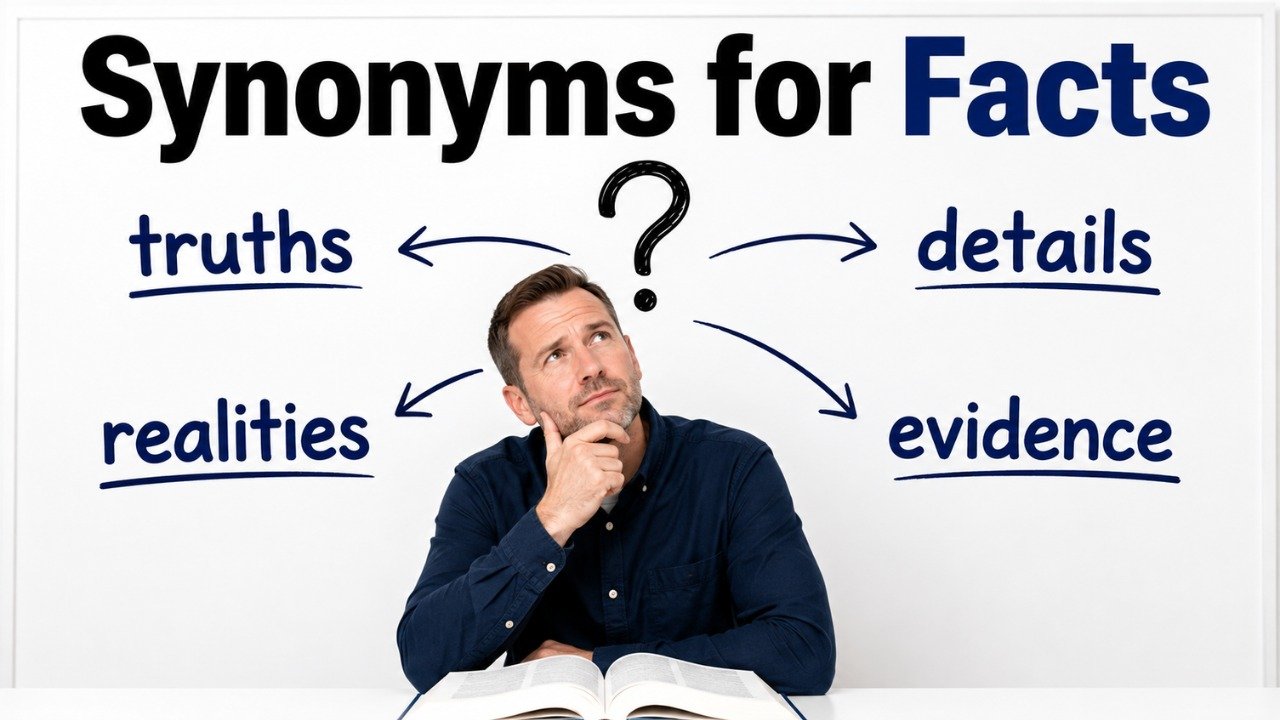
Quick Answer: Useful synonyms for facts include truths, realities, information, details, evidence, data, particulars, circumstances, actualities, and findings. Use truths when emphasizing what is correct, realities when describing conditions that genuinely exist, information for general knowledge, details for specific points, data for measured or collected information, evidence when supporting a claim, particulars for precise facts, and findings for information discovered through investigation or research.
Pronunciation and Word Details
Word: Facts
Pronunciation: /fækts/
Part of Speech: Plural noun
Meaning: Pieces of information that are known or accepted to be true.
US Pronunciation:
UK Pronunciation:
What Does “Facts” Mean?
Facts are pieces of information that are true, real, or supported by reliable observation, evidence, or knowledge.
Facts is the plural form of fact and functions as a noun. A fact may describe something that happened, something that exists, a verified detail, a measured result, or a statement that accurately represents reality.
In everyday conversation, facts often means true information.
Example: We need the facts before making a decision.
In academic or professional writing, facts may refer to verified information, established details, research findings, observations, or recorded data.
Example: The report presents the facts clearly.
Facts can also contrast with opinions, assumptions, rumors, or guesses.
Example: Her conclusion was based on facts rather than speculation.
The meaning stays connected to truth, but the best synonym changes according to whether the sentence focuses on reality, information, evidence, data, or specific details.
Meaning, Tone, and Context of “Facts”
Facts has a neutral and widely used tone. It works naturally in formal writing, casual speech, academic discussion, reports, essays, news style writing, professional communication, research, education, and everyday conversation.
In casual conversation, facts often means information that is definitely true.
Example: Those are the facts of the situation.
In formal writing, facts can refer to established information that helps support an argument or explanation.
Example: The essay should distinguish facts from personal opinions.
In research and technical contexts, data, findings, results, measurements, and observations may sometimes be more precise than facts.
Facts can also sound strong when a speaker wants to emphasize certainty.
Example: We must deal with the facts.
The word itself is usually neutral, but its effect can become firm or emphatic when used to contrast truth with belief, assumption, exaggeration, or misinformation.
When and How to Use “Facts”
For True Information
Use facts when referring generally to information that is known to be true.
Example: The students checked the facts before writing their report.
For Supporting an Argument
Facts can strengthen a claim by providing reliable information.
Example: She supported her position with relevant facts.
For Describing Reality
Facts can refer to real conditions or circumstances that must be accepted.
Example: The facts show that the project requires more time.
For Specific Details
Use facts when referring to particular information about a person, event, place, or situation.
Example: The investigator gathered the facts of the case.
For Research and Study
Facts may describe established knowledge, although data, findings, or results can be more precise in research contexts.
Example: The article combines historical facts with careful analysis.
For Contrasting With Opinion
Facts are often discussed alongside opinions to distinguish objective information from personal judgment.
Example: The discussion separated facts from opinions.
For Emphasis
Facts can create a firm tone when the speaker wants attention placed on reality rather than speculation.
Example: Let us focus on the facts.
Best Synonyms for Facts
Truths: Statements or realities that are true.
Example: The investigation revealed several important truths.
Realities: Conditions or situations that actually exist.
Example: The report explains the economic realities facing small communities.
Information: Knowledge or details about a subject.
Example: The guide provides useful information about the process.
Details: Specific pieces of information.
Example: She included all the important details in her explanation.
Evidence: Information or material that helps prove whether something is true.
Example: The evidence supported his account of the event.
Data: Collected facts, figures, measurements, or observations used for analysis.
Example: The researchers examined the data carefully.
Particulars: Specific facts or details about something.
Example: The agreement contains the main particulars of the arrangement.
Circumstances: Facts and conditions connected with a situation.
Example: The circumstances of the incident remain under review.
Actualities: Things or conditions that genuinely exist.
Example: The discussion focused on practical actualities rather than assumptions.
Findings: Facts or conclusions discovered through research, examination, or investigation.
Example: The findings provided a clearer picture of the problem.
50 Synonyms for Facts with Short Meanings
- Truths: Things known or accepted as true.
- Realities: Conditions or situations that genuinely exist.
- Information: Knowledge communicated about a subject.
- Details: Specific pieces of information.
- Evidence: Information that helps support or establish a claim.
- Data: Collected information used for study or analysis.
- Particulars: Exact or specific facts about something.
- Circumstances: Facts and conditions surrounding an event or situation.
- Actualities: Things that exist in reality.
- Findings: Information discovered through research or examination.
- Truth: What is real or correct.
- Reality: The true state of things.
- Certainties: Things accepted as definitely true.
- Verities: Truths or true principles.
- Specifics: Precise facts or details.
- Points: Individual pieces of information or consideration.
- Items: Separate pieces of information.
- Elements: Individual parts of a larger set of information.
- Features: Noticeable or important factual characteristics.
- Aspects: Particular parts or sides of a subject.
- Occurrences: Events that actually happen.
- Events: Things that take place.
- Incidents: Specific events or happenings.
- Conditions: Existing states or circumstances.
- Situations: Sets of facts and circumstances at a particular time.
- Observations: Information gained by watching or examining.
- Measurements: Quantified information obtained through measuring.
- Figures: Numerical facts or statistics.
- Statistics: Numerical information collected and analyzed.
- Records: Stored or documented factual information.
- Documentation: Written material that records information or evidence.
- Reports: Accounts that present factual information.
- Results: Outcomes or information produced by a process or study.
- Outcomes: Final results or consequences.
- Discoveries: Facts or information found through investigation.
- Revelations: Previously unknown facts that become known.
- Knowledge: Information and understanding gained through experience or study.
- Intelligence: Collected information, especially for analysis or decision making.
- Material: Information used for discussion, research, or writing.
- Content: Information contained in a text, record, or communication.
- Background: Relevant facts explaining a situation or subject.
- Context: Surrounding facts that help explain meaning or circumstances.
- Proof: Information or material showing that something is true.
- Confirmation: Information that verifies something previously uncertain.
- Verification: Evidence or checking that establishes accuracy.
- Substantiation: Supporting information that strengthens a claim.
- Testimony: Statements offered as factual evidence.
- Accounts: Descriptions or reports of events.
- Chronicles: Factual records of events arranged over time.
- Essentials: The most important facts or points.
Read Also:
Synonyms for Era

Synonyms for Facts by Context
When Facts Means Truths
When facts refers to things that are definitely true, useful alternatives include truths, certainties, verities, realities, and actualities.
Example: We cannot ignore the facts.
Alternative: We cannot ignore the realities.
Truths works especially well when the sentence contrasts truth with falsehood. Realities is stronger when discussing actual conditions that people must recognize.
When Facts Means Information
When facts simply refers to information about a subject, information, details, particulars, specifics, and points are natural choices.
Example: She gave us the facts about the meeting.
Alternative: She gave us the details about the meeting.
Details emphasizes individual pieces of information. Particulars sounds slightly more formal and often refers to precise information.
When Facts Means Research Information
In research, analysis, or technical writing, data, findings, observations, measurements, figures, statistics, and results may be more precise.
Example: The study presents facts about changing temperatures.
Alternative: The study presents data about changing temperatures.
Data works best for collected information. Findings is more suitable for what researchers discover after examining the data.
When Facts Means Supporting Information
When facts are used to prove or support something, evidence, proof, confirmation, verification, and substantiation may fit.
Example: The lawyer presented facts supporting the claim.
Alternative: The lawyer presented evidence supporting the claim.
Evidence is usually better when the information serves to establish whether a statement or claim is true.
When Facts Means Circumstances
For facts connected with a particular event, circumstances, conditions, situation, background, and context may be better choices.
Example: We need to understand all the facts surrounding the decision.
Alternative: We need to understand all the circumstances surrounding the decision.
Circumstances focuses on the conditions surrounding an event, while background refers to information that helps explain how the situation developed.
When Facts Means Recorded Information
Records, reports, documentation, accounts, and chronicles can replace facts when the information has been formally recorded.
Example: Historical facts show how the town developed.
Alternative: Historical records show how the town developed.
Records is especially useful when the information comes from written or stored documentation.
Another Word for Facts
Information is often the best broad replacement for facts because it works naturally in many everyday and professional situations. However, the best alternative depends on the exact meaning.
Use truths when emphasizing what is true, details for specific pieces of information, evidence for support, data for collected information, and realities for actual conditions.
Original: We need all the facts before making a decision.
Better Option: We need all the information before making a decision.
Original: The report contains several important facts about the population.
Better Option: The report contains several important statistics about the population.
Original: She explained the facts of the incident.
Better Option: She explained the details of the incident.
Original: The facts supported his argument.
Better Option: The evidence supported his argument.
When Not to Use “Facts”
Facts is a useful general word, but a more precise term can often improve clarity.
Do not use facts when you specifically mean numerical information. Data, figures, or statistics will usually be clearer.
Weak: The study collected facts from 500 responses.
Better: The study collected data from 500 responses.
Avoid facts when you are referring to material that proves a particular claim. Evidence is more precise.
Weak: The investigators searched for facts that could prove the allegation.
Better: The investigators searched for evidence that could support the allegation.
Facts may also sound too broad when you mean the exact circumstances of an event.
Weak: We discussed the facts around the accident.
Better: We discussed the circumstances surrounding the accident.
Do not call opinions, predictions, beliefs, or assumptions facts unless they have been established as true.
Weak: Her opinion about the future is a fact.
Better: Her opinion about the future is a prediction.
Avoid unnecessary repetition when facts appears several times in one paragraph.
Weak: The facts in the report provide facts that confirm the facts we already knew.
Better: The information in the report provides evidence confirming what we already knew.
Words Commonly Confused With Facts
Facts vs Opinions: Facts describe information that can be established as true, while opinions express personal beliefs, judgments, or preferences.
Facts vs Evidence: Facts are true pieces of information. Evidence is information, material, or testimony used to support or challenge a claim.
Facts vs Data: Facts is a broad term for true information. Data usually refers to collected observations, figures, measurements, or records used for analysis.
Facts vs Truth: A fact is a specific piece of true information, while truth is the broader quality or state of being true.
Facts vs Details: Facts are true pieces of information, while details are specific pieces of information and are not automatically emphasized as verified truths.
Facts vs Statistics: Facts can take many forms. Statistics specifically refers to numerical information that has been collected or analyzed.
Facts vs Findings: Facts may already be known, while findings are usually facts, results, or conclusions discovered through research or investigation.
Which Synonym Should You Choose?
Choose truths when emphasizing the difference between what is true and what is false.
Choose realities when discussing conditions that actually exist, especially when those conditions must be accepted.
Choose information for general everyday or professional communication.
Choose details when referring to specific pieces of information about a person, event, plan, or situation.
Choose particulars in more formal writing when you need precise individual facts.
Choose data in research, reports, experiments, surveys, and analytical writing.
Choose statistics when the information is numerical.
Choose evidence when the information supports or challenges a claim.
Choose findings when describing information discovered through research or investigation.
Choose circumstances when referring to the conditions surrounding an event.
Choose records when the facts come from documented historical, administrative, or official material.
Choose background when explaining information that helps readers understand a topic.
Real Life Examples of “Facts” in Sentences
Original: We need the facts before we respond.
Better Option: We need the information before we respond.
Original: The facts in the study were carefully reviewed.
Better Option: The data in the study were carefully reviewed.
Original: She explained the facts of the case.
Better Option: She explained the particulars of the case.
Original: These facts prove that the process worked.
Better Option: This evidence shows that the process worked.
Original: The teacher asked students to separate facts from opinions.
Better Option: The teacher asked students to separate truths from personal judgments.
Original: Historical facts reveal how the region changed.
Better Option: Historical records reveal how the region changed.
Original: The facts about the accident are still unclear.
Better Option: The circumstances surrounding the accident are still unclear.
Original: The article presents facts about household spending.
Better Option: The article presents statistics about household spending.
Original: The facts from the investigation surprised everyone.
Better Option: The findings from the investigation surprised everyone.
Original: We must accept the facts of the situation.
Better Option: We must accept the realities of the situation.
Synonym Groups and Usage Differences
Truth Group
Truths, certainties, verities, realities, and actualities all connect facts with what is genuinely true.
Truths is the most natural general option. Realities often focuses on actual conditions rather than individual statements.
Example: The discussion forced everyone to confront difficult realities.
Information Group
Information, details, particulars, specifics, points, and items describe pieces of knowledge about a topic.
Information is broad, while details, particulars, and specifics emphasize smaller individual facts.
Example: Please provide the relevant details before the meeting.
Research Group
Data, findings, observations, measurements, figures, statistics, results, and discoveries are useful in academic, scientific, analytical, and technical contexts.
Data refers to collected information, while findings refers to what is learned from examining it.
Example: The findings suggest a clear difference between the two groups.
Evidence Group
Evidence, proof, confirmation, verification, substantiation, and testimony relate to information used to establish truth or support a claim.
Proof is usually stronger than evidence because it suggests that the matter has been conclusively established.
Example: The documents provided evidence supporting the explanation.
Circumstance Group
Circumstances, conditions, situations, background, and context describe factual information surrounding an event or issue.
Context helps explain why a fact matters, while circumstances focus more directly on the conditions present at the time.
Example: The decision becomes easier to understand when we consider the context.
Record Group
Records, reports, documentation, accounts, and chronicles refer to factual information that has been written, stored, or formally presented.
Example: The historical records contain valuable information about the town.
Antonyms of Facts
The opposite of facts usually involves false, uncertain, invented, or subjective information.
Falsehoods: Statements that are not true.
Lies: Deliberately false statements.
Fiction: Invented information or imagined events.
Opinions: Personal judgments or beliefs rather than established facts.
Assumptions: Ideas accepted without sufficient proof.
Guesses: Answers or beliefs formed without enough information.
Speculation: Ideas based on possibility rather than established knowledge.
Rumors: Unverified information passed from person to person.
Myths: Widely repeated beliefs or stories that may not be factual.
Fabrications: Deliberately invented statements or stories.
Errors: Incorrect statements or information.
Misconceptions: Incorrect beliefs or understandings.
Comparison: Facts vs Related Words
Facts vs Information
Facts are pieces of information established as true. Information is broader and can include facts, instructions, descriptions, opinions, or other communicated knowledge.
Example With Facts: The article presents verified facts about the event.
Example With Information: The article provides information about attending the event.
Facts vs Evidence
Facts exist as true information, while evidence is used to support a claim, conclusion, or explanation.
Example With Facts: The facts show when the meeting took place.
Example With Evidence: The records provide evidence that the meeting took place.
Facts vs Data
Facts can be individual truths, while data usually consists of collected information used for analysis.
Example With Facts: One fact is that the building opened in 1985.
Example With Data: The researchers analyzed population data from several years.
Facts vs Details
Facts emphasize truth, while details emphasize specificity.
Example With Facts: The report contains verified facts about the incident.
Example With Details: The report contains detailed information about what happened.
Facts vs Truths
Facts are usually individual pieces of true information. Truths may refer more broadly to principles, realities, or statements considered true.
Example With Facts: The document lists several facts about the project.
Example With Truths: Experience taught her several difficult truths about leadership.
Facts vs Findings
Facts can already be established before an investigation begins. Findings are information or conclusions discovered during research or examination.
Example With Facts: The known facts guided the investigation.
Example With Findings: The findings were published after the investigation ended.
Common Phrases and Expressions With Facts
The Facts: The true information about a situation.
Basic Facts: The most important or fundamental information.
Key Facts: The most important facts to know.
Known Facts: Information already established as true.
Hard Facts: Clear facts that are difficult to dispute.
Relevant Facts: Information directly connected with the issue being discussed.
Historical Facts: Verified information about past events.
Facts and Figures: Factual information combined with numerical data.
Get the Facts: Find accurate information before deciding or judging.
Stick to the Facts: Focus on verified information rather than opinions or speculation.
Common Mistakes to Avoid
A common mistake is using facts and opinions as though they mean the same thing. A fact presents information that can be established as true, while an opinion expresses a judgment or belief.
Another mistake is replacing facts with evidence in every sentence. Evidence is used to establish or support something. A fact does not always serve as evidence.
Avoid using data as an automatic replacement for facts. Data usually refers to collected information, measurements, figures, or observations, especially in research and analysis.
Be careful with the phrase true facts. Since facts are already understood as true, true facts can be unnecessarily repetitive unless the sentence deliberately contrasts them with false claims.
Weak: She gave us the true facts about the situation.
Better: She gave us the facts about the situation.
Do not use statistics when the information is not numerical.
Weak: His birthplace is one of the statistics in his biography.
Better: His birthplace is one of the facts in his biography.
Avoid vague phrases such as some facts when the exact information can be stated more clearly.
Vague: The report contains some facts about the problem.
Better: The report contains data, figures, and documented findings about the problem.
Repetition can also make writing sound mechanical.
Repetitive: The facts in the article explain the facts researchers found and the facts readers need.
Better: The information in the article explains the researchers’ findings and the key details readers need.
Finally, choose synonyms according to meaning rather than simply replacing every occurrence of facts with a different word. Information, data, evidence, realities, details, and findings overlap with facts, but they are not identical in every context.
Conclusion
The best synonyms for facts include truths, realities, information, details, data, evidence, particulars, circumstances, and findings. Use information for general knowledge, details for specific points, data and statistics for research or numerical material, evidence for support, and realities when describing actual conditions. Facts is still the clearest general word when you simply mean information known to be true. Choosing a more precise alternative can make essays, reports, explanations, and everyday communication clearer and more accurate.
FAQs About Synonyms for Facts
What is the best synonym for facts?
Information is the broadest everyday alternative. Truths, details, data, evidence, and realities may be better when the context is more specific.
What is another word for facts and information?
Details, particulars, data, knowledge, and findings can work depending on the type of information being discussed.
Is evidence a synonym for facts?
Evidence is a close alternative in some contexts, but the words are not identical. Evidence is information used to support or challenge a claim.
Is data another word for facts?
Data can replace facts when referring to collected information, measurements, observations, or figures. It is especially common in research and analytical writing.
What is a formal synonym for facts?
Particulars, findings, evidence, data, actualities, and verities can serve as formal alternatives depending on the sentence.
What is the opposite of facts?
Common opposites include falsehoods, lies, fiction, opinions, assumptions, guesses, rumors, and fabrications.
What synonym for facts works best in an essay?
Information works for general discussion, evidence works when supporting an argument, data fits research based writing, and findings fits information discovered through investigation.
