
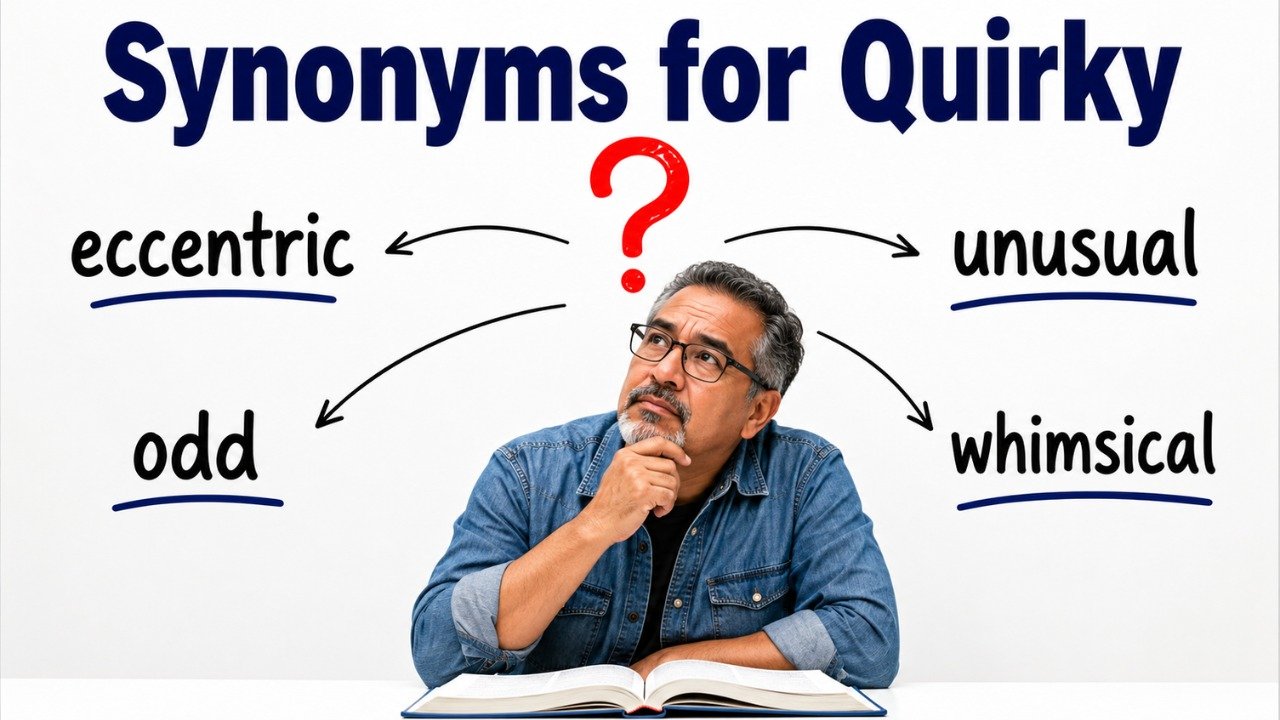
Quick Answer: Useful synonyms for quirky include eccentric, unusual, unconventional, peculiar, odd, offbeat, distinctive, whimsical, idiosyncratic, and original. Among these synonyms for quirky, eccentric works well for noticeably unusual behavior or personality, unconventional suits formal writing about ideas or methods, whimsical suggests playful unusualness, distinctive emphasizes individuality, and offbeat works naturally in casual descriptions. Peculiar and odd can sound more critical, while original usually gives the unusual quality a positive tone.
Pronunciation and Word Details
Word: Quirky
Pronunciation: /ˈkwɝː.ki/
Part of Speech: Adjective
Meaning: Unusual in an interesting, distinctive, surprising, or sometimes amusing way.
US Pronunciation:
UK Pronunciation:
What Does “Quirky” Mean?
Quirky means unusual in a way that is distinctive, interesting, surprising, or sometimes amusing. It is an adjective commonly used to describe people, personalities, habits, ideas, designs, behaviors, stories, places, and personal styles.
When quirky describes a person, it usually refers to unusual habits, tastes, expressions, or personality traits.
Example: She has a quirky sense of humor that makes ordinary conversations entertaining.
When it describes an object, place, or design, quirky often suggests something visually unusual or creatively different.
Example: The room had a quirky arrangement of mismatched furniture.
The word can also describe ideas or behavior that do not follow ordinary expectations.
Example: His quirky approach to solving problems often produced creative results.
Quirky is often positive or affectionate, although context can make it mildly critical. Calling someone quirky usually sounds friendlier than calling that person strange or bizarre.
Meaning, Tone, and Context of “Quirky”
Quirky usually has a neutral to positive tone. It suggests unusualness without necessarily suggesting that something is bad, disturbing, or unacceptable.
Conversational Tone: Quirky is common in everyday speech when describing personalities, habits, clothing, humor, or creative choices.
Example: His quirky personality makes him memorable.
Positive Tone: Quirky can express admiration for individuality or originality.
Example: The artist is known for her quirky imagination.
Playful Tone: The word often describes something unusual in an amusing or charming way.
Example: The story is filled with quirky characters and unexpected situations.
Creative Context: Quirky frequently appears when discussing art, decoration, writing, clothing, architecture, or unusual ideas.
Example: The designer created a quirky pattern inspired by everyday objects.
Formal Context: Quirky may sound slightly conversational in highly formal writing. Words such as unconventional, distinctive, atypical, or idiosyncratic can sometimes be more precise.
Example: The study examined an unconventional method of organizing information.
Critical Context: If you want to clearly express disapproval, quirky may be too gentle. Strange, peculiar, bizarre, or erratic may communicate criticism more directly.
When and How to Use “Quirky”
For Personality: Use quirky to describe someone with unusual but often appealing characteristics.
Example: Her quirky personality makes every conversation unpredictable and fun.
For Behavior: Use quirky when someone’s habits or actions are noticeably different from what is expected.
Example: He has a quirky habit of arranging his books according to height.
For Humor: Quirky works well for unusual, unexpected, or playful humor.
Example: The writer is known for a quirky sense of humor.
For Creative Style: Use quirky for designs, clothing, art, or decoration that deliberately avoid ordinary conventions.
Example: The apartment has a quirky style filled with unusual shapes and patterns.
For Ideas: Quirky can describe ideas that are unexpected but imaginative.
Example: Her quirky solution turned out to be surprisingly practical.
For Stories and Characters: Use quirky for fictional personalities or plots that feel unusual and memorable.
Example: The novel follows several quirky characters living in a small town.
For Places: Quirky can describe locations with an unusual atmosphere, appearance, or collection of features.
Example: The neighborhood contains several quirky little shops and colorful buildings.
Best Synonyms for Quirky
Eccentric: Unconventional or noticeably different in behavior, appearance, or habits.
Example: The eccentric professor was famous for wearing brightly patterned jackets.
Unusual: Different from what is normal, expected, or common.
Example: She has an unusual approach to decorating her home.
Unconventional: Not following established customs, expectations, or traditional methods.
Example: His unconventional teaching style encouraged students to think independently.
Peculiar: Strange, unusual, or distinctive in a noticeable way.
Example: There was something peculiar about the way he organized his desk.
Odd: Different from what is expected or normal.
Example: She has an odd habit of naming all her houseplants.
Offbeat: Unconventional, unusual, and often creatively interesting.
Example: The film is remembered for its offbeat humor.
Distinctive: Noticeably different and easy to recognize.
Example: Her distinctive style makes her work immediately recognizable.
Whimsical: Playfully unusual, imaginative, or charming.
Example: The garden has a whimsical design filled with unexpected shapes.
Idiosyncratic: Having distinctive personal habits, characteristics, or ways of doing things.
Example: His idiosyncratic writing style is difficult to imitate.
Original: Fresh, individual, and different from ordinary ideas or styles.
Example: Her original approach gave the project a unique character.
50 Synonyms for Quirky with Short Meanings
- Eccentric: Noticeably unconventional in behavior or style.
- Unusual: Different from what is normal or expected.
- Unconventional: Not following traditional customs or methods.
- Peculiar: Strange or noticeably different.
- Odd: Unusual in an easily noticed way.
- Offbeat: Creatively different from ordinary expectations.
- Distinctive: Clearly different and recognizable.
- Whimsical: Playfully unusual or imaginative.
- Idiosyncratic: Characterized by highly individual traits or habits.
- Original: Fresh, individual, and unlike common examples.
- Unique: Different from everything else of its kind.
- Strange: Unfamiliar, unusual, or difficult to explain.
- Curious: Unusual in a way that attracts attention.
- Individualistic: Showing a strong independent personal style.
- Unorthodox: Different from accepted traditions or established practices.
- Atypical: Not representative of the usual type.
- Singular: Remarkably unusual or distinctive.
- Uncommon: Not frequently seen or experienced.
- Rare: Unusual because it occurs infrequently.
- Novel: New, original, or surprisingly different.
- Creative: Showing imagination and original thinking.
- Imaginative: Showing unusual or inventive ideas.
- Playful: Lighthearted, lively, or creatively amusing.
- Fanciful: Imaginative and somewhat removed from ordinary reality.
- Unexpected: Different from what people anticipated.
- Surprising: Producing unexpected interest or reaction.
- Unpredictable: Difficult to anticipate because of unusual behavior or choices.
- Colorful: Full of interesting, unusual, or lively qualities.
- Characterful: Having a strong and memorable personality or appearance.
- Unstandard: Not following an ordinary or established form.
- Nontraditional: Different from conventional customs or practices.
- Outlandish: Extremely unusual or striking.
- Bizarre: Very strange or unconventional.
- Wacky: Amusingly strange or unconventional.
- Kooky: Informally strange in an amusing or likable way.
- Zany: Comically unusual, energetic, or unconventional.
- Funky: Unconventional, distinctive, and often stylish.
- Bohemian: Unconventional in lifestyle, appearance, or artistic values.
- Unusual Looking: Having an appearance that differs from the ordinary.
- Unusual Minded: Inclined toward uncommon ideas or perspectives.
- Nonconforming: Refusing to follow typical expectations or conventions.
- Independent: Guided by personal choices rather than common expectations.
- Distinct: Clearly different from others.
- Remarkable: Unusual enough to attract attention.
- Unordinary: Different from what is considered ordinary.
- Curious Looking: Having an unusual or attention catching appearance.
- Out of the Ordinary: Noticeably different from common experience.
- Left Field: Unexpected or unconventional in an informal sense.
- Unpredictably Creative: Original in ways that are difficult to anticipate.
- Delightfully Strange: Unusual in an appealing or amusing way.
Read Also:
Synonyms for Noise
Synonyms for Quirky by Context
When Quirky Means Unusual
Unusual, odd, peculiar, uncommon, atypical, and strange work when the main idea is simply that something differs from what is normal.
Example: She has an unusual way of remembering people’s names.
Example: His odd morning ritual surprised his guests.
Use unusual when you want a neutral description. Odd and peculiar can sound more critical depending on the sentence.
When Quirky Means Unconventional
Unconventional, unorthodox, nontraditional, nonconforming, and offbeat are good choices for ideas, methods, behavior, or styles that reject ordinary conventions.
Example: The teacher uses an unconventional approach to classroom discussions.
Example: His offbeat decorating choices make the apartment memorable.
Unconventional is especially suitable for professional or formal writing.
When Quirky Means Playfully Strange
Whimsical, kooky, wacky, zany, playful, and fanciful describe unusualness with an amusing or imaginative quality.
Example: The book contains a whimsical collection of imaginary creatures.
Example: Her kooky sense of humor keeps conversations lively.
These words work best when the unusual quality is entertaining rather than troubling.
When Quirky Means Distinctive
Distinctive, unique, singular, individualistic, original, and characterful focus on individuality rather than strangeness.
Example: His distinctive voice makes his writing instantly recognizable.
Example: She developed an original style that separated her work from conventional designs.
These alternatives are useful when you want a clearly positive tone.
When Quirky Means Extremely Strange
Bizarre, outlandish, strange, and wacky express a stronger degree of unusualness.
Example: The character wore an outlandish costume covered in unusual patterns.
Example: The story takes several bizarre turns.
These synonyms are stronger than quirky and may change the emotional tone of the sentence.
Another Word for Quirky
The best general replacement for quirky is unusual, because it works in a wide range of contexts without strongly suggesting approval or criticism. However, the best alternative depends on the intended tone. Use eccentric for personality, whimsical for playful creativity, unconventional for methods or ideas, and distinctive when you want to emphasize individuality positively.
Original: She has a quirky personality.
Better Option: She has an eccentric personality.
Original: The room has a quirky design.
Better Option: The room has a distinctive design.
Original: He suggested a quirky solution.
Better Option: He suggested an unconventional solution.
Original: The illustrations have a quirky charm.
Better Option: The illustrations have a whimsical charm.
When Not to Use “Quirky”
Quirky is not always precise enough for every type of unusualness. In formal, academic, or technical writing, a more specific adjective may communicate your meaning more clearly.
Weak: The researchers used a quirky method.
Better: The researchers used an unconventional method.
Avoid quirky when the unusual quality is genuinely disturbing, dangerous, or alarming. The word often sounds lighthearted.
Weak: The machine displayed quirky behavior before failing.
Better: The machine displayed abnormal behavior before failing.
Quirky can also sound too positive when you intend serious criticism.
Weak: His quirky decisions repeatedly caused major problems.
Better: His erratic decisions repeatedly caused major problems.
Do not use quirky repeatedly when you can identify the specific quality.
Weak: She has a quirky personality, quirky clothes, and quirky ideas.
Better: She has an eccentric personality, distinctive clothes, and unconventional ideas.
Quirky should also not replace words such as unique or original automatically. Something can be unique without being strange, and something can be original without being playful.
Words Commonly Confused With Quirky
Quirky vs Eccentric: Quirky usually suggests unusual traits that are interesting or charming. Eccentric often describes stronger and more noticeable departures from conventional behavior.
Quirky vs Strange: Quirky tends to sound lighter and friendlier. Strange is broader and can suggest discomfort, confusion, or suspicion.
Quirky vs Peculiar: Peculiar means noticeably unusual and can sound more negative or suspicious than quirky.
Quirky vs Whimsical: Quirky describes unusual characteristics generally. Whimsical specifically suggests playful imagination, charm, or fantasy.
Quirky vs Unique: Unique means unlike anything else. Quirky means unusually distinctive, but something quirky does not have to be completely unique.
Quirky vs Unconventional: Quirky often describes personality or style, while unconventional frequently describes ideas, methods, choices, or behavior that do not follow established norms.
Quirky vs Odd: Odd is a broad word for something unusual. Quirky often adds a sense of personality, charm, or individuality that odd may lack.
Which Synonym Should You Choose?
Choose unusual when you need a neutral word for something different from the norm.
Choose eccentric when describing a person whose habits, appearance, or behavior are noticeably unconventional.
Choose unconventional for formal writing about methods, ideas, approaches, careers, or choices that differ from established practices.
Choose whimsical when the unusual quality feels playful, imaginative, charming, or artistic.
Choose offbeat in casual writing or conversation when something is creatively different and interesting.
Choose distinctive when you want to emphasize memorable individuality without suggesting strangeness.
Choose idiosyncratic in academic, analytical, or formal writing when describing highly individual characteristics or habits.
Choose peculiar when something is noticeably strange and you want a slightly stronger or more questioning tone.
Choose odd in everyday conversation for behavior, details, or circumstances that seem unusual.
Choose bizarre only when the difference is extreme enough to seem very strange or surprising.
Real Life Examples of “Quirky” in Sentences
Original: She has a quirky sense of humor.
Better Option: She has an offbeat sense of humor.
Original: His quirky personality makes him easy to remember.
Better Option: His eccentric personality makes him easy to remember.
Original: They chose a quirky design for the living room.
Better Option: They chose a distinctive design for the living room.
Original: The writer created several quirky characters.
Better Option: The writer created several eccentric characters.
Original: Her quirky ideas often lead to creative solutions.
Better Option: Her unconventional ideas often lead to creative solutions.
Original: The cafe has a quirky atmosphere.
Better Option: The cafe has an offbeat atmosphere.
Original: The story has a quirky charm.
Better Option: The story has a whimsical charm.
Original: He uses a quirky method for organizing his notes.
Better Option: He uses an unconventional method for organizing his notes.
Original: Her quirky clothing makes her stand out.
Better Option: Her distinctive clothing makes her stand out.
Original: The artist became known for his quirky illustrations.
Better Option: The artist became known for his idiosyncratic illustrations.
Synonym Groups and Usage Differences
Unusualness Group
Unusual, odd, peculiar, strange, uncommon, and atypical describe things that differ from what is normal or expected.
The degree and tone vary. Unusual is neutral, while strange and peculiar can sound more negative.
Example: The building has an unusual shape that attracts attention.
Personality Group
Eccentric, idiosyncratic, individualistic, kooky, and distinctive work well for unusual personal traits.
Eccentric and idiosyncratic are more precise when discussing consistent individual characteristics.
Example: His eccentric personality is reflected in everything he creates.
Creative Group
Whimsical, imaginative, creative, original, fanciful, and playful emphasize imagination and originality.
These words are usually more positive than strange or bizarre.
Example: The illustrator created a whimsical world filled with unusual animals.
Unconventional Group
Unconventional, unorthodox, nontraditional, nonconforming, and offbeat describe departures from accepted practices or expectations.
Example: Her unconventional approach produced an unexpected solution.
Strong Unusualness Group
Bizarre, outlandish, wacky, zany, and strange communicate a stronger degree of difference.
These choices should be used carefully because they can sound more judgmental than quirky.
Example: The performer appeared in an outlandish costume that immediately caught everyone’s attention.
Antonyms of Quirky
The opposite of quirky depends on whether quirky refers to unusualness, originality, behavior, or style.
Conventional: Following commonly accepted customs or practices.
Ordinary: Normal and not especially unusual.
Typical: Having the characteristics normally expected.
Normal: Conforming to usual patterns or expectations.
Standard: Following an established or commonly accepted form.
Traditional: Based on established customs or long accepted practices.
Predictable: Easy to anticipate because it follows familiar patterns.
Commonplace: Ordinary and frequently encountered.
Regular: Consistent with an expected pattern.
Conforming: Following established expectations, rules, or social norms.
Unremarkable: Not sufficiently unusual to attract special attention.
Conservative: Favoring familiar or established styles and practices.
Comparison: Quirky vs Related Words
Quirky vs Eccentric
Quirky and eccentric both describe unusual qualities, but quirky often sounds lighter, more affectionate, and more playful. Eccentric can suggest a stronger departure from ordinary behavior.
Example With Quirky: She has a quirky habit of giving names to all her plants.
Example With Eccentric: The eccentric inventor followed an unusual daily schedule.
Quirky vs Unusual
Unusual is broader and more neutral. Quirky usually suggests that the unusual quality is distinctive, interesting, or charming.
Example With Quirky: The apartment has a quirky decorating style.
Example With Unusual: The apartment has an unusual floor plan.
Quirky vs Odd
Odd simply means different from what is expected. Quirky often carries more personality and can sound more positive.
Example With Quirky: He has a quirky sense of humor.
Example With Odd: He made an odd comment during the meeting.
Quirky vs Whimsical
Quirky refers broadly to unusual characteristics. Whimsical emphasizes imagination, playfulness, and charm.
Example With Quirky: The shop has a quirky interior.
Example With Whimsical: The shop has a whimsical interior filled with playful shapes.
Quirky vs Peculiar
Peculiar can suggest that something seems strange, suspicious, or difficult to understand. Quirky generally feels warmer and less critical.
Example With Quirky: She has a quirky way of organizing her desk.
Example With Peculiar: There was a peculiar smell coming from the empty room.
Quirky vs Unconventional
Quirky often describes personality, appearance, humor, or style. Unconventional is particularly useful for methods, decisions, beliefs, and approaches that differ from accepted standards.
Example With Quirky: He has a quirky personal style.
Example With Unconventional: He uses an unconventional approach to problem solving.
Common Phrases and Expressions With “Quirky”
Quirky Personality: A personality with unusual, distinctive, or amusing traits.
Quirky Sense of Humor: Humor that is unusual, unexpected, or unconventional.
Quirky Style: A distinctive appearance that differs from ordinary fashion or design.
Quirky Character: A person or fictional figure with memorable unusual traits.
Quirky Habit: An uncommon behavior regularly performed by someone.
Quirky Design: A creative design containing unexpected or unconventional features.
Quirky Charm: An appealing quality created by unusual characteristics.
Quirky Idea: An unexpected or unconventional thought or suggestion.
Quirky Behavior: Actions that seem unusual but may also be interesting or amusing.
Quirky Detail: A small unusual feature that gives something individuality.
Common Mistakes to Avoid
A common mistake is treating all synonyms for quirky as exact replacements. Their emotional strength and meaning can differ significantly.
Do not use bizarre when you only mean mildly unusual. Bizarre is much stronger and may suggest something extremely strange.
Avoid replacing quirky with unique unless the thing truly differs from all comparable examples. Quirky describes an unusual quality, while unique has a more specific meaning.
Do not automatically use eccentric for every quirky person. Eccentric may suggest stronger or more established unconventional behavior.
Another mistake is using whimsical when there is no playful or imaginative quality. Whimsical works best for charming creativity, fantasy, art, stories, or design.
Avoid overusing quirky in descriptions. Instead of writing quirky personality, quirky clothing, quirky room, and quirky behavior repeatedly, choose more precise alternatives such as eccentric, distinctive, offbeat, and unconventional.
In formal writing, consider whether quirky sounds too conversational. Idiosyncratic, atypical, distinctive, or unconventional may communicate the idea more precisely.
Finally, consider tone before choosing a synonym. Odd, peculiar, and strange may sound critical, while distinctive, original, whimsical, and individualistic often sound more positive.
Conclusion
Understanding synonyms for quirky makes it easier to describe unusual personalities, habits, ideas, designs, and styles with the right tone. Unusual is a neutral general replacement, while eccentric suits distinctive personalities, unconventional works well for ideas and methods, and whimsical emphasizes playful creativity. Choose offbeat for casual descriptions and distinctive when individuality is the main point. More critical words such as odd, peculiar, and bizarre should be used carefully because they can make the description sound stronger or less positive.
FAQs About Synonyms for Quirky
What is the best synonym for quirky?
The best general synonym is unusual. For a person’s distinctive behavior, eccentric is often stronger, while whimsical works well for playful or imaginative unusualness.
What is a positive synonym for quirky?
Positive alternatives include distinctive, original, whimsical, creative, individualistic, and offbeat. These words can emphasize individuality rather than strangeness.
Is eccentric the same as quirky?
They are similar but not identical. Quirky usually sounds lighter and more charming, while eccentric can describe stronger or more noticeable unconventional behavior.
Is quirky a positive or negative word?
Quirky is usually neutral to positive. It often describes unusual characteristics that are interesting, charming, memorable, or amusing, although context can make it mildly critical.
What is a formal synonym for quirky?
Useful formal alternatives include unconventional, idiosyncratic, atypical, distinctive, and unorthodox. The best option depends on what exactly is unusual.
What is another word for a quirky personality?
Good choices include eccentric, idiosyncratic, unconventional, kooky, and individualistic. Eccentric is usually the strongest general replacement for describing personality.
What is the difference between quirky and strange?
Quirky usually suggests unusualness with personality, charm, or humor. Strange is broader and may suggest that something is confusing, uncomfortable, unfamiliar, or suspicious.
