
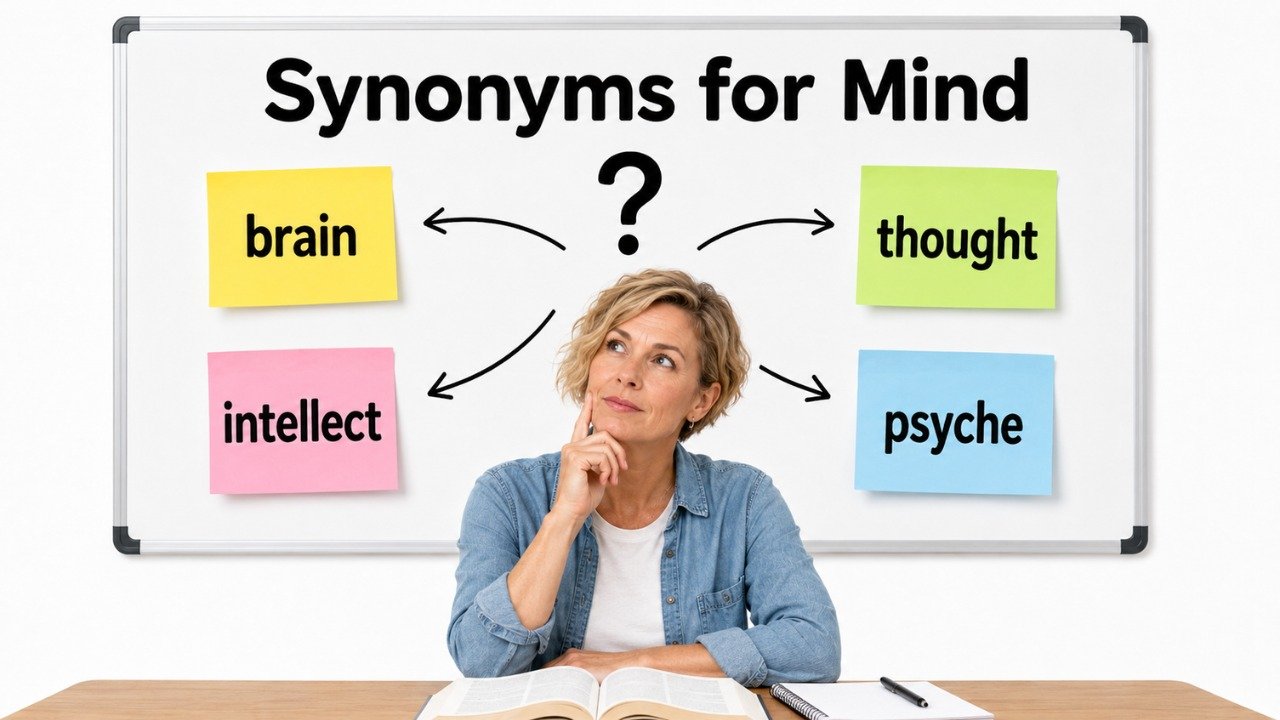
Quick Answer: The best synonyms for mind include intellect, brain, thoughts, consciousness, awareness, attention, memory, opinion, judgment, and intention. Use intellect when referring to reasoning ability, thoughts for ideas passing through the mind, consciousness for awareness of yourself and your surroundings, attention when focusing on something, memory when referring to remembered information, opinion for a personal view, and intention when mind means a plan or purpose. The most accurate replacement depends on how mind functions in the sentence.
Pronunciation and Word Details
Word: Mind.
Pronunciation: /maɪnd/
Part of Speech: Noun and verb.
Meaning: The part of a person responsible for thinking, understanding, remembering, feeling, deciding, and forming intentions.
US Pronunciation:
UK Pronunciation:
What Does “Mind” Mean?
Mind refers to the part of a person that thinks, understands, remembers, imagines, feels, judges, and makes decisions.
As a noun, mind can describe a person’s mental abilities, thoughts, attention, memory, opinion, intention, or state of awareness. As a verb, mind can mean to care about something, object to something, pay attention, or look after someone or something.
As Mental Ability: Mind can refer broadly to intelligence and reasoning.
Example: She has a sharp mind for solving difficult problems.
As Thoughts: Mind can refer to the ideas and thoughts occupying a person.
Example: Several questions were running through his mind.
As Attention: Mind can describe mental focus.
Example: Keep your mind on the task.
As Memory: Mind can refer to the ability to remember something.
Example: The name slipped from my mind.
As Opinion: Mind can mean someone’s view or decision.
Example: She changed her mind after hearing the full explanation.
As Intention: Mind can refer to a plan or purpose.
Example: He had a different destination in mind.
The meaning therefore changes significantly according to context.
Meaning, Tone, and Context of “Mind”
Tone: Mind is usually neutral and natural in both formal and casual English.
Conversational Use: It is extremely common when discussing thoughts, opinions, memory, attention, decisions, preferences, and intentions.
Formal Use: Mind also appears naturally in essays, psychology related writing, philosophy, education, literature, and discussions of cognition.
Academic Use: In academic contexts, more specific terms such as intellect, cognition, consciousness, awareness, memory, reasoning, or perception may provide greater precision.
Emotional Use: Mind can describe emotional and mental states, especially in expressions involving worry, peace, confusion, fear, or concentration.
Polite Use: As a verb, mind often appears in polite questions such as asking whether someone objects to an action.
Example: Would you mind opening the window?
Strong Use: Expressions such as make up your mind can emphasize the need to decide.
Because mind has several meanings, choosing a synonym requires identifying whether the sentence refers to intelligence, thoughts, awareness, memory, opinion, attention, intention, or judgment.
When and How to Use “Mind”
For Intelligence: Use mind when referring broadly to a person’s ability to think and reason.
Example: Her analytical mind helped her understand the problem quickly.
For Thoughts: Use mind when discussing ideas, worries, memories, or images someone is thinking about.
Example: The conversation remained in his mind all evening.
For Attention: Mind can describe a person’s mental focus.
Example: Keep your mind on the instructions.
For Memory: Use mind when referring to remembered or forgotten information.
Example: I cannot bring his name to mind.
For Opinion: Mind can mean a person’s view, preference, or decision.
Example: She spoke her mind during the discussion.
For Intention: Mind can describe something a person plans, wants, or intends.
Example: What did you have in mind for the project?
For Awareness: Mind can describe conscious thought and awareness.
Example: His mind gradually became clearer after waking.
For Polite Requests: As a verb, mind can ask whether someone objects to something.
Example: Do you mind if I sit here?
For Taking Care: As a verb, mind can also mean watch or take care of something.
Example: Please mind the children while I prepare dinner.
Best Synonyms for Mind
Intellect: The ability to think, understand, and reason.
Example: Her intellect made complex ideas easier to understand.
Brain: The organ associated with thought, or informally a person’s mental ability.
Example: He used his brain to find a practical solution.
Thoughts: Ideas, reflections, worries, or mental impressions.
Example: Her thoughts returned to the conversation.
Consciousness: The state of being mentally aware.
Example: He slowly regained consciousness.
Awareness: Knowledge or perception of something.
Example: Greater awareness helped her recognize the problem.
Attention: Mental focus directed toward someone or something.
Example: The teacher asked for everyone’s attention.
Memory: The ability to remember information and experiences.
Example: Her memory for names is excellent.
Opinion: A personal belief, judgment, or viewpoint.
Example: His opinion changed after reviewing the evidence.
Judgment: The ability to form sensible decisions or conclusions.
Example: Good judgment is important in difficult situations.
Intention: A plan, purpose, or desired action.
Example: Her intention was to finish the work before evening.
50 Synonyms for Mind with Short Meanings
- Intellect: The ability to think and reason.
- Brain: The organ of thought, or a person’s mental ability.
- Thoughts: Ideas or mental impressions.
- Consciousness: The state of being mentally aware.
- Awareness: Knowledge or perception of something.
- Attention: Mental focus on a person, object, or activity.
- Memory: The ability to retain and recall information.
- Opinion: A personal view or belief.
- Judgment: The ability to make considered decisions.
- Intention: A plan or purpose.
- Intelligence: The ability to learn, understand, and reason.
- Reason: The ability to think logically.
- Understanding: The ability to comprehend meaning.
- Thinking: The process of forming ideas and judgments.
- Thought: An idea or mental process.
- Cognition: The mental process of knowing and understanding.
- Perception: The way something is mentally understood or interpreted.
- Insight: A deep understanding of something.
- Wisdom: Good understanding and judgment gained through knowledge or experience.
- Sense: Practical understanding or sound judgment.
- Wits: Mental quickness and intelligence.
- Mentality: A characteristic way of thinking.
- Mindset: A person’s established way of thinking.
- Outlook: A person’s general way of viewing life or a situation.
- Viewpoint: A particular way of considering something.
- Perspective: A way of understanding or seeing a subject.
- View: An opinion or way of thinking.
- Belief: Something accepted as true.
- Idea: A thought or concept.
- Notion: A belief, idea, or impression.
- Imagination: The ability to create mental images or possibilities.
- Reflection: Careful thought about something.
- Contemplation: Deep or sustained thought.
- Consideration: Careful thought before making a decision.
- Reasoning: The process of forming conclusions through thought.
- Comprehension: The ability to understand something.
- Discernment: The ability to judge and understand subtle differences.
- Faculty: A natural mental ability or power.
- Mental capacity: The ability to think, understand, and decide.
- Mental ability: A person’s capacity for thought and reasoning.
- Mental state: A person’s condition of thought or awareness.
- Disposition: A person’s usual mental or emotional tendency.
- Attitude: A settled way of thinking or feeling.
- Purpose: The reason or intention behind an action.
- Aim: Something a person intends to achieve.
- Plan: An intended course of action.
- Intent: A purpose or determination to act.
- Preference: A greater liking for one option than another.
- Decision: A conclusion reached after consideration.
- Focus: Concentrated mental attention.
Read Also:
Synonyms for Aspire

Synonyms for Mind by Context
When Mind Means Intelligence
Intellect: Refers to a person’s ability to reason and understand difficult ideas.
Example: Her intellect was evident in the way she approached the problem.
Intelligence: Describes the general ability to learn, reason, and solve problems.
Example: His intelligence helped him master the subject quickly.
Reason: Focuses on logical thought.
Example: Reason should guide the final decision.
Wits: Refers to quick thinking and mental sharpness.
Example: She relied on her wits during the unexpected situation.
Mental capacity: A more formal expression for the ability to understand, think, and decide.
Example: The activity requires considerable mental capacity.
When Mind Means Thoughts
Thoughts: The most natural substitute when referring to ideas passing through someone’s mind.
Example: Her thoughts turned to the upcoming interview.
Thinking: Refers to the process of considering ideas.
Example: His thinking changed after the discussion.
Reflection: Suggests careful and thoughtful consideration.
Example: After some reflection, she chose a different approach.
Contemplation: Suggests deeper and more sustained thought.
Example: The question deserves careful contemplation.
Idea: Works when mind refers to one particular thought or concept.
Example: An interesting idea came to her during the meeting.
When Mind Means Awareness
Consciousness: Refers to the state of being mentally awake and aware.
Example: The patient remained conscious and showed full awareness.
Awareness: Describes knowing or noticing something.
Example: Public awareness of the issue increased.
Perception: Refers to how something is noticed, understood, or interpreted.
Example: Her perception of the situation changed.
Cognition: A formal term for mental processes involving thought, memory, and understanding.
Example: Sleep can influence cognition and concentration.
When Mind Means Opinion
Opinion: The best general replacement when mind refers to a personal view.
Example: She expressed her opinion clearly.
View: A natural word for a belief or position.
Example: His view on the matter remained unchanged.
Viewpoint: Refers to a particular position from which someone considers an issue.
Example: The article presents a different viewpoint.
Perspective: Describes a broader way of seeing or interpreting something.
Example: Experience gave her a new perspective.
Belief: Refers to something a person accepts as true.
Example: His belief influenced his decision.
When Mind Means Attention
Attention: The clearest synonym when mind refers to mental focus.
Example: Please give the instructions your full attention.
Focus: Refers to concentrated attention.
Example: Her focus remained on completing the project.
Concentration: Describes sustained mental attention.
Example: The noise disturbed his concentration.
Consideration: Refers to giving something careful mental attention.
Example: The proposal deserves serious consideration.
When Mind Means Intention
Intention: The strongest general synonym when mind refers to what someone plans to do.
Example: Her intention was to complete the task early.
Intent: A slightly more formal alternative for purpose or intention.
Example: His intent was clear from the beginning.
Purpose: Refers to the reason behind an action.
Example: The purpose of the meeting was to resolve the issue.
Plan: Best when a specific course of action is intended.
Example: Their plan was to leave before sunrise.
Aim: Refers to something a person hopes to achieve.
Example: Her aim is to improve communication within the team.
Another Word for Mind
The best general replacement for mind is often intellect when the word refers to thinking ability. However, mind has several meanings, so no single synonym works in every sentence. Use thoughts for mental ideas, attention for focus, opinion for a personal view, memory for remembered information, and intention for a plan or purpose.
Original: She has a brilliant mind.
Better Option: She has a brilliant intellect.
Original: That question stayed in my mind all day.
Better Option: That question stayed in my thoughts all day.
Original: Keep your mind on your work.
Better Option: Keep your attention on your work.
Original: He changed his mind after hearing the explanation.
Better Option: He changed his opinion after hearing the explanation.
When Not to Use “Mind”
Do not use mind when a more specific term would communicate your meaning more accurately.
Weak: The scientist studied the mind of memory.
Better: The scientist studied human memory.
Use opinion when referring specifically to someone’s view rather than their entire mental state.
Weak: My mind is that the proposal needs revision.
Better: My opinion is that the proposal needs revision.
Use attention when you mean focus.
Weak: Please give your mind to the speaker.
Better: Please give your attention to the speaker.
Use intention when referring to a specific plan.
Weak: Her mind was to finish the project early.
Better: Her intention was to finish the project early.
Use intellect or intelligence when discussing reasoning ability in formal writing.
Weak: The researcher measured the participants’ minds.
Better: The researcher examined the participants’ cognitive abilities.
Avoid repeating mind several times in a short passage when thoughts, memory, attention, intention, or opinion would be clearer.
Words Commonly Confused With Mind
Mind vs Brain: Mind refers to thought, awareness, memory, and mental experience, while brain refers to the physical organ associated with these processes.
Mind vs Intellect: Mind is broader and can include thoughts, feelings, memory, attention, and intention. Intellect focuses mainly on reasoning and understanding.
Mind vs Thought: Mind refers to the broader mental system or state, while a thought is one idea or mental event.
Mind vs Consciousness: Mind includes many mental abilities, while consciousness specifically refers to awareness and conscious experience.
Mind vs Memory: Mind is broader. Memory is specifically the ability to store and recall information or experiences.
Mind vs Opinion: Mind can mean opinion in certain expressions, but opinion specifically means a personal judgment or belief.
Mind vs Attention: Mind can refer to mental focus, but attention is more precise when someone is concentrating on something.
Mind vs Intention: Mind can express plans in phrases such as have in mind, while intention directly refers to a purpose or planned action.
Which Synonym Should You Choose?
Choose intellect when discussing reasoning ability, intelligence, or intellectual strength in formal writing.
Choose thoughts when referring to ideas, worries, memories, or reflections passing through someone’s mind.
Choose consciousness when discussing awareness, wakefulness, or conscious mental experience.
Choose awareness when referring to knowledge or recognition of a situation.
Choose attention when writing about focus during work, study, listening, or observation.
Choose memory when discussing remembered information, experiences, names, facts, or events.
Choose opinion in essays, discussions, messages, or conversations when mind refers to someone’s personal view.
Choose judgment when discussing someone’s ability to make sensible decisions.
Choose intention when referring to what a person plans or means to do.
Choose perspective when explaining how someone views or interprets an issue.
Choose cognition in academic or technical writing about processes such as thinking, learning, remembering, and reasoning.
Choose mindset when describing someone’s established pattern or attitude toward thinking.
Real Life Examples of “Mind” in Sentences
Original: She has a creative mind.
Better Option: She has a creative intellect.
Original: Too many thoughts were filling his mind.
Better Option: Too many ideas were filling his thoughts.
Original: Keep your mind on the road.
Better Option: Keep your attention on the road.
Original: His name suddenly came to mind.
Better Option: His name suddenly returned to my memory.
Original: She changed her mind about the proposal.
Better Option: She changed her opinion about the proposal.
Original: I have a different solution in mind.
Better Option: I have a different plan in mind.
Original: His mind was focused on the examination.
Better Option: His attention was focused on the examination.
Original: The experience changed her mind about leadership.
Better Option: The experience changed her perspective on leadership.
Original: A strange idea entered his mind.
Better Option: A strange thought occurred to him.
Original: Peace finally returned to her mind.
Better Option: Calm finally returned to her thoughts.
Synonym Groups and Usage Differences
Intelligence Group
Words: Intellect, intelligence, reason, wits, understanding, mental ability.
These words describe a person’s ability to think, reason, understand, and solve problems. Intellect is especially useful in formal contexts, while wits is more conversational.
Example: Her intellect allowed her to understand the complex argument quickly.
Thought Group
Words: Thoughts, thinking, reflection, contemplation, idea, notion.
These words relate to ideas and the process of thinking. Thoughts is broad and natural, while contemplation suggests longer and deeper consideration.
Example: After careful reflection, he decided to accept the offer.
Awareness Group
Words: Consciousness, awareness, perception, cognition, understanding.
These words refer to mental awareness and understanding. Consciousness concerns conscious experience, while perception focuses on how something is noticed or interpreted.
Example: Her awareness of the problem improved after the discussion.
Opinion Group
Words: Opinion, viewpoint, perspective, view, belief, outlook.
These words describe ways of thinking about a subject. Opinion is best for personal judgments, while perspective often describes a broader way of seeing an issue.
Example: His perspective changed after hearing both sides.
Attention Group
Words: Attention, focus, concentration, consideration.
These alternatives describe directing mental energy toward something. Focus emphasizes concentration, while consideration suggests careful thought before a decision.
Example: The task requires complete concentration.
Intention Group
Words: Intention, intent, purpose, aim, plan.
These words describe what someone wants or plans to do. Intention is broad, while aim emphasizes a desired result.
Example: Her intention was to solve the problem peacefully.
Antonyms of Mind
The opposite of mind depends on the meaning being used. Mind itself does not have one universal antonym because it can refer to intellect, attention, awareness, memory, opinion, or intention.
Ignorance: Lack of knowledge or understanding.
Unawareness: Lack of awareness or recognition.
Inattention: Failure to give proper mental focus.
Forgetfulness: A tendency to fail to remember information.
Distraction: Something that draws attention away from the intended focus.
Confusion: A state of unclear or disordered thinking.
Thoughtlessness: Lack of careful consideration.
Unconsciousness: A state in which conscious awareness is absent.
Indecision: Difficulty or inability to make a decision.
Neglect: Failure to give appropriate attention or care.
Comparison: Mind vs Related Words
Mind vs Intellect
Mind is a broad term covering thought, memory, awareness, emotion, opinion, and intention. Intellect refers more specifically to reasoning and understanding.
Example With Mind: Her mind was full of questions.
Example With Intellect: Her intellect helped her solve the difficult problem.
Mind vs Brain
Brain is the physical organ inside the head, while mind refers to mental experiences and abilities such as thought, memory, awareness, and judgment.
Example With Mind: The puzzle occupied his mind for hours.
Example With Brain: The brain processes information received from the senses.
Mind vs Thoughts
Mind describes the broader mental space or capacity in which thinking happens. Thoughts are individual ideas, reflections, or mental impressions.
Example With Mind: The memory remained in her mind.
Example With Thoughts: Her thoughts returned to her childhood.
Mind vs Consciousness
Mind includes many mental processes. Consciousness refers especially to awareness of oneself, thoughts, sensations, and surroundings.
Example With Mind: His mind was busy planning the day.
Example With Consciousness: He regained consciousness after a brief period of unconsciousness.
Mind vs Memory
Mind includes thought, judgment, awareness, and memory. Memory is specifically concerned with retaining and recalling information.
Example With Mind: Keep the instructions in mind.
Example With Memory: Her memory of the event remained clear.
Mind vs Opinion
Mind can mean opinion in expressions such as change your mind, but opinion refers directly to a person’s view or judgment.
Example With Mind: She changed her mind about attending.
Example With Opinion: She changed her opinion about the proposal.
Mind vs Attention
Mind is broader, while attention specifically means mental focus.
Example With Mind: His mind wandered during the lecture.
Example With Attention: His attention returned when the speaker asked a question.
Mind vs Mindset
Mind refers broadly to mental processes, while mindset means an established attitude or way of thinking.
Example With Mind: His mind was occupied by the problem.
Example With Mindset: His positive mindset helped him handle the challenge.
Common Phrases and Expressions With Mind
Change Your Mind: To form a different opinion or decision.
Make Up Your Mind: To reach a decision.
Keep in Mind: To remember or consider something.
Bear in Mind: To remember something important while thinking or deciding.
Speak Your Mind: To express your true opinion openly.
Have in Mind: To be thinking about or planning something.
Come to Mind: To appear suddenly in your thoughts or memory.
Bring to Mind: To cause someone to remember or think about something.
Peace of Mind: A feeling of calm caused by freedom from worry.
Open Mind: A willingness to consider different ideas or opinions.
Common Mistakes to Avoid
Using One Synonym for Every Meaning: Mind has several meanings. Intellect does not replace mind when the intended meaning is opinion, attention, or intention.
Confusing Mind With Brain: Brain refers to a physical organ. Mind usually describes thought, consciousness, understanding, and mental experience.
Using Intellect for Ordinary Thoughts: Intellect refers to reasoning ability rather than every thought in a person’s mind.
Weak: Several worries filled her intellect.
Better: Several worries filled her mind.
Confusing Opinion With Attention: Opinion describes a view, while attention means mental focus.
Weak: Keep your opinion on the road.
Better: Keep your attention on the road.
Using Memory When the Meaning Is Intention: Memory refers to remembered information, not plans.
Weak: I have a new memory for the project.
Better: I have a new plan for the project.
Repeating Mind Too Often: Replace repeated uses with thoughts, opinion, attention, intention, intellect, perspective, or memory when the context supports the change.
Using Technical Words Unnecessarily: Cognition can be useful in academic writing but may sound overly technical in ordinary conversation.
Being Vague: When clarity matters, state whether you mean someone’s thoughts, intelligence, opinion, memory, focus, or intention.
Weak: His mind was different.
Better: His perspective on the issue was different.
Conclusion
Understanding synonyms for mind makes it easier to express thoughts and mental processes with greater precision. Use intellect or intelligence for reasoning ability, thoughts for mental ideas, attention for focus, memory for remembered information, opinion or perspective for personal views, and intention for plans or purposes. Terms such as consciousness, awareness, cognition, judgment, and mindset are useful in more specific contexts. Choosing the right synonym helps your writing sound clearer, more natural, and more accurate.
FAQs About Synonyms for Mind
What is the best synonym for mind?
Answer: Intellect is a strong synonym when mind refers to thinking ability, but thoughts, attention, memory, opinion, and intention may be better in other contexts.
What is another word for mind in formal writing?
Answer: Intellect, cognition, consciousness, reasoning, judgment, and mental capacity are useful formal alternatives depending on the meaning.
What is another word for mind when talking about thoughts?
Answer: Thoughts, thinking, reflection, contemplation, and ideas are natural alternatives.
Is brain a synonym for mind?
Answer: Brain can be an informal synonym when referring to intelligence, but it primarily means the physical organ associated with mental processes.
What synonym for mind means opinion?
Answer: Opinion, view, viewpoint, perspective, belief, and outlook can replace mind when referring to a person’s way of thinking about something.
What synonym for mind means attention?
Answer: Attention, focus, concentration, and consideration are useful alternatives when mind refers to mental focus.
What is the difference between mind and mindset?
Answer: Mind refers broadly to thinking, awareness, memory, and mental activity. Mindset refers specifically to an established attitude or way of thinking.
