
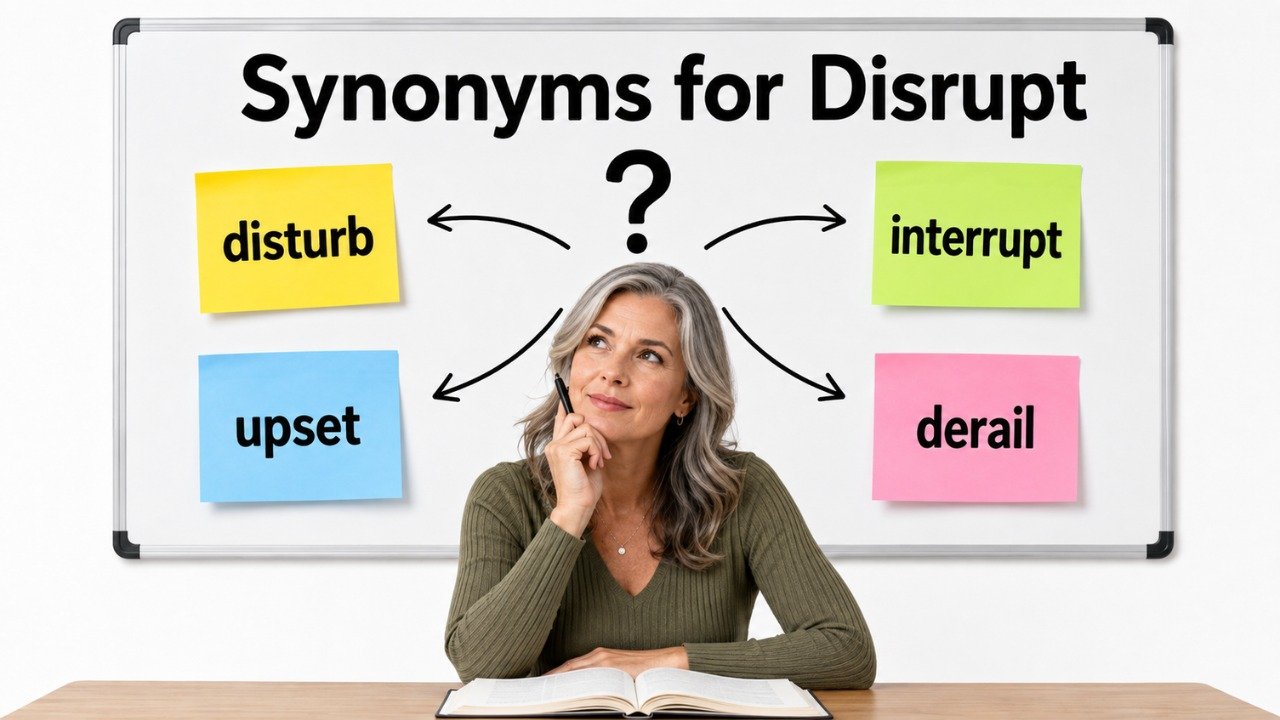
Quick Answer: Common synonyms for disrupt include interrupt, disturb, interfere, obstruct, hinder, upset, unsettle, derail, break, and destabilize. The best synonyms for disrupt depend on context. Use interrupt for stopping an activity briefly, disturb for causing disorder or discomfort, interfere for getting in the way of a process, obstruct for blocking progress, hinder for slowing progress, derail for causing a plan to fail, and destabilize for weakening a system or situation.
Pronunciation and Word Details
Word: Disrupt.
Pronunciation: /dɪsˈrʌpt/
Part of Speech: Verb.
Meaning: To interrupt, disturb, or prevent the normal progress, order, or operation of something.
US Pronunciation:
UK Pronunciation:
What Does “Disrupt” Mean?
Disrupt means to interrupt the normal order, progress, activity, or operation of something.
It is mainly used as a verb. Someone or something can disrupt a meeting, disrupt traffic, disrupt a routine, disrupt communication, or disrupt a larger system.
The word often suggests that something was functioning normally before an interruption, disturbance, or major change occurred.
Example: Heavy rain disrupted travel across the region.
In another context, disrupt can describe interference with plans or activities.
Example: Frequent interruptions disrupted her concentration.
It can also describe major changes that alter an established process, system, industry, or way of working.
Example: New methods can disrupt traditional working practices.
The exact meaning depends on whether the disruption is temporary, serious, deliberate, accidental, physical, social, or organizational.
Meaning, Tone, and Context of “Disrupt”
Disrupt is generally a neutral to strong word. It often describes an unwanted interruption, but it can also describe major change without automatically meaning that the change is harmful.
In everyday conversation, disrupt may refer to noise, delays, interruptions, or unexpected events.
In formal writing, it is common when discussing systems, services, plans, routines, transportation, education, communication, and business operations.
In academic writing, disrupt can describe a change that alters an established process, pattern, relationship, or structure.
In technical contexts, the word may describe interference with normal operation.
The tone becomes stronger when disruption causes serious damage, confusion, instability, or failure.
Neutral Use: The schedule was disrupted by bad weather.
Strong Use: The failure disrupted essential services.
Formal Use: The incident disrupted normal operations.
Conversational Use: The noise disrupted my sleep.
When and How to Use “Disrupt”
For Interrupting an Activity
Use disrupt when something prevents an activity from continuing normally.
Example: Loud construction work disrupted the lesson.
For Disturbing a Routine
Disrupt works well when an event changes a normal pattern or schedule.
Example: The sudden delay disrupted her morning routine.
For Blocking Progress
Use disrupt when something makes progress difficult or prevents a process from working properly.
Example: Equipment failure disrupted production.
For Creating Disorder
Disrupt can describe an action that causes confusion, disorder, or instability.
Example: The unexpected announcement disrupted the meeting.
For Affecting Services
The word is common when transportation, communication, electricity, or other services stop working normally.
Example: Severe weather disrupted train services.
For Changing an Established System
Use disrupt when a new method or development significantly changes an existing way of doing something.
Example: The new process disrupted several traditional practices.
For Disturbing Concentration
Disrupt can describe something that breaks a person’s focus or attention.
Example: Repeated phone calls disrupted his concentration.
Best Synonyms for Disrupt
Interrupt
Synonym: Interrupt means to stop an activity or process temporarily.
Example: Please do not interrupt the speaker during the presentation.
Disturb
Synonym: Disturb means to interfere with peace, order, concentration, or normal activity.
Example: The loud music disturbed the neighbors.
Interfere
Synonym: Interfere means to become involved in a way that prevents something from working properly.
Example: Background noise can interfere with communication.
Obstruct
Synonym: Obstruct means to block movement, action, or progress.
Example: Fallen branches obstructed the road.
Hinder
Synonym: Hinder means to make progress more difficult or slower.
Example: Poor planning can hinder development.
Upset
Synonym: Upset means to disturb an arrangement, balance, plan, or normal condition.
Example: The sudden change upset the schedule.
Unsettle
Synonym: Unsettle means to disturb stability, confidence, or normal order.
Example: The unexpected news unsettled the team.
Derail
Synonym: Derail means to cause a plan, process, or effort to fail or move away from its intended course.
Example: A lack of funding could derail the project.
Break
Synonym: Break means to interrupt continuity, order, or normal operation.
Example: The announcement broke the calm atmosphere.
Destabilize
Synonym: Destabilize means to make a system, situation, or structure less stable.
Example: Sudden changes can destabilize a carefully managed process.
50 Synonyms for Disrupt with Short Meanings
- Interrupt: Stop an activity temporarily.
- Disturb: Interfere with normal peace or order.
- Interfere: Get in the way of normal progress.
- Obstruct: Block movement or progress.
- Hinder: Make progress more difficult.
- Upset: Disturb an arrangement or balance.
- Unsettle: Make a situation less stable or calm.
- Derail: Cause a plan or process to fail.
- Break: Interrupt continuity or normal operation.
- Destabilize: Make something less stable.
- Disorganize: Cause a loss of order or structure.
- Disarrange: Put something out of its normal order.
- Displace: Move something from its usual position.
- Confuse: Make a situation unclear or disordered.
- Agitate: Disturb calm or stability.
- Trouble: Cause difficulty, disturbance, or concern.
- Hamper: Make movement or progress harder.
- Impede: Slow or block progress.
- Block: Prevent movement or action.
- Delay: Cause something to happen later.
- Prevent: Stop something from occurring.
- Stop: Bring an activity or process to an end.
- Suspend: Temporarily stop an activity.
- Discontinue: Cause something to stop continuing.
- Pause: Temporarily interrupt progress.
- Distract: Draw attention away from an activity.
- Divert: Turn attention or activity away from its course.
- Disconcert: Disturb confidence or composure.
- Rattle: Cause someone to lose calm or confidence.
- Jar: Disturb suddenly or unpleasantly.
- Shake: Disturb stability or confidence.
- Frustrate: Prevent a plan from succeeding easily.
- Sabotage: Deliberately damage or interfere with success.
- Undermine: Gradually weaken effectiveness or stability.
- Complicate: Make a process more difficult.
- Disorder: Cause confusion or lack of organization.
- Disrupt Order: Cause normal organization to break down.
- Throw Off: Cause something to lose its normal pattern.
- Set Back: Delay progress or development.
- Hold Up: Delay or prevent normal progress.
- Break Up: Interrupt the continuity of an activity.
- Cut Off: Stop a supply, connection, or process.
- Dislocate: Disturb a normal arrangement or system.
- Disrupt Flow: Interrupt smooth movement or progress.
- Disrupt Routine: Interrupt a normal pattern of activity.
- Disrupt Operations: Prevent normal activities from continuing smoothly.
- Cause Disorder: Create confusion or lack of organization.
- Cause Delay: Make progress slower than planned.
- Create Confusion: Make a process or situation less clear.
- Alter: Change the normal course or condition of something.
Read Also:
Synonyms for Mind

Synonyms for Disrupt by Context
When Disrupt Means Interrupt
When disrupt refers to stopping an activity temporarily, the best alternatives include interrupt, pause, break, suspend, and stop.
Example: The announcement disrupted the discussion.
Alternative: The announcement interrupted the discussion.
Interrupt is usually the most precise choice when the activity continues afterward.
When Disrupt Means Disturb
When disrupt means to disturb peace, concentration, routine, or normal order, useful synonyms include disturb, unsettle, agitate, jar, trouble, and rattle.
Example: The noise disrupted her sleep.
Alternative: The noise disturbed her sleep.
Disturb is often more natural when talking about sleep, peace, concentration, or comfort.
When Disrupt Means Block Progress
When something prevents progress or makes it harder, useful alternatives include hinder, hamper, impede, obstruct, block, and delay.
Example: Poor communication disrupted the project.
Alternative: Poor communication hindered the project.
Hinder is a strong choice when progress continues but becomes more difficult.
When Disrupt Means Cause a Plan to Fail
For plans, projects, strategies, or schedules, useful synonyms include derail, frustrate, sabotage, upset, delay, and set back.
Example: A funding problem disrupted the expansion plan.
Alternative: A funding problem derailed the expansion plan.
Derail is especially useful when a problem causes a plan to move far away from its intended course.
When Disrupt Means Change a System
When disrupt refers to a major change in an established system, process, or structure, useful alternatives include destabilize, alter, disorganize, displace, undermine, and transform depending on the intended meaning.
Example: The sudden policy change disrupted normal operations.
Alternative: The sudden policy change destabilized normal operations.
Destabilize works best when the change reduces stability rather than simply causing a brief interruption.
Another Word for Disrupt
Another word for disrupt is interrupt when the meaning involves stopping a normal activity or process. However, the best alternative depends on context.
Use disturb for peace or concentration, hinder for progress, obstruct for physical or practical blockage, derail for plans, and destabilize for systems.
Original: Loud noise disrupted the meeting.
Better Option: Loud noise interrupted the meeting.
Original: Poor coordination disrupted progress.
Better Option: Poor coordination hindered progress.
Original: The unexpected problem disrupted the plan.
Better Option: The unexpected problem derailed the plan.
Original: The sudden change disrupted the system.
Better Option: The sudden change destabilized the system.
When Not to Use “Disrupt”
Disrupt can sound too broad when a more precise word explains what actually happened.
Weak: The chair disrupted the doorway.
Better: The chair obstructed the doorway.
Obstruct is better because the issue involves physical blockage.
Disrupt may also sound too strong for a minor or brief interruption.
Weak: She disrupted me to ask a quick question.
Better: She interrupted me to ask a quick question.
When discussing emotional discomfort, disturb or unsettle may be more accurate.
Weak: The news disrupted him.
Better: The news unsettled him.
Avoid using disrupt repeatedly when the sentence requires different meanings.
Weak: Rain disrupted traffic and disrupted our schedule, which disrupted the event.
Better: Rain slowed traffic, delayed our schedule, and interrupted the event.
Use disrupt only when it clearly describes interference with normal order, operation, progress, or activity.
Words Commonly Confused With Disrupt
Disrupt vs Interrupt: Interrupt usually describes a temporary stop in an activity. Disrupt is broader and can involve serious interference with normal order or operation.
Disrupt vs Disturb: Disturb often refers to peace, comfort, sleep, concentration, or emotional calm. Disrupt usually focuses more on normal activity, systems, plans, or processes.
Disrupt vs Interfere: Interfere means to get involved or create difficulty. Disrupt suggests that the normal flow or operation has actually been affected.
Disrupt vs Obstruct: Obstruct usually means to block something physically or practically. Disrupt means to interfere with normal functioning or progress.
Disrupt vs Hinder: Hinder means to make progress slower or more difficult. Disrupt can involve a more noticeable interruption or breakdown.
Disrupt vs Derail: Derail usually suggests that a plan or process has been pushed seriously away from its intended course. Disrupt may describe either a temporary or serious interruption.
Disrupt vs Destabilize: Destabilize means to reduce stability. Disrupt is broader and does not always imply long term instability.
Which Synonym Should You Choose?
Choose interrupt when an activity stops briefly and then continues.
Choose disturb when discussing sleep, peace, concentration, or emotional calm.
Choose interfere when one thing affects another process in an unwanted way.
Choose obstruct when something blocks movement, access, or progress.
Choose hinder when progress becomes slower or more difficult.
Choose hamper for a slightly more formal way to describe restricted progress.
Choose impede in formal reports, essays, and academic writing when something slows progress.
Choose derail when a plan, project, or effort is pushed away from its intended course.
Choose unsettle when the effect involves confidence, emotional calm, or stability.
Choose destabilize when a system, organization, structure, or situation becomes less stable.
Choose delay when the main effect is that something happens later than planned.
Choose distract when the main problem is lost attention rather than interrupted operation.
Real Life Examples of “Disrupt” in Sentences
Original: Loud conversations disrupted the class.
Better Option: Loud conversations interrupted the class.
Original: Heavy rain disrupted traffic during the morning.
Better Option: Heavy rain delayed traffic during the morning.
Original: The noise disrupted my concentration.
Better Option: The noise disturbed my concentration.
Original: Poor planning disrupted the project.
Better Option: Poor planning hindered the project.
Original: A technical problem disrupted the presentation.
Better Option: A technical problem interrupted the presentation.
Original: The unexpected resignation disrupted the team.
Better Option: The unexpected resignation unsettled the team.
Original: Road repairs disrupted access to the building.
Better Option: Road repairs obstructed access to the building.
Original: The shortage disrupted production.
Better Option: The shortage hampered production.
Original: A major error disrupted the entire plan.
Better Option: A major error derailed the entire plan.
Original: Sudden changes disrupted the organization.
Better Option: Sudden changes destabilized the organization.
Synonym Groups and Usage Differences
Interruption Group
Interrupt, pause, break, suspend, stop, and discontinue describe stopping an activity or process.
Interrupt is best for a temporary break. Suspend suggests an official or temporary stop, while discontinue usually suggests that something will no longer continue.
Example: The alarm interrupted the lecture.
Disturbance Group
Disturb, unsettle, agitate, jar, rattle, trouble, and disconcert describe a loss of calm, order, confidence, or comfort.
These words are useful for emotional situations, concentration, sleep, or personal reactions.
Example: The unexpected criticism unsettled the new employee.
Progress Group
Hinder, hamper, impede, obstruct, block, delay, and hold up describe difficulty in moving forward.
Hinder and hamper suggest slower progress, while obstruct and block suggest a stronger barrier.
Example: Limited resources hindered the team’s progress.
Failure Group
Derail, frustrate, sabotage, undermine, and set back describe interference that threatens success.
Derail is suitable for plans. Sabotage usually involves deliberate interference, while undermine often suggests gradual weakening.
Example: Poor preparation could derail the entire project.
Stability Group
Destabilize, disorganize, disarrange, shake, dislocate, and upset describe disturbance to order, structure, or stability.
These terms are useful for organizations, systems, plans, and established arrangements.
Example: Repeated changes destabilized the process.
Antonyms of Disrupt
The opposite of disrupt depends on whether the word refers to progress, order, stability, operation, or attention.
Continue: Keep an activity or process moving.
Maintain: Keep something in its existing condition.
Preserve: Protect normal order or stability.
Support: Help something function or succeed.
Assist: Help an activity or process progress.
Facilitate: Make progress or action easier.
Stabilize: Make a situation or system more secure.
Organize: Arrange something into a clear order.
Restore: Return something to its normal condition.
Resume: Begin again after an interruption.
Advance: Help something move forward.
Strengthen: Make a system, plan, or structure more effective.
Comparison: Disrupt vs Related Words
Disrupt vs Interrupt
Disrupt is broader and often suggests greater interference with normal activity. Interrupt usually describes a temporary break.
Example With Disrupt: The storm disrupted transportation throughout the area.
Example With Interrupt: A phone call interrupted our conversation.
Disrupt vs Disturb
Disrupt often affects normal operation or progress. Disturb commonly affects peace, comfort, sleep, or concentration.
Example With Disrupt: The power failure disrupted the event.
Example With Disturb: The loud music disturbed my sleep.
Disrupt vs Hinder
Disrupt may interrupt normal activity, while hinder means to make progress slower or more difficult.
Example With Disrupt: The equipment failure disrupted production.
Example With Hinder: Limited funding hindered expansion.
Disrupt vs Obstruct
Disrupt refers to interference with normal activity. Obstruct usually means physically or practically blocking something.
Example With Disrupt: The protest disrupted traffic.
Example With Obstruct: A fallen tree obstructed the road.
Disrupt vs Derail
Disrupt can describe a temporary problem. Derail usually suggests that a plan or process has been seriously pushed off course.
Example With Disrupt: The delay disrupted our schedule.
Example With Derail: The loss of funding derailed the project.
Disrupt vs Destabilize
Disrupt means to interfere with normal operation. Destabilize specifically means to reduce stability.
Example With Disrupt: The outage disrupted communication.
Example With Destabilize: Frequent leadership changes destabilized the organization.
Common Phrases and Expressions With “Disrupt”
Disrupt a Meeting: Interrupt the normal progress of a meeting.
Disrupt a Routine: Break or disturb a normal pattern of activity.
Disrupt Traffic: Prevent traffic from moving normally.
Disrupt Services: Interfere with the normal availability of services.
Disrupt Operations: Prevent normal activities from functioning smoothly.
Disrupt Communication: Interfere with the exchange of information.
Disrupt the Flow: Interrupt smooth or continuous progress.
Disrupt a Schedule: Cause planned timing to change.
Disrupt a Process: Interfere with the normal stages of an activity.
Disrupt the System: Cause a system to stop working normally or become unstable.
Common Mistakes to Avoid
A common mistake is treating every synonym for disrupt as interchangeable.
Interrupt is appropriate when something stops briefly, but it may be too weak when an entire system fails.
Obstruct is useful for blockage, while disturb is better for sleep, concentration, peace, or comfort.
Another mistake is using derail when the problem is only minor. Derail usually suggests serious interference with a plan or project.
Avoid using sabotage unless deliberate harmful interference is intended. It is much stronger than disrupt.
Writers also sometimes use disrupt when delay would be more accurate. If the main effect is simply that something happens later, use delay.
Do not repeat disrupt several times in the same paragraph when interrupt, hinder, disturb, delay, or derail would improve clarity.
Finally, make sure the sentence explains what has been disrupted. Vague phrases such as “it disrupted things” provide little useful information. Naming the affected process, service, routine, plan, or activity makes the meaning clearer.
Conclusion
Understanding synonyms for disrupt makes it easier to describe different kinds of interruption, interference, delay, and disorder accurately. Interrupt works best for temporary stops, disturb for peace or concentration, hinder for slowed progress, obstruct for blockage, derail for damaged plans, and destabilize for weakened systems. Other useful choices include hamper, interfere, unsettle, and delay. Choosing the right alternative based on context helps your writing sound clearer, more natural, and more precise.
FAQs About Synonyms for Disrupt
What is the best synonym for disrupt?
Interrupt is a strong general synonym when disrupt means stopping an activity temporarily. Disturb, hinder, interfere, derail, and obstruct may be better in other contexts.
What is another word for disrupt in formal writing?
Impede, obstruct, interfere, destabilize, and hinder are useful formal alternatives. The best choice depends on what kind of disruption occurred.
What is a synonym for disrupt a process?
Interrupt, interfere with, hinder, impede, derail, or obstruct can describe disruption to a process.
What is another word for disrupt a meeting?
Interrupt is usually the most natural alternative. Disturb may work when noise or disorder affects the meeting.
Are disrupt and disturb the same?
They are related but not identical. Disrupt usually affects normal activity or operation, while disturb often affects calm, comfort, sleep, or concentration.
What is a strong synonym for disrupt?
Derail, destabilize, sabotage, and obstruct can be stronger than disrupt in specific contexts. Sabotage should only be used when deliberate interference is meant.
Can interrupt always replace disrupt?
No. Interrupt works well for temporary stops, but disrupt can also describe serious interference, instability, delay, or major changes to a system or plan.
