
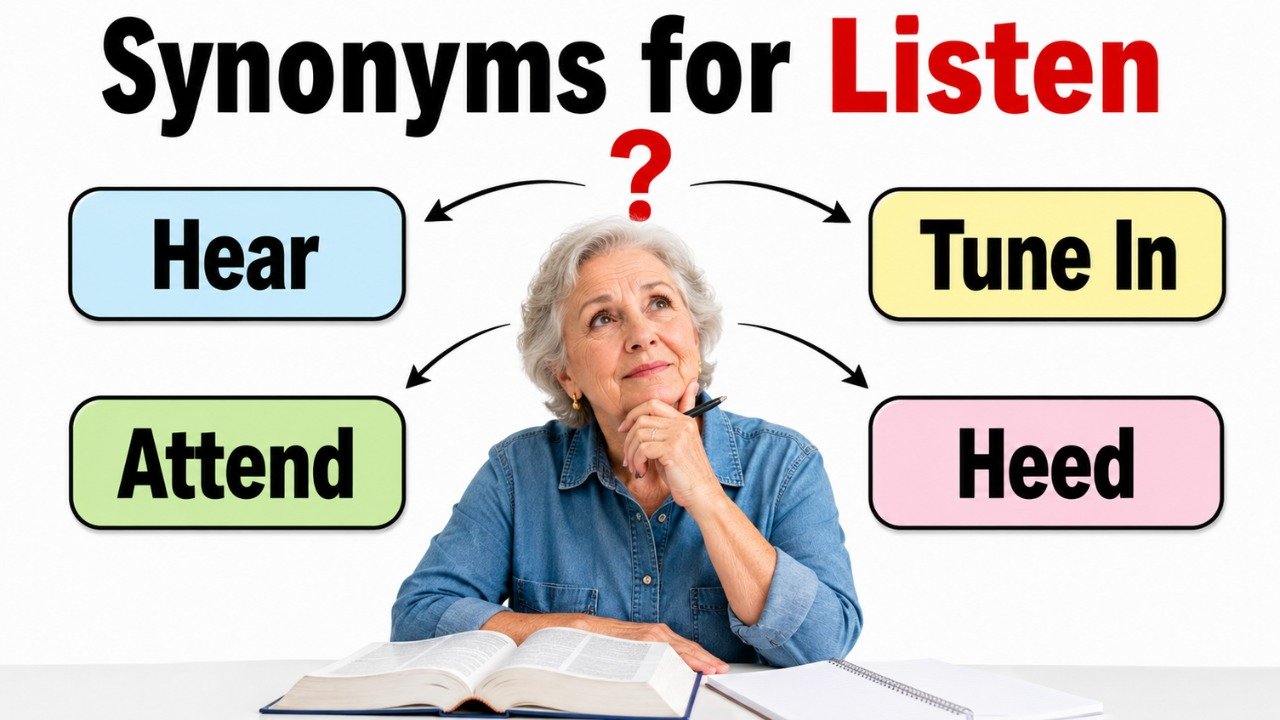
Quick Answer: The best synonyms for listen include hear, attend, heed, pay attention, take notice, tune in, concentrate, consider, obey, and give ear. The best choice depends on context. Use hear for receiving sound, attend or pay attention for focused listening, heed for taking advice seriously, tune in for directing attention to spoken or audio content, consider for thoughtful attention, and obey when listening means following instructions.
Pronunciation and Word Details
Word: Listen.
Pronunciation: /ˈlɪsən/
Part of Speech: Verb.
Meaning: To give attention to a sound, speaker, message, instruction, or piece of advice.
US Pronunciation:
UK Pronunciation:
What Does “Listen” Mean?
Listen means to give deliberate attention to sounds, words, advice, instructions, or another person’s ideas.
Listen is mainly used as a verb. Unlike simply hearing a sound, listening usually involves attention and intention.
A person can listen to music, listen to a conversation, listen for a particular sound, listen carefully to instructions, or listen to someone’s advice.
For Sound: Listen means deliberately paying attention to something you can hear.
Example: She listened to the rain outside her window.
For Conversation: It means giving attention to what another person is saying.
Example: Please listen while I explain the problem.
For Advice: Listen can mean considering or accepting guidance.
Example: He finally listened to his teacher’s advice.
For Instructions: It can mean paying attention and sometimes following what has been said.
Example: Listen carefully before beginning the exercise.
The exact meaning depends on whether the sentence focuses on sound, attention, advice, instructions, or obedience.
Meaning, Tone, and Context of “Listen”
Listen is a neutral and common English word. It works naturally in casual conversation, professional communication, education, instructions, storytelling, and formal writing.
Its tone changes with context.
In everyday conversation, listen often introduces a request for attention.
Example: Listen, I need to explain something.
In polite communication, it can show respect for another person’s opinions or concerns.
Example: Good leaders listen to their teams.
In instructions, listen can sound direct or firm.
Example: Listen carefully to each question.
In emotional situations, the word may suggest empathy and patience.
Example: Sometimes people need someone who will simply listen.
In academic or professional writing, more precise alternatives such as attend to, consider, heed, or pay attention to may suit the context better.
When and How to Use “Listen”
For Paying Attention to Sound
Use listen when someone deliberately focuses on a sound.
Example: Listen to the birds in the garden.
For Following a Conversation
Use listen when someone gives attention to another speaker.
Example: She listened carefully while her colleague explained the issue.
For Advice
Listen can mean taking someone’s suggestions or warnings seriously.
Example: You should listen to experienced people before making the decision.
For Instructions
Use listen when asking someone to pay close attention to directions.
Example: Listen to the instructions before starting the task.
For Empathy
Listen can describe giving another person your full emotional attention.
Example: He listened patiently while his friend described the problem.
For Detecting a Particular Sound
Use listen for when someone actively tries to notice a certain noise.
Example: Listen for the bell before entering the room.
For Obedience
In some contexts, listen means accepting authority or following directions.
Example: The children finally listened to their coach.
Best Synonyms for Listen
Hear: To perceive sound through the ears.
Example: I could hear someone calling from the hallway.
Attend: To give careful attention to something.
Example: Please attend carefully to the instructions.
Heed: To pay serious attention to advice or a warning.
Example: Drivers should heed the safety warning.
Pay Attention: To focus carefully on what is being said or happening.
Example: Pay attention while the directions are explained.
Take Notice: To become attentive to something important.
Example: She took notice of the warning in his voice.
Tune In: To direct attention toward sounds, speech, or information.
Example: He tuned in to the discussion as soon as the topic changed.
Concentrate: To focus mental attention closely.
Example: Concentrate on what the speaker is saying.
Consider: To think carefully about someone’s words, advice, or ideas.
Example: Please consider what she has told you.
Obey: To follow an instruction, rule, or command.
Example: The students obeyed the teacher’s directions.
Give Ear: To listen carefully or sympathetically.
Example: She gave ear to his concerns before responding.
50 Synonyms for Listen with Short Meanings
- Hear: To perceive sound.
- Attend: To give careful attention.
- Heed: To listen seriously to advice or warnings.
- Pay Attention: To focus on what is being said.
- Take Notice: To become attentive to something.
- Tune In: To direct attention toward sound or speech.
- Concentrate: To focus mental attention.
- Consider: To think carefully about what is said.
- Obey: To follow spoken instructions or commands.
- Give Ear: To listen carefully.
- Attend To: To focus carefully on someone or something.
- Hear Out: To listen until someone has finished speaking.
- Listen Closely: To give very careful attention.
- Listen Carefully: To focus closely on sound or speech.
- Pay Heed: To take advice or warnings seriously.
- Take Heed: To give serious attention to a warning.
- Take In: To absorb and understand spoken information.
- Absorb: To receive and understand information.
- Focus: To direct attention toward something.
- Concentrate On: To give full attention to something.
- Be Attentive: To listen with care and interest.
- Be All Ears: To be eager and ready to listen.
- Give Attention: To focus on what someone is saying.
- Lend an Ear: To listen sympathetically.
- Give Someone an Ear: To listen to someone’s concerns.
- Take Advice: To listen to and follow guidance.
- Follow Advice: To act according to guidance received.
- Mind: To pay attention to a warning or instruction.
- Observe: To pay careful attention.
- Notice: To become aware of something.
- Register: To consciously notice or understand information.
- Understand: To grasp the meaning of what is heard.
- Comprehend: To understand spoken information fully.
- Process: To mentally consider what has been heard.
- Reflect On: To think carefully about spoken ideas.
- Think About: To consider someone’s words.
- Consider Carefully: To give thoughtful attention.
- Respond To: To react after listening to something.
- Take Seriously: To treat someone’s words as important.
- Acknowledge: To recognize and respond to what is said.
- Follow: To pay attention to and understand speech.
- Keep an Ear Out: To listen for a particular sound.
- Listen For: To try to hear a specific sound.
- Listen In: To listen to a conversation or discussion.
- Hearken: To listen or pay attention, especially in literary use.
- Hark: To listen attentively, especially in older or literary English.
- Give Audience To: To listen formally to someone.
- Be Receptive: To be willing to hear and consider ideas.
- Take On Board: To understand and accept advice or information.
- Give Consideration To: To listen to and think seriously about something.
Read Also:
Synonyms for Delightful

Synonyms for Listen by Context
When Listen Means Hear Carefully
When listen refers to deliberately focusing on sound, good alternatives include hear, attend, listen closely, listen carefully, tune in, and concentrate.
Example: Listen carefully to the announcement.
Alternative: Pay close attention to the announcement.
Example: She listened to the sound of footsteps outside.
Alternative: She concentrated on the sound of footsteps outside.
When Listen Means Pay Attention
When the main idea is attention rather than sound itself, pay attention, attend to, focus, concentrate, take notice, and be attentive are useful choices.
Example: Listen while the teacher explains the answer.
Alternative: Pay attention while the teacher explains the answer.
Example: He listened closely during the meeting.
Alternative: He remained attentive during the meeting.
When Listen Means Accept Advice
When listen means taking guidance seriously, heed, pay heed, take advice, follow advice, consider, and take seriously are stronger alternatives.
Example: You should listen to her warning.
Alternative: You should heed her warning.
Example: He listened to his doctor’s advice.
Alternative: He followed his doctor’s advice.
When Listen Means Hear Someone Fully
When someone needs time to explain themselves, hear out, lend an ear, give ear, and be receptive work well.
Example: Please listen before making a judgment.
Alternative: Please hear me out before making a judgment.
Example: She listened patiently to his concerns.
Alternative: She lent an ear to his concerns.
When Listen Means Follow Instructions
When listening implies obedience, obey, follow, mind, heed, and take advice may be more accurate.
Example: The students listened to their instructor.
Alternative: The students followed their instructor’s directions.
Another Word for Listen
The best general replacement for listen is pay attention when the focus is deliberate concentration. However, hear may be better for sounds, heed for warnings and advice, and attend for more formal situations.
Original: Listen carefully to what she says.
Better Option: Pay attention carefully to what she says.
Original: You should listen to the warning.
Better Option: You should heed the warning.
Original: He listened while I explained my concerns.
Better Option: He heard me out while I explained my concerns.
Original: Listen for the sound of the alarm.
Better Option: Keep an ear out for the sound of the alarm.
When Not to Use “Listen”
Listen is natural in many situations, but a more precise word can sometimes improve clarity.
Do not use listen when you only mean that a sound entered someone’s ears without deliberate attention. Hear is more accurate in that situation.
Weak: I listened a loud noise outside while I was sleeping.
Better: I heard a loud noise outside while I was sleeping.
Avoid repeating listen several times in a short paragraph.
Weak: She listened to the speaker, listened to the questions, and listened to the final instructions.
Better: She listened to the speaker, considered the questions, and paid attention to the final instructions.
When discussing warnings or serious advice, heed may communicate the intended meaning more precisely.
Weak: People should listen to the safety notice.
Better: People should heed the safety notice.
When the intended meaning is obedience, use obey or follow rather than relying on listen alone.
Weak: The child refused to listen to the rule.
Better: The child refused to follow the rule.
Words Commonly Confused With Listen
Listen vs Hear: Listen involves deliberate attention. Hear means perceiving sound, even when no effort is made.
Listen vs Heed: Listen means paying attention to words or sounds. Heed means taking advice, warnings, or instructions seriously.
Listen vs Attend: Listen focuses mainly on auditory attention. Attend can mean giving careful mental attention and often sounds more formal.
Listen vs Obey: Listen does not always mean following what someone says. Obey specifically means carrying out an instruction or command.
Listen vs Understand: A person can listen without fully understanding. Understand means successfully grasping the meaning.
Listen vs Notice: Listen usually involves intentional attention to sound. Notice means becoming aware of something through any sense or observation.
Listen vs Concentrate: Listen specifically relates to sound or spoken information, while concentrate can involve any activity requiring focused attention.
Which Synonym Should You Choose?
Choose hear when referring simply to the ability to perceive a sound.
Choose pay attention for everyday situations where focused listening is important.
Choose heed for advice, warnings, cautions, or serious instructions.
Choose attend when you want a more formal word for giving careful attention.
Choose hear out when someone should be allowed to finish explaining an opinion or concern.
Choose lend an ear when describing sympathetic or supportive listening.
Choose tune in when focusing attention on speech, discussion, or audio content.
Choose concentrate when emphasizing mental focus rather than the act of hearing.
Choose obey when listening means carrying out an instruction or command.
Choose consider for professional writing, essays, emails, or reports when someone’s words or recommendations need thoughtful evaluation.
Real Life Examples of “Listen” in Sentences
Original: Please listen to the instructions before starting.
Better Option: Please pay attention to the instructions before starting.
Original: She listened to her friend’s concerns.
Better Option: She lent an ear to her friend’s concerns.
Original: You should listen to the warning.
Better Option: You should heed the warning.
Original: He listened while I explained the entire situation.
Better Option: He heard me out while I explained the entire situation.
Original: The students listened carefully during the lesson.
Better Option: The students remained attentive during the lesson.
Original: Listen for your name to be called.
Better Option: Keep an ear out for your name to be called.
Original: She finally listened to her parents’ advice.
Better Option: She finally followed her parents’ advice.
Original: He listened closely to every detail.
Better Option: He concentrated on every detail.
Original: The manager listened to the team’s suggestions.
Better Option: The manager considered the team’s suggestions.
Original: The children would not listen to their coach.
Better Option: The children would not obey their coach.
Synonym Groups and Usage Differences
Hearing Group
Hear, listen closely, listen carefully, listen for, and keep an ear out relate directly to sound.
Use these when auditory attention is the main idea.
Example: Keep an ear out for the doorbell.
Attention Group
Pay attention, attend, focus, concentrate, and be attentive emphasize mental concentration.
These alternatives work well in classrooms, meetings, conversations, and instructions.
Example: Please pay attention while the process is explained.
Advice Group
Heed, take advice, follow advice, pay heed, and take seriously relate to guidance or warnings.
Use these when listening should influence a person’s decision or behavior.
Example: Travelers should heed local safety instructions.
Empathy Group
Lend an ear, hear out, give ear, and give someone an ear emphasize patient or supportive listening.
Example: She was willing to hear him out before responding.
Understanding Group
Take in, absorb, comprehend, understand, and process focus on receiving and mentally grasping information.
Example: Give students enough time to absorb the instructions.
Obedience Group
Obey, follow, mind, and take heed are useful when listening involves carrying out instructions.
Example: Everyone should follow the emergency directions carefully.
Antonyms of Listen
The opposite of listen depends on whether the intended meaning involves attention, advice, understanding, or obedience.
Ignore: To deliberately give no attention.
Disregard: To treat something as unimportant.
Dismiss: To reject someone’s words without proper consideration.
Overlook: To fail to notice or consider something.
Neglect: To fail to give necessary attention.
Interrupt: To speak before another person has finished.
Disobey: To refuse to follow instructions or commands.
Reject: To refuse to accept advice or an idea.
Tune Out: To stop paying attention to what is being said.
Mishear: To hear something incorrectly.
Misunderstand: To interpret spoken information incorrectly.
Resist: To refuse to accept advice, influence, or direction.
Comparison: Listen vs Related Words
Listen vs Hear
Listen involves intentional attention. Hear is the natural ability to perceive sound.
Example With Listen: Listen carefully to the instructions.
Example With Hear: I could hear music from the next room.
Listen vs Heed
Listen means giving attention. Heed means acting seriously on what has been heard.
Example With Listen: Listen to what your instructor says.
Example With Heed: Heed your instructor’s warning.
Listen vs Attend
Listen usually focuses on spoken words or sounds. Attend can mean giving careful mental attention and has a more formal tone.
Example With Listen: She listened carefully to his explanation.
Example With Attend: She attended closely to every detail of his explanation.
Listen vs Obey
Listening does not necessarily mean agreement or compliance. Obey specifically means following a command.
Example With Listen: He listened to the instructions.
Example With Obey: He obeyed the instructions immediately.
Listen vs Pay Attention
Listen mainly relates to auditory information. Pay attention can apply to sounds, sights, actions, and other information.
Example With Listen: Listen to the speaker carefully.
Example With Pay Attention: Pay attention to the speaker’s examples.
Listen vs Understand
Listening is the process of receiving spoken information attentively. Understanding means successfully grasping its meaning.
Example With Listen: She listened to the explanation.
Example With Understand: She understood the explanation after hearing it twice.
Common Phrases and Expressions With Listen
Listen Carefully: Give close attention to what is being heard.
Example: Listen carefully before answering the question.
Listen Closely: Focus strongly on spoken words or sounds.
Example: Listen closely to the difference between the two sounds.
Listen To Advice: Pay attention to guidance or suggestions.
Example: It is wise to listen to advice from experienced people.
Listen To Reason: Accept sensible arguments or advice.
Example: He eventually listened to reason and changed his decision.
Listen Up: A direct expression used to ask people for immediate attention.
Example: Listen up because the next instruction is important.
Listen In: Pay attention to a conversation, discussion, or broadcast.
Example: She listened in as the group discussed the plan.
Listen For: Try to detect a particular sound.
Example: Listen for the signal before opening the door.
Listen To Your Instincts: Pay attention to your inner judgment or feelings.
Example: Sometimes it helps to listen to your instincts.
Listen With an Open Mind: Hear another viewpoint without immediately rejecting it.
Example: Listen with an open mind before forming an opinion.
Stop and Listen: Pause other activity and give full attention to a sound or person.
Example: Stop and listen when someone is explaining an important concern.
Common Mistakes to Avoid
One of the most common mistakes is confusing listen with hear. Listen usually requires deliberate attention, while hear can happen automatically.
Incorrect: I was sleeping when I listened to a strange noise.
Correct: I was sleeping when I heard a strange noise.
Another common mistake involves forgetting to after listen when an object follows.
Incorrect: Listen the teacher carefully.
Correct: Listen to the teacher carefully.
Do not add to when listen is followed by for.
Incorrect: Listen to for the alarm.
Correct: Listen for the alarm.
Avoid using every synonym as though it has exactly the same meaning. Heed implies serious attention to advice or warnings, while obey means following a command.
Weak: I obeyed the music for an hour.
Better: I listened to the music for an hour.
Watch for repetition in essays and reports. Replacing some uses of listen with attend, consider, heed, pay attention, or hear out can improve variety when the context supports the change.
Avoid vague sentences in which it is unclear what someone should listen to.
Vague: You need to listen more.
Clear: You need to listen more carefully when your teammates explain their concerns.
Conclusion
The best synonyms for listen depend on whether the sentence refers to hearing, attention, advice, understanding, empathy, or obedience. Hear works for perceiving sound, while pay attention and attend emphasize focus. Heed is stronger for warnings and advice, hear out suits patient listening, and obey works when instructions must be followed. Understanding these differences makes synonyms for listen easier to use naturally and helps writers choose words that match the exact meaning, tone, and context of a sentence.
FAQs About Synonyms for Listen
What is the best synonym for listen?
Pay attention is one of the best general alternatives when listen means giving deliberate focus. Hear is better when the sentence only refers to perceiving sound.
What is another word for listen carefully?
Attend, pay attention, concentrate, listen closely, and be attentive are useful alternatives for listen carefully.
What is a formal synonym for listen?
Attend, heed, consider, and give attention are useful formal alternatives, depending on the context.
What is a synonym for listening to advice?
Heed is one of the strongest choices. Take advice, follow advice, consider, and pay heed are also useful.
Are hear and listen synonyms?
They are related but not identical. Hear means perceiving sound, while listen means deliberately paying attention to sound.
What is another word for listening to someone’s problems?
Lend an ear, hear someone out, give ear, and listen sympathetically are natural options.
What is the opposite of listen?
Ignore, disregard, dismiss, tune out, and disobey can be opposites depending on whether listen means attention, consideration, or following instructions.
