
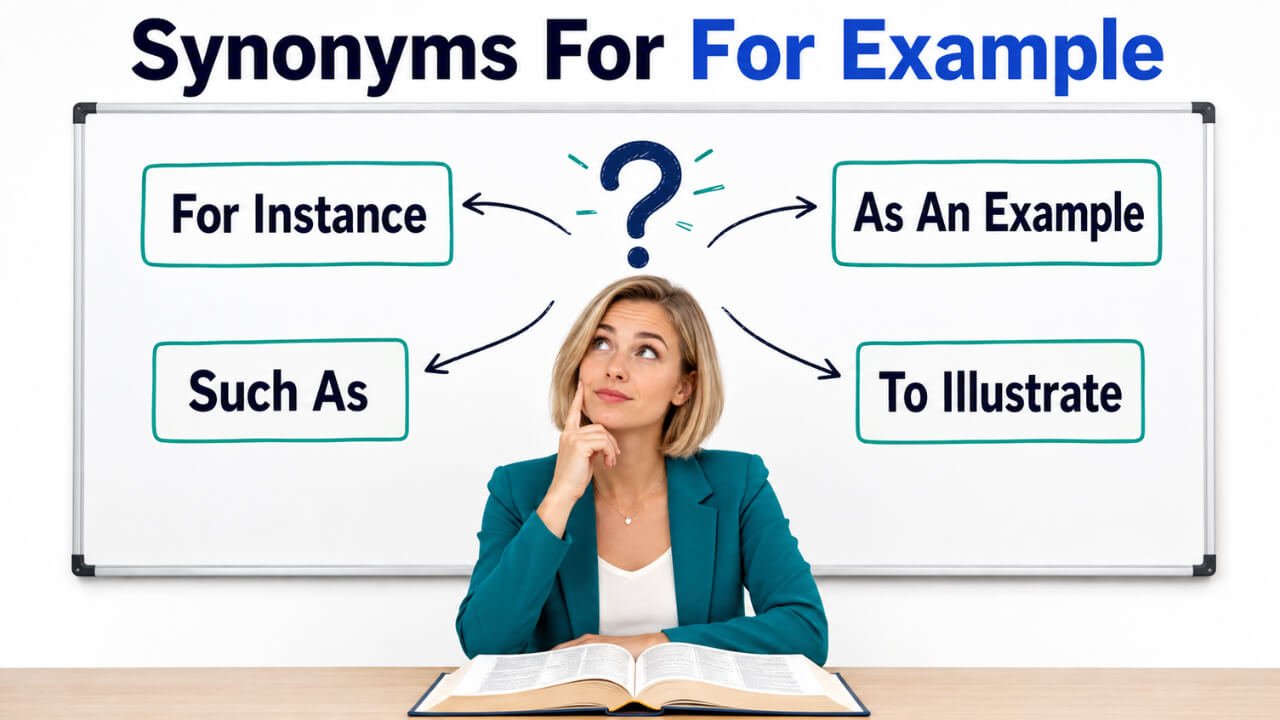
Quick Answer: The best synonyms for for example include for instance, such as, including, like, as an illustration, to illustrate, as a case in point, namely, to give an example, and in particular. Use for instance in general writing, such as before a list, to illustrate in essays, as a case in point in formal explanations, and like in casual speech. These synonyms for for example help you introduce examples clearly without repeating the same phrase too often.
Pronunciation and Word Details
Word: For example.
Pronunciation: /fər ɪɡˈzæm.pəl/.
Part of Speech: Phrase and transitional expression.
Meaning: A phrase used to introduce one or more examples that explain, support, or clarify an idea.
US Pronunciation:
UK Pronunciation:
What Does “For Example” Mean?
Direct Answer: “For example” means “as one example” or “to show what I mean.”
“For example” is a phrase used to introduce a sample, illustration, case, detail, or situation that supports a larger idea. It helps readers understand a general statement by showing a specific instance.
The phrase can appear at the beginning of a sentence, in the middle of a sentence, or before a list. It is common in essays, explanations, definitions, grammar lessons, reports, emails, and everyday conversation.
Example: Many words can show certainty. For example, “definitely” and “surely” both express strong belief.
Meaning, Tone, and Context of “For Example”
“For example” has a neutral, clear, and helpful tone. It is not too formal or too casual, so it works in most types of writing and speech.
In academic writing, it introduces evidence, illustrations, or sample cases. In grammar and vocabulary writing, it helps explain word meanings. In everyday conversation, it makes ideas easier to understand.
The phrase is especially useful when you want to move from a broad idea to a specific detail. It signals that the next words will make the previous idea clearer.
When and How to Use “For Example”
For Giving an Example: Use “for example” when you want to show one sample from a larger group.
Example: Some adjectives describe feelings. For example, “happy” describes a positive emotion.
For Explaining a General Idea: Use it when a broad statement needs a clear detail.
Example: Good writing uses precise words. For example, “rapid” is more specific than “fast” in some contexts.
For Supporting a Point: Use it when an example proves or strengthens your idea.
Example: Polite language can soften a request. For example, “Could you please help me?” sounds respectful.
For Introducing a List: Use it before several items that belong to the same category.
Example: Some words show contrast, for example, “however,” “although,” and “yet.”
For Teaching Vocabulary: Use it to show how a word works in a sentence.
Example: “Bright” can describe light or intelligence. For example, “She is a bright student” means she is intelligent.
Best Synonyms for For Example
For instance: Used to introduce a specific example.
Example: Some animals live in water. For instance, dolphins spend their lives in the ocean.
Such as: Used before examples in a list.
Example: Strong verbs, such as “create,” “solve,” and “lead,” make writing clearer.
Including: Used to show that examples are part of a larger group.
Example: The lesson covers several topics, including grammar, punctuation, and vocabulary.
Like: A simple and casual way to introduce examples.
Example: Choose polite words like “please” and “thank you.”
As an illustration: A formal way to introduce an example that explains an idea.
Example: As an illustration, a confident speaker uses a steady voice.
To illustrate: Used when an example makes an idea easier to understand.
Example: To illustrate, consider how tone changes the meaning of a sentence.
As a case in point: Used for a strong example that proves a point.
Example: Clear punctuation improves meaning. As a case in point, commas can change how a sentence is read.
Namely: Used to name exact examples or specific details.
Example: Two skills are essential, namely listening and speaking.
To give an example: A direct phrase used before a clear sample.
Example: To give an example, “brave” and “courageous” have similar meanings.
In particular: Used to focus on one specific example from a larger group.
Example: Several words fit here. In particular, “assured” sounds natural in formal writing.
50 Synonyms for For Example with Short Meanings
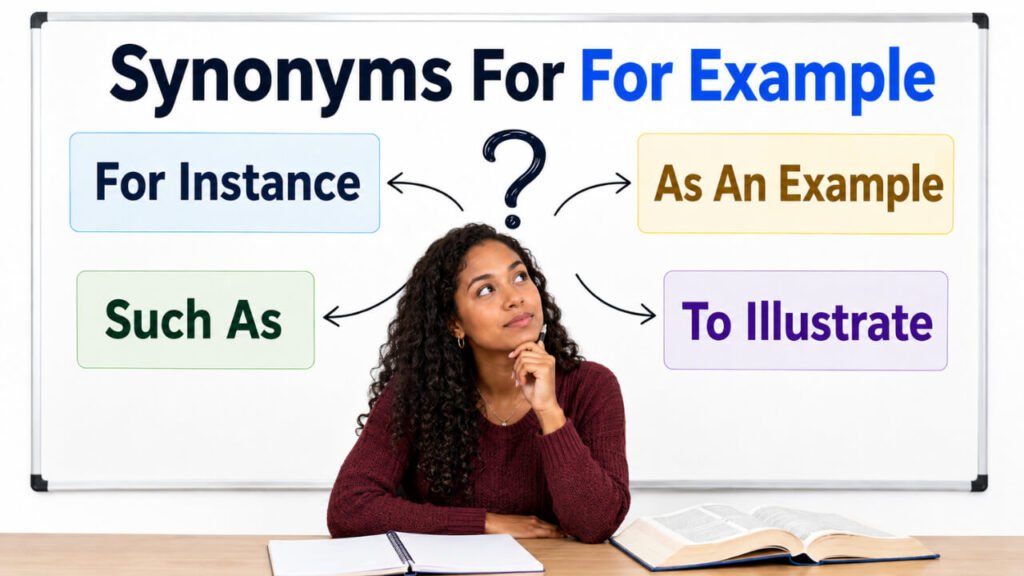
- For instance: Used to introduce one clear example.
- Such as: Used before examples in a list.
- Including: Showing examples that are part of a group.
- Like: Casual word for giving examples.
- As an example: Direct phrase for presenting a sample.
- To give an example: Clear phrase before a specific instance.
- To illustrate: Used when an example explains an idea.
- As an illustration: Formal phrase for a clarifying example.
- By way of example: Formal phrase meaning as an example.
- As a case in point: Strong example that supports a point.
- In particular: Used to focus on one specific example.
- Particularly: Used to highlight a specific example.
- Specifically: Used to introduce an exact example.
- Namely: Used to name exact examples.
- That is: Used to clarify or explain more directly.
- In other words: Used to restate an idea with clearer detail.
- To be specific: Used before a more exact example.
- To be precise: Used before a more exact detail.
- Take: Used casually to introduce an example.
- Consider: Used to ask the reader to think about an example.
- Look at: Casual phrase for directing attention to an example.
- Think of: Used to suggest an easy example.
- Say: Casual word used before a possible example.
- Suppose: Used to introduce an imagined example.
- Imagine: Used to create a sample situation.
- As shown by: Used when an example proves an idea.
- As demonstrated by: Formal phrase for an example that shows proof.
- As seen in: Used when pointing to a visible or known example.
- As reflected in: Used when an example shows a larger pattern.
- As represented by: Used when one example stands for a group.
- As evidenced by: Formal phrase for example based support.
- As indicated by: Used when an example points to a conclusion.
- One example is: Direct phrase for naming an example.
- A good example is: Used before a strong or helpful example.
- A clear example is: Used before an easy to understand example.
- An example would be: Used before a possible example.
- An instance is: Formal phrase for one example.
- One case is: Used to introduce one situation as an example.
- One illustration is: Used to introduce an explanatory example.
- A sample is: Used when giving a model or specimen.
- A typical example is: Used for a common example.
- A common example is: Used for an example people often recognize.
- A notable example is: Used for an important example.
- A simple example is: Used before an easy example.
- A practical example is: Used for a real use situation.
- In the case of: Used to introduce a specific case.
- With regard to: Used to focus on a particular example area.
- When it comes to: Conversational phrase for introducing a topic example.
- Among others: Shows that more examples exist.
- And similar examples: Shows that the example belongs to a wider group.
Read Also:
Synonyms for Confident

Synonyms for For Example by Context
When For Example Introduces a Single Example
Use these phrases when you want to give one specific example.
For instance: Some verbs show action. For instance, “run” shows movement.
As an example: Some nouns name places. As an example, “school” names a place.
One example is: One example is the word “quick,” which describes speed.
A clear example is: A clear example is “polite,” which describes respectful behavior.
When For Example Introduces a List
Use these alternatives before several examples.
Such as: Use transition words such as “however,” “therefore,” and “meanwhile.”
Including: The guide covers grammar topics, including tense, punctuation, and sentence structure.
Namely: Three areas need practice, namely reading, writing, and speaking.
Among others: The course teaches several skills, among others, listening and pronunciation.
When For Example Sounds Formal
Use these phrases in essays, reports, academic writing, and professional explanations.
To illustrate: To illustrate, a topic sentence often introduces the main point.
As an illustration: As an illustration, active verbs make sentences stronger.
By way of example: By way of example, a synonym can make repeated wording sound smoother.
As a case in point: As a case in point, precise word choice improves clarity.
When For Example Sounds Casual
Use these phrases in simple speech, friendly messages, or informal explanations.
Like: Try softer words like “could,” “please,” and “kindly.”
Say: Choose a short word, say “help,” when clarity matters.
Think of: Think of “tiny” as a stronger word for “very small.”
Take: Take “happy,” which can be replaced by “joyful” in some sentences.
When For Example Adds Specific Detail
Use these phrases when the example needs to be exact.
Specifically: Some words express time, specifically “before,” “after,” and “during.”
In particular: The sentence needs a stronger verb. In particular, “explain” works better than “say.”
To be specific: To be specific, the word “rapid” fits movement or change.
To be precise: To be precise, “certain” means completely sure.
Another Word for For Example
The best single replacement for “for example” is for instance. It has the same general meaning and works well in essays, explanations, definitions, and everyday writing. However, the best alternative depends on sentence context. Use such as before a list, to illustrate for formal explanation, and like for casual examples.
Original: Some words show certainty. For example, “certain” and “sure” are common choices.
Better Option: Some words show certainty. For instance, “certain” and “sure” are common choices.
Original: You can use polite phrases, for example, “please” and “thank you.”
Better Option: You can use polite phrases, such as “please” and “thank you.”
Original: For example, a clear sentence is easier to understand.
Better Option: To illustrate, a clear sentence is easier to understand.
Original: Try simple words, for example, “help” and “start.”
Better Option: Try simple words like “help” and “start.”
When Not to Use “For Example”
Do not use “for example” too many times in the same paragraph. Repetition can make writing sound flat and basic. Use alternatives like for instance, such as, to illustrate, or in particular when the sentence needs variety.
Do not use “for example” when you are not actually giving an example. If you are explaining a definition, use in other words. If you are naming exact details, use namely. If you are showing contrast, use however or in contrast.
Weak: Many words are adjectives. For example, they describe nouns.
Better: Many words are adjectives. In other words, they describe nouns.
Weak: There are three main colors, for example, red, blue, and yellow.
Better: There are three main colors, namely red, blue, and yellow.
Weak: For example, the rule is important because it improves clarity.
Better: This rule is important because it improves clarity.
Weak: The sentence uses many examples, for example, for example, and for example again.
Better: The sentence uses repeated example phrases and needs more variety.
Words Commonly Confused With For Example
For Example vs For Instance: Both introduce examples. “For instance” is the closest synonym and often sounds slightly smoother when used repeatedly.
For Example vs Such As: “For example” often starts a clause or sentence. “Such as” usually appears before a list of examples.
For Example vs Including: “Including” shows that listed items are part of a larger group. “For example” simply introduces a sample.
For Example vs Namely: “For example” gives one or more samples. “Namely” identifies exact items, often after a complete statement.
For Example vs In Other Words: “For example” gives an example. “In other words” explains the same idea in a clearer way.
For Example vs Specifically: “For example” introduces a sample. “Specifically” narrows the idea to an exact detail.
For Example vs To Illustrate: “For example” is general. “To illustrate” is more formal and often used before an explanation that makes a point clearer.
Which Synonym Should You Choose?
Choose for instance when you need the closest natural replacement for “for example.”
Choose such as when you introduce a list of examples inside the same sentence.
Choose including when the examples are part of a larger group.
Choose to illustrate when writing essays, grammar explanations, or formal paragraphs.
Choose as an illustration when you want a polished and academic tone.
Choose as a case in point when the example strongly proves your argument.
Choose namely when you are naming exact items rather than giving loose examples.
Choose in particular when you want to focus on one specific example.
Choose like when writing casually or conversationally.
Choose to give an example when you want direct and simple wording for learners.
Real Life Examples of “For Example” in Sentences
Original: Some words have similar meanings. For example, “big” and “large” are close in meaning.
Better Option: Some words have similar meanings. For instance, “big” and “large” are close in meaning.
Original: You can use transition words, for example, “however” and “therefore.”
Better Option: You can use transition words, such as “however” and “therefore.”
Original: Many nouns name places. For example, “city” names a place.
Better Option: Many nouns name places. As an example, “city” names a place.
Original: Some phrases sound polite. For example, “Could you help me?” sounds respectful.
Better Option: Some phrases sound polite. To illustrate, “Could you help me?” sounds respectful.
Original: Choose stronger verbs, for example, “create,” “build,” and “improve.”
Better Option: Choose stronger verbs, including “create,” “build,” and “improve.”
Original: For example, a comma can change the meaning of a sentence.
Better Option: As a case in point, a comma can change the meaning of a sentence.
Original: Some words describe feelings. For example, “sad” describes an unhappy feeling.
Better Option: Some words describe feelings. Specifically, “sad” describes an unhappy feeling.
Original: Try a simple greeting, for example, “Good morning.”
Better Option: Try a simple greeting, like “Good morning.”
Original: For example, “tiny” means very small.
Better Option: To be specific, “tiny” means very small.
Original: Some words show time, for example, “before,” “after,” and “soon.”
Better Option: Some words show time, namely “before,” “after,” and “soon.”
Synonym Groups and Usage Differences
Example Introduction Group
This group includes for instance, as an example, one example is, and to give an example. These phrases are direct replacements when you want to introduce a clear sample.
Example: One example is the word “bright,” which can describe light or intelligence.
List Example Group
This group includes such as, including, namely, and among others. These phrases work best before or around lists.
Example: Helpful grammar terms include noun, verb, adjective, and adverb.
Formal Illustration Group
This group includes to illustrate, as an illustration, by way of example, and as a case in point. These are useful in essays, reports, and careful explanations.
Example: To illustrate, a stronger verb can make a sentence clearer.
Specific Detail Group
This group includes specifically, in particular, to be specific, and to be precise. These phrases narrow a broad idea to a focused detail.
Example: In particular, the word “certain” works well for factual confidence.
Casual Example Group
This group includes like, say, think of, and take. These sound natural in conversation and simple explanations.
Example: Think of “small” and “tiny” when comparing word strength.
Antonyms of For Example
“For example” does not have a direct opposite because it is a phrase used to introduce examples. However, some expressions have the opposite function because they generalize, summarize, contrast, or move away from examples.
In general: Refers to the whole idea instead of one example.
Overall: Summarizes the main idea rather than giving a sample.
In summary: Closes or condenses information instead of illustrating it.
Broadly: Speaks in a wide way without focusing on one example.
Generally speaking: Gives a general statement instead of a specific case.
In contrast: Shows difference rather than giving an example.
However: Introduces contrast instead of illustration.
Except: Shows exclusion rather than an example.
Without illustration: Means no example is being provided.
Not including: Excludes items instead of presenting them as examples.
Comparison: For Example vs Related Words
For Example vs For Instance
“For example” and “for instance” are very close in meaning. “For instance” can sound slightly smoother when you want to avoid repeating “for example.”
Example With For Example: Some words show time. For example, “soon” refers to a near future time.
Example With For Instance: Some words show time. For instance, “soon” refers to a near future time.
For Example vs Such As
“For example” can introduce a full sentence or clause. “Such as” usually introduces examples inside the same sentence.
Example With For Example: Several words describe speed. For example, “rapid” means very fast.
Example With Such As: Several words, such as “rapid” and “swift,” describe speed.
For Example vs Including
“For example” introduces sample items. “Including” shows that the examples are part of the full group.
Example With For Example: The lesson covers grammar. For example, it explains nouns and verbs.
Example With Including: The lesson covers grammar topics, including nouns and verbs.
For Example vs Namely
“For example” gives samples, but the list may not be complete. “Namely” introduces exact items and often suggests a complete identification.
Example With For Example: Two skills matter here. For example, listening can improve communication.
Example With Namely: Two skills matter here, namely listening and speaking.
For Example vs To Illustrate
“For example” is common and neutral. “To illustrate” sounds more formal and is useful when an example explains a point.
Example With For Example: Clear words improve writing. For example, “purchase” can replace “buy” in formal writing.
Example With To Illustrate: Clear words improve writing. To illustrate, “purchase” can replace “buy” in formal writing.
For Example vs Specifically
“For example” introduces a sample. “Specifically” focuses on an exact detail.
Example With For Example: Some punctuation marks help clarity. For example, commas separate ideas.
Example With Specifically: Some punctuation marks help clarity. Specifically, commas separate ideas.
Common Phrases and Expressions With For Example
For Example: A phrase used to introduce a sample or illustration.
For Example Sentence: A sentence that shows how a word or phrase is used.
For Example Phrase: A phrase that begins or introduces an example.
For Example List: A list of sample items after a general statement.
For Example Meaning: The meaning of the phrase as one sample or instance.
For Example Usage: The way the phrase is used in writing or speech.
For Example in Writing: Use of the phrase to support or clarify an idea.
For Example in Grammar: Use of the phrase to show how a rule works.
For Example in a Sentence: Placement of the phrase inside a complete sentence.
For Example and Such As: Two related phrases used to introduce examples.
Common Mistakes to Avoid
A common mistake is repeating “for example” in every paragraph. This makes writing sound basic and predictable. Use for instance, such as, to illustrate, or in particular to add variety.
Another mistake is using “for example” before a complete list when namely would be more accurate. If you are naming exact items, “namely” can be clearer.
Writers also confuse “for example” with “in other words.” “For example” gives a sample, while “in other words” explains the same idea again in a clearer way.
Be careful with punctuation. When “for example” starts a sentence, it is usually followed by a comma. When it appears in the middle, commas often help separate it from the main sentence.
Weak: There are two main choices, for example, formal and informal.
Better: There are two main choices, namely formal and informal.
Weak: Grammar helps writing. For example, it makes meaning clearer.
Better: Grammar helps writing. In other words, it makes meaning clearer.
Weak: Use better words, for example, such as clear and direct.
Better: Use better words, such as clear and direct.
Weak: For example the word “kind” can describe a helpful person.
Better: For example, the word “kind” can describe a helpful person.
Conclusion
Learning synonyms for for example helps you write clearer, smoother, and more varied sentences. Use for instance as the closest replacement, such as before lists, including for items inside a group, to illustrate in formal writing, and like in casual speech. The phrase “for example” is useful, but repeating it too often can weaken your writing. Choosing the right alternative makes your examples sound natural, precise, and suitable for the context.
FAQs About Synonyms for For Example
What are the best synonyms for for example?
The best synonyms for for example are for instance, such as, including, like, to illustrate, as an example, namely, and in particular.
What is another word for for example in formal writing?
A strong formal alternative is to illustrate. You can also use as an illustration, by way of example, or as a case in point.
Can I use such as instead of for example?
Yes, but use such as mainly before a list. Use “for example” when introducing a full example sentence or a separate explanation.
Is for instance the same as for example?
Yes, for instance and for example have almost the same meaning. “For instance” is often the closest natural replacement.
What is a casual synonym for for example?
A casual synonym is like. You can also use say, think of, or take in conversational writing.
What is the difference between for example and namely?
“For example” gives one or more samples. “Namely” identifies exact items and often makes the meaning more specific.
Should I put a comma after for example?
Usually, yes. When “for example” begins a sentence, it is commonly followed by a comma, as in “For example, clear verbs improve writing.”
