
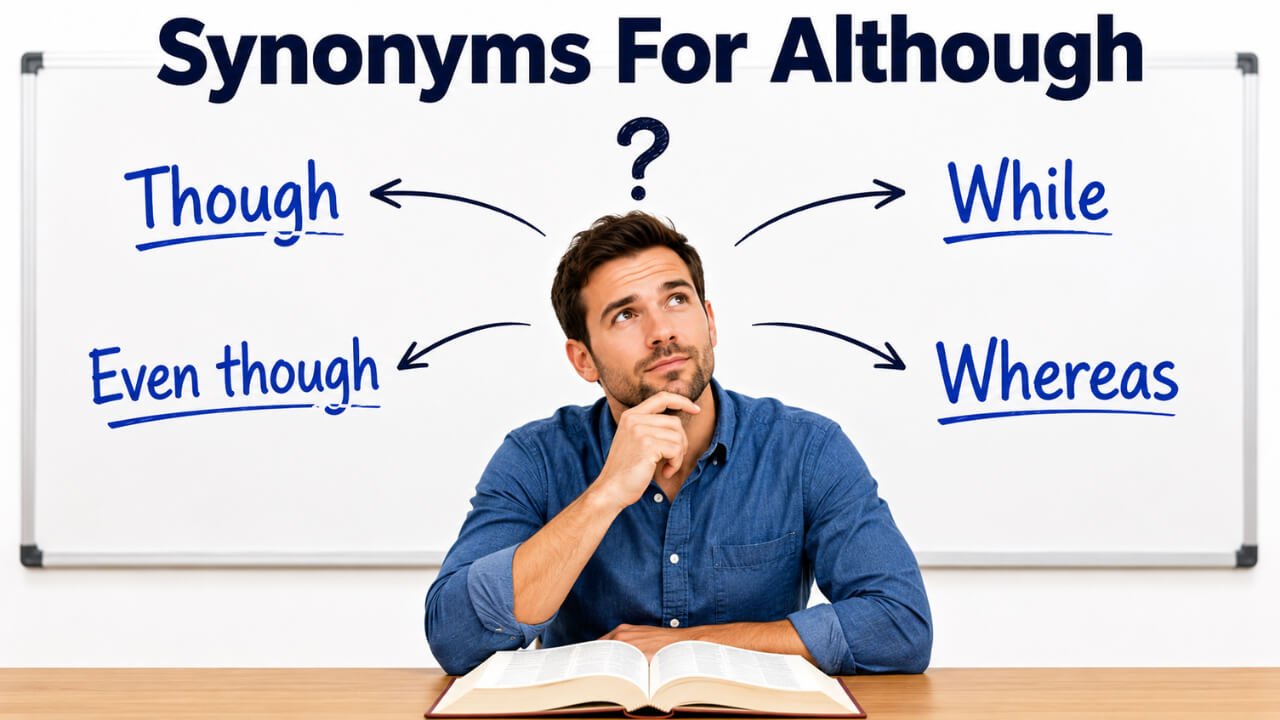
Quick Answer: The best synonyms for although include though, even though, while, whereas, despite the fact that, in spite of the fact that, even if, granted that, notwithstanding, and albeit. Use though in casual speech, even though for stronger contrast, while and whereas in comparisons, despite the fact that in formal writing, and albeit in concise academic or polished writing.
Pronunciation and Word Details
Word: Although.
Pronunciation: /ɔːlˈðoʊ/.
Part of Speech: Subordinating conjunction.
Meaning: A word used to introduce a contrast, concession, or unexpected idea.
US Pronunciation:
UK Pronunciation:
What Does “Although” Mean?
Although means even though something is true, another contrasting fact is also true.
It is a subordinating conjunction used to connect two ideas where one idea contrasts with the other. It often introduces a dependent clause, which means the clause needs another complete idea to make full sense.
Example: Although it was raining, we continued walking.
In this sentence, although it was raining creates contrast with we continued walking. The word works well at the beginning or middle of a sentence.
Meaning, Tone, and Context of “Although”
Although has a neutral, polite, formal, and academic tone. It is common in essays, reports, explanations, grammar examples, professional writing, and clear everyday speech.
It sounds more formal than though and less heavy than despite the fact that. It is useful when you want to show contrast without sounding too casual or emotional.
Writers use although to present a fact, then show that the next idea is surprising, different, or opposite in some way.
When and How to Use “Although”
For Contrast: Use although when two ideas are different or opposite.
Example: Although the task was difficult, she completed it on time.
For Concession: Use although when you accept one fact but still show another important point.
Example: Although he is young, he speaks with confidence.
For Unexpected Results: Use although when the result is not what the reader may expect.
Example: Although the room was small, it felt comfortable.
For Balanced Writing: Use although to make writing sound thoughtful and fair.
Example: Although the plan has risks, it also has clear benefits.
For Formal Sentences: Use although in essays, reports, and professional explanations.
Example: Although the evidence is limited, the conclusion is reasonable.
Best Synonyms for Although
Though: A simple and common synonym for although.
Example: Though it was late, we kept working.
Even Though: A stronger way to show contrast.
Example: Even though she was tired, she stayed focused.
While: Used when comparing two different ideas.
Example: While the first option is cheaper, the second is safer.
Whereas: Used to compare opposite facts or situations.
Example: He prefers quiet places, whereas his brother enjoys busy rooms.
Despite The Fact That: A formal phrase meaning although.
Example: Despite the fact that it was cold, they went outside.
In Spite Of The Fact That: A formal phrase showing contrast against expectation.
Example: In spite of the fact that he was nervous, he answered clearly.
Even If: Used when something may be true but does not change the result.
Example: Even if it rains, the event will continue.
Granted That: Used when accepting a point before giving another point.
Example: Granted that the method is slow, it is still reliable.
Notwithstanding: A formal word meaning despite or although.
Example: Notwithstanding the delay, the project succeeded.
Albeit: A concise formal word meaning although.
Example: The solution was useful, albeit temporary.
50 Synonyms for Although with Short Meanings
- Though: A common word showing contrast.
- Even Though: A stronger form of though.
- While: Used to contrast two ideas.
- Whereas: Used to compare opposite facts.
- Even If: Used when a condition does not change the result.
- Despite The Fact That: A formal phrase meaning although.
- In Spite Of The Fact That: A formal phrase showing contrast.
- Granted That: Used to accept one point before another.
- Granting That: Used when admitting a fact.
- Admitting That: Used when accepting a fact before contrast.
- Accepting That: Used to recognize one point.
- Even When: Used when contrast happens during a situation.
- Whilst: A formal or traditional form of while.
- Notwithstanding: A formal word meaning despite.
- Albeit: A concise formal word meaning although.
- Much As: Used to show contrast with feeling or opinion.
- As Much As: Used to admit one idea before another.
- For All That: Used to mean despite that fact.
- All The Same: Used to show a contrasting result.
- Still: Used to show contrast after a fact.
- Yet: Used to show an opposite or unexpected idea.
- However: Used to introduce contrast between sentences.
- Nevertheless: Used to show contrast after a fact.
- Nonetheless: Used to show that something remains true.
- Even So: Used to show contrast after a statement.
- In Contrast: Used to show difference.
- On The Other Hand: Used to present another side.
- At The Same Time: Used to show a balancing idea.
- Be That As It May: Used to accept a point before contrast.
- That Said: Used to add a contrasting point.
- Having Said That: Used to add a different view.
- Still And All: Used informally to mean nevertheless.
- In Any Case: Used to show a result remains true.
- At Any Rate: Used to return to the main point after contrast.
- No Matter That: Used to show something does not change the result.
- Regardless Of The Fact That: Used to show contrast with a known fact.
- Despite: Used before a noun to show contrast.
- In Spite Of: Used before a noun to show contrast.
- Regardless Of: Used before a noun to show something does not matter.
- For All: Used before a noun phrase to show contrast.
- Notwithstanding The Fact That: A very formal contrast phrase.
- Conceding That: Used when admitting a point.
- Allowing That: Used when accepting something as true.
- Supposing That: Used when considering a possible fact.
- Assuming That: Used when accepting a condition for argument.
- If: Used in some concession sentences.
- But: Used to show contrast between ideas.
- Yet Still: Used for strong contrast.
- Even With: Used before a noun to show contrast.
- All Though: A mistaken form sometimes confused with although.
Read Also:
Synonyms for Enjoy
Synonyms for Although by Context
When Although Means Though
Use these words when although simply introduces contrast in a clear sentence.
Though: Though the answer was short, it was correct.
Even Though: Even though the work was hard, they finished it.
While: While the idea sounds simple, it needs careful planning.
Whilst: Whilst the rule is useful, it has exceptions.
When Although Means Despite The Fact That
Use these options when you want a more formal phrase.
Despite The Fact That: Despite the fact that the road was narrow, traffic moved smoothly.
In Spite Of The Fact That: In spite of the fact that she was nervous, she spoke clearly.
Regardless Of The Fact That: Regardless of the fact that the price was high, many people bought it.
Notwithstanding The Fact That: Notwithstanding the fact that the data is limited, the pattern is clear.
When Although Means Whereas
Use these words when comparing two different facts, choices, people, or situations.
Whereas: The first answer is direct, whereas the second gives more detail.
While: While he prefers short notes, she likes detailed explanations.
In Contrast: The old system was slow. In contrast, the new one is faster.
On The Other Hand: The room is small. On the other hand, it is very bright.
When Although Means Even If
Use these options when a fact, condition, or possibility does not change the result.
Even If: Even if the meeting runs late, I will finish the report.
No Matter That: No matter that the path was steep, they continued climbing.
Regardless Of: Regardless of the delay, the result remained strong.
Even When: Even when the work is difficult, she stays patient.
When Although Means Admitting That
Use these words when you accept one point before making a different or stronger point.
Granted That: Granted that the plan is expensive, it may still save time.
Admitting That: Admitting that the test was hard, the results were still fair.
Conceding That: Conceding that the design is simple, it remains effective.
Allowing That: Allowing that the idea is new, it deserves attention.
Another Word for Although
The best single replacement for although is usually though because it is natural, common, and easy to understand. However, the best alternative depends on the sentence. Use even though for stronger contrast, whereas for comparison, despite the fact that for formal writing, and albeit for concise academic style.
Original: Although it was cold, we went outside.
Better Option: Though it was cold, we went outside.
Original: Although the plan is costly, it may work.
Better Option: Even though the plan is costly, it may work.
Original: Although the first answer is short, the second is detailed.
Better Option: Whereas the first answer is short, the second is detailed.
Original: The result was useful, although temporary.
Better Option: The result was useful, albeit temporary.
When Not to Use “Although”
Do not use although when the sentence does not show real contrast. It can sound unclear if both ideas support each other instead of opposing each other.
Weak: Although she studied hard, she passed the exam.
Better: Because she studied hard, she passed the exam.
Do not overuse although in every sentence. Repetition makes writing sound stiff and mechanical.
Weak: Although the room was small, it was clean. Although the bed was old, it was comfortable.
Better: Although the room was small, it was clean. Still, the old bed was comfortable.
Do not use although with but in the same clause structure.
Weak: Although it was raining, but we went outside.
Better: Although it was raining, we went outside.
Use despite before a noun, not before a full clause without the right structure.
Weak: Despite it was raining, we went outside.
Better: Although it was raining, we went outside.
Words Commonly Confused With Although
Although vs Though: Although is slightly more formal, while though is more common in casual speech.
Although vs Even Though: Even though gives stronger contrast than although.
Although vs While: While can show time or contrast, but although only shows contrast or concession.
Although vs Whereas: Whereas is best for direct comparison, while although is better for concession.
Although vs Despite: Although introduces a clause, while despite is usually followed by a noun, pronoun, or gerund.
Although vs However: Although joins clauses inside one sentence, while however usually connects separate sentences or independent ideas.
Although vs Albeit: Albeit means although, but it is more formal and often used in shorter phrases.
Which Synonym Should You Choose?
Choose though when you want a simple and natural replacement in casual or general writing.
Choose even though when the contrast is strong, surprising, or important.
Choose while when comparing two facts, choices, or situations in a balanced sentence.
Choose whereas when writing a direct comparison between two opposite points.
Choose despite the fact that when you need a formal phrase for reports, essays, or careful explanations.
Choose in spite of the fact that when you want a formal but slightly longer contrast phrase.
Choose albeit when you want a concise, polished, and academic word.
Choose notwithstanding when the tone is legal, formal, or highly official.
Choose however when you need to start a new sentence with a contrast.
Choose nevertheless when the second idea remains true despite the first idea.
Real Life Examples of “Although” in Sentences
Original: Although the test was difficult, she remained calm.
Better Option: Even though the test was difficult, she remained calm.
Original: Although he was tired, he finished the work.
Better Option: Though he was tired, he finished the work.
Original: Although the house is old, it is very strong.
Better Option: Despite the fact that the house is old, it is very strong.
Original: Although the first method is fast, the second is safer.
Better Option: Whereas the first method is fast, the second is safer.
Original: Although the meal was simple, it tasted wonderful.
Better Option: Even though the meal was simple, it tasted wonderful.
Original: Although the answer is short, it is complete.
Better Option: While the answer is short, it is complete.
Original: Although the result was helpful, it was temporary.
Better Option: The result was helpful, albeit temporary.
Original: Although the road was narrow, the drive was smooth.
Better Option: In spite of the fact that the road was narrow, the drive was smooth.
Original: Although the plan has limits, it is practical.
Better Option: Granted that the plan has limits, it is practical.
Original: Although the price is high, the quality is excellent.
Better Option: Even so, the quality is excellent despite the high price.
Synonym Groups and Usage Differences
Simple Contrast Group
This group includes easy words that replace although in most everyday sentences.
Use: Choose though, even though, or while when you want a clear contrast without sounding too formal.
Example: Though the weather was cold, the walk was pleasant.
Formal Concession Group
This group works well in essays, reports, and professional writing.
Use: Choose despite the fact that, in spite of the fact that, or notwithstanding when the tone needs to be formal.
Example: Despite the fact that the data is limited, the trend is useful.
Comparison Group
This group is best when two ideas, people, choices, or results are being compared.
Use: Choose whereas, while, in contrast, or on the other hand for clear comparison.
Example: The first version is brief, whereas the second gives more detail.
Strong Contrast Group
This group shows a more surprising or forceful contrast.
Use: Choose even though, nevertheless, nonetheless, or even so when the second idea remains true against expectation.
Example: Even though the task was hard, they completed it early.
Concise Academic Group
This group is useful when you need shorter formal wording.
Use: Choose albeit, granted that, or conceding that in polished academic or analytical writing.
Example: The result was promising, albeit incomplete.
Antonyms of Although
Because: Shows reason rather than contrast.
Since: Introduces a cause or reason.
As: Gives a reason or explanation.
Therefore: Shows result or conclusion.
Thus: Shows logical result.
So: Shows effect or consequence.
Consequently: Shows what happened as a result.
Accordingly: Shows action based on a reason.
For This Reason: Explains why something happened.
Due To The Fact That: Gives a cause instead of contrast.
As A Result: Shows an outcome, not a concession.
That Is Why: Explains the reason for something.
Comparison: Although vs Related Words
Although vs Though
Although is a little more formal than though. Though sounds more conversational and can also appear at the end of a sentence.
Example With Although: Although it was late, we continued the discussion.
Example With Though: Though it was late, we continued the discussion.
Although vs Even Though
Even though adds stronger emphasis. It makes the contrast feel more surprising or important.
Example With Although: Although she was nervous, she answered well.
Example With Even Though: Even though she was nervous, she answered well.
Although vs While
While can mean during the time that or although, so context matters. Although is clearer when the main meaning is contrast.
Example With Although: Although the work is simple, it takes time.
Example With While: While the work is simple, it takes time.
Although vs Whereas
Whereas is best for comparing two different facts. Although is better when one fact is surprising in relation to another.
Example With Although: Although the room is small, it feels open.
Example With Whereas: The room is small, whereas the hall is wide.
Although vs Despite
Although is followed by a clause with a subject and verb. Despite is usually followed by a noun, pronoun, or gerund.
Example With Although: Although it rained, the match continued.
Example With Despite: Despite the rain, the match continued.
Although vs However
Although joins a dependent clause to a main clause. However usually introduces contrast in a separate sentence.
Example With Although: Although the answer is short, it is correct.
Example With However: The answer is short. However, it is correct.
Although vs Albeit
Albeit is more formal and concise. It often appears before an adjective, adverb, or short phrase.
Example With Although: Although the change was small, it mattered.
Example With Albeit: The change was small, albeit important.
Common Phrases and Expressions With Although
Although It Is True: Used to admit a fact before contrast.
Although It Seems: Used when appearance differs from reality.
Although It May: Used to introduce a possible contrast.
Although Not: Used to limit or qualify an idea.
Although Rare: Used to show something is uncommon but possible.
Although Difficult: Used to admit challenge before a positive point.
Although Different: Used to compare two unlike things.
Although Similar: Used to show difference despite likeness.
Although Important: Used to admit value before adding another point.
Although Useful: Used to show that something has limits despite value.
Common Mistakes to Avoid
A common mistake is using although and but together in the same sentence. Write Although it was raining, we went out, not Although it was raining, but we went out.
Another mistake is confusing although with because. Although shows contrast, while because gives a reason.
Writers also confuse although with despite. Use although before a full clause, and use despite before a noun, pronoun, or gerund.
Avoid repeating although too often in one paragraph. Mix it with though, even though, while, whereas, however, and nevertheless when the sentence structure allows it.
Do not use a formal synonym when a simple one is clearer. Though is often better than notwithstanding in everyday writing.
Conclusion
The keyword synonyms for although includes useful contrast words such as though, even though, while, whereas, despite the fact that, albeit, and nevertheless. The best choice depends on grammar and tone. Use though for simple speech, even though for strong contrast, whereas for comparison, and despite the fact that for formal writing. Clear synonym choice makes sentences smoother, more precise, and easier to understand.
FAQs About Synonyms for Although
What Is The Best Synonym For Although?
The best synonym for although is though. It is simple, natural, and works in many of the same sentence patterns.
What Is A Formal Synonym For Although?
A formal synonym for although is despite the fact that. Other formal options include notwithstanding, albeit, and in spite of the fact that.
Can I Use Though Instead Of Although?
Yes, though can often replace although. Though is slightly more casual, while although sounds a little more formal.
What Is The Difference Between Although And Even Though?
Even though is stronger than although. Use it when the contrast is surprising, important, or more forceful.
Is Whereas A Synonym For Although?
Yes, whereas can be a synonym when the sentence compares two different facts. It is best for comparison, not general contrast.
Can A Sentence Start With Although?
Yes, a sentence can start with although. Use a comma after the although clause when it comes first.
What Is The Opposite Of Although?
The opposite meaning of although is often shown by reason words such as because, since, therefore, or as a result.
