
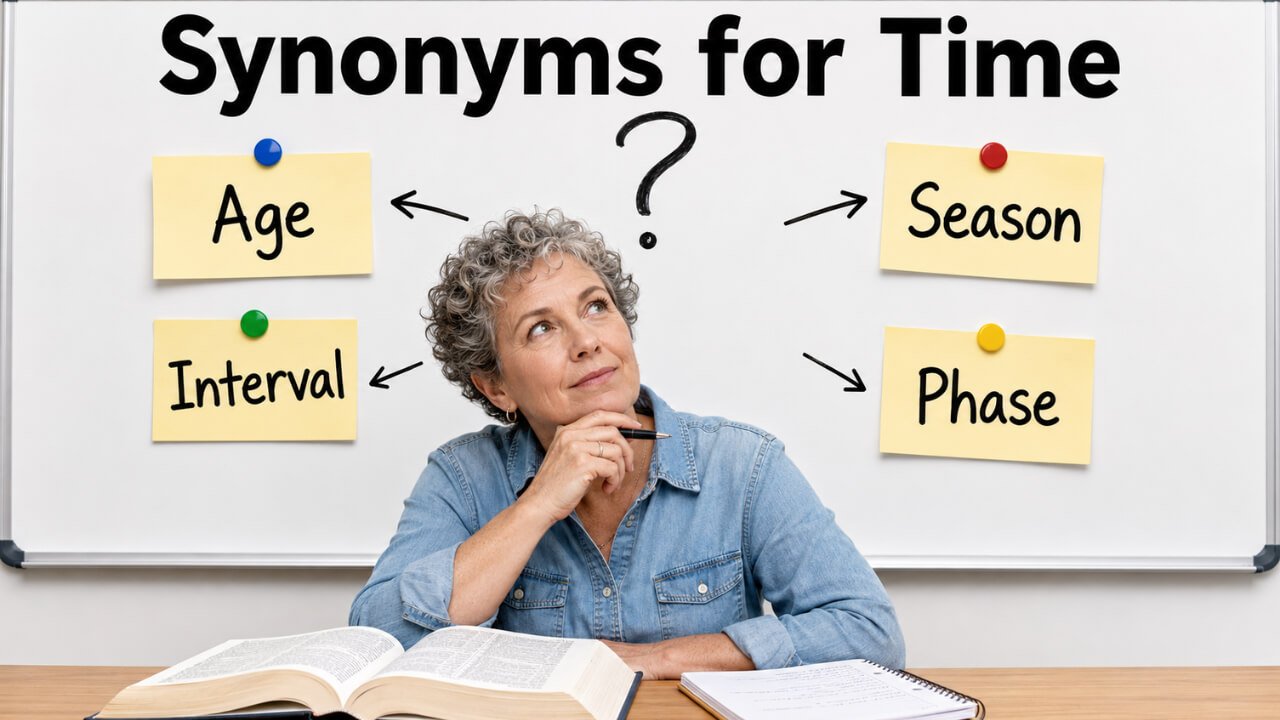
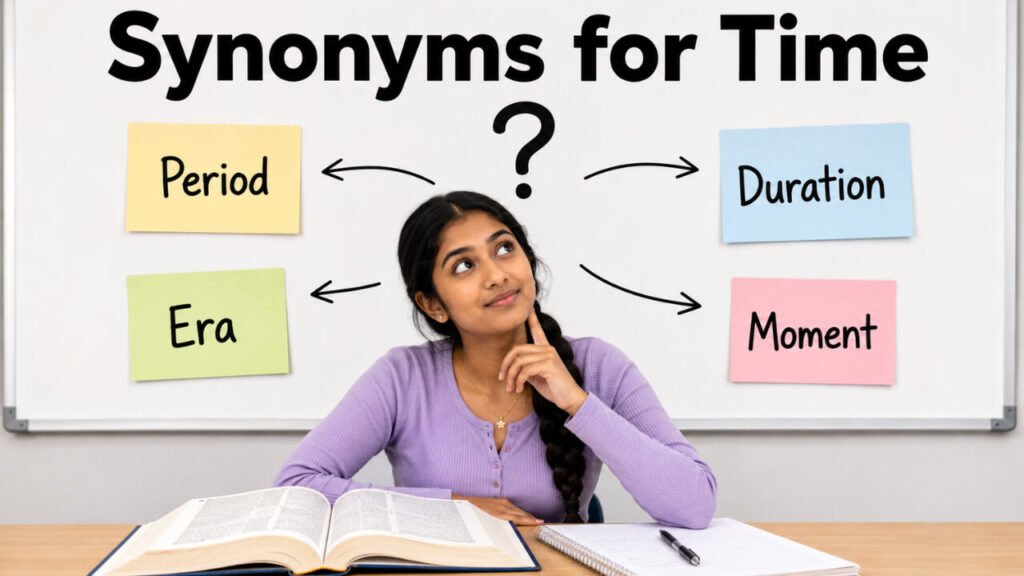
Quick Answer: Synonyms for time include period, moment, era, age, season, occasion, duration, interval, hour, and opportunity. Use period for a general length of time, moment for a short point in time, era for a long historical stage, duration for how long something lasts, and occasion for a specific event or suitable chance.
Pronunciation and Word Details
Word: Time
Pronunciation: /taɪm/
Part of Speech: Noun and verb
Meaning: Time means a point, period, duration, or occasion in which something happens.
US Pronunciation:
UK Pronunciation:
What Does “Time” Mean?
Direct Answer: Time means the continued progress of moments, hours, days, years, or the specific point when something happens.
As a noun: Time can refer to a moment, period, duration, occasion, era, schedule, or opportunity.
As a verb: Time means to measure when something happens or to choose the right moment for an action.
In sentences: Time can describe when something occurs, how long it lasts, how often it happens, or whether a moment is suitable.
Example: We need more time to finish the work.
Example: She timed her speech carefully.
Meaning, Tone, and Context of “Time”
Tone: Time is neutral, common, and widely used in both formal and casual English.
Context: It appears in everyday speech, academic writing, business communication, planning, history, science, storytelling, and personal conversations.
Formal Use: In formal writing, words like period, duration, interval, phase, and schedule often sound more precise than time.
Casual Use: In casual speech, words like moment, hour, chance, and occasion are natural and easy to understand.
Technical Use: In science, music, sports, and measurement, words like duration, interval, tempo, timing, and chronology may be more accurate.
When and How to Use “Time”
For Duration: Use time when you mean how long something lasts.
Example: The project will take a lot of time.
For a Specific Moment: Use time when you mean a particular point when something happens.
Example: What time does the meeting begin?
For an Occasion: Use time when you mean an event, chance, or situation.
Example: This is a good time to ask questions.
For History: Use time when discussing the past, present, future, or a historical period.
Example: At that time, travel was much slower.
For Scheduling: Use time when planning events, appointments, or routines.
Example: We need to choose a time for the call.
For Measurement: Use time when measuring speed, duration, or performance.
Example: The runner improved his time.
Best Synonyms for Time
Period: A length of time during which something happens.
Example: She studied abroad for a short period.
Moment: A very brief point in time.
Example: Please wait a moment.
Era: A long and important period in history.
Example: The discovery marked a new era in medicine.
Age: A long stage in history or life.
Example: We live in an age of rapid change.
Duration: The amount of time something lasts.
Example: The duration of the exam is two hours.
Interval: A space of time between two events.
Example: There was a short interval between the two meetings.
Occasion: A particular time when something happens.
Example: It was a special occasion for the family.
Hour: A specific unit or point of time.
Example: The final hour of the event was exciting.
Season: A period known for a certain activity, mood, or condition.
Example: Spring is the season of new growth.
Opportunity: A favorable time to do something.
Example: This is a great opportunity to learn.
50 Synonyms for Time with Short Meanings
- Period: A length of time.
- Moment: A short point in time.
- Era: A long historical period.
- Age: A major stage in history or life.
- Duration: The length of time something lasts.
- Interval: Time between two events.
- Occasion: A specific time or event.
- Hour: A unit or point of time.
- Minute: A short unit of time.
- Second: A very small unit of time.
- Day: A period of twenty four hours.
- Year: A period of twelve months.
- Season: A natural or activity based period.
- Phase: A stage in a process.
- Stage: A step or period in development.
- Spell: A short period of activity or condition.
- Stretch: A continuous length of time.
- Span: The full length of time covered.
- Term: A fixed or limited period.
- Session: A period set aside for an activity.
- Shift: A work period or change in time.
- Cycle: A repeating period or sequence.
- Schedule: A planned arrangement of times.
- Timetable: A list of planned times.
- Date: A specific day or point in time.
- Deadline: The final time for completion.
- Appointment: An arranged time to meet.
- Event: A happening at a particular time.
- Juncture: An important point in time.
- Instant: A very brief moment.
- Opportunity: A suitable time to act.
- Chance: A possible or favorable time.
- Opening: A free or available time.
- Slot: A set place in a schedule.
- Turn: A person’s proper time to act.
- Pace: The speed at which something happens.
- Tempo: The speed or rhythm of movement.
- Rhythm: A repeated pattern in time.
- Timing: The choice or control of when something happens.
- Chronology: The order of events in time.
- Timeline: A sequence of events over time.
- History: Past events over time.
- Future: Time that has not happened yet.
- Present: The current time.
- Past: Time that has already happened.
- Lifetime: The full period of a person’s life.
- Generation: A period linked to people of similar age.
- Epoch: A notable period in history.
- Milestone: An important point in time.
- Horizon: A future period or expected limit.
Read Also:
Synonyms For Delicious

Synonyms for Time by Context
When Time Means a Period
Useful Synonyms: Period, duration, span, stretch, term, spell.
Example: The training lasted for a short period.
Example: The duration of the film is two hours.
Example: She worked there for a long span of years.
When Time Means a Moment
Useful Synonyms: Moment, instant, second, minute, juncture.
Example: I need a moment to think.
Example: He answered in an instant.
Example: At that juncture, the team changed its plan.
When Time Means an Era
Useful Synonyms: Era, age, epoch, generation, history.
Example: The invention began a new era.
Example: The story takes place in a different age.
Example: That epoch changed how people lived.
When Time Means an Occasion
Useful Synonyms: Occasion, event, appointment, date, session.
Example: It was a joyful occasion.
Example: We scheduled a session for tomorrow.
Example: The appointment is set for morning.
When Time Means an Opportunity
Useful Synonyms: Opportunity, chance, opening, slot, turn.
Example: This is the best opportunity to improve.
Example: She got a chance to explain.
Example: Your turn will come soon.
When Time Means Schedule or Planning
Useful Synonyms: Schedule, timetable, deadline, slot, timing.
Example: The schedule is full today.
Example: The deadline is next week.
Example: Good timing made the plan successful.
When Time Means Rhythm or Speed
Useful Synonyms: Pace, tempo, rhythm, timing, cycle.
Example: The song has a slow tempo.
Example: The work moved at a steady pace.
Example: The rhythm of the routine felt natural.
Another Word for Time
Best Single Replacement: Period is often the best general replacement for time when you mean a length or section of time. However, the best alternative depends on context. Use moment for a short point, duration for length, occasion for an event, and opportunity for a good chance.
Original: We spent a lot of time on the project.
Better Option: We spent a long period on the project.
Original: Give me some time to answer.
Better Option: Give me a moment to answer.
Original: The time of the meeting changed.
Better Option: The schedule of the meeting changed.
Original: This is the right time to invest in learning.
Better Option: This is the right opportunity to invest in learning.
When Not to Use “Time”
Avoid Repetition: Do not repeat time too often in the same paragraph when a clearer synonym fits.
Weak: The time of the event was a good time for everyone.
Better: The schedule of the event was convenient for everyone.
Avoid Vagueness: Do not use time when you need a specific meaning such as duration, date, deadline, or appointment.
Weak: The time is important for the report.
Better: The deadline is important for the report.
Avoid Casual Use in Formal Writing: In academic or business writing, more precise words often sound stronger.
Weak: The survey covered a long time.
Better: The survey covered a long period.
Avoid Wrong Synonym Choice: Do not use era for a short moment or moment for a long historical period.
Weak: I waited for an era outside the room.
Better: I waited for a long while outside the room.
Words Commonly Confused With Time
Time vs Period: Time is broad, while period usually means a specific length of time.
Time vs Moment: Time can be long or short, while moment means a brief point.
Time vs Duration: Time is general, while duration focuses on how long something lasts.
Time vs Date: Time can mean any point or length, while date means a specific calendar day.
Time vs Deadline: Time can be general, while deadline means the final point for completing something.
Time vs Timing: Time can mean a moment or period, while timing means choosing the right moment.
Time vs Era: Time is broad, while era means a long and important historical period.
Which Synonym Should You Choose?
Choose period: When writing about a general length of time.
Choose duration: When explaining how long something lasts.
Choose moment: When talking about a short point in time.
Choose era: When discussing a long historical stage.
Choose occasion: When referring to a special event or particular happening.
Choose opportunity: When time means a suitable chance to do something.
Choose schedule: When discussing planned times, meetings, or routines.
Choose deadline: When writing about the final time something must be done.
Choose interval: When describing time between two actions or events.
Choose timing: When the focus is on choosing the right moment.
Real Life Examples of “Time” in Sentences
Original: I need more time to finish this task.
Better Option: I need more time to complete this task.
Original: We met at a difficult time.
Better Option: We met during a difficult period.
Original: Please give me a little time.
Better Option: Please give me a moment.
Original: The time of the exam is two hours.
Better Option: The duration of the exam is two hours.
Original: It was a happy time for our family.
Better Option: It was a happy occasion for our family.
Original: This is the best time to start.
Better Option: This is the best opportunity to start.
Original: The time between meetings was short.
Better Option: The interval between meetings was short.
Original: The old time was different from today.
Better Option: The old era was different from today.
Original: We should set a time for the visit.
Better Option: We should schedule a date for the visit.
Original: His time in the race improved.
Better Option: His race result improved.
Synonym Groups and Usage Differences
Duration Group
Synonyms: Duration, period, span, stretch, term.
Use: These words describe how long something continues.
Example: The course lasts for a six month period.
Moment Group
Synonyms: Moment, instant, second, minute, juncture.
Use: These words refer to a short point or exact point in time.
Example: She paused for a moment before speaking.
History Group
Synonyms: Era, age, epoch, generation, history.
Use: These words describe broad historical or social periods.
Example: The city changed during that era.
Event Group
Synonyms: Occasion, date, appointment, session, event.
Use: These words describe planned or meaningful happenings.
Example: The ceremony was a memorable occasion.
Opportunity Group
Synonyms: Opportunity, chance, opening, slot, turn.
Use: These words describe a suitable or available time to act.
Example: He found an opening in his schedule.
Schedule Group
Synonyms: Schedule, timetable, deadline, timing, slot.
Use: These words relate to planning, order, and fixed arrangements.
Example: The timetable shows every class.
Rhythm Group
Synonyms: Pace, tempo, rhythm, cycle, timing.
Use: These words describe speed, movement, and repeated patterns.
Example: The speech had a steady rhythm.
Antonyms of Time
Timelessness: A state not limited by time.
Permanence: The quality of lasting forever or for a very long period.
Eternity: Endless time with no clear beginning or end.
Infinity: Something without limit.
Stillness: A lack of movement or change.
Delay: A late or postponed action.
Pause: A temporary stop in action or progress.
Stagnation: A lack of progress over time.
Immortality: Endless life or existence.
Urgency: A need for immediate action, often opposite to having enough time.
Comparison: Time vs Related Words
Time vs Period
Difference: Time is broad and flexible. Period is more specific and means a length of time.
Example With Time: We need more time to prepare.
Example With Period: We need a longer preparation period.
Time vs Moment
Difference: Time can refer to any length, while moment means a brief point.
Example With Time: It was a hard time for her.
Example With Moment: It was a hard moment for her.
Time vs Duration
Difference: Time is general. Duration focuses on how long something lasts.
Example With Time: The class time is short.
Example With Duration: The class duration is short.
Time vs Date
Difference: Time can mean a point or period. Date means a specific calendar day.
Example With Time: What time is the event?
Example With Date: What date is the event?
Time vs Timing
Difference: Time may mean a moment, period, or schedule. Timing means the choice or control of when something happens.
Example With Time: The time of the announcement mattered.
Example With Timing: The timing of the announcement mattered.
Time vs Era
Difference: Time is general. Era means a long period known for major features or changes.
Example With Time: People lived differently in that time.
Example With Era: People lived differently in that era.
Common Phrases and Expressions With Time
On Time: At the correct or expected time.
In Time: Early enough before it is too late.
At the Same Time: Happening together.
From Time to Time: Occasionally or sometimes.
Time After Time: Repeatedly.
A Matter of Time: Something that will likely happen eventually.
Ahead of Time: Before the expected time.
Behind Time: Later than planned.
Take Your Time: Do something without rushing.
The Right Time: The most suitable moment.
Common Mistakes to Avoid
Repeating Time Too Often: Use synonyms like period, moment, duration, occasion, or schedule when repetition weakens the sentence.
Choosing a Weak Synonym: Do not use a dramatic word like era for a short wait or a small event.
Ignoring Context: Time can mean duration, schedule, moment, history, or opportunity, so choose the synonym that matches the exact meaning.
Using Date and Time as the Same Word: Date refers to a calendar day, while time often refers to an hour, moment, or period.
Confusing Duration With Deadline: Duration means how long something lasts. Deadline means the final point for completion.
Using Vague Phrasing: Replace unclear uses of time with more precise words when needed.
Weak: The time of the task was difficult.
Better: The duration of the task was difficult.
Conclusion
Synonyms for time help you write with more accuracy, variety, and clarity. Use period for a length, moment for a short point, duration for how long something lasts, era for history, occasion for an event, and opportunity for a suitable chance. In formal writing, choose precise words like duration, interval, schedule, or deadline. In casual speech, moment, chance, and hour often sound natural. The best synonym always depends on the meaning you want to express.
FAQs About Synonyms for Time
What are the best synonyms for time?
Answer: The best synonyms for time are period, moment, era, duration, interval, occasion, hour, season, opportunity, and schedule.
What is another word for time in formal writing?
Answer: In formal writing, use period, duration, interval, schedule, deadline, or chronology depending on the sentence.
What is another word for a short time?
Answer: Moment, instant, second, minute, and brief spell can all mean a short time.
What is another word for a long time?
Answer: Period, era, age, epoch, span, and lifetime can describe a long time.
What is another word for the right time?
Answer: Opportunity, chance, occasion, opening, and suitable moment can mean the right time.
What is the difference between time and duration?
Answer: Time is a broad word. Duration specifically means how long something lasts.
Can time be used as a verb?
Answer: Yes. As a verb, time means to measure how long something takes or choose when something should happen.
