
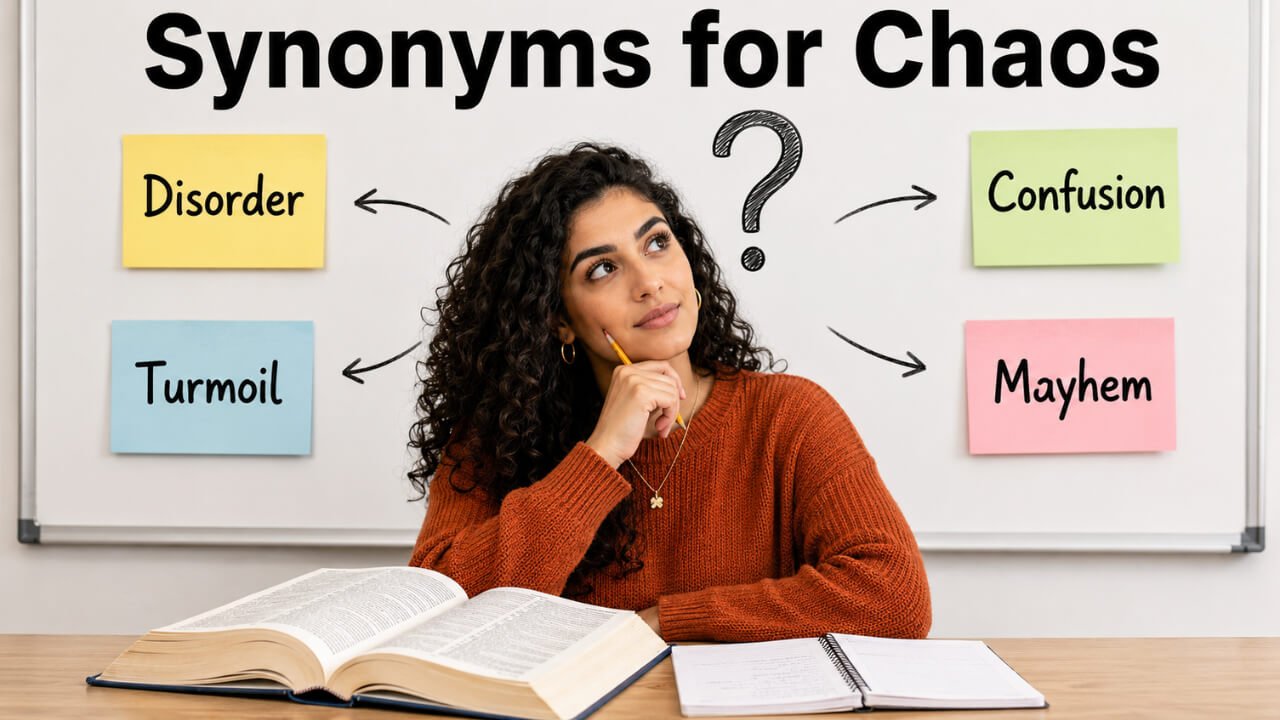
Quick Answer: Synonyms for chaos include disorder, confusion, turmoil, mayhem, pandemonium, havoc, anarchy, disarray, mess, and commotion. Use disorder for formal writing, mess for casual speech, turmoil for emotional or political unrest, mayhem for noisy confusion, anarchy for lack of control, and havoc when chaos causes damage or serious disruption.
Pronunciation and Word Details
Word: Chaos
Pronunciation: /ˈkeɪɑːs/
Part of Speech: Noun
Meaning: Chaos means a state of complete confusion, disorder, or lack of control.
US Pronunciation:
UK Pronunciation:
What Does “Chaos” Mean?
Direct Answer: Chaos means a situation where things are confused, disorganized, uncontrolled, or difficult to manage.
As a noun: Chaos describes disorder, confusion, unrest, or a breakdown of structure. It can refer to a messy room, a noisy crowd, a failed plan, a political crisis, a busy workplace, or an emotional situation.
In everyday use: Chaos often means too much is happening at once and no clear order exists.
In formal use: Chaos can describe social disorder, organizational failure, public unrest, or unstable conditions.
Example: The sudden announcement caused chaos in the office.
Meaning, Tone, and Context of “Chaos”
Tone: Chaos is a strong, negative, and dramatic word.
Formality: Chaos is common in both formal and casual English, but it can sound more intense than simple words like mess or confusion.
Emotional Context: Chaos often suggests stress, panic, pressure, noise, or loss of control.
Academic Context: In serious writing, chaos may refer to disorder in systems, societies, events, or organizations.
Conversational Context: In daily speech, chaos can describe a messy home, a busy day, a crowded place, or a situation that feels overwhelming.
Technical Context: In some subjects, chaos can describe unpredictable behavior in complex systems, but in general vocabulary it usually means confusion and disorder.
When and How to Use “Chaos”
For Disorder: Use chaos when things are not arranged, controlled, or organized.
Example: The room was in chaos after the party.
For Confusion: Use chaos when people do not understand what is happening.
Example: The unclear instructions created chaos among the students.
For Panic: Use chaos when a situation becomes rushed, noisy, or frightening.
Example: The alarm caused chaos in the building.
For Public Unrest: Use chaos when describing serious social, political, or public disorder.
Example: The city fell into chaos after the power failure.
For Emotional Overwhelm: Use chaos when someone feels mentally or emotionally overloaded.
Example: Her thoughts were in chaos after the bad news.
For Workplace Problems: Use chaos when plans, systems, or teams stop working smoothly.
Example: The missing files caused chaos before the meeting.
Best Synonyms for Chaos
Disorder: A lack of arrangement, control, or organization.
Example: The sudden changes created disorder in the department.
Confusion: A state of uncertainty or lack of clear understanding.
Example: The mixed messages led to confusion among the team.
Turmoil: A state of great disturbance, worry, or unrest.
Example: The country went through years of political turmoil.
Mayhem: Wild, noisy, and uncontrolled confusion.
Example: The concert ended in complete mayhem.
Pandemonium: Loud and extreme confusion, often involving many people.
Example: Pandemonium broke out when the doors opened.
Havoc: Serious damage, disruption, or disorder.
Example: The storm caused havoc across the town.
Anarchy: A state with no control, rules, or authority.
Example: Without leadership, the meeting turned into anarchy.
Disarray: A messy or disorganized state.
Example: The documents were left in disarray.
Mess: A casual word for a confused, dirty, or disorganized situation.
Example: The kitchen was a complete mess.
Commotion: Noisy activity, movement, or confusion.
Example: There was a commotion outside the classroom.
50 Synonyms for Chaos with Short Meanings
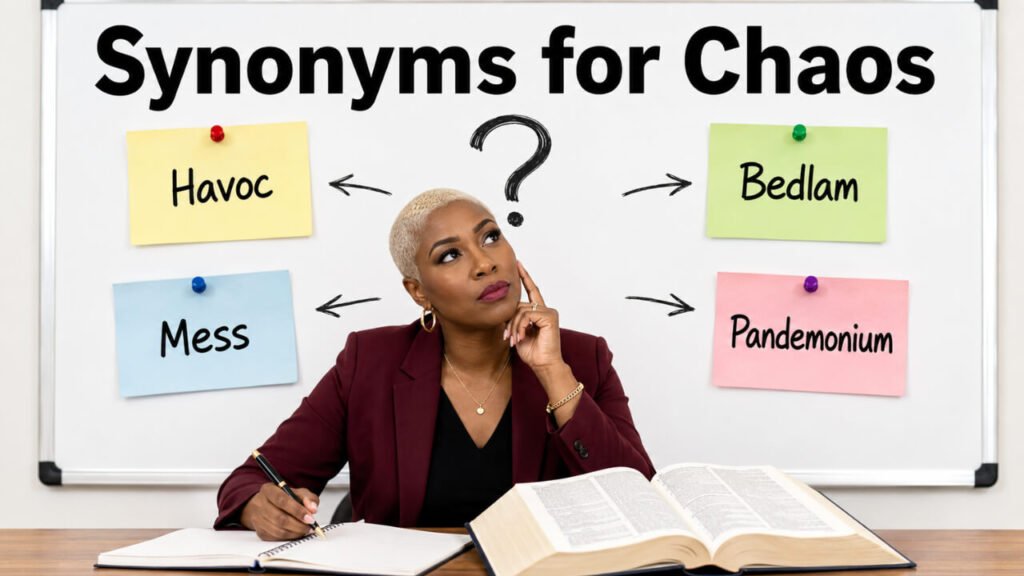
- Disorder: Lack of order or control.
- Confusion: Unclear or mixed up situation.
- Turmoil: Serious disturbance or unrest.
- Mayhem: Wild and noisy disorder.
- Pandemonium: Extreme noise and confusion.
- Havoc: Damage and major disruption.
- Anarchy: Absence of rules or control.
- Disarray: Messy and disorganized condition.
- Mess: Casual word for disorder.
- Commotion: Noisy confusion or activity.
- Uproar: Loud anger, protest, or disorder.
- Tumult: Loud and confused disturbance.
- Bedlam: A scene of wild confusion.
- Clutter: Untidy collection of things.
- Disorganization: Lack of proper arrangement.
- Confusion: Lack of clarity or order.
- Disruption: Interruption of normal order.
- Disturbance: Trouble that interrupts peace.
- Unrest: Public or emotional disturbance.
- Instability: Lack of steadiness or control.
- Turbulence: Agitation, disturbance, or instability.
- Upheaval: Sudden major change or disorder.
- Crisis: A serious and unstable situation.
- Frenzy: Wild excitement or uncontrolled activity.
- Madness: Extreme disorder or foolish confusion.
- Riot: Violent public disorder.
- Scramble: Rushed and confused activity.
- Jumble: Mixed and disordered collection.
- Tangle: Confused or complicated situation.
- Muddle: Confusing or disorganized condition.
- Shambles: A ruined or very messy state.
- Wreck: A badly damaged or ruined state.
- Ruin: Severe damage or destruction.
- Disorderliness: Quality of being untidy or uncontrolled.
- Lawlessness: Lack of respect for rules or law.
- Confoundedness: State of being deeply confused.
- Wildness: Lack of control or restraint.
- Noise: Loud sound that may create confusion.
- Ruckus: Noisy disturbance or trouble.
- Hullabaloo: Loud fuss or noisy confusion.
- Fuss: Unnecessary excitement or concern.
- Brouhaha: Noisy reaction or public fuss.
- Flurry: Sudden burst of activity or confusion.
- Rush: Fast and pressured activity.
- Pressure: Stressful force or demand.
- Disorientation: Loss of direction or clear understanding.
- Misrule: Poor or uncontrolled leadership.
- Breakdown: Failure of order or system.
- Collapse: Sudden failure or loss of structure.
- Uncertainty: Lack of clear knowledge or direction.
Read Also:
Synonyms For Time

Synonyms for Chaos by Context
When Chaos Means Disorder
Useful Synonyms: Disorder, disarray, disorganization, mess, clutter, shambles.
Example: The office was in complete disorder after the move.
Example: Her desk was covered in clutter.
Example: The plan ended in shambles.
When Chaos Means Confusion
Useful Synonyms: Confusion, muddle, jumble, tangle, uncertainty, disorientation.
Example: The unclear rules caused confusion.
Example: The notes were a jumble of ideas.
Example: The sudden change created uncertainty.
When Chaos Means Noise and Panic
Useful Synonyms: Mayhem, pandemonium, uproar, bedlam, commotion, ruckus.
Example: The room erupted into pandemonium.
Example: A loud commotion came from the hallway.
Example: The children created mayhem in the living room.
When Chaos Means Damage or Disruption
Useful Synonyms: Havoc, disruption, breakdown, collapse, wreck, ruin.
Example: The heavy rain caused havoc on the roads.
Example: The system breakdown delayed every order.
Example: The sudden collapse of the plan shocked everyone.
When Chaos Means Social or Political Unrest
Useful Synonyms: Turmoil, unrest, anarchy, lawlessness, upheaval, instability.
Example: The region faced years of unrest.
Example: Poor leadership created instability.
Example: The protest led to political turmoil.
When Chaos Means Fast Uncontrolled Activity
Useful Synonyms: Frenzy, scramble, rush, flurry, madness, pressure.
Example: There was a final rush before the deadline.
Example: The team worked in a frenzy to finish.
Example: A flurry of calls filled the morning.
Another Word for Chaos
Best Single Replacement: Disorder is often the best single replacement for chaos because it works in formal, casual, academic, and professional writing. However, the best alternative depends on the exact meaning. Use confusion for unclear situations, turmoil for serious unrest, mayhem for wild noise, and havoc for damage or disruption.
Original: The new rules caused chaos in the office.
Better Option: The new rules caused disorder in the office.
Original: The crowd was in chaos after the announcement.
Better Option: The crowd was in pandemonium after the announcement.
Original: The storm created chaos across the city.
Better Option: The storm caused havoc across the city.
Original: The country was in chaos for months.
Better Option: The country was in turmoil for months.
When Not to Use “Chaos”
Avoid Overstatement: Do not use chaos for a small problem if the situation is only slightly messy or mildly confusing.
Weak: My pencil fell, and the desk was in chaos.
Better: My pencil fell, and the desk looked untidy.
Avoid Repetition: If you use chaos many times, replace it with more specific words like disorder, turmoil, confusion, or havoc.
Weak: The chaos at work caused chaos in every meeting.
Better: The disorder at work created confusion in every meeting.
Avoid Casual Words in Formal Writing: Words like mess and ruckus may sound too informal for reports or academic writing.
Weak: The policy change created a mess in the department.
Better: The policy change created disorder in the department.
Avoid Wrong Context: Do not use anarchy unless there is a lack of authority, rules, or control.
Weak: The files were in anarchy on the table.
Better: The files were in disarray on the table.
Words Commonly Confused With Chaos
Chaos vs Disorder: Chaos is stronger and more dramatic, while disorder simply means a lack of order.
Chaos vs Confusion: Chaos can include noise, panic, and disorder, while confusion focuses on not understanding something clearly.
Chaos vs Turmoil: Chaos means disorder, while turmoil often suggests emotional, political, or social disturbance.
Chaos vs Mayhem: Chaos is broad, while mayhem suggests wild, noisy, and uncontrolled activity.
Chaos vs Havoc: Chaos describes disorder, while havoc emphasizes damage or serious disruption.
Chaos vs Anarchy: Chaos can happen anywhere, while anarchy means absence of rules, government, or authority.
Chaos vs Disarray: Chaos sounds intense, while disarray usually means something is messy or poorly arranged.
Which Synonym Should You Choose?
Choose disorder: When you need a clear and formal synonym for lack of order.
Choose confusion: When the problem is unclear information or misunderstanding.
Choose turmoil: When writing about emotional, political, social, or economic unrest.
Choose mayhem: When describing wild, noisy, and uncontrolled scenes.
Choose pandemonium: When many people are loud, excited, or panicked.
Choose havoc: When chaos causes damage, delay, or serious disruption.
Choose anarchy: When there is no authority, leadership, or control.
Choose disarray: When things are messy, scattered, or poorly organized.
Choose mess: When speaking casually about disorder.
Choose commotion: When the focus is on noise, movement, and disturbance.
Real Life Examples of “Chaos” in Sentences
Original: The classroom was full of chaos after the teacher left.
Better Option: The classroom was full of mayhem after the teacher left.
Original: The sudden rain caused chaos on the roads.
Better Option: The sudden rain caused havoc on the roads.
Original: The office was in chaos during the move.
Better Option: The office was in disarray during the move.
Original: The unclear message created chaos among the staff.
Better Option: The unclear message created confusion among the staff.
Original: The country faced chaos after the election.
Better Option: The country faced turmoil after the election.
Original: The kitchen was chaos after dinner.
Better Option: The kitchen was a mess after dinner.
Original: The crowd turned into chaos when the gates opened.
Better Option: The crowd turned into pandemonium when the gates opened.
Original: The project fell into chaos without a leader.
Better Option: The project fell into disorder without a leader.
Original: There was chaos in the hallway.
Better Option: There was a commotion in the hallway.
Original: The company went through chaos after the system failed.
Better Option: The company went through disruption after the system failed.
Synonym Groups and Usage Differences
Disorder Group
Synonyms: Disorder, disarray, disorganization, clutter, mess.
Use: These words describe things that are not arranged, managed, or controlled properly.
Example: The files were left in disarray after the audit.
Confusion Group
Synonyms: Confusion, muddle, jumble, tangle, uncertainty.
Use: These words describe unclear thinking, mixed information, or difficulty understanding a situation.
Example: The instructions created a muddle for the new workers.
Panic and Noise Group
Synonyms: Mayhem, pandemonium, uproar, bedlam, commotion.
Use: These words describe loud, fast, or uncontrolled activity involving people.
Example: The final announcement caused an uproar in the hall.
Damage and Disruption Group
Synonyms: Havoc, disruption, breakdown, collapse, ruin.
Use: These words describe chaos that causes harm, delays, or failure.
Example: The power outage caused a major disruption.
Unrest Group
Synonyms: Turmoil, unrest, upheaval, instability, anarchy.
Use: These words describe serious emotional, social, political, or organizational disturbance.
Example: The leadership change created months of instability.
Rushed Activity Group
Synonyms: Frenzy, scramble, rush, flurry, pressure.
Use: These words describe fast, stressful, or hurried activity.
Example: There was a scramble to finish the report before noon.
Antonyms of Chaos
Order: A neat, controlled, or arranged state.
Organization: A planned and structured condition.
Calm: A peaceful state without panic or noise.
Peace: A quiet and stable condition.
Control: The ability to manage a situation.
Stability: A steady and balanced condition.
Harmony: A smooth and pleasant arrangement.
Clarity: Easy understanding without confusion.
Structure: A clear and organized system.
Discipline: Controlled behavior or order.
Arrangement: A neat and planned setup.
Balance: A steady and well managed state.
Comparison: Chaos vs Related Words
Chaos vs Disorder
Difference: Chaos is stronger and often suggests complete confusion or loss of control. Disorder can simply mean things are not properly arranged.
Example With Chaos: The airport was in chaos after the flights were canceled.
Example With Disorder: The shelves were in disorder after the sale.
Chaos vs Confusion
Difference: Chaos includes disorder and possible panic. Confusion mainly means lack of clear understanding.
Example With Chaos: The sudden evacuation caused chaos.
Example With Confusion: The unclear map caused confusion.
Chaos vs Turmoil
Difference: Chaos is general disorder. Turmoil suggests deep disturbance, often emotional, political, or social.
Example With Chaos: The office was in chaos after the system crashed.
Example With Turmoil: The nation was in turmoil after the crisis.
Chaos vs Mayhem
Difference: Chaos can be quiet or loud. Mayhem usually means noisy and uncontrolled activity.
Example With Chaos: The files were in chaos.
Example With Mayhem: The playground turned into mayhem.
Chaos vs Havoc
Difference: Chaos focuses on disorder. Havoc focuses on damage or serious disruption caused by that disorder.
Example With Chaos: The schedule change created chaos.
Example With Havoc: The storm caused havoc in the town.
Chaos vs Anarchy
Difference: Chaos means disorder. Anarchy means a lack of authority, rules, or governing control.
Example With Chaos: The meeting became chaos after the argument.
Example With Anarchy: Without leadership, the group slipped into anarchy.
Common Phrases and Expressions With Chaos
Complete Chaos: Total disorder or confusion.
Organized Chaos: A busy situation that looks messy but still works.
Pure Chaos: Extreme confusion or disorder.
Total Chaos: A fully uncontrolled situation.
Cause Chaos: To create disorder or confusion.
Create Chaos: To make a situation messy or uncontrolled.
Fall Into Chaos: To become confused, unstable, or disorganized.
Descend Into Chaos: To gradually become completely disorderly.
Chaos Breaks Out: Disorder suddenly begins.
A State of Chaos: A condition of confusion, disorder, or lack of control.
Common Mistakes to Avoid
Using Chaos Too Dramatically: Chaos is a strong word, so avoid using it for small problems.
Wrong: My bag was in chaos because one book moved.
Better: My bag was slightly messy.
Repeating Chaos Too Often: Too much repetition makes writing weak and less precise.
Wrong: The chaos in the classroom caused more chaos in the hallway.
Better: The mayhem in the classroom caused a commotion in the hallway.
Confusing Chaos With Confusion: Use confusion when people do not understand something. Use chaos when the whole situation is disorderly.
Wrong: I felt chaos about the question.
Better: I felt confusion about the question.
Using Anarchy for Simple Mess: Anarchy is about lack of control or authority, not just untidiness.
Wrong: My closet is in anarchy.
Better: My closet is in disarray.
Choosing Informal Words in Formal Writing: Mess, ruckus, and hullabaloo may not fit serious writing.
Wrong: The policy created a mess in the system.
Better: The policy created disorder in the system.
Conclusion
Synonyms for chaos help you describe disorder with the right level of strength and detail. Use disorder for formal writing, confusion for unclear situations, turmoil for emotional or political unrest, mayhem for wild activity, and havoc for damage or disruption. Words like disarray, commotion, anarchy, and mess also work well in the right context. The best synonym depends on whether you mean noise, panic, disorder, damage, or loss of control.
FAQs About Synonyms for Chaos
What are the best synonyms for chaos?
Answer: The best synonyms for chaos are disorder, confusion, turmoil, mayhem, pandemonium, havoc, anarchy, disarray, mess, and commotion.
What is another word for chaos in formal writing?
Answer: Disorder is the best formal synonym for chaos. You can also use disarray, turmoil, instability, disruption, or unrest depending on the context.
What is a casual synonym for chaos?
Answer: Mess is a common casual synonym for chaos. Other casual options include ruckus, commotion, and madness.
What is a stronger word than chaos?
Answer: Pandemonium, mayhem, bedlam, and anarchy can sound stronger than chaos in certain contexts.
What is the difference between chaos and havoc?
Answer: Chaos means disorder or confusion. Havoc means damage, disruption, or destruction caused by a disorderly event.
What is the opposite of chaos?
Answer: The opposite of chaos is order. Other antonyms include calm, peace, control, stability, structure, harmony, and organization.
Can chaos be used in professional writing?
Answer: Yes, chaos can be used in professional writing, but more precise words like disorder, disruption, instability, or disarray may sound clearer.
