

Quick Answer: Synonyms for learning include education, study, knowledge, training, instruction, schooling, scholarship, understanding, research, and discovery. The best synonym depends on context. Use education for formal systems, study for personal effort, training for practical skill building, knowledge for what someone has learned, instruction for teaching, and research for careful investigation or academic work.
Pronunciation and Word Details
Word: Learning
Pronunciation: ˈlɜːrnɪŋ
Part of Speech: Noun
Meaning: The process of gaining knowledge, skill, understanding, or experience.
US Pronunciation:
UK Pronunciation:
What Does “Learning” Mean?
Learning means: The process of gaining knowledge, understanding, skills, or experience through study, practice, teaching, observation, or life events.
Part of speech: Learning is mainly used as a noun, but it can also appear as the present participle form of the verb learn.
Simple use: As a noun, learning describes the act or process of becoming more informed or skilled.
Example: Her learning improved through daily reading and practice.
Sentence context: Learning can refer to school education, workplace training, personal growth, language study, technical practice, emotional development, or academic research.
Meaning, Tone, and Context of “Learning”
Tone: Learning is a neutral and positive word.
Context: It is used in academic, professional, personal, and everyday situations.
Formality: Learning works well in both formal and casual writing.
Academic use: It often refers to education, study, research, and knowledge development.
Professional use: It can describe training, skill building, coaching, and workplace improvement.
Personal use: It can describe growth, discovery, self improvement, and understanding gained from experience.
Technical use: In specialized fields, learning may refer to the process by which a system improves from data or experience.
When and How to Use “Learning”
For Education: Use learning when talking about school, college, lessons, or academic development.
Example: Early learning builds the foundation for future success.
For Skill Development: Use learning when someone gains a practical ability through practice.
Example: Learning a new language takes patience and regular effort.
For Personal Growth: Use learning when experience helps someone become wiser or more aware.
Example: Every mistake became part of his learning.
For Workplace Training: Use learning when employees improve knowledge or performance.
Example: The company supports continuous learning for all team members.
For Research and Study: Use learning when knowledge comes from reading, investigation, or analysis.
Example: Her learning in history helped her understand modern events.
For Understanding: Use learning when someone begins to understand a subject more clearly.
Example: His learning deepened after he started asking better questions.
Best Synonyms for Learning
Education: Formal teaching and knowledge gained through school or instruction.
Example: Education gives students the tools to think clearly.
Study: The act of reading, practicing, or examining a subject carefully.
Example: Daily study helped her master the topic.
Knowledge: Information, facts, or understanding gained through learning.
Example: His knowledge of grammar improved his writing.
Training: Practical learning that develops a skill or ability.
Example: The team received training before using the new system.
Instruction: Teaching or guidance given to help someone learn.
Example: Clear instruction made the task easier.
Schooling: Formal education received at school.
Example: Her schooling prepared her for advanced study.
Scholarship: Deep academic learning or serious study.
Example: His scholarship in literature was widely respected.
Understanding: Clear knowledge of meaning, reason, or purpose.
Example: Practice gave her a better understanding of the method.
Research: Careful study used to discover facts or gain deeper knowledge.
Example: Research helped him answer the difficult question.
Discovery: The process of finding or realizing something new.
Example: Learning often begins with discovery.
50 Synonyms for Learning with Short Meanings
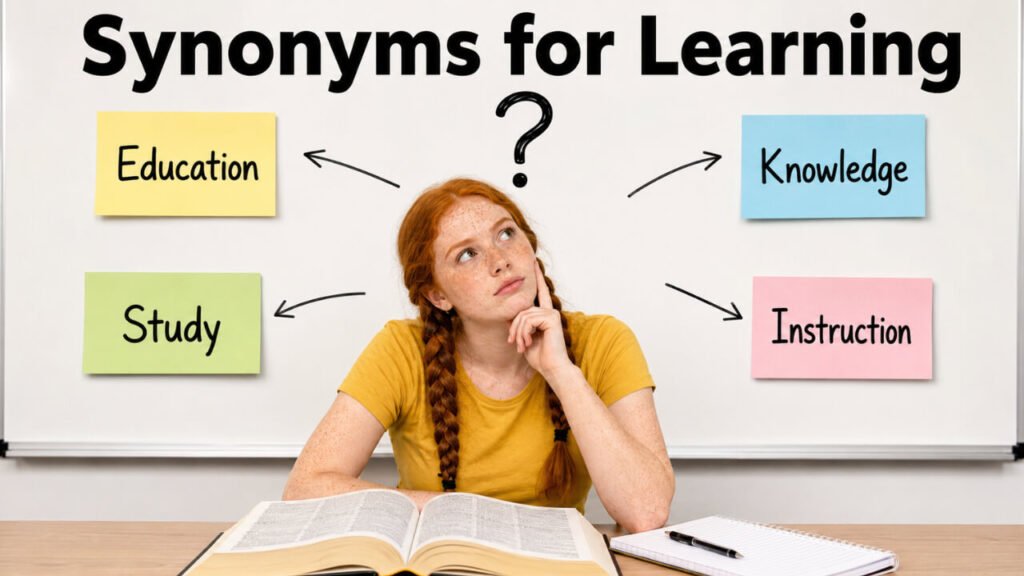
- Education: Formal process of gaining knowledge.
- Study: Careful effort to understand a subject.
- Knowledge: Information and understanding gained over time.
- Training: Practical preparation for a skill or task.
- Instruction: Teaching or guidance given to learners.
- Schooling: Education received in school.
- Scholarship: Serious academic study and knowledge.
- Understanding: Clear awareness of meaning or purpose.
- Research: Careful investigation to gain knowledge.
- Discovery: Finding or realizing something new.
- Study: Focused reading, practice, or review.
- Practice: Repeated action used to improve skill.
- Tuition: Teaching or instruction, often formal.
- Coaching: Guided learning to improve performance.
- Tutoring: Personal teaching for better understanding.
- Apprenticeship: Practical learning under an experienced person.
- Development: Gradual growth in skill or knowledge.
- Improvement: Becoming better through learning or practice.
- Growth: Personal or intellectual progress.
- Experience: Knowledge gained by doing or observing.
- Awareness: Knowledge or recognition of something.
- Insight: Deep understanding of a subject or situation.
- Comprehension: Ability to understand meaning clearly.
- Mastery: Strong skill or complete understanding.
- Acquisition: The act of gaining knowledge or skill.
- Absorption: Taking in knowledge or information.
- Assimilation: Fully understanding and accepting new knowledge.
- Literacy: Ability or knowledge in a subject area.
- Expertise: Advanced skill or knowledge.
- Wisdom: Good judgment gained from knowledge and experience.
- Enlightenment: Greater understanding or awareness.
- Instructional Growth: Improvement through teaching or guidance.
- Academic Study: Formal study in an educational setting.
- Self Education: Learning done independently.
- Self Study: Studying without direct teacher support.
- Skill Building: Developing practical ability.
- Knowledge Building: Increasing information and understanding.
- Lesson: Knowledge gained from teaching or experience.
- Teaching: The process that helps learning happen.
- Guidance: Support that helps someone learn correctly.
- Mentoring: Learning through advice from an experienced person.
- Observation: Learning by watching carefully.
- Reading: Gaining knowledge through written material.
- Exploration: Learning by examining or trying new things.
- Inquiry: Learning through questions and investigation.
- Investigation: Careful search for information or truth.
- Experimentation: Learning by testing ideas or methods.
- Revision: Reviewing material to improve understanding.
- Reflection: Thinking carefully to learn from experience.
- Familiarization: Becoming used to or knowledgeable about something.
Read Also:
Synonyms For Chaos

Synonyms for Learning by Context
When Learning Means Education
Education: Formal learning through school, lessons, or organized teaching.
Example: Education helps people build knowledge and confidence.
Schooling: Learning received through school systems.
Example: Good schooling can shape a child’s future.
Instruction: Direct teaching or guidance.
Example: The students improved after clear instruction.
Tuition: Formal teaching, often in a class or private setting.
Example: She received tuition in mathematics.
When Learning Means Study
Study: Careful effort to understand a subject.
Example: Study is necessary before the final exam.
Research: Detailed investigation into a topic.
Example: His research revealed new information.
Reading: Learning through books, articles, or written material.
Example: Reading improves vocabulary and comprehension.
Revision: Reviewing material to remember and understand it better.
Example: Revision helped her prepare for the test.
When Learning Means Skill Development
Training: Practical learning for a job, task, or skill.
Example: Training helped the workers use the equipment safely.
Practice: Repeated effort to improve ability.
Example: Practice made his speaking more fluent.
Coaching: Guided support to improve performance.
Example: Coaching improved her confidence in interviews.
Apprenticeship: Learning a trade by working with an expert.
Example: His apprenticeship taught him real workplace skills.
When Learning Means Understanding
Comprehension: Clear understanding of meaning.
Example: Her comprehension improved after careful reading.
Insight: Deep understanding of a subject or problem.
Example: The discussion gave him new insight.
Awareness: Knowledge that something exists or matters.
Example: The program raised awareness about healthy habits.
Realization: Understanding something clearly for the first time.
Example: Her realization changed the way she studied.
When Learning Means Personal Growth
Growth: Improvement in mind, character, or ability.
Example: Travel brought him personal growth.
Development: Gradual progress in knowledge, skill, or maturity.
Example: The course supported his professional development.
Wisdom: Good judgment gained from learning and experience.
Example: Experience gave her wisdom beyond books.
Reflection: Thinking deeply to learn from events.
Example: Reflection helped him understand his mistake.
Another Word for Learning
Best single replacement: Education is often the best general synonym for learning when you mean formal knowledge gained through teaching. However, the best alternative depends on context. Use study for personal effort, training for practical skills, knowledge for what has been learned, and understanding for mental clarity.
Original: Her learning improved after joining the course.
Better Option: Her education improved after joining the course.
Original: His learning of computer skills took six months.
Better Option: His training in computer skills took six months.
Original: The book increased my learning about history.
Better Option: The book increased my knowledge of history.
Original: Learning from mistakes helped her grow.
Better Option: Reflection on mistakes helped her grow.
When Not to Use “Learning”
Avoid repetition: Do not repeat learning too often when a clearer synonym fits better.
Weak: Learning helps students improve their learning through learning activities.
Better: Education helps students improve their knowledge through practical activities.
Avoid vague use: Learning can sound unclear if you do not explain what kind of learning you mean.
Weak: The program supports learning.
Better: The program supports language training and reading skills.
Avoid casual wording in formal reports: In academic or professional writing, a more precise word may be stronger.
Weak: The survey measured learning.
Better: The survey measured knowledge acquisition.
Avoid using learning for results only: Learning is the process, while knowledge is often the result.
Weak: She has a lot of learning about science.
Better: She has a lot of knowledge about science.
Avoid wrong synonym choice: Training is not always the same as education.
Weak: His training in philosophy lasted four years.
Better: His education in philosophy lasted four years.
Words Commonly Confused With Learning
Learning vs Education: Learning is the general process of gaining knowledge or skill. Education is usually formal learning through schools, teachers, or organized programs.
Learning vs Knowledge: Learning is the process. Knowledge is what someone gains from that process.
Learning vs Study: Learning is the result or process of gaining understanding. Study is the focused effort used to learn.
Learning vs Training: Learning can be broad, while training usually develops a specific practical skill.
Learning vs Teaching: Learning is what the learner does. Teaching is what the instructor does.
Learning vs Understanding: Learning can include memorizing, practicing, or discovering. Understanding means clearly grasping meaning.
Learning vs Research: Learning is broad. Research is a careful method of finding information or answers.
Which Synonym Should You Choose?
Choose education: When writing about schools, colleges, courses, formal systems, or academic development.
Choose study: When writing about personal effort, reading, review, or exam preparation.
Choose knowledge: When referring to information or understanding someone already has.
Choose training: When writing about job skills, practical ability, technical work, or workplace preparation.
Choose instruction: When focusing on teaching, directions, or guided lessons.
Choose research: When writing about investigation, academic work, facts, or evidence.
Choose understanding: When the focus is clarity, meaning, or mental grasp.
Choose practice: When someone improves through repeated effort.
Choose scholarship: When discussing deep academic learning or serious intellectual work.
Choose growth: When learning connects to personal change, maturity, or self improvement.
Real Life Examples of “Learning” in Sentences
Original: Learning a new skill takes time.
Better Option: Training in a new skill takes time.
Original: Her learning improved after daily reading.
Better Option: Her knowledge improved after daily reading.
Original: The school focuses on early learning.
Better Option: The school focuses on early education.
Original: Learning helped him understand the topic.
Better Option: Study helped him understand the topic.
Original: The workers need more learning before using the machine.
Better Option: The workers need more training before using the machine.
Original: His learning came from years of experience.
Better Option: His wisdom came from years of experience.
Original: Online learning gave her more flexibility.
Better Option: Online education gave her more flexibility.
Original: The lesson supported student learning.
Better Option: The lesson supported student understanding.
Original: Learning about grammar improved his writing.
Better Option: Studying grammar improved his writing.
Original: The project encouraged active learning.
Better Option: The project encouraged active exploration.
Synonym Groups and Usage Differences
Education Group
Use: Education, schooling, tuition, and instruction are best when learning happens through formal teaching.
Example: Formal education helped her develop strong writing skills.
Study Group
Use: Study, revision, reading, and research are best when someone works carefully to understand a subject.
Example: Careful study helped him understand the chapter.
Skill Group
Use: Training, practice, coaching, and apprenticeship are best for practical abilities and performance.
Example: Training helped the staff complete the task safely.
Understanding Group
Use: Understanding, comprehension, insight, and awareness are best when learning creates clarity.
Example: The explanation gave students a deeper understanding.
Growth Group
Use: Growth, development, wisdom, and reflection are best when learning changes a person over time.
Example: Reflection turned the mistake into personal growth.
Knowledge Group
Use: Knowledge, expertise, literacy, and mastery are best when describing what someone has gained through learning.
Example: Her expertise in design grew through years of practice.
Antonyms of Learning
Ignorance: Lack of knowledge or awareness.
Unawareness: Not knowing that something exists or matters.
Misunderstanding: Incorrect understanding of meaning or information.
Confusion: Lack of clarity or certainty.
Forgetfulness: Failure to remember learned information.
Inexperience: Lack of practical knowledge or skill.
Illiteracy: Lack of reading, writing, or subject knowledge.
Neglect: Failure to study, practice, or give attention.
Stagnation: Lack of growth, improvement, or development.
Misinformation: False or incorrect information that harms understanding.
Comparison: Learning vs Related Words
Learning vs Education
Difference: Learning is any process of gaining knowledge or skill. Education is usually formal and organized.
Example With Learning: Learning can happen through books, practice, or experience.
Example With Education: Education often happens through schools, teachers, and courses.
Learning vs Study
Difference: Study is the effort or activity used to learn. Learning is the broader process or result.
Example With Learning: Her learning improved throughout the semester.
Example With Study: Her study routine helped her prepare for exams.
Learning vs Knowledge
Difference: Learning is the process of gaining information. Knowledge is the information gained.
Example With Learning: Learning about health can change daily habits.
Example With Knowledge: Knowledge about health can help people make better choices.
Learning vs Training
Difference: Learning can be general, while training is usually practical and goal focused.
Example With Learning: Learning improves the mind in many ways.
Example With Training: Training improves a specific job skill.
Learning vs Understanding
Difference: Learning may include memorizing or practicing. Understanding means clearly knowing meaning or reason.
Example With Learning: Learning the rules is the first step.
Example With Understanding: Understanding the rules helps you apply them correctly.
Learning vs Research
Difference: Learning is broad. Research is careful investigation used to discover facts.
Example With Learning: Learning about plants can be enjoyable.
Example With Research: Research about plants can reveal how they grow.
Common Phrases and Expressions With Learning
Learning Process: The steps involved in gaining knowledge or skill.
Learning Experience: An event or activity that teaches someone something.
Learning Curve: The rate at which someone gains skill or understanding.
Active Learning: Learning through participation, discussion, practice, or problem solving.
Lifelong Learning: Continuous learning throughout life.
Online Learning: Learning through digital lessons, courses, or materials.
Early Learning: Education and development during early childhood.
Student Learning: Knowledge or skill gained by students.
Deep Learning: A strong and meaningful level of understanding.
Learning Outcome: The knowledge or skill someone is expected to gain.
Common Mistakes to Avoid
Repeating the word too much: Use synonyms like education, study, training, knowledge, or understanding when the sentence becomes repetitive.
Choosing a vague synonym: Do not use education when you mean practical workplace training. Do not use training when you mean broad academic study.
Confusing process and result: Learning is the process, while knowledge is often the result.
Using study in the wrong context: Study usually means focused effort. It does not always replace learning in general statements.
Using schooling too broadly: Schooling refers mainly to formal school education, not every type of learning.
Ignoring tone: Scholarship sounds formal and academic, while practice sounds simple and practical.
Writing unnatural phrases: Say knowledge of grammar, not learning of grammar, when you mean what someone knows.
Being unclear: Add details about the subject, skill, or purpose of learning so the reader understands the exact meaning.
Conclusion
Synonyms for learning help you choose clearer and more natural words for different contexts. Use education for formal study, training for practical skills, knowledge for what someone has gained, study for personal effort, and understanding for clear meaning. Words like research, instruction, scholarship, practice, and growth can also improve your writing when used carefully. The best synonym depends on whether you mean school, skill building, personal development, academic work, or knowledge gained through experience.
FAQs About Synonyms for Learning
What are the best synonyms for learning?
Answer: The best synonyms for learning are education, study, knowledge, training, instruction, schooling, research, understanding, scholarship, and discovery.
What is another word for learning in school?
Answer: Education is the best word for learning in school. Schooling and instruction are also useful in formal education contexts.
What is another word for learning a skill?
Answer: Training is the best synonym for learning a skill. Practice, coaching, apprenticeship, and skill building are also natural choices.
What is the difference between learning and knowledge?
Answer: Learning is the process of gaining information or skill. Knowledge is the information or understanding gained through that process.
What is a formal synonym for learning?
Answer: Education, instruction, scholarship, knowledge acquisition, and academic study are formal synonyms for learning.
What is a casual synonym for learning?
Answer: Study, practice, reading, and discovery can work as casual synonyms depending on the sentence.
Can training replace learning?
Answer: Training can replace learning when the context is practical skill development. It should not replace learning when the meaning is broad education or personal understanding.
