
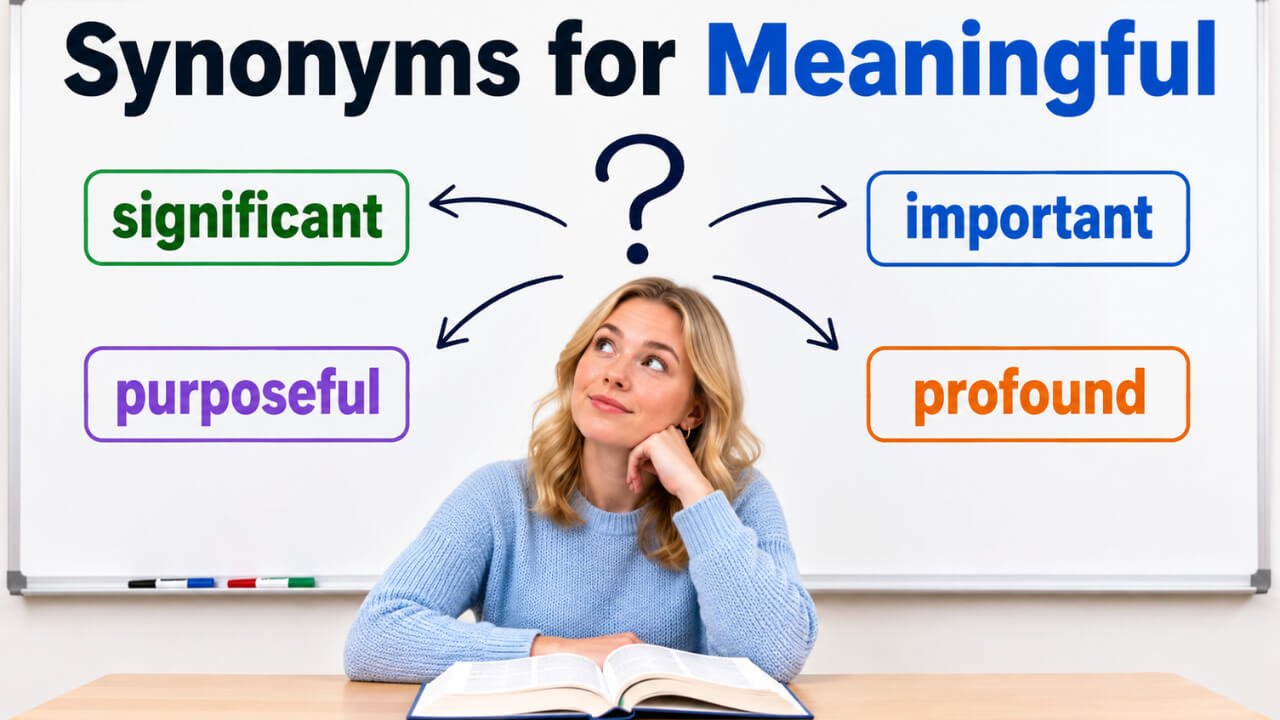
Quick Answer: Synonyms for meaningful include significant, important, purposeful, valuable, relevant, deep, profound, expressive, worthwhile, and consequential. Use significant for formal writing, important for everyday clarity, purposeful for intention, valuable for worth, relevant for connection, profound for emotional or intellectual depth, and expressive when something communicates feeling or meaning clearly.
Pronunciation and Word Details
Word: Meaningful
Pronunciation: ˈmiːnɪŋfəl
Part of Speech: Adjective
Meaning: Having importance, purpose, value, or clear significance.
US Pronunciation:
UK Pronunciation:
What Does “Meaningful” Mean?
Meaningful means: Having real importance, value, purpose, or emotional significance.
Part of speech: Meaningful is an adjective.
Simple use: It describes something that matters, communicates a clear idea, or has a deeper purpose.
Example: She gave him a meaningful smile.
Sentence context: Meaningful can describe conversations, relationships, work, gifts, actions, gestures, results, experiences, lessons, symbols, and memories. It can also describe something that is emotionally deep, practically useful, personally valuable, or clearly connected to a larger purpose.
Meaning, Tone, and Context of “Meaningful”
Tone: Meaningful is usually positive, thoughtful, and respectful.
Formality: It works well in both formal and casual writing.
Emotional use: Meaningful can describe something touching, deep, sincere, or personally important.
Professional use: It can describe useful work, valuable progress, important results, or relevant feedback.
Academic use: It can describe significant findings, purposeful discussion, or important interpretation.
Conversational use: It often describes moments, relationships, words, or actions that feel sincere and valuable.
Technical use: In formal analysis, meaningful can mean statistically important, relevant, or useful for interpretation.
When and How to Use “Meaningful”
For Importance: Use meaningful when something has value or matters in a real way.
Example: The award was meaningful because it recognized years of effort.
For Purpose: Use meaningful when an action has a clear reason or intention.
Example: Her volunteer work felt meaningful and rewarding.
For Emotion: Use meaningful when something touches the heart or carries personal feeling.
Example: The letter was short, but it was deeply meaningful.
For Communication: Use meaningful when words, gestures, or signs express something clearly.
Example: His silence gave the moment a meaningful pause.
For Relevance: Use meaningful when something connects clearly to the subject or situation.
Example: The teacher gave meaningful examples during the lesson.
For Value: Use meaningful when something brings worth, benefit, or usefulness.
Example: The project created meaningful change in the community.
Best Synonyms for Meaningful
Significant: Important because of meaning, effect, or value.
Example: The study showed significant improvement in reading skills.
Important: Having great value, influence, or concern.
Example: This is an important step in your personal growth.
Purposeful: Done with clear intention or useful aim.
Example: She made a purposeful choice to change her routine.
Valuable: Worth a lot because it is useful, helpful, or meaningful.
Example: His advice was valuable during a difficult time.
Relevant: Closely connected to the subject or situation.
Example: The report included relevant details for the decision.
Profound: Very deep in meaning, feeling, or thought.
Example: The speech had a profound effect on the audience.
Expressive: Showing feeling, meaning, or emotion clearly.
Example: Her expressive words made the message more powerful.
Worthwhile: Important enough to deserve time, effort, or attention.
Example: The long discussion was worthwhile because it solved the problem.
Consequential: Having important results or effects.
Example: It was a consequential decision for the whole team.
Substantial: Important, real, or large enough to matter.
Example: The plan led to substantial progress.
50 Synonyms for Meaningful with Short Meanings
- Significant: Important because of value, effect, or meaning.
- Important: Having strong value or influence.
- Purposeful: Done with clear intention or aim.
- Valuable: Useful, helpful, or worth attention.
- Relevant: Connected clearly to the subject.
- Profound: Deep in thought, emotion, or meaning.
- Expressive: Showing feeling or meaning clearly.
- Worthwhile: Deserving time, effort, or care.
- Consequential: Having important results or effects.
- Substantial: Real, serious, or important enough to matter.
- Deep: Having serious emotional or intellectual meaning.
- Sincere: Genuine in feeling, intention, or expression.
- Heartfelt: Filled with honest emotion.
- Touching: Causing gentle emotion or sympathy.
- Moving: Emotionally powerful or affecting.
- Poignant: Deeply touching, often with sadness or tenderness.
- Thoughtful: Showing care, attention, or consideration.
- Symbolic: Representing a deeper meaning or idea.
- Expressive: Clearly showing emotion or meaning.
- Purposeful: Guided by intention or useful purpose.
- Insightful: Showing deep understanding or clear thought.
- Illuminating: Helping someone understand something better.
- Revealing: Showing something important or previously hidden.
- Weighty: Serious, important, or worth careful thought.
- Serious: Important enough to deserve attention.
- Momentous: Very important because of lasting effect.
- Notable: Worth noticing because of importance.
- Memorable: Important or special enough to be remembered.
- Impactful: Having a strong effect or influence.
- Powerful: Strong in meaning, effect, or emotion.
- Effective: Producing a useful or intended result.
- Useful: Helpful for a purpose or need.
- Practical: Useful in real situations.
- Beneficial: Producing good results or value.
- Constructive: Helpful and aimed at improvement.
- Productive: Leading to useful progress or results.
- Rewarding: Giving satisfaction, value, or emotional benefit.
- Fulfilling: Giving a sense of purpose or satisfaction.
- Enriching: Adding value, knowledge, or depth.
- Purpose Driven: Guided by a clear reason or aim.
- Intentional: Done with care, plan, or purpose.
- Considered: Carefully thought through.
- Rich: Full of meaning, detail, or value.
- Resonant: Creating a strong emotional or meaningful response.
- Evocative: Bringing strong thoughts, memories, or feelings.
- Telling: Clearly showing something important.
- Pertinent: Directly related and appropriate.
- Material: Important to the main point or decision.
- Valid: Reasonable, meaningful, or well supported.
- Essential: Very important and necessary.
Read Also:
Synonyms for Learning

Synonyms for Meaningful by Context
When Meaningful Means Important
Significant: Use this when something has clear importance or noticeable effect.
Example: The meeting produced significant changes.
Important: Use this for general value, concern, or influence.
Example: Honest feedback is important for improvement.
Consequential: Use this when something leads to serious results.
Example: The vote was consequential for the entire group.
Momentous: Use this when something is very important and memorable.
Example: Graduation was a momentous day for the family.
When Meaningful Means Purposeful
Purposeful: Use this when something is done with clear aim.
Example: Her purposeful actions helped the team stay focused.
Intentional: Use this when something is planned or done with thought.
Example: He made an intentional effort to listen better.
Purpose Driven: Use this when something is guided by a strong reason.
Example: Their work became more purpose driven after the new mission.
Considered: Use this when something is carefully thought through.
Example: She gave a considered response instead of a quick answer.
When Meaningful Means Emotionally Deep
Heartfelt: Use this when something shows honest feeling.
Example: His heartfelt apology repaired the friendship.
Touching: Use this when something creates gentle emotion.
Example: The child gave her teacher a touching note.
Moving: Use this when something strongly affects the emotions.
Example: The story was moving and unforgettable.
Poignant: Use this when something is emotionally deep, often with tenderness or sadness.
Example: The final scene was quiet but poignant.
When Meaningful Means Valuable
Valuable: Use this when something has usefulness, worth, or benefit.
Example: The mentor gave valuable guidance.
Worthwhile: Use this when something deserves effort or attention.
Example: The project was difficult but worthwhile.
Beneficial: Use this when something creates a good result.
Example: The training was beneficial for new employees.
Rewarding: Use this when something gives satisfaction or inner value.
Example: Teaching children can be a rewarding career.
When Meaningful Means Relevant
Relevant: Use this when something connects directly to the subject.
Example: The essay included relevant examples.
Pertinent: Use this in formal writing for directly related information.
Example: The report included pertinent details.
Material: Use this when something matters to a decision or argument.
Example: The missing evidence was material to the case.
Telling: Use this when something reveals an important truth.
Example: Her reaction was a telling sign of concern.
When Meaningful Means Expressive
Expressive: Use this when words, art, or gestures show clear feeling.
Example: His expressive eyes showed gratitude.
Symbolic: Use this when something represents a deeper idea.
Example: The ring was symbolic of their promise.
Evocative: Use this when something brings strong feelings or memories.
Example: The poem was evocative and rich with emotion.
Resonant: Use this when something connects deeply with people.
Example: Her message was resonant because it felt honest.
Another Word for Meaningful
Best single replacement: Significant is often the best general synonym for meaningful because it works in formal, academic, professional, and everyday writing. However, the best alternative depends on context. Use heartfelt for emotion, purposeful for intention, relevant for connection, and valuable for usefulness.
Original: The speech was meaningful to the audience.
Better Option: The speech was significant to the audience.
Original: She wanted to do meaningful work.
Better Option: She wanted to do purposeful work.
Original: His gift was small but meaningful.
Better Option: His gift was small but heartfelt.
Original: The teacher gave meaningful feedback.
Better Option: The teacher gave valuable feedback.
When Not to Use “Meaningful”
Avoid vague use: Meaningful can sound unclear if you do not explain what kind of value or importance you mean.
Weak: The change was meaningful.
Better: The change was significant because it improved student confidence.
Avoid repetition: Do not repeat meaningful when specific words can make the sentence stronger.
Weak: They had a meaningful talk about meaningful goals.
Better: They had a thoughtful talk about purposeful goals.
Avoid emotional use in technical writing: In formal reports, significant, relevant, or material may be more precise.
Weak: The data showed a meaningful difference.
Better: The data showed a significant difference.
Avoid using it for simple usefulness only: If something is practical rather than deep, useful or effective may be clearer.
Weak: The tool was meaningful for daily work.
Better: The tool was useful for daily work.
Avoid using it when you mean emotional only: Heartfelt, touching, or moving may express feeling more clearly.
Weak: Her goodbye message was meaningful.
Better: Her goodbye message was heartfelt.
Words Commonly Confused With Meaningful
Meaningful vs Significant: Meaningful suggests value, purpose, or emotional depth. Significant emphasizes importance, effect, or measurable value.
Meaningful vs Important: Meaningful often feels deeper or more personal. Important is broader and can describe anything that matters.
Meaningful vs Relevant: Meaningful means valuable or purposeful. Relevant means connected to the topic or situation.
Meaningful vs Purposeful: Meaningful can describe value or emotion. Purposeful focuses on clear intention.
Meaningful vs Valuable: Meaningful can be emotional, symbolic, or personal. Valuable focuses on usefulness or worth.
Meaningful vs Profound: Meaningful can be simple or deep. Profound means very deep in thought, emotion, or effect.
Meaningful vs Symbolic: Meaningful means having value or significance. Symbolic means representing an idea beyond itself.
Which Synonym Should You Choose?
Choose significant: When writing formally about importance, change, results, findings, or impact.
Choose important: When you need a simple and clear word for something that matters.
Choose purposeful: When describing actions, goals, work, or choices with clear intention.
Choose valuable: When something is helpful, useful, or worth attention.
Choose relevant: When something connects directly to the topic, question, or situation.
Choose profound: When something has deep emotional or intellectual meaning.
Choose heartfelt: When describing sincere emotion, apologies, thanks, messages, or gifts.
Choose worthwhile: When something deserves time, energy, or effort.
Choose consequential: When a decision, event, or action has serious effects.
Choose expressive: When words, art, gestures, or looks communicate feeling clearly.
Real Life Examples of “Meaningful” in Sentences
Original: She wanted a meaningful career.
Better Option: She wanted a purposeful career.
Original: The conversation was meaningful to both friends.
Better Option: The conversation was heartfelt to both friends.
Original: The report showed meaningful progress.
Better Option: The report showed significant progress.
Original: He gave a meaningful gift.
Better Option: He gave a thoughtful gift.
Original: The teacher shared meaningful advice.
Better Option: The teacher shared valuable advice.
Original: Their silence felt meaningful.
Better Option: Their silence felt expressive.
Original: The lesson had a meaningful message.
Better Option: The lesson had a profound message.
Original: The meeting produced meaningful results.
Better Option: The meeting produced substantial results.
Original: The story was meaningful because it felt real.
Better Option: The story was moving because it felt real.
Original: The question was meaningful to the discussion.
Better Option: The question was relevant to the discussion.
Synonym Groups and Usage Differences
Importance Group
Use: Significant, important, consequential, substantial, and momentous describe things that matter because of their effect or value.
Example: The new policy brought significant improvement.
Purpose Group
Use: Purposeful, intentional, purpose driven, considered, and focused describe actions or choices made with clear aim.
Example: She made an intentional decision to build better habits.
Emotional Depth Group
Use: Heartfelt, touching, moving, poignant, and profound describe words, actions, or moments that create feeling.
Example: His heartfelt message comforted everyone in the room.
Value Group
Use: Valuable, worthwhile, beneficial, rewarding, and enriching describe something that gives benefit, worth, or satisfaction.
Example: The workshop was valuable for new writers.
Relevance Group
Use: Relevant, pertinent, material, valid, and telling describe things that connect clearly to a topic or decision.
Example: The witness gave pertinent details.
Expression Group
Use: Expressive, symbolic, resonant, evocative, and rich describe things that communicate meaning, memory, or feeling.
Example: The painting was symbolic of hope and renewal.
Antonyms of Meaningful
Meaningless: Having no clear value, purpose, or importance.
Insignificant: Not important enough to matter.
Trivial: Too small or unimportant to deserve serious attention.
Pointless: Having no useful purpose or result.
Empty: Lacking real feeling, value, or substance.
Shallow: Lacking depth, seriousness, or strong meaning.
Irrelevant: Not connected to the topic or situation.
Useless: Not helpful or practical.
Worthless: Having no value or worth.
Inconsequential: Having little or no important effect.
Superficial: Concerned only with the surface, not deeper meaning.
Unimportant: Not carrying strong value or concern.
Comparison: Meaningful vs Related Words
Meaningful vs Significant
Difference: Meaningful focuses on value, purpose, or emotional depth. Significant focuses on importance, effect, or measurable change.
Example With Meaningful: The visit was meaningful because it brought the family together.
Example With Significant: The visit caused a significant change in his attitude.
Meaningful vs Important
Difference: Important is a broad word for anything that matters. Meaningful often suggests deeper personal, emotional, or symbolic value.
Example With Meaningful: Her words were meaningful because they came from experience.
Example With Important: Her words were important because they changed the decision.
Meaningful vs Purposeful
Difference: Meaningful describes value or significance. Purposeful describes clear intention or aim.
Example With Meaningful: He wanted meaningful work that helped others.
Example With Purposeful: He made purposeful choices to improve his life.
Meaningful vs Valuable
Difference: Meaningful can be emotional or symbolic. Valuable usually means useful, helpful, or worth something.
Example With Meaningful: The old photo was meaningful to her family.
Example With Valuable: The old photo was valuable to the museum.
Meaningful vs Relevant
Difference: Meaningful means important or full of value. Relevant means connected to the topic or need.
Example With Meaningful: The story gave the lesson a meaningful ending.
Example With Relevant: The story gave the lesson a relevant example.
Meaningful vs Profound
Difference: Meaningful can be simple, personal, or practical. Profound is stronger and means deeply thoughtful or emotionally powerful.
Example With Meaningful: The note was meaningful to her.
Example With Profound: The note had a profound effect on her life.
Common Phrases and Expressions With Meaningful
Meaningful Conversation: A talk with depth, honesty, or value.
Meaningful Relationship: A relationship that brings emotional value and connection.
Meaningful Work: Work that feels purposeful or worthwhile.
Meaningful Change: Change that has real importance or useful impact.
Meaningful Difference: A difference that matters or creates clear effect.
Meaningful Impact: A strong and valuable effect on people or situations.
Meaningful Experience: An event that teaches, affects, or matters deeply.
Meaningful Gift: A gift with personal, emotional, or symbolic value.
Meaningful Moment: A moment that feels important, special, or memorable.
Meaningful Feedback: Feedback that is useful, thoughtful, and helpful for improvement.
Common Mistakes to Avoid
Using meaningful too often: Repetition can make writing sound weak. Replace it with significant, purposeful, heartfelt, relevant, or valuable when the meaning is more specific.
Choosing the wrong synonym: Do not use heartfelt for data, relevant for emotion, or training for purpose. Match the synonym to the sentence context.
Being too vague: A sentence like this was meaningful may not explain why. Add details about value, purpose, feeling, or effect.
Confusing meaningful with important: Important can be practical or urgent. Meaningful often adds emotional, personal, or symbolic depth.
Confusing meaningful with relevant: Relevant means connected to the topic. Meaningful means valuable or significant.
Overusing profound: Profound is stronger than meaningful. Use it only when something is deeply thoughtful or emotionally powerful.
Using meaningful for every positive idea: Sometimes useful, effective, thoughtful, or beneficial is clearer.
Ignoring audience and tone: Significant works well in formal writing, while heartfelt feels warmer and more personal.
Conclusion
Synonyms for meaningful help you choose words that express importance, purpose, emotion, value, or relevance more clearly. Use significant for formal or measurable importance, purposeful for clear intention, heartfelt for sincere emotion, valuable for usefulness, and relevant for direct connection. Words like profound, touching, worthwhile, consequential, and expressive can add depth when the context needs stronger meaning. The best synonym depends on whether you are describing a result, feeling, relationship, message, action, or experience.
FAQs About Synonyms for Meaningful
What are the best synonyms for meaningful?
Answer: The best synonyms for meaningful are significant, important, purposeful, valuable, relevant, profound, heartfelt, worthwhile, consequential, and expressive.
What is another word for meaningful in formal writing?
Answer: Significant is often the best formal synonym for meaningful. Relevant, material, consequential, and substantial also work well in professional or academic writing.
What is another word for meaningful in emotional writing?
Answer: Heartfelt, touching, moving, poignant, and profound are strong choices when meaningful refers to emotion or personal value.
What is another word for meaningful work?
Answer: Purposeful work is the best phrase. Worthwhile work, rewarding work, valuable work, and fulfilling work are also natural options.
What is the difference between meaningful and significant?
Answer: Meaningful often suggests personal value, emotion, or purpose. Significant focuses more on importance, effect, or measurable result.
Can important replace meaningful?
Answer: Important can replace meaningful when the sentence is about value or concern. It may not fully replace meaningful when the sentence needs emotional or symbolic depth.
What is the opposite of meaningful?
Answer: The opposite of meaningful can be meaningless, insignificant, pointless, empty, shallow, irrelevant, or trivial depending on the context.
