
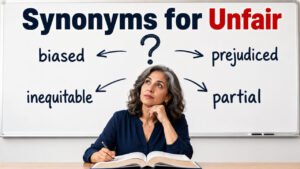
Quick Answer: The best synonyms for unfair include unjust, biased, inequitable, unreasonable, one sided, prejudiced, discriminatory, partial, improper, and wrongful. Use unjust for serious moral or legal wrongs, biased when someone favors one side, inequitable for unequal treatment, unreasonable for demands or rules, and discriminatory when unfairness is based on identity, status, or category.
Pronunciation and Word Details
Word: Unfair.
Pronunciation: /ʌnˈfer/
Part of Speech: Adjective.
Meaning: Not just, equal, honest, or reasonable.
US Pronunciation:
UK Pronunciation:
What Does “Unfair” Mean?
Direct Answer: Unfair means not just, not equal, or not based on honest and reasonable treatment.
The word unfair is an adjective. It describes actions, rules, decisions, systems, behavior, treatment, or situations that do not give people what they deserve. A decision can be unfair if it favors one person without a good reason. A rule can be unfair if it affects one group more harshly than another. A situation can feel unfair when it creates unequal results.
Unfair can appear before a noun, as in unfair rule, unfair price, or unfair treatment. It can also come after a linking verb, as in the decision was unfair. In writing, unfair is useful because it is clear and familiar, but stronger synonyms can often show the exact kind of unfairness more precisely.
Meaning, Tone, and Context of “Unfair”
Tone: Unfair is neutral to emotional, depending on the context.
Common Use: It is common in everyday speech, school writing, workplace discussion, legal topics, social issues, reviews, complaints, and personal conversations.
Formality: Unfair is suitable for both casual and formal writing, but some synonyms sound more precise in professional or academic contexts.
Emotional Strength: Unfair can express disappointment, frustration, anger, or moral concern.
Best Contexts: Use unfair when you want a simple word for unequal treatment, wrong judgment, unreasonable rules, or dishonest advantage.
Precise Contexts: Use unjust for moral wrong, biased for favoritism, inequitable for unequal distribution, and discriminatory for unfair treatment based on a protected or personal category.
When and How to Use “Unfair”
For Unequal Treatment: Use unfair when someone is treated differently without a valid reason.
Example: The policy is unfair to new employees.
For Favoritism: Use unfair when one person or group receives special help or advantage.
Example: Giving extra time to one candidate was unfair.
For Unreasonable Rules: Use unfair when a rule demands too much or ignores real circumstances.
Example: The deadline felt unfair because the team received the task late.
For Wrong Decisions: Use unfair when a judgment does not match the facts.
Example: It was unfair to blame her without hearing her explanation.
For Emotional Reaction: Use unfair when something feels morally wrong or personally disappointing.
Example: Losing the award after meeting every requirement seemed unfair.
Best Synonyms for Unfair
Unjust: Not morally right or fair.
Example: The punishment was unjust because the student had done nothing wrong.
Biased: Favoring one side, person, or opinion unfairly.
Example: The judge gave a biased review of the performance.
Inequitable: Not equal or not fairly distributed.
Example: The funding system was inequitable across small schools.
Unreasonable: Not fair, sensible, or practical.
Example: Asking one worker to finish the entire project alone was unreasonable.
One sided: Favoring only one side of a situation.
Example: The report gave a one sided view of the argument.
Prejudiced: Influenced by unfair opinions formed before knowing the facts.
Example: A prejudiced decision can damage trust.
Discriminatory: Treating people unfairly because of group, identity, status, or category.
Example: The rule was discriminatory because it excluded qualified applicants.
Partial: Showing unfair preference toward someone or something.
Example: The manager appeared partial to his close friends.
Improper: Not acceptable, suitable, or fair in a situation.
Example: It was improper to change the rules after the contest began.
Wrongful: Not just, lawful, or morally acceptable.
Example: The employee filed a complaint about wrongful dismissal.
50 Synonyms for Unfair with Short Meanings
- Unjust: Not morally right or fair.
- Biased: Favoring one side unfairly.
- Inequitable: Not equally or fairly shared.
- Unreasonable: Not fair, sensible, or practical.
- One sided: Supporting only one side.
- Prejudiced: Based on unfair prior judgment.
- Discriminatory: Treating people unfairly by category.
- Partial: Showing unfair preference.
- Wrongful: Unjust or not acceptable.
- Improper: Not suitable or fair.
- Unbalanced: Not equal or evenly judged.
- Unequal: Not the same in treatment or result.
- Unjustified: Not supported by good reason.
- Arbitrary: Based on personal choice rather than fair rules.
- Unethical: Morally wrong or dishonest.
- Dishonest: Not truthful or fair.
- Unprincipled: Not guided by fair values.
- Corrupt: Dishonest and unfair for personal gain.
- Exploitative: Taking unfair advantage of others.
- Oppressive: Harsh and unfairly controlling.
- Abusive: Harmful and unfair in treatment.
- Harsh: Too severe or strict.
- Severe: Stronger than needed or deserved.
- Cruel: Intentionally hurtful or unfair.
- Unkind: Lacking fairness or compassion.
- Unmerited: Not deserved.
- Undeserved: Not earned or justified.
- Unwarranted: Not necessary or justified.
- Unfounded: Not based on facts.
- Groundless: Without fair reason or evidence.
- Invalid: Not reasonable, correct, or acceptable.
- Unacceptable: Not suitable or fair enough.
- Improperly judged: Decided in an unfair way.
- Skewed: Distorted in favor of one side.
- Slanted: Presented with unfair bias.
- Loaded: Designed to influence unfairly.
- Manipulative: Controlling others unfairly.
- Predatory: Taking advantage of weakness.
- Uneven: Not equal in treatment or effect.
- Lopsided: Strongly favoring one side.
- Unfair minded: Not open to fair judgment.
- Subjective: Based too much on personal feeling.
- Preferential: Giving special advantage unfairly.
- Favored: Given better treatment than others.
- Unlawful: Against the law.
- Illegitimate: Not acceptable by fair rules.
- Morally wrong: Against ethical fairness.
- Unfairly strict: Too demanding or severe.
- Disproportionate: Greater than what is reasonable.
- Unjustly applied: Used in an unequal or unfair way.
Read Also:
Synonyms for Unfair
Synonyms for Unfair by Context
When Unfair Means Not Just
Use these synonyms when unfair means morally wrong, legally wrong, or not based on justice.
Unjust: The decision was unjust because it ignored the evidence.
Wrongful: The worker challenged the wrongful dismissal.
Unethical: The company made an unethical choice.
Improper: It was improper to hide important details.
When Unfair Means Biased
Use these synonyms when unfair means one person, side, or opinion receives special treatment.
Biased: The article sounded biased against one group.
Partial: The coach seemed partial to older players.
One sided: The debate became one sided.
Slanted: The summary gave a slanted version of events.
When Unfair Means Unequal
Use these synonyms when unfair means treatment, opportunity, payment, or support is not equal.
Inequitable: The plan created inequitable results.
Unequal: The workers complained about unequal pay.
Uneven: The rules produced uneven outcomes.
Disproportionate: The punishment was disproportionate to the mistake.
When Unfair Means Unreasonable
Use these synonyms when unfair means a demand, rule, price, or expectation is too much.
Unreasonable: The landlord made an unreasonable demand.
Harsh: The penalty was harsh for a first mistake.
Severe: The response was more severe than necessary.
Unwarranted: The criticism was unwarranted.
When Unfair Means Discriminatory
Use these synonyms when unfair treatment is connected to identity, status, background, age, gender, ability, belief, or category.
Discriminatory: The policy was discriminatory in practice.
Prejudiced: The decision reflected a prejudiced attitude.
Oppressive: The system felt oppressive to vulnerable workers.
Exploitative: The contract was exploitative for low paid staff.
Another Word for Unfair
Best Single Replacement: Unjust is often the best single replacement for unfair because it clearly means not fair, not right, or not morally acceptable.
The best alternative depends on context. Use biased for favoritism, inequitable for unequal treatment, unreasonable for harsh demands, and discriminatory for unfair treatment based on category or identity.
Original: The decision was unfair to the applicants.
Better Option: The decision was unjust to the applicants.
Original: The article was unfair toward one side.
Better Option: The article was biased toward one side.
Original: The rule created unfair results.
Better Option: The rule created inequitable results.
Original: The teacher gave an unfair punishment.
Better Option: The teacher gave a disproportionate punishment.
When Not to Use “Unfair”
Do not use unfair when a more exact synonym gives clearer meaning. Unfair can sound too general in formal reports, legal writing, academic writing, or serious complaints. It may also sound emotional if the sentence needs objective language.
Weak: The hiring process was unfair.
Better: The hiring process was biased.
Weak: The tax rule was unfair.
Better: The tax rule was inequitable.
Weak: His comment was unfair.
Better: His comment was unjustified.
Weak: The punishment was unfair.
Better: The punishment was disproportionate.
Weak: The article was unfair.
Better: The article was one sided.
Words Commonly Confused With Unfair
Unfair vs Unjust: Unfair is a broad word for unequal or unreasonable treatment. Unjust is stronger and often suggests a moral, legal, or ethical wrong.
Unfair vs Biased: Unfair can describe many kinds of wrong treatment. Biased specifically means influenced by favoritism, prejudice, or one sided judgment.
Unfair vs Inequitable: Unfair is general and conversational. Inequitable is more formal and often describes unequal systems, policies, pay, or access.
Unfair vs Discriminatory: Unfair can describe any unequal treatment. Discriminatory means unfair treatment based on a personal or social category.
Unfair vs Unreasonable: Unfair focuses on justice and equality. Unreasonable focuses on demands, decisions, prices, or expectations that are not sensible.
Unfair vs Harsh: Unfair means not just or equal. Harsh means too strict, severe, or hard.
Which Synonym Should You Choose?
Choose unjust when writing about moral wrongs, legal issues, punishments, rights, or decisions that violate fairness.
Choose biased when someone favors one person, group, side, opinion, or result.
Choose inequitable when writing about systems, policies, access, pay, funding, resources, or distribution.
Choose unreasonable when writing about demands, rules, prices, deadlines, expectations, or behavior that lacks good sense.
Choose discriminatory when unfair treatment is based on age, background, identity, ability, belief, status, or category.
Choose partial when someone is not neutral in judgment.
Choose one sided when a report, argument, article, or discussion presents only one view.
Choose disproportionate when the response, punishment, cost, or consequence is greater than the situation deserves.
Choose wrongful when the action is improper, unjust, or possibly against accepted rules.
Choose harsh when the treatment is too severe, even if it is not clearly illegal or discriminatory.
Real Life Examples of “Unfair” in Sentences
Original: The rule was unfair to small business owners.
Better Option: The rule was inequitable to small business owners.
Original: It was unfair to blame him without proof.
Better Option: It was unjust to blame him without proof.
Original: The article gave an unfair picture of the event.
Better Option: The article gave a biased picture of the event.
Original: The teacher made an unfair decision.
Better Option: The teacher made a partial decision.
Original: The company had an unfair hiring policy.
Better Option: The company had a discriminatory hiring policy.
Original: The punishment felt unfair.
Better Option: The punishment felt disproportionate.
Original: Asking her to work all weekend was unfair.
Better Option: Asking her to work all weekend was unreasonable.
Original: The debate was unfair to the second speaker.
Better Option: The debate was one sided against the second speaker.
Original: The fee was unfair for new students.
Better Option: The fee was excessive for new students.
Original: The complaint made an unfair claim.
Better Option: The complaint made an unfounded claim.
Synonym Groups and Usage Differences
Justice Group
This group includes unjust, wrongful, unethical, improper, and morally wrong. Use these when unfairness involves justice, rights, honesty, or moral responsibility.
Example: The court corrected an unjust ruling.
Bias Group
This group includes biased, partial, one sided, slanted, skewed, and prejudiced. Use these when unfairness comes from favoritism or a lack of neutrality.
Example: The review was biased in favor of one candidate.
Equality Group
This group includes inequitable, unequal, uneven, lopsided, and disproportionate. Use these when unfairness comes from unequal results, unequal support, or unequal treatment.
Example: The new policy created inequitable access to training.
Reasonableness Group
This group includes unreasonable, harsh, severe, unwarranted, and unjustified. Use these when unfairness comes from excessive demands, strict rules, or weak reasoning.
Example: The deadline was unreasonable for such a large task.
Harm Group
This group includes exploitative, oppressive, abusive, predatory, and cruel. Use these when unfairness causes serious harm or takes advantage of someone.
Example: The contract was exploitative because it gave workers no protection.
Antonyms of Unfair
Fair: Just, equal, and reasonable.
Just: Morally right and based on fairness.
Equitable: Fairly shared or distributed.
Impartial: Not favoring any side.
Unbiased: Free from unfair preference.
Reasonable: Fair, sensible, and practical.
Objective: Based on facts rather than personal feelings.
Honest: Truthful and morally fair.
Ethical: Guided by good moral principles.
Proper: Suitable and acceptable according to rules.
Balanced: Considering all sides fairly.
Equal: Giving the same treatment, chance, or value.
Comparison: Unfair vs Related Words
Unfair vs Unjust
Unfair is broad and common. Unjust is stronger and often used for moral, legal, or serious wrongs.
Example With Unfair: The rule was unfair to part time workers.
Example With Unjust: The ruling was unjust because it ignored clear evidence.
Unfair vs Biased
Unfair can describe any lack of fairness. Biased means judgment is influenced by preference, prejudice, or favoritism.
Example With Unfair: The selection process was unfair.
Example With Biased: The selection process was biased toward experienced candidates.
Unfair vs Inequitable
Unfair is simple and general. Inequitable is formal and often used for policies, money, resources, access, or systems.
Example With Unfair: The funding system was unfair.
Example With Inequitable: The funding system was inequitable across rural schools.
Unfair vs Unreasonable
Unfair focuses on justice. Unreasonable focuses on whether something is sensible, practical, or acceptable.
Example With Unfair: The decision was unfair to the team.
Example With Unreasonable: The workload was unreasonable for one employee.
Unfair vs Discriminatory
Unfair can describe any unequal treatment. Discriminatory describes unfair treatment linked to identity, status, background, or group.
Example With Unfair: The policy felt unfair.
Example With Discriminatory: The policy was discriminatory toward older applicants.
Common Phrases and Expressions With Unfair
Unfair Treatment: Behavior that does not treat someone justly.
Unfair Advantage: A benefit that someone gets in a dishonest or unequal way.
Unfair Decision: A choice that is not based on equal or reasonable judgment.
Unfair Rule: A rule that treats people unequally or too harshly.
Unfair Practice: A method that is dishonest, biased, or harmful.
Unfair Competition: Competition where one side has an improper advantage.
Unfair Punishment: A penalty that is too harsh or not deserved.
Unfair Criticism: Negative judgment that is not supported by facts.
Unfair System: A structure that creates unequal or unjust outcomes.
Unfair Share: More or less than what is reasonable or equal.
Common Mistakes to Avoid
One common mistake is using unfair too often when a sharper synonym would improve clarity. In formal writing, unjust, inequitable, biased, discriminatory, or unreasonable may explain the exact problem better.
Another mistake is using biased when the issue is not favoritism. If the problem is unequal distribution, use inequitable. If the problem is excessive punishment, use disproportionate. If the problem is a demand that lacks sense, use unreasonable.
Avoid vague complaints such as the situation is unfair without explaining why. Strong writing names the unfair action, the affected person, and the reason. Also avoid using discriminatory unless the unfair treatment is connected to a group, identity, status, or category. Careful synonym choice makes your writing more accurate, respectful, and persuasive.
Conclusion
Synonyms for unfair help you describe different kinds of injustice with more accuracy. Use unjust for serious moral wrongs, biased for favoritism, inequitable for unequal systems, unreasonable for harsh demands, and discriminatory for category based mistreatment. The word unfair is useful and easy to understand, but stronger alternatives can make your meaning clearer. Choosing the right synonym depends on whether you are writing about treatment, rules, judgment, systems, punishment, or personal behavior.
FAQs About Synonyms for Unfair
What are the best synonyms for unfair?
The best synonyms for unfair are unjust, biased, inequitable, unreasonable, one sided, prejudiced, discriminatory, partial, wrongful, and improper.
What is another word for unfair treatment?
Another word for unfair treatment is unjust treatment. In formal contexts, inequitable treatment or discriminatory treatment may be more precise.
Is unjust stronger than unfair?
Yes, unjust is usually stronger than unfair. It suggests a serious moral, legal, or ethical wrong.
What is a formal synonym for unfair?
Formal synonyms for unfair include unjust, inequitable, discriminatory, improper, wrongful, and unethical.
What is a casual synonym for unfair?
Casual alternatives include not right, one sided, harsh, wrong, and unreasonable.
What is the difference between unfair and biased?
Unfair means not just or equal. Biased means unfair because of favoritism, prejudice, or preference for one side.
What is the opposite of unfair?
The opposite of unfair is fair. Other antonyms include just, equitable, impartial, unbiased, reasonable, honest, and balanced.
