
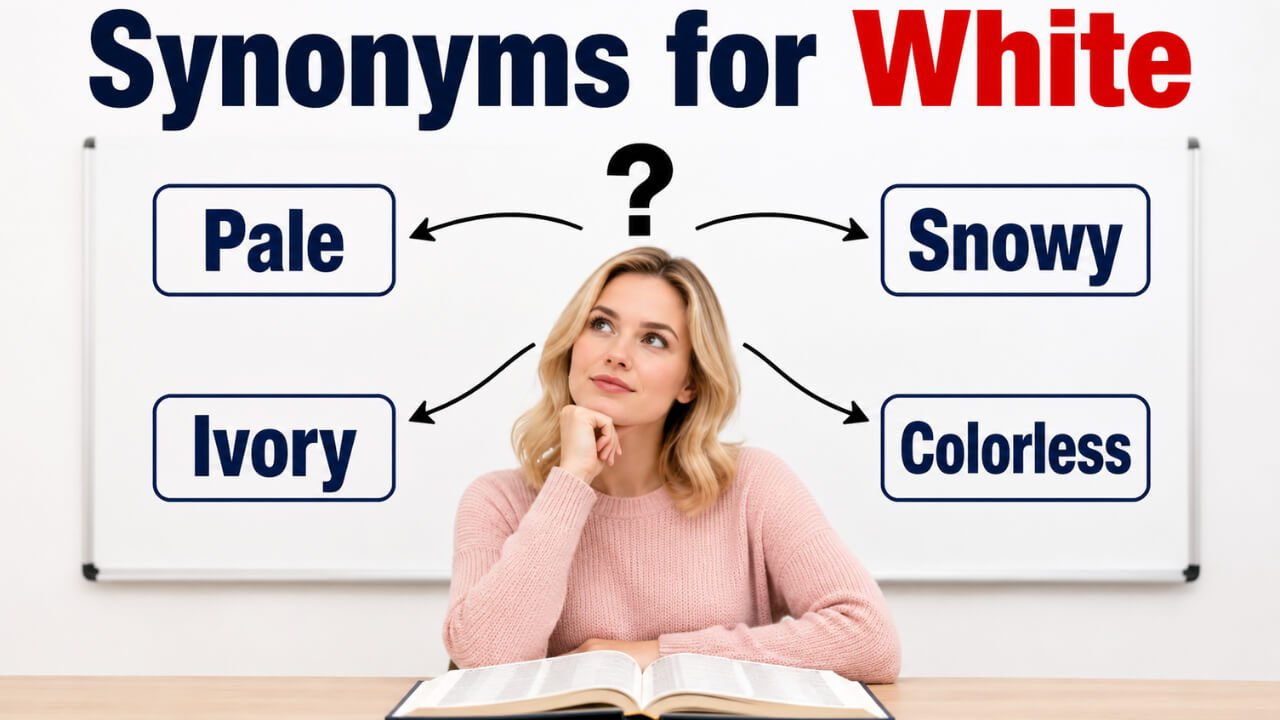
Quick Answer: Synonyms for white include snowy, milky, ivory, pearl, alabaster, porcelain, chalky, pale, fair, and pure. Use snowy for bright natural whiteness, ivory for a soft warm shade, alabaster for smooth elegant whiteness, pale for a light or faded look, and pure when white suggests cleanliness, innocence, or simplicity. The best synonym depends on whether you mean color, brightness, skin tone, cleanliness, blank space, or symbolic purity.
Pronunciation and Word Details
Word: White
Pronunciation: /waɪt/
Part of Speech: Mainly adjective, also noun
Meaning: White means having the color of fresh snow, milk, or a very light surface.
US Pronunciation:
UK Pronunciation:
What Does “White” Mean?
White means a very light color, usually the color of snow, milk, paper, or a clean bright surface. It is mainly used as an adjective, as in white shirt, white wall, or white flower. It can also work as a noun when naming the color itself, as in white is a calm color.
White can describe physical color, brightness, blankness, cleanliness, purity, or a pale appearance. In writing, it often appears before nouns to describe objects, clothing, light, flowers, clouds, rooms, paint, pages, and visual details.
Meaning, Tone, and Context of “White”
White is a neutral and common word. It is not too formal or too casual, so it works well in everyday speech, academic writing, product descriptions, design content, poetry, and general explanations. Its tone depends on the context.
In color descriptions, white is direct and simple. In creative writing, words like ivory, alabaster, pearl, snowy, and porcelain can sound more vivid. In emotional or symbolic writing, white may suggest purity, peace, innocence, simplicity, freshness, or cleanliness. In medical or physical descriptions, pale, pallid, wan, or ashen may be more accurate than white.
When and How to Use “White”
For Color Description: Use white when describing a clear light color similar to snow, milk, or paper.
Example: She wore a white dress to the garden party.
For Brightness: Use white when something looks bright, clean, or full of light.
Example: The room looked larger because of the white walls.
For Cleanliness: Use white when the color suggests freshness, neatness, or a clean appearance.
Example: The hotel used white sheets in every room.
For Blank Space: Use white when talking about empty or unused visual space.
Example: The design needs more white space around the title.
For Pale Appearance: Use white when someone or something looks drained of color.
Example: His face turned white after the sudden noise.
For Symbolic Meaning: Use white when it represents peace, purity, innocence, or simplicity.
Example: The white dove became a sign of peace.
Best Synonyms for White
Snowy: Bright white like fresh snow.
Example: The mountain peak looked snowy in the morning light.
Milky: Soft white with a smooth or cloudy appearance.
Example: A milky glow spread across the sky.
Ivory: Warm white with a soft cream tone.
Example: She chose an ivory dress instead of a bright white one.
Pearl: Smooth white with a gentle shine.
Example: The necklace had a pearl finish.
Alabaster: Elegant, smooth, and pale white.
Example: The statue had an alabaster surface.
Porcelain: Delicate white with a smooth polished look.
Example: The porcelain vase looked graceful on the table.
Chalky: Dull white with a dry or powdery appearance.
Example: The old wall had a chalky finish.
Pale: Very light in color, often weak or faded.
Example: His face looked pale after the long trip.
Fair: Light in color, often used for skin or hair.
Example: The child had fair hair and bright eyes.
Pure: Clean, clear, or free from marks, often used symbolically.
Example: The room had a pure white look.
50 Synonyms for White with Short Meanings
- Snowy: Bright and white like snow.
- Snow white: Completely white like fresh snow.
- Milky: Soft white like milk.
- Ivory: Warm white with a creamy shade.
- Pearl: Smooth white with gentle shine.
- Pearly: Shiny and softly white.
- Alabaster: Smooth elegant pale white.
- Porcelain: Fine smooth white.
- Chalky: Dull dry white.
- Cream: Soft yellowish white.
- Creamy: Smooth warm white.
- Off white: Slightly tinted white.
- Eggshell: Soft pale white with warmth.
- Bone: Natural dull white shade.
- Bone white: Pale natural white.
- Vanilla: Soft creamy white.
- Frosty: Cold bright white.
- Frost white: White like frost.
- Glacial: Icy pale white.
- Icy: Very pale and cold looking.
- Bleached: Made very white or pale.
- Bright: Full of light and whiteness.
- Light: Pale or not dark.
- Pale: Weak, light, or faded in color.
- Fair: Light in hair, skin, or tone.
- Lily white: Pure white like a lily.
- Swan white: Soft graceful white.
- Cotton white: Soft white like cotton.
- Paper white: Plain white like clean paper.
- Marble white: Smooth white like marble.
- Silver white: White with a silver tone.
- Silvery: Pale white with silver shine.
- Opaline: Milky white with soft color play.
- Nacreous: Pearly white with a shell like shine.
- Ashen: Pale grayish white.
- Pallid: Unnaturally pale or white.
- Wan: Weak and pale in appearance.
- Bloodless: Very pale, often from fear or illness.
- Ghostly: Extremely pale and strange looking.
- Colorless: Without strong color.
- Washed out: Faded and pale.
- Faded: Less strong in color.
- Clean: Fresh and free from dirt.
- Spotless: Completely clean and unmarked.
- Immaculate: Perfectly clean or pure.
- Pristine: Fresh, clean, and untouched.
- Stainless: Without marks or stains.
- Unsullied: Pure and not spoiled.
- Blank: Empty and unmarked.
- Unmarked: Having no writing, stain, or sign.
Read Also:
Synonyms for Strength

Synonyms for White by Context
When White Means Snow Colored
Use these synonyms when white describes a bright, clear, snow like color.
Synonyms: Snowy, snow white, frost white, cotton white, paper white.
Example: The snowy blanket covered the entire field.
Example: She picked paper white flowers for the table.
When White Means Soft Warm White
Use these choices when the color is not sharp or bright, but gentle and slightly warm.
Synonyms: Ivory, cream, creamy, eggshell, vanilla, off white.
Example: The ivory curtains made the room feel calm.
Example: The walls were painted eggshell for a softer look.
When White Means Smooth and Elegant
Use these words when describing fine surfaces, polished objects, fabric, stone, or delicate beauty.
Synonyms: Alabaster, porcelain, pearl, pearly, marble white.
Example: The sculpture had an alabaster glow.
Example: Her pearl scarf caught the soft light.
When White Means Pale or Colorless
Use these synonyms when white describes a face, skin, light, or faded color.
Synonyms: Pale, pallid, wan, ashen, bloodless, washed out.
Example: His face looked ashen after the shock.
Example: The old photo had a washed out background.
When White Means Clean or Pure
Use these words when white suggests cleanliness, innocence, freshness, or moral purity.
Synonyms: Pure, clean, spotless, immaculate, pristine, stainless, unsullied.
Example: The room had a spotless white finish.
Example: The ceremony used white flowers to suggest purity.
When White Means Blank or Empty
Use these synonyms when white refers to empty paper, unused space, or an unmarked surface.
Synonyms: Blank, unmarked, bare, plain, clear.
Example: She stared at the blank page before writing.
Example: The sign was plain white with no design.
Another Word for White
Another word for white is snowy when you mean a bright, clean white color. However, the best alternative depends on context. Use ivory for a warm white shade, alabaster for elegant smooth whiteness, pale for a light or faded appearance, and pure when white suggests cleanliness or innocence.
Original: She wore a white scarf.
Better Option: She wore an ivory scarf.
Original: The white mountain shone in the sun.
Better Option: The snowy mountain shone in the sun.
Original: His white face showed fear.
Better Option: His pale face showed fear.
Original: The white statue stood in the hall.
Better Option: The alabaster statue stood in the hall.
When Not to Use “White”
Do not use white when a more exact shade would help the reader imagine the color. White can sound too basic in creative writing, fashion writing, design descriptions, and visual details. It may also sound unclear when the object is really cream, ivory, pale gray, pearl, or off white.
Weak: She bought a white dress.
Better: She bought an ivory dress.
Weak: The room had white light.
Better: The room had a soft milky light.
Weak: His face was white.
Better: His face was pale with fear.
Weak: The table was white.
Better: The table had a smooth porcelain finish.
Weak: The page looked white.
Better: The page was blank and unmarked.
Words Commonly Confused With White
White vs Pale: White is a clear color, while pale means light, weak, or lacking strong color.
White vs Ivory: White is usually brighter and cleaner, while ivory is warmer and softer.
White vs Cream: White is more neutral, while cream has a yellow or warm tone.
White vs Blank: White describes color, while blank describes an empty or unmarked surface.
White vs Pure: White can be a color, while pure means clean, innocent, or free from anything mixed in.
White vs Fair: White describes color in general, while fair often describes light skin, light hair, or a gentle appearance.
White vs Colorless: White is a visible color, while colorless means having no noticeable color.
Which Synonym Should You Choose?
Choose snowy when describing bright natural whiteness, especially snow, mountains, fields, or winter scenes.
Choose ivory when writing about clothing, decor, fabric, paint, or a warm white shade.
Choose alabaster when describing smooth beauty, statues, skin, stone, or elegant surfaces.
Choose porcelain when describing delicate, polished, smooth, or refined white objects.
Choose milky when describing cloudy liquid, soft light, glass, mist, or a gentle white glow.
Choose chalky when describing a dry, dull, powdery, or rough white finish.
Choose pale when describing a weak color, a tired face, fear, illness, or a faded appearance.
Choose fair when describing light hair, light complexion, or a gentle physical tone.
Choose pure when white suggests cleanliness, innocence, peace, or simplicity.
Choose blank when white means empty paper, empty space, or an unmarked surface.
Real Life Examples of “White” in Sentences
Original: The bride wore a white dress.
Better Option: The bride wore an ivory dress.
Original: The white snow covered the road.
Better Option: The snowy blanket covered the road.
Original: The white cup sat on the shelf.
Better Option: The porcelain cup sat on the shelf.
Original: The room had white walls.
Better Option: The room had soft eggshell walls.
Original: His face turned white.
Better Option: His face turned pale.
Original: The white moon appeared behind the clouds.
Better Option: The pearly moon appeared behind the clouds.
Original: She opened a white page.
Better Option: She opened a blank page.
Original: The white statue looked smooth.
Better Option: The alabaster statue looked smooth.
Original: The white light filled the hallway.
Better Option: A milky light filled the hallway.
Original: The tablecloth was white and clean.
Better Option: The tablecloth was spotless and clean.
Synonym Groups and Usage Differences
Bright White Group
This group includes words that describe strong, clear, bright whiteness. These are useful for snow, clouds, flowers, paper, and clean surfaces.
Synonyms: Snowy, snow white, paper white, cotton white, frost white.
Example: The snowy peaks looked bright against the blue sky.
Warm White Group
This group includes white shades with a soft yellow, cream, or beige tone. These words are useful for fashion, paint, design, and home decor.
Synonyms: Ivory, cream, creamy, eggshell, vanilla, off white.
Example: The ivory walls made the bedroom feel warmer.
Elegant White Group
This group describes smooth, graceful, or refined whiteness. It works well in creative writing, art, product descriptions, and visual storytelling.
Synonyms: Alabaster, porcelain, pearl, pearly, marble white.
Example: The porcelain lamp gave the room a refined look.
Pale Appearance Group
This group describes a face, skin, or object that lacks strong color. It can suggest fear, sickness, tiredness, age, or fading.
Synonyms: Pale, pallid, wan, ashen, bloodless, washed out.
Example: Her wan smile showed how tired she was.
Clean and Pure Group
This group connects white with freshness, cleanliness, innocence, and perfection.
Synonyms: Pure, clean, spotless, immaculate, pristine, stainless.
Example: The kitchen looked immaculate after cleaning.
Blank Space Group
This group describes an empty page, unmarked surface, or unused visual area.
Synonyms: Blank, unmarked, bare, plain, clear.
Example: The blank card was ready for a message.
Antonyms of White
White has different opposites depending on the meaning. If white means color, the opposite is usually black. If white means clean, the opposite may be dirty or stained. If white means blank, the opposite may be marked or filled.
Black: The darkest color and the direct color opposite of white.
Dark: Having little light or a deep color.
Colored: Having a clear color other than white.
Stained: Marked with dirt, color, or spots.
Dirty: Not clean or fresh.
Dull: Lacking brightness or shine.
Marked: Having writing, signs, or visible marks.
Filled: Not empty or blank.
Tainted: No longer pure or clean.
Impure: Mixed with unwanted elements or no longer pure.
Comparison: White vs Related Words
White vs Snowy
White is the general color term. Snowy describes something that looks like snow or is covered with snow.
Example With White: The white roof reflected the sunlight.
Example With Snowy: The snowy roof sparkled in the morning.
White vs Ivory
White is usually brighter and more neutral. Ivory is a warmer, softer shade of white.
Example With White: She painted the door white.
Example With Ivory: She painted the bedroom ivory for a warmer feel.
White vs Pale
White describes a clear color. Pale describes a weak, light, or faded color.
Example With White: The flower had white petals.
Example With Pale: The flower had pale petals after days in the sun.
White vs Alabaster
White is simple and general. Alabaster sounds more elegant and describes smooth pale beauty.
Example With White: The statue was white.
Example With Alabaster: The statue had an alabaster glow.
White vs Blank
White describes the color of a surface. Blank describes the absence of writing, marks, or content.
Example With White: The notebook had white pages.
Example With Blank: The notebook had blank pages.
White vs Pure
White names a color. Pure describes cleanliness, innocence, or freedom from anything mixed or spoiled.
Example With White: The curtains were white.
Example With Pure: The design had a pure and peaceful look.
Common Phrases and Expressions With White
White Dress: A dress that is white in color, often formal or ceremonial.
White Shirt: A common shirt color used in casual, formal, or professional clothing.
White Paper: Paper that is plain, clean, or light in color.
White Space: Empty space in a design, page, or layout.
White Light: Light that appears clear or contains all visible colors together.
White Flag: A sign of surrender or peace.
White Noise: A steady background sound that can cover other sounds.
White Lie: A small lie often told to avoid hurting someone.
White Clouds: Light colored clouds in the sky.
White Paint: Paint used to create a bright, clean, or simple surface.
Common Mistakes to Avoid
One common mistake is using white for every light shade. Ivory, cream, pearl, eggshell, and off white are often more accurate. Another mistake is using white when you mean pale. A pale face does not always look truly white. Writers also repeat white too often in descriptions, which can make sentences sound plain.
Avoid choosing a synonym only because it sounds fancy. Alabaster, porcelain, and pearly work best for smooth or elegant descriptions. Chalky works for dry surfaces, not soft fabric. Blank works for empty pages, not color alone. Always choose the synonym that matches the object, tone, and meaning.
Conclusion
Synonyms for white can make your writing clearer, richer, and more exact. Use snowy for bright natural whiteness, ivory for warm soft shades, alabaster for elegant surfaces, milky for gentle light, pale for a faded or fearful appearance, and pure for symbolic cleanliness or innocence. White is a simple and useful word, but the right synonym can show color, texture, mood, and meaning more accurately. Choose the word that fits the sentence, not just the closest dictionary match.
FAQs About Synonyms for White
What is the best synonym for white?
The best synonym for white depends on context. Snowy is best for bright white, ivory for warm white, alabaster for elegant white, and pale for a light or faded appearance.
What is another word for white in color?
Another word for white in color is snowy. Other good choices include ivory, pearl, milky, alabaster, porcelain, and eggshell.
What is a fancy word for white?
Alabaster is a fancy word for white, especially when describing smooth, pale, elegant beauty. Porcelain and pearly also sound refined.
What is a soft white color called?
A soft white color can be called ivory, cream, eggshell, vanilla, or off white. These words describe warmer and gentler shades of white.
What is a synonym for white skin tone?
Fair and pale can describe a light skin tone, but they are not always the same as white. Pale often suggests a weak, tired, or colorless look.
What is a synonym for pure white?
Snow white, snowy, spotless, pristine, and immaculate can suggest pure white. Use snow white for color and spotless or pristine for cleanliness.
What is the opposite of white?
The direct color opposite of white is black. Other opposites include dark, dirty, stained, marked, colored, and impure, depending on the sentence.
