
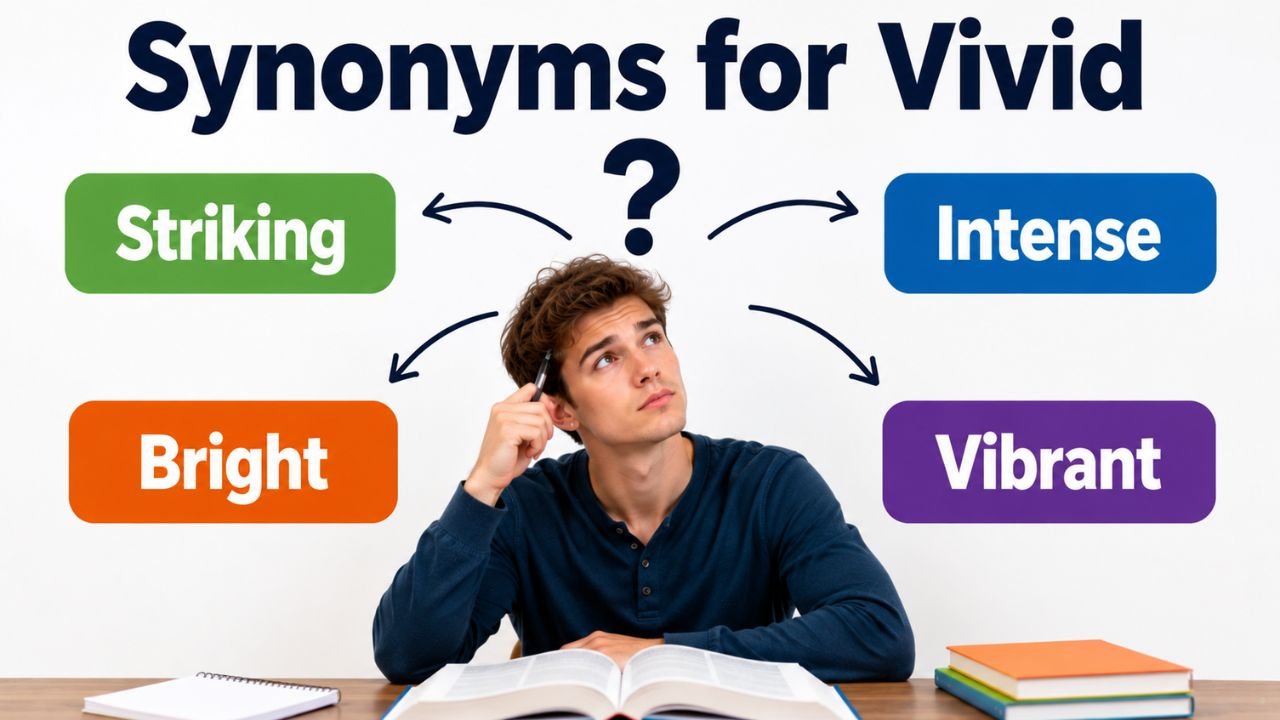
Quick Answer: The best synonyms for vivid include bright, vibrant, colorful, striking, intense, graphic, detailed, clear, memorable, and lifelike. Use bright or colorful for strong colors, detailed or graphic for descriptions, clear for memories and ideas, lifelike for realistic images, and striking for something that immediately attracts attention. The best choice among the synonyms for vivid depends on whether you are describing color, imagination, memory, emotion, language, dreams, or visual detail.
Pronunciation and Word Details
Word: Vivid.
Pronunciation: /ˈvɪvɪd/.
Part of Speech: Adjective.
Meaning: Producing a strong, clear, detailed, or powerful impression on the mind or senses.
US Pronunciation:
UK Pronunciation:
What Does “Vivid” Mean?
Vivid means extremely clear, bright, detailed, or powerful in appearance, memory, description, or imagination. It is an adjective used to describe something that creates a strong impression on the senses or mind.
When vivid describes a color, it means bright, rich, and noticeable.
Example: She wore a vivid red dress.
When vivid describes a memory, it means clear and easy to remember.
Example: He still has a vivid memory of his first day at school.
When vivid describes writing or speech, it means detailed and expressive enough to create a strong mental picture.
Example: The author gave a vivid description of the storm.
When vivid describes a dream or imagination, it suggests that the experience feels unusually clear, realistic, or intense.
Example: She had a vivid dream about walking through a silent forest.
The word can therefore refer to physical appearance, mental clarity, emotional intensity, realistic detail, or expressive language.
Meaning, Tone, and Context of “Vivid”
Vivid has a strong but generally neutral tone. It is suitable for formal writing, academic work, creative descriptions, everyday conversation, reviews, reports, and storytelling.
The word often carries a positive meaning when it describes attractive colors, strong imagination, expressive writing, or memorable experiences. However, it can also describe unpleasant experiences, such as a vivid nightmare or a vivid memory of an accident.
Formal Context: Vivid can describe detailed evidence, memories, accounts, or observations.
Example: The witness provided a vivid account of the incident.
Creative Context: It is often used for expressive descriptions, imagery, characters, settings, and emotions.
Example: The poem creates a vivid picture of life near the sea.
Conversational Context: It can describe bright colors, memorable events, or realistic dreams.
Example: I had a vivid dream last night.
Emotional Context: Vivid can suggest that a feeling, experience, or memory remains powerful.
Example: The moment remains vivid in her mind.
Visual Context: It commonly refers to bold, rich, or intense colors.
Example: The room was decorated in vivid shades of blue and green.
When and How to Use “Vivid”
For Bright Colors
Use vivid when a color is strong, rich, and immediately noticeable.
Example: The garden was filled with vivid purple flowers.
For Clear Memories
Use vivid when a past experience remains detailed and easy to recall.
Example: She has vivid memories of visiting her grandparents.
For Detailed Descriptions
Use vivid when words create a clear picture in the reader’s or listener’s mind.
Example: His vivid description made the ancient city seem real.
For Powerful Imagination
Use vivid when someone can form clear and detailed mental images.
Example: The child has a vivid imagination.
For Realistic Dreams
Use vivid when a dream feels clear, intense, and almost real.
Example: He woke suddenly after a vivid dream.
For Strong Emotions
Use vivid when feelings or experiences create a powerful impression.
Example: The music brought back vivid feelings of happiness.
For Striking Images
Use vivid when a photograph, painting, or scene contains strong detail and visual impact.
Example: The photograph captured the landscape in vivid detail.
For Memorable Experiences
Use vivid when an event remains strongly present in someone’s mind.
Example: Their first meeting was still vivid years later.
Best Synonyms for Vivid
Bright: Giving off or reflecting a large amount of light or displaying a strong color.
Example: The artist used bright yellow paint for the sunflowers.
Vibrant: Full of rich color, energy, and life.
Example: The market was filled with vibrant fabrics and fresh flowers.
Colorful: Containing many strong, varied, or attractive colors.
Example: The children created a colorful mural for the classroom.
Striking: Unusual, impressive, or noticeable enough to attract immediate attention.
Example: The building has a striking modern design.
Intense: Extremely strong in color, feeling, effect, or degree.
Example: The sunset produced an intense orange glow.
Graphic: Described or shown with clear, powerful, and sometimes disturbing detail.
Example: The report included a graphic account of the damage.
Detailed: Containing many specific facts, features, or pieces of information.
Example: She gave a detailed explanation of the process.
Clear: Easy to see, understand, remember, or imagine.
Example: He has a clear memory of the conversation.
Memorable: Likely to remain in the mind because it is unusual, important, or impressive.
Example: The final scene was powerful and memorable.
Lifelike: Closely resembling a real person, object, or experience.
Example: The painter created a lifelike portrait of the musician.
50 Synonyms for Vivid with Short Meanings
- Bright: Strong in color or light.
- Vibrant: Full of color, energy, and life.
- Colorful: Containing bright or varied colors.
- Striking: Immediately noticeable or impressive.
- Intense: Extremely strong in appearance or feeling.
- Graphic: Presented in clear and powerful detail.
- Detailed: Containing many specific features.
- Clear: Easy to see, understand, or remember.
- Memorable: Likely to remain strongly in the mind.
- Lifelike: Closely resembling real life.
- Brilliant: Exceptionally bright or impressive.
- Radiant: Shining brightly or expressing happiness.
- Dazzling: Extremely bright or impressive.
- Luminous: Giving off or reflecting light.
- Glowing: Shining with warm light or color.
- Rich: Deep, strong, and attractive in color.
- Bold: Strong, noticeable, and confident in appearance.
- Brilliantly Colored: Displaying exceptionally strong colors.
- Saturated: Having a deep and concentrated color.
- Flamboyant: Bright, noticeable, and highly decorative.
- Picturesque: Visually attractive like a picture.
- Expressive: Clearly communicating an idea or emotion.
- Evocative: Bringing strong images, feelings, or memories to mind.
- Descriptive: Providing clear information about appearance or qualities.
- Illustrative: Helping explain something through clear examples or images.
- Pictorial: Represented through pictures or visual detail.
- Imagistic: Using strong and clear mental imagery.
- Realistic: Closely representing real life.
- Naturalistic: Showing life in an accurate and realistic manner.
- Authentic: Appearing genuine, true, or believable.
- Concrete: Specific and easy to imagine or understand.
- Precise: Exact and clearly defined.
- Explicit: Stated or shown clearly and directly.
- Distinct: Clearly different, recognizable, or noticeable.
- Sharp: Clear, strongly defined, or intense.
- Crisp: Clear, fresh, and sharply detailed.
- Lucid: Clearly expressed and easy to understand.
- Definite: Clear, certain, and unmistakable.
- Unmistakable: Impossible to misunderstand or overlook.
- Powerful: Producing a strong effect or impression.
- Forceful: Strong and effective in expression.
- Dramatic: Exciting, impressive, or emotionally powerful.
- Impressive: Creating admiration or strong attention.
- Compelling: Holding attention through strong interest or power.
- Moving: Producing a strong emotional response.
- Haunting: Remaining strongly and emotionally in the mind.
- Unforgettable: Extremely difficult to forget.
- Alive: Appearing energetic, active, or full of life.
- Animated: Full of movement, energy, or expression.
- Tangible: Clear or real enough to seem physically present.
Read Also:
Synonyms for Area

Synonyms for Vivid by Context
When Vivid Means Bright or Colorful
Use these alternatives when describing paint, clothing, flowers, photographs, light, decoration, or natural scenery.
Bright: Strong in color or light.
Example: Bright orange flowers bordered the path.
Vibrant: Rich, energetic, and full of life.
Example: The walls were covered with vibrant artwork.
Colorful: Containing several attractive colors.
Example: A colorful blanket lay across the bed.
Brilliant: Exceptionally bright and noticeable.
Example: Brilliant blue water surrounded the island.
Radiant: Shining brightly or warmly.
Example: The radiant sky turned pink at sunset.
Saturated: Deep and concentrated in color.
Example: The photograph featured saturated shades of green.
When Vivid Means Clear or Detailed
Use these synonyms for memories, explanations, accounts, descriptions, images, and observations.
Clear: Easy to remember, understand, or visualize.
Example: She has a clear memory of the ceremony.
Detailed: Containing many specific pieces of information.
Example: The guide provided a detailed description of the route.
Graphic: Showing something in powerful and exact detail.
Example: He gave a graphic account of the storm.
Precise: Exact and carefully defined.
Example: The architect produced a precise drawing of the entrance.
Explicit: Directly and clearly expressed.
Example: The instructions were explicit and easy to follow.
Crisp: Sharply defined and clear.
Example: The camera captured crisp images of the mountains.
When Vivid Means Realistic
Use these alternatives when something looks, sounds, or feels like real life.
Lifelike: Closely resembling a real person, object, or scene.
Example: The statue looked remarkably lifelike.
Realistic: Accurate and believable in its representation of reality.
Example: The novel contains realistic dialogue.
Naturalistic: Showing people or events in an accurate and natural way.
Example: The performance was praised for its naturalistic style.
Authentic: Believable because it feels genuine.
Example: The setting gave the story an authentic atmosphere.
Tangible: So clear or strong that it seems physically present.
Example: The tension in the room felt tangible.
When Vivid Means Memorable
Use these synonyms for experiences, moments, scenes, performances, and impressions that remain in the mind.
Memorable: Worth remembering because it is special or impressive.
Example: The speech ended with a memorable message.
Unforgettable: So powerful that it cannot easily be forgotten.
Example: The mountain view was unforgettable.
Haunting: Remaining in the mind in a powerful or emotional way.
Example: The song has a haunting melody.
Striking: Noticeable and impressive.
Example: Her striking appearance attracted immediate attention.
Impressive: Causing admiration or respect.
Example: The performance was technically impressive.
When Vivid Means Emotionally Powerful
Use these words for intense feelings, descriptions, experiences, and artistic works.
Intense: Extremely strong or concentrated.
Example: He felt intense relief after hearing the news.
Powerful: Having a strong emotional or mental effect.
Example: The film delivered a powerful message.
Moving: Causing deep emotion or sympathy.
Example: Her farewell speech was deeply moving.
Dramatic: Producing excitement, emotion, or a strong effect.
Example: The story ended with a dramatic discovery.
Evocative: Bringing particular emotions, memories, or images to mind.
Example: The scent was evocative of summer evenings.
When Vivid Means Expressive
Use these alternatives when language, art, movement, or facial expressions communicate ideas clearly.
Expressive: Showing thoughts or feelings effectively.
Example: His expressive voice made the story more engaging.
Descriptive: Providing enough information to form a clear picture.
Example: The essay uses descriptive language throughout.
Illustrative: Explaining an idea through helpful examples or images.
Example: The speaker included an illustrative story.
Imagistic: Filled with strong mental pictures.
Example: The poet is known for imagistic language.
Pictorial: Presented through pictures or picturelike detail.
Example: The book offers a pictorial record of village life.
Another Word for Vivid
Bright is often the best single replacement for vivid when discussing color or light. However, the best alternative depends on the intended meaning.
Use vibrant for energetic colors, clear for memories, detailed for descriptions, lifelike for realistic images, and intense for strong emotions.
Original: She wore a vivid green jacket.
Better Option: She wore a vibrant green jacket.
Original: I have a vivid memory of that afternoon.
Better Option: I have a clear memory of that afternoon.
Original: The writer created a vivid picture of the village.
Better Option: The writer created a detailed picture of the village.
Original: The dream was extremely vivid.
Better Option: The dream felt remarkably lifelike.
When Not to Use “Vivid”
Do not use vivid when a more exact word would communicate the meaning more clearly. The word can become repetitive or vague when it appears several times in the same paragraph.
When Describing Technical Accuracy
Vivid focuses on strength and clarity, not necessarily factual accuracy. Use precise or accurate when correctness matters.
Weak: The scientist provided a vivid measurement of the sample.
Better: The scientist provided a precise measurement of the sample.
When Referring Only to High Light Levels
Use bright when the main idea is the amount of light rather than visual detail or emotional impact.
Weak: The vivid lamp illuminated the desk.
Better: The bright lamp illuminated the desk.
When Describing Several Different Colors
Colorful may be more natural when something contains many colors.
Weak: The parade featured vivid costumes in dozens of shades.
Better: The parade featured colorful costumes in dozens of shades.
When Describing Factual Detail
Detailed is usually clearer for reports, instructions, plans, and explanations.
Weak: The manager prepared a vivid financial report.
Better: The manager prepared a detailed financial report.
When Describing Realistic Appearance
Lifelike or realistic may communicate resemblance more precisely.
Weak: The sculpture was so vivid that it seemed alive.
Better: The sculpture was so lifelike that it seemed alive.
When the Word Becomes Repetitive
Avoid using vivid for every color, memory, image, or description in a passage.
Weak: She remembered the vivid room, the vivid curtains, and the vivid painting.
Better: She remembered the bright room, the colorful curtains, and the striking painting.
Words Commonly Confused With Vivid
Vivid vs Bright: Vivid suggests strong color, detail, or mental impact. Bright mainly refers to strong light or a noticeable color.
Vivid vs Vibrant: Vivid emphasizes clarity and intensity. Vibrant often adds a sense of energy, liveliness, or movement.
Vivid vs Colorful: Vivid can describe one strong color, a memory, a dream, or a description. Colorful usually describes something containing several colors or lively details.
Vivid vs Detailed: Vivid creates a strong mental impression. Detailed means that many specific facts or features are included.
Vivid vs Graphic: Both can refer to clear descriptions, but graphic often suggests direct, powerful, or disturbing detail.
Vivid vs Lifelike: Vivid means clear and impressive. Lifelike specifically means closely resembling reality.
Vivid vs Intense: Vivid emphasizes clarity or visual strength. Intense emphasizes an extreme degree of color, emotion, pressure, or experience.
Vivid vs Clear: Clear means understandable, visible, or easy to remember. Vivid adds a sense of strength, richness, or emotional impact.
Vivid vs Striking: Vivid describes clarity, detail, or brightness. Striking describes something that attracts immediate attention.
Vivid vs Evocative: Vivid creates a clear mental picture. Evocative brings particular emotions, memories, or associations to mind.
Which Synonym Should You Choose?
Choose bright when describing strong light or a clearly noticeable color.
Choose vibrant when describing colors, places, or scenes that feel energetic and full of life.
Choose colorful when something contains many attractive or varied colors.
Choose detailed when writing reports, explanations, instructions, plans, or descriptions containing specific information.
Choose clear when discussing memories, ideas, explanations, or images that are easy to understand or recall.
Choose precise when exact measurements, facts, numbers, or technical information matter.
Choose graphic when a description presents events in powerful, direct, or potentially disturbing detail.
Choose lifelike when a picture, statue, character, sound, or dream closely resembles reality.
Choose striking when something immediately attracts attention because of its appearance or effect.
Choose intense when describing an extreme color, emotion, sensation, or experience.
Choose memorable when an event, performance, statement, or image remains strongly in the mind.
Choose evocative when something brings a particular mood, memory, image, or feeling to mind.
Choose expressive when a person, artwork, or piece of language communicates emotion clearly.
Choose crisp when an image, sound, or visual edge is sharp and clearly defined.
Choose dramatic when something creates excitement, contrast, emotion, or a powerful change.
Real Life Examples of “Vivid” in Sentences
Original: The painter used vivid colors in the landscape.
Better Option: The painter used vibrant colors in the landscape.
Original: She gave a vivid description of the old house.
Better Option: She gave a detailed description of the old house.
Original: I still have a vivid memory of our first conversation.
Better Option: I still have a clear memory of our first conversation.
Original: He woke after a vivid dream about flying.
Better Option: He woke after a lifelike dream about flying.
Original: The documentary presented vivid scenes of the storm.
Better Option: The documentary presented striking scenes of the storm.
Original: The witness offered a vivid account of what happened.
Better Option: The witness offered a graphic account of what happened.
Original: The photograph shows the bird in vivid detail.
Better Option: The photograph shows the bird in crisp detail.
Original: The story created a vivid image of village life.
Better Option: The story created an evocative image of village life.
Original: Her vivid imagination helped her invent unusual characters.
Better Option: Her powerful imagination helped her invent unusual characters.
Original: The experience remained vivid in his mind for years.
Better Option: The experience remained unforgettable for years.
Synonym Groups and Usage Differences
Color and Brightness Group
Bright, vibrant, colorful, brilliant, radiant, glowing, rich, bold, and saturated describe strong visual color or light.
Bright focuses on light or visibility. Vibrant suggests life and energy. Saturated refers to concentrated color, while radiant and glowing suggest emitted or reflected light.
Example: The room featured vibrant blue walls and bright white curtains.
Clarity and Detail Group
Clear, detailed, precise, explicit, sharp, crisp, distinct, and definite describe information or images that are easy to recognize or understand.
Clear is the broadest choice. Detailed emphasizes the amount of information. Precise focuses on exactness, while crisp and sharp often describe visual quality.
Example: The report included a detailed explanation and precise figures.
Realism Group
Lifelike, realistic, naturalistic, authentic, tangible, and pictorial describe something that resembles or represents reality.
Lifelike is common for portraits, statues, dreams, and images. Realistic is broader and can apply to plans, dialogue, expectations, and artistic representation.
Example: The realistic setting made the characters seem lifelike.
Emotional Impact Group
Intense, powerful, forceful, dramatic, moving, haunting, and compelling describe strong emotional or mental effects.
Intense focuses on degree. Moving creates emotion, while haunting remains in the mind. Compelling holds attention and encourages interest or belief.
Example: The film delivered a powerful and moving conclusion.
Memory Group
Clear, memorable, unforgettable, haunting, distinct, and unmistakable describe experiences or images that remain in the mind.
Memorable suggests that something is worth remembering. Unforgettable is stronger, while haunting often carries an emotional, mysterious, or troubling feeling.
Example: Her performance was memorable, but the final song was unforgettable.
Expression Group
Expressive, descriptive, illustrative, evocative, imagistic, and graphic describe language or art that communicates ideas strongly.
Descriptive provides information. Expressive communicates emotion. Evocative creates associations, while graphic presents direct and powerful detail.
Example: The author used evocative imagery and descriptive language.
Attention Group
Striking, impressive, dazzling, flamboyant, dramatic, and bold describe something that attracts immediate notice.
Striking is broad and often positive. Dazzling suggests exceptional brightness or beauty. Flamboyant describes an unusually decorative or attention seeking style.
Example: The actor appeared in a bold and striking costume.
Antonyms of Vivid
The opposite of vivid depends on whether vivid refers to color, memory, description, emotion, or appearance.
Dull: Lacking brightness, interest, or energy.
Faded: Having lost strength or brightness of color.
Pale: Light and lacking strong color.
Muted: Softened or reduced in strength.
Drab: Unattractive because of dull colors or limited variety.
Dim: Not bright, clear, or easy to see.
Blurry: Lacking sharp visual definition.
Vague: Not clearly expressed, remembered, or understood.
Unclear: Difficult to see, understand, or interpret.
Indistinct: Not sharply defined or easily recognized.
Faint: Weak in appearance, sound, memory, or effect.
Forgettable: Not interesting or distinctive enough to remember.
Lifeless: Lacking energy, expression, or realism.
Flat: Lacking emotional impact, depth, or visual energy.
Colorless: Lacking color, interest, or distinctive qualities.
Imprecise: Not exact or clearly defined.
Abstract: Existing mainly as an idea rather than a concrete image.
Weak: Producing little force, effect, or impression.
Comparison: Vivid vs Related Words
Vivid vs Bright
Vivid can describe colors, memories, dreams, images, imagination, or language. Bright mainly describes strong light, intelligence, cheerfulness, or a noticeable color.
Example With Vivid: She remembers the celebration in vivid detail.
Example With Bright: She decorated the room with bright flowers.
Vivid vs Vibrant
Vivid emphasizes clarity, brightness, and strong detail. Vibrant emphasizes energy, richness, and liveliness.
Example With Vivid: The book offers a vivid description of the city.
Example With Vibrant: The city has a vibrant music scene.
Vivid vs Colorful
Vivid may refer to one intense color or a clear mental experience. Colorful usually means containing many colors or interesting details.
Example With Vivid: He painted the door a vivid shade of red.
Example With Colorful: The festival included colorful flags and costumes.
Vivid vs Detailed
Vivid creates a strong mental picture, while detailed contains many specific pieces of information.
Example With Vivid: Her vivid storytelling made the audience feel present.
Example With Detailed: Her detailed report covered every stage of the project.
Vivid vs Graphic
Vivid suggests clarity and strong imagery. Graphic often describes direct, explicit, and potentially disturbing details.
Example With Vivid: The guide gave a vivid description of the mountain view.
Example With Graphic: The witness gave a graphic description of the accident.
Vivid vs Lifelike
Vivid means clear, strong, and impressive. Lifelike means closely resembling something real.
Example With Vivid: He had a vivid dream about the ocean.
Example With Lifelike: The animated character looked surprisingly lifelike.
Vivid vs Clear
Clear means easy to see, remember, or understand. Vivid means clear in a particularly strong, detailed, or impressive way.
Example With Vivid: The childhood scene remained vivid in her mind.
Example With Clear: She gave a clear explanation of the rules.
Vivid vs Intense
Vivid focuses on clarity, color, or detail. Intense refers to extreme strength or degree.
Example With Vivid: The sunset contained vivid shades of pink.
Example With Intense: The intense heat continued throughout the afternoon.
Vivid vs Evocative
Vivid creates a clear mental image. Evocative awakens emotions, memories, or associations.
Example With Vivid: The writer presented a vivid image of the marketplace.
Example With Evocative: The music was evocative of quiet summer evenings.
Vivid vs Striking
Vivid describes something clear, bright, or detailed. Striking describes something that attracts immediate attention.
Example With Vivid: The photograph captured the scene in vivid color.
Example With Striking: The photograph showed a striking contrast between light and shadow.
Common Phrases and Expressions With Vivid
Vivid Memory: A past experience remembered with great clarity and detail.
Vivid Imagination: A strong ability to create clear mental pictures and ideas.
Vivid Description: Language that creates a clear and powerful mental image.
Vivid Colors: Bright, rich, or intense colors.
Vivid Dream: A dream that feels clear, detailed, and realistic.
Vivid Detail: Information or imagery presented with exceptional clarity.
Vivid Picture: A clear visual or mental representation of something.
Vivid Image: A strong and clearly defined picture in the mind or in visual form.
Vivid Account: A detailed and powerful explanation of an event.
Vivid Impression: A strong effect that remains clearly in the mind.
Common Mistakes to Avoid
Repeating Vivid Too Often
Using vivid several times in one paragraph can make the writing sound repetitive.
Incorrect: The vivid room contained vivid artwork in vivid colors.
Improved: The bright room contained striking artwork in vibrant colors.
Using Vivid for Exact Measurements
Vivid does not mean mathematically exact. Use precise or accurate for measurements and data.
Incorrect: The engineer recorded a vivid measurement.
Improved: The engineer recorded a precise measurement.
Confusing Vivid With Colorful
Something can be vivid without containing many colors. A single red object can be vivid, while a multicolored object is colorful.
Incorrect: The black and white memory was colorful in her mind.
Improved: The black and white memory was vivid in her mind.
Confusing Vivid With Bright
Bright mainly refers to light or strong color. Vivid has broader uses involving memory, dreams, descriptions, and imagination.
Incorrect: He had a bright memory of the event.
Improved: He had a vivid memory of the event.
Using Graphic Without Considering Tone
Graphic may suggest disturbing or explicit detail. Do not use it as a general replacement for vivid unless that stronger meaning is appropriate.
Incorrect: She gave a graphic description of the beautiful garden.
Improved: She gave a vivid description of the beautiful garden.
Using Vivid for Every Strong Emotion
Intense, powerful, deep, or overwhelming may be more natural for emotions.
Incorrect: He felt vivid anger after the argument.
Improved: He felt intense anger after the argument.
Choosing an Unnatural Synonym
Not every synonym works in every sentence. Bright can replace vivid in vivid colors, but it cannot naturally replace vivid in vivid imagination.
Incorrect: She has a bright imagination.
Improved: She has a powerful imagination.
Using Vivid Vaguely
Make sure readers understand what is vivid and why.
Vague: The experience was vivid.
Improved: The sounds, colors, and emotions of the experience remained vivid in her memory.
Conclusion
The most useful synonyms for vivid include bright, vibrant, striking, detailed, clear, lifelike, intense, graphic, memorable, and evocative. Use bright or vibrant for strong colors, detailed for informative descriptions, clear for memories, lifelike for realistic images, and intense for powerful feelings. Although these synonyms for vivid share ideas of clarity and strength, each one carries a different emphasis. Choosing the most precise alternative will make your descriptions more natural, expressive, and suitable for their context.
FAQs About Synonyms for Vivid
What Is the Best Synonym for Vivid?
Bright is a strong general synonym when vivid describes color. Clear works better for memories, while detailed is best for descriptions.
What Is Another Word for Vivid Colors?
Vibrant, bright, brilliant, rich, bold, saturated, and radiant are useful alternatives for vivid colors.
What Is a Synonym for a Vivid Memory?
Clear, distinct, strong, unforgettable, and detailed can describe a memory that remains easy to recall.
What Is Another Word for a Vivid Description?
Detailed, graphic, expressive, evocative, illustrative, and descriptive are suitable alternatives depending on the tone.
Is Vibrant the Same as Vivid?
Not completely. Vivid emphasizes clarity and intensity, while vibrant often suggests energy, movement, and liveliness.
Can Vivid Describe a Dream?
Yes. A vivid dream is unusually clear, detailed, intense, or realistic.
Is Vivid a Positive Word?
Vivid is usually neutral or positive, but it can describe unpleasant experiences, such as vivid nightmares, painful memories, or graphic events.
