
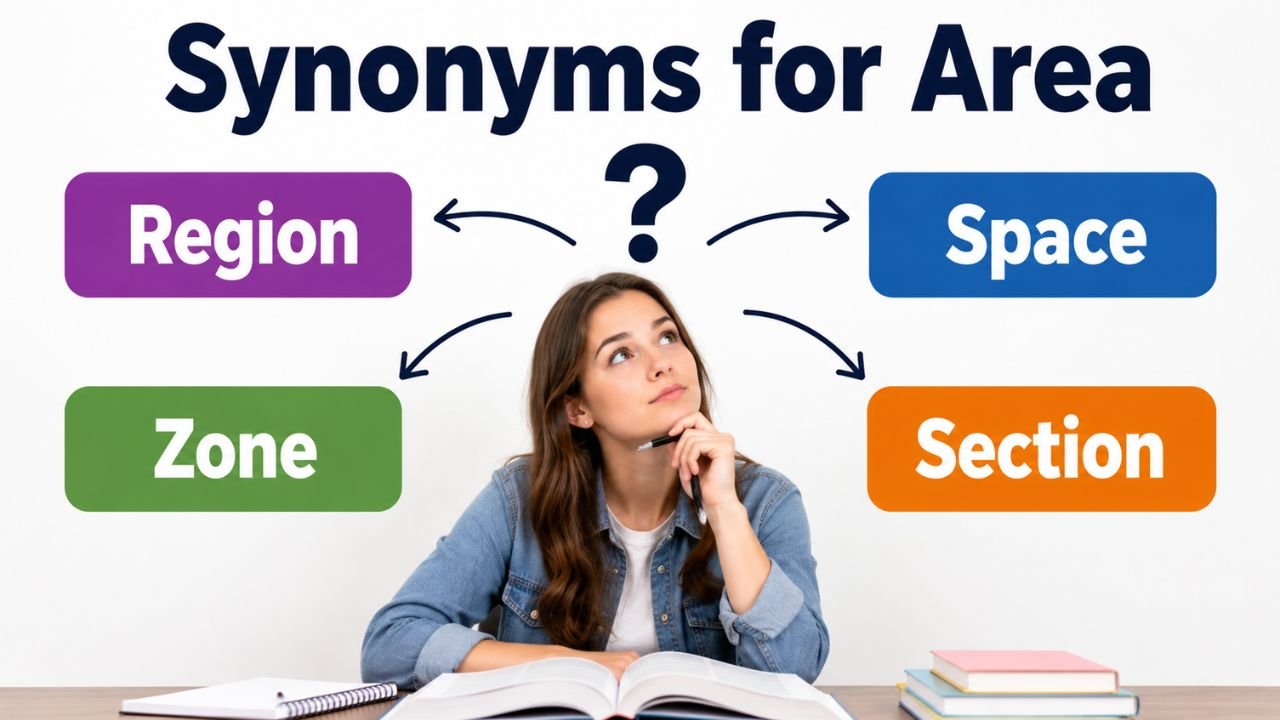
Quick Answer: The best synonyms for area include region, zone, district, territory, space, section, field, domain, site, and vicinity. Use region, district, or territory for a geographical place. Choose space or site for a physical location. Section and portion work for one part of something. Field, domain, and sphere are better for knowledge, work, or study. In formal reports, region, sector, domain, and jurisdiction sound precise. In casual conversation, place, space, neighborhood, and part sound more natural.
Pronunciation and Word Details
Word: Area.
Pronunciation: /ˈeə.ri.ə/
Part of Speech: Noun.
Meaning: An area is a particular place, space, region, subject, or part of something.
US Pronunciation:
UK Pronunciation:
What Does “Area” Mean?
Area means a particular place, space, region, subject, or part of something. It is mainly used as a countable noun, although it can also describe measured space in mathematical and technical contexts.
In geographical sentences, area refers to a place or region.
Example: This area receives heavy rainfall during the summer.
In descriptions of buildings or objects, it means a particular space or section.
Example: Please keep the entrance area clear.
In education and professional writing, area can mean a subject, field, or branch of knowledge.
Example: Language development is her main area of research.
In mathematics, area refers to the amount of surface contained within a shape or boundary.
Example: The students calculated the area of the rectangle.
The exact meaning becomes clear from the words around it. A residential area is a place where people live, while an area of expertise is a subject someone understands well.
Meaning, Tone, and Context of “Area”
Area is a neutral and flexible word. It is neither strongly formal nor strongly casual, so it works in conversation, essays, reports, instructions, academic writing, and technical explanations.
In everyday speech, area often describes a general place.
Example: Is there a quiet area where we can sit?
In formal geographical writing, region, district, sector, or territory may provide more detail than area.
Example: The northern region depends heavily on agriculture.
In professional communication, area may describe responsibility, performance, knowledge, or improvement.
Example: Customer service is one area that requires attention.
In academic writing, field, discipline, domain, and subject are often more precise when discussing knowledge or research.
Example: Her field of study is environmental science.
In technical language, area can refer to surface measurement, floor space, coverage, or physical extent. Writers should choose a more exact term when measurements or boundaries are important.
When and How to Use “Area”
For a Geographical Place
Use area when referring to a general location without giving exact administrative boundaries.
Example: The area is known for its fertile land and mild climate.
For a Physical Space
Use area for a particular space inside or outside a building.
Example: The waiting area has enough seats for twenty visitors.
For Part of an Object
Area can identify one part of an object, surface, image, or document.
Example: Apply the cream only to the affected area.
For a Subject of Study
Use area when talking about a topic, discipline, or branch of knowledge.
Example: Communication is an important area of language learning.
For Professional Responsibility
Area may describe a duty, department, skill, or responsibility.
Example: Financial planning is not part of my area of responsibility.
For Performance or Improvement
Area often appears in discussions about strengths, weaknesses, and progress.
Example: Time management is an area where he could improve.
For Mathematical Measurement
Use area for the amount of surface within a two dimensional shape.
Example: The area of the square is sixty four square meters.
For a Defined Zone
Area can refer to a place with a particular purpose or restriction.
Example: Visitors must remain outside the restricted area.
Best Synonyms for Area
Region: A broad geographical part of a country or the world.
Example: The coastal region attracts many visitors during the warmer months.
Zone: A place marked for a particular purpose, condition, or activity.
Example: The street is part of a pedestrian zone.
District: A defined part of a city, state, or administrative region.
Example: The business district becomes crowded every morning.
Territory: Land controlled, occupied, or claimed by a person, group, or government.
Example: The animals protect their territory from unfamiliar rivals.
Space: An available physical place or amount of room.
Example: There is enough space for another desk near the window.
Section: A distinct part of a larger place, object, or document.
Example: The children’s section is located at the back of the library.
Field: A subject of study, work, research, or professional activity.
Example: She has worked in the medical field for twelve years.
Domain: A particular area of knowledge, activity, authority, or influence.
Example: Data protection falls within the legal domain.
Site: A particular place where something exists, happens, or is built.
Example: Workers inspected the construction site before beginning the project.
Vicinity: The place or region close to a particular location.
Example: Several small shops are located in the vicinity of the station.
50 Synonyms for Area with Short Meanings
- Region: A broad geographical part of a larger place.
- Zone: A place defined by its purpose or conditions.
- District: An officially or commonly recognized part of a town or region.
- Territory: Land controlled, occupied, or claimed by someone.
- Locality: A particular place or small geographical region.
- Location: The exact or general position of something.
- Place: A particular point, position, or location.
- Site: A place where something exists, happens, or is built.
- Space: An available physical place or amount of room.
- Section: A distinct part of a larger whole.
- Sector: A particular division of a place, economy, or activity.
- Part: One piece or division of something larger.
- Portion: A limited part of a whole.
- Segment: A separate section of something.
- Division: A part created by separating a larger whole.
- Tract: A large continuous stretch of land.
- Patch: A small area that differs from its surroundings.
- Belt: A long narrow region with a particular feature.
- Quarter: A particular district or section of a town.
- Neighborhood: A local area where people live.
- Vicinity: The surrounding place close to a location.
- Surroundings: The places and conditions around something.
- Locale: A place where an event or activity occurs.
- Environment: The surrounding place and its conditions.
- Setting: The place or conditions in which something happens.
- Expanse: A wide and open area.
- Extent: The amount of space that something covers.
- Surface: The outer or upper area of something.
- Acreage: An area of land measured in acres.
- Ground: A particular piece or stretch of land.
- Land: A solid area of the earth’s surface.
- Plot: A small piece of land with defined boundaries.
- Parcel: A measured or officially divided piece of land.
- Lot: A piece of land intended for a particular use.
- Block: An area of buildings surrounded by streets.
- Field: An area of study, work, knowledge, or activity.
- Domain: An area of knowledge, influence, or responsibility.
- Sphere: A particular area of activity, interest, or influence.
- Realm: A field, subject, or area of experience.
- Discipline: An organized area of academic study.
- Subject: A topic or area being studied or discussed.
- Specialty: An area in which someone has expert knowledge.
- Department: An organized area of responsibility within an institution.
- Branch: A division of knowledge, work, or an organization.
- Aspect: A particular area or feature of a subject.
- Range: The complete area, variety, or extent covered.
- Scope: The area or limit of an activity or subject.
- Coverage: The amount of an area reached or included.
- Province: A particular area of knowledge or responsibility.
- Jurisdiction: An area controlled by a legal or official authority.
Read Also:
Synonyms for Pressure

Synonyms for Area by Context
When Area Means a Region or Place
Region, district, locality, territory, neighborhood, zone, and vicinity describe geographical places. They differ in size, boundaries, and purpose.
Region: Best for a broad geographical part of a country or continent.
Example: This region has a dry climate and rocky soil.
District: Best for a recognized part of a town or administrative system.
Example: The historic district contains several old buildings.
Locality: Best for a smaller or less formally defined place.
Example: The plant is common in this locality.
Neighborhood: Best for a residential community or nearby streets.
Example: Their neighborhood has a small public park.
Vicinity: Best for the space near a particular point.
Example: No parking is available in the immediate vicinity.
When Area Means Physical Space
Space, site, place, section, surface, ground, plot, and lot refer to physical locations or available room.
Space: Emphasizes room or capacity.
Example: We need more space for the new equipment.
Site: Identifies a location connected with an event, building, or activity.
Example: Engineers examined the site before approving construction.
Surface: Refers to the outer or upper part of an object.
Example: Clean the surface with a soft cloth.
Plot: Describes a small piece of land with boundaries.
Example: They purchased a plot for their new home.
When Area Means a Subject or Activity
Field, domain, discipline, sphere, realm, subject, and specialty describe knowledge, work, study, or influence.
Field: A common choice for professional work or research.
Example: She hopes to enter the field of education.
Domain: A formal word for an area of knowledge, authority, or activity.
Example: Privacy law belongs to a complex legal domain.
Discipline: An organized branch of academic study.
Example: Economics is a broad academic discipline.
Specialty: A subject in which someone has advanced skill or knowledge.
Example: Child development is his professional specialty.
When Area Means a Part or Section
Section, portion, segment, part, division, branch, and sector identify one piece of something larger.
Section: A clearly separated part.
Example: Read the final section of the report carefully.
Portion: A limited amount or part.
Example: A large portion of the garden receives direct sunlight.
Segment: A distinct part of a process, market, group, or object.
Example: This customer segment prefers affordable products.
Division: A major organizational or structural part.
Example: She manages the research division.
When Area Means Measurement or Extent
Surface, extent, acreage, scope, coverage, range, and expanse describe size, reach, or measurement.
Acreage: Used for land measured in acres.
Example: The farm has enough acreage for several crops.
Extent: Describes how much space something covers.
Example: The full extent of the damage was difficult to measure.
Coverage: Refers to the area reached by a service, signal, plan, or activity.
Example: The new system provides wider coverage.
Expanse: Describes a broad and often open space.
Example: An expanse of green fields surrounded the village.
Another Word for Area
Region is one of the best general replacements for area when discussing geography. However, the most accurate alternative depends on whether area refers to a location, available space, section, subject, measurement, or responsibility.
Original: Heavy rain is expected across the northern area.
Better Option: Heavy rain is expected across the northern region.
Original: This area of the office is reserved for meetings.
Better Option: This section of the office is reserved for meetings.
Original: Writing is her strongest area.
Better Option: Writing is her strongest field.
Original: There is not enough area for another table.
Better Option: There is not enough space for another table.
When Not to Use “Area”
Area is useful, but it can sound vague when a more precise word is available.
When Boundaries Are Official
Use district, zone, territory, or jurisdiction when the location has legal, political, or administrative boundaries.
Weak: The officer works in this area.
Better: The officer works within this jurisdiction.
When Discussing Academic Knowledge
Field, domain, subject, discipline, or specialty may sound clearer than area.
Weak: Biology is an interesting area.
Better: Biology is an interesting field of study.
When Describing Available Room
Space is usually more natural when discussing capacity.
Weak: There is no area for additional chairs.
Better: There is no space for additional chairs.
When Giving Exact Measurements
Use surface area, acreage, floor space, dimensions, or extent when precision matters.
Weak: The building has a large area.
Better: The building provides more than two thousand square meters of floor space.
When the Word Becomes Repetitive
Using area several times in one paragraph can make writing sound dull or unclear.
Weak: The area has a shopping area beside a residential area.
Better: The district has a shopping zone beside a residential neighborhood.
When Identifying a Specific Part
Use section, portion, segment, or part when discussing one division of a larger object.
Weak: The damaged area of the document must be rewritten.
Better: The damaged section of the document must be rewritten.
Words Commonly Confused With Area
Area vs Region: Area is a broad general word for any place or space. Region usually describes a larger geographical location with shared physical, cultural, or political features.
Area vs Space: Area can describe a place, subject, or measurement. Space mainly refers to available room, distance, or an empty physical location.
Area vs Place: Area often covers a wider or less exact location. Place usually refers to a particular point, building, or location.
Area vs Field: Area can describe both physical places and subjects. Field is more specific when discussing professional work, research, or academic study.
Area vs Zone: Area is neutral and general. Zone usually suggests defined boundaries, special rules, conditions, or functions.
Area vs District: Area may have no official limits. District often has recognized administrative, commercial, educational, or residential boundaries.
Area vs Territory: Area simply identifies a place. Territory often suggests ownership, control, occupation, or authority.
Area vs Site: Area can cover a broad location. Site identifies a specific place connected with construction, history, work, or an event.
Which Synonym Should You Choose?
Choose region when describing a broad geographical part of a country, continent, or landscape.
Choose district when referring to a recognized administrative, commercial, residential, or educational part of a town.
Choose zone when a place has defined rules, conditions, restrictions, or purposes.
Choose territory when control, ownership, occupation, or authority is important.
Choose space when discussing available room, capacity, or physical distance.
Choose section when identifying a distinct part of a building, object, document, or organization.
Choose site when referring to a specific location where an event, activity, or construction project occurs.
Choose field when writing about professional work, research, education, or knowledge.
Choose domain in formal writing about authority, expertise, knowledge, or influence.
Choose neighborhood in casual speech when describing a residential community.
Choose vicinity when referring to the place immediately surrounding a specific location.
Choose acreage, surface, extent, or floor space when discussing measurement.
Choose jurisdiction in legal or official writing about an authority’s geographical limits.
Choose sector in reports about the economy, business, government, or an organized part of a city.
Real Life Examples of “Area” in Sentences
Original: This area is famous for its mountain views.
Better Option: This region is famous for its mountain views.
Original: We need a larger area for the training session.
Better Option: We need a larger space for the training session.
Original: The children waited in the reception area.
Better Option: The children waited in the reception section.
Original: Technology is an area that changes quickly.
Better Option: Technology is a field that changes quickly.
Original: The police searched the surrounding area.
Better Option: The police searched the surrounding vicinity.
Original: This area of the report needs more evidence.
Better Option: This section of the report needs more evidence.
Original: The company wants to enter a new area of business.
Better Option: The company wants to enter a new business sector.
Original: The area near the river is at risk of flooding.
Better Option: The zone near the river is at risk of flooding.
Original: Marketing is outside my area of expertise.
Better Option: Marketing is outside my professional specialty.
Original: The damaged area covers most of the wall.
Better Option: The damaged portion covers most of the wall.
Synonym Groups and Usage Differences
Geographical Group
Region, district, zone, territory, locality, neighborhood, and vicinity describe physical locations. Region usually covers a large place, while neighborhood and vicinity describe smaller local spaces. District and zone often have clearer boundaries or purposes. Territory may involve ownership or authority.
Example: The northern region contains several protected zones and residential districts.
Physical Space Group
Space, site, place, surface, ground, plot, parcel, and lot describe physical positions or pieces of land. Space emphasizes capacity, while site points to a specific location. Plot, parcel, and lot usually describe land with defined boundaries.
Example: The site includes enough space for a building and a small parking lot.
Subject and Knowledge Group
Field, domain, sphere, realm, discipline, subject, and specialty describe areas of knowledge, work, or interest. Field is common in professional language. Discipline is academic, while specialty suggests advanced expertise.
Example: Her specialty belongs to the wider field of language education.
Part and Division Group
Section, portion, segment, division, branch, part, and sector describe pieces of a larger whole. Section and part are general. Segment is common in business and analysis. Branch and division frequently refer to organizations or knowledge.
Example: One division of the company serves the fastest growing market segment.
Measurement and Extent Group
Surface, acreage, extent, expanse, scope, range, and coverage describe size, reach, or limits. Surface and acreage relate closely to physical measurement. Scope describes the limits of a project or subject. Coverage shows how much territory or content is included.
Example: The report explains the scope and geographical coverage of the project.
Antonyms of Area
Area has several meanings, so it does not have one exact antonym. The best opposite depends on the sentence.
Whole: The complete object rather than one area or section.
Entirety: Everything included instead of a limited portion.
Point: One exact position rather than a broad area.
Center: The middle point rather than the surrounding region.
Outside: A place beyond a defined area or boundary.
Exterior: The outer part as opposed to an internal area.
Nowhere: No place, in contrast with a particular area or location.
Narrowness: Limited width or extent, in contrast with a broad expanse.
Unrelated Subject: A topic outside a particular area of study.
Foreign Territory: Land outside a person’s familiar or controlled area.
Comparison: Area vs Related Words
Area vs Region
Area is a general word for a location, space, subject, or section. Region usually refers to a broad geographical location with shared features.
Example With Area: The area around the school becomes busy in the afternoon.
Example With Region: The southern region produces most of the country’s fruit.
Area vs Zone
Area does not always have clear boundaries. Zone usually refers to a defined place with a particular rule, condition, or purpose.
Example With Area: Families often visit this area during the weekend.
Example With Zone: Vehicles are not permitted inside the pedestrian zone.
Area vs Space
Area can describe geography, knowledge, responsibility, or measurement. Space usually refers to available room or physical distance.
Example With Area: This area of research requires further investigation.
Example With Space: There is enough space beside the window for a chair.
Area vs Field
Area is broad and works in many contexts. Field is more specific for professional work, academic study, or research.
Example With Area: Public health is an important area of study.
Example With Field: She has extensive experience in the public health field.
Area vs Territory
Area simply refers to a place. Territory usually involves control, ownership, political boundaries, or animal behavior.
Example With Area: The hikers explored the wooded area.
Example With Territory: The birds defended their nesting territory.
Area vs Section
Area may describe any space or part. Section suggests a clearer division within something larger.
Example With Area: The damaged area should be cleaned carefully.
Example With Section: The final section of the guide explains the safety rules.
Area vs Site
Area can be broad or general. Site usually identifies one specific location where something exists, happened, or will be built.
Example With Area: Several ancient objects were found in the area.
Example With Site: Researchers protected the archaeological site.
Common Phrases and Expressions With Area
Local Area: The place close to where someone lives or works.
Surrounding Area: The region around a particular location.
Residential Area: A place mainly containing homes.
Urban Area: A developed place with a large population and many buildings.
Rural Area: A countryside location with fewer buildings and people.
Common Area: A shared space available to several people.
Surface Area: The total amount of exposed outer space on an object.
Floor Area: The amount of usable floor space inside a building.
Area of Expertise: A subject in which someone has advanced knowledge or skill.
Area of Concern: A subject, issue, or place that requires attention.
Common Mistakes to Avoid
Repeating Area Too Often
Frequent repetition can make writing vague and monotonous. Replace repeated uses with region, section, field, space, district, or another context appropriate word.
Weak: The area has a commercial area and a residential area.
Better: The district contains a commercial zone and a residential neighborhood.
Using Every Synonym Interchangeably
Region, site, territory, field, and space do not have identical meanings. Choose a synonym that matches the sentence.
Weak: Medicine is a large territory of study.
Better: Medicine is a broad field of study.
Using Area for an Exact Location
Area may be too general when readers need a precise point or address.
Weak: The meeting will take place somewhere in the central area.
Better: The meeting will take place at the conference site in the central district.
Using Area Instead of Space
When discussing room or capacity, space often sounds more natural.
Weak: We do not have enough area for the equipment.
Better: We do not have enough space for the equipment.
Using Area Instead of Field or Domain
For academic or professional subjects, field and domain are usually more specific.
Weak: Cybersecurity is a growing area of work.
Better: Cybersecurity is a growing professional field.
Writing Redundant Phrases
Avoid unnecessary expressions such as “the surrounding area around the building.” Surrounding already communicates the idea of being around something.
Weak: The surrounding area around the hospital was crowded.
Better: The area surrounding the hospital was crowded.
Ignoring Countable Noun Grammar
Area is usually countable when it means a place, subject, or section. Use an article or another determiner with the singular form.
Weak: This is important area of research.
Better: This is an important area of research.
Omitting Measurement Units
When area refers to size, include clear units whenever precision matters.
Weak: The room has an area of forty.
Better: The room has an area of forty square meters.
Conclusion
Choosing the right synonyms for area depends on the meaning you need. Use region, district, locality, or zone for geography. Choose space, site, section, or portion for a physical place or part. Use field, domain, sphere, or discipline for knowledge and work. For measurement, surface, extent, acreage, and floor space are more precise. Area remains a useful neutral word, but a specific synonym often makes descriptions clearer, stronger, and easier to understand in essays, reports, instructions, and everyday conversation.
FAQs About Synonyms for Area
What Is the Best Synonym for Area?
Region is a strong general synonym when area refers to a geographical place. Space, section, field, or domain may be better in other contexts.
What Is Another Word for a Geographical Area?
Region, district, zone, territory, locality, neighborhood, and vicinity can all describe a geographical area.
What Is Another Word for an Area of Study?
Field, discipline, subject, domain, branch, specialty, and sphere are suitable alternatives.
Is Space a Synonym for Area?
Yes. Space is a synonym when area means available room or a physical location. It does not usually replace area when discussing a subject or region.
What Is a Formal Synonym for Area?
Region, domain, sector, jurisdiction, territory, and locality are useful formal alternatives, depending on the context.
What Is the Difference Between Area and Region?
Area is a general word for a place, space, section, or subject. Region usually refers to a broad geographical location with shared features.
Can Area Mean a Subject?
Yes. Area can refer to a subject of study, work, research, interest, responsibility, or expertise.
