
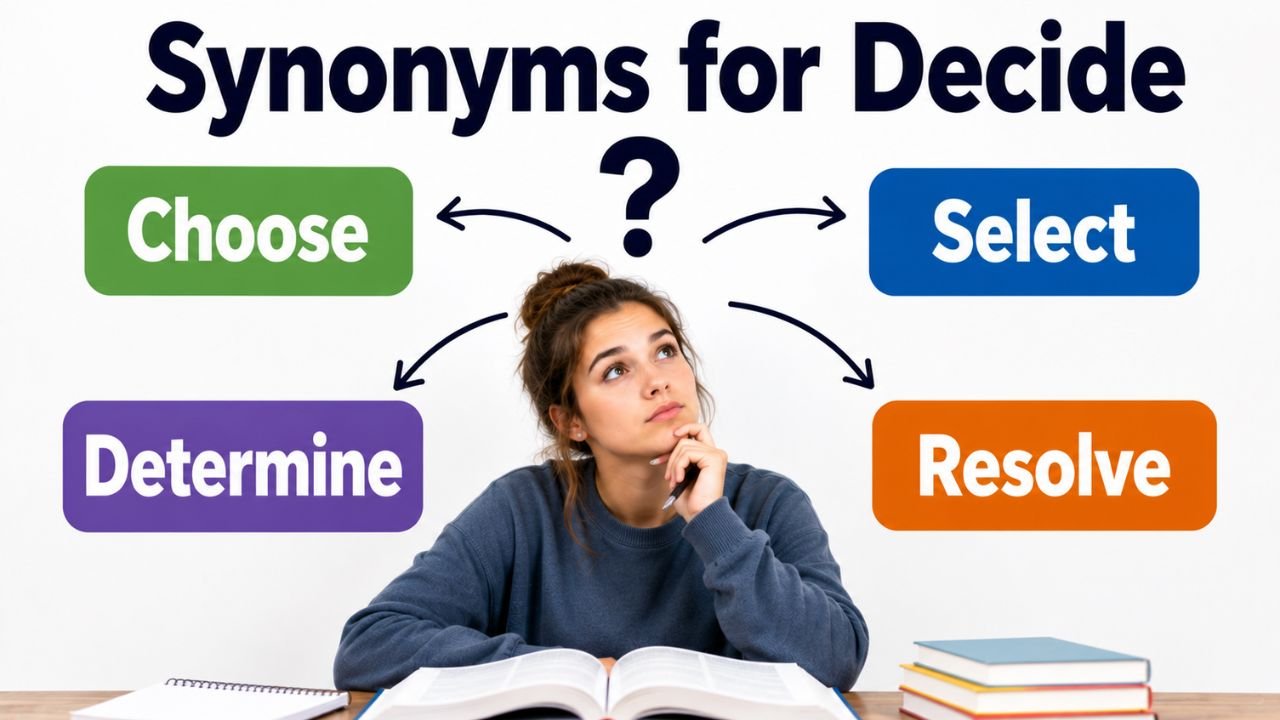
Quick Answer: The best synonyms for decide include choose, determine, resolve, settle, conclude, select, opt, judge, establish, and rule. Use choose or select when picking between options, determine in formal writing or when identifying an outcome, resolve when ending uncertainty or a problem, settle when reaching a final agreement, conclude when forming an opinion, and rule in legal contexts. The best synonym depends on whether you are expressing a personal choice, formal judgment, agreement, conclusion, or final result.
Pronunciation and Word Details
Word: Decide.
Pronunciation: /dɪˈsaɪd/.
Part of Speech: Verb.
Meaning: To make a choice, reach a conclusion, or determine the result of something.
US Pronunciation:
UK Pronunciation:
What Does “Decide” Mean?
Decide means to make a choice after considering different possibilities. It is a verb that can describe choosing an action, forming an opinion, settling a disagreement, or determining an outcome.
Someone can decide to do something.
Example: She decided to apply for the position.
A person can decide between two or more options.
Example: We need to decide between the blue curtains and the green ones.
A group can decide on a plan.
Example: The committee decided on a new meeting date.
A person in authority can decide a case or dispute.
Example: The judge will decide the case next week.
An event or action can also decide an outcome.
Example: The final goal decided the result of the match.
The meaning of decide changes slightly according to context. It may refer to a personal choice, an official judgment, a settled opinion, a final agreement, or the factor that determines what happens.
Meaning, Tone, and Context of “Decide”
Decide is a neutral and widely used verb. It is natural in casual conversation, formal writing, professional communication, academic discussion, reports, instructions, and legal contexts.
Neutral Tone: Decide usually sounds direct without being overly formal or emotional.
Example: We will decide after reviewing the information.
Conversational Context: People commonly use decide when discussing everyday plans, purchases, meals, travel, clothing, or personal choices.
Example: I cannot decide what to wear.
Formal Context: Decide can refer to an official conclusion, policy choice, or organizational action.
Example: The board will decide whether to approve the proposal.
Academic Context: The word may describe selecting a method, reaching a conclusion, or determining the importance of evidence.
Example: Researchers must decide which variables to examine.
Legal Context: Decide can mean to settle a case, issue a ruling, or determine which side is correct.
Example: The court will decide the dispute.
Emotional Context: Decide can suggest determination when someone finally overcomes uncertainty.
Example: He decided that fear would not control his choices.
Technical Context: In technical writing, determine may sometimes be more precise than decide, especially when a result follows from evidence, calculation, or testing.
When and How to Use “Decide”
For Making a Personal Choice
Use decide when someone selects an action after considering different possibilities.
Example: Maya decided to study at home.
For Choosing Between Options
Use decide when a person must select one option from two or more alternatives.
Example: We could not decide between the two apartments.
For Selecting a Plan
Use decide on when a person or group reaches agreement about a specific plan, date, design, or approach.
Example: They decided on a simple design for the room.
For Reaching a Conclusion
Use decide when someone forms an opinion after reviewing facts, experiences, or evidence.
Example: After reading both reports, she decided that the first proposal was stronger.
For Settling a Disagreement
Use decide when an authority, group, or process brings a dispute to an end.
Example: An independent panel will decide the matter.
For Determining an Outcome
Use decide when an action, event, or condition controls the final result.
Example: The last round may decide the winner.
For Making a Commitment
Use decide when someone moves from uncertainty to firm intention.
Example: He decided to complete the course.
For Giving an Official Judgment
Use decide in legal, organizational, or administrative contexts when someone has authority to make a binding choice.
Example: The committee will decide whether the request meets the rules.
Best Synonyms for Decide
Choose: To select one possibility from two or more options.
Example: You may choose whichever seat you prefer.
Determine: To establish something through thought, evidence, calculation, or authority.
Example: The investigation will determine what caused the problem.
Resolve: To make a firm decision or bring a problem to an end.
Example: She resolved to improve her writing skills.
Settle: To reach a final agreement or make a definite choice.
Example: We settled on a location near the city center.
Conclude: To form a final opinion after considering information.
Example: The researchers concluded that more testing was necessary.
Select: To carefully choose something from a group of possibilities.
Example: Participants may select one of the available topics.
Opt: To make a deliberate choice, usually between several possibilities.
Example: He opted to travel by train.
Judge: To form an opinion or make a decision after examining facts.
Example: It is difficult to judge which explanation is more convincing.
Establish: To determine or confirm a fact, rule, result, or arrangement.
Example: The tests established that the material was safe.
Rule: To make an official or legal decision.
Example: The court ruled that the evidence was insufficient.
50 Synonyms for Decide with Short Meanings
- Choose: To select one option from several possibilities.
- Determine: To establish an answer, result, or course of action.
- Resolve: To make a firm choice or settle a difficulty.
- Settle: To reach a final decision or agreement.
- Conclude: To form a judgment after considering information.
- Select: To carefully choose from a group of options.
- Opt: To deliberately choose a particular possibility.
- Judge: To form an opinion after examining facts.
- Establish: To confirm or determine something clearly.
- Rule: To make an official or legal judgment.
- Elect: To choose a person or course of action.
- Pick: To choose something, especially in casual speech.
- Fix: To determine a date, price, location, or arrangement.
- Designate: To officially select someone or something.
- Commit: To make a firm choice and accept responsibility for it.
- Agree: To reach the same decision with another person.
- Decree: To decide something through formal authority.
- Pronounce: To formally announce a judgment or decision.
- Adjudicate: To make an official judgment in a dispute.
- Arbitrate: To settle a disagreement between opposing sides.
- Finalize: To complete and confirm a choice or arrangement.
- Confirm: To approve or make a previous choice definite.
- Approve: To officially accept a proposal, action, or request.
- Authorize: To give formal permission for an action.
- Endorse: To express official support for a choice or proposal.
- Ratify: To formally confirm an agreement or decision.
- Choose Between: To select one of two or more alternatives.
- Make a Choice: To select an option after consideration.
- Make Up One’s Mind: To stop hesitating and reach a firm choice.
- Reach a Decision: To arrive at a final choice or judgment.
- Reach a Conclusion: To form a final opinion from available information.
- Come to a Conclusion: To develop a settled opinion after thought.
- Settle On: To choose something after considering alternatives.
- Opt For: To deliberately select a particular option.
- Select From: To choose an item from an available group.
- Settle the Matter: To bring uncertainty or disagreement to an end.
- Resolve the Issue: To find a final answer to a problem.
- Determine the Outcome: To control or establish the final result.
- Reach a Verdict: To make a formal judgment after reviewing evidence.
- Render a Judgment: To give an official decision.
- Pass Judgment: To form or announce a definite opinion.
- Form a Judgment: To develop an opinion after considering facts.
- Give a Ruling: To announce an official or legal decision.
- Make the Call: To take responsibility for a choice.
- Call the Shots: To control important choices or actions.
- Choose a Course: To select a particular plan or direction.
- Commit to a Plan: To firmly accept a specific course of action.
- Fix Upon: To choose something after careful thought.
- Settle Upon: To reach a definite choice after discussion.
- Come Down in Favor Of: To support one option after considering alternatives.
Read Also:
Synonyms for Vivid

Synonyms for Decide by Context
When Decide Means Choose
Use these alternatives when someone selects an option, object, person, activity, or direction.
Choose: The most natural general alternative for making a selection.
Example: She chose the earlier appointment.
Select: A slightly more formal word that suggests careful choice.
Example: Please select a suitable payment method.
Pick: A casual alternative commonly used in conversation.
Example: You can pick any book from the shelf.
Opt For: A deliberate choice between available alternatives.
Example: They opted for a smaller venue.
Elect: A formal word for choosing a person or deciding to follow a particular action.
Example: The patient elected to continue treatment.
When Decide Means Reach a Conclusion
Use these alternatives when someone forms an opinion after studying facts, evidence, or experience.
Conclude: To form a final opinion based on evidence or reasoning.
Example: The analyst concluded that demand was increasing.
Determine: To discover or establish an answer through investigation.
Example: The test will determine whether the system is working.
Judge: To evaluate information and form an opinion.
Example: Readers can judge which argument is more persuasive.
Establish: To prove or confirm something clearly.
Example: The inquiry established that no rule had been broken.
Form a Judgment: To develop a considered opinion.
Example: Review all the evidence before forming a judgment.
When Decide Means Settle a Problem
Use these alternatives when a decision brings uncertainty, conflict, or disagreement to an end.
Resolve: To settle a difficulty or make a firm decision.
Example: The discussion resolved the main disagreement.
Settle: To end uncertainty or reach a final agreement.
Example: The two sides settled the dispute peacefully.
Arbitrate: To settle a disagreement as an independent third party.
Example: A neutral expert was asked to arbitrate the dispute.
Adjudicate: To make a formal judgment about a legal or official matter.
Example: A tribunal will adjudicate the claim.
Settle the Matter: To bring a question or disagreement to a conclusion.
Example: The final report should settle the matter.
When Decide Means Make a Firm Commitment
Use these words when someone stops hesitating and accepts a definite plan.
Resolve: To make a strong personal commitment.
Example: She resolved to speak more confidently.
Commit: To firmly accept a plan or responsibility.
Example: He committed to finishing the project by Friday.
Make Up One’s Mind: To reach a decision after uncertainty.
Example: I finally made up my mind to move.
Choose a Course: To select a direction or strategy.
Example: The team must choose a course before the next meeting.
Finalize: To confirm the remaining details of a plan.
Example: We finalized the schedule yesterday.
When Decide Means Give an Official Judgment
Use these alternatives in legal, administrative, professional, or formal settings.
Rule: To issue an official judgment.
Example: The court ruled in favor of the applicant.
Decree: To order or determine something through authority.
Example: The council decreed that the property would remain protected.
Pronounce: To formally state a judgment.
Example: The panel pronounced the candidate qualified.
Adjudicate: To officially decide a dispute.
Example: The board will adjudicate the complaint.
Give a Ruling: To announce an official judgment.
Example: The chairperson gave a ruling on the disputed procedure.
When Decide Means Determine an Outcome
Use these alternatives when an event, fact, action, or condition controls the final result.
Determine: To control or establish what happens.
Example: Preparation may determine the success of the presentation.
Settle: To produce a final result.
Example: One final vote settled the contest.
Influence: To affect a result without controlling it completely.
Example: Cost may influence which option they choose.
Control: To have the strongest power over an outcome.
Example: Weather conditions could control when the work begins.
Determine the Outcome: To establish the final result of a situation.
Example: The final interview will determine the outcome.
Another Word for Decide
Choose is often the best general replacement for decide when someone selects between options. However, the best alternative depends on the sentence. Use determine for results or facts, resolve for firm commitments, settle for agreements, conclude for opinions, and rule for official legal judgments.
Original: We need to decide which color to use.
Better Option: We need to choose which color to use.
Original: The test will decide whether the machine is safe.
Better Option: The test will determine whether the machine is safe.
Original: She decided to exercise every morning.
Better Option: She resolved to exercise every morning.
Original: The judge will decide the dispute.
Better Option: The judge will rule on the dispute.
When Not to Use “Decide”
Decide is clear and flexible, but another word may be more accurate in technical, legal, academic, or highly specific contexts.
When Evidence Produces an Answer
Use determine when facts, testing, calculation, or investigation leads to a result.
Weak: The laboratory will decide the cause of the failure.
Better: The laboratory will determine the cause of the failure.
When Selecting One Item
Choose or select may sound clearer when the sentence focuses only on picking an option.
Weak: Decide one photograph for the cover.
Better: Select one photograph for the cover.
When Making a Legal Judgment
Use rule, adjudicate, or give a ruling when an authority makes a formal legal decision.
Weak: The court decided against the company.
Better: The court ruled against the company.
When Ending a Dispute
Use resolve or settle when the main meaning is bringing conflict to an end.
Weak: The meeting decided the disagreement.
Better: The meeting resolved the disagreement.
When Forming an Academic Conclusion
Use conclude when a writer reaches an opinion after examining evidence.
Weak: The researchers decided that the method was unreliable.
Better: The researchers concluded that the method was unreliable.
When the Word Becomes Repetitive
Using decide repeatedly can make writing sound plain and monotonous.
Weak: We decided to meet, decided on a location, and decided what to discuss.
Better: We agreed to meet, selected a location, and settled on the discussion topics.
When Responsibility Needs Emphasis
Use make the call when you want to emphasize that a person has authority or responsibility, especially in conversation.
Weak: The manager must decide.
Better: The manager must make the call.
Words Commonly Confused With Decide
Decide vs Choose: Decide emphasizes reaching a conclusion after thought. Choose focuses on selecting one possibility from several options.
Decide vs Determine: Decide usually involves human choice or judgment. Determine can mean discovering a fact or controlling a result.
Decide vs Resolve: Decide is neutral and general. Resolve often suggests firmness, determination, or the successful ending of a problem.
Decide vs Settle: Decide may refer to any choice. Settle suggests that uncertainty, discussion, or disagreement has ended.
Decide vs Conclude: Decide often leads to an action or selection. Conclude usually refers to an opinion reached from evidence or reasoning.
Decide vs Select: Decide describes the full process of reaching a choice. Select focuses on choosing a particular item or person.
Decide vs Opt: Decide is broad, while opt suggests a deliberate choice among available alternatives.
Decide vs Judge: Decide refers to reaching a choice or result. Judge emphasizes evaluating quality, facts, behavior, or evidence.
Decide vs Rule: Decide can be informal or formal. Rule specifically suggests an official judgment made by someone in authority.
Decide vs Agree: A person can decide alone, but agree normally involves two or more people reaching the same position.
Which Synonym Should You Choose?
Choose choose for everyday decisions involving two or more options.
Choose pick for relaxed and casual conversation.
Choose select for forms, menus, instructions, applications, and formal choices.
Choose opt for deliberate personal choices, especially when alternatives are clearly available.
Choose determine when discussing tests, research, causes, results, facts, or future outcomes.
Choose conclude in essays, reports, studies, and academic discussions based on evidence.
Choose resolve when expressing strong personal intention or ending a difficult problem.
Choose settle when reaching an agreement or making a final choice after discussion.
Choose agree when several people reach the same decision.
Choose rule for judgments made by a court, official, or authority.
Choose adjudicate for highly formal legal or administrative disputes.
Choose finalize when most of the decision has already been made and only confirmation remains.
Choose make up one’s mind in informal conversation when someone has stopped hesitating.
Choose make the call when responsibility for the final choice belongs to one person.
Choose approve when an authority accepts a proposal, request, or plan.
Choose authorize when someone officially gives permission for an action.
Real Life Examples of “Decide” in Sentences
Original: I need to decide which laptop suits my work.
Better Option: I need to choose which laptop suits my work.
Original: The team decided on a new project deadline.
Better Option: The team settled on a new project deadline.
Original: The test will decide whether the water is safe.
Better Option: The test will determine whether the water is safe.
Original: She decided to become more organized.
Better Option: She resolved to become more organized.
Original: The researchers decided that the first theory was incorrect.
Better Option: The researchers concluded that the first theory was incorrect.
Original: The court will decide the case next month.
Better Option: The court will rule on the case next month.
Original: We decided to use the simpler design.
Better Option: We opted for the simpler design.
Original: The committee will decide the successful applicant.
Better Option: The committee will select the successful applicant.
Original: One final question may decide the winner.
Better Option: One final question may determine the winner.
Original: They decided the disagreement through discussion.
Better Option: They resolved the disagreement through discussion.
Synonym Groups and Usage Differences
Choice Group
Choose, select, pick, opt, elect, and make a choice describe selecting one possibility from several alternatives.
Choose is the most general option. Select sounds more formal and careful. Pick is conversational, while opt often suggests a deliberate personal preference.
Example: After comparing the plans, they opted for the most affordable one.
Commitment Group
Resolve, commit, make up one’s mind, choose a course, and commit to a plan describe a firm intention to act.
Resolve suggests strong determination. Commit emphasizes responsibility, while make up one’s mind describes the end of hesitation.
Example: She resolved to continue despite the difficulty.
Conclusion Group
Conclude, determine, establish, judge, reach a conclusion, and form a judgment describe reaching an opinion through thought or evidence.
Conclude is especially useful in reports and essays. Determine often involves investigation, while judge emphasizes evaluation.
Example: The evidence led investigators to conclude that the damage was accidental.
Agreement Group
Agree, settle, settle on, settle upon, ratify, and finalize describe reaching or confirming a shared decision.
Agree focuses on shared understanding. Settle suggests that discussion has ended, while ratify gives an agreement formal approval.
Example: The group settled on a practical solution.
Legal Judgment Group
Rule, decree, pronounce, adjudicate, render a judgment, and give a ruling describe formal decisions made by authorities.
Rule is the most familiar legal term. Adjudicate is more technical, while decree emphasizes authority.
Example: The court ruled that the agreement remained valid.
Outcome Group
Determine, settle, control, determine the outcome, and decide the result describe factors that establish what finally happens.
Determine is usually the most natural alternative when evidence, performance, or circumstances produce a result.
Example: The quality of preparation may determine the outcome.
Approval Group
Approve, authorize, endorse, confirm, and ratify describe official acceptance of a proposal, request, agreement, or action.
Approve means to accept. Authorize gives permission, while ratify formally confirms an agreement that has already been made.
Example: The committee approved the revised plan.
Antonyms of Decide
The opposite of decide depends on whether the word refers to choosing, reaching certainty, making a commitment, or settling a matter.
Hesitate: To pause because of uncertainty.
Delay: To postpone making or carrying out a choice.
Defer: To move a decision to a later time.
Postpone: To arrange for consideration or action to happen later.
Waver: To move between different opinions or choices.
Vacillate: To repeatedly change between alternatives.
Doubt: To feel uncertain about what is true or best.
Question: To challenge or remain unsure about a conclusion.
Reconsider: To think again about a choice already made.
Avoid: To refuse to address or make a choice.
Suspend: To temporarily stop the decision process.
Remain Undecided: To continue without choosing an option.
Leave Open: To avoid reaching a final conclusion.
Reserve Judgment: To delay forming an opinion until more information is available.
Change One’s Mind: To replace a previous choice with a different one.
Comparison: Decide vs Related Words
Decide vs Choose
Decide emphasizes the process of reaching a conclusion. Choose focuses on selecting a particular option.
Example With Decide: We must decide what to do next.
Example With Choose: We must choose one of these three plans.
Decide vs Determine
Decide usually involves choice or judgment. Determine often involves facts, evidence, testing, or causes.
Example With Decide: The family will decide where to travel.
Example With Determine: The inspection will determine whether repairs are needed.
Decide vs Resolve
Decide is a general word for reaching a choice. Resolve suggests firmness or the successful ending of a problem.
Example With Decide: She decided to change her routine.
Example With Resolve: She resolved to follow her routine consistently.
Decide vs Settle
Decide can refer to any choice. Settle often suggests that uncertainty or disagreement has ended.
Example With Decide: They decided where to eat.
Example With Settle: They settled on a quiet restaurant near the station.
Decide vs Conclude
Decide often concerns an action or choice. Conclude refers to an opinion formed from information.
Example With Decide: We decided to cancel the meeting.
Example With Conclude: We concluded that the meeting was unnecessary.
Decide vs Select
Decide describes reaching a choice. Select focuses on carefully choosing one item, person, or option.
Example With Decide: You must decide which course interests you.
Example With Select: Please select one course from the list.
Decide vs Opt
Decide is broad and neutral. Opt commonly introduces the chosen action with for or to.
Example With Decide: He decided to remain at home.
Example With Opt: He opted to remain at home.
Decide vs Judge
Decide focuses on reaching a result. Judge focuses on evaluating information, quality, behavior, or evidence.
Example With Decide: The panel will decide who receives the award.
Example With Judge: The panel will judge each entry on originality.
Decide vs Rule
Decide can be used in ordinary or official situations. Rule refers specifically to an authoritative judgment.
Example With Decide: The manager decided that the request was reasonable.
Example With Rule: The court ruled that the request was legally valid.
Decide vs Agree
One person can decide independently. Agree normally means that multiple people share the same view or choice.
Example With Decide: I decided to start earlier.
Example With Agree: We agreed to start earlier.
Common Phrases and Expressions With “Decide”
Decide On: To choose a particular person, object, plan, or arrangement.
Example: We decided on a date for the event.
Decide Between: To choose one of two or more alternatives.
Example: She could not decide between the two dresses.
Decide Against: To choose not to do or accept something.
Example: They decided against moving during the winter.
Decide in Favor Of: To choose or judge that one side or option should succeed.
Example: The panel decided in favor of the second proposal.
Decide to Act: To make a firm choice to take action.
Example: He decided to act before the problem became worse.
Decide Whether: To determine if something should or should not happen.
Example: We must decide whether to continue.
Decide for Yourself: To form your own opinion or choice.
Example: Read both arguments and decide for yourself.
Decide Once and for All: To settle an issue permanently.
Example: We need to decide once and for all where the equipment belongs.
Decide the Outcome: To determine the final result.
Example: The final presentation could decide the outcome.
Decide a Case: To make an official legal judgment.
Example: A senior judge will decide the case.
Common Mistakes to Avoid
Using Decide Without the Correct Structure
Decide commonly appears with to, on, between, against, that, or whether.
Incorrect: She decided buying the larger table.
Correct: She decided to buy the larger table.
Confusing Decide On and Decide To
Use decide on before a noun or noun phrase. Use decide to before a verb.
Incorrect: We decided to the blue design.
Correct: We decided on the blue design.
Incorrect: We decided on leave early.
Correct: We decided to leave early.
Using Decide About When Decide On Is Clearer
Decide about is possible, but decide on often sounds more natural when a specific choice is made.
Less Natural: We decided about the meeting date.
Better: We decided on the meeting date.
Using Decide Instead of Determine
Use determine when facts, testing, or calculations establish an answer.
Incorrect: The scan will decide the cause of the pain.
Correct: The scan will determine the cause of the pain.
Using Decide Instead of Conclude
Use conclude when discussing an opinion reached through evidence in formal writing.
Less Precise: The report decided that the policy was ineffective.
Better: The report concluded that the policy was ineffective.
Using Decide Instead of Resolve
Resolve is usually better when the meaning involves ending a dispute or problem.
Less Precise: The conversation decided the conflict.
Better: The conversation resolved the conflict.
Repeating Decide Too Often
Replace repeated uses with choose, settle, conclude, determine, or agree when appropriate.
Repetitive: We decided to meet and decided on a place before deciding what to discuss.
Improved: We agreed to meet, selected a place, and settled on several discussion topics.
Choosing an Overly Formal Synonym
Words such as adjudicate and ratify are not natural replacements in ordinary conversation.
Unnatural: I adjudicated which sandwich to order.
Natural: I chose which sandwich to order.
Confusing Decide With Decision
Decide is a verb, while decision is a noun.
Incorrect: She made a decide quickly.
Correct: She made a decision quickly.
Correct: She decided quickly.
Using Both Decide and Make a Decision Unnecessarily
Avoid repeating the same idea in one clause.
Wordy: We decided to make a decision before Friday.
Better: We decided before Friday.
Better: We agreed to make a final choice before Friday.
Conclusion
The most useful synonyms for decide include choose, determine, resolve, settle, conclude, select, opt, judge, establish, and rule. Choose works best for everyday options, determine for facts and outcomes, resolve for firm intentions or problems, settle for agreements, and conclude for evidence based opinions. In formal legal contexts, rule or adjudicate may be more precise. Understanding the differences among synonyms for decide helps you express personal choices, professional judgments, conclusions, and official decisions with greater clarity.
FAQs About Synonyms for Decide
What Is the Best Synonym for Decide?
Choose is the best general synonym when selecting between options. Determine, resolve, settle, and conclude are better in more specific contexts.
What Is Another Word for Decide in Formal Writing?
Determine, conclude, resolve, establish, select, and adjudicate are useful formal alternatives depending on the meaning.
What Is a Casual Synonym for Decide?
Choose, pick, make up your mind, and make the call are natural choices in casual conversation.
What Is the Difference Between Decide and Choose?
Decide emphasizes reaching a conclusion, while choose emphasizes selecting one option from several possibilities.
What Is a Synonym for Decide on a Plan?
Settle on, agree on, select, finalize, and commit to are useful alternatives for deciding on a plan.
What Is a Synonym for Decide a Legal Case?
Rule, adjudicate, render a judgment, reach a verdict, and give a ruling are appropriate legal alternatives.
Can Determine Replace Decide?
Determine can replace decide when facts, evidence, tests, or events establish an answer or outcome. It is less natural for simple personal choices.
