
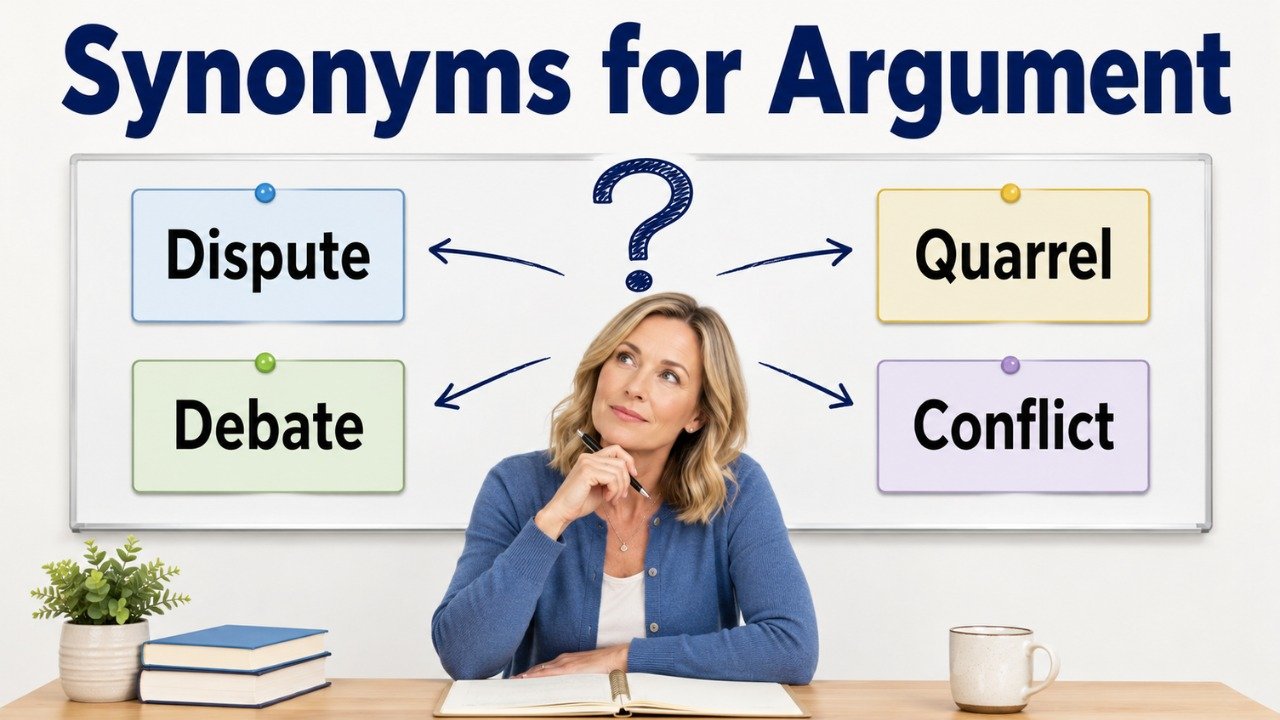
Quick Answer: The best synonyms for argument include disagreement, dispute, quarrel, debate, conflict, claim, case, reasoning, position, and contention. Use disagreement for a general difference of opinion, dispute for a serious or continuing disagreement, quarrel for an emotional personal conflict, and debate for an organized exchange of views. In formal or academic writing, case, reasoning, position, and contention describe a supported idea rather than a verbal fight.
Pronunciation and Word Details
Word: Argument.
Pronunciation: /ˈɑːrɡjəmənt/
Part of Speech: Noun.
Meaning: A disagreement between people or a set of reasons used to support an opinion or conclusion.
US Pronunciation:
UK Pronunciation:
What Does “Argument” Mean?
Argument means a disagreement between people or a set of reasons presented to support a particular opinion, claim, or decision.
As a noun, argument has two main uses. In everyday conversation, it often describes an angry or serious disagreement.
Example: The neighbors had an argument about the noise.
In formal, academic, legal, and professional contexts, argument refers to a reasoned position supported by facts, examples, or evidence.
Example: Her argument for changing the policy was convincing.
The word can also describe the central idea of an essay, speech, presentation, or discussion.
Example: The main argument of the essay is that public spaces improve community life.
In technical language, an argument can be a value provided to a function or command. This meaning is different from disagreement and logical reasoning.
Meaning, Tone, and Context of “Argument”
Argument can sound neutral, formal, academic, emotional, or confrontational depending on the context.
When it refers to a difference of opinion, argument often has a negative or emotional tone. It may suggest raised voices, frustration, blame, or tension.
Example: Their argument became louder as the evening continued.
When argument refers to reasoning, it usually has a neutral or formal tone. In essays, reports, speeches, and professional discussions, an argument is a position supported by reasons.
Example: The report presents a strong argument for improving workplace safety.
Argument is common in several contexts.
Conversational Context: A disagreement between friends, relatives, coworkers, or neighbors.
Academic Context: A central claim supported by reasoning and evidence.
Legal Context: A position presented to persuade a judge, court, or decision maker.
Professional Context: A reasoned case for a plan, policy, proposal, or change.
Technical Context: A value supplied to a function, instruction, or command.
Because the word has several meanings, the most accurate synonym depends on whether the writer means disagreement, conflict, discussion, reasoning, or a supported claim.
When and How to Use “Argument”
For a General Disagreement
Use argument when two or more people strongly disagree about an issue.
Example: We had an argument about how the project should be managed.
For a Personal Conflict
Use argument when a disagreement becomes emotional or affects a relationship.
Example: Their argument started over a small misunderstanding.
For an Academic Claim
Use argument when describing the main position of an essay, paper, or presentation.
Example: The writer develops an argument about the importance of early education.
For Persuasion
Use argument when someone gives reasons intended to influence another person.
Example: She made a persuasive argument for extending the deadline.
For Formal Debate
Use argument when a speaker presents a structured position during a formal exchange of ideas.
Example: Each participant was given time to explain an argument.
For Legal Reasoning
Use argument for a position presented during a legal proceeding.
Example: The lawyer prepared an argument based on the available records.
For Supporting a Decision
Use argument when explaining why a particular action, plan, or choice is reasonable.
Example: There is a strong argument for investing in staff training.
For Technical Instructions
Use argument when referring to a value supplied to a function or command.
Example: The function requires a number as its first argument.
Best Synonyms for Argument
Disagreement
Synonym: Disagreement.
Meaning: A situation in which people have different opinions.
Example: The meeting ended with a disagreement about the budget.
Dispute
Synonym: Dispute.
Meaning: A serious disagreement that may continue for some time.
Example: The two companies resolved their dispute through negotiation.
Quarrel
Synonym: Quarrel.
Meaning: An emotional or angry disagreement, often between people who know each other.
Example: The brothers had a quarrel over the family property.
Debate
Synonym: Debate.
Meaning: A structured discussion in which different opinions are presented.
Example: The proposal created a lively debate among the committee members.
Conflict
Synonym: Conflict.
Meaning: A serious difference between people, ideas, goals, or interests.
Example: A conflict developed between the two departments.
Claim
Synonym: Claim.
Meaning: A statement that someone presents as true.
Example: The researcher supported her claim with detailed results.
Case
Synonym: Case.
Meaning: A collection of reasons used to support a position or decision.
Example: He made a strong case for increasing the training budget.
Reasoning
Synonym: Reasoning.
Meaning: The logical process used to reach or support a conclusion.
Example: The conclusion was based on careful reasoning.
Position
Synonym: Position.
Meaning: A particular opinion or attitude about an issue.
Example: The speaker clearly explained her position on the proposal.
Contention
Synonym: Contention.
Meaning: A formal claim or opinion presented as part of an argument.
Example: His main contention was that the rule created unnecessary delays.
50 Synonyms for Argument with Short Meanings
- Disagreement: A difference of opinion.
- Dispute: A serious or continuing disagreement.
- Quarrel: An emotional personal disagreement.
- Conflict: A serious clash of views or interests.
- Clash: A direct and forceful disagreement.
- Altercation: A loud or angry verbal conflict.
- Row: A noisy and emotional argument.
- Squabble: A minor argument over something unimportant.
- Spat: A brief and usually minor quarrel.
- Debate: A structured exchange of opposing opinions.
- Controversy: Public disagreement about an important issue.
- Confrontation: A direct and tense disagreement.
- Dissension: Serious disagreement within a group.
- Discord: A lack of agreement or harmony.
- Friction: Tension caused by differences between people.
- Feud: A long and bitter conflict.
- Wrangle: A prolonged and complicated dispute.
- Bickering: Repeated arguing about small matters.
- Difference: A point on which people do not agree.
- Contention: A disputed claim or formal position.
- Exchange: A verbal interaction that may involve opposing views.
- Discussion: A conversation about different ideas or opinions.
- Claim: A statement presented as true.
- Case: A set of reasons supporting a position.
- Reasoning: Logical thought used to support a conclusion.
- Rationale: The main reason behind a belief or decision.
- Position: A particular opinion on an issue.
- Point: An idea presented for consideration.
- Viewpoint: A personal way of seeing an issue.
- Thesis: The central claim of an essay or study.
- Proposition: A formal idea offered for discussion.
- Assertion: A confident statement of belief or fact.
- Premise: A statement on which reasoning is based.
- Logic: A clear system of valid reasoning.
- Justification: A reason that explains or defends something.
- Explanation: A statement that makes a reason or idea clear.
- Reason: A fact or idea supporting a conclusion.
- Plea: An urgent or formal appeal.
- Submission: A formal position presented for consideration.
- Defense: Reasons given to support or protect a position.
- Rebuttal: A response intended to challenge another argument.
- Counterargument: An argument presented against another claim.
- Line of Reasoning: A connected series of supporting ideas.
- Train of Thought: A sequence of connected thoughts or ideas.
- Interpretation: A particular explanation of meaning or events.
- Perspective: A way of understanding or viewing an issue.
- Analysis: A careful examination used to reach a conclusion.
- Advocacy: Public support for a particular position or cause.
- Standpoint: A position from which an issue is considered.
- Grounds: Reasons or facts supporting a claim or decision.
Read Also:
Synonyms for Worried

Synonyms for Argument by Context
When Argument Means a Disagreement
Disagreement is the broadest and most neutral synonym. It shows that people hold different opinions without necessarily suggesting anger.
Dispute is stronger and often describes a disagreement that continues over time.
Difference is softer and works well in polite or professional communication.
Example: The managers had a disagreement about the new schedule.
Example: The disagreement developed into a formal dispute.
Example: They recognized their difference of opinion without becoming hostile.
When Argument Means an Angry Conflict
Quarrel, altercation, row, clash, and confrontation describe more emotional disagreements.
Quarrel is common for personal relationships. Altercation suggests anger and may involve threatening behavior. Row is informal and describes a noisy argument. Confrontation emphasizes direct tension.
Example: The couple had a quarrel about their travel plans.
Example: A verbal altercation occurred near the entrance.
Example: The meeting ended in a tense confrontation.
When Argument Means a Minor Disagreement
Squabble, spat, and bickering describe smaller or less serious conflicts.
A squabble is usually about something unimportant. A spat is brief. Bickering describes repeated small arguments.
Example: The children had a squabble over the last piece of cake.
Example: Their spat ended after a few minutes.
Example: Constant bickering made the journey unpleasant.
When Argument Means a Formal Discussion
Debate, discussion, exchange, and controversy are useful when different views are being examined rather than expressed through anger.
Debate suggests opposing sides and organized reasoning. Discussion is more cooperative. Controversy describes broad or public disagreement.
Example: The issue inspired a thoughtful debate.
Example: The team held a discussion about possible solutions.
Example: The decision created considerable controversy.
When Argument Means a Supported Claim
Claim, case, contention, position, thesis, and proposition describe ideas that someone is trying to establish or defend.
Claim is a statement presented as true. Case is a complete set of supporting reasons. Thesis is the central idea of an essay. Contention is formal and often used in academic or legal writing.
Example: The author supports the claim with several examples.
Example: The report makes a convincing case for reform.
Example: Her central contention is clearly stated in the introduction.
When Argument Means Logical Support
Reasoning, logic, rationale, justification, grounds, and line of reasoning focus on how an idea is supported.
Reasoning describes the thought process. Rationale explains the purpose behind a decision. Justification defends an action or belief. Grounds are the facts or reasons on which a conclusion is based.
Example: The conclusion follows from sound reasoning.
Example: The manager explained the rationale for the change.
Example: There were reasonable grounds for reviewing the decision.
Another Word for Argument
Disagreement is the best general replacement when argument refers to people holding different opinions. However, the best alternative depends on the intended meaning.
Use dispute for a serious continuing disagreement, quarrel for an emotional personal conflict, debate for an organized exchange of views, and case for a set of reasons supporting a position.
Original: We had an argument about the schedule.
Better Option: We had a disagreement about the schedule.
Original: The two organizations remain involved in an argument over ownership.
Better Option: The two organizations remain involved in a dispute over ownership.
Original: The article presents an argument for improving public transport.
Better Option: The article presents a case for improving public transport.
Original: The students listened to both sides of the argument.
Better Option: The students listened to both sides of the debate.
When Not to Use “Argument”
Avoid argument when a more precise word can show the seriousness, tone, or purpose of the situation.
When the Conversation Was Calm
Argument may sound too negative when people simply discussed different views.
Weak: We had an argument about which design was more practical.
Better: We had a discussion about which design was more practical.
When the Disagreement Was Minor
Argument may sound too serious for a brief or unimportant difference.
Weak: The children had an argument over a pencil.
Better: The children had a squabble over a pencil.
When the Conflict Was Serious and Continuing
Argument may sound too general when describing a long legal, political, or business disagreement.
Weak: The two groups are involved in an argument over access to the land.
Better: The two groups are involved in a dispute over access to the land.
When Writing an Academic Paper
Argument can become repetitive when it appears several times in one paragraph. Use claim, thesis, position, reasoning, or case when those words express the meaning more clearly.
Weak: The writer introduces an argument and supports the argument with several arguments.
Better: The writer introduces a claim and supports the position with several reasons.
When Referring Only to Supporting Information
Evidence and argument are not the same. Evidence supports an argument, while the argument explains what the evidence is meant to prove.
Weak: The survey results are the writer’s argument.
Better: The survey results are evidence supporting the writer’s argument.
When the Conflict Became Aggressive
Argument may be too mild for an intense or threatening incident.
Weak: A serious argument occurred outside the building.
Better: A serious confrontation occurred outside the building.
Words Commonly Confused With Argument
Argument vs Disagreement: A disagreement is any difference of opinion. An argument may be a disagreement, but it can also mean a supported claim.
Argument vs Debate: An argument can be emotional or logical. A debate is usually an organized exchange in which different sides present reasons.
Argument vs Quarrel: Argument is a broad word. Quarrel usually refers to a personal and emotional conflict.
Argument vs Discussion: A discussion is generally cooperative and calm. An argument often suggests opposition, tension, or persuasion.
Argument vs Claim: A claim is a statement presented as true. An argument contains reasons intended to support that claim.
Argument vs Evidence: An argument is the conclusion or position being defended. Evidence consists of facts, observations, or examples used to support it.
Argument vs Reasoning: Reasoning is the process of connecting ideas logically. An argument is the position and supporting reasons produced through that process.
Argument vs Opinion: An opinion is a personal belief. An argument attempts to support a belief with reasons or evidence.
Argument vs Controversy: An argument may occur between a small number of people. A controversy is usually a broader public disagreement.
Argument vs Parameter: In technical usage, an argument is the actual value supplied to a function. A parameter is the named variable that receives that value.
Which Synonym Should You Choose?
Choose disagreement for a neutral difference of opinion in everyday or professional communication.
Choose dispute for a serious disagreement involving rules, ownership, money, responsibility, or rights.
Choose quarrel for an emotional disagreement between friends, relatives, partners, or other people with a personal relationship.
Choose spat for a brief and relatively minor personal argument.
Choose squabble when people argue about something small or unimportant.
Choose altercation for a loud, angry, or potentially aggressive verbal conflict.
Choose conflict when goals, needs, interests, or beliefs are incompatible.
Choose debate for an organized discussion in which opposing views are examined.
Choose controversy for a subject that creates broad public disagreement.
Choose claim for a statement that needs to be proved or supported.
Choose thesis for the central argument of an essay, paper, or study.
Choose case when presenting several reasons for a decision, proposal, or position.
Choose contention for formal essays, reports, legal writing, and serious analysis.
Choose reasoning when focusing on the logical process behind a conclusion.
Choose rationale when explaining why a decision, policy, or action was chosen.
Choose justification when defending a choice, action, or belief.
Choose position or standpoint when describing someone’s view on a subject.
Choose counterargument when presenting a reasoned response against another position.
Choose discussion in emails or workplace communication when you want a calm and cooperative tone.
Real Life Examples of “Argument” in Sentences
Original: I had an argument with my sister about the guest list.
Better Option: I had a quarrel with my sister about the guest list.
Original: The departments are having an argument about funding.
Better Option: The departments are having a dispute about funding.
Original: The students presented an argument about school uniforms.
Better Option: The students presented a debate about school uniforms.
Original: His argument was that the plan would save time.
Better Option: His claim was that the plan would save time.
Original: The report gives a strong argument for additional training.
Better Option: The report makes a strong case for additional training.
Original: Their argument continued throughout the meeting.
Better Option: Their disagreement continued throughout the meeting.
Original: The main argument of the essay appears in the introduction.
Better Option: The main thesis of the essay appears in the introduction.
Original: Her argument was based on careful research.
Better Option: Her reasoning was based on careful research.
Original: A small argument developed over who should sit near the window.
Better Option: A small squabble developed over who should sit near the window.
Original: The speaker responded to the opposing argument.
Better Option: The speaker responded to the opposing contention.
Synonym Groups and Usage Differences
General Disagreement Group
Disagreement, difference, dispute, and contention describe situations in which people do not share the same opinion.
Disagreement is the most neutral. Difference is softer and more polite. Dispute is stronger and may involve an unresolved issue. Contention is more formal.
Example: A disagreement arose about how the work should be divided.
Emotional Conflict Group
Quarrel, row, altercation, confrontation, and clash suggest emotional tension.
Quarrel is personal. Row is informal and noisy. Altercation suggests anger. Confrontation emphasizes direct opposition. Clash may involve strong personalities, beliefs, or interests.
Example: Their conversation became a heated confrontation.
Minor Conflict Group
Squabble, spat, and bickering describe less serious arguments.
Squabble often concerns something trivial. Spat is brief. Bickering is repeated and irritating.
Example: The roommates were bickering about household chores.
Formal Discussion Group
Debate, discussion, exchange, and controversy involve the communication of different views.
Discussion is usually cooperative. Debate presents opposing sides. Exchange is neutral and focuses on communication. Controversy suggests widespread disagreement.
Example: The proposal led to a detailed debate.
Academic Claim Group
Claim, thesis, proposition, assertion, contention, and position describe ideas presented for acceptance.
A claim needs support. A thesis is the central claim of an academic text. A proposition is offered for consideration. An assertion is stated confidently. A position is a person’s overall view.
Example: The paper’s thesis is supported by clear examples.
Supporting Reason Group
Reasoning, rationale, logic, justification, grounds, and line of reasoning describe the support behind a conclusion.
Reasoning explains the thought process. Logic focuses on valid connections. Rationale explains purpose. Justification defends a choice. Grounds provide a factual basis.
Example: The recommendation is supported by sound reasoning.
Response Group
Rebuttal, counterargument, defense, and plea describe arguments made in response to another position or situation.
A rebuttal challenges a claim. A counterargument presents an opposing case. A defense protects a position. A plea is a serious or emotional appeal.
Example: The writer includes a counterargument before presenting the final conclusion.
Antonyms of Argument
The antonym of argument depends on whether the word means disagreement or a reasoned claim.
Agreement: A shared opinion or decision.
Accord: A formal or friendly state of agreement.
Consensus: General agreement within a group.
Harmony: A peaceful relationship without serious conflict.
Peace: A condition without fighting or hostility.
Unity: A state of being joined in purpose or opinion.
Unanimity: Complete agreement among everyone involved.
Acceptance: Willingness to recognize or approve a position.
Concession: Acceptance that another person’s point is correct.
Compliance: Agreement to follow a rule, request, or decision.
Cooperation: People working together toward a shared goal.
Reconciliation: The restoration of a friendly relationship after conflict.
Comparison: Argument vs Related Words
Argument vs Disagreement
A disagreement is simply a difference of opinion. An argument may involve a disagreement, but it may also refer to formal reasoning.
Example With Argument: The author presents an argument for changing the law.
Example With Disagreement: The committee members had a disagreement about the deadline.
Argument vs Debate
An argument may be emotional, informal, or one sided. A debate is usually structured and allows opposing positions to be presented.
Example With Argument: The neighbors had an argument about the fence.
Example With Debate: The candidates participated in a debate about education.
Argument vs Quarrel
Argument is a general term for disagreement. Quarrel usually describes an emotional conflict between people who know each other.
Example With Argument: We had an argument about the cost.
Example With Quarrel: The friends had a quarrel over a broken promise.
Argument vs Conflict
An argument is usually expressed through words. A conflict can involve opposing goals, interests, duties, or actions even when no verbal argument occurs.
Example With Argument: The employees had an argument about the schedule.
Example With Conflict: The schedule created a conflict between work and family responsibilities.
Argument vs Claim
A claim is the statement a person wants others to accept. An argument consists of the reasons used to support that statement.
Example With Argument: The essay develops an argument about equal access to education.
Example With Claim: The essay makes the claim that education should be accessible to everyone.
Argument vs Reasoning
An argument is the position being presented. Reasoning is the logical process that connects the supporting ideas.
Example With Argument: Her argument supports a change in policy.
Example With Reasoning: Her reasoning explains why the change is necessary.
Argument vs Discussion
An argument suggests opposition or persuasion. A discussion is usually calmer and may involve people working together to understand a topic.
Example With Argument: The meeting turned into an argument about responsibility.
Example With Discussion: The meeting included a productive discussion about responsibility.
Argument vs Contention
Argument is common in both everyday and formal language. Contention is more formal and usually refers to a specific claim that someone is defending.
Example With Argument: His argument focused on the cost of the plan.
Example With Contention: His central contention was that the plan would cost too much.
Common Phrases and Expressions With “Argument”
Have an Argument: To become involved in a disagreement.
Get Into an Argument: To begin arguing with another person.
Heated Argument: An intense disagreement involving strong emotion.
Strong Argument: A position supported by convincing reasons.
Weak Argument: A position that lacks sufficient logic or support.
Main Argument: The central claim in a speech, essay, or discussion.
Make an Argument: To present reasons supporting a position.
Argument in Favor of: A set of reasons supporting an idea or proposal.
Argument Against: A set of reasons opposing an idea or proposal.
Settle an Argument: To resolve a disagreement or determine which position is correct.
Common Mistakes to Avoid
Using Argument for Every Difference of Opinion
Not every difference is an argument. Discussion, disagreement, debate, and difference may create a more accurate tone.
Incorrect: We had a friendly argument about possible designs.
Improved: We had a friendly discussion about possible designs.
Confusing an Argument With Evidence
An argument is a conclusion supported by reasons. Evidence is the information used to strengthen that conclusion.
Incorrect: The statistics are the main argument.
Improved: The statistics support the main argument.
Repeating Argument Too Often
Repeated use can make writing sound dull or unclear. Replace it with claim, case, position, reasoning, thesis, or contention when appropriate.
Repetitive: The argument begins with a claim, and the argument supports another argument.
Improved: The discussion begins with a claim, and the reasoning supports the central position.
Choosing a Synonym With the Wrong Intensity
Quarrel, altercation, confrontation, and feud are stronger than disagreement. Squabble and spat are usually less serious.
Incorrect: The nations had a small spat that continued for several decades.
Improved: The nations had a dispute that continued for several decades.
Calling Every Conversation a Debate
A debate normally includes opposing positions and supporting reasons. A casual exchange of ideas may simply be a discussion.
Incorrect: We had a debate about where to eat lunch, and everyone agreed immediately.
Improved: We had a discussion about where to eat lunch, and everyone agreed immediately.
Using Argue About and Argue That Incorrectly
Use argue about when identifying the subject of a disagreement.
Example: They argued about the final price.
Use argue that when introducing a claim or position.
Example: The writer argues that the policy should be revised.
Using Argument Without Clarifying Its Meaning
In formal writing, readers may not know whether argument means a disagreement or a supported claim. Add context or choose a more specific synonym.
Unclear: The argument affected the final report.
Clearer: The disagreement affected the final report.
Clearer: The central claim affected the report’s conclusion.
Conclusion
The best synonyms for argument depend on whether the word describes a disagreement or a supported position. Disagreement is the most neutral everyday choice, while dispute, quarrel, clash, and confrontation express different levels of conflict. In academic and formal writing, claim, case, thesis, contention, position, and reasoning are often more precise. Understanding these differences helps you choose synonyms for argument that match the tone, seriousness, purpose, and context of each sentence.
FAQs About Synonyms for Argument
What Is the Best Synonym for Argument?
Disagreement is the best general synonym when argument refers to different opinions. Case is often the best choice when argument means a supported position.
What Is a Formal Synonym for Argument?
Contention, dispute, case, position, and line of reasoning are useful formal alternatives. The right choice depends on whether you mean conflict or logical support.
What Is a Synonym for an Angry Argument?
Quarrel, altercation, row, confrontation, and clash can describe an angry argument. Altercation and confrontation usually sound more serious.
Can Debate Be Used as a Synonym for Argument?
Debate can replace argument when people present opposing views in an organized or thoughtful way. It is less suitable for an emotional personal conflict.
What Is the Difference Between an Argument and a Disagreement?
A disagreement is any difference of opinion. An argument may be an emotional disagreement or a formal set of reasons supporting a claim.
What Is Another Word for Argument in an Essay?
Claim, thesis, contention, case, position, and line of reasoning are useful alternatives in essays. Thesis usually refers to the essay’s central argument.
Is Argument Always a Negative Word?
No. Argument sounds negative when it describes a conflict, but it is neutral in academic, legal, and professional writing where it means a reasoned position.
