
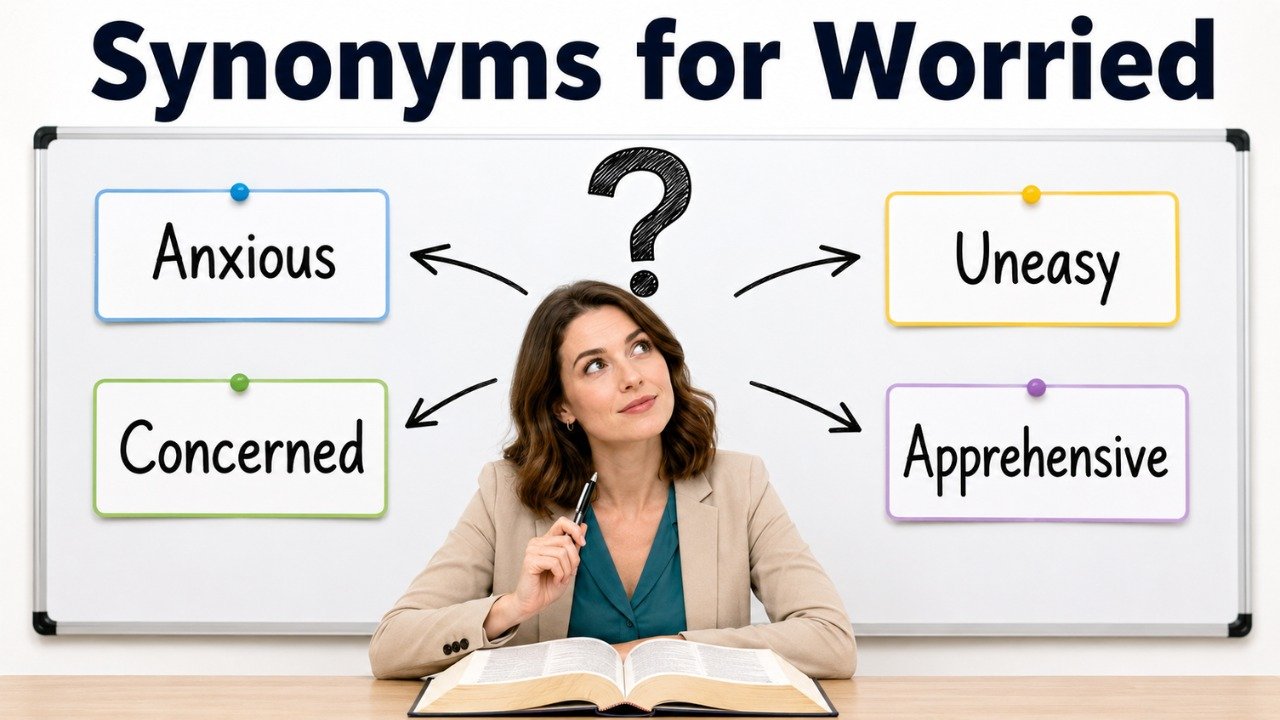
Quick Answer: Synonyms for worried include anxious, concerned, uneasy, troubled, nervous, apprehensive, distressed, alarmed, fearful, and tense. Choose concerned for polite or formal communication, anxious for uncertainty about the future, nervous for an upcoming event, uneasy for mild discomfort, and distressed for serious emotional pain. Troubled works well when a problem continues over time, while alarmed suggests sudden concern caused by danger or unexpected news.
Pronunciation and Word Details
Word: Worried.
Pronunciation: /ˈwʌr.id/
Part of Speech: Adjective. It is also the past tense and past participle form of the verb worry.
Meaning: Feeling concerned, nervous, or afraid because something may go wrong.
US Pronunciation:
UK Pronunciation:
What Does “Worried” Mean?
Worried means feeling concerned, nervous, or uncomfortable because of a possible problem, danger, or uncertain result.
As an adjective, worried describes the emotional condition of a person.
Example: She looked worried after receiving the message.
The word can describe concern about another person, an upcoming event, a difficult situation, or an uncertain future.
Concern About Someone: He was worried about his younger brother.
Concern About an Event: We are worried about the approaching storm.
Concern About a Result: The students felt worried about their examination results.
Worried is also the past tense and past participle of the verb worry.
Past Tense Example: The delay worried everyone in the room.
Past Participle Example: The sudden change had worried the entire team.
The exact meaning depends on the sentence. It may describe mild concern, continuing anxiety, serious fear, or emotional stress.
Meaning, Tone, and Context of “Worried”
Worried is a common and emotionally clear word. Its tone is usually neutral, but its emotional strength depends on the situation.
Neutral Use: Worried can describe ordinary concern without sounding dramatic.
Example: I am worried that we may arrive late.
Emotional Use: It can communicate personal fear or emotional discomfort.
Example: Her parents were deeply worried about her health.
Conversational Use: Worried is natural in daily speech and informal writing.
Example: Do not be worried about the small mistake.
Formal Use: The word can appear in professional communication, although concerned often sounds more controlled and polished.
Example: Management is worried about the decline in customer satisfaction.
Stronger Use: Words such as distressed, alarmed, distraught, and panicked communicate more intense feelings.
Example: The missing child’s family was distraught.
Worried is commonly used in conversations, emails, news reports, essays, stories, workplace discussions, and personal messages. It is suitable when the writer wants to express concern clearly without using technical or complicated language.
When and How to Use “Worried”
For Concern About a Person
Use worried when you care about someone’s safety, health, feelings, or situation.
Example: I am worried about Maria because she has not answered her phone.
For an Uncertain Result
Use worried when you do not know what will happen and fear an unfavorable result.
Example: The applicants were worried about the final decision.
For an Upcoming Event
Use worried when an approaching event causes nervousness or concern.
Example: He felt worried before his first public speech.
For a Possible Problem
Use worried when you believe something may go wrong.
Example: The homeowner was worried about the crack in the wall.
For Financial Pressure
Use worried when expenses, income, debt, or financial uncertainty creates concern.
Example: The family was worried about paying the unexpected repair bill.
For Health Concerns
Use worried when a symptom, medical test, or health change causes concern.
Example: She became worried when the pain continued.
For Work or Academic Pressure
Use worried when a deadline, project, test, or responsibility creates mental stress.
Example: The team was worried about completing the project on time.
For Serious Danger
Worried may describe fear of danger, but alarmed or frightened may be more accurate when the danger is immediate.
Example: Residents became alarmed when they smelled smoke.
Best Synonyms for Worried
Anxious
Synonym: Feeling nervous or concerned about an uncertain event or result.
Example: She was anxious about the interview results.
Concerned
Synonym: Feeling that a person, issue, or situation needs attention.
Example: The teacher was concerned about the student’s declining grades.
Uneasy
Synonym: Feeling slightly uncomfortable, doubtful, or nervous.
Example: He felt uneasy about entering the empty building.
Troubled
Synonym: Feeling disturbed by a serious or continuing problem.
Example: She appeared troubled by the recent changes.
Nervous
Synonym: Feeling tense or afraid before an event or action.
Example: The speaker was nervous before walking onto the stage.
Apprehensive
Synonym: Feeling worried that something unpleasant may happen.
Example: They were apprehensive about moving to an unfamiliar city.
Distressed
Synonym: Feeling severe worry, sadness, or emotional pain.
Example: The family was distressed by the unexpected news.
Alarmed
Synonym: Suddenly worried or frightened by possible danger.
Example: Residents were alarmed by the smell of gas.
Fearful
Synonym: Feeling afraid that something harmful may occur.
Example: The passengers were fearful during the violent storm.
Tense
Synonym: Unable to relax because of worry, pressure, or uncertainty.
Example: Everyone became tense while waiting for the announcement.
50 Synonyms for Worried with Short Meanings
- Anxious: Nervous about an uncertain result.
- Concerned: Aware of and troubled by a possible problem.
- Uneasy: Slightly nervous or uncomfortable.
- Troubled: Emotionally disturbed by a difficult situation.
- Nervous: Tense or afraid about an upcoming event.
- Apprehensive: Worried that something unpleasant may happen.
- Distressed: Experiencing serious emotional worry or pain.
- Alarmed: Suddenly frightened or concerned by danger.
- Fearful: Afraid that something harmful may happen.
- Tense: Unable to relax because of worry.
- Bothered: Emotionally affected by an issue or problem.
- Agitated: Visibly upset, restless, or worried.
- Unsettled: Unable to feel calm or certain.
- Fretful: Regularly worried, restless, or unhappy.
- Perturbed: Disturbed or made anxious by something.
- Disquieted: Made worried or mentally uncomfortable.
- Disturbed: Emotionally affected by troubling information.
- Restless: Unable to relax because of concern.
- Stressed: Experiencing mental pressure or strain.
- Preoccupied: Unable to stop thinking about a concern.
- Afraid: Feeling fear about a possible danger or result.
- Panicked: Overcome by sudden and intense fear.
- Terrified: Extremely frightened about danger or harm.
- Jittery: Nervous, shaky, or unable to remain calm.
- Edgy: Tense, irritable, or easily disturbed.
- Overwrought: Extremely anxious and emotionally upset.
- Distraught: Deeply worried and unable to think calmly.
- Harried: Feeling pressured by many demands or problems.
- Flustered: Confused and nervous because of pressure.
- Anguished: Experiencing intense emotional suffering or worry.
- Tormented: Continuously troubled by painful thoughts.
- Careworn: Showing the effects of long lasting worry.
- Insecure: Lacking confidence or a sense of safety.
- Doubtful: Unsure that something will happen successfully.
- Hesitant: Uncertain and unwilling to act immediately.
- Uncertain: Not confident about what will happen.
- Wary: Cautious because of possible danger or trouble.
- Disconcerted: Confused or unsettled by something unexpected.
- Discomposed: Unable to remain calm or emotionally controlled.
- Fraught: Filled with worry, tension, or difficulty.
- Rattled: Nervous or upset after a surprising event.
- Plagued: Continuously troubled by worries or difficulties.
- Haunted: Repeatedly troubled by painful thoughts or memories.
- Beset: Surrounded or repeatedly affected by problems.
- Ill at Ease: Uncomfortable, nervous, or unable to relax.
- On Edge: Nervous and expecting something unpleasant.
- Worried Sick: Extremely concerned about someone or something.
- Full of Concern: Feeling a strong sense of worry.
- Under Strain: Experiencing pressure that causes worry.
- In Distress: Experiencing serious worry, pain, or difficulty.
Read Also:
Synonyms for Effort

Synonyms for Worried by Context
When Worried Means Mildly Concerned
Concerned, uneasy, bothered, unsettled, and disquieted work well for mild or controlled worry.
Concerned Example: I am concerned about the recent decrease in attendance.
Uneasy Example: She felt uneasy about signing the agreement so quickly.
Bothered Example: He seemed bothered by the rude comment.
Unsettled Example: The unexplained noise left everyone unsettled.
These choices express discomfort without suggesting panic or extreme fear.
When Worried Means Nervous About the Future
Anxious, nervous, apprehensive, doubtful, hesitant, and uncertain describe worry about an upcoming event or unknown result.
Anxious Example: The family was anxious about the test results.
Nervous Example: He became nervous before the presentation.
Apprehensive Example: She was apprehensive about starting a new job.
Uncertain Example: Investors remained uncertain about future conditions.
Anxious and apprehensive focus on what may happen. Nervous often relates to a specific event that is about to occur.
When Worried Means Emotionally Troubled
Troubled, distressed, distraught, anguished, tormented, and overwrought describe deeper emotional suffering.
Troubled Example: His troubled expression suggested that something was wrong.
Distressed Example: She was distressed by the condition of the injured animal.
Distraught Example: The parents were distraught when their child disappeared.
Anguished Example: He gave an anguished response to the tragic news.
Use these words carefully because they are stronger than worried.
When Worried Means Suddenly Afraid
Alarmed, afraid, fearful, panicked, terrified, and rattled describe worry connected with sudden danger or fear.
Alarmed Example: The workers were alarmed by the warning signal.
Fearful Example: Residents were fearful of another flood.
Panicked Example: The crowd panicked when the lights went out.
Rattled Example: The unexpected call left him rattled.
Alarmed and rattled suggest a sudden reaction. Panicked and terrified communicate much greater intensity.
When Worried Means Under Pressure
Stressed, tense, agitated, harried, flustered, restless, and on edge describe worry caused by demands, responsibilities, or pressure.
Stressed Example: She felt stressed by the growing workload.
Tense Example: The atmosphere became tense before the decision.
Harried Example: The harried manager rushed between meetings.
On Edge Example: He had been on edge throughout the entire week.
These words are useful when worry affects a person’s behavior, concentration, or ability to relax.
When Worried Means Formally Concerned
Concerned, apprehensive, troubled, disquieted, and perturbed are suitable for formal writing.
Concerned Example: The committee is concerned about the lack of progress.
Apprehensive Example: Residents are apprehensive about the proposed changes.
Perturbed Example: Officials were perturbed by the unexpected findings.
Concerned is usually the safest option for reports, essays, professional emails, and formal discussions.
Another Word for Worried
Anxious is often the best single replacement for worried. However, the ideal alternative depends on the cause, intensity, and context of the feeling.
Use anxious for uncertainty, concerned for controlled or professional worry, nervous for an approaching event, and distressed for serious emotional pain.
Original: She was worried about the final examination.
Better Option: She was anxious about the final examination.
Original: The manager was worried about the safety issue.
Better Option: The manager was concerned about the safety issue.
Original: He felt worried before the competition.
Better Option: He felt nervous before the competition.
Original: The family was worried after receiving the terrible news.
Better Option: The family was distressed after receiving the terrible news.
When Not to Use “Worried”
Worried is clear and useful, but it may sound repetitive, weak, vague, or less accurate than another word in some situations.
When the Concern Is Professional
Concerned usually sounds more controlled and professional than worried.
Weak: We are worried about the errors in the report.
Better: We are concerned about the errors in the report.
When the Feeling Is About an Upcoming Event
Nervous may be more specific when someone fears performing badly or feels physical tension.
Weak: She was worried before speaking to the audience.
Better: She was nervous before speaking to the audience.
When the Fear Is Sudden
Alarmed is more precise when a person reacts immediately to danger or shocking information.
Weak: The guard was worried when the alarm sounded.
Better: The guard was alarmed when the warning sounded.
When the Emotional Pain Is Severe
Distressed or distraught communicates stronger emotional suffering.
Weak: The family was worried by the devastating news.
Better: The family was distraught after hearing the devastating news.
When the Word Becomes Repetitive
Repeating worried several times can make a paragraph sound dull.
Weak: She was worried about the test, worried about the deadline, and worried about disappointing her teacher.
Better: She was anxious about the test, stressed by the deadline, and concerned about disappointing her teacher.
When the Meaning Is Unclear
Explain the cause of the worry rather than using the word alone.
Weak: He looked worried.
Better: He looked uneasy after noticing that the door was open.
Words Commonly Confused With Worried
Worried vs Anxious: Worried is a broad word for concern about a problem. Anxious often focuses on uncertainty about the future and may suggest stronger nervousness.
Worried vs Concerned: Worried sounds more emotional and personal. Concerned sounds calmer, more polite, and more suitable for professional communication.
Worried vs Nervous: Worried can relate to any problem or uncertainty. Nervous often describes tension before a specific event, such as a test, interview, or performance.
Worried vs Afraid: Worried describes concern that something may go wrong. Afraid places greater emphasis on fear, danger, or harm.
Worried vs Stressed: Worried describes concerned thoughts. Stressed describes mental or physical pressure caused by demands, responsibilities, or problems.
Worried vs Troubled: Worried may describe a temporary concern. Troubled often suggests a deeper or continuing emotional problem.
Worried vs Uneasy: Worried is more direct. Uneasy describes mild discomfort or a feeling that something is not right.
Worried vs Alarmed: Worried may develop gradually. Alarmed usually describes a sudden reaction to danger, shocking news, or an unexpected event.
Which Synonym Should You Choose?
Choose anxious when writing about uncertainty, future results, health tests, decisions, or situations that are difficult to predict.
Choose concerned when writing formal emails, reports, essays, workplace messages, or polite statements about a problem.
Choose uneasy when the worry is mild or based on a feeling that something is wrong.
Choose troubled when the concern is serious, personal, or continuing over time.
Choose nervous when someone is preparing for an interview, examination, speech, competition, meeting, or performance.
Choose apprehensive when someone expects an unpleasant experience or result.
Choose distressed when the worry causes serious emotional pain.
Choose alarmed when the concern begins suddenly because of possible danger.
Choose fearful when the sentence focuses on fear of harm or loss.
Choose tense when worry makes it difficult for someone to relax.
Choose stressed when pressure from work, study, finances, or responsibilities causes the feeling.
Choose distraught when a person is so worried or upset that calm thinking becomes difficult.
Real Life Examples of “Worried” in Sentences
Original: I am worried about the delay in receiving the documents.
Better Option: I am concerned about the delay in receiving the documents.
Original: She felt worried before meeting the interview panel.
Better Option: She felt nervous before meeting the interview panel.
Original: The parents were worried about their missing child.
Better Option: The parents were distraught about their missing child.
Original: He became worried when he heard the warning signal.
Better Option: He became alarmed when he heard the warning signal.
Original: We are worried that the weather may affect the event.
Better Option: We are apprehensive that the weather may affect the event.
Original: The patient looked worried while waiting for the results.
Better Option: The patient looked anxious while waiting for the results.
Original: She was worried because the room felt unusually quiet.
Better Option: She was uneasy because the room felt unusually quiet.
Original: The employees were worried about the increasing workload.
Better Option: The employees were stressed by the increasing workload.
Original: His worried expression revealed that the problem was serious.
Better Option: His troubled expression revealed that the problem was serious.
Original: Everyone felt worried during the difficult discussion.
Better Option: Everyone felt tense during the difficult discussion.
Synonym Groups and Usage Differences
Concern Group
Concerned, bothered, disquieted, and perturbed describe awareness of a problem that needs attention.
Concerned is the most neutral and professional choice. Bothered is more conversational. Disquieted and perturbed are more formal.
Example: The committee was concerned about the missing information.
Uncertainty Group
Anxious, apprehensive, doubtful, hesitant, and uncertain describe worry about an unknown future or unclear result.
Anxious emphasizes emotional nervousness. Apprehensive suggests expecting something unpleasant. Doubtful and uncertain emphasize a lack of confidence.
Example: She was apprehensive about accepting the unfamiliar role.
Nervousness Group
Nervous, jittery, edgy, restless, and on edge describe physical or emotional tension.
Nervous is common before an event. Jittery suggests visible physical nervousness. Edgy and on edge suggest irritability and an inability to relax.
Example: He became jittery as the interview approached.
Emotional Distress Group
Distressed, distraught, anguished, tormented, and overwrought communicate intense emotional pain.
Distressed is serious but widely usable. Distraught suggests a loss of emotional control. Anguished and tormented describe deep or continuing suffering.
Example: The family was deeply distressed by the accident.
Fear Group
Afraid, fearful, alarmed, panicked, and terrified connect worry with danger or harm.
Afraid and fearful are general. Alarmed describes sudden concern. Panicked and terrified express extreme fear.
Example: The residents were alarmed by the rising water.
Pressure Group
Stressed, tense, harried, flustered, and agitated describe worry caused by demands or difficult circumstances.
Stressed relates to pressure. Tense describes an inability to relax. Harried suggests being rushed by many responsibilities. Flustered describes temporary confusion.
Example: The coordinator became flustered when several problems appeared at once.
Continuing Trouble Group
Troubled, plagued, haunted, beset, and careworn describe worry that continues over time.
Troubled is broad and natural. Plagued and beset suggest repeated problems. Haunted often relates to painful memories. Careworn describes the visible effects of long lasting worry.
Example: He was haunted by memories of the difficult experience.
Antonyms of Worried
The opposite of worried depends on whether the sentence focuses on fear, uncertainty, tension, or emotional distress.
Calm: Free from nervousness or emotional disturbance.
Relaxed: Comfortable and not under pressure.
Reassured: Made less worried by comforting information.
Confident: Certain about one’s ability or the expected result.
Secure: Feeling safe, protected, and free from fear.
Unconcerned: Not feeling troubled by a situation.
Composed: Calm and emotionally controlled.
Peaceful: Free from worry, tension, or conflict.
Hopeful: Expecting a positive result.
Certain: Confident that something is true or will happen.
Comfortable: Feeling relaxed and emotionally at ease.
Optimistic: Expecting events to develop positively.
Comparison: Worried vs Related Words
Worried vs Anxious
Worried is a general word for concern about a problem. Anxious often suggests stronger nervousness about an uncertain future.
Example With Worried: She was worried about her son’s long journey.
Example With Anxious: She was anxious to receive news of his safe arrival.
Worried vs Concerned
Worried is more emotional and personal. Concerned is more controlled, polite, and formal.
Example With Worried: I am worried that he may be lost.
Example With Concerned: I am concerned about the lack of communication.
Worried vs Nervous
Worried can describe concern about any situation. Nervous usually describes tension before a specific event.
Example With Worried: He was worried about the condition of his car.
Example With Nervous: He was nervous before taking the driving test.
Worried vs Uneasy
Worried clearly identifies concern. Uneasy describes mild nervousness or a feeling that something is wrong.
Example With Worried: She was worried about the missing payment.
Example With Uneasy: She felt uneasy when the caller refused to identify himself.
Worried vs Troubled
Worried can be temporary or mild. Troubled often suggests deeper concern or an ongoing personal problem.
Example With Worried: He was worried about tomorrow’s meeting.
Example With Troubled: He had been troubled by the decision for several months.
Worried vs Afraid
Worried focuses on concern about what may happen. Afraid places stronger emphasis on fear or danger.
Example With Worried: They were worried about the approaching storm.
Example With Afraid: They were afraid the storm would destroy their home.
Worried vs Stressed
Worried describes thoughts of concern. Stressed describes pressure that affects emotional or physical comfort.
Example With Worried: She was worried about completing the assignment correctly.
Example With Stressed: She was stressed by several assignments and approaching deadlines.
Worried vs Alarmed
Worried may develop slowly. Alarmed describes a sudden reaction to danger or unexpected information.
Example With Worried: Residents were worried about the changing weather.
Example With Alarmed: Residents were alarmed when the emergency warning sounded.
Common Phrases and Expressions With Worried
Worried About: Feeling concerned regarding a person, issue, or situation.
Example: She is worried about her friend.
Deeply Worried: Experiencing serious concern.
Example: His family is deeply worried about his condition.
Increasingly Worried: Becoming more concerned over time.
Example: Residents are increasingly worried about the water supply.
Extremely Worried: Feeling a very high level of concern.
Example: The doctor’s message left him extremely worried.
Worried Sick: So concerned that the worry causes severe emotional discomfort.
Example: Her parents were worried sick when she did not return home.
Look Worried: To appear concerned through facial expression or behavior.
Example: You look worried about something.
Seem Worried: To give the impression of feeling concerned.
Example: He seemed worried during the conversation.
Get Worried: To begin feeling concerned.
Example: Do not get worried before all the facts are available.
Worried That: Concerned that a particular event may happen.
Example: She was worried that she had made a mistake.
Worried for Someone: Concerned about another person’s safety or wellbeing.
Example: I am worried for anyone traveling in this weather.
Common Mistakes to Avoid
Repeating Worried Too Often
Using worried several times in one paragraph makes the writing sound repetitive.
Incorrect: I was worried about the test, worried about the time, and worried about forgetting the answers.
Improved: I was anxious about the test, concerned about the time, and afraid of forgetting the answers.
Choosing a Synonym With the Wrong Intensity
Do not use panicked, terrified, or distraught for mild concern.
Incorrect: She was terrified that the meeting might start five minutes late.
Improved: She was concerned that the meeting might start five minutes late.
Confusing Worried and Nervous
Use nervous for tension before an event. Use worried for concern about a possible problem.
Incorrect: He was worried before walking onto the stage.
Improved: He was nervous before walking onto the stage.
Confusing Worried and Stressed
A person may be worried about one issue but stressed by many demands.
Incorrect: She was worried by her heavy workload and lack of sleep.
Improved: She was stressed by her heavy workload and lack of sleep.
Using Worried Without Explaining the Cause
Add details so the reader understands why the person feels concerned.
Vague: The manager was worried.
Clear: The manager was worried about missing the project deadline.
Using Concerned When Strong Emotion Is Needed
Concerned can sound too controlled for a tragic or emotionally intense situation.
Weak: The parents were concerned when their child disappeared.
Better: The parents were distraught when their child disappeared.
Using Unnatural Phrasing
Worried is commonly followed by about, that, or for.
Incorrect: She was worried from the examination.
Correct: She was worried about the examination.
Incorrect: He was worried of losing his job.
Correct: He was worried about losing his job.
Conclusion
Synonyms for worried help express different levels and causes of concern more accurately. Use concerned for formal or controlled communication, anxious for uncertain results, nervous for upcoming events, uneasy for mild discomfort, and troubled for continuing problems. Alarmed suits sudden danger, while distressed and distraught communicate serious emotional pain. Choosing the right alternative makes descriptions clearer, prevents repetition, and helps readers understand whether the feeling involves uncertainty, pressure, fear, or deep emotional suffering.
FAQs About Synonyms for Worried
What Is the Best Synonym for Worried?
Anxious is a strong general synonym. Concerned is better for formal situations, while nervous is best for an upcoming event.
What Is a Formal Word for Worried?
Concerned, apprehensive, troubled, perturbed, and disquieted are suitable formal alternatives.
What Is a Stronger Word Than Worried?
Distressed, distraught, anguished, alarmed, panicked, and terrified express stronger emotions than worried.
What Is a Mild Synonym for Worried?
Uneasy, concerned, bothered, and unsettled express mild or moderate worry.
Are Worried and Anxious the Same?
They are similar, but anxious often emphasizes uncertainty about the future. Worried is broader and can describe concern about any problem.
Can Concerned Replace Worried?
Concerned can replace worried in many sentences, especially in professional, polite, and formal communication. It may sound less emotional.
What Is the Opposite of Worried?
Common opposites include calm, relaxed, reassured, confident, secure, composed, and unconcerned.
