
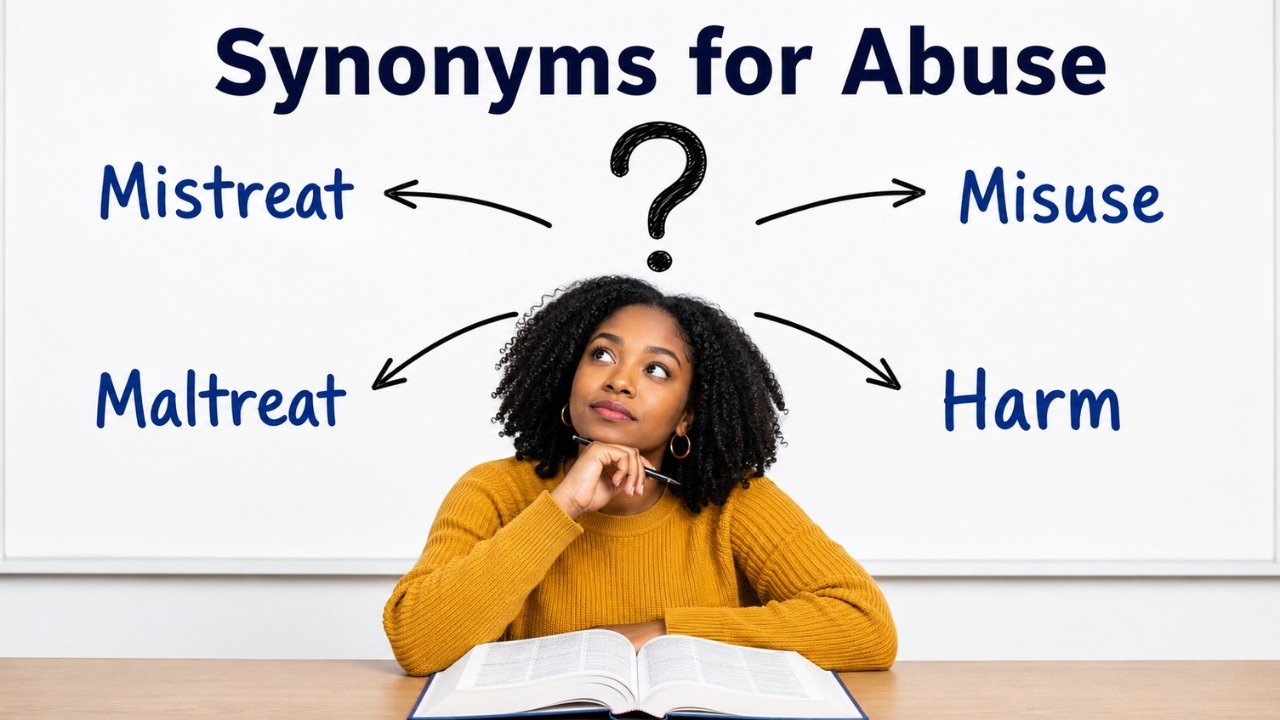
Quick Answer: Synonyms for abuse include mistreatment, maltreatment, cruelty, harm, violence, exploitation, harassment, misuse, oppression, and insults. Use mistreatment as the best general alternative when someone is treated badly. Choose misuse when something, such as authority, money, or equipment, is used improperly. Harassment suits repeated unwanted behavior, exploitation emphasizes unfair advantage, and insults or verbal attacks describe harmful language. The correct replacement depends on whether abuse refers to harmful treatment, offensive speech, neglect, violence, or improper use.
Pronunciation and Word Details
Word: Abuse.
Pronunciation: /əˈbjuːs/ as a noun and /əˈbjuːz/ as a verb.
Part of Speech: Noun and verb.
Meaning: Cruel or harmful treatment, offensive language, or the improper use of something.
US Pronunciation:
UK Pronunciation:
What Does “Abuse” Mean?
Abuse means harmful treatment of a person or animal, offensive language directed at someone, or the improper use of power, substances, objects, or privileges.
As a noun, abuse can describe harmful behavior or improper use.
Example: The organization introduced measures to prevent abuse of authority.
As a verb, abuse means to treat someone cruelly, speak to someone offensively, or use something improperly.
Example: No person should abuse a position of trust.
The word can refer to physical harm, emotional mistreatment, verbal attacks, exploitation, neglect, or controlling behavior. It can also describe the misuse of power, information, resources, medication, or public services.
Human Treatment Context: Abuse refers to behavior that causes harm, fear, humiliation, or suffering.
Example: The investigation uncovered serious abuse of vulnerable workers.
Language Context: Abuse can mean insulting, threatening, or degrading speech.
Example: The customer directed verbal abuse at the employee.
Misuse Context: Abuse may describe using something for the wrong purpose or in an excessive way.
Example: The rules are intended to prevent abuse of the system.
Because abuse has several meanings, a more precise synonym can often make a sentence clearer.
Meaning, Tone, and Context of “Abuse”
Abuse is a strong and serious word. It usually has a negative, emotional, and formal tone because it describes harmful, cruel, unjust, or improper behavior.
In everyday conversation, people may use abuse to describe insults, unfair treatment, or the misuse of power.
Conversational Use: The player received abuse from angry spectators.
In formal writing, abuse often appears in discussions about safety, rights, authority, professional conduct, law, education, health, and social welfare.
Formal Use: The policy prohibits abuse of authority by senior employees.
In academic writing, the word may describe patterns of harmful behavior, exploitation, neglect, or improper use.
Academic Use: The paper examines how abuse of power damages public trust.
In legal or professional contexts, abuse may be too broad unless the exact behavior is clearly identified. Words such as harassment, assault, neglect, coercion, or exploitation may provide greater precision.
Specific Use: The complaint described repeated intimidation and harassment.
Abuse is not always limited to physical violence. It may involve emotional harm, verbal humiliation, threats, manipulation, neglect, financial control, or misuse of authority.
When referring to objects, systems, or privileges, abuse usually means misuse rather than cruelty.
Example: Abuse of the refund policy led to stricter rules.
When and How to Use “Abuse”
For Harmful Treatment: Use abuse when someone is treated cruelly, unfairly, or in a way that causes suffering.
Example: The charity provides support to people affected by abuse.
For Offensive Language: Use abuse when someone directs insults, threats, or degrading words at another person.
Example: The official refused to tolerate verbal abuse during the meeting.
For Misuse of Authority: Use abuse when a person uses power or responsibility unfairly for personal advantage.
Example: The investigation focused on possible abuse of authority.
For Exploitation: Use abuse when someone takes unfair advantage of another person’s weakness, trust, work, or dependence.
Example: Stronger protections were introduced to prevent the abuse of temporary workers.
For Improper Use: Use abuse when an object, system, service, privilege, or resource is used wrongly.
Example: Repeated abuse of the booking system caused delays.
For Excessive Use: Use abuse when something is used in a harmful or uncontrolled way.
Example: The guidance warns against the abuse of certain medications.
For Neglect: Use abuse carefully when serious neglect causes harm or places someone in danger.
Example: The report identified neglect and other forms of abuse.
For Formal Complaints: Use abuse when describing serious harmful conduct, but add details so the reader understands what occurred.
Example: The complaint described abuse involving threats, humiliation, and unfair punishment.
Best Synonyms for Abuse
Mistreatment
Synonym: Mistreatment means unfair, cruel, or harmful treatment of a person or animal.
Example: The workers reported repeated mistreatment by their supervisor.
Maltreatment
Synonym: Maltreatment means serious or continued harmful treatment, especially in formal writing.
Example: The inquiry examined allegations of maltreatment at the facility.
Cruelty
Synonym: Cruelty means behavior that deliberately causes pain, fear, or suffering.
Example: The new rules aim to prevent cruelty toward animals.
Harm
Synonym: Harm means physical, emotional, or practical damage caused to someone.
Example: The policy was created to protect children from harm.
Exploitation
Synonym: Exploitation means unfairly using someone for personal benefit.
Example: The law protects vulnerable workers from exploitation.
Harassment
Synonym: Harassment means repeated unwanted behavior that causes distress, fear, or humiliation.
Example: She reported persistent harassment from a colleague.
Violence
Synonym: Violence means the use of physical force intended to injure or control.
Example: The campaign seeks to reduce violence within families.
Oppression
Synonym: Oppression means prolonged cruel or unjust control over people.
Example: The novel portrays a community struggling against oppression.
Misuse
Synonym: Misuse means using something incorrectly, unfairly, or for an improper purpose.
Example: The audit revealed misuse of public funds.
Insults
Synonym: Insults are offensive or disrespectful words directed at someone.
Example: The discussion ended after repeated insults were exchanged.
50 Synonyms for Abuse with Short Meanings
- Mistreatment: Cruel, unfair, or harmful treatment.
- Maltreatment: Serious or repeated harmful treatment.
- Ill Treatment: Bad or unjust treatment of someone.
- Cruelty: Deliberate behavior that causes pain or suffering.
- Harm: Physical, emotional, or practical damage.
- Violence: Physical force used to injure or control.
- Brutality: Extremely cruel or violent behavior.
- Oppression: Prolonged and unjust control over others.
- Persecution: Persistent cruel treatment because of identity or beliefs.
- Exploitation: Unfair use of a person for personal benefit.
- Victimization: Unfairly targeting or harming someone.
- Harassment: Repeated unwanted behavior that causes distress.
- Intimidation: Behavior intended to frighten or control.
- Bullying: Repeatedly hurting, frightening, or humiliating someone.
- Coercion: Forcing someone through pressure or threats.
- Manipulation: Unfairly controlling another person’s choices or emotions.
- Neglect: Failure to provide necessary care or attention.
- Torment: Severe physical or emotional suffering.
- Tyranny: Cruel and unfair use of power.
- Aggression: Hostile or forceful behavior.
- Hostility: Unfriendly, threatening, or harmful behavior.
- Insults: Offensive words intended to hurt or disrespect.
- Name Calling: The use of hurtful or insulting names.
- Verbal Attacks: Aggressive or harmful spoken criticism.
- Humiliation: Behavior that causes shame or loss of dignity.
- Degradation: Treatment that lowers someone’s dignity or worth.
- Belittling: Making someone feel unimportant or inferior.
- Ridicule: Unkind words or actions that make someone appear foolish.
- Mockery: Cruel imitation or disrespectful laughter.
- Threats: Statements showing an intention to cause harm.
- Misuse: Improper or harmful use of something.
- Misapplication: Using something in the wrong way or situation.
- Mishandling: Dealing with something carelessly or incorrectly.
- Improper Use: Using something against its intended purpose.
- Overuse: Using something more than is necessary or safe.
- Excessive Use: Using something in an uncontrolled amount.
- Mismanagement: Poor or irresponsible control of resources or duties.
- Corruption: Dishonest use of power for personal advantage.
- Distortion: Unfairly changing facts, meaning, or information.
- Violation: An act that breaks a right, rule, or boundary.
- Infringement: An act that interferes with a right or freedom.
- Misconduct: Improper or unacceptable behavior.
- Wrongdoing: Behavior that is dishonest, harmful, or unlawful.
- Injustice: Unfair treatment or denial of rights.
- Assault: A violent attack or unlawful physical threat.
- Rough Treatment: Harsh or physically careless treatment.
- Inhumanity: Extreme lack of kindness or compassion.
- Savagery: Shockingly cruel or violent behavior.
- Injury: Physical or emotional damage.
- Damage: Harm caused to a person, object, system, or reputation.
Read Also:
Synonyms for Collaborative

Synonyms for Abuse by Context
When Abuse Means Mistreatment
When abuse describes cruel or harmful treatment, useful synonyms include mistreatment, maltreatment, cruelty, ill treatment, victimization, and harm.
Example With Abuse: The inquiry examined the abuse of residents at the care home.
Example With Maltreatment: The inquiry examined the maltreatment of residents at the care home.
Mistreatment is the best general choice. Maltreatment sounds more formal and often suggests serious or repeated harm.
When Abuse Means Physical Harm
When abuse involves physical force or injury, appropriate alternatives include violence, brutality, assault, aggression, and rough treatment.
Example With Abuse: The report documented physical abuse within the institution.
Example With Violence: The report documented physical violence within the institution.
Violence is more precise when physical force is central to the sentence. Assault may be suitable when describing a particular attack.
When Abuse Means Harmful Speech
When abuse refers to offensive or degrading language, choose insults, verbal attacks, name calling, ridicule, mockery, humiliation, or threats.
Example With Abuse: The employee experienced abuse from an angry customer.
Example With Verbal Attacks: The employee experienced verbal attacks from an angry customer.
Insults describes offensive words, while threats indicates that the speaker expressed an intention to cause harm.
When Abuse Means Unfair Control
When abuse involves control, fear, or pressure, useful synonyms include intimidation, coercion, manipulation, oppression, tyranny, and bullying.
Example With Abuse: The manager used abuse to control the staff.
Example With Intimidation: The manager used intimidation to control the staff.
Intimidation emphasizes fear. Coercion emphasizes pressure that forces someone to act.
When Abuse Means Exploitation
When someone unfairly benefits from another person’s work, trust, dependence, or weakness, exploitation is often the strongest synonym.
Example With Abuse: The new regulations aim to prevent the abuse of migrant workers.
Example With Exploitation: The new regulations aim to prevent the exploitation of migrant workers.
Victimization may work when a person is repeatedly targeted, while exploitation focuses on unfair personal gain.
When Abuse Means Misuse
When abuse refers to using authority, money, equipment, information, or a system improperly, use misuse, mishandling, misapplication, corruption, or improper use.
Example With Abuse: The investigation uncovered abuse of public funds.
Example With Misuse: The investigation uncovered misuse of public funds.
Misuse is the clearest general alternative. Corruption is stronger and usually implies dishonesty or personal benefit.
When Abuse Means Excessive Use
When abuse describes harmful or uncontrolled use, choose overuse, excessive use, misuse, or dependency related wording that accurately fits the sentence.
Example With Abuse: The report discusses the abuse of prescription medication.
Example With Misuse: The report discusses the misuse of prescription medication.
Misuse is often a more neutral choice when the sentence focuses on harmful patterns of use rather than a person’s character.
Another Word for Abuse
The best general alternative for abuse is mistreatment when the word refers to harmful treatment. However, the correct replacement depends on the sentence.
Use misuse for improper use, exploitation for unfair advantage, harassment for repeated unwanted conduct, and insults for offensive language. As a verb, mistreat is often the clearest replacement when someone is treated badly.
Original: The workers complained about abuse in the workplace.
Better Option: The workers complained about mistreatment in the workplace.
Original: The audit uncovered abuse of company resources.
Better Option: The audit uncovered misuse of company resources.
Original: The official was accused of abusing his authority.
Better Option: The official was accused of misusing his authority.
Original: The speaker directed abuse at the audience member.
Better Option: The speaker directed insults at the audience member.
When Not to Use “Abuse”
Do not use abuse when a more specific word can clearly identify the behavior. The term can sound vague in reports, complaints, and formal documents if the reader is not told what happened.
Weak: The employee reported abuse.
Better: The employee reported repeated threats and verbal harassment.
Avoid using abuse as a replacement for every type of conflict. A disagreement, criticism, rude comment, or isolated argument is not automatically described clearly by this word.
Weak: The editor abused the writer’s first draft.
Better: The editor criticized the writer’s first draft harshly.
Do not use abuse when misuse is the more natural term for objects, resources, information, or systems.
Weak: The instructions prevent abuse of the machine.
Better: The instructions prevent misuse of the machine.
Avoid broad wording when a formal report requires the exact behavior.
Weak: The investigation found abuse of authority.
Better: The investigation found intimidation, favoritism, and misuse of authority.
Do not choose an extremely strong synonym unless the severity of the situation supports it.
Weak: The supervisor committed brutality by speaking impatiently.
Better: The supervisor behaved rudely and impatiently.
Avoid repeating abuse several times in the same paragraph.
Weak: The report describes verbal abuse, workplace abuse, and abuse of authority.
Better: The report describes verbal harassment, workplace mistreatment, and misuse of authority.
Words Commonly Confused With Abuse
Abuse vs Mistreatment: Abuse is a broad term for serious harmful behavior or improper use. Mistreatment specifically means treating a person or animal badly.
Abuse vs Misuse: Abuse may refer to harmful treatment or improper use. Misuse mainly refers to using an object, power, substance, system, or privilege incorrectly.
Abuse vs Neglect: Abuse usually involves harmful behavior, while neglect involves failing to provide necessary care, attention, protection, or support.
Abuse vs Harassment: Abuse can include many kinds of harm. Harassment usually refers to repeated unwanted behavior that creates fear, humiliation, or distress.
Abuse vs Violence: Abuse may be physical, verbal, emotional, financial, or connected with misuse. Violence specifically involves physical force or the threat of physical force.
Abuse vs Insult: Abuse can describe a pattern of harmful language or behavior. An insult is a particular offensive statement or action.
Abuse vs Exploitation: Abuse is the wider term. Exploitation specifically means unfairly using someone for labor, money, influence, or another personal benefit.
Which Synonym Should You Choose?
Choose mistreatment when writing generally about someone being treated badly.
Choose maltreatment for formal reports about serious or repeated harmful treatment.
Choose cruelty when the behavior intentionally causes pain, fear, or suffering.
Choose violence when physical force is involved.
Choose harassment when describing repeated unwanted conduct in a workplace, school, public place, or personal situation.
Choose intimidation when someone uses fear to influence another person.
Choose coercion when pressure or threats force someone to act.
Choose exploitation when someone unfairly benefits from another person’s work, trust, weakness, or dependence.
Choose insults or verbal attacks when the abuse consists mainly of offensive language.
Choose humiliation when the purpose or effect is to damage someone’s dignity.
Choose neglect when necessary care or protection is not provided.
Choose misuse when writing about authority, money, equipment, information, medication, systems, or privileges.
Choose corruption when power is used dishonestly for personal benefit.
Choose improper use in simple instructions, workplace communication, or general explanations.
For formal reports, maltreatment, harassment, exploitation, coercion, and misuse provide greater precision.
For essays, mistreatment is a useful general alternative, while oppression and exploitation work for discussions of power and inequality.
For emails, choose calm and specific words such as inappropriate conduct, harassment, misuse, or insulting language.
For casual conversation, treated badly, insulted, bullied, or used unfairly may sound more natural than highly formal terms.
Real Life Examples of “Abuse” in Sentences
Original: The organization has strict rules against abuse of employees.
Better Option: The organization has strict rules against mistreatment of employees.
Original: The report describes abuse of vulnerable patients.
Better Option: The report describes maltreatment of vulnerable patients.
Original: The manager was investigated for abuse of power.
Better Option: The manager was investigated for misuse of power.
Original: The customer shouted abuse at the receptionist.
Better Option: The customer directed insults at the receptionist.
Original: The workers experienced abuse from the contractor.
Better Option: The workers experienced exploitation by the contractor.
Original: The student reported repeated abuse from classmates.
Better Option: The student reported repeated bullying from classmates.
Original: The policy protects residents from emotional abuse.
Better Option: The policy protects residents from emotional mistreatment.
Original: The audit revealed abuse of charitable funds.
Better Option: The audit revealed misuse of charitable funds.
Original: The witness described abuse involving repeated threats.
Better Option: The witness described intimidation involving repeated threats.
Original: The law seeks to prevent abuse of dependent adults.
Better Option: The law seeks to prevent victimization of dependent adults.
Synonym Groups and Usage Differences
Mistreatment Group
Mistreatment, maltreatment, ill treatment, cruelty, harm, and victimization describe harmful treatment of a person or animal.
Mistreatment is broad and natural. Maltreatment is more formal. Cruelty emphasizes deliberate suffering, while victimization emphasizes being repeatedly targeted.
Example: The investigation revealed prolonged mistreatment of the residents.
Physical Harm Group
Violence, brutality, assault, aggression, injury, and rough treatment relate to physical force or physical damage.
Violence is the broadest option. Assault may describe a particular attack, while brutality suggests extreme cruelty.
Example: The witness reported physical violence during the incident.
Verbal Harm Group
Insults, name calling, verbal attacks, ridicule, mockery, threats, and belittling describe harmful speech.
Insults are offensive statements. Belittling makes someone feel unimportant, while threats create fear of possible harm.
Example: Repeated belittling damaged the employee’s confidence.
Control Group
Intimidation, coercion, manipulation, bullying, oppression, and tyranny describe attempts to control someone unfairly.
Intimidation uses fear. Coercion uses pressure or threats. Manipulation uses deceptive emotional or psychological influence.
Example: The supervisor relied on intimidation to silence complaints.
Exploitation Group
Exploitation, corruption, injustice, persecution, and victimization involve unfair advantage or unfair treatment.
Exploitation focuses on personal gain. Corruption involves dishonest use of power, while persecution describes persistent targeting.
Example: The reforms were designed to reduce the exploitation of low paid workers.
Misuse Group
Misuse, misapplication, mishandling, improper use, mismanagement, and overuse describe using something wrongly.
Misuse is the most flexible choice. Misapplication means using something in the wrong situation, while overuse means using too much.
Example: The investigation found serious misuse of confidential information.
Antonyms of Abuse
The opposite of abuse changes according to whether the word means mistreatment, harmful speech, or improper use.
Care: Kind and responsible attention to someone’s needs.
Protection: Action taken to keep someone safe from harm.
Kindness: Friendly and considerate treatment.
Respect: Recognition of another person’s dignity and rights.
Compassion: Concern for someone who is suffering.
Support: Help given to improve another person’s safety or well being.
Fairness: Equal and reasonable treatment.
Safety: Protection from danger, injury, or harmful conduct.
Proper Use: Using something for its correct purpose.
Responsible Use: Using power, resources, or substances carefully.
Preservation: Keeping something safe from damage or misuse.
Praise: Positive words that express approval or admiration.
Comparison: Abuse vs Related Words
Abuse vs Mistreatment
Abuse is a broad word that can describe harmful treatment, offensive speech, or improper use. Mistreatment refers specifically to treating a person or animal badly.
Example With Abuse: The complaint included allegations of verbal and emotional abuse.
Example With Mistreatment: The complaint described the mistreatment of junior employees.
Abuse vs Misuse
Abuse may involve people, language, authority, systems, or substances. Misuse focuses on using something incorrectly or improperly.
Example With Abuse: The organization introduced safeguards against abuse of authority.
Example With Misuse: The organization introduced safeguards against misuse of confidential data.
Abuse vs Harassment
Abuse is a broad category of harmful conduct. Harassment usually involves repeated unwanted actions, comments, threats, or contact.
Example With Abuse: The resident reported ongoing emotional abuse.
Example With Harassment: The employee reported repeated unwanted messages and workplace harassment.
Abuse vs Violence
Abuse can be physical or nonphysical. Violence involves physical force or threats of physical force.
Example With Abuse: The program supports people affected by emotional abuse.
Example With Violence: The witness described an incident of physical violence.
Abuse vs Exploitation
Abuse emphasizes harm or improper treatment. Exploitation emphasizes unfair benefit gained from another person.
Example With Abuse: The report describes abuse of vulnerable residents.
Example With Exploitation: The report describes the exploitation of workers through unpaid labor.
Abuse vs Neglect
Abuse usually involves harmful actions, while neglect involves failing to provide necessary care or protection.
Example With Abuse: The investigation found evidence of verbal abuse.
Example With Neglect: The investigation found that basic medical care had been neglected.
Common Phrases and Expressions With Abuse
Abuse of Power: Unfair or improper use of authority.
Abuse of Authority: Using an official position to control or disadvantage others unfairly.
Verbal Abuse: Insults, threats, shouting, or degrading language.
Physical Abuse: Harmful treatment involving physical force.
Emotional Abuse: Behavior that repeatedly causes fear, shame, distress, or loss of confidence.
Domestic Abuse: Harmful or controlling behavior within a family or close relationship.
Child Abuse: Harmful treatment, exploitation, or serious neglect of a child.
Animal Abuse: Cruel, harmful, or neglectful treatment of an animal.
Substance Abuse: Harmful or uncontrolled use of drugs, alcohol, or medication.
Abuse of Trust: Using another person’s confidence or dependence dishonestly.
Common Mistakes to Avoid
Ignoring the Pronunciation Change: The noun abuse ends with an s sound, while the verb abuse ends with a z sound.
Noun Example: The policy addresses abuse of authority.
Verb Example: A leader must not abuse authority.
Confusing Abuse With Misuse: Use abuse for harmful treatment or serious improper behavior. Use misuse when the main idea is incorrect use.
Unclear: The employee abused the software.
Clearer: The employee misused the software.
Using a Broad Word Without Details: Abuse can cover many different behaviors. Formal writing should identify whether the issue involves threats, violence, harassment, neglect, exploitation, or misuse.
Vague: The report found abuse.
Specific: The report found repeated intimidation and financial exploitation.
Choosing a Synonym With the Wrong Strength: Brutality and tyranny are much stronger than rudeness or unfairness. Select a word that matches the seriousness of the behavior.
Unnatural: The customer committed tyranny by making one rude comment.
Natural: The customer made an insulting comment.
Repeating Abuse Too Often: Replace repeated uses with precise alternatives where appropriate.
Repetitive: The policy addresses verbal abuse, financial abuse, and abuse of authority.
Improved: The policy addresses verbal harassment, financial exploitation, and misuse of authority.
Confusing Abuse With Criticism: Honest criticism is not the same as abuse. Abuse usually involves harmful, degrading, threatening, or seriously improper conduct.
Incorrect: The teacher abused the essay by correcting its grammar.
Correct: The teacher criticized the essay and corrected its grammar.
Using Abuse Without a Clear Object: Readers should know who or what was harmed or misused.
Vague: The rules prevent abuse.
Clear: The rules prevent abuse of confidential information.
Conclusion
Synonyms for abuse include mistreatment, maltreatment, cruelty, harassment, exploitation, violence, insults, intimidation, and misuse. Choose mistreatment for general harmful treatment, harassment for repeated unwanted conduct, exploitation for unfair personal gain, and misuse for improper use of authority, resources, or systems. More precise wording helps readers understand whether a sentence refers to physical harm, emotional cruelty, verbal attacks, neglect, control, or irresponsible use. Always select a synonym that matches the context and seriousness of the situation.
FAQs About Synonyms for Abuse
What Is the Best Synonym for Abuse?
Mistreatment is the best general synonym when abuse refers to treating someone badly. Misuse is better when referring to power, money, equipment, or a system.
What Is a Formal Synonym for Abuse?
Maltreatment, exploitation, victimization, harassment, coercion, and misuse are useful formal alternatives.
What Is a Synonym for Verbal Abuse?
Insults, verbal attacks, name calling, ridicule, threats, and belittling can describe different forms of verbal abuse.
What Is Another Word for Abuse of Power?
Misuse of power, corruption, oppression, tyranny, and abuse of authority are suitable alternatives depending on the severity and context.
Are Abuse and Harassment the Same?
No. Abuse is a broader term for harmful treatment or misuse. Harassment usually involves repeated unwanted behavior that causes distress, fear, or humiliation.
What Is the Difference Between Abuse and Misuse?
Abuse can refer to mistreating people or using something improperly. Misuse mainly describes using an object, resource, substance, privilege, or authority incorrectly.
Can Mistreatment Replace Abuse in Every Sentence?
No. Mistreatment works when a person or animal is treated badly. It does not naturally replace abuse when the meaning is improper use, as in abuse of power or abuse of a system.
