
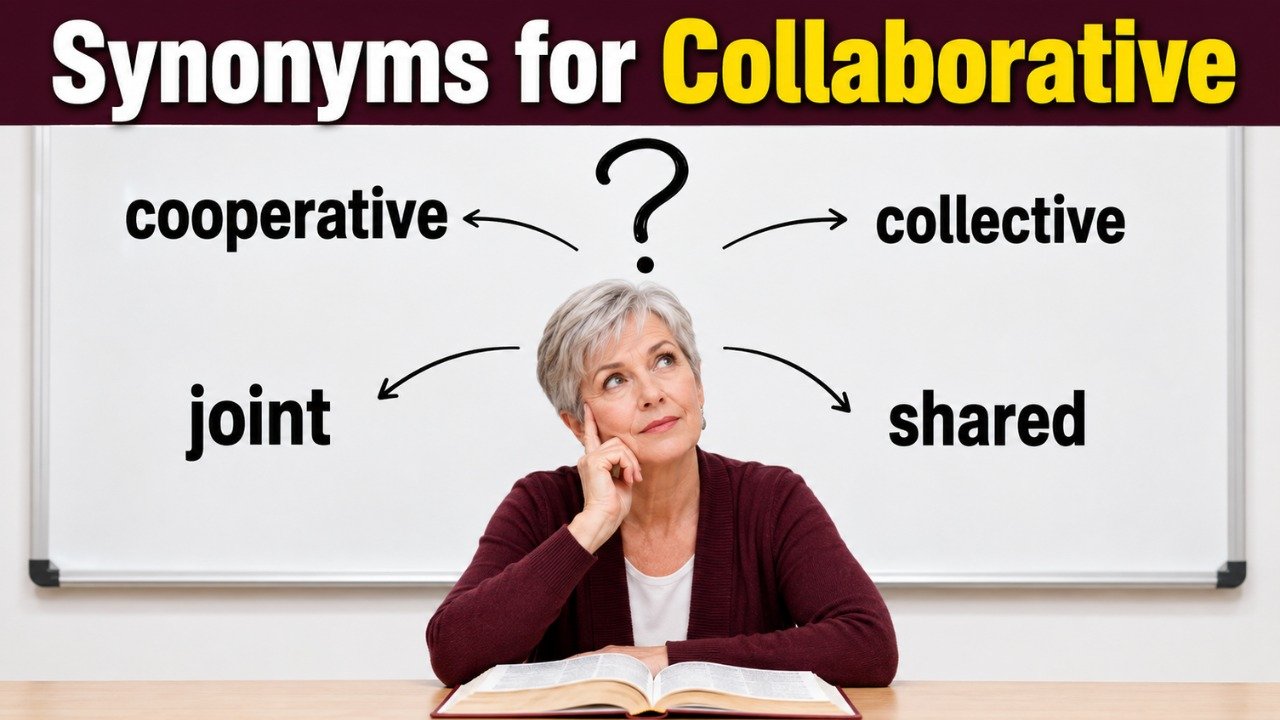
Quick Answer: The best synonyms for collaborative include cooperative, joint, collective, coordinated, shared, participatory, collegial, consultative, integrated, and team oriented. Use cooperative for people who willingly work together, joint for work completed by two or more parties, collective for group responsibility, coordinated for organized teamwork, and participatory when everyone contributes. Collegial suits professional or academic relationships, while consultative describes a process that actively seeks ideas and advice from others.
Pronunciation and Word Details
Word: Collaborative.
Pronunciation: /kəˈlæb.ə.rə.tɪv/
Part of Speech: Adjective.
Meaning: Involving two or more people or groups working together toward a shared goal.
US Pronunciation:
UK Pronunciation:
What Does “Collaborative” Mean?
Collaborative means involving people, teams, or organizations working together to create, solve, plan, or achieve something.
The word collaborative is an adjective. It describes a person, relationship, process, environment, project, effort, or approach based on cooperation and shared contribution.
A collaborative person listens to others, shares ideas, accepts feedback, and contributes toward a common result.
Example: She is a collaborative manager who values suggestions from every team member.
A collaborative project involves several people combining their knowledge, skills, or resources.
Example: The report was the result of a collaborative research project.
A collaborative environment encourages open communication, shared responsibility, and active participation.
Example: The teacher created a collaborative learning environment.
The word can also describe work between different departments, professions, communities, or institutions.
Example: The campaign required a collaborative effort from several departments.
Collaborative does not simply mean that people are present in the same group. It suggests that they actively communicate, contribute, and work toward the same purpose.
Meaning, Tone, and Context of “Collaborative”
Collaborative has a positive, neutral, and professional tone. It usually suggests cooperation, openness, shared responsibility, communication, and respect for different ideas.
The word is common in professional, academic, educational, creative, technical, and community contexts. It often appears in discussions about teamwork, leadership, research, planning, design, problem solving, and decision making.
In workplace communication, collaborative describes teams or leaders who work openly with others.
Example: The department follows a collaborative approach to planning.
In education, collaborative often refers to activities in which students or teachers learn and solve problems together.
Example: Collaborative learning helped the students understand the topic.
In academic writing, the word may describe research completed by several researchers or disciplines.
Example: The study was a collaborative investigation involving several specialists.
In creative work, collaborative describes ideas, designs, writing, or performances developed through shared input.
Example: The exhibition was a collaborative creative project.
The word sounds more formal than working together. It is suitable for reports, essays, professional emails, presentations, policies, and formal descriptions.
However, collaborative can sound vague when a writer does not explain who is cooperating, what they are doing, or what shared goal they are pursuing. In such cases, a more precise word such as joint, coordinated, consultative, interdisciplinary, or participatory may communicate the meaning more clearly.
When and How to Use “Collaborative”
For Teamwork
Use collaborative when team members share ideas, tasks, and responsibility for an outcome.
Example: The collaborative team completed the assignment ahead of schedule.
For a Shared Project
Use collaborative when a project is created or managed by more than one person or group.
Example: The mural was a collaborative project involving local artists and students.
For Leadership
Use collaborative to describe a leader who seeks input and involves others in decisions.
Example: Her collaborative leadership style improved trust within the department.
For Problem Solving
Use collaborative when several people combine their knowledge to solve a problem.
Example: A collaborative problem solving session produced several practical solutions.
For Decision Making
Use collaborative when decisions are discussed and shaped through group participation.
Example: The committee used a collaborative decision making process.
For Learning
Use collaborative to describe learning through discussion, shared tasks, and group participation.
Example: Collaborative learning encouraged students to explain their ideas clearly.
For Research
Use collaborative when researchers, departments, or specialists work together.
Example: The findings came from a collaborative research effort.
For Communication
Use collaborative when communication is open, respectful, and focused on shared progress.
Example: A collaborative conversation helped both sides identify common goals.
For Creative Work
Use collaborative when writers, artists, designers, or performers develop something together.
Example: The play grew from a collaborative writing process.
For Community Planning
Use collaborative when residents, organizers, and public groups contribute to a shared plan.
Example: The neighborhood adopted a collaborative approach to improving public spaces.
Best Synonyms for Collaborative
Cooperative
Synonym: Willing to work with others toward a common result.
Example: The cooperative team handled the challenge calmly.
Joint
Synonym: Created, owned, managed, or completed by two or more parties.
Example: The departments issued a joint statement.
Collective
Synonym: Involving the combined participation or responsibility of a group.
Example: The decision reflected the collective judgment of the committee.
Coordinated
Synonym: Organized so that different people or activities work effectively together.
Example: The event required a coordinated effort from every volunteer.
Shared
Synonym: Held, experienced, or completed together.
Example: The group worked toward a shared objective.
Participatory
Synonym: Allowing or encouraging people to take an active role.
Example: The organization used a participatory planning process.
Collegial
Synonym: Friendly, respectful, and cooperative in a professional or academic setting.
Example: The discussion remained collegial even when opinions differed.
Consultative
Synonym: Based on seeking advice, opinions, or input before making decisions.
Example: The director adopted a consultative management style.
Integrated
Synonym: Combining separate people, skills, systems, or activities into a connected whole.
Example: The project used an integrated approach to health and education.
Team Oriented
Synonym: Focused on teamwork, shared responsibility, and group success.
Example: Employers often value people with a team oriented attitude.
50 Synonyms for Collaborative with Short Meanings
- Cooperative: Willing to work helpfully with others.
- Joint: Completed or shared by two or more parties.
- Collective: Involving the combined action of a group.
- Coordinated: Organized so that people or activities work together effectively.
- Shared: Held, experienced, or completed together.
- United: Joined by a common purpose or goal.
- Mutual: Experienced, given, or shared by each side.
- Communal: Shared by or involving a community.
- Participatory: Encouraging active involvement from everyone concerned.
- Collegial: Friendly and cooperative in a professional setting.
- Interactive: Involving communication and responses between participants.
- Inclusive: Welcoming contributions from different people.
- Consultative: Seeking opinions or advice before deciding.
- Integrated: Combining separate parts into one connected system.
- Combined: Formed by bringing people, ideas, or resources together.
- Allied: Joined in support of a common purpose.
- Concerted: Planned and performed through combined effort.
- Unified: Brought together into a single coordinated group.
- Reciprocal: Involving exchange or support between people or groups.
- Contributive: Adding ideas, effort, or value to shared work.
- Team Oriented: Focused on group success and cooperation.
- Team Based: Organized around the work of a team.
- Group Based: Developed or completed through group activity.
- Group Oriented: Designed to support participation and group results.
- Partnership Based: Built on cooperation between partners.
- Partnership Driven: Guided by active cooperation between parties.
- Consensus Based: Guided by general agreement among participants.
- Consensus Driven: Focused on reaching decisions accepted by the group.
- Community Led: Directed through active community participation.
- Community Based: Developed with or for a particular community.
- Multidisciplinary: Involving knowledge from several professional fields.
- Interdisciplinary: Combining methods or ideas from different subjects.
- Cross Functional: Involving people from different departments or roles.
- Interconnected: Linked so that people or parts influence one another.
- Mutually Supportive: Providing help and encouragement to each other.
- Jointly Created: Produced through the contributions of several people.
- Jointly Developed: Designed or improved by more than one party.
- Jointly Planned: Organized through shared discussion and preparation.
- Jointly Managed: Controlled or supervised by several parties.
- Jointly Produced: Made through combined work or resources.
- Jointly Written: Written by two or more contributors.
- Cooperatively Organized: Arranged through shared effort and agreement.
- Cooperatively Managed: Directed through cooperation and shared responsibility.
- Cooperatively Developed: Improved or created through teamwork.
- Working Together: Combining effort to reach the same result.
- Acting Together: Taking coordinated action as a group.
- Coordinated in Effort: Organized around a common purpose.
- Open to Input: Willing to consider ideas and feedback from others.
- Cooperative in Approach: Based on helpful and respectful teamwork.
- Synergistic: Producing a stronger result through combined effort.
Read Also:
Synonyms for Explores

Synonyms for Collaborative by Context
When Collaborative Means Cooperative
Cooperative is the closest general synonym when describing people who willingly work together. Mutually supportive, team oriented, and open to input also fit this meaning.
Cooperative Example: The participants were cooperative throughout the discussion.
Mutually Supportive Example: The partners developed a mutually supportive relationship.
Team Oriented Example: She is a team oriented employee who shares information freely.
Open to Input Example: A manager who is open to input can strengthen team trust.
When Collaborative Means Joint
Joint is best when two or more people, departments, or organizations officially share responsibility for something.
Joint Example: The two departments prepared a joint proposal.
Jointly Developed Example: The policy was jointly developed by teachers and administrators.
Jointly Managed Example: The center is jointly managed by several community groups.
Jointly Written Example: The article was jointly written by two researchers.
When Collaborative Means Collective
Collective emphasizes the group as a whole. It is useful for decisions, responsibility, knowledge, action, and achievement.
Collective Example: The final result reflected the collective effort of the entire team.
Combined Example: Their combined experience improved the plan.
United Example: The residents presented a united response.
Unified Example: The members formed a unified working group.
When Collaborative Means Coordinated
Coordinated describes teamwork that is carefully organized. It focuses on planning, timing, communication, and the relationship between different tasks.
Coordinated Example: A coordinated response reduced confusion during the emergency.
Concerted Example: The problem required a concerted effort from several teams.
Integrated Example: The organization introduced an integrated support system.
Cross Functional Example: A cross functional team reviewed the entire process.
When Collaborative Means Participatory
Participatory emphasizes active involvement. It is often used for planning, education, leadership, research, and community decisions.
Participatory Example: The council introduced a participatory budgeting process.
Inclusive Example: The facilitator used an inclusive discussion method.
Community Led Example: The project followed a community led planning model.
Consensus Based Example: The committee used a consensus based approach.
When Collaborative Means Consultative
Consultative describes a process in which leaders or decision makers seek advice and opinions before acting.
Consultative Example: The principal used a consultative approach before changing the schedule.
Interactive Example: The workshop was interactive and encouraged questions.
Collegial Example: The professors maintained a collegial working relationship.
Reciprocal Example: The partnership was based on reciprocal learning.
When Collaborative Means Interdisciplinary
Interdisciplinary and multidisciplinary are useful when people from different fields contribute their expertise.
Interdisciplinary Example: The team used an interdisciplinary approach to the complex problem.
Multidisciplinary Example: A multidisciplinary group examined the patient’s needs.
Integrated Example: The course offered an integrated view of science and communication.
Cross Functional Example: A cross functional committee included members from finance, operations, and training.
Another Word for Collaborative
The best single replacement for collaborative is cooperative because both words describe people or groups working together toward a shared purpose. However, cooperative often describes willingness and behavior, while collaborative can also describe a formal process, project, environment, or method.
The strongest alternative depends on the context. Use joint for shared ownership, coordinated for organized teamwork, participatory for active involvement, and collegial for respectful professional relationships.
Original: The department uses a collaborative approach to planning.
Better Option: The department uses a cooperative approach to planning.
Original: The two researchers completed a collaborative study.
Better Option: The two researchers completed a joint study.
Original: The emergency required a collaborative response.
Better Option: The emergency required a coordinated response.
Original: The council introduced a collaborative decision process.
Better Option: The council introduced a participatory decision process.
When Not to Use “Collaborative”
Collaborative is useful, but it can become vague, repetitive, or overly formal when a more specific word would describe the situation better.
When Only One Person Is Responsible
Do not use collaborative when a task was completed independently.
Weak: She completed the collaborative report alone.
Better: She completed the report independently.
When the Relationship Is Officially Shared
Joint may be clearer when two named parties formally create, own, or manage something.
Weak: The departments released a collaborative statement.
Better: The departments released a joint statement.
When Organization Is the Main Meaning
Coordinated is more precise when the sentence focuses on planning, timing, or organized action.
Weak: The rescue teams made a collaborative response.
Better: The rescue teams made a coordinated response.
When Participation Is the Main Meaning
Participatory or inclusive may be better when the emphasis is on giving people an active voice.
Weak: The residents attended a collaborative planning meeting.
Better: The residents attended a participatory planning meeting.
When Advice Is Requested Before a Decision
Consultative is more accurate when a leader seeks ideas but keeps final decision making authority.
Weak: The director followed a collaborative process before deciding.
Better: The director followed a consultative process before deciding.
When the Sentence Becomes Repetitive
Repeated use of collaborative can make professional writing sound mechanical.
Weak: The collaborative team used a collaborative process to produce a collaborative solution.
Better: The cooperative team used a shared process to produce a joint solution.
When Casual Language Sounds More Natural
In informal conversation, working together may sound clearer and less formal.
Weak: We had a collaborative experience while preparing dinner.
Better: We worked together while preparing dinner.
When Different Fields Are Involved
Interdisciplinary or multidisciplinary may provide more detail when specialists from several subjects contribute.
Weak: The university created a collaborative research group.
Better: The university created an interdisciplinary research group.
Words Commonly Confused With Collaborative
Collaborative vs Cooperative: Collaborative describes work, processes, or relationships involving shared contribution. Cooperative often describes a person’s willingness to help and work peacefully with others.
Collaborative vs Joint: Collaborative emphasizes the process of working together. Joint emphasizes shared ownership, responsibility, authorship, or control.
Collaborative vs Collective: Collaborative focuses on active cooperation. Collective focuses on the group as a whole or the combined result of its members.
Collaborative vs Coordinated: Collaborative highlights shared ideas and participation. Coordinated highlights organization, timing, and connected action.
Collaborative vs Collegial: Collaborative can describe any shared work. Collegial usually describes respectful and friendly relationships among professional or academic colleagues.
Collaborative vs Consultative: Collaborative suggests that people actively shape the work or decision together. Consultative means that opinions are requested, although one person or group may make the final decision.
Collaborative vs Participatory: Collaborative focuses on people working together. Participatory focuses on giving people an active role in a process.
Collaborative vs Inclusive: Collaborative describes cooperation. Inclusive describes a process or environment that welcomes different people, perspectives, and needs.
Collaborative vs Interdisciplinary: Collaborative can involve people from the same or different fields. Interdisciplinary specifically combines knowledge or methods from different subjects.
Collaborative vs Interactive: Collaborative requires participants to work toward a shared result. Interactive only requires communication or responses between participants.
Which Synonym Should You Choose?
Choose cooperative when describing someone who willingly helps, communicates, and works well with others.
Choose joint when two or more parties officially share a project, statement, responsibility, or decision.
Choose collective when emphasizing the combined voice, effort, knowledge, or responsibility of a group.
Choose coordinated when describing organized teamwork, careful timing, or connected action.
Choose shared when the focus is on a common goal, value, responsibility, experience, or resource.
Choose participatory when people are encouraged to take an active role in planning or decision making.
Choose collegial when describing respectful cooperation among colleagues, professionals, teachers, or researchers.
Choose consultative when a person seeks opinions or advice before making a decision.
Choose integrated when different services, ideas, systems, or skills are combined into one connected approach.
Choose interdisciplinary when people from different academic subjects or areas of knowledge work together.
Choose multidisciplinary when several specialists contribute separately from their own professional fields.
Choose cross functional when employees from different departments or roles work on the same task.
Choose consensus based when the group aims to reach general agreement before acting.
Choose inclusive when the process welcomes different participants, perspectives, and experiences.
Choose interactive when the activity involves discussion, questions, responses, and active communication.
Choose team oriented in resumes, professional profiles, workplace descriptions, and casual business communication.
Choose working together in everyday conversation when collaborative sounds too formal.
Real Life Examples of “Collaborative” in Sentences
Original: The manager has a collaborative leadership style.
Better Option: The manager has a consultative leadership style.
Original: The departments created a collaborative report.
Better Option: The departments created a joint report.
Original: The team made a collaborative response to the problem.
Better Option: The team made a coordinated response to the problem.
Original: The school encourages collaborative learning.
Better Option: The school encourages participatory learning.
Original: The researchers followed a collaborative method.
Better Option: The researchers followed an interdisciplinary method.
Original: The committee reached a collaborative decision.
Better Option: The committee reached a consensus based decision.
Original: The employees work in a collaborative environment.
Better Option: The employees work in a cooperative environment.
Original: The neighborhood began a collaborative improvement project.
Better Option: The neighborhood began a community led improvement project.
Original: The designers used a collaborative creative process.
Better Option: The designers used a jointly developed creative process.
Original: Her collaborative attitude strengthened the group.
Better Option: Her team oriented attitude strengthened the group.
Synonym Groups and Usage Differences
Cooperation Group
Cooperative, mutually supportive, team oriented, and cooperative in approach describe helpful behavior and a willingness to work with others.
Cooperative is the most direct option for people. Mutually supportive emphasizes help flowing in both directions. Team oriented focuses on commitment to group success.
Example: His cooperative attitude made the difficult discussion more productive.
Shared Work Group
Joint, shared, jointly created, jointly developed, jointly planned, and jointly produced describe work completed by more than one person or group.
Joint is concise and formal. Shared highlights common responsibility or ownership. Jointly developed emphasizes the process of creating or improving something together.
Example: The two teams prepared a joint training program.
Group Action Group
Collective, combined, united, unified, and concerted describe people acting as a group.
Collective emphasizes the whole group. Combined focuses on bringing resources or abilities together. Concerted suggests deliberate and organized effort.
Example: The volunteers made a concerted effort to complete the work.
Organized Teamwork Group
Coordinated, integrated, cross functional, interconnected, and acting together emphasize organization and connection.
Coordinated is useful for responses, plans, and activities. Integrated describes separate parts forming a complete system. Cross functional refers to cooperation between different workplace roles or departments.
Example: A coordinated plan helped every department understand its responsibilities.
Participation Group
Participatory, inclusive, community led, community based, consensus based, and consensus driven describe processes that involve people in planning or decisions.
Participatory highlights active involvement. Inclusive emphasizes access and representation. Consensus based emphasizes general agreement.
Example: The residents preferred a participatory approach to neighborhood planning.
Professional Relationship Group
Collegial, consultative, interactive, reciprocal, and open to input describe communication and professional cooperation.
Collegial emphasizes respect among colleagues. Consultative focuses on asking for advice. Reciprocal suggests an exchange of knowledge or support.
Example: The committee maintained a collegial atmosphere throughout the debate.
Multiple Fields Group
Interdisciplinary, multidisciplinary, cross functional, and integrated describe cooperation across areas of expertise.
Interdisciplinary blends ideas and methods from different fields. Multidisciplinary includes several specialists who contribute from their own areas. Cross functional is most common for workplace departments.
Example: The complex issue required an interdisciplinary research team.
Partnership Group
Partnership based, partnership driven, allied, mutual, and reciprocal describe cooperation between distinct parties.
Partnership based emphasizes an established working relationship. Allied suggests support for a common purpose. Mutual highlights benefits or responsibilities shared by both sides.
Example: The program used a partnership based model to expand local services.
Antonyms of Collaborative
The opposite of collaborative may describe independent work, poor cooperation, conflict, exclusion, or one sided control.
Independent: Completed without help or shared participation.
Individual: Relating to one person rather than a group.
Solo: Performed by one person alone.
Separate: Kept apart rather than combined.
Isolated: Disconnected from other people or groups.
Uncooperative: Unwilling to work helpfully with others.
Competitive: Focused on defeating others rather than sharing effort.
Adversarial: Involving conflict or opposition between sides.
Divisive: Causing disagreement or separation within a group.
Exclusive: Limiting participation to selected people.
Unilateral: Decided or performed by only one party.
Authoritarian: Requiring obedience while allowing little shared input.
Disjointed: Lacking coordination or connection.
Fragmented: Divided into separate and poorly connected parts.
Conflicting: Involving ideas, interests, or actions that oppose one another.
Comparison: Collaborative vs Related Words
Collaborative vs Cooperative
Collaborative describes an activity or process in which people contribute together. Cooperative often describes behavior and willingness.
Example With Collaborative: The writers used a collaborative editing process.
Example With Cooperative: The writers were cooperative during the editing session.
Collaborative vs Joint
Collaborative emphasizes shared effort and interaction. Joint emphasizes shared ownership, responsibility, or authorship.
Example With Collaborative: The artists followed a collaborative creative process.
Example With Joint: The artists opened a joint exhibition.
Collaborative vs Collective
Collaborative describes how people work. Collective describes the group or the combined result.
Example With Collaborative: The team used a collaborative approach to solving the issue.
Example With Collective: The solution reflected the team’s collective experience.
Collaborative vs Coordinated
Collaborative focuses on cooperation and contribution. Coordinated focuses on organization and timing.
Example With Collaborative: The departments discussed the issue in a collaborative meeting.
Example With Coordinated: The departments launched a coordinated response.
Collaborative vs Participatory
Collaborative means working together toward a result. Participatory means giving people an active role in a process.
Example With Collaborative: The students completed a collaborative project.
Example With Participatory: The students joined a participatory workshop.
Collaborative vs Consultative
Collaborative suggests shared influence over the work or outcome. Consultative suggests that advice is requested before a decision.
Example With Collaborative: The team created the policy through a collaborative process.
Example With Consultative: The director used a consultative process before approving the policy.
Collaborative vs Collegial
Collaborative refers to shared work. Collegial refers to respectful and friendly professional relationships.
Example With Collaborative: The researchers developed a collaborative study.
Example With Collegial: The researchers maintained a collegial relationship.
Collaborative vs Inclusive
Collaborative describes cooperation among participants. Inclusive describes openness to different participants, needs, and viewpoints.
Example With Collaborative: The committee used a collaborative planning method.
Example With Inclusive: The committee created an inclusive environment for discussion.
Collaborative vs Interdisciplinary
Collaborative can involve any people working together. Interdisciplinary specifically involves multiple subjects or fields of knowledge.
Example With Collaborative: The authors completed a collaborative writing project.
Example With Interdisciplinary: The researchers conducted an interdisciplinary study of language and psychology.
Collaborative vs Interactive
Collaborative work produces a shared result. Interactive communication involves active responses but may not produce a common outcome.
Example With Collaborative: The students prepared a collaborative presentation.
Example With Interactive: The students attended an interactive lecture.
Common Phrases and Expressions With “Collaborative”
Collaborative Effort: Work completed through the combined contributions of several people.
Example: The event succeeded because of a collaborative effort.
Collaborative Approach: A method based on shared ideas, responsibility, and action.
Example: The team adopted a collaborative approach to solving the problem.
Collaborative Process: A series of activities completed through group participation.
Example: The policy emerged from a collaborative process.
Collaborative Project: A project created or managed by several contributors.
Example: The students completed a collaborative project on local history.
Collaborative Environment: A setting that encourages communication, trust, and teamwork.
Example: Open discussion helped create a collaborative environment.
Collaborative Team: A team whose members share information and responsibility.
Example: A collaborative team can respond quickly to changing needs.
Collaborative Leadership: Leadership that involves others in ideas, planning, and decisions.
Example: Collaborative leadership increased employee participation.
Collaborative Learning: Learning through group discussion, shared tasks, and peer support.
Example: Collaborative learning improved the students’ communication skills.
Collaborative Research: Research completed by several researchers, departments, or fields.
Example: The discovery resulted from collaborative research.
Collaborative Relationship: A relationship based on shared goals, trust, and active cooperation.
Example: The two organizations developed a collaborative relationship.
Common Mistakes to Avoid
Using Collaborative for Independent Work
Collaborative requires involvement from more than one person or group. Do not use it for work completed entirely alone.
Incorrect: She wrote the collaborative essay without help from anyone.
Correct: She wrote the essay independently.
Confusing Collaborative With Cooperative
Collaborative describes shared work or a shared process. Cooperative often describes a helpful attitude.
Less Precise: He has a collaborative personality.
Better: He has a cooperative personality.
Confusing Collaborative With Joint
Joint is often better when the focus is official shared responsibility or ownership.
Wordy: The departments published a collaborative statement.
Better: The departments published a joint statement.
Using Collaborative When Coordinated Is More Precise
A response can involve cooperation, but coordinated better describes organized timing and action.
Vague: The agencies provided a collaborative emergency response.
Precise: The agencies provided a coordinated emergency response.
Treating Collaborative and Participatory as Identical
Collaborative work requires people to work together. Participatory processes allow people to take part, but they may have different levels of influence.
Unclear: The public attended a collaborative survey.
Better: The public took part in a participatory survey.
Repeating Collaborative Too Often
Too much repetition can make business or academic writing sound unnatural.
Repetitive: The collaborative group held a collaborative meeting to create a collaborative plan.
Improved: The cooperative group held a joint meeting to create a shared plan.
Using Collaborative Without Naming the Shared Goal
The word becomes vague when the reader cannot identify what people are doing together.
Vague: The department became more collaborative.
Clear: The department began sharing information and planning projects across teams.
Using Collaborative as a Noun
Collaborative is mainly an adjective. It usually needs to modify a noun.
Incorrect: The project succeeded because of the collaborative.
Correct: The project succeeded because of collaboration.
Confusing Collaborative With Collaboration
Collaborative is an adjective, while collaboration is a noun.
Adjective Example: They developed a collaborative strategy.
Noun Example: Their collaboration produced a practical strategy.
Using Overly Formal Language in Casual Speech
Collaborative may sound unnatural in simple everyday situations.
Formal: We used a collaborative approach to cleaning the kitchen.
Natural: We worked together to clean the kitchen.
Conclusion
The best synonyms for collaborative depend on the type of cooperation being described. Cooperative suits helpful people, joint describes officially shared work, coordinated emphasizes organized action, and participatory highlights active involvement. Collegial works well for professional relationships, while consultative describes decision making that seeks advice. When choosing among synonyms for collaborative, consider whether the sentence focuses on teamwork, shared ownership, group participation, professional respect, multiple fields, or carefully organized effort.
FAQs About Synonyms for Collaborative
What Is the Best Synonym for Collaborative?
Cooperative is the best general synonym for collaborative. Joint, collective, coordinated, and participatory may be more precise in specific contexts.
What Is a Formal Synonym for Collaborative?
Joint, collective, coordinated, consultative, integrated, and interdisciplinary are useful formal alternatives.
What Is Another Word for a Collaborative Person?
A collaborative person may be described as cooperative, team oriented, supportive, collegial, communicative, or open to input.
Is Cooperative the Same as Collaborative?
The words are closely related but not identical. Cooperative emphasizes willingness to help, while collaborative emphasizes active shared work and contribution.
What Is a Synonym for a Collaborative Team?
A collaborative team can be called a cooperative team, coordinated group, integrated team, cross functional team, or united group.
What Is the Opposite of Collaborative?
Common opposites include independent, uncooperative, isolated, competitive, adversarial, unilateral, and disjointed.
Can Joint Replace Collaborative?
Joint can replace collaborative when two or more parties officially share ownership, responsibility, authorship, or control. It may not fully express open discussion or continuous cooperation.
