
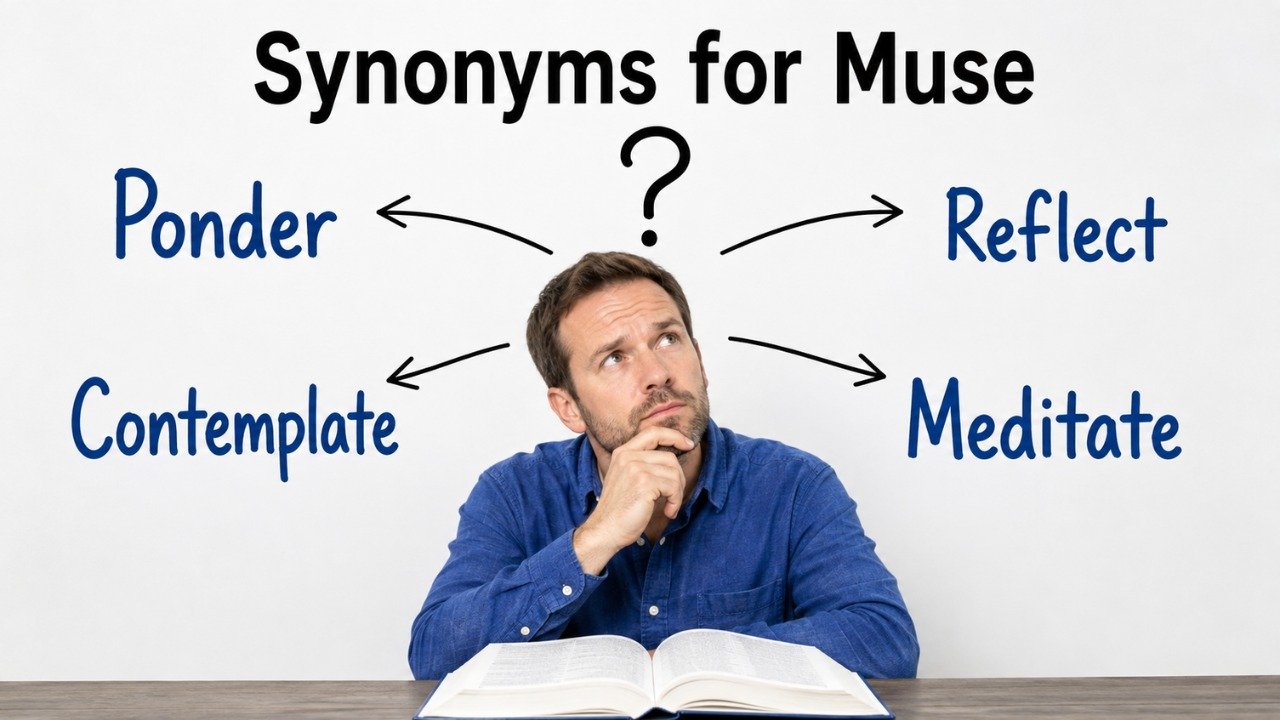
Quick Answer: The best synonyms for muse include inspiration, influence, catalyst, spark, guide, model, contemplate, ponder, reflect, and meditate. When muse is a noun, inspiration is usually the clearest replacement for a person, idea, or experience that encourages creativity. Influence suits something that shapes an artist or writer, while catalyst describes something that starts a creative process. When muse is a verb, contemplate, ponder, and reflect are best for formal writing, while think about and mull over sound more natural in casual conversation.
Pronunciation and Word Details
Word: Muse.
Pronunciation: /mjuːz/.
Part of Speech: Noun and verb.
Meaning: A muse is a source of creative inspiration, while to muse means to think deeply or quietly about something.
US Pronunciation:
UK Pronunciation:
What Does “Muse” Mean?
Muse has two main meanings. As a noun, it means a person, place, experience, idea, or feeling that inspires creative work. As a verb, it means to think carefully, quietly, or imaginatively about something.
Writers, painters, musicians, designers, and other creative people may describe someone or something as their muse. In this sense, the word often carries an artistic, emotional, or poetic tone.
Noun Example: The changing colors of the countryside became her muse.
As a verb, muse describes a thoughtful mental process. It often suggests that someone is considering an idea slowly rather than making a quick decision.
Verb Example: He mused about what his life might be like in another city.
Muse can also appear in narrative writing when a character speaks thoughtfully.
Narrative Example: “Perhaps we were looking in the wrong place,” she mused.
The correct meaning depends on how the word functions in the sentence. A noun muse provides inspiration, while the verb muse describes deep thought.
Meaning, Tone, and Context of “Muse”
Muse is generally a thoughtful and expressive word. Its tone changes according to its grammatical use.
As a Noun: Muse often sounds artistic, emotional, literary, or poetic. It is commonly used when discussing creativity, imagination, beauty, art, writing, music, design, and personal influence.
As a Verb: Muse usually sounds reflective, formal, or literary. It suggests quiet consideration, curiosity, or imagination.
In Creative Contexts: Muse may refer to a person, memory, place, idea, or emotion that inspires original work.
In Formal Writing: Contemplate, reflect, and consider are often clearer than muse when precision is important.
In Conversation: Think about or wonder may sound more natural than muse.
In Storytelling: Muse works well when describing a character who is thinking aloud or considering a possibility.
Muse is not normally a technical word. It is more common in creative, descriptive, personal, and reflective language.
When and How to Use “Muse”
For Creative Inspiration
Use muse as a noun when someone or something inspires creative ideas.
Example: The ocean has always been his muse.
For Personal Influence
A person may be called a muse when their appearance, personality, ideas, or presence inspires another person’s work.
Example: The novelist described her grandmother as her greatest muse.
For Artistic Subjects
Muse can identify a subject that repeatedly appears in paintings, poems, photographs, stories, or other creative works.
Example: The old city became a muse for several of her poems.
For Quiet Reflection
Use muse as a verb when someone thinks calmly and deeply.
Example: She mused about the choices that had brought her there.
For Considering Possibilities
Muse can describe imaginative thought about what might happen.
Example: They mused about opening a small bookshop near the lake.
For Speaking Thoughtfully
In fiction, muse may describe a comment spoken in a reflective manner.
Example: “Time changes everything,” he mused.
For Remembering the Past
Muse can describe thoughtful consideration of past experiences.
Example: He mused over the friendships he had formed during his travels.
For Exploring an Idea
Use muse when someone examines a subject with curiosity rather than reaching an immediate conclusion.
Example: The essay muses on the relationship between memory and identity.
Best Synonyms for Muse
Inspiration
Synonym: A person, idea, or experience that encourages creativity or action.
Example: The garden was the inspiration for her latest collection of poems.
Influence
Synonym: Someone or something that shapes a person’s ideas, style, or work.
Example: Traditional architecture was a major influence on his designs.
Catalyst
Synonym: Something that begins or speeds up a creative process or change.
Example: Their conversation became the catalyst for her new story.
Spark
Synonym: A small idea or experience that begins creative thought.
Example: A childhood memory provided the spark for the novel.
Guide
Synonym: A person or idea that provides direction and encouragement.
Example: Her teacher became a guide throughout her creative development.
Contemplate
Synonym: To think carefully and deeply about something.
Example: He contemplated the meaning of the unexpected message.
Ponder
Synonym: To consider a question or situation for some time.
Example: She pondered whether the opportunity was right for her.
Reflect
Synonym: To think carefully about an experience, idea, or decision.
Example: They reflected on everything they had learned.
Meditate
Synonym: To focus the mind deeply on a subject or thought.
Example: The writer meditated on the importance of forgiveness.
Mull
Synonym: To think about something slowly before making a decision.
Example: Let me mull the proposal before I respond.
50 Synonyms for Muse with Short Meanings
The following list includes alternatives for muse as both a noun and a verb.
- Inspiration: A source of creative ideas or motivation.
- Inspirer: A person who encourages creativity or action.
- Influence: Something that shapes ideas, style, or behavior.
- Stimulus: Something that causes thought, activity, or creativity.
- Impetus: A force that encourages action or development.
- Motivation: A reason or desire that encourages effort.
- Catalyst: Something that begins or accelerates change.
- Spark: A small beginning of an idea or creative process.
- Guide: Someone or something that provides direction.
- Mentor: An experienced person who offers guidance.
- Model: A person or example worthy of imitation.
- Ideal: A perfect example that inspires admiration.
- Icon: A greatly admired person or symbol.
- Vision: A clear imaginative idea of something.
- Creative Force: A powerful source of artistic energy.
- Guiding Spirit: A person or idea that directs creative work.
- Source: The origin of an idea, feeling, or inspiration.
- Wellspring: A rich and continuing source of ideas.
- Fountainhead: The original source of inspiration or activity.
- Encouragement: Support that increases confidence or motivation.
- Contemplate: To think deeply and carefully.
- Ponder: To consider something for a long time.
- Reflect: To think carefully about an experience or idea.
- Meditate: To focus deeply on a subject.
- Deliberate: To consider something carefully before deciding.
- Consider: To think about something thoughtfully.
- Think: To use the mind to examine an idea.
- Brood: To think repeatedly, often with sadness or worry.
- Ruminate: To think deeply and repeatedly about something.
- Speculate: To consider possibilities without complete information.
- Wonder: To think curiously about something uncertain.
- Cogitate: To think deeply in a formal or humorous way.
- Mull: To consider something slowly and carefully.
- Daydream: To imagine pleasant or unlikely situations.
- Imagine: To form an idea or picture in the mind.
- Envision: To imagine a future situation clearly.
- Examine: To consider something closely and carefully.
- Analyze: To study something by examining its parts.
- Review: To think about something again.
- Study: To give careful thought or attention to something.
- Weigh: To compare different choices or possibilities.
- Assess: To consider the value or importance of something.
- Debate: To consider opposing ideas or choices.
- Question: To think critically about whether something is true.
- Introspect: To examine one’s own thoughts and emotions.
- Reminisce: To think or talk about past experiences.
- Fantasize: To imagine unlikely or desirable situations.
- Dream: To imagine possibilities, hopes, or future experiences.
- Dwell: To continue thinking about a subject for a long time.
- Philosophize: To think or speak about deep questions and ideas.
Read Also:
Synonyms for Abuse

Synonyms for Muse by Context
When Muse Means a Source of Inspiration
Inspiration is the most direct synonym when muse refers to someone or something that encourages creative work.
Other useful alternatives include source, spark, stimulus, wellspring, and creative force.
Example With Muse: The forest became her muse.
Example With Inspiration: The forest became her inspiration.
Example With Wellspring: The forest became a wellspring of ideas for her paintings.
When Muse Means a Creative Influence
Influence works well when a person, culture, style, or experience shapes someone’s work over time.
Model, guide, mentor, icon, and guiding spirit may also fit this meaning.
Example With Muse: The poet considered his grandfather his muse.
Example With Influence: The poet considered his grandfather his greatest influence.
Example With Guide: His grandfather served as a creative guide throughout his career.
When Muse Means to Think Deeply
Contemplate, ponder, reflect, and meditate are strong replacements when muse is used as a verb.
Example With Muse: She mused about the meaning of success.
Example With Contemplate: She contemplated the meaning of success.
Example With Reflect: She reflected on what success truly meant to her.
When Muse Means to Consider a Decision
Consider, deliberate, weigh, assess, and mull are suitable when someone is thinking about a choice.
Example With Muse: He mused over whether to accept the position.
Example With Deliberate: He deliberated over whether to accept the position.
Example With Mull: He mulled over whether to accept the position.
When Muse Means to Imagine Possibilities
Imagine, envision, wonder, dream, speculate, and daydream work when muse describes creative or uncertain thought.
Example With Muse: They mused about living beside the sea.
Example With Imagine: They imagined living beside the sea.
Example With Envision: They envisioned a peaceful life beside the sea.
When Muse Means to Think About the Past
Reflect, reminisce, review, and dwell may replace muse when discussing memories.
Example With Muse: She mused over her childhood summers.
Example With Reminisce: She reminisced about her childhood summers.
Example With Reflect: She reflected on the summers she had spent there.
Another Word for Muse
The best single replacement for muse depends on whether it is being used as a noun or a verb.
As a noun, inspiration is usually the clearest alternative. It works for people, places, memories, objects, and experiences that encourage creativity.
As a verb, ponder is one of the closest replacements because it expresses careful and thoughtful consideration.
Original: The mountains were his muse.
Better Option: The mountains were his inspiration.
Original: She mused about her future.
Better Option: She pondered her future.
Original: The conversation became his muse for the story.
Better Option: The conversation became the spark for his story.
Original: He mused over the meaning of the dream.
Better Option: He reflected on the meaning of the dream.
When Not to Use “Muse”
Muse may be unsuitable when the intended meaning needs to be direct, precise, or easy to understand.
When the Meaning Is Ambiguous
Because muse can be a noun or a verb, it may confuse readers when the sentence does not provide enough context.
Weak: Her muse changed everything.
Better: Her creative inspiration changed everything.
When Formal Precision Is Needed
In reports, instructions, or analytical writing, contemplate, consider, or evaluate may communicate the action more clearly.
Weak: The committee mused over the available evidence.
Better: The committee evaluated the available evidence.
When the Tone Sounds Too Literary
Muse may feel unnecessarily poetic in simple conversation.
Weak: I shall muse upon your suggestion.
Better: I will think about your suggestion.
When Describing Quick Thought
Muse suggests slow or reflective thought. It is not ideal for an immediate reaction.
Weak: She mused for a second before answering.
Better: She paused briefly before answering.
When Referring to Practical Decision Making
Words such as assess, weigh, and deliberate are more specific when discussing choices.
Weak: The manager mused about the two proposals.
Better: The manager compared the two proposals carefully.
When It Becomes Repetitive
Repeated use of muse can make creative writing sound forced.
Weak: He mused about the letter, mused about the past, and mused about his next decision.
Better: He pondered the letter, reflected on the past, and considered his next decision.
Words Commonly Confused With Muse
Muse vs Amuse: Muse means to think deeply or to inspire creativity. Amuse means to entertain or make someone smile.
Muse vs Inspiration: A muse is usually a particular source of creativity, while inspiration can refer to the feeling, idea, person, or influence that encourages action.
Muse vs Mentor: A muse inspires creativity, while a mentor actively teaches, advises, or supports someone.
Muse vs Model: A muse inspires artistic work, while a model may be someone who poses for an artist or provides an example to follow.
Muse vs Ponder: Muse and ponder both mean to think deeply. Muse often sounds more imaginative or literary, while ponder is clearer in general writing.
Muse vs Reflect: Muse may involve imagination, possibilities, or quiet thought. Reflect more often involves careful thought about past experiences or known information.
Muse vs Meditate: Muse means to think thoughtfully about a subject. Meditate often suggests focused mental practice, deep concentration, or serious reflection.
Muse vs Ruminate: Both words describe extended thought. Ruminate often suggests repeatedly thinking about the same issue, sometimes in a worried or negative way.
Which Synonym Should You Choose?
Choose inspiration when referring to a person, place, object, emotion, or experience that encourages creativity.
Choose influence when describing something that shapes a person’s ideas, style, or development over time.
Choose spark when describing the first small idea that begins a creative project.
Choose catalyst when something causes an important creative change or begins a new process.
Choose mentor when the person provides active guidance, knowledge, and advice rather than inspiration alone.
Choose contemplate for formal writing about serious, complex, or important questions.
Choose ponder when describing careful thought about a question, possibility, or decision.
Choose reflect when thinking about memories, experiences, lessons, or past events.
Choose deliberate when comparing choices before making a decision.
Choose consider in reports, essays, emails, and professional communication when a clear and neutral word is needed.
Choose mull in casual speech when someone needs time to think about an idea or proposal.
Choose meditate when describing focused, calm, or philosophical thought.
Choose imagine or envision when considering future possibilities or creative scenes.
Choose ruminate when someone repeatedly returns to the same thought, particularly when the tone is serious or troubled.
Choose wonder when the thought is curious, uncertain, or expressed as a question.
Real Life Examples of “Muse” in Sentences
Original: The peaceful village became her muse.
Better Option: The peaceful village became her creative inspiration.
Original: His mother was the muse behind many of his stories.
Better Option: His mother was the influence behind many of his stories.
Original: She mused about changing her career.
Better Option: She contemplated changing her career.
Original: He mused over the offer for several days.
Better Option: He deliberated over the offer for several days.
Original: They mused about what the future might bring.
Better Option: They wondered what the future might bring.
Original: The artist found a new muse in the landscape.
Better Option: The artist found a new source of inspiration in the landscape.
Original: She mused on the lessons she had learned.
Better Option: She reflected on the lessons she had learned.
Original: A brief conversation became his muse for the play.
Better Option: A brief conversation became the spark for the play.
Original: He sat by the window and mused about his childhood.
Better Option: He sat by the window and reminisced about his childhood.
Original: The designer used nature as her muse.
Better Option: The designer used nature as her guiding influence.
Synonym Groups and Usage Differences
Creative Inspiration Group
Inspiration, spark, stimulus, catalyst, source, wellspring, and creative force describe something that encourages new ideas.
Inspiration is the broadest word. Spark emphasizes the beginning of an idea, while wellspring suggests a rich and continuing source.
Example: The changing seasons became a wellspring of ideas for the writer.
Personal Influence Group
Influence, guide, mentor, model, ideal, icon, and guiding spirit refer to people or examples that shape creativity or development.
Mentor includes active advice and teaching. Muse and influence do not necessarily involve direct guidance.
Example: Her former teacher remained an important influence throughout her career.
Deep Thought Group
Contemplate, ponder, reflect, meditate, cogitate, and ruminate describe serious or extended thought.
Contemplate sounds formal. Ponder is thoughtful and neutral. Ruminate suggests returning to the same thought repeatedly.
Example: He pondered the question before giving an answer.
Decision Group
Consider, deliberate, weigh, assess, examine, and debate are useful when choices or evidence must be studied.
Deliberate emphasizes careful decision making, while weigh emphasizes comparing advantages and disadvantages.
Example: The family weighed several options before choosing a new home.
Imagination Group
Imagine, envision, dream, fantasize, speculate, wonder, and daydream describe thoughts about possibilities.
Envision often refers to a clear future image. Speculate involves uncertainty, while daydream usually describes pleasant or unrealistic thought.
Example: She envisioned a future in which the project served the whole community.
Memory Group
Reflect, reminisce, review, dwell, and brood may describe thought about past events.
Reminisce usually has a warm or personal tone. Brood and dwell can suggest excessive or unhappy thought.
Example: They reminisced about the summers they had spent together.
Analytical Thought Group
Analyze, examine, assess, review, study, and question describe careful intellectual consideration.
These words are often more suitable than muse in academic, professional, or technical contexts.
Example: The researchers analyzed the results before reaching a conclusion.
Antonyms of Muse
The opposite of muse changes according to whether muse means inspiration or deep thought.
Discouragement: Something that reduces confidence, effort, or creativity.
Demotivation: A loss of desire or willingness to act.
Deterrent: Something that prevents or discourages action.
Obstacle: Something that blocks creativity or progress.
Distraction: Something that takes attention away from careful thought.
Indifference: A lack of interest, concern, or emotional involvement.
Neglect: Failure to give attention or thought to something.
Disregard: Deliberate lack of consideration.
Forgetfulness: Failure to remember or reflect on something.
Impulsiveness: Acting without careful thought.
Thoughtlessness: Lack of consideration or reflection.
Certainty: Complete confidence that removes the need to speculate or wonder.
Dismissal: Rejection of an idea without careful consideration.
Inattention: Failure to focus on a subject.
Creative Block: A condition in which ideas or inspiration are difficult to produce.
Comparison: Muse vs Related Words
Muse vs Inspiration
Muse often identifies the particular person, place, or subject that inspires creative work. Inspiration is broader and can describe either the source or the feeling of creative excitement.
Example With Muse: The old house became her muse.
Example With Inspiration: She found inspiration in the old house.
Muse vs Influence
Muse usually has an artistic or emotional connection. Influence describes any person, idea, event, or tradition that shapes someone’s thoughts or work.
Example With Muse: The dancer became the painter’s muse.
Example With Influence: Traditional dance was an important influence on the painter’s style.
Muse vs Mentor
A muse inspires, but a mentor teaches and advises.
Example With Muse: The musician considered the city his muse.
Example With Mentor: An experienced composer became his mentor.
Muse vs Ponder
As verbs, both mean to think carefully. Muse is more literary and may include imagination, while ponder is more direct and widely used.
Example With Muse: She mused about the meaning of the message.
Example With Ponder: She pondered the meaning of the message.
Muse vs Reflect
Muse can refer to imaginative thought about possibilities. Reflect usually involves careful thought about something that has happened or been learned.
Example With Muse: He mused about where the journey might lead.
Example With Reflect: He reflected on what the journey had taught him.
Muse vs Contemplate
Both words express deep thought. Contemplate sounds more formal and serious, while muse can sound more creative or personal.
Example With Muse: They mused about moving abroad.
Example With Contemplate: They contemplated moving abroad.
Muse vs Ruminate
Muse often suggests calm, curious, or imaginative thought. Ruminate suggests repeated and extended thinking, which may be negative.
Example With Muse: She mused about the possibilities.
Example With Ruminate: She ruminated on the mistake for several days.
Muse vs Meditate
Muse means to think about a specific idea or possibility. Meditate suggests deeper mental focus and may refer to a structured reflective practice.
Example With Muse: He mused on the nature of happiness.
Example With Meditate: He meditated on the nature of happiness.
Common Phrases and Expressions With “Muse”
My Muse: A person, place, or idea that provides personal inspiration.
Creative Muse: A source that encourages artistic or imaginative ideas.
Artistic Muse: A person or subject that inspires visual art.
Literary Muse: A person, memory, or idea that inspires writing.
Musical Muse: Something or someone that inspires musical creation.
Find Your Muse: Discover a source of creativity or motivation.
Become a Muse: Begin serving as someone’s creative inspiration.
Serve as a Muse: Act as the inspiration for another person’s work.
Muse About Something: Think thoughtfully or imaginatively about a subject.
Muse on Something: Consider an idea deeply, often in a philosophical way.
Muse Over Something: Think carefully about an experience, problem, or decision.
A Source of Inspiration: A clear alternative phrase for someone or something that functions as a muse.
Common Mistakes to Avoid
Confusing Muse With Amuse
Muse and amuse have different meanings. Muse relates to inspiration or thought, while amuse relates to entertainment.
Incorrect: The comedian mused the audience.
Correct: The comedian amused the audience.
Ignoring the Noun and Verb Difference
As a noun, muse refers to a source of inspiration. As a verb, it describes thoughtful consideration.
Noun: Nature was her muse.
Verb: She mused about the beauty of nature.
Using Muse for Every Type of Thinking
Muse suggests deep, quiet, or imaginative thought. It is not the best choice for calculation, quick recall, or immediate judgment.
Unnatural: He mused the total cost.
Better: He calculated the total cost.
Choosing an Inaccurate Synonym
Mentor is not always a replacement for muse. A mentor gives direct guidance, while a muse may inspire without teaching.
Unclear: The sunset was her mentor.
Better: The sunset was her muse.
Overusing Muse in Creative Writing
Repeated use can make the writing sound artificial. Vary the wording with reflect, ponder, wonder, consider, and contemplate.
Repetitive: She mused about the past and mused about the future.
Improved: She reflected on the past and wondered about the future.
Using Muse When the Meaning Is Too Vague
In academic or professional writing, replace muse with a more precise verb.
Vague: The report muses about the problem.
Clearer: The report examines the problem.
Using the Wrong Preposition
Muse may appear with about, on, or over. Muse about is common for possibilities, muse on often sounds philosophical, and muse over suggests extended consideration.
Example With About: She mused about changing her routine.
Example With On: The essay muses on the meaning of freedom.
Example With Over: He mused over the decision all evening.
Calling Every Inspiring Person a Muse
Muse often carries an artistic or personal meaning. In professional contexts, influence, mentor, guide, or role model may be clearer.
Less Precise: My manager is my muse.
More Precise: My manager is an important mentor and professional influence.
Conclusion
The best synonyms for muse depend on whether the word describes creative inspiration or thoughtful reflection. Inspiration, influence, spark, catalyst, and guiding spirit work well when muse is a noun. Contemplate, ponder, reflect, meditate, consider, and mull are stronger choices when muse is a verb. Choose the alternative that matches the tone and purpose of your sentence. Understanding these synonyms for muse will help you write more clearly, avoid repetition, and express creative or reflective ideas with greater precision.
FAQs About Synonyms for Muse
What Is the Best Synonym for Muse?
Inspiration is the best general synonym when muse is a noun. Ponder or contemplate is usually best when muse is a verb.
Can Inspiration Replace Muse?
Yes. Inspiration can replace muse when referring to a person, place, idea, or experience that encourages creativity.
What Is a Synonym for Muse as a Verb?
Common verb synonyms include ponder, reflect, contemplate, meditate, consider, wonder, and mull.
Is a Muse the Same as a Mentor?
No. A muse inspires creative work, while a mentor provides direct advice, teaching, or guidance.
Can a Place Be a Muse?
Yes. A landscape, building, city, room, or natural setting can be described as a muse when it inspires creativity.
Is Muse a Formal Word?
Muse is slightly formal or literary as a verb. As a noun, it is common in artistic, creative, and personal contexts.
What Is the Difference Between Muse and Ponder?
Both words can mean to think deeply. Muse sounds more literary or imaginative, while ponder is more direct and suitable for general writing.
