
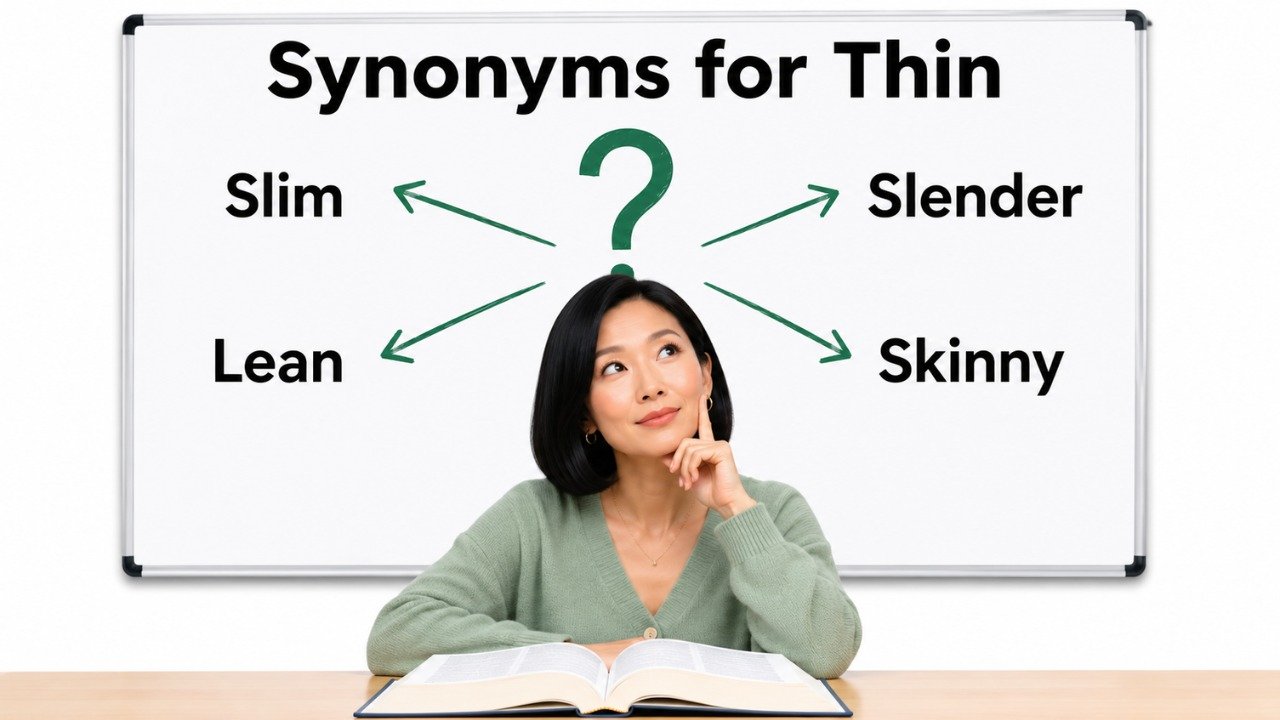
Quick Answer: Common synonyms for thin include slim, slender, lean, narrow, fine, sparse, sheer, watery, flimsy, and weak. Use slim or slender for an attractively lean person, narrow for something with little width, fine for a small diameter, sparse for limited coverage, sheer for delicate fabric, watery for a liquid lacking thickness, and flimsy for weak material. The best synonym depends on whether thin describes body shape, physical dimensions, density, consistency, strength, or amount.
Pronunciation and Word Details
Word: Thin.
Pronunciation: /θɪn/.
Part of Speech: Adjective.
Meaning: Having little thickness, width, density, strength, or substance.
US Pronunciation:
UK Pronunciation:
What Does “Thin” Mean?
Thin means having a small distance between two opposite surfaces or containing less material, substance, or density than expected.
Thin is mainly used as an adjective. It can describe a person with little body fat, an object with little thickness, a narrow shape, a liquid with a light consistency, or an area with limited coverage.
A thin sheet has little thickness. A thin person has a slight or lean body shape. Thin soup contains too much liquid and not enough substance. A thin crowd has relatively few people.
The word can also describe weak ideas, sounds, excuses, or evidence. In these contexts, thin means unconvincing, lacking strength, or insufficient.
Meaning, Tone, and Context of “Thin”
Thin is a common and generally neutral word, but its tone changes according to context.
When describing objects, materials, layers, lines, or liquids, thin is usually neutral and practical. It appears naturally in everyday conversation, instructions, descriptions, academic writing, and technical communication.
When describing a person, thin can sound neutral, complimentary, concerned, or critical. Slim, slender, and lean are often more positive. Skinny, scrawny, and bony can sound negative or insulting.
In formal or technical writing, a more exact word may be preferable. Narrow describes width, fine describes diameter, sparse describes density, diluted describes concentration, and flimsy describes weakness.
Thin can also carry an emotional meaning. A thin excuse sounds unconvincing, while thin hope suggests that success is unlikely.
When and How to Use “Thin”
For Body Shape
Use thin to describe a person or animal with little body fat or a slight build. Choose the wording carefully because comments about appearance can be sensitive.
Example: He became noticeably thin after several months of intense training.
For Objects with Little Thickness
Use thin when the distance between two surfaces is small.
Example: Place a thin layer of cream over the cake.
For Narrow Shapes
Thin can describe something that appears narrow, such as a line, strip, branch, or face.
Example: She drew a thin line along the edge of the page.
For Limited Density or Coverage
Use thin when people, plants, hair, clouds, or other elements are spread apart.
Example: The trees became thin near the top of the mountain.
For Light Liquid Consistency
Thin can describe a liquid that flows easily or lacks thickness.
Example: The sauce became too thin after extra water was added.
For Weak Material
Use thin when a material lacks strength because it contains little substance.
Example: The thin cardboard bent under the weight of the books.
For Weak Evidence or Reasoning
Thin can describe an argument, excuse, explanation, or claim that is not convincing.
Example: The explanation was thin and failed to address the main concern.
For a Limited Amount
Thin can indicate that something is scarce, limited, or insufficient.
Example: Employment opportunities were thin in the small village.
Best Synonyms for Thin
Slim: Attractively thin or small in width.
Example: She wore a slim silver bracelet.
Slender: Gracefully thin and well proportioned.
Example: A slender tree stood beside the entrance.
Lean: Thin, fit, and containing little unnecessary fat.
Example: The runner had a strong, lean build.
Narrow: Having little width from side to side.
Example: They followed a narrow path through the forest.
Fine: Very small in thickness or diameter.
Example: A fine thread connected the two pieces.
Sparse: Thinly distributed or present in small numbers.
Example: Vegetation was sparse across the dry landscape.
Sheer: Extremely thin, light, or partly transparent.
Example: The curtains were made from sheer fabric.
Watery: Containing too much water and lacking thickness or flavor.
Example: The soup tasted watery and weak.
Flimsy: Thin, light, and not physically strong.
Example: The package arrived in a flimsy cardboard box.
Tenuous: Very thin, weak, slight, or uncertain.
Example: The connection between the two events was tenuous.
50 Synonyms for Thin with Short Meanings
- Slim: Attractively thin or small in width.
- Slender: Gracefully thin and narrow.
- Lean: Thin, fit, and low in body fat.
- Slight: Small and delicate in build.
- Skinny: Very thin, sometimes unattractively.
- Lanky: Tall and noticeably thin.
- Bony: So thin that the bones are visible.
- Gaunt: Unhealthily thin, often because of hardship.
- Scrawny: Unattractively thin and physically weak.
- Frail: Thin, delicate, and physically weak.
- Underweight: Weighing less than the expected range.
- Emaciated: Extremely and often dangerously thin.
- Narrow: Having little width.
- Fine: Very small in thickness or diameter.
- Delicate: Light, fine, and easily damaged.
- Threadlike: Extremely thin like a piece of thread.
- Hairlike: As thin as a strand of hair.
- Wispy: Thin, light, and delicate in appearance.
- Papery: Very thin and similar to paper.
- Gauzy: Thin, light, and partly transparent.
- Sheer: Extremely thin and almost transparent.
- Translucent: Allowing some light to pass through.
- Transparent: Thin or clear enough to see through.
- Sparse: Present in small numbers or limited coverage.
- Scant: Barely sufficient in amount.
- Scanty: Small, limited, or insufficient.
- Meager: Lacking quantity, richness, or substance.
- Limited: Restricted in quantity or availability.
- Scarce: Difficult to find because little is available.
- Minimal: Extremely small in amount or degree.
- Light: Not heavy, dense, or substantial.
- Patchy: Unevenly distributed with visible gaps.
- Dispersed: Spread widely with space between parts.
- Rarefied: Thin or less dense, especially air.
- Tenuous: Very thin, weak, or uncertain.
- Attenuated: Reduced in thickness, strength, or intensity.
- Flimsy: Thin and lacking physical strength.
- Fragile: Delicate and easily broken or damaged.
- Weak: Lacking strength, power, or substance.
- Feeble: Very weak or lacking force.
- Insubstantial: Lacking strength, thickness, or importance.
- Lightweight: Light in weight or construction.
- Watery: Too liquid and lacking thickness.
- Runny: Flowing too easily because of low thickness.
- Diluted: Made thinner or weaker by added liquid.
- Dilute: Weak in concentration.
- Fluid: Flowing easily and lacking stiffness.
- Loose: Not thick, firm, or compact.
- Shallow: Having little depth.
- Slimline: Designed with a thin or narrow shape.
Read Also:
Synonyms for Muse

Synonyms for Thin by Context
When Thin Means Slim in Body Shape
Slim, slender, lean, slight, and lanky describe different types of thin body shapes.
Slim is usually positive and suggests an attractive shape. Slender suggests grace and balanced proportions. Lean often suggests fitness or muscle definition. Slight describes a small and delicate build. Lanky describes someone who is tall with long, thin limbs.
Example: The dancer had a slender and graceful figure.
Example: Years of training gave him a lean physique.
When Thin Means Narrow or Fine
Narrow, fine, threadlike, hairlike, slimline, and delicate describe objects with little width or thickness.
Narrow is best for roads, spaces, openings, and paths. Fine is suitable for lines, threads, wires, and details. Threadlike and hairlike emphasize extreme thinness.
Example: A narrow passage connected the two rooms.
Example: Fine cracks appeared across the glass.
When Thin Means Sparse
Sparse, scant, scanty, patchy, dispersed, limited, and scarce describe low density or quantity.
Sparse is useful for hair, vegetation, crowds, and information. Patchy means that coverage is uneven. Scant and meager suggest that the available amount is not enough.
Example: Grass was sparse in the driest part of the field.
Example: The report contained scant evidence for its conclusion.
When Thin Means Weak or Flimsy
Flimsy, fragile, weak, feeble, tenuous, and insubstantial describe something lacking strength.
Flimsy commonly describes materials or poorly constructed objects. Tenuous describes weak connections, arguments, relationships, or possibilities. Insubstantial suggests a lack of meaningful content or support.
Example: The chair felt flimsy and unsafe.
Example: Their argument depended on a tenuous assumption.
When Thin Means Watery
Watery, runny, diluted, dilute, fluid, and loose describe liquids or mixtures with low thickness or concentration.
Watery often suggests poor quality or weak flavor. Runny describes food that should be thicker. Diluted means that another liquid has reduced the original concentration.
Example: The gravy was runny because it had not cooked long enough.
Example: The cleaner was diluted with water before use.
When Thin Means Transparent
Sheer, gauzy, translucent, transparent, and papery describe materials that are light, delicate, or easy to see through.
Sheer and gauzy are often used for fabric. Translucent allows light through without providing a perfectly clear view. Transparent permits a clearer view through the material.
Example: Morning light passed through the sheer curtains.
Example: The container was made from translucent plastic.
Another Word for Thin
Slender is one of the best general replacements for thin when describing a person, plant, object, or shape positively. However, the best alternative always depends on the intended meaning.
Use narrow for width, fine for diameter, sparse for density, watery for liquid consistency, and flimsy for weak material.
Original: A thin tree grew beside the fence.
Better Option: A slender tree grew beside the fence.
Original: We walked along a thin road.
Better Option: We walked along a narrow road.
Original: He drew a thin line with a pencil.
Better Option: He drew a fine line with a pencil.
Original: The garden had thin vegetation.
Better Option: The garden had sparse vegetation.
When Not to Use “Thin”
Avoid thin when a more precise word would make the sentence clearer.
When describing a person, thin may sound overly direct or critical. Slim, slender, or lean may communicate the intended meaning more tactfully.
Weak: She has a thin body.
Better: She has a slender build.
Do not use thin for width when narrow is more exact.
Weak: The car entered a thin street.
Better: The car entered a narrow street.
Avoid thin when describing limited numbers or uneven coverage.
Weak: A thin crowd attended the event.
Better: A sparse crowd attended the event.
Do not use thin when the problem is weak concentration rather than physical thickness.
Weak: The juice tasted thin.
Better: The juice tasted diluted.
Avoid thin for weak reasoning when a more descriptive word is available.
Weak: The proposal was based on thin evidence.
Better: The proposal was based on insufficient evidence.
Do not use thin repeatedly in the same paragraph. Change the synonym according to the object, meaning, and tone.
Words Commonly Confused With Thin
Thin vs Slim: Thin is neutral and describes little thickness or body fat. Slim is usually more positive and often suggests an attractive shape.
Thin vs Skinny: Thin can be neutral, while skinny often sounds critical and may suggest excessive thinness.
Thin vs Slender: Thin is broad and general. Slender suggests graceful proportions or an elegant narrow shape.
Thin vs Lean: Thin refers mainly to low thickness or body fat. Lean often suggests physical fitness, firmness, and little unnecessary fat.
Thin vs Narrow: Thin usually describes thickness. Narrow describes width from side to side.
Thin vs Fine: Thin is a general description. Fine is more precise for small lines, threads, wires, particles, or details.
Thin vs Sparse: Thin can describe low density, but sparse specifically means widely spaced or limited in number.
Thin vs Watery: Thin describes consistency generally. Watery suggests that too much water has weakened the substance or flavor.
Thin vs Flimsy: Thin describes physical dimensions. Flimsy also suggests that the object is weak, poorly made, or easily damaged.
Which Synonym Should You Choose?
Choose slim when describing an attractively thin person, object, or design.
Choose slender when you want to suggest grace, elegance, or balanced proportions.
Choose lean when describing a fit person, an efficient organization, or something without unnecessary material.
Choose narrow when referring to roads, openings, spaces, paths, or limited width.
Choose fine when describing threads, lines, wires, cracks, hair, or detailed work.
Choose sparse when referring to hair, vegetation, crowds, information, or limited coverage.
Choose sheer when describing extremely thin or partly transparent fabric.
Choose watery when food, paint, or another liquid contains too much water.
Choose flimsy when an object or material is both thin and weak.
Choose tenuous when describing a weak argument, connection, relationship, or possibility.
Choose scant or meager when an amount is too small or insufficient.
Choose translucent when a material allows light to pass through but is not completely clear.
Real Life Examples of “Thin” in Sentences
Original: She wore a thin gold chain around her neck.
Better Option: She wore a fine gold chain around her neck.
Original: A thin path led toward the old house.
Better Option: A narrow path led toward the old house.
Original: The young tree had a thin trunk.
Better Option: The young tree had a slender trunk.
Original: His hair became thin near the front.
Better Option: His hair became sparse near the front.
Original: The fabric was thin enough to let light through.
Better Option: The fabric was sheer enough to let light through.
Original: The soup was thin and lacked flavor.
Better Option: The soup was watery and lacked flavor.
Original: The box was too thin to protect the glass.
Better Option: The box was too flimsy to protect the glass.
Original: The article offered thin evidence for its claim.
Better Option: The article offered scant evidence for its claim.
Original: The mist formed a thin layer over the lake.
Better Option: The mist formed a light layer over the lake.
Original: Their connection to the incident was thin.
Better Option: Their connection to the incident was tenuous.
Synonym Groups and Usage Differences
Body Shape Group
Slim, slender, lean, slight, skinny, lanky, gaunt, and scrawny describe body shape.
Slim, slender, and lean are usually positive or neutral. Skinny and scrawny can sound negative. Gaunt often suggests illness, stress, age, or hardship.
Example: The athlete remained lean throughout the competitive season.
Width and Thickness Group
Narrow, fine, delicate, threadlike, hairlike, papery, and slimline describe small physical dimensions.
Narrow refers mainly to width. Fine, threadlike, and hairlike emphasize a very small diameter. Papery describes something almost as thin as paper.
Example: A hairlike crack appeared near the corner of the screen.
Density and Quantity Group
Sparse, scant, meager, limited, scarce, minimal, patchy, and dispersed describe low density or a limited amount.
Sparse focuses on space between individual elements. Scant and meager suggest insufficiency. Patchy means the material or coverage is uneven.
Example: The available information was meager and incomplete.
Consistency Group
Watery, runny, diluted, dilute, fluid, and loose describe liquids or mixtures that lack thickness.
Watery often implies excessive water. Runny describes food, paint, cream, or mixtures that do not hold their intended form.
Example: The filling remained runny after cooling.
Strength and Substance Group
Flimsy, fragile, weak, feeble, tenuous, and insubstantial describe limited physical or figurative strength.
Flimsy is suitable for materials and construction. Tenuous is common for connections, claims, and possibilities. Insubstantial describes something lacking meaningful content or support.
Example: The conclusion rested on an insubstantial argument.
Transparency Group
Sheer, gauzy, translucent, and transparent describe light materials that allow some or all light to pass through.
Sheer and gauzy often describe fabrics. Translucent provides partial visibility, while transparent allows a clearer view.
Example: The lampshade produced a soft glow through its translucent surface.
Antonyms of Thin
The opposite of thin depends on its meaning. Thick is the general opposite for physical thickness, while broad, dense, abundant, strong, concentrated, and opaque apply to other contexts.
Thick: Having a large distance between opposite surfaces.
Wide: Having a large measurement from side to side.
Broad: Wide or extensive in size or range.
Heavy: Dense, substantial, or greater in weight.
Dense: Closely packed with little empty space.
Crowded: Containing many people or objects.
Abundant: Available in large quantities.
Plentiful: Existing in more than sufficient amounts.
Strong: Having considerable strength, force, or influence.
Sturdy: Firmly built and difficult to damage.
Substantial: Large, strong, important, or meaningful.
Concentrated: Containing a high amount of a substance.
Rich: Thick, full, strong, or intense in quality.
Opaque: Not allowing light to pass through.
Solid: Firm, strong, and not easily damaged.
Comparison of Thin and Related Words
Thin vs Slim
Thin is a broad word that can describe people, objects, liquids, materials, crowds, or arguments. Slim usually has a more positive tone and is commonly used for attractive body shapes or narrow designs.
Example With Thin: The book was thin and easy to carry.
Example With Slim: The phone had a slim and elegant design.
Thin vs Slender
Thin simply means lacking thickness or body fat. Slender suggests a graceful, delicate, or well proportioned shape.
Example With Thin: The branch was thin enough to bend.
Example With Slender: A slender branch reached toward the window.
Thin vs Lean
Thin focuses on small size, thickness, or body fat. Lean often suggests strength, fitness, or efficiency.
Example With Thin: The dog looked thin after being lost for several days.
Example With Lean: The dog had a healthy, lean build.
Thin vs Narrow
Thin usually measures the distance between front and back surfaces. Narrow measures the distance from one side to the other.
Example With Thin: The table had a thin wooden top.
Example With Narrow: The table was narrow enough to fit in the hallway.
Thin vs Fine
Thin is a general description, while fine emphasizes a very small diameter or delicate detail.
Example With Thin: A thin wire connected the device.
Example With Fine: A fine wire connected the delicate components.
Thin vs Sparse
Thin can describe limited coverage, but sparse is more precise when elements are widely separated.
Example With Thin: The forest became thin near the rocky ground.
Example With Sparse: Vegetation became sparse near the rocky ground.
Thin vs Watery
Thin describes a liquid with low thickness. Watery also suggests excessive water, weak flavor, or reduced quality.
Example With Thin: The paint was thin and easy to spread.
Example With Watery: The paint was watery and failed to cover the wall.
Thin vs Flimsy
Thin refers to physical thickness. Flimsy means thin, weak, and easily bent or damaged.
Example With Thin: The folder was made from thin plastic.
Example With Flimsy: The flimsy folder tore after a few uses.
Common Phrases and Expressions With Thin
Thin Air: An expression used when something disappears or appears without an obvious explanation.
Thin Ice: A dangerous or uncertain situation in which one mistake may cause trouble.
Thin Line: A small difference or boundary between two conditions.
Thin Layer: A small amount of material spread over a surface.
Thin Skin: A tendency to become offended or upset easily.
Thin Voice: A voice that lacks strength, depth, or fullness.
Thin Argument: An argument that lacks convincing evidence or logic.
Thin Crowd: A gathering containing relatively few people.
Thin Soup: Soup with a light, watery consistency.
Thin Fabric: Material with little thickness, often light or transparent.
Common Mistakes to Avoid
One common mistake is using thin for every meaning without considering a more precise alternative. A road is usually narrow, hair may be sparse, a line may be fine, and weak sauce may be watery.
Avoid using skinny as a neutral replacement for thin in formal or polite communication. Skinny can sound judgmental or insulting when used for a person.
Do not assume slim, slender, and lean are identical. Slim emphasizes an attractive lack of excess size. Slender suggests elegance. Lean often suggests fitness or efficiency.
Avoid describing an object as flimsy only because it is thin. Some thin materials are strong. Flimsy should be used only when weakness is part of the meaning.
Do not confuse translucent with transparent. A translucent material allows light through but does not provide a perfectly clear view.
Avoid vague statements such as thin information or thin results when scant, limited, insufficient, or weak would communicate the meaning more clearly.
Do not repeat thin several times in nearby sentences. Select synonyms according to width, thickness, consistency, strength, density, or tone.
Conclusion
Synonyms for thin help writers describe body shape, dimensions, density, consistency, strength, and quantity more precisely. Slim, slender, and lean work well for body shape. Narrow and fine describe physical dimensions, while sparse and scant express limited coverage or amount. Watery and runny suit liquids, and flimsy or tenuous describe weakness. Choosing the right alternative improves clarity, tone, and accuracy. Always consider what is thin, why it is thin, and whether the description should sound neutral, positive, technical, or critical.
FAQs About Synonyms for Thin
What Is the Best Synonym for Thin?
Slender is a strong general synonym when describing a graceful person, plant, or object. The best choice still depends on context.
What Is a Positive Word for Thin?
Slim, slender, and lean are generally positive alternatives. Slim suggests an attractive shape, while lean may suggest fitness.
What Is a Negative Synonym for Thin?
Skinny, scrawny, bony, gaunt, and emaciated can carry negative or concerning meanings. They should be used carefully.
What Is Another Word for a Thin Object?
Narrow, fine, delicate, papery, threadlike, and slimline can describe thin objects, depending on their shape and material.
What Is Another Word for Thin Hair?
Sparse, fine, wispy, or patchy may describe thin hair. Sparse emphasizes low density, while fine describes individual strands.
What Is Another Word for Thin Liquid?
Watery, runny, diluted, fluid, or loose can describe a thin liquid. Watery usually suggests too much water or weak flavor.
What Is the Difference Between Thin and Slender?
Thin is a general word for limited thickness or body fat. Slender is more positive and suggests a graceful, narrow, or well proportioned shape.
