
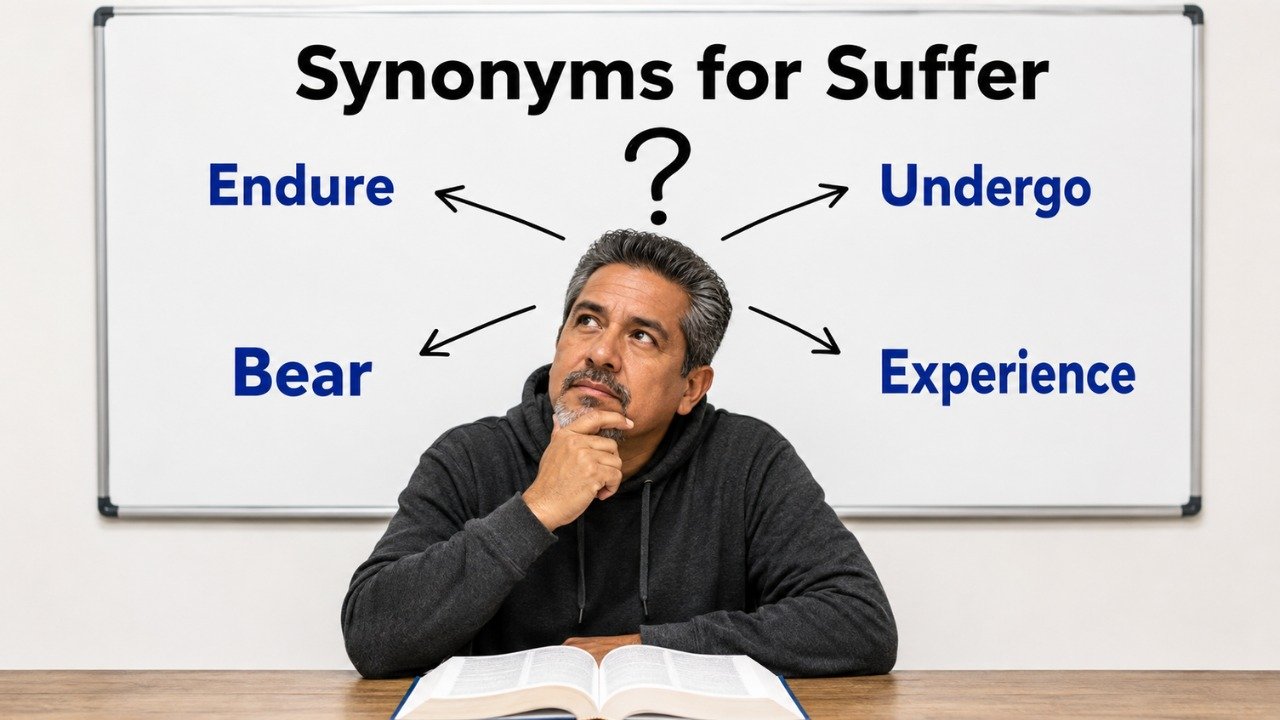
Quick Answer: The best synonyms for suffer are endure, undergo, experience, bear, tolerate, withstand, struggle, ache, grieve, and deteriorate. Choose endure when someone continues through hardship, undergo for an unpleasant process, and experience for a neutral or formal description. Bear and tolerate describe accepting discomfort, while withstand emphasizes resisting pressure or harm. Use ache for physical or emotional pain, grieve for loss, struggle for ongoing difficulty, and deteriorate when health, quality, performance, or conditions become worse.
Pronunciation and Word Details
Word: Suffer.
Pronunciation: /ˈsʌfər/.
Part of Speech: Verb.
Meaning: To experience pain, distress, hardship, damage, loss, or another unpleasant condition.
US Pronunciation:
UK Pronunciation:
What Does “Suffer” Mean?
Suffer means to experience physical pain, emotional distress, hardship, damage, loss, or another unpleasant situation.
It is mainly used as a verb. The exact meaning changes according to the sentence.
A person may suffer from an illness, injury, disappointment, grief, stress, loneliness, or financial difficulty.
Example: She suffered from severe back pain after the accident.
Suffer can also mean to undergo an unpleasant event or consequence.
Example: The company suffered a major loss during the difficult season.
It may describe a decline in quality, condition, reputation, or performance.
Example: His concentration suffered because he was not sleeping well.
Suffer can also mean to tolerate or endure something difficult.
Example: The residents suffered through several days without electricity.
In older or highly formal usage, suffer may mean to allow or permit something. This meaning is uncommon in modern everyday language.
Example: The teacher would not suffer repeated interruptions.
The word can therefore describe pain, endurance, harm, decline, loss, or tolerance. Readers must consider the surrounding words to understand the intended meaning.
Meaning, Tone, and Context of “Suffer”
Suffer is generally a strong and emotional word. It often communicates that an experience is painful, damaging, difficult, or unwanted.
Emotional Tone: Suffer can express sadness, fear, grief, loneliness, disappointment, or emotional pressure.
Physical Context: It is commonly used for pain, injury, illness, weakness, or discomfort.
Formal Context: Suffer appears naturally in reports, essays, news writing, medical discussions, legal descriptions, and professional communication.
Conversational Context: In everyday speech, people often use phrases such as go through, deal with, struggle with, or be in pain instead.
Academic Context: Suffer may describe negative effects on people, communities, systems, environments, or economies.
Business Context: It commonly refers to losses, declining performance, reputational damage, or reduced demand.
Literary Context: Suffer may create a serious, dramatic, compassionate, or tragic tone.
Neutral Context: Experience or undergo may be better when the writer wants to describe an unpleasant event without adding strong emotion.
Suffer is not always interchangeable with every related word. Endure emphasizes continuing through difficulty, while suffer emphasizes experiencing the difficulty itself.
When and How to Use “Suffer”
For Physical Pain
Use suffer when someone experiences pain, illness, injury, or physical discomfort.
Example: He suffered from intense headaches for several weeks.
For Emotional Distress
Suffer can describe sadness, grief, anxiety, humiliation, or emotional pain.
Example: She suffered deeply after losing a close friend.
For Illness or a Medical Condition
The phrase suffer from commonly introduces a health condition or repeated symptom.
Example: Many people suffer from seasonal allergies.
For Hardship
Use suffer when someone experiences poverty, hunger, conflict, isolation, or another difficult condition.
Example: The community suffered during the long period of drought.
For Loss
Suffer can describe financial, personal, professional, or competitive loss.
Example: The business suffered a significant decline in sales.
For Damage
Objects, systems, organizations, and places can suffer damage or deterioration.
Example: Several buildings suffered damage during the storm.
For Negative Consequences
Use suffer when an action leads to an unpleasant result.
Example: He ignored the warning and later suffered the consequences.
For Declining Performance
A person’s work, health, concentration, reputation, or relationships may suffer when they become worse.
Example: Her academic performance suffered because of constant interruptions.
For Enduring Difficulty
Suffer can describe continuing through an unpleasant experience.
Example: The travelers suffered through hours of heavy rain.
For Unfair Treatment
Use suffer when someone is harmed, disadvantaged, or treated badly.
Example: Small communities often suffer when essential services are removed.
Best Synonyms for Suffer
Endure
Synonym: To continue through pain, hardship, or discomfort without giving up.
Example: The hikers endured freezing temperatures throughout the night.
Undergo
Synonym: To experience a process, treatment, change, or unpleasant event.
Example: She underwent several months of physical therapy.
Experience
Synonym: To have something happen or personally feel its effects.
Example: The region experienced serious flooding during the rainy season.
Bear
Synonym: To accept or carry pain, responsibility, or difficulty.
Example: He could no longer bear the constant pressure.
Tolerate
Synonym: To accept discomfort, behavior, or conditions without stopping them.
Example: She could not tolerate the loud noise any longer.
Withstand
Synonym: To resist pressure, damage, pain, or difficult conditions successfully.
Example: The structure was designed to withstand strong winds.
Struggle
Synonym: To have serious difficulty dealing with a problem or situation.
Example: Many students struggle with managing their time.
Ache
Synonym: To experience a continuous physical or emotional pain.
Example: His shoulders ached after hours of lifting heavy boxes.
Grieve
Synonym: To feel deep sadness after a loss.
Example: The family grieved for their beloved relative.
Deteriorate
Synonym: To become progressively worse in condition, quality, or performance.
Example: Communication between the two groups began to deteriorate.
50 Synonyms for Suffer with Short Meanings
- Endure: To continue through pain or hardship.
- Undergo: To experience a difficult process or event.
- Experience: To personally encounter a condition or feeling.
- Bear: To carry or accept pain and difficulty.
- Tolerate: To accept an unpleasant condition.
- Withstand: To resist pressure, harm, or discomfort.
- Sustain: To experience an injury, loss, or damage.
- Face: To confront a difficult situation.
- Encounter: To meet or experience a problem.
- Weather: To survive a difficult period successfully.
- Survive: To remain alive or continue after hardship.
- Brave: To face danger, pain, or difficulty courageously.
- Stomach: To tolerate something unpleasant or offensive.
- Accept: To receive or endure an unwanted reality.
- Put Up With: To tolerate an annoying or difficult situation.
- Go Through: To experience a challenging period or event.
- Live Through: To survive and experience a difficult event.
- Be Subjected To: To be forced to experience something unpleasant.
- Be Afflicted By: To experience illness, pain, or serious trouble.
- Be Troubled By: To experience worry, difficulty, or discomfort.
- Be Plagued By: To be repeatedly affected by a serious problem.
- Be Burdened By: To carry a heavy responsibility or difficulty.
- Be Beset By: To be surrounded or repeatedly troubled by problems.
- Hurt: To experience physical or emotional pain.
- Ache: To feel a continuous dull pain.
- Grieve: To feel deep sorrow after a loss.
- Mourn: To express or experience sadness after a death or loss.
- Agonize: To experience extreme physical or emotional pain.
- Struggle: To have difficulty coping or succeeding.
- Languish: To remain in a weak, unhappy, or neglected condition.
- Smart: To feel a sharp physical or emotional pain.
- Writhe: To twist because of intense pain or discomfort.
- Feel Pain: To experience physical or emotional hurt.
- Feel Distress: To experience serious worry or suffering.
- Be in Pain: To experience physical or emotional discomfort.
- Be in Anguish: To experience severe emotional or physical pain.
- Be Miserable: To feel extremely unhappy or uncomfortable.
- Be Distressed: To feel deeply worried, upset, or troubled.
- Be Harmed: To experience injury, loss, or negative effects.
- Be Damaged: To become physically or emotionally harmed.
- Be Impaired: To become weakened or less effective.
- Be Weakened: To lose strength, power, or effectiveness.
- Be Affected: To experience the influence or result of something.
- Deteriorate: To become worse in condition or quality.
- Decline: To become weaker, poorer, or less successful.
- Worsen: To become more serious or unpleasant.
- Take a Hit: To experience a noticeable loss or setback.
- Pay the Price: To experience negative consequences.
- Fall Victim To: To be harmed by a person, event, or condition.
- Succumb To: To be overcome by illness, pressure, or difficulty.
Read Also:
Synonyms for Thin
Synonyms for Suffer by Context
When Suffer Means to Experience Pain
Use hurt, ache, agonize, smart, writhe, feel pain, or be in anguish when referring to physical or emotional pain.
Hurt is broad and conversational. Ache usually describes a continuing dull pain. Agonize and be in anguish express much stronger suffering.
Example With Suffer: She suffered after injuring her shoulder.
Example With Ache: Her shoulder ached after the injury.
Example With Agonize: She agonized over the painful recovery process.
When Suffer Means to Endure Hardship
Use endure, bear, tolerate, withstand, weather, survive, or live through when someone continues despite difficulty.
Endure emphasizes persistence. Withstand suggests resistance, while weather often means surviving a difficult period successfully.
Example With Suffer: The family suffered through a difficult winter.
Example With Endure: The family endured a difficult winter.
Example With Weather: The family managed to weather the difficult winter.
When Suffer Means to Undergo an Experience
Use undergo, experience, encounter, face, go through, or be subjected to when describing an event, process, or condition.
Undergo is common for treatment, examination, change, or a formal process. Experience is broader and more neutral.
Example With Suffer: He suffered a sudden change in his circumstances.
Example With Experience: He experienced a sudden change in his circumstances.
Example With Undergo: His circumstances underwent a sudden change.
When Suffer Means to Experience Illness
Use be afflicted by, be affected by, struggle with, be troubled by, or be plagued by when discussing illness or repeated symptoms.
Be afflicted by sounds formal and serious. Struggle with is more personal and emphasizes difficulty managing the condition.
Example With Suffer: She suffers from recurring migraines.
Example With Be Afflicted By: She is afflicted by recurring migraines.
Example With Struggle: She struggles with recurring migraines.
When Suffer Means to Feel Emotional Pain
Use grieve, mourn, hurt, agonize, be distressed, or be miserable when describing emotional suffering.
Grieve and mourn relate mainly to loss. Agonize describes severe worry or emotional pain.
Example With Suffer: He suffered after the relationship ended.
Example With Grieve: He grieved after the relationship ended.
Example With Hurt: He felt deeply hurt when the relationship ended.
When Suffer Means to Be Damaged
Use be harmed, be damaged, be impaired, be weakened, deteriorate, worsen, or decline when something loses quality, strength, or effectiveness.
Deteriorate describes gradual worsening. Be damaged focuses on the harmful result.
Example With Suffer: The roof suffered during the storm.
Example With Be Damaged: The roof was damaged during the storm.
Example With Deteriorate: The roof began to deteriorate after years of harsh weather.
When Suffer Means to Lose
Use sustain, take a hit, decline, fall, or experience a loss when discussing business, sports, reputation, or performance.
Sustain is formal and commonly appears with loss, injury, or damage. Take a hit is informal.
Example With Suffer: The company suffered heavy losses.
Example With Sustain: The company sustained heavy losses.
Example With Take a Hit: The company took a major financial hit.
When Suffer Means to Face Consequences
Use pay the price, face the consequences, be penalized, or be harmed when an action produces a negative result.
Pay the price is expressive and often suggests that the result could have been avoided.
Example With Suffer: They suffered because they ignored the warning.
Example With Pay the Price: They paid the price for ignoring the warning.
Example With Face the Consequences: They faced the consequences of ignoring the warning.
Another Word for Suffer
Endure is often the best single replacement for suffer when the sentence describes continuing through hardship. However, the best alternative always depends on the intended meaning.
Use experience for neutral descriptions, undergo for processes, ache for physical pain, grieve for loss, and deteriorate for declining quality or condition.
Original: The villagers suffered through a severe winter.
Better Option: The villagers endured a severe winter.
Original: She suffered a painful medical procedure.
Better Option: She underwent a painful medical procedure.
Original: He suffered after the loss of his companion.
Better Option: He grieved after the loss of his companion.
Original: The building suffered after years of neglect.
Better Option: The building deteriorated after years of neglect.
When Not to Use “Suffer”
Suffer is useful, but it can sound vague, repetitive, overly emotional, or less accurate than a more specific verb.
When a More Precise Medical Verb Is Available
Suffer may not explain whether someone developed, experienced, or was diagnosed with a condition.
Weak: He suffered a fever yesterday.
Better: He developed a fever yesterday.
When Describing a Formal Procedure
Undergo is usually more precise for treatment, testing, inspection, or surgery.
Weak: She suffered an examination at the clinic.
Better: She underwent an examination at the clinic.
When the Event Is Neutral
Suffer adds a negative meaning. Do not use it for an experience that is neutral or positive.
Weak: The town suffered rapid population growth.
Better: The town experienced rapid population growth.
When Describing Damage Directly
Use damaged, weakened, impaired, or deteriorated when the type of harm is clear.
Weak: The bridge suffered because of corrosion.
Better: The bridge was weakened by corrosion.
When Discussing a Business Result
Loss, decline, fall, or decrease may provide greater precision.
Weak: Sales suffered last month.
Better: Sales declined last month.
When the Tone Is Too Dramatic
Suffer can make a minor inconvenience sound more serious than it is.
Weak: I suffered because the meeting started ten minutes late.
Better: I was inconvenienced because the meeting started ten minutes late.
When the Word Becomes Repetitive
Repeated use weakens the emotional force of suffer.
Weak: She suffered from stress, suffered at work, and suffered in silence.
Better: She struggled with stress, faced pressure at work, and kept her distress private.
When the Cause Is Unclear
A vague use of suffer may leave readers unsure about what happened.
Weak: The project suffered.
Better: The project was delayed because several important resources were unavailable.
Words Commonly Confused With Suffer
Suffer vs Endure: Suffer focuses on experiencing pain or difficulty. Endure emphasizes continuing through it without giving up.
Suffer vs Experience: Suffer always suggests something negative. Experience can describe positive, negative, or neutral events.
Suffer vs Undergo: Suffer emphasizes discomfort or harm. Undergo describes experiencing a process, treatment, test, or change.
Suffer vs Tolerate: Suffer means to experience something unpleasant. Tolerate means to accept or allow it without necessarily being seriously harmed.
Suffer vs Struggle: Suffer describes pain or hardship. Struggle emphasizes active difficulty in trying to cope, improve, or succeed.
Suffer vs Hurt: Suffer can describe physical pain, emotional distress, loss, damage, or decline. Hurt usually focuses directly on physical or emotional pain.
Suffer vs Grieve: Suffer is broad. Grieve specifically refers to deep sadness caused by death, separation, or another meaningful loss.
Suffer vs Deteriorate: A person can suffer because of a condition. Deteriorate means that the condition itself becomes worse.
Suffer vs Sustain: Suffer is common and broad. Sustain is more formal and is often used with injury, damage, or loss.
Suffer vs Survive: Suffer means to experience hardship. Survive means to remain alive or continue after the hardship.
Which Synonym Should You Choose?
Choose endure when someone continues through pain, hardship, inconvenience, or difficult conditions.
Choose undergo when writing about surgery, treatment, testing, investigation, inspection, or a major process.
Choose experience when you need a neutral and flexible alternative for reports, essays, or formal descriptions.
Choose bear when the sentence concerns carrying emotional pain, responsibility, pressure, or an unpleasant burden.
Choose tolerate when someone accepts annoying behavior, discomfort, noise, or unfavorable conditions.
Choose withstand when something successfully resists pressure, force, damage, heat, cold, or criticism.
Choose struggle when a person has continuing difficulty with work, health, money, learning, or emotions.
Choose ache when describing a steady physical pain or a deep feeling of longing.
Choose grieve when the suffering is caused by death, separation, or personal loss.
Choose agonize when the emotional or physical pain is extremely severe.
Choose be afflicted by when formal writing describes illness, disease, pain, or repeated trouble.
Choose sustain when writing formally about an injury, loss, or damage.
Choose deteriorate when health, quality, relationships, performance, or physical condition gradually becomes worse.
Choose decline when numbers, sales, standards, strength, or performance become lower.
Choose take a hit in casual conversation when a person or organization experiences a noticeable loss or setback.
Choose pay the price when emphasizing that a negative consequence resulted from an earlier choice or action.
Real Life Examples of “Suffer” in Sentences
Original: She suffers from severe allergies every spring.
Better Option: She struggles with severe allergies every spring.
Original: The team suffered a disappointing defeat.
Better Option: The team experienced a disappointing defeat.
Original: He suffered through months of uncertainty.
Better Option: He endured months of uncertainty.
Original: The patient suffered several medical tests.
Better Option: The patient underwent several medical tests.
Original: The old building suffered from years of neglect.
Better Option: The old building deteriorated after years of neglect.
Original: Their relationship suffered because they rarely communicated.
Better Option: Their relationship weakened because they rarely communicated.
Original: The business suffered heavy financial losses.
Better Option: The business sustained heavy financial losses.
Original: She suffered after losing her closest friend.
Better Option: She grieved after losing her closest friend.
Original: His work suffered because he was constantly distracted.
Better Option: His work declined because he was constantly distracted.
Original: The crops suffered during the dry summer.
Better Option: The crops were badly affected during the dry summer.
Synonym Groups and Usage Differences
Pain Group
Hurt, ache, agonize, smart, writhe, feel pain, and be in anguish describe physical or emotional pain.
Hurt is the broadest and most conversational choice. Ache describes a steady pain, while agonize and writhe suggest extreme suffering.
Example: His injured knee ached throughout the evening.
Endurance Group
Endure, bear, tolerate, withstand, weather, brave, survive, and live through describe continuing despite difficulty.
Endure and bear focus on carrying the hardship. Withstand suggests successful resistance, while survive emphasizes remaining alive or continuing afterward.
Example: The residents endured several weeks of extreme heat.
Experience Group
Experience, undergo, encounter, face, go through, and be subjected to describe having something happen.
Experience is neutral. Undergo is formal and process focused. Be subjected to emphasizes that the event was forced or unwanted.
Example: Every applicant must undergo a detailed interview.
Illness Group
Be afflicted by, be affected by, be plagued by, be troubled by, and struggle with describe health conditions or recurring symptoms.
Be plagued by suggests repeated and serious trouble. Struggle with emphasizes personal difficulty in managing the condition.
Example: The area was plagued by repeated outbreaks of illness.
Emotional Distress Group
Grieve, mourn, agonize, be distressed, be miserable, and feel anguish describe emotional suffering.
Grieve and mourn relate to loss. Be distressed is suitable for formal or neutral writing, while be miserable is more conversational.
Example: The family mourned the loss of their home.
Damage Group
Be harmed, be damaged, be impaired, be weakened, and be affected describe negative effects.
Be damaged usually refers to clear harm. Be impaired means that ability or function has been reduced.
Example: His ability to concentrate was impaired by exhaustion.
Decline Group
Deteriorate, decline, worsen, weaken, and take a hit describe a reduction in quality, condition, strength, or success.
Deteriorate often suggests gradual change. Worsen is direct, while take a hit is informal.
Example: Road conditions worsened after several days of rain.
Consequence Group
Pay the price, face the consequences, sustain a loss, and fall victim to describe harmful results.
Pay the price often connects the result to a choice. Fall victim to presents the person or group as the target of harm.
Example: Customers may pay the price for poor quality control.
Antonyms of Suffer
The antonym of suffer depends on whether the word refers to pain, hardship, damage, loss, or decline.
Enjoy: To take pleasure in an experience.
Thrive: To grow, develop, or succeed strongly.
Prosper: To become successful, healthy, or financially secure.
Flourish: To develop successfully and remain in a strong condition.
Benefit: To receive an advantage or positive result.
Gain: To obtain something useful or valuable.
Recover: To return to health or a normal condition.
Heal: To become healthy after illness, pain, or injury.
Improve: To become better in quality or condition.
Strengthen: To become more powerful, stable, or effective.
Succeed: To achieve a desired result.
Rejoice: To feel or express great happiness.
Relax: To become calm and free from tension.
Relieve: To reduce pain, worry, or difficulty.
Comfort: To provide relief from sadness or distress.
Avoid: To prevent an unpleasant experience from happening.
Escape: To get free from danger or hardship.
Overcome: To successfully defeat or manage a difficulty.
Comparison: Suffer vs Related Words
Suffer vs Endure
Suffer means to experience pain or hardship. Endure adds the idea of continuing through it with patience, strength, or persistence.
Example With Suffer: The workers suffered in the extreme heat.
Example With Endure: The workers endured the extreme heat until the task was complete.
Suffer vs Experience
Suffer is limited to negative experiences. Experience can describe any event, feeling, or condition.
Example With Suffer: The town suffered serious flooding.
Example With Experience: The town experienced rapid economic growth.
Suffer vs Undergo
Suffer emphasizes pain or negative effects. Undergo focuses on taking part in a process or change, even when the process is necessary.
Example With Suffer: He suffered considerable pain after the procedure.
Example With Undergo: He underwent a routine procedure.
Suffer vs Tolerate
Suffer describes experiencing something unpleasant. Tolerate means allowing or accepting it despite dislike or discomfort.
Example With Suffer: She suffered because of the constant noise.
Example With Tolerate: She could no longer tolerate the constant noise.
Suffer vs Struggle
Suffer focuses on pain or hardship. Struggle focuses on the effort required to cope, improve, or succeed.
Example With Suffer: He suffered from poor health.
Example With Struggle: He struggled to maintain his usual routine because of poor health.
Suffer vs Grieve
Suffer is a broad word for any pain or hardship. Grieve specifically describes deep sorrow after a meaningful loss.
Example With Suffer: She suffered greatly after the separation.
Example With Grieve: She grieved for the relationship she had lost.
Suffer vs Ache
Suffer can describe many kinds of pain, loss, or damage. Ache usually refers to a steady physical pain or deep emotional longing.
Example With Suffer: His body suffered after the demanding journey.
Example With Ache: His legs ached after the demanding journey.
Suffer vs Deteriorate
Suffer describes experiencing harm. Deteriorate means becoming progressively worse.
Example With Suffer: His health suffered because of prolonged stress.
Example With Deteriorate: His health deteriorated during the stressful period.
Suffer vs Sustain
Both words can describe injury, damage, or loss. Sustain sounds more formal and usually appears directly before a noun.
Example With Suffer: The vehicle suffered extensive damage.
Example With Sustain: The vehicle sustained extensive damage.
Common Phrases and Expressions With “Suffer”
Suffer From: To experience an illness, condition, problem, or repeated difficulty.
Suffer in Silence: To experience pain or distress without telling others.
Suffer a Loss: To lose money, property, opportunities, or someone important.
Suffer Damage: To be physically or structurally harmed.
Suffer Defeat: To lose a competition, battle, argument, or contest.
Suffer the Consequences: To experience the negative results of an action.
Suffer a Setback: To experience a problem that delays progress.
Suffer Hardship: To experience serious difficulty or deprivation.
Suffer Through: To endure an unpleasant event or period.
Suffer Fools Gladly: To patiently tolerate foolish or irritating people, usually used in a negative expression.
Long Suffering: Patiently enduring difficulty or unpleasant behavior for a long period.
Common Mistakes to Avoid
Confusing Suffer With Experience
Experience may describe any event, but suffer should normally describe something negative.
Incorrect: The family suffered a wonderful holiday.
Correct: The family experienced a wonderful holiday.
Using Suffer With an Unnatural Object
Some nouns do not naturally follow suffer. Choose a verb that matches the specific action.
Unnatural: She suffered a decision.
Better: She faced a difficult decision.
Overusing Suffer From
Suffer from is common for illness and repeated problems, but it can become repetitive.
Repetitive: He suffers from stress and suffers from poor sleep.
Improved: He struggles with stress and experiences poor sleep.
Using Suffer When Undergo Is More Precise
Procedures, examinations, treatment, and testing are usually undergone.
Less Precise: The patient suffered a medical examination.
Better: The patient underwent a medical examination.
Confusing Suffer and Sustain
Sustain is formal and normally takes a noun such as injury, damage, or loss.
Correct: She sustained an injury.
Correct: She suffered after the injury.
Making Minor Problems Sound Extreme
Suffer can exaggerate a small inconvenience.
Exaggerated: We suffered because the meal arrived five minutes late.
Natural: We were slightly inconvenienced because the meal arrived late.
Leaving the Meaning Vague
Explain what became worse or what kind of difficulty occurred.
Vague: The organization suffered.
Clear: The organization lost funding and had to reduce several services.
Choosing the Wrong Emotional Synonym
Grieve is connected to loss, while agonize usually involves severe pain, worry, or indecision.
Incorrect: She grieved over which shirt to buy.
Better: She struggled to decide which shirt to buy.
Confusing Pain With Decline
Use hurt or ache for direct pain. Use deteriorate, decline, or weaken for worsening condition.
Pain: His injured hand ached.
Decline: His health deteriorated.
Forgetting the Correct Verb Form
The past tense and past participle of suffer are suffered. The present participle is suffering.
Present: They suffer from repeated delays.
Past: They suffered a major setback.
Continuous: They are suffering because of the shortage.
Conclusion
The best synonyms for suffer depend on the kind of difficulty being described. Use endure for continuing through hardship, undergo for a process, experience for a neutral description, and tolerate for accepting discomfort. Hurt and ache suit pain, while grieve and mourn express loss. Choose deteriorate, decline, or weaken when something becomes worse. Learning these synonyms for suffer helps you communicate pain, hardship, damage, and negative consequences with greater accuracy, sensitivity, and variety.
FAQs About Synonyms for Suffer
What Is the Best Synonym for Suffer?
Endure is a strong general synonym when someone continues through hardship. Experience is better for neutral or formal descriptions.
What Is Another Word for Suffer From?
Useful alternatives include struggle with, be affected by, be afflicted by, experience, and deal with.
Can Endure Replace Suffer?
Yes, when the sentence emphasizes continuing through pain or difficulty. Endure often suggests patience, strength, or persistence.
What Is a Formal Synonym for Suffer?
Undergo, experience, sustain, endure, and be afflicted by are suitable formal alternatives, depending on the context.
What Is a Synonym for Emotional Suffering?
Grieve, mourn, hurt, agonize, feel distressed, and be in anguish can describe emotional suffering.
What Is a Synonym for Suffer a Loss?
Sustain a loss, experience a loss, take a hit, decline, and lose are useful alternatives.
What Is the Difference Between Suffer and Struggle?
Suffer means to experience pain or hardship. Struggle emphasizes the active effort to manage, resist, or overcome the difficulty.
