
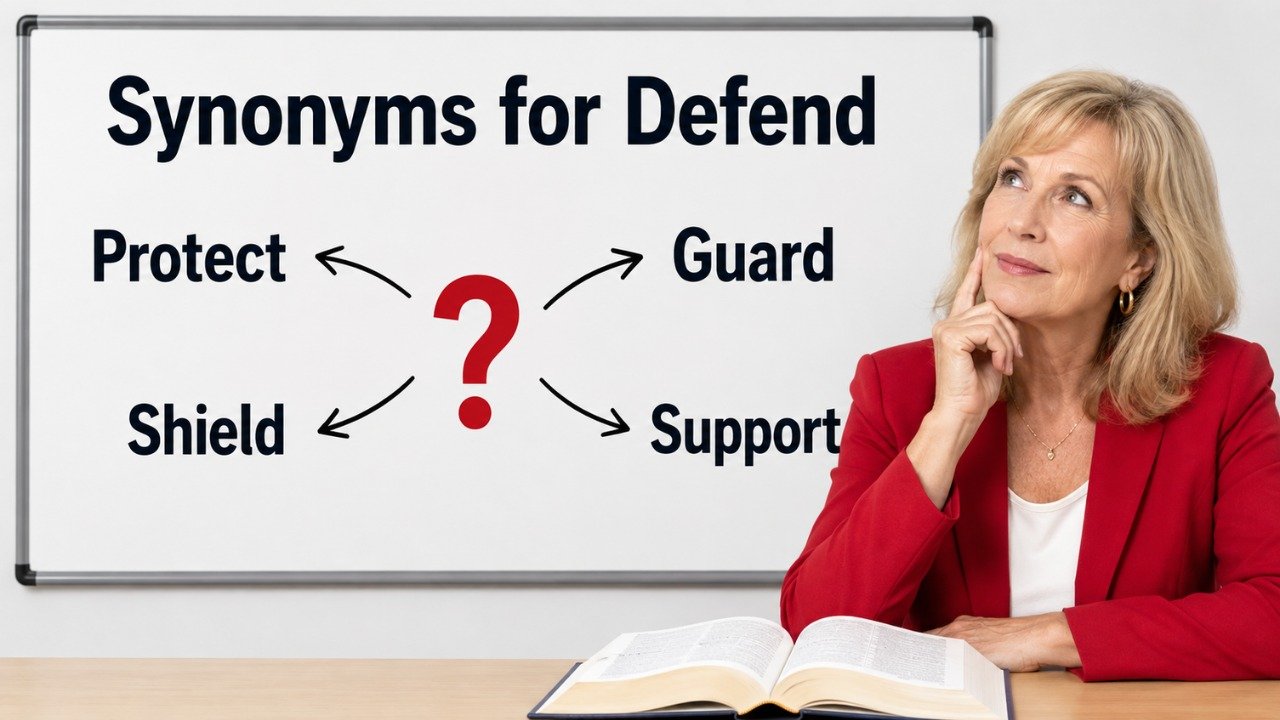
Quick Answer: The best synonyms for defend include protect, guard, shield, safeguard, support, uphold, justify, advocate, resist, and represent. Use protect or shield when keeping someone safe from harm. Choose guard for active watch, safeguard for preventing future danger, and resist for opposing an attack. In formal writing, uphold works well for rights and principles, while justify means giving reasons for an action. Advocate suits public support, and represent is best in a legal context.
Pronunciation and Word Details
Word: Defend.
Pronunciation: /dɪˈfend/.
Part of Speech: Verb.
Meaning: To protect someone or something from harm, attack, criticism, or unfair treatment.
US Pronunciation:
UK Pronunciation:
What Does “Defend” Mean?
Defend means to protect a person, place, belief, right, action, or position from danger, attack, criticism, or opposition.
Defend is a verb. It can refer to physical protection, verbal support, legal representation, military resistance, or the preservation of an idea or principle.
A person may defend a friend from danger, defend an opinion during a discussion, defend a client in court, or defend a building against attack. The word can also mean explaining why an action was reasonable.
The meaning changes according to the object being defended. Defending a person usually involves protection or support. Defending a decision often involves justification. Defending a territory generally involves resistance against attack.
Meaning, Tone, and Context of “Defend”
Defend is a neutral but strong word. It suggests action, loyalty, resistance, protection, or public support.
In everyday conversation, defend often means supporting someone who has been criticized. A person might defend a friend, family member, colleague, or personal choice.
In formal writing, defend can refer to protecting rights, maintaining an argument, supporting a claim, or explaining a conclusion. It is common in essays, reports, debates, legal discussions, sports, security, and public policy.
In legal contexts, defend means representing someone who has been accused of wrongdoing. In physical contexts, it means protecting someone or something from injury or attack.
The word can sound emotional when it involves loyalty or personal relationships. It can sound formal and analytical when used for arguments, theories, research, or decisions.
When and How to Use “Defend”
For Physical Protection
Use defend when someone takes action to keep a person, animal, place, or object safe from harm.
Example: The guard moved quickly to defend the entrance.
For Supporting a Person
Use defend when speaking in support of someone who is being blamed, criticized, or treated unfairly.
Example: She defended her colleague against an unfair accusation.
For Supporting an Opinion
Use defend when giving evidence, reasons, or explanations for a belief or position.
Example: The student defended her argument with clear examples.
For Legal Representation
Use defend when a legal professional represents a person accused of an offense.
Example: The lawyer agreed to defend the client in court.
For Protecting Rights
Use defend when preserving freedoms, values, principles, or legal protections.
Example: The organization works to defend the rights of vulnerable people.
For Resisting an Attack
Use defend when a person, team, group, or country resists an attacking force.
Example: The players defended their goal throughout the final minutes.
For Justifying an Action
Use defend when explaining why a decision or behavior was reasonable.
Example: The manager defended the decision to delay the project.
For Preserving a Position
Use defend when trying to keep a title, achievement, lead, or status.
Example: The champion returned to defend the title.
Best Synonyms for Defend
Protect: To keep someone or something safe from harm.
Example: Thick walls protect the building from strong winds.
Guard: To watch over someone or something to prevent danger.
Example: Two officers guarded the main entrance.
Shield: To place a protective barrier between someone and danger.
Example: She used her coat to shield the child from the rain.
Safeguard: To take measures that prevent harm, loss, or damage.
Example: Strong passwords safeguard private information.
Support: To stand behind a person, belief, decision, or cause.
Example: Several experts supported the proposed solution.
Uphold: To defend and maintain a law, principle, right, or decision.
Example: The judge promised to uphold the law fairly.
Justify: To give reasons showing that an action or decision was reasonable.
Example: He tried to justify the additional expense.
Advocate: To speak publicly in favor of a person, cause, or policy.
Example: She advocates equal access to education.
Resist: To oppose or withstand an attack, force, or pressure.
Example: The community resisted efforts to remove the public garden.
Represent: To act or speak legally or officially for another person.
Example: The attorney represented the family during the hearing.
50 Synonyms for Defend with Short Meanings
- Protect: Keep safe from harm or danger.
- Guard: Watch over to prevent attack or damage.
- Shield: Cover or protect from danger.
- Safeguard: Prevent harm, loss, or injury.
- Secure: Make safe from danger or interference.
- Shelter: Protect from harmful conditions.
- Cover: Give protection or support.
- Screen: Hide or protect behind a barrier.
- Fortify: Strengthen against attack.
- Reinforce: Make a defense stronger.
- Barricade: Block access for protection.
- Insulate: Protect from harmful outside effects.
- Buffer: Reduce the effect of harm or pressure.
- Preserve: Keep safe from damage or destruction.
- Conserve: Protect something from loss or waste.
- Uphold: Maintain and support a principle or decision.
- Support: Give assistance or approval.
- Back: Publicly or privately support someone.
- Champion: Strongly support a person or cause.
- Advocate: Speak or argue in favor of something.
- Justify: Give acceptable reasons for an action.
- Vindicate: Show that someone was right or innocent.
- Explain: Give reasons for an action or belief.
- Excuse: Offer reasons that reduce blame.
- Maintain: Continue to assert that something is true.
- Assert: State and defend a position confidently.
- Argue for: Present reasons in support of something.
- Plead for: Make an urgent appeal in support.
- Speak for: Express support on another person’s behalf.
- Represent: Act officially or legally for someone.
- Stand by: Continue supporting someone during difficulty.
- Stand up for: Protect or support someone against unfairness.
- Resist: Oppose force, pressure, or attack.
- Oppose: Act against an idea, action, or threat.
- Repel: Force an attacker or threat away.
- Withstand: Remain strong against pressure or attack.
- Counter: Respond to an attack or argument.
- Fight: Struggle against danger or opposition.
- Fend off: Keep an attacker or threat away.
- Ward off: Prevent danger or harm from approaching.
- Deflect: Turn an attack or criticism aside.
- Block: Stop movement, access, or attack.
- Deter: Discourage someone from attacking or acting.
- Prevent: Stop harm or danger before it happens.
- Protect against: Keep safe from a particular danger.
- Hold the line: Maintain a defensive position.
- Save: Prevent someone or something from harm.
- Rescue: Remove someone from immediate danger.
- Patrol: Watch an area regularly for protection.
- Watch over: Guard and care for someone or something.
Read Also:
Synonyms for Suffer

Synonyms for Defend by Context
When Defend Means Protect from Harm
Protect, guard, shield, safeguard, shelter, secure, and watch over describe keeping someone or something safe.
Protect is the broadest option. Guard suggests active watching. Shield suggests placing a barrier between a person and danger. Safeguard focuses on preventing future harm.
Example: Parents naturally want to protect their children.
Example: The trees shielded the house from the wind.
When Defend Means Support Someone
Support, back, stand by, stand up for, champion, and speak for describe helping a person who faces criticism or unfair treatment.
Support is neutral and widely useful. Back is more conversational. Stand up for suggests courage. Champion suggests strong and active support.
Example: Her friends stood by her during the investigation.
Example: He spoke up to support a colleague who had been blamed unfairly.
When Defend Means Justify a Decision
Justify, explain, vindicate, maintain, assert, and argue for describe giving reasons for an action, belief, or conclusion.
Justify means showing that an action was reasonable. Vindicate means proving that a person or decision was right. Maintain means continuing to claim that something is true.
Example: The report attempted to justify the increased cost.
Example: Later evidence vindicated her original decision.
When Defend Means Resist an Attack
Resist, repel, withstand, counter, fight, fend off, ward off, and hold the line describe opposition to physical force or pressure.
Resist is broad and can describe physical or political opposition. Repel means forcing an attacker away. Withstand emphasizes remaining strong under attack.
Example: The walls were designed to withstand heavy pressure.
Example: The defenders managed to repel the attack.
When Defend Means Support a Cause
Advocate, champion, uphold, support, promote, and stand up for describe active support for a principle, policy, right, or social cause.
Advocate is common in formal writing. Champion suggests enthusiastic leadership. Uphold is best for laws, rights, values, and official decisions.
Example: Many teachers advocate improved access to learning materials.
Example: Courts are expected to uphold legal rights.
When Defend Means Act in a Legal Case
Represent, advocate for, plead for, argue for, and speak for can describe acting on behalf of another person.
Represent is the most precise legal alternative. Plead for can also mean making an emotional or formal appeal.
Example: An experienced lawyer represented the accused person.
Example: The attorney argued for a reduced sentence.
Another Word for Defend
Protect is the best general replacement for defend when the meaning involves safety from harm. However, the most accurate alternative depends on context.
Use support for personal loyalty, justify for explaining a decision, uphold for principles or rights, represent for legal cases, and resist for opposing an attack.
Original: The fence helps defend the garden from animals.
Better Option: The fence helps protect the garden from animals.
Original: She defended her friend during the meeting.
Better Option: She supported her friend during the meeting.
Original: The director defended the decision to close early.
Better Option: The director justified the decision to close early.
Original: The lawyer defended the client at the hearing.
Better Option: The lawyer represented the client at the hearing.
When Not to Use “Defend”
Avoid defend when the sentence needs a more precise word.
When no active threat exists, protect may sound more natural.
Weak: Sunscreen defends the skin from sunlight.
Better: Sunscreen protects the skin from sunlight.
Do not use defend when you simply mean agreeing with someone. Support or agree with may be clearer.
Weak: I defend your suggestion about the schedule.
Better: I support your suggestion about the schedule.
Avoid defend when describing a legal professional if represent is more precise.
Weak: She will defend the company during the contract discussion.
Better: She will represent the company during the contract discussion.
Do not use defend when the intended meaning is explaining a decision.
Weak: The manager defended why the deadline changed.
Better: The manager explained why the deadline changed.
Avoid defend when a person merely watches an area.
Weak: The officer defended the entrance all night.
Better: The officer guarded the entrance all night.
Do not repeat defend throughout an essay. Use protect, support, uphold, justify, resist, or advocate according to the specific meaning.
Words Commonly Confused With Defend
Defend vs Protect: Defend often suggests responding to an existing attack or criticism. Protect can include preventing harm before it occurs.
Defend vs Guard: Defend means resisting danger or criticism. Guard means watching a person, place, or object to prevent danger.
Defend vs Support: Defend involves protection against attack or blame. Support is broader and can mean helping, approving, or encouraging.
Defend vs Justify: Defend can mean protecting or supporting something. Justify specifically means giving reasons that show an action was reasonable.
Defend vs Advocate: Defend often responds to opposition. Advocate means actively speaking in favor of a person, cause, or policy.
Defend vs Uphold: Defend can apply to people, places, arguments, or decisions. Uphold is especially suitable for laws, rights, values, and official rulings.
Defend vs Resist: Defend focuses on protection. Resist focuses on opposition to force, pressure, change, or attack.
Defend vs Represent: Defend may describe legal protection, while represent means officially acting or speaking for another person.
Defend vs Vindicate: Defend means supporting someone against criticism. Vindicate means proving that the person was right, justified, or innocent.
Which Synonym Should You Choose?
Choose protect when keeping a person, place, object, or system safe from harm.
Choose guard when someone actively watches an entrance, building, object, or individual.
Choose shield when a barrier protects someone from danger, criticism, weather, or pressure.
Choose safeguard in formal writing about preventing loss, damage, risk, or misuse.
Choose support in emails, conversations, and workplace writing when expressing approval or loyalty.
Choose back in casual speech when showing that you support a person, plan, or decision.
Choose uphold in essays, reports, and legal writing when discussing rights, laws, principles, or judgments.
Choose justify when explaining why an action, expense, choice, or decision was reasonable.
Choose advocate when speaking publicly or formally in favor of a policy, cause, or group.
Choose represent when discussing legal or official action on another person’s behalf.
Choose resist when describing opposition to force, attack, pressure, or unwanted change.
Choose repel when attackers or threats are successfully forced away.
Choose withstand when something remains strong despite pressure, damage, or attack.
Choose vindicate when later evidence proves that someone was correct or innocent.
Real Life Examples of “Defend” in Sentences
Original: The wall was built to defend the village from flooding.
Better Option: The wall was built to protect the village from flooding.
Original: Two officers defended the entrance.
Better Option: Two officers guarded the entrance.
Original: She defended her younger brother from criticism.
Better Option: She stood up for her younger brother during the criticism.
Original: The speaker defended the new environmental policy.
Better Option: The speaker advocated the new environmental policy.
Original: The manager defended the additional spending.
Better Option: The manager justified the additional spending.
Original: The lawyer defended the family in court.
Better Option: The lawyer represented the family in court.
Original: The soldiers defended the bridge throughout the night.
Better Option: The soldiers held the bridge throughout the night.
Original: He defended the accuracy of his report.
Better Option: He maintained that his report was accurate.
Original: The group defended the right to peaceful assembly.
Better Option: The group upheld the right to peaceful assembly.
Original: Strong gates defended the property from unwanted visitors.
Better Option: Strong gates secured the property against unwanted visitors.
Synonym Groups and Usage Differences
Protection Group
Protect, guard, shield, safeguard, secure, shelter, and watch over belong to the protection group.
Protect is general. Guard suggests active observation. Shield suggests a protective barrier. Safeguard emphasizes prevention.
Example: Safety procedures safeguard workers from avoidable risks.
Personal Support Group
Support, back, stand by, stand up for, speak for, and champion describe loyalty toward a person.
Back is conversational. Stand by suggests continued loyalty during hardship. Stand up for suggests confronting unfair treatment.
Example: Her colleagues stood by her when the complaint was reviewed.
Argument Group
Justify, explain, maintain, assert, argue for, and vindicate relate to defending ideas, actions, and conclusions.
Justify explains why something was reasonable. Assert states a position confidently. Vindicate proves that a position or action was correct.
Example: The researcher justified the method with reliable evidence.
Rights and Principles Group
Uphold, preserve, advocate, champion, support, and safeguard describe the defense of values, rights, traditions, or laws.
Uphold is formal and authoritative. Advocate involves active public support. Preserve focuses on preventing loss or destruction.
Example: Public institutions must uphold equal treatment under the law.
Resistance Group
Resist, oppose, repel, withstand, counter, fight, and fend off describe action against attack or pressure.
Resist means refusing to give way. Repel means forcing danger away. Withstand means remaining strong despite pressure.
Example: The structure was designed to withstand extreme weather.
Legal Group
Represent, advocate for, plead for, argue for, and speak for describe action taken on another person’s behalf.
Represent is the clearest legal term. Plead for suggests requesting mercy, understanding, or a particular judgment.
Example: The attorney represented the tenant during the dispute.
Antonyms of Defend
The opposite of defend depends on whether defend means protect, support, justify, or resist.
Attack: Use force or criticism against someone.
Assault: Physically attack a person or place.
Harm: Cause injury, damage, or suffering.
Endanger: Put someone or something at risk.
Expose: Leave someone open to harm or criticism.
Abandon: Leave without protection or support.
Betray: Act against someone who trusted you.
Accuse: Claim that someone did something wrong.
Condemn: Express strong disapproval.
Criticize: Point out faults or weaknesses.
Oppose: Act against a person, idea, or proposal.
Reject: Refuse to accept or support something.
Surrender: Stop resisting and give control to another.
Yield: Give way under pressure.
Undermine: Weaken someone’s position, authority, or confidence.
Disprove: Show that an argument or claim is false.
Neglect: Fail to provide proper care or protection.
Withdraw: Remove support or participation.
Comparison of Defend and Related Words
Defend vs Protect
Defend often involves responding to an attack, criticism, or immediate danger. Protect includes both prevention and active defense.
Example With Defend: The team defended its goal during the final minutes.
Example With Protect: A strong password protects the account from unauthorized access.
Defend vs Guard
Defend means resisting danger or attack. Guard means watching something to keep it safe.
Example With Defend: The residents defended their homes from the advancing fire.
Example With Guard: An officer guarded the gate throughout the night.
Defend vs Support
Defend means protecting someone against criticism or blame. Support means giving help, approval, or encouragement.
Example With Defend: She defended her colleague against an unfair complaint.
Example With Support: She supported her colleague during a difficult project.
Defend vs Justify
Defend has several meanings, including protection and support. Justify specifically means showing that an action or decision was reasonable.
Example With Defend: The director defended the new policy.
Example With Justify: The director justified the new policy with financial evidence.
Defend vs Advocate
Defend often happens after criticism or opposition appears. Advocate means actively recommending or promoting something.
Example With Defend: He defended the proposal when others questioned it.
Example With Advocate: He advocated a proposal that would improve public safety.
Defend vs Uphold
Defend is broad and can apply to people, places, beliefs, and actions. Uphold is more formal and is commonly used for laws, rights, principles, and official decisions.
Example With Defend: Citizens defended their freedom of expression.
Example With Uphold: The court upheld the right to freedom of expression.
Defend vs Resist
Defend emphasizes keeping someone or something safe. Resist emphasizes refusing to accept force, pressure, or attack.
Example With Defend: The group defended the community center.
Example With Resist: The group resisted efforts to close the community center.
Defend vs Vindicate
Defend means supporting someone against blame. Vindicate means showing through evidence that the person was right or innocent.
Example With Defend: Her friends defended her during the investigation.
Example With Vindicate: New evidence vindicated her after the investigation.
Common Phrases and Expressions With Defend
Defend Yourself: Protect yourself physically or answer criticism directed at you.
Defend a Position: Give reasons and evidence supporting an opinion.
Defend a Decision: Explain why a choice was reasonable.
Defend a Title: Compete to keep a championship or position.
Defend Your Rights: Protect legal or moral freedoms.
Defend Against Attack: Resist a physical, verbal, or digital threat.
Defend Someone’s Honor: Protect a person’s reputation from insult or accusation.
Defend a Claim: Provide evidence supporting a statement.
Defend a Territory: Protect an area from an opposing force.
Defend the Goal: Prevent the opposing team from scoring.
Common Mistakes to Avoid
A common mistake is using defend when protect would be more natural. Defend often suggests an existing attack, while protect may describe general safety or prevention.
Avoid using defend and support as exact replacements in every sentence. You can support a proposal without responding to criticism. Defend usually suggests opposition, blame, or danger.
Do not confuse defend with justify. A person may defend a decision by supporting it, but justify is more precise when the focus is on explaining why the decision was reasonable.
Use the correct preposition. Someone may defend a person from danger or defend a place against attack. Both forms can be correct, but the choice depends on the sentence.
Avoid unclear objects. Instead of writing “She defended strongly,” explain what she defended.
Unclear: She defended strongly during the meeting.
Clear: She strongly defended her proposal during the meeting.
Do not overuse defend in essays about arguments. Use support, justify, uphold, maintain, assert, or advocate when they express the intended meaning more accurately.
Be careful with vindicate. It does not simply mean support. It means proving that someone was right, innocent, or justified.
Avoid writing advocate for when advocate is used as a verb unless the sentence requires the preposition for clarity. Both forms occur, but direct use is often more concise.
Wordy: She advocated for stronger safety rules.
Concise: She advocated stronger safety rules.
Conclusion
Synonyms for defend express different forms of protection, support, justification, and resistance. Protect, guard, and shield are best for physical safety. Support, back, and stand up for describe personal loyalty. Justify and vindicate work when explaining or proving a decision, while uphold and advocate suit rights, principles, and causes. Use represent for legal action and resist or repel for attacks. Choosing the most precise alternative makes your writing clearer, stronger, and better suited to its context.
FAQs About Synonyms for Defend
What Is the Best Synonym for Defend?
Protect is the best general synonym when defend means keeping someone or something safe. Other choices depend on the context.
What Is a Formal Synonym for Defend?
Safeguard, uphold, advocate, justify, and represent are useful formal alternatives. Each expresses a different meaning of defend.
What Is Another Word for Defending Someone?
Supporting, backing, protecting, standing by, and standing up for someone are natural alternatives.
What Is a Synonym for Defend an Argument?
Support, justify, maintain, assert, and argue for are suitable when defending an argument or position.
What Is the Difference Between Defend and Protect?
Defend often suggests responding to attack or criticism. Protect can also describe preventing danger before it occurs.
What Is a Legal Synonym for Defend?
Represent is the clearest legal alternative. An attorney represents a client during legal proceedings.
What Is the Opposite of Defend?
Attack, accuse, condemn, expose, abandon, betray, and surrender can be opposites, depending on the meaning and context.
