
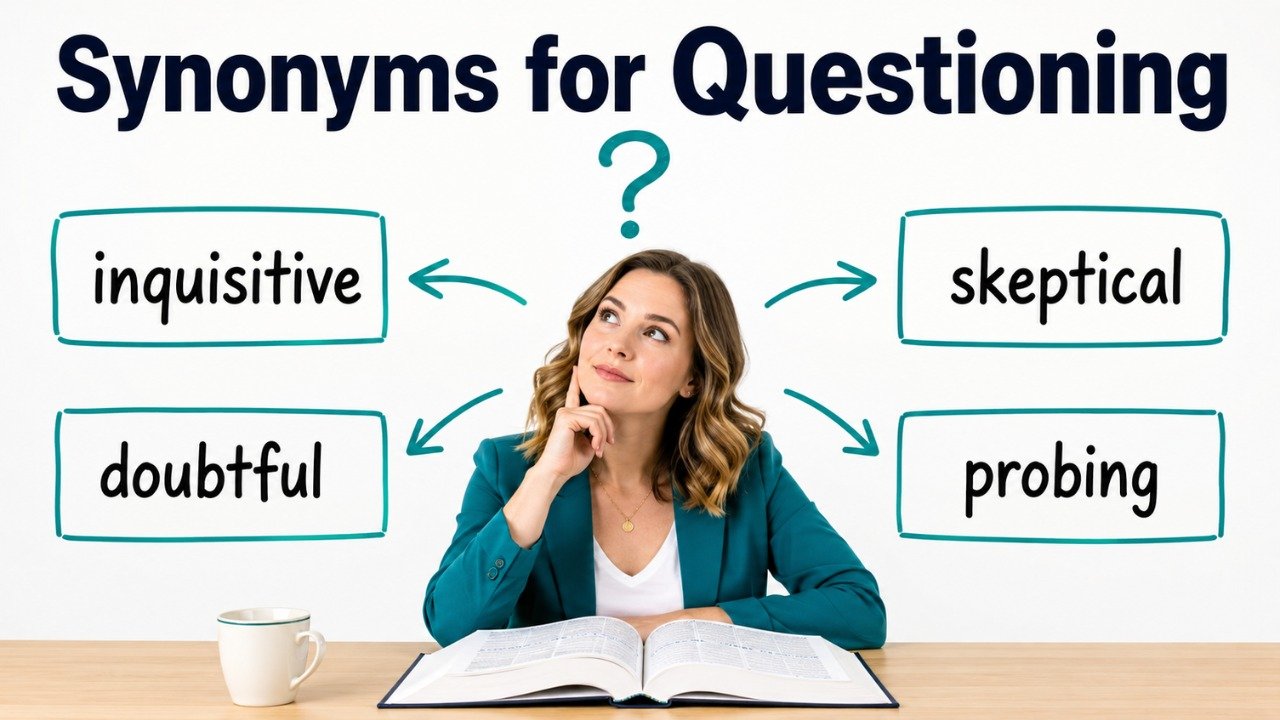
Quick Answer: The best synonyms for questioning include inquiry, interrogation, probing, examination, investigation, querying, scrutiny, skepticism, doubt, and challenge. Use inquiry for a neutral or formal request for information, interrogation for forceful or official questioning, and probing for detailed questions intended to uncover more information. Skepticism and doubt are best when questioning means expressing uncertainty, while challenge works when someone disputes an idea, claim, or decision.
Pronunciation and Word Details
Word: Questioning
Pronunciation: /ˈkwestʃənɪŋ/
Part of Speech: Noun, adjective, and present participle
Meaning: The act of asking questions, examining information, or expressing doubt about something.
US Pronunciation:
UK Pronunciation:
What Does “Questioning” Mean?
Questioning means asking someone for information, examining an idea carefully, or expressing uncertainty about whether something is correct.
As a noun, questioning refers to the process of asking questions.
Example: The witness remained calm during questioning.
As an adjective, questioning describes a doubtful, curious, or searching attitude, expression, or tone.
Example: She gave him a questioning look.
As the present participle of question, it describes the action of asking, examining, challenging, or doubting something.
Example: The committee is questioning whether the plan is practical.
The word can have a neutral, positive, or negative meaning. Neutral questioning seeks information. Positive questioning encourages curiosity and critical thinking. Negative questioning may sound suspicious, confrontational, or distrustful.
The intended meaning depends on who is asking, why the questions are being asked, and how forceful the situation is.
Meaning, Tone, and Context of “Questioning”
Questioning has several tones because it can describe curiosity, investigation, doubt, criticism, or formal examination.
Neutral Tone: Questioning can simply mean asking for information.
Example: Her questioning helped clarify the instructions.
Curious Tone: It can show an active desire to learn or understand.
Example: The child had a naturally questioning mind.
Formal Tone: Questioning is common in reports, investigations, interviews, academic discussions, and official proceedings.
Example: The panel continued its questioning throughout the afternoon.
Skeptical Tone: It may suggest doubt about a statement, decision, belief, or explanation.
Example: Several members were questioning the accuracy of the report.
Critical Tone: Questioning can involve evaluating assumptions or challenging accepted ideas.
Example: The essay encourages readers to develop a questioning attitude.
Confrontational Tone: In a tense situation, questioning may sound forceful or accusatory.
Example: He became uncomfortable with the aggressive questioning.
Academic Tone: Questioning is often presented as an important part of analysis, research, learning, and critical thinking.
Example: Careful questioning can reveal weaknesses in an argument.
Conversational Tone: In everyday speech, asking, wondering, checking, and wanting to know may sound more natural.
Example: I was only asking because I wanted to understand.
When and How to Use “Questioning”
For Requesting Information
Use questioning when a person asks for facts, explanations, opinions, or details.
Example: The teacher used careful questioning to assess the students’ understanding.
For Conducting an Interview
Use questioning when an interviewer asks structured questions to gather information.
Example: The applicant responded confidently during the questioning.
For Investigating a Situation
Use questioning when questions are intended to establish facts or discover what happened.
Example: The investigation included questioning several witnesses.
For Expressing Doubt
Use questioning when someone is uncertain about the truth, value, accuracy, or wisdom of something.
Example: Residents are questioning whether the changes will solve the problem.
For Challenging an Idea
Use questioning when a person disputes an assumption, claim, rule, or decision.
Example: The article is questioning the belief that one method works for everyone.
For Encouraging Critical Thinking
Use questioning when discussing careful analysis and intellectual curiosity.
Example: A questioning mind examines evidence before reaching a conclusion.
For Showing Curiosity
Use questioning to describe a look, tone, expression, or attitude that seeks an explanation.
Example: She raised her eyebrows with a questioning expression.
For Seeking Clarification
Use questioning when someone asks for clearer or more specific information.
Example: His questioning revealed that the original instructions were unclear.
For Official Examination
Use questioning when a person is formally examined by investigators, officials, lawyers, or a committee.
Example: The witness was released after several hours of questioning.
Best Synonyms for Questioning
Inquiry
Synonym: The act of asking for information or examining a subject.
Example: The manager opened an inquiry into the missing records.
Interrogation
Synonym: Formal, intensive, or forceful questioning intended to obtain information.
Example: The suspect remained silent during the interrogation.
Probing
Synonym: Detailed questioning intended to uncover deeper information.
Example: Her probing revealed several problems with the proposal.
Examination
Synonym: Careful questioning or inspection used to evaluate knowledge, evidence, or facts.
Example: The examination focused on the accuracy of the witness’s account.
Investigation
Synonym: A structured attempt to discover facts about an event, problem, or claim.
Example: The investigation involved interviewing everyone who attended the meeting.
Querying
Synonym: Asking questions or expressing uncertainty about something.
Example: Several readers were querying the meaning of the final paragraph.
Scrutiny
Synonym: Close and critical examination of information, actions, or evidence.
Example: The figures came under careful scrutiny.
Skepticism
Synonym: An attitude of doubt that leads someone to question a claim.
Example: The announcement was received with understandable skepticism.
Doubt
Synonym: A feeling of uncertainty about whether something is true or correct.
Example: His explanation created doubt rather than confidence.
Challenge
Synonym: An act of disputing or questioning the truth, authority, or value of something.
Example: The decision faced a strong challenge from several members.
50 Synonyms for Questioning with Short Meanings
- Inquiry: A request for information or a formal investigation.
- Interrogation: Intensive or official questioning.
- Examination: Careful questioning used to evaluate facts or knowledge.
- Investigation: A structured search for facts or explanations.
- Probing: Detailed questioning intended to uncover more information.
- Asking: Requesting information from someone.
- Inquiring: Seeking facts, explanations, or details.
- Querying: Asking a question or expressing uncertainty.
- Interviewing: Asking organized questions to gather information.
- Quizzing: Asking several questions to test knowledge or obtain details.
- Cross examination: Detailed questioning intended to test a statement or account.
- Catechizing: Asking a person a series of detailed questions.
- Debriefing: Questioning someone about an event or experience.
- Polling: Asking people for their views or preferences.
- Surveying: Gathering information by asking a set of questions.
- Canvassing: Seeking opinions or information from several people.
- Consultation: A discussion held to obtain information or advice.
- Discussion: An exchange of questions, ideas, and opinions.
- Fact finding: The process of discovering reliable information.
- Information gathering: Collecting facts by asking questions or conducting research.
- Exploration: Careful investigation of an idea, issue, or possibility.
- Scrutiny: Close and critical examination.
- Inspection: Careful observation intended to identify facts or problems.
- Research: Systematic investigation used to discover information.
- Clarification request: A question asking for clearer information.
- Information request: A direct request for facts or details.
- Follow up inquiry: An additional question asked after an earlier response.
- Challenge: An act of disputing or testing a claim.
- Doubt: Uncertainty about whether something is true.
- Skepticism: A questioning attitude toward claims or evidence.
- Suspicion: A belief that something may be wrong or dishonest.
- Uncertainty: A lack of confidence about a fact or decision.
- Disbelief: Difficulty accepting something as true.
- Dispute: Disagreement about a statement, decision, or fact.
- Objection: An expression of opposition or concern.
- Critique: A careful evaluation that identifies strengths and weaknesses.
- Reconsideration: Thinking about a decision or belief again.
- Review: Examining information again before reaching a conclusion.
- Evaluation: Judging the quality, accuracy, or value of something.
- Analysis: Detailed examination of ideas, evidence, or information.
- Reflection: Careful thought about a subject or experience.
- Deliberation: Thoughtful discussion before making a decision.
- Curiosity: A desire to learn or understand more.
- Inquisitiveness: A strong interest in asking questions and discovering facts.
- Puzzlement: Confusion that leads someone to seek an explanation.
- Inquisitive: Eager to ask questions and learn more.
- Skeptical: Unconvinced and willing to examine a claim critically.
- Doubtful: Uncertain about the truth or likelihood of something.
- Puzzled: Confused and looking for an explanation.
- Searching: Showing a desire to discover the truth or deeper meaning.
Read Also:
Synonyms for Cutie

Synonyms for Questioning by Context
When Questioning Means Asking for Information
Use asking, inquiring, querying, inquiry, interviewing, and consultation when the main purpose is to obtain information.
Asking: The simplest and most conversational alternative.
Example: She was asking about the application process.
Inquiring: A polite or slightly formal way to describe seeking information.
Example: He called to inquire about the available courses.
Querying: Useful when someone raises a specific question or uncertainty.
Example: The editor queried an unclear sentence in the report.
Inquiry: Suitable for formal requests, investigations, and written communication.
Example: We received an inquiry about the new policy.
Interviewing: Best when one person asks organized questions of another.
Example: The researcher is interviewing local residents.
When Questioning Means Formal Examination
Use interrogation, examination, cross examination, debriefing, quizzing, and investigation for structured or official questioning.
Interrogation: Suggests pressure, intensity, or official authority.
Example: The questioning became more intense during the interrogation.
Examination: Suitable for legal, academic, medical, and formal contexts.
Example: The examination focused on the order of events.
Cross Examination: Refers to detailed questions intended to test the reliability of an account.
Example: The witness remained composed during cross examination.
Debriefing: Used when someone is asked to describe an event, task, or experience.
Example: The team attended a debriefing after the exercise.
Quizzing: Often suggests repeated or rapid questions.
Example: Reporters continued quizzing the official about the decision.
When Questioning Means Expressing Doubt
Use doubt, skepticism, uncertainty, suspicion, disbelief, and doubtful when someone is not fully convinced.
Doubt: A general feeling of uncertainty.
Example: The missing details created doubt about the explanation.
Skepticism: A thoughtful refusal to accept a claim without evidence.
Example: The proposal was met with skepticism.
Uncertainty: A lack of confidence about what is true or what should happen.
Example: There is uncertainty about the final result.
Suspicion: A belief that something may be dishonest, incorrect, or harmful.
Example: His sudden change in behavior caused suspicion.
Disbelief: A strong inability or unwillingness to accept something as true.
Example: She listened to the claim in disbelief.
When Questioning Means Challenging an Idea
Use challenge, objection, dispute, critique, scrutiny, and reconsideration when questioning involves testing or opposing a claim.
Challenge: Best for directly disputing an argument, rule, or decision.
Example: The evidence presents a challenge to the original theory.
Objection: Best when expressing a specific concern or disagreement.
Example: Several members raised an objection to the proposal.
Dispute: Useful for disagreement about facts, ownership, responsibility, or meaning.
Example: The two groups dispute the accuracy of the figures.
Critique: Best for thoughtful evaluation rather than simple rejection.
Example: Her critique identified weaknesses in the research method.
Scrutiny: Best when something is being examined closely and critically.
Example: The financial records came under scrutiny.
When Questioning Means Showing Curiosity
Use curiosity, inquisitiveness, exploration, inquisitive, puzzled, and searching when the tone is thoughtful or eager to learn.
Curiosity: A natural desire to know more.
Example: His curiosity led him to ask several thoughtful questions.
Inquisitiveness: A strong habit of seeking knowledge through questions.
Example: Her inquisitiveness made her an attentive researcher.
Exploration: A broad investigation of ideas or possibilities.
Example: The discussion became an exploration of several possible solutions.
Inquisitive: Describes a person, expression, or attitude that seeks information.
Example: The student gave the teacher an inquisitive look.
Searching: Describes an expression, question, or thought intended to discover deeper meaning.
Example: She asked a searching question about the project’s purpose.
When Questioning Means Careful Analysis
Use analysis, evaluation, review, examination, reflection, and deliberation when ideas or evidence are being considered carefully.
Analysis: Best for detailed examination of information or arguments.
Example: The analysis questions several assumptions in the original report.
Evaluation: Best when judging quality, effectiveness, or accuracy.
Example: The evaluation considered whether the program achieved its goals.
Review: Best when examining information again.
Example: A review of the evidence revealed several inconsistencies.
Reflection: Best for personal or thoughtful consideration.
Example: Reflection helped her recognize why the decision felt uncertain.
Deliberation: Best for careful discussion before a decision.
Example: After lengthy deliberation, the panel requested more information.
Another Word for Questioning
Inquiry is often the best general replacement for questioning because it can describe both asking for information and examining a subject. However, the strongest alternative depends on context. Use interrogation for forceful official questions, probing for detailed investigation, skepticism for doubt, and challenge for disagreement.
Original: The manager continued questioning the employee about the missing document.
Better Option: The manager continued interviewing the employee about the missing document.
Original: Her questioning revealed several weaknesses in the plan.
Better Option: Her probing revealed several weaknesses in the plan.
Original: The public is questioning the accuracy of the figures.
Better Option: The public is expressing skepticism about the accuracy of the figures.
Original: His questioning look showed that he did not understand.
Better Option: His puzzled look showed that he did not understand.
When Not to Use “Questioning”
Do not use questioning when a more specific word would explain the purpose, tone, or intensity of the questions.
The word may sound vague because it does not tell the reader whether the situation involves an interview, investigation, interrogation, expression of doubt, or request for clarification.
Weak: The official faced questioning.
Better: The official faced detailed questioning from the committee.
Better: The official faced an investigation into the missing funds.
Avoid questioning when the interaction is casual and asking sounds more natural.
Weak: I was questioning her about the meeting time.
Better: I was asking her about the meeting time.
Do not use interrogation for ordinary or friendly questions because it sounds forceful and intimidating.
Weak: My neighbor interrogated me about my weekend.
Better: My neighbor asked me about my weekend.
Avoid inquiry when you specifically mean doubt rather than a request for information.
Weak: There is inquiry about whether the claim is accurate.
Better: There is doubt about whether the claim is accurate.
Do not use questioning repeatedly in the same paragraph.
Weak: The questioning began with basic questioning before the questioning became more detailed.
Better: The interview began with basic questions before the discussion became more detailed.
Avoid questioning when the person is simply thinking privately rather than asking or challenging something.
Weak: She sat quietly, questioning about her future.
Better: She sat quietly, reflecting on her future.
Words Commonly Confused With Questioning
Questioning vs Asking: Asking is the general act of requesting information. Questioning can suggest a longer, more detailed, critical, or doubtful process.
Questioning vs Inquiry: Questioning describes the act of asking questions. Inquiry can mean a single request for information or a formal investigation.
Questioning vs Interrogation: Questioning may be friendly, neutral, or formal. Interrogation is usually more forceful, intensive, and official.
Questioning vs Interviewing: Interviewing involves organized questions asked for a clear purpose. Questioning is broader and can include casual, critical, or suspicious questions.
Questioning vs Investigation: Questioning is one method used during an investigation. An investigation may also include research, observation, document review, and evidence collection.
Questioning vs Skepticism: Questioning is an action or attitude. Skepticism is a state of doubt that may lead someone to ask questions.
Questioning vs Doubt: Questioning may involve asking for information or challenging a claim. Doubt is the feeling of uncertainty behind some forms of questioning.
Questioning vs Probing: Questioning is broad. Probing specifically suggests persistent or detailed questions intended to uncover deeper information.
Questioning vs Curiosity: Curiosity is the desire to learn. Questioning is one way of satisfying that desire.
Questioning vs Criticism: Questioning seeks information or tests an idea. Criticism judges or identifies faults, although careful questioning can form part of a critique.
Which Synonym Should You Choose?
Choose inquiry for formal requests, reports, professional communication, and neutral investigations.
Choose asking for casual conversation and simple requests for information.
Choose inquiring when you want a polite and slightly formal alternative.
Choose querying for written questions, specific uncertainties, or requests about unclear information.
Choose interviewing when organized questions are being asked to gather someone’s experiences, views, or qualifications.
Choose interrogation when the questioning is forceful, official, intensive, or connected to an investigation.
Choose probing when the questions are detailed and intended to uncover information that is not immediately visible.
Choose examination for formal evaluation of evidence, knowledge, statements, or arguments.
Choose investigation for a broad process of discovering facts about an event or problem.
Choose scrutiny when an action, claim, record, or decision is being examined closely.
Choose skepticism when questioning means refusing to accept a claim without sufficient evidence.
Choose doubt when writing about uncertainty in essays, reports, emails, or conversation.
Choose challenge when someone openly disputes an idea, decision, rule, or belief.
Choose critique when the purpose is thoughtful evaluation rather than rejection.
Choose curiosity when questioning is motivated by a desire to learn.
Choose inquisitive to describe a curious person, expression, attitude, or mind.
Choose puzzled to describe a questioning expression caused by confusion.
Choose searching when a question or look seeks a deep, honest, or meaningful answer.
Real Life Examples of “Questioning” in Sentences
Original: The manager began questioning the applicant about her experience.
Better Option: The manager began interviewing the applicant about her experience.
Original: The witness remained calm during questioning.
Better Option: The witness remained calm during the examination.
Original: Her questioning uncovered an error in the calculation.
Better Option: Her probing uncovered an error in the calculation.
Original: Residents are questioning the need for the new rule.
Better Option: Residents are challenging the need for the new rule.
Original: The reader was questioning whether the claim was accurate.
Better Option: The reader was skeptical about whether the claim was accurate.
Original: The child gave his father a questioning look.
Better Option: The child gave his father a puzzled look.
Original: Careful questioning helped the team understand the problem.
Better Option: Careful inquiry helped the team understand the problem.
Original: The committee’s questioning continued for several hours.
Better Option: The committee’s examination continued for several hours.
Original: She has a questioning attitude toward unsupported claims.
Better Option: She has a skeptical attitude toward unsupported claims.
Original: His questioning encouraged a deeper discussion.
Better Option: His thoughtful inquiry encouraged a deeper discussion.
Synonym Groups and Usage Differences
Information Seeking Group
This group includes asking, inquiring, querying, inquiry, consultation, and information gathering. These words focus on obtaining facts, explanations, or advice.
Asking is the most conversational. Inquiry sounds more formal, while consultation suggests seeking guidance from someone with knowledge or experience.
Example: The customer made an inquiry about the return process.
Formal Examination Group
This group includes interrogation, examination, interviewing, cross examination, debriefing, and quizzing. These words describe structured questions asked for a specific purpose.
Interrogation is the strongest term. Interviewing is usually neutral, while cross examination tests the reliability of a person’s statement.
Example: The investigator continued interviewing the witnesses.
Investigation Group
This group includes investigation, probing, scrutiny, inspection, research, and fact finding. These alternatives involve a deeper search for facts.
Probing focuses on detailed questions. Scrutiny emphasizes close inspection, while research suggests an organized process of gathering and analyzing information.
Example: Further investigation revealed the cause of the failure.
Doubt Group
This group includes doubt, skepticism, uncertainty, suspicion, disbelief, and doubtful. These words describe a lack of confidence or acceptance.
Skepticism often involves rational evaluation. Suspicion suggests concern about dishonesty or hidden problems, while disbelief is a stronger refusal to accept something as true.
Example: The unsupported promise was met with skepticism.
Challenge Group
This group includes challenge, objection, dispute, critique, and reconsideration. These words describe opposition to or examination of an idea.
A challenge directly tests a claim. An objection raises a concern, while a critique provides a detailed evaluation of strengths and weaknesses.
Example: Her critique questioned several assumptions in the proposal.
Curiosity Group
This group includes curiosity, inquisitiveness, inquisitive, exploration, puzzled, and searching. These alternatives describe a desire for understanding.
Inquisitive is usually positive. Puzzled suggests confusion, while searching suggests a serious attempt to discover meaning or truth.
Example: His searching questions encouraged everyone to think more deeply.
Analysis Group
This group includes examination, analysis, evaluation, review, reflection, and deliberation. These words focus on careful thought and judgment.
Analysis separates information into parts. Evaluation judges quality or value, while deliberation involves careful discussion before a decision.
Example: The committee began a detailed evaluation of the available options.
Antonyms of Questioning
The opposite of questioning depends on whether the word means asking, doubting, investigating, or challenging.
Answering: Providing information rather than requesting it.
Acceptance: Agreeing with an idea or situation without opposition.
Certainty: Complete confidence that something is true.
Confidence: A strong belief in the accuracy or reliability of something.
Agreement: Sharing the same opinion or accepting a proposal.
Belief: Acceptance that a statement or idea is true.
Trust: Confidence in the honesty or reliability of someone or something.
Assurance: A feeling of certainty and security.
Approval: A positive judgment or expression of support.
Confirmation: Evidence or a statement showing that something is correct.
Compliance: Following instructions or rules without challenge.
Silence: The absence of spoken questions or responses.
Unquestioning Acceptance: Accepting a claim without examining or challenging it.
Obedience: Following authority without resistance.
Resolution: The point at which uncertainty or doubt has been settled.
Comparison: Questioning vs Related Words
Questioning vs Inquiry
Questioning describes the act or process of asking questions. Inquiry can mean a request for information or a formal investigation.
Example With Questioning: The questioning focused on the missing records.
Example With Inquiry: An official inquiry was opened into the missing records.
Questioning vs Asking
Asking is simple and neutral. Questioning may suggest repeated, detailed, doubtful, or critical questions.
Example With Questioning: The manager continued questioning the employee about the error.
Example With Asking: The manager asked the employee when the error occurred.
Questioning vs Interrogation
Questioning can be friendly or formal. Interrogation usually suggests pressure, authority, suspicion, or intensity.
Example With Questioning: The reporter’s questioning was polite but detailed.
Example With Interrogation: The suspect was taken to another room for interrogation.
Questioning vs Interviewing
Questioning is a broad term. Interviewing is a planned process in which one person asks organized questions for a specific purpose.
Example With Questioning: Her questioning covered several unrelated subjects.
Example With Interviewing: She was interviewing candidates for the position.
Questioning vs Probing
Questioning includes any act of asking questions. Probing suggests persistent and detailed questions that seek hidden or deeper information.
Example With Questioning: The teacher’s questioning checked basic understanding.
Example With Probing: The researcher’s probing revealed the reasons behind the decision.
Questioning vs Investigation
Questioning is one activity. Investigation is a complete process that may involve questions, records, observations, evidence, and analysis.
Example With Questioning: The questioning of witnesses began in the morning.
Example With Investigation: The investigation continued for several weeks.
Questioning vs Skepticism
Questioning can mean asking for information. Skepticism specifically means doubt about whether a claim should be believed.
Example With Questioning: Her questioning helped clarify the proposal.
Example With Skepticism: Her skepticism increased when no evidence was provided.
Questioning vs Doubt
Questioning may be an external action, while doubt is an internal feeling of uncertainty.
Example With Questioning: He is questioning the accuracy of the figures.
Example With Doubt: He has serious doubt about the accuracy of the figures.
Questioning vs Challenge
Questioning may seek understanding. A challenge directly disputes the truth, authority, fairness, or value of something.
Example With Questioning: The students were questioning how the rule worked.
Example With Challenge: The students challenged the fairness of the rule.
Common Phrases and Expressions With “Questioning”
Line of Questioning: A connected series of questions focused on one subject.
Questioning Look: A facial expression showing confusion, curiosity, or doubt.
Questioning Tone: A voice that suggests uncertainty or requests confirmation.
Questioning Attitude: A habit of examining ideas instead of accepting them immediately.
Questioning Mind: A curious and analytical way of thinking.
Persistent Questioning: Repeated questions asked until sufficient information is obtained.
Careful Questioning: Thoughtful questions designed to produce accurate information.
Under Questioning: Being asked questions in a formal or investigative setting.
Questioning the Evidence: Examining whether available proof is reliable or complete.
Questioning a Decision: Expressing doubt about whether a choice was correct.
Common Mistakes to Avoid
Using Questioning When Asking Is More Natural
Questioning can sound formal, critical, or intense. Use asking for ordinary conversation.
Weak: I was questioning my friend about the restaurant.
Better: I was asking my friend about the restaurant.
Treating Every Inquiry as an Interrogation
Interrogation suggests pressure or official authority. It is too strong for polite interviews or casual discussions.
Weak: The teacher interrogated the student about her favorite book.
Better: The teacher asked the student about her favorite book.
Confusing Questioning With Doubt
Questioning may involve asking for information. Doubt specifically refers to uncertainty.
Weak: There is questioning that the plan will succeed.
Better: There is doubt that the plan will succeed.
Using Questioning Without a Clear Object
Readers should understand who or what is being questioned.
Vague: The group continued questioning.
Clear: The group continued questioning the witness about the timeline.
Using Questioning About in Unnatural Sentences
When questioning is used as a verb, place the person or idea directly after it when possible.
Weak: The reporter was questioning about the missing documents.
Better: The reporter was asking about the missing documents.
Better: The reporter was questioning the official about the missing documents.
Repeating Questioning Too Often
Use inquiry, examination, probing, interviewing, scrutiny, or discussion to improve variety.
Weak: The questioning began calmly, but the questioning became more detailed as the questioning continued.
Better: The interview began calmly, but the questions became more detailed as the examination continued.
Choosing a Synonym With the Wrong Tone
Use interrogation only for intense or official situations. Use curiosity for positive interest, skepticism for doubt, and challenge for direct disagreement.
Confusing Inquisitive With Intrusive
Inquisitive often describes healthy curiosity. Intrusive describes questions that enter private areas or make someone uncomfortable.
Inquisitive: The student asked thoughtful questions about the experiment.
Intrusive: The interviewer asked unnecessary questions about private family matters.
Using Question If When Whether Is Clearer
When questioning means expressing doubt, whether is often clearer in formal writing.
Less Clear: The report questions if the method is reliable.
Clearer: The report questions whether the method is reliable.
Assuming Questioning Is Always Negative
Questioning can show curiosity, careful thinking, and intellectual independence. Context determines whether it sounds positive, neutral, or confrontational.
Conclusion
The best synonyms for questioning depend on whether the word refers to asking, investigating, doubting, or challenging. Use inquiry for neutral information seeking, interrogation for forceful official questions, probing for detailed investigation, and skepticism for doubt. Challenge works when disputing an idea, while inquisitive suits a curious person or expression. Understanding these synonyms for questioning helps you communicate tone accurately, avoid vague wording, and select a natural alternative for conversations, essays, interviews, reports, and formal examinations.
FAQs About Synonyms for Questioning
What Is the Best Synonym for Questioning?
Inquiry is the best general synonym. Probing, interrogation, skepticism, and challenge are more precise in particular contexts.
What Is a Formal Synonym for Questioning?
Inquiry, examination, investigation, interrogation, and scrutiny are useful formal alternatives.
What Is Another Word for Asking Questions?
Inquiring, querying, interviewing, quizzing, and probing can all mean asking questions.
What Is a Synonym for Questioning a Claim?
Challenge, dispute, doubt, skepticism, critique, and scrutiny are strong choices.
Are Questioning and Interrogation the Same?
No. Questioning is a broad term, while interrogation usually involves intensive or forceful questions in an official situation.
What Is a Positive Synonym for Questioning?
Curiosity, inquisitiveness, exploration, and inquiry are positive alternatives that suggest a desire to learn.
What Word Describes a Questioning Look?
Inquisitive, puzzled, doubtful, skeptical, curious, and searching can describe a questioning look.
