
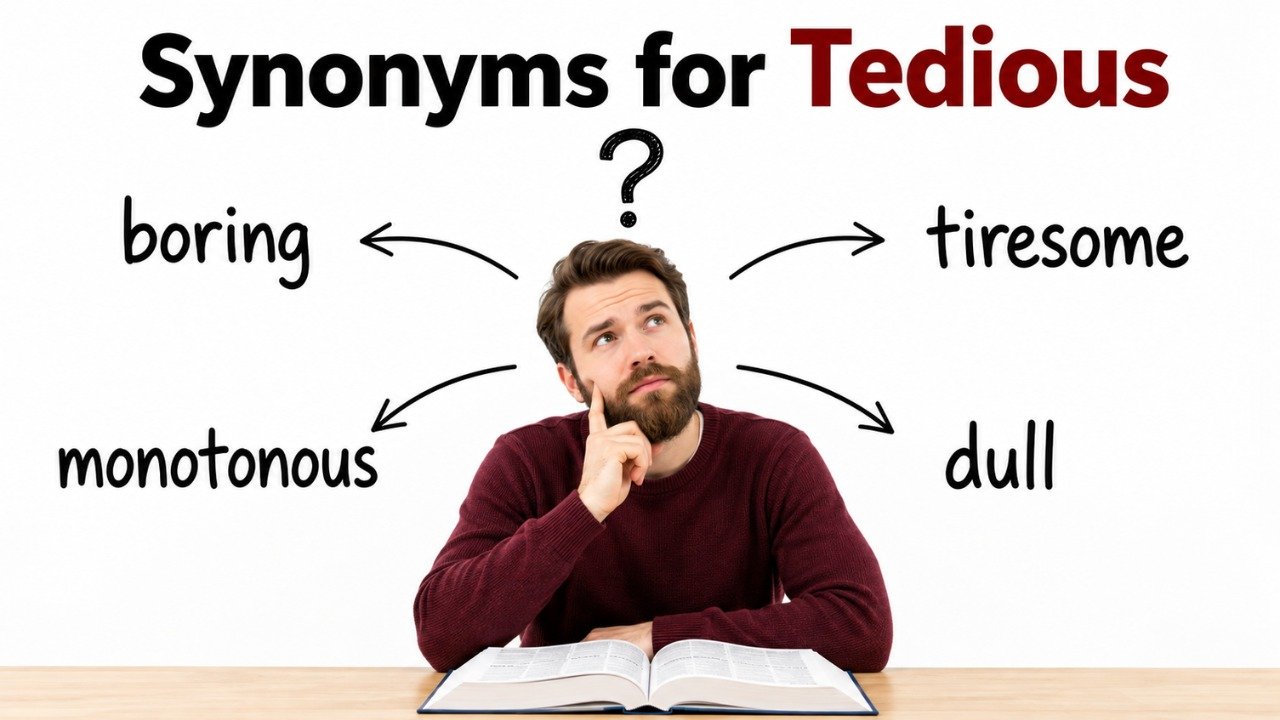
Quick Answer: The best synonyms for tedious include boring, monotonous, tiresome, wearisome, dull, repetitive, laborious, painstaking, arduous, and mind numbing. Use boring in casual speech for something that fails to hold attention. Choose monotonous when repetition causes boredom, laborious when work requires prolonged effort, and painstaking when a task demands careful attention. Tiresome and wearisome describe something that gradually drains energy or patience, while arduous emphasizes serious physical or mental difficulty.
Pronunciation and Word Details
Word: Tedious.
Pronunciation: /ˈtiː.di.əs/
Part of Speech: Adjective.
Meaning: Too long, repetitive, dull, or tiring to remain interesting or enjoyable.
US Pronunciation:
UK Pronunciation:
What Does “Tedious” Mean?
Tedious means boring, tiring, or frustrating because something continues for too long, involves too much repetition, or requires prolonged attention.
Tedious is an adjective. It commonly describes tasks, processes, meetings, explanations, routines, journeys, paperwork, and other experiences that feel slow or difficult to complete.
A tedious activity is not necessarily physically hard. It may simply demand patience for a long time. Copying hundreds of records can be tedious because the work is repetitive. Reading an unnecessarily detailed report can also be tedious because it takes too long and fails to hold attention.
The word can also describe work that requires careful effort. In this sense, tedious may suggest that the activity is tiring because it contains many small steps.
Example: Entering every number by hand was a tedious task.
Example: The speaker gave a tedious explanation of a simple idea.
Example: Cleaning the old files was tedious but necessary.
Meaning, Tone, and Context of “Tedious”
Tedious usually has a negative tone. It expresses boredom, impatience, mental fatigue, or frustration.
The word is more formal than boring, but it is still common in everyday conversation. It works well in essays, reports, emails, reviews, workplace discussions, and descriptive writing.
Formal Context: Tedious can describe a slow process, detailed procedure, repetitive duty, or unnecessarily long explanation.
Casual Context: It can describe any activity that feels boring and takes too much time.
Workplace Context: Tedious often refers to repetitive administrative work, data entry, paperwork, checking, filing, or manual processing.
Academic Context: It may describe long calculations, detailed research, repetitive exercises, or overly complicated explanations.
Technical Context: Tedious can describe a process that requires many manual steps or repeated checks.
Emotional Context: The word can show that a person feels mentally drained, impatient, or uninterested.
Tedious is usually stronger than dull because it often combines boredom with length, repetition, or effort. Something dull may simply be uninteresting. Something tedious is often uninteresting for an extended period.
When and How to Use “Tedious”
For Repetitive Work: Use tedious when a task requires the same action many times.
Example: Checking each record individually became tedious after several hours.
For Long Processes: Use tedious when a procedure contains too many stages or takes an excessive amount of time.
Example: Applying for the permit involved a tedious approval process.
For Boring Activities: Use tedious when an activity fails to hold attention and feels difficult to continue.
Example: The lecture became tedious because the speaker repeated the same point.
For Detailed Tasks: Use tedious when a job demands careful attention to numerous small details.
Example: Restoring the damaged document was tedious work.
For Administrative Duties: Use tedious for paperwork, filing, data entry, and similar responsibilities that demand patience.
Example: Completing the forms was tedious but unavoidable.
For Slow Explanations: Use tedious when a description or discussion is much longer than necessary.
Example: His tedious explanation confused the audience instead of helping them.
For Mental Fatigue: Use tedious when an activity gradually drains concentration or patience.
Example: Comparing hundreds of nearly identical entries was mentally tedious.
For Necessary but Unpleasant Work: Use tedious when a task is important but not enjoyable.
Example: Organizing the archive was tedious, yet it improved the entire system.
Best Synonyms for Tedious
Boring: Not interesting or enjoyable.
Example: The presentation was boring because it offered no new information.
Monotonous: Repetitive and lacking variety.
Example: The monotonous routine made every workday feel the same.
Tiresome: Causing boredom, annoyance, or fatigue.
Example: Answering the same question repeatedly became tiresome.
Wearisome: Gradually causing tiredness or loss of patience.
Example: The wearisome journey continued for several hours.
Dull: Lacking interest, excitement, or variety.
Example: The report was informative, but its writing style was dull.
Repetitive: Containing the same actions, words, or ideas many times.
Example: The repetitive training exercise quickly lost its value.
Laborious: Requiring considerable time and effort.
Example: Sorting the damaged records was a laborious process.
Painstaking: Requiring great care, patience, and attention to detail.
Example: The researcher completed a painstaking review of every document.
Arduous: Extremely difficult and tiring.
Example: Rebuilding the entire system was an arduous undertaking.
Mind Numbing: So repetitive or dull that it reduces concentration.
Example: Copying the figures manually was mind numbing work.
50 Synonyms for Tedious with Short Meanings
- Boring: Not interesting or engaging.
- Monotonous: Repetitive and lacking variety.
- Tiresome: Causing fatigue, boredom, or annoyance.
- Wearisome: Gradually draining energy or patience.
- Dull: Lacking excitement or interest.
- Repetitive: Involving the same action many times.
- Laborious: Requiring prolonged effort and time.
- Painstaking: Demanding careful and patient attention.
- Arduous: Very difficult and tiring.
- Mind Numbing: Extremely dull or repetitive.
- Uninteresting: Failing to attract or hold attention.
- Humdrum: Ordinary, repetitive, and lacking excitement.
- Dreary: Dull, depressing, or lacking energy.
- Drab: Unexciting and lacking variety.
- Stale: No longer fresh, interesting, or original.
- Dry: Presented without energy or interest.
- Flat: Lacking excitement, emotion, or liveliness.
- Lifeless: Showing little energy or interest.
- Unexciting: Not producing enthusiasm or interest.
- Routine: Regular and lacking novelty.
- Mechanical: Performed repeatedly without thought or variation.
- Repetitious: Containing unnecessary repetition.
- Unvarying: Remaining the same without change.
- Same: Lacking noticeable difference or variety.
- Predictable: Easy to anticipate and lacking surprise.
- Never Ending: Seeming to continue for too long.
- Lengthy: Continuing for an excessive period.
- Prolonged: Extended beyond a comfortable duration.
- Drawn Out: Made longer than necessary.
- Slow: Taking more time than expected.
- Time Consuming: Requiring a large amount of time.
- Demanding: Requiring significant effort or attention.
- Exhausting: Causing extreme tiredness.
- Fatiguing: Producing physical or mental tiredness.
- Draining: Gradually reducing energy or patience.
- Grueling: Extremely tiring and difficult.
- Onerous: Involving a heavy or unpleasant burden.
- Burdensome: Difficult to manage or complete.
- Strenuous: Requiring intense effort or energy.
- Trying: Difficult to tolerate or complete patiently.
- Taxing: Placing heavy demands on energy or concentration.
- Challenging: Requiring effort, skill, or persistence.
- Cumbersome: Slow or difficult because of complexity.
- Complicated: Containing many difficult parts or steps.
- Fussy: Requiring excessive attention to small details.
- Intricate: Containing many closely connected details.
- Meticulous: Requiring extreme care and precision.
- Annoying: Causing irritation or impatience.
- Frustrating: Creating difficulty, delay, or dissatisfaction.
- Thankless: Requiring effort without enjoyment or recognition.
Read Also:
Synonyms for Questioning

Synonyms for Tedious by Context
When Tedious Means Boring
The best synonyms are boring, dull, uninteresting, dry, flat, lifeless, and unexciting.
Boring is the clearest everyday alternative. Dull is slightly more descriptive and can refer to writing, conversation, events, or experiences. Dry often describes information that is presented without energy, humor, or personality.
Example With Tedious: The documentary became tedious after the first hour.
Example With Boring: The documentary became boring after the first hour.
Example With Dry: The documentary presented an important subject in a dry manner.
When Tedious Means Repetitive
Useful synonyms include monotonous, repetitive, repetitious, mechanical, routine, unvarying, and humdrum.
Monotonous is the strongest choice when an activity lacks change or variety. Repetitive is more neutral and simply describes repeated actions. Mechanical suggests that something is performed automatically and without creativity.
Example With Tedious: Entering the same information into every form was tedious.
Example With Monotonous: Entering the same information into every form was monotonous.
Example With Mechanical: The work became mechanical after several hours.
When Tedious Means Long
Useful alternatives include lengthy, prolonged, drawn out, never ending, slow, and time consuming.
Lengthy is relatively neutral and works well in formal writing. Drawn out is more critical because it suggests that something lasted longer than necessary. Never ending is more emotional and often appears in casual conversation.
Example With Tedious: The approval process was tedious.
Example With Lengthy: The approval process was lengthy.
Example With Drawn Out: The approval process was unnecessarily drawn out.
When Tedious Means Difficult and Tiring
The best choices include arduous, laborious, grueling, strenuous, exhausting, fatiguing, and taxing.
Arduous describes work that requires serious effort. Laborious emphasizes time and careful work. Grueling is stronger and suggests extreme physical or mental exhaustion.
Example With Tedious: Preparing every file manually was tedious.
Example With Laborious: Preparing every file manually was laborious.
Example With Grueling: Preparing the files under a strict deadline was grueling.
When Tedious Means Detailed
Useful synonyms include painstaking, meticulous, intricate, fussy, complicated, and cumbersome.
Painstaking has a more positive tone than tedious because it can suggest admirable care. Meticulous describes precision and attention to detail. Fussy is more negative and suggests that a task requires unnecessary attention to minor details.
Example With Tedious: Repairing the pattern was tedious work.
Example With Painstaking: Repairing the pattern required painstaking work.
Example With Meticulous: Repairing the pattern required meticulous attention.
When Tedious Means Annoying
The best alternatives are tiresome, wearisome, annoying, frustrating, trying, burdensome, and onerous.
Tiresome combines annoyance with fatigue. Wearisome emphasizes gradual exhaustion. Frustrating works well when obstacles or delays make a task difficult.
Example With Tedious: Repeating the entire process was tedious.
Example With Tiresome: Repeating the entire process was tiresome.
Example With Frustrating: Repeating the process because of an error was frustrating.
Another Word for Tedious
The best single replacement for tedious is boring when the main idea is a lack of interest. However, the most accurate alternative depends on why the activity feels unpleasant.
Choose monotonous when repetition causes boredom. Use laborious when a task demands considerable effort. Select painstaking when detailed care is required. Tiresome works well when something gradually becomes irritating or exhausting.
Original: Updating each record manually was tedious.
Better Option: Updating each record manually was monotonous.
Original: The application procedure was tedious.
Better Option: The application procedure was time consuming.
Original: Repairing every damaged section was tedious.
Better Option: Repairing every damaged section was painstaking.
Original: The speaker gave a tedious presentation.
Better Option: The speaker gave a boring presentation.
When Not to Use “Tedious”
Do not use tedious when a more specific adjective can explain exactly what makes an activity unpleasant.
If a task is physically difficult rather than boring, arduous or strenuous may be more accurate.
Weak: Climbing the steep mountain was tedious.
Better: Climbing the steep mountain was arduous.
Avoid tedious when the main problem is complexity rather than boredom or duration.
Weak: The instructions were tedious because nobody could understand them.
Better: The instructions were complicated and unclear.
Do not use tedious for an activity that is merely slow unless the delay also causes boredom, fatigue, or frustration.
Weak: The vehicle moved at a tedious speed.
Better: The vehicle moved at a frustratingly slow speed.
Avoid using tedious repeatedly in the same paragraph. Choose precise alternatives to create variety and improve clarity.
Weak: The tedious process involved tedious paperwork and tedious checking.
Better: The lengthy process involved repetitive paperwork and painstaking checking.
Do not use tedious when you want to praise careful work. Painstaking or meticulous may create a more respectful tone.
Weak: The artist completed a tedious restoration of the painting.
Better: The artist completed a painstaking restoration of the painting.
Avoid calling an important personal experience tedious when the word could sound dismissive or insensitive.
Weak: Listening to her describe the difficult experience was tedious.
Better: Listening to the lengthy account required patience and attention.
Words Commonly Confused With Tedious
Tedious vs Boring: Tedious usually describes something boring because it is long, repetitive, or demanding. Boring simply means uninteresting.
Tedious vs Monotonous: Tedious expresses the effect an activity has on a person. Monotonous specifically describes a lack of variety or change.
Tedious vs Tiresome: Tedious often refers to a task or process. Tiresome emphasizes the annoyance or fatigue caused by something.
Tedious vs Wearisome: Tedious combines boredom with duration or repetition. Wearisome places greater emphasis on gradual exhaustion.
Tedious vs Laborious: Tedious describes something unpleasantly long or boring. Laborious describes something that requires substantial work and effort.
Tedious vs Arduous: Tedious may involve mild or moderate fatigue. Arduous describes serious difficulty and intense effort.
Tedious vs Painstaking: Tedious is generally negative. Painstaking may be positive because it praises careful and patient work.
Tedious vs Repetitive: Tedious describes a negative experience. Repetitive simply states that something happens again and again.
Tedious vs Dull: Tedious often suggests excessive length or repetition. Dull mainly refers to a lack of interest, energy, or excitement.
Tedious vs Cumbersome: Tedious describes boredom or fatigue. Cumbersome describes a process or system that is difficult to use because it is large, complex, or inefficient.
Which Synonym Should You Choose?
Choose Boring: Use boring in casual speech when something fails to hold attention.
Choose Dull: Use dull in essays, reviews, and descriptions of uninteresting material.
Choose Monotonous: Use monotonous when a routine contains little or no variety.
Choose Repetitive: Use repetitive in reports and professional writing when an action occurs too many times.
Choose Tiresome: Use tiresome when an activity causes annoyance, fatigue, or loss of patience.
Choose Wearisome: Use wearisome in formal or literary writing when something gradually drains energy.
Choose Laborious: Use laborious for work that requires considerable time and sustained effort.
Choose Painstaking: Use painstaking when detailed work requires care, precision, and patience.
Choose Arduous: Use arduous when a task or journey is seriously difficult and exhausting.
Choose Grueling: Use grueling for extremely demanding work, training, or physical activity.
Choose Lengthy: Use lengthy in reports and emails when something lasts longer than expected.
Choose Drawn Out: Use drawn out when a discussion, process, or event continues longer than necessary.
Choose Time Consuming: Use time consuming in professional communication when the main concern is the amount of time required.
Choose Cumbersome: Use cumbersome when a process is inefficient because it has too many steps or complicated requirements.
Choose Mind Numbing: Use mind numbing in informal conversation for extremely repetitive or unstimulating work.
Real Life Examples of “Tedious” in Sentences
Original: Entering the customer details manually was tedious.
Better Option: Entering the customer details manually was monotonous.
Original: The approval process became tedious after several weeks.
Better Option: The approval process became drawn out after several weeks.
Original: Reading the entire document was tedious.
Better Option: Reading the entire document was time consuming.
Original: The manager gave a tedious explanation of the new procedure.
Better Option: The manager gave an unnecessarily lengthy explanation of the new procedure.
Original: Sorting the damaged files was tedious work.
Better Option: Sorting the damaged files was laborious work.
Original: The meeting was tedious and repetitive.
Better Option: The meeting was dull and repetitive.
Original: Correcting each individual error was tedious.
Better Option: Correcting each individual error was painstaking.
Original: The daily routine soon became tedious.
Better Option: The daily routine soon became monotonous.
Original: Waiting for the results was tedious.
Better Option: Waiting for the results was frustrating.
Original: The long journey through heavy traffic was tedious.
Better Option: The long journey through heavy traffic was wearisome.
Synonym Groups and Usage Differences
Boredom Group
This group includes boring, dull, uninteresting, dry, flat, lifeless, and unexciting.
These words focus on a lack of interest or stimulation. Boring is the most common choice. Dull is slightly more descriptive, while dry often refers to writing, teaching, or explanations that lack personality.
Example: The subject was useful, but the presentation was dry and uninteresting.
Repetition Group
This group includes monotonous, repetitive, repetitious, mechanical, routine, unvarying, and humdrum.
These words describe activities that contain too little change. Monotonous is strongly negative. Repetitive is more neutral, while mechanical suggests work performed automatically.
Example: The repetitive task required workers to complete the same action every minute.
Duration Group
This group includes lengthy, prolonged, drawn out, never ending, slow, and time consuming.
These alternatives emphasize how long something takes. Lengthy works in formal writing. Drawn out suggests unnecessary extension. Never ending expresses strong frustration.
Example: The drawn out discussion prevented the group from making a decision.
Effort Group
This group includes laborious, arduous, grueling, strenuous, demanding, exhausting, and taxing.
These words focus on difficulty and effort rather than boredom alone. Laborious often describes detailed work. Arduous suggests severe difficulty, while taxing emphasizes pressure on energy or concentration.
Example: Preparing the evidence for review was a laborious process.
Detail Group
This group includes painstaking, meticulous, intricate, fussy, and complicated.
These words describe tasks containing many details. Painstaking and meticulous can be positive because they suggest care and precision. Fussy is negative because it implies unnecessary detail.
Example: The editor conducted a meticulous review of the final document.
Annoyance Group
This group includes tiresome, wearisome, annoying, frustrating, trying, and burdensome.
These words describe the emotional effect of a difficult experience. Tiresome suggests increasing annoyance. Wearisome suggests gradual exhaustion, while trying emphasizes the need for patience.
Example: The repeated delays created a frustrating experience for everyone involved.
Antonyms of Tedious
The opposite of tedious depends on whether the word describes boredom, repetition, excessive length, or demanding effort.
Interesting: Able to attract and hold attention.
Engaging: Pleasantly involving or absorbing.
Exciting: Creating enthusiasm or strong interest.
Stimulating: Encouraging thought, energy, or curiosity.
Entertaining: Providing enjoyment or amusement.
Enjoyable: Giving pleasure or satisfaction.
Fascinating: Extremely interesting or attractive.
Absorbing: Holding complete attention.
Captivating: Attracting and maintaining strong interest.
Lively: Full of energy, movement, or enthusiasm.
Varied: Containing different elements or experiences.
Dynamic: Characterized by activity, change, or energy.
Effortless: Requiring little or no difficulty.
Simple: Easy to understand or complete.
Easy: Requiring little effort.
Brief: Lasting for a short time.
Efficient: Producing results without wasted time or effort.
Refreshing: Pleasantly different and mentally energizing.
Rewarding: Providing satisfaction or worthwhile results.
Pleasant: Enjoyable and comfortable.
Comparison: Tedious vs Related Words
Tedious vs Boring
Tedious suggests boredom caused by excessive length, repetition, or effort. Boring is broader and simply means that something is not interesting.
Example With Tedious: Reviewing hundreds of similar records was tedious.
Example With Boring: The film was boring because the story lacked conflict.
Tedious vs Monotonous
Tedious describes the unpleasant effect of an activity. Monotonous identifies repetition and lack of variety as the main problem.
Example With Tedious: The work became tedious after several hours.
Example With Monotonous: The work followed the same monotonous pattern every day.
Tedious vs Tiresome
Tedious often describes an activity that is long or repetitive. Tiresome emphasizes the fatigue or irritation it causes.
Example With Tedious: Completing the paperwork was tedious.
Example With Tiresome: His constant complaints became tiresome.
Tedious vs Wearisome
Tedious suggests boredom and impatience. Wearisome more strongly suggests gradual mental or physical exhaustion.
Example With Tedious: The detailed discussion was tedious.
Example With Wearisome: The long journey through difficult conditions was wearisome.
Tedious vs Laborious
Tedious emphasizes boredom or frustration. Laborious emphasizes the amount of effort and time required.
Example With Tedious: Copying the information by hand was tedious.
Example With Laborious: Reconstructing the damaged records was laborious.
Tedious vs Painstaking
Tedious has a negative tone and focuses on discomfort. Painstaking often has a positive tone because it highlights careful, patient effort.
Example With Tedious: Checking every symbol felt tedious.
Example With Painstaking: The researcher performed a painstaking examination of every symbol.
Tedious vs Arduous
Tedious may be boring without being extremely difficult. Arduous describes something seriously demanding and exhausting.
Example With Tedious: Organizing the files was tedious.
Example With Arduous: Carrying the equipment up the mountain was arduous.
Tedious vs Repetitive
Tedious describes how an activity feels. Repetitive describes its structure.
Example With Tedious: The daily exercise became tedious.
Example With Repetitive: The daily exercise involved repetitive movements.
Tedious vs Cumbersome
Tedious describes something that is boring or tiring. Cumbersome describes something difficult to manage because of its complexity or inefficiency.
Example With Tedious: Entering the data manually was tedious.
Example With Cumbersome: The old data entry system was cumbersome and difficult to navigate.
Common Phrases and Expressions With “Tedious”
Tedious Task: A job that is boring, repetitive, or slow.
Tedious Process: A procedure that contains too many steps or takes too long.
Tedious Work: Work that requires patience because it is repetitive or detailed.
Tedious Job: An occupation or assignment that lacks variety and interest.
Tedious Routine: A repeated pattern that has become boring.
Tedious Meeting: A long or uninteresting formal discussion.
Tedious Explanation: A description that contains unnecessary detail or repetition.
Tedious Procedure: A method that requires excessive time or effort.
Tedious Details: Small points that require prolonged attention.
Tedious Repetition: The unnecessary recurrence of the same action or idea.
Common Mistakes to Avoid
Using Tedious for Every Difficult Task: Not every difficult activity is tedious. Use arduous, strenuous, or grueling when physical or mental difficulty is the main idea.
Confusing Tedious With Boring: Boring is a broad description of something uninteresting. Tedious usually suggests that length, repetition, or effort causes the boredom.
Ignoring the Reason for the Boredom: A more precise synonym can improve the sentence. Use monotonous for repetition, lengthy for duration, and laborious for effort.
Repeating Tedious Too Often: Using the same adjective in several nearby sentences makes writing sound limited. Replace it with specific alternatives where appropriate.
Repetitive: The tedious task involved a tedious process and tedious instructions.
Improved: The boring task involved a lengthy process and repetitive instructions.
Using Painstaking as a Negative Word: Painstaking often praises careful work. Do not use it when you simply mean dull or annoying.
Incorrect: The lecture was painstaking and put everyone to sleep.
Correct: The lecture was tedious and put everyone to sleep.
Using Monotonous for Physical Difficulty: Monotonous means lacking variety. It does not necessarily mean physically exhausting.
Incorrect: The steep climb was monotonous.
Correct: The steep climb was arduous.
Using Tedious With an Unnatural Noun: Tedious normally describes activities, duties, processes, explanations, routines, and experiences.
Unnatural: She wore a tedious dress.
Natural: She listened to a tedious speech.
Creating Vague Descriptions: Explain what makes the task tedious when the reason matters.
Vague: The project was tedious.
Clearer: The project was tedious because every calculation had to be checked manually.
Overusing Informal Alternatives: Mind numbing can sound too casual for academic or professional writing. Choose monotonous, repetitive, or laborious in formal contexts.
Conclusion
The best synonyms for tedious depend on what makes an activity unpleasant. Use boring or dull for a lack of interest, monotonous or repetitive for repeated actions, and lengthy or drawn out for excessive duration. Laborious, arduous, and taxing emphasize effort, while painstaking and meticulous describe careful attention to detail. Choosing precise synonyms for tedious makes descriptions clearer and helps readers understand whether a task is boring, difficult, repetitive, slow, or mentally exhausting.
FAQs About Synonyms for Tedious
What Is the Best Synonym for Tedious?
Boring is the best general synonym. Monotonous is better for repetitive activities, while laborious suits work that requires prolonged effort.
Is Tedious the Same as Boring?
They are similar, but tedious usually suggests that something is boring because it is too long, repetitive, or demanding.
What Is a Formal Synonym for Tedious?
Monotonous, wearisome, laborious, arduous, and onerous are suitable formal alternatives, depending on the context.
What Is a Synonym for Tedious Work?
Laborious, repetitive, painstaking, monotonous, demanding, and time consuming can describe tedious work.
Can Painstaking Replace Tedious?
Painstaking can replace tedious when a task requires careful attention to detail. However, painstaking often has a more positive and respectful tone.
What Is the Difference Between Tedious and Monotonous?
Tedious describes something that causes boredom or fatigue. Monotonous specifically describes something that lacks variety or change.
What Is the Opposite of Tedious?
Common antonyms include interesting, engaging, exciting, stimulating, enjoyable, varied, effortless, and rewarding.
