
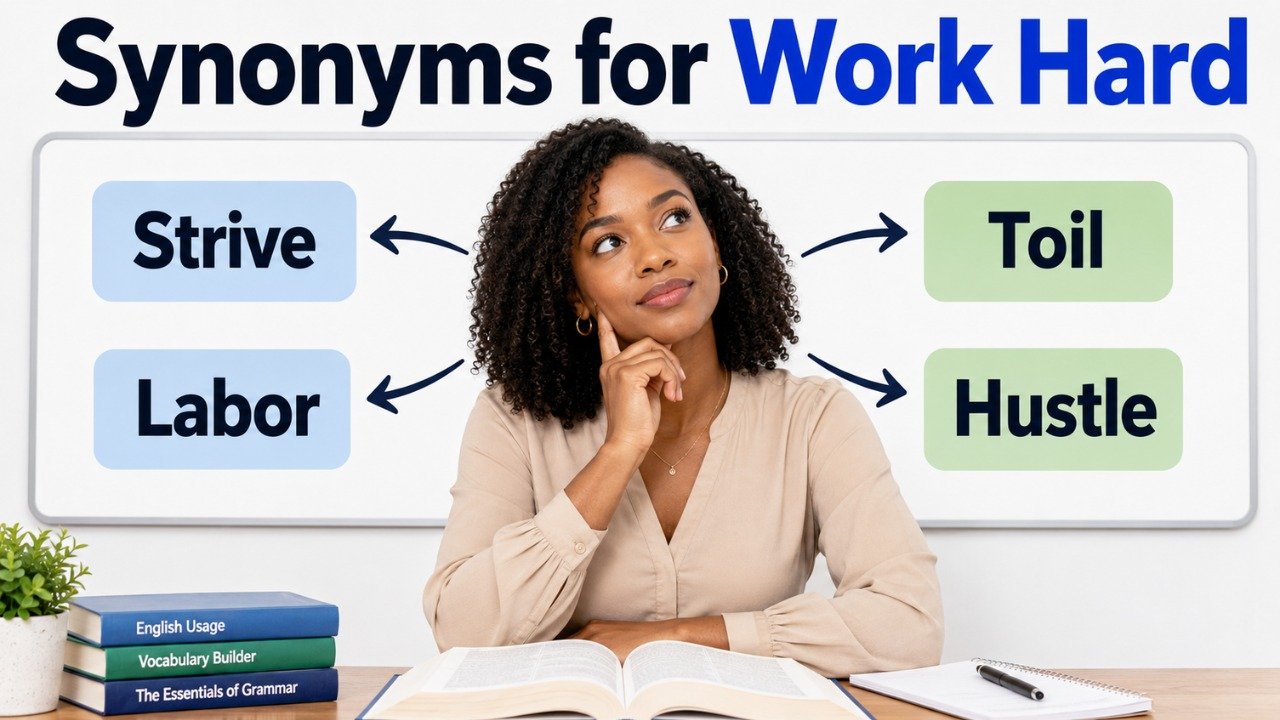
Quick Answer: The best synonyms for work hard include work diligently, strive, apply yourself, exert yourself, put in effort, persevere, labor, give it your all, work tirelessly, and make every effort. Use work diligently in formal or professional writing, strive when emphasizing determination toward a goal, and put in effort in neutral conversation. Give it your all works well for encouragement, while persevere emphasizes continuing despite difficulty. Work tirelessly adds strong emphasis when someone consistently gives significant time and energy to a task.
Pronunciation and Word Details
Word: Work Hard.
Pronunciation: /wɝːk hɑːrd/
Part of Speech: Verb phrase.
Meaning: To use significant effort, energy, time, and determination to complete a task or achieve a goal.
US Pronunciation:
UK Pronunciation:
What Does “Work Hard” Mean?
Work hard means to put serious effort, energy, attention, and determination into an activity or goal. It is a common verb phrase used to describe someone making a strong effort rather than completing something casually or with little attention.
The phrase can describe physical, mental, academic, professional, or personal effort.
Someone may work hard to finish a project, improve a skill, earn good results, support a family, solve a difficult problem, or achieve a personal goal.
Physical Effort: The workers worked hard to finish the repairs before evening.
Mental Effort: She worked hard to understand the difficult concept.
Academic Effort: He worked hard throughout the course and improved his writing.
Professional Effort: The entire team worked hard to complete the project successfully.
Personal Goal: She worked hard to become more confident in public speaking.
The phrase is flexible because it focuses on the amount or seriousness of effort rather than the exact type of activity being performed.
Meaning, Tone, and Context of “Work Hard”
Work hard has a neutral and conversational tone. It is appropriate in everyday speech, professional conversations, academic contexts, motivational writing, and many informal situations.
The phrase is easy to understand, but a more precise synonym may sometimes communicate the intended meaning more effectively.
Neutral Context: Work hard is suitable when simply describing considerable effort.
Formal Context: Work diligently, strive, apply oneself, and exert oneself may sound more polished.
Casual Context: Put in the work, buckle down, keep at it, and give it your all sound natural in conversation.
Motivational Context: Strive, persevere, keep pushing, and give your best emphasize determination.
Professional Context: Work diligently, stay committed, make every effort, and work conscientiously fit workplace communication.
Academic Context: Apply yourself, study diligently, strive, and make a serious effort are useful when discussing learning and achievement.
Strong Emotional Context: Work tirelessly and spare no effort suggest unusually intense dedication.
The correct alternative depends on whether you want to emphasize effort, persistence, discipline, intensity, or commitment.
When and How to Use “Work Hard”
For General Effort: Use work hard when someone gives serious attention and energy to a task.
Example: You need to work hard if you want to improve your writing skills.
For Professional Dedication: Use the phrase when describing commitment to responsibilities or goals.
Example: The staff worked hard to complete the project on schedule.
For Academic Effort: Work hard can describe serious studying, practicing, researching, or learning.
Example: She worked hard to prepare for the final examination.
For Personal Improvement: The phrase can describe effort toward developing a skill or changing a habit.
Example: He worked hard to become a more confident speaker.
For Persistence: Use work hard when continuous effort contributes to progress.
Example: They worked hard for months before reaching their goal.
For Encouragement: Work hard often appears in advice about effort and achievement.
Example: Work hard, remain patient, and continue learning from your mistakes.
For Physical Labor: The phrase can describe demanding physical effort.
Example: The crew worked hard throughout the afternoon to clear the damaged area.
Best Synonyms for Work Hard
Work Diligently: To perform a task carefully, consistently, and responsibly.
Example: She worked diligently to complete every part of the assignment correctly.
Strive: To make a determined effort to achieve something.
Example: The students strive to improve their communication skills.
Apply Yourself: To give serious attention and effort to a task.
Example: If you apply yourself, you can make significant progress.
Exert Yourself: To use considerable physical or mental effort.
Example: He exerted himself to finish the demanding task on time.
Put In Effort: To give the necessary energy and attention to something.
Example: You must put in effort if you want your skills to improve.
Persevere: To continue trying despite problems or difficulty.
Example: She persevered even when the project became challenging.
Labor: To work with considerable physical or mental effort.
Example: They labored for hours to prepare the site.
Give It Your All: To make the strongest effort you can.
Example: Give it your all during the final stage of the competition.
Work Tirelessly: To work with great energy for a long period.
Example: The volunteers worked tirelessly to complete the community project.
Make Every Effort: To do everything reasonably possible to accomplish something.
Example: We will make every effort to finish the work before the deadline.
50 Synonyms for Work Hard with Short Meanings
- Work Diligently: Work carefully and consistently.
- Strive: Make a determined effort toward a goal.
- Labor: Perform demanding physical or mental work.
- Toil: Work for a long time with significant effort.
- Exert Oneself: Use considerable physical or mental energy.
- Apply Oneself: Give serious attention and effort to something.
- Make An Effort: Try seriously to accomplish something.
- Put In Effort: Give energy and attention to a task.
- Give It Your All: Use your maximum effort.
- Work Tirelessly: Continue working with great energy.
- Work Assiduously: Work with persistent care and attention.
- Work Industriously: Work actively and productively.
- Work Persistently: Continue working without easily stopping.
- Work Intensely: Work with strong concentration and energy.
- Work Earnestly: Work with serious and sincere effort.
- Work Conscientiously: Perform duties carefully and responsibly.
- Work Steadily: Maintain consistent effort over time.
- Work Devotedly: Work with strong commitment.
- Work Determinedly: Work with firm intention to succeed.
- Work Seriously: Give a task proper attention and effort.
- Persevere: Continue despite difficulty or delay.
- Persist: Keep making an effort despite obstacles.
- Push Yourself: Encourage yourself to make greater effort.
- Buckle Down: Begin working seriously and with concentration.
- Knuckle Down: Start giving a task serious attention.
- Put Your Shoulder To The Wheel: Give serious practical effort to a task.
- Go All Out: Use as much effort as possible.
- Give Your Best: Perform with your strongest available effort.
- Do Your Utmost: Try as hard as possible.
- Spare No Effort: Use every reasonable means to achieve something.
- Make Every Effort: Try everything reasonably possible.
- Put In The Hours: Spend substantial time working.
- Put In The Work: Perform the effort needed for success.
- Stay Committed: Continue giving attention and dedication.
- Stay Focused: Maintain concentration on a task or goal.
- Keep At It: Continue making an effort.
- Press On: Continue despite difficulty.
- Keep Pushing: Continue making strong efforts.
- Dedicate Yourself: Commit your time and energy seriously.
- Devote Yourself: Give considerable attention and effort to something.
- Pour Energy Into: Give a task a large amount of effort.
- Throw Yourself Into: Become deeply involved in an activity.
- Work With Determination: Perform with a strong intention to succeed.
- Work With Dedication: Give consistent and committed effort.
- Work With Discipline: Follow a focused and controlled approach.
- Work With Persistence: Continue making effort despite obstacles.
- Work With Purpose: Perform tasks with clear intention and focus.
- Work At Full Capacity: Use your available ability and energy fully.
- Do The Heavy Lifting: Perform the most demanding part of a task.
- Sweat Over: Spend considerable effort completing something difficult.
Read Also:
Synonyms for Buddy

Synonyms for Work Hard by Context
When Work Hard Means Making Strong Effort
When the main idea is simply giving substantial energy to a task, use make an effort, put in effort, exert yourself, give your best, or do your utmost.
Example: She put in considerable effort to improve the final report.
Example: He did his utmost to solve the problem before the deadline.
When Work Hard Means Being Diligent
When effort also involves care, responsibility, and consistency, work diligently, work conscientiously, work assiduously, and work industriously are stronger choices.
Example: She worked diligently to check every calculation.
Example: The researcher worked conscientiously throughout the project.
When Work Hard Means Continuing Despite Difficulty
Use persevere, persist, keep at it, press on, or keep pushing when the important idea is refusing to stop.
Example: He persevered despite several unexpected setbacks.
Example: Keep at it until you understand the process completely.
When Work Hard Means Working Intensely
Use toil, labor, work intensely, go all out, or work tirelessly when emphasizing the strength or difficulty of the effort.
Example: They labored throughout the afternoon to finish the repairs.
Example: The group worked tirelessly to prepare everything in time.
When Work Hard Means Being Committed
Use dedicate yourself, devote yourself, stay committed, work with dedication, or work with purpose when commitment is more important than physical effort.
Example: She dedicated herself to mastering the new skill.
Example: The team stayed committed throughout the difficult project.
Another Word for Work Hard
Strive is one of the strongest single word alternatives for work hard because it expresses determined effort toward achieving a goal. However, the best replacement depends on context.
Work diligently is better when careful and responsible effort matters. Persevere is better when someone continues despite difficulty. Labor is appropriate when the task itself is demanding.
Original: She works hard to improve her writing.
Better Option: She strives to improve her writing.
Original: He worked hard on every part of the report.
Better Option: He worked diligently on every part of the report.
Original: They continued to work hard despite repeated problems.
Better Option: They persevered despite repeated problems.
Original: The crew worked hard throughout the afternoon.
Better Option: The crew labored throughout the afternoon.
When Not to Use “Work Hard”
Work hard is clear and natural, but it can become repetitive or vague when more specific language would explain how someone is making an effort.
Avoid repeatedly using work hard when you really mean persistence, carefulness, intense physical labor, or total commitment.
Weak: She worked hard and worked hard until the assignment was finished.
Better: She worked diligently until the assignment was finished.
Weak: He worked hard even after several failures.
Better: He persevered even after several failures.
Weak: The researchers worked hard to ensure that every detail was correct.
Better: The researchers worked conscientiously to ensure that every detail was correct.
Weak: The crew worked hard moving the heavy materials.
Better: The crew labored to move the heavy materials.
Weak: She wants to work hard toward becoming a better musician.
Better: She wants to dedicate herself to becoming a better musician.
More precise alternatives make sentences clearer because they identify the exact type of effort being described.
Words Commonly Confused With Work Hard
Work Hard vs Hard Work: Work hard is a verb phrase describing an action, while hard work is a noun phrase describing effort itself.
Example With Work Hard: You must work hard to develop the skill.
Example With Hard Work: Developing the skill requires hard work.
Work Hard vs Hardly Work: Work hard means make a strong effort. Hardly work means do very little work because hardly means scarcely or almost not.
Example With Work Hard: She works hard every morning.
Example With Hardly Work: The damaged machine can hardly work.
Work Hard vs Hardworking: Work hard describes an action, while hardworking is an adjective describing a person who regularly makes strong efforts.
Example With Work Hard: They work hard during busy periods.
Example With Hardworking: They are hardworking employees.
Work Hard vs Strive: Work hard emphasizes effort, while strive usually emphasizes determined movement toward a specific goal.
Example: She strives to become a better writer.
Work Hard vs Persevere: Work hard emphasizes effort, while persevere emphasizes continuing despite difficulty.
Example: He persevered after several unsuccessful attempts.
Work Hard vs Overwork: Working hard does not necessarily mean working excessively. Overwork means working more than is reasonable or healthy.
Example: He works hard, but he also allows enough time for rest.
Which Synonym Should You Choose?
Choose work diligently when formal writing needs to emphasize careful and consistent effort.
Choose strive when someone is making a determined effort to achieve a particular goal.
Choose apply yourself when discussing study, learning, practice, or personal improvement.
Choose exert yourself when emphasizing the amount of physical or mental energy being used.
Choose persevere when someone continues despite problems, failure, or discouragement.
Choose labor when describing demanding physical or mental work.
Choose give it your all in casual conversation, encouragement, or motivational language.
Choose work tirelessly when you want strong emphasis on continuous dedication and energy.
Choose make every effort in professional communication, reports, formal emails, or promises about completing a task.
Choose put in the work in casual conversation when emphasizing the effort required before success is possible.
Choose work conscientiously in reports, evaluations, or professional descriptions where responsibility and carefulness are important.
Choose buckle down in informal conversation when someone needs to stop delaying and begin working seriously.
Real Life Examples of “Work Hard” in Sentences
Original: You need to work hard to become confident at public speaking.
Better Option: You need to apply yourself to become confident at public speaking.
Original: She worked hard to improve the quality of the report.
Better Option: She worked diligently to improve the quality of the report.
Original: He continued to work hard despite disappointing results.
Better Option: He persevered despite disappointing results.
Original: They worked hard to complete the construction before winter.
Better Option: They labored to complete the construction before winter.
Original: Our team worked hard to solve the technical problem.
Better Option: Our team made every effort to solve the technical problem.
Original: She works hard toward becoming a better designer.
Better Option: She strives to become a better designer.
Original: The students worked hard throughout the semester.
Better Option: The students applied themselves throughout the semester.
Original: He worked hard when the final deadline approached.
Better Option: He buckled down when the final deadline approached.
Original: Everyone worked hard to make the event successful.
Better Option: Everyone gave their best to make the event successful.
Original: She worked hard for years to develop her expertise.
Better Option: She dedicated herself for years to developing her expertise.
Synonym Groups and Usage Differences
Diligence Group
Work diligently, work conscientiously, work assiduously, and work industriously emphasize careful, responsible, and consistent effort.
These alternatives are especially useful in professional, academic, or formal contexts.
Example: She worked diligently to verify every detail before submitting the document.
Effort Group
Make an effort, put in effort, exert yourself, give your best, and do your utmost emphasize the amount of energy someone gives to a task.
These expressions work well when the main idea is simply trying seriously.
Example: He made every effort to finish the assignment before the deadline.
Persistence Group
Persevere, persist, keep at it, press on, and keep pushing emphasize continuing when something becomes difficult.
These words are stronger than work hard when obstacles or setbacks are important to the meaning.
Example: She persevered despite several unsuccessful attempts.
Intensity Group
Labor, toil, work intensely, work tirelessly, and go all out suggest particularly demanding or energetic effort.
Some choices, especially toil, can imply that the work is tiring or difficult.
Example: The workers toiled for hours in difficult conditions.
Commitment Group
Dedicate yourself, devote yourself, stay committed, work with dedication, and work with purpose emphasize loyalty to a goal rather than simply effort.
Example: He devoted himself to developing the skills required for the position.
Antonyms of Work Hard
The opposite of work hard depends on whether the intended meaning involves effort, commitment, persistence, or productivity.
Avoid Effort: Deliberately choose not to make much effort.
Neglect: Fail to give proper attention to a responsibility.
Slack Off: Reduce effort or avoid serious work.
Give Up: Stop trying before accomplishing the goal.
Coast: Continue with minimal effort because little additional work seems necessary.
Procrastinate: Delay doing something that should be completed.
Idle: Spend time without productive activity.
Quit: Stop performing a task or pursuing a goal.
Disengage: Stop being actively involved or committed.
Underperform: Perform below the expected or possible level.
Work Carelessly: Perform a task without sufficient attention or effort.
Do The Minimum: Complete only the smallest amount of required work.
Comparison: Work Hard vs Related Words
Work Hard vs Work Diligently
Work hard emphasizes considerable effort. Work diligently adds the idea of careful, responsible, and consistent performance.
Example With Work Hard: She worked hard to finish the report.
Example With Work Diligently: She worked diligently to ensure that every part of the report was accurate.
Work Hard vs Strive
Work hard describes effort in general. Strive usually connects determined effort with a particular goal or improvement.
Example With Work Hard: He works hard at his lessons.
Example With Strive: He strives to become a stronger writer.
Work Hard vs Persevere
Work hard emphasizes energy and effort. Persevere emphasizes continuing despite difficulty, delay, or failure.
Example With Work Hard: They worked hard to solve the problem.
Example With Persevere: They persevered after several solutions failed.
Work Hard vs Toil
Work hard is neutral and can describe almost any serious effort. Toil usually suggests prolonged, tiring, or difficult work.
Example With Work Hard: She worked hard in the garden.
Example With Toil: She toiled for hours preparing the neglected garden.
Work Hard vs Apply Yourself
Work hard can refer to physical or mental effort. Apply yourself usually refers to concentrating seriously on learning, improving, or completing a task.
Example With Work Hard: He worked hard throughout the course.
Example With Apply Yourself: If you apply yourself, your writing will improve considerably.
Work Hard vs Exert Yourself
Work hard is broad and conversational. Exert yourself specifically emphasizes using physical or mental energy.
Example With Work Hard: They worked hard during the difficult task.
Example With Exert Yourself: You may need to exert yourself to complete the task within the available time.
Common Phrases and Expressions With Work Hard
Work Hard At Something: Give significant effort to developing or completing something.
Example: She works hard at improving her vocabulary.
Work Hard On Something: Put substantial effort into a particular task or project.
Example: They worked hard on the final presentation.
Work Hard For Something: Make a significant effort to obtain a result or opportunity.
Example: He worked hard for the opportunity.
Work Hard Toward A Goal: Make consistent effort in the direction of an objective.
Example: She continues to work hard toward her goal.
Work Hard To Achieve Something: Give strong effort in order to accomplish a result.
Example: They worked hard to achieve better results.
Work Hard To Improve: Make a serious effort to become better.
Example: He works hard to improve his writing.
Work Hard Under Pressure: Continue giving strong effort in demanding circumstances.
Example: She can work hard under pressure without losing focus.
Work Hard For A Living: Earn income through significant effort or demanding work.
Example: His parents worked hard for a living.
Work Hard Behind The Scenes: Make significant efforts that may not be obvious to others.
Example: The entire team worked hard behind the scenes.
Work Hard And Persevere: Combine strong effort with determination to continue.
Example: You must work hard and persevere when progress feels slow.
Common Mistakes to Avoid
A common mistake is replacing hard with hardly. Hard and hardly have very different meanings.
Incorrect: She hardly works to achieve her goals.
This usually means she does almost no work.
Correct: She works hard to achieve her goals.
Another mistake is confusing work hard with hard work.
Incorrect: His work hard produced excellent results.
Correct: His hard work produced excellent results.
Work hard functions as a verb phrase, while hard work functions as a noun phrase.
Avoid using very intense synonyms when the situation does not justify them. Work tirelessly suggests prolonged and exceptional effort, while toil can suggest exhausting or unpleasant work.
Do not replace work hard with persevere unless continuing through difficulty is part of the intended meaning.
Avoid unnecessary repetition.
Repetitive: She worked hard because she knew she had to work hard to succeed.
Better: She worked diligently because she knew consistent effort was necessary for success.
Choose alternatives according to the specific type of effort you want to communicate rather than treating every synonym as completely interchangeable.
Conclusion
The best synonyms for work hard depend on the kind of effort you want to describe. Work diligently emphasizes careful and consistent performance, while strive highlights determination toward a goal. Persevere is best when someone continues despite difficulty, and labor or toil can describe demanding work. Give it your all and put in the work are more conversational choices. By selecting a synonym based on effort, persistence, intensity, or commitment, you can make your sentences clearer, more precise, and more natural.
FAQs About Synonyms for Work Hard
What Is The Best Synonym for Work Hard?
Work diligently is one of the best general alternatives because it suggests serious, careful, and consistent effort. Strive is better when the sentence focuses on achieving a goal.
What Is A Formal Synonym for Work Hard?
Work diligently, strive, apply oneself, exert oneself, and work conscientiously are useful formal alternatives.
What Is A Professional Way To Say Work Hard?
Work diligently, make every effort, remain committed, and work conscientiously sound professional in workplace communication.
What Is A Casual Way To Say Work Hard?
Put in the work, give it your all, buckle down, keep at it, and go all out are natural casual alternatives.
Is Strive A Synonym for Work Hard?
Yes. Strive means making a determined effort to achieve something, so it is especially useful when a specific goal is involved.
What Is The Difference Between Work Hard And Hard Work?
Work hard is a verb phrase describing an action. Hard work is a noun phrase referring to the effort itself.
Example With Work Hard: You must work hard to improve.
Example With Hard Work: Improvement requires hard work.
Is Hardly Work The Same As Work Hard?
No. Work hard means make a strong effort. Hardly work usually means do almost no work. Hardly means scarcely or almost not, so these expressions have nearly opposite meanings.
