
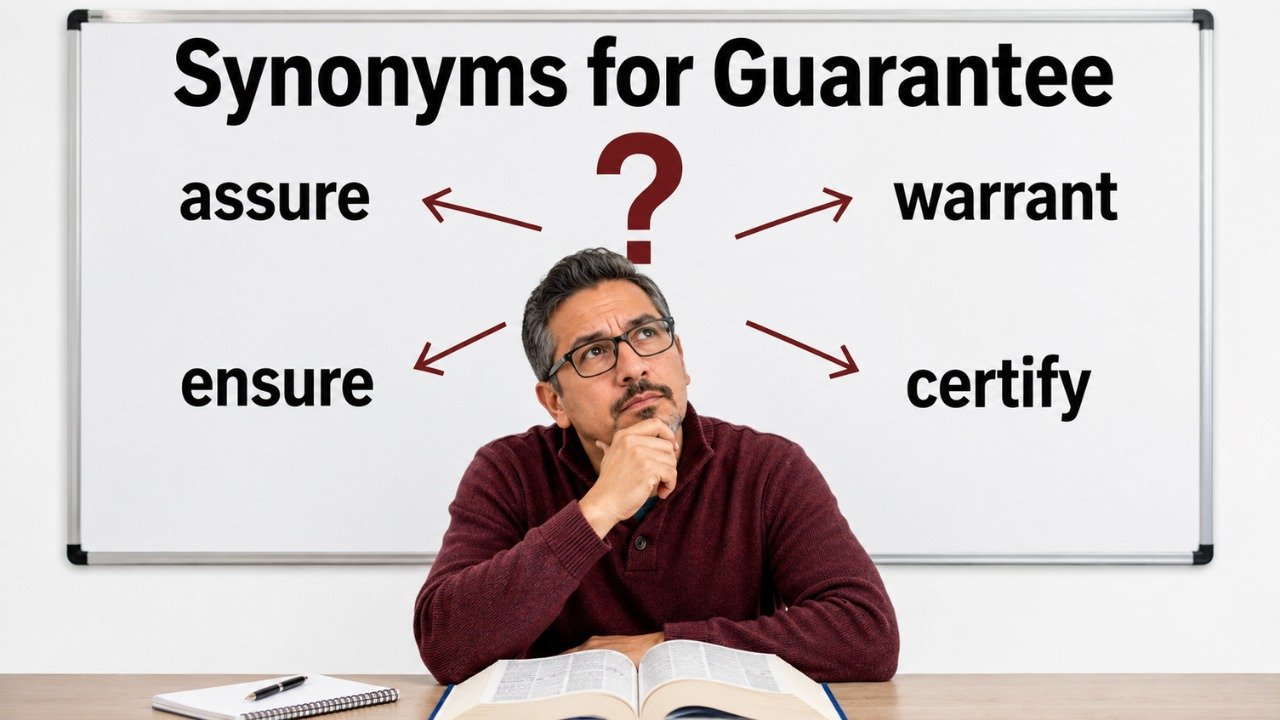
Quick Answer: The best synonyms for guarantee include assure, ensure, warrant, promise, pledge, secure, certify, safeguard, back, and vouch for. The best choice depends onhttps://synonymvocab.com/synonyms-for-guarantee/ context. Use ensure when making an outcome certain, assure when giving someone confidence, warrant for formal claims about quality or justification, promise for personal commitments, certify for official confirmation, and safeguard when the meaning involves protection. Some synonyms for guarantee express certainty, while others emphasize commitment, proof, financial protection, or responsibility.
Pronunciation and Word Details
Word: Guarantee
Pronunciation: /ˌɡær.ənˈtiː/
Part of Speech: Noun and verb
Meaning: A promise, assurance, or action that makes something certain, reliable, protected, or formally supported.
US Pronunciation:
UK Pronunciation:
What Does “Guarantee” Mean?
Guarantee means to promise that something will happen, be correct, work properly, or meet a particular standard. As a noun, it can also mean a formal promise or assurance that gives someone confidence about an outcome, product, payment, responsibility, or result.
As a verb, guarantee often expresses strong certainty.
Example: Careful preparation cannot guarantee success, but it can improve your chances.
As a noun, guarantee can describe a promise or protection.
Example: The agreement includes a guarantee of payment.
The word can also refer to responsibility for quality.
Example: The repair came with a guarantee covering certain defects.
Guarantee is therefore broader than words such as promise or ensure because its meaning changes according to whether the context involves certainty, commitment, protection, quality, payment, or proof.
Meaning, Tone, and Context of “Guarantee”
Guarantee usually has a strong and confident tone. It suggests more certainty or responsibility than weaker expressions such as expect, hope, or believe.
In everyday conversation, guarantee can emphasize confidence.
Example: I guarantee you will notice the difference.
In formal writing, guarantee may describe an obligation, protection, or promised result.
Example: The agreement does not guarantee future employment.
In business and financial contexts, guarantee can refer to responsibility for a payment, obligation, or standard.
Example: The borrower provided additional security to guarantee repayment.
In legal or contractual language, guarantee may carry a more specific meaning related to an obligation or promise. In general writing, however, it often simply means to make certain or confidently promise something.
The word is neutral in itself, but it can sound very strong because it implies a high level of certainty. Writers should therefore avoid using guarantee when an outcome is merely probable rather than certain.
When and How to Use “Guarantee”
For Making an Outcome Certain
Use guarantee when an action or condition makes a result certain or extremely dependable.
Example: Regular maintenance helps guarantee reliable operation.
For Making a Strong Promise
Guarantee can communicate a firm commitment about what will happen.
Example: I guarantee that the work will be completed as agreed.
For Quality Assurance
Use guarantee when responsibility is accepted for the quality or performance of something.
Example: The manufacturer guarantees the equipment against certain faults.
For Financial Responsibility
Guarantee can describe a promise to meet an obligation if another person or organization cannot do so.
Example: The parent company agreed to guarantee the payment.
For Protection
Guarantee may refer to arrangements that protect someone against a particular loss or problem.
Example: The contract guarantees basic protection for both parties.
For Strong Confidence
In conversation, guarantee can emphasize that the speaker feels completely certain.
Example: I can guarantee that the process will require patience.
For Rights or Access
Guarantee can describe something that is formally secured or protected.
Example: The policy guarantees equal access to the service.
Best Synonyms for Guarantee
Assure: To give someone confidence that something is true or will happen.
Example: She assured the client that the issue would be resolved.
Ensure: To make certain that something happens.
Example: Clear instructions help ensure consistent results.
Warrant: To formally promise quality or justify confidence in something.
Example: The supplier warranted that the materials met the required standard.
Promise: To give your word that you will do something or that something will happen.
Example: He promised to return the documents before Friday.
Pledge: To make a serious or formal promise.
Example: The committee pledged to protect the funds.
Secure: To make something safe, certain, or protected.
Example: The agreement secured continued access to the property.
Certify: To officially confirm that something meets a requirement or is true.
Example: An inspector certified that the system met the required standard.
Safeguard: To protect something from harm, loss, or risk.
Example: Strong procedures safeguard confidential information.
Back: To support a claim, promise, person, or obligation.
Example: The organization backed its commitment with additional funding.
Vouch for: To personally express confidence in a person, statement, quality, or reliability.
Example: I can vouch for her professionalism and reliability.
50 Synonyms for Guarantee with Short Meanings
- Assure: Give confidence about something.
- Ensure: Make an outcome certain.
- Warrant: Formally promise or support quality.
- Promise: Commit to doing or providing something.
- Pledge: Make a serious promise.
- Secure: Make something safe or certain.
- Certify: Officially confirm truth or quality.
- Safeguard: Protect against harm or loss.
- Back: Provide support for a promise or claim.
- Vouch for: Personally confirm reliability or quality.
- Affirm: State confidently that something is true.
- Confirm: Establish that something is correct or certain.
- Verify: Check and establish truth or accuracy.
- Attest: Formally declare that something is true.
- Insure: Provide financial protection against specified loss.
- Protect: Keep someone or something safe.
- Underwrite: Accept financial responsibility for a risk or obligation.
- Stand behind: Accept responsibility for quality or reliability.
- Commit: Bind yourself to an action or responsibility.
- Undertake: Formally agree to perform an action.
- Covenant: Make a formal agreement or promise.
- Give one’s word: Make a personal promise.
- Swear: Make a very strong declaration or promise.
- Vow: Make a solemn promise.
- Make certain: Cause something to become definite.
- Make sure: Take steps so something happens correctly.
- Validate: Confirm that something is acceptable or sound.
- Authenticate: Establish that something is genuine.
- Endorse: Express formal or public support.
- Support: Provide backing for a claim or commitment.
- Indemnify: Protect someone against specified financial loss.
- Cover: Provide protection against a particular risk or cost.
- Bind oneself: Formally accept an obligation.
- Obligate oneself: Commit to carrying out a responsibility.
- Provide assurance: Give confidence or certainty.
- Give assurance: State firmly that something can be trusted.
- Provide security: Supply protection against uncertainty or loss.
- Offer protection: Give safeguards against a risk.
- Secure against: Protect from a particular danger or loss.
- Stand surety: Accept responsibility for another obligation.
- Assurance: A confident promise or statement.
- Warranty: A formal promise concerning quality or performance.
- Security: Protection against risk or failure.
- Certainty: The state of being definite or sure.
- Commitment: A firm promise or obligation.
- Undertaking: A formal promise to perform something.
- Backing: Support that strengthens a promise or claim.
- Protection: Something that prevents harm or loss.
- Coverage: Protection provided against specified risks or costs.
- Surety: A formal assurance or responsibility for an obligation.
Read Also:
Synonyms for Win

Synonyms for Guarantee by Context
When Guarantee Means Make Certain
When guarantee means causing a particular result to happen, ensure and make certain are usually the strongest alternatives.
Ensure: Best for processes, requirements, systems, and outcomes.
Example: Regular testing helps ensure accurate results.
Make certain: Useful when emphasizing deliberate action to prevent uncertainty.
Example: Check the details again to make certain everything is correct.
Secure: Useful when the result involves obtaining or preserving something.
Example: The agreement secured continued access to the facilities.
When Guarantee Means Promise
Promise, pledge, undertake, and give one’s word work when guarantee expresses personal or formal commitment.
Promise: Natural for everyday commitments.
Example: She promised to provide an answer by Monday.
Pledge: Stronger and more formal than promise.
Example: The organization pledged to maintain the program.
Undertake: Appropriate for formal responsibilities.
Example: The contractor undertook to complete the repairs.
Give one’s word: Personal and conversational.
Example: He gave his word that the information would remain private.
When Guarantee Means Provide Quality Assurance
Warrant, certify, stand behind, and back are useful when discussing quality, reliability, or standards.
Warrant: Strong in formal quality statements.
Example: The supplier warranted the quality of the materials.
Certify: Best when an authorized person officially confirms compliance.
Example: The inspector certified the equipment as safe for use.
Stand behind: Natural when someone accepts responsibility for quality.
Example: The builder stands behind the quality of the work.
Back: Useful when support strengthens a claim.
Example: The company backed the commitment with a written agreement.
When Guarantee Means Protect
Safeguard, protect, insure, cover, and indemnify work when guarantee involves protection from harm or financial loss.
Safeguard: Best for preventing harm or misuse.
Example: These procedures safeguard sensitive information.
Protect: The broadest alternative for preventing damage or loss.
Example: The agreement protects both parties.
Insure: Appropriate when discussing insurance protection.
Example: Owners can insure the property against specified risks.
Indemnify: A more formal term involving protection against certain losses or liabilities.
Example: The agreement requires one party to indemnify the other for specified costs.
When Guarantee Means Confirm
Certify, verify, attest, affirm, and confirm work when guarantee refers to establishing truth or reliability.
Verify: Best when something is checked for accuracy.
Example: The technician verified the measurements.
Attest: Formal and often used when someone declares that information is true.
Example: The witness attested to the accuracy of the statement.
Confirm: Neutral and broadly useful.
Example: The final test confirmed the earlier findings.
Another Word for Guarantee
The best single replacement for guarantee is often ensure when the intended meaning is to make something certain. However, the best alternative always depends on context. Promise is better for personal commitments, warrant fits formal quality claims, and assure works when giving a person confidence.
Original: Careful planning can guarantee that the event runs smoothly.
Better Option: Careful planning can ensure that the event runs smoothly.
Original: I guarantee that I will return the book tomorrow.
Better Option: I promise that I will return the book tomorrow.
Original: The supplier guarantees the quality of the materials.
Better Option: The supplier warrants the quality of the materials.
Original: She guaranteed him that the documents were safe.
Better Option: She assured him that the documents were safe.
When Not to Use “Guarantee”
Guarantee can be too strong when the result is uncertain. It should not be used simply because something is likely, expected, or possible.
Weak: Studying every evening will guarantee the highest score.
Better: Studying every evening can improve your chances of earning a high score.
Guarantee may also sound unnatural when the sentence is mainly about reassuring a person.
Weak: She guaranteed me that everything was fine.
Better: She assured me that everything was fine.
Use ensure when the main idea is taking steps to make something happen.
Weak: Double check the information to guarantee accuracy.
Better: Double check the information to ensure accuracy.
Avoid guarantee when certify is more precise for official confirmation.
Weak: The inspector guaranteed that the equipment met the standard.
Better: The inspector certified that the equipment met the standard.
Guarantee can also become repetitive in formal writing if it appears in several nearby sentences. Using ensure, warrant, protect, promise, or assure according to the intended meaning makes the writing more precise.
Words Commonly Confused With Guarantee
Guarantee vs Ensure: Guarantee expresses a strong promise or certainty, while ensure focuses on taking action that makes a result happen.
Guarantee vs Assure: Guarantee can refer to outcomes, quality, obligations, or promises. Assure usually means giving a person confidence or removing doubt.
Guarantee vs Insure: Guarantee broadly means promise or make certain. Insure usually refers to providing insurance protection against financial loss.
Guarantee vs Warranty: Guarantee can be a noun or verb with several meanings. Warranty is primarily a noun describing a formal promise concerning quality, condition, repair, or performance.
Guarantee vs Promise: A promise is a commitment to do something. Guarantee often adds a stronger sense of certainty, responsibility, or protection.
Guarantee vs Certify: Guarantee gives assurance, while certify officially confirms that something meets a standard or is true.
Guarantee vs Warrant: Guarantee is broad. Warrant can express a formal assurance about quality or indicate that circumstances justify a particular action or conclusion.
Which Synonym Should You Choose?
Choose ensure when describing actions designed to make a result certain.
Choose assure when giving a person confidence or removing doubt.
Choose promise when describing a personal commitment in everyday conversation.
Choose pledge when the commitment is serious, public, or formal.
Choose warrant when discussing formal assurances about quality, condition, or reliability.
Choose certify when an authorized person officially confirms compliance, accuracy, or quality.
Choose safeguard when the purpose is to protect something from harm, misuse, or loss.
Choose insure when referring specifically to insurance coverage against financial risks.
Choose verify when accuracy must be checked rather than promised.
Choose vouch for when a person personally supports the reliability, character, or quality of someone or something.
For essays and reports, ensure, confirm, verify, warrant, and certify often provide greater precision than guarantee.
For emails and professional communication, assure, confirm, ensure, and commit can sound natural depending on what is being promised.
For casual conversation, promise, make sure, give one’s word, and vouch for are usually more conversational.
Real Life Examples of “Guarantee” in Sentences
Original: Clear Examples of “Guarantee” in Sentences
Original: Clear instructions guarantee that everyone follows the same process.
Better Option: Clear instructions ensure that everyone follows the same process.
Original: I guarantee that I will call you after the meeting.
Better Option: I promise that I will call you after the meeting.
Original: She guaranteed the customer that the problem would be investigated.
Better Option: She assured the customer that the problem would be investigated.
Original: The supplier guarantees that the materials meet the required standard.
Better Option: The supplier warrants that the materials meet the required standard.
Original: These procedures guarantee the safety of confidential files.
Better Option: These procedures safeguard confidential files.
Original: The inspection guarantees that the machine meets the required standard.
Better Option: The inspection certifies that the machine meets the required standard.
Original: I can guarantee his reliability.
Better Option: I can vouch for his reliability.
Original: Additional funding will guarantee the continuation of the project.
Better Option: Additional funding will secure the continuation of the project.
Original: The agreement guarantees both parties against certain financial losses.
Better Option: The agreement protects both parties against certain financial losses.
Original: The organization guaranteed its commitment with additional financial support.
Better Option: The organization backed its commitment with additional financial support.
Synonym Groups and Usage Differences
Certainty Group
Ensure, make certain, make sure, and secure belong to the certainty group. These words focus on making an outcome dependable rather than merely promising it.
Example: Additional checks help ensure that the figures are accurate.
Ensure is especially useful for procedures, standards, safety, accuracy, and results.
Promise Group
Promise, pledge, vow, undertake, commit, and give one’s word describe commitments.
Promise is neutral and common. Pledge is more formal or serious. Vow is especially strong and personal. Undertake is suitable for formal obligations.
Example: The committee pledged to complete the review.
Assurance Group
Assure, affirm, confirm, attest, and vouch for provide confidence in different ways.
Assure usually addresses a person’s concerns. Confirm establishes that something is true. Attest is more formal. Vouch for expresses personal confidence.
Example: She assured the team that the schedule had not changed.
Quality and Verification Group
Warrant, certify, verify, validate, and authenticate are useful when reliability, standards, accuracy, or genuineness matters.
Example: The technician verified the accuracy of the readings.
Certify is more official, while verify emphasizes checking.
Protection Group
Safeguard, protect, insure, indemnify, cover, and secure against belong to the protection group.
Example: Strong access controls safeguard private records.
These alternatives should be chosen according to the type of protection involved. Insure is especially associated with insurance, while indemnify has a more formal financial or contractual meaning.
Antonyms of Guarantee
The opposite of guarantee depends on whether guarantee means certainty, promise, protection, or confirmation.
Doubt: Lack of confidence or certainty.
Uncertainty: A condition in which the outcome is not known.
Risk: The possibility that something undesirable may happen.
Possibility: Something that may happen but is not certain.
Question: To express doubt about the truth or reliability of something.
Deny: State that something is not true.
Disclaim: Refuse or reject responsibility for something.
Withdraw: Remove a promise, offer, or commitment.
Endanger: Put someone or something at risk.
Expose: Leave someone or something without sufficient protection.
Invalidate: Make something no longer valid or acceptable.
Contradict: State or demonstrate the opposite of a claim.
Comparison of Guarantee and Related Words
Guarantee vs Ensure
Guarantee communicates a strong promise or level of certainty. Ensure emphasizes actions that make a result happen.
Example With Guarantee: No training program can guarantee immediate success.
Example With Ensure: Regular reviews help ensure that everyone understands the procedure.
Guarantee vs Assure
Guarantee can relate to a result or obligation. Assure is normally directed toward a person who needs confidence.
Example With Guarantee: The agreement guarantees access for registered participants.
Example With Assure: She assured the participants that their registrations were valid.
Guarantee vs Promise
Promise focuses on personal or organizational commitment. Guarantee often sounds stronger because it can imply responsibility for the outcome.
Example With Guarantee: I cannot guarantee that the train will arrive on time.
Example With Promise: I promise to meet you when the train arrives.
Guarantee vs Warrant
Guarantee is the broader term. Warrant often suits formal statements about quality, condition, or justified confidence.
Example With Guarantee: The seller guarantees the quality of the materials.
Example With Warrant: The seller warrants that the materials meet the agreed specifications.
Guarantee vs Certify
Guarantee gives assurance about something. Certify means officially confirming that something is true or meets a standard.
Example With Guarantee: The supplier guarantees that the equipment will perform as stated.
Example With Certify: The inspector certified that the equipment met the required safety standard.
Guarantee vs Warranty
Guarantee can function as both a verb and a noun. Warranty is mainly a noun referring to a formal promise about condition, quality, repair, replacement, or performance.
Example With Guarantee: The supplier guarantees the equipment for a specified period.
Example With Warranty: The equipment includes a warranty covering specified defects.
Common Phrases and Expressions With “Guarantee”
Guarantee Success: Promise or make a successful result certain.
Example: Experience alone cannot guarantee success.
Guarantee Payment: Promise that a required payment will be made.
Example: Additional security was provided to guarantee payment.
Guarantee Quality: Accept responsibility for a particular standard of quality.
Example: Careful inspection helps guarantee quality.
Guarantee Results: Promise that a particular outcome will occur.
Example: No responsible method can guarantee results in every situation.
Guarantee Protection: Provide dependable protection against a particular risk.
Example: The agreement is designed to guarantee protection for both parties.
Guarantee Access: Make certain that someone can enter, obtain, or use something.
Example: The new policy guarantees access to essential information.
Guarantee Delivery: Promise that something will be delivered as agreed.
Example: The arrangement guarantees delivery within the agreed period.
Guarantee Performance: Promise that something will operate or perform according to a standard.
Example: Regular testing helps guarantee performance.
Money Back Guarantee: A promise that payment will be returned under stated conditions.
Example: The agreement included a money back guarantee under certain conditions.
No Guarantee: A statement that a particular result is not promised.
Example: Completing the course offers valuable preparation, but there is no guarantee of employment.
Common Mistakes to Avoid
One common mistake is using guarantee for outcomes that cannot realistically be certain. If the result depends on many unpredictable factors, words such as improve, increase the likelihood, support, or help may be more accurate.
Another mistake is confusing guarantee with assure.
Incorrect: She guaranteed me that the information was accurate.
Better: She assured me that the information was accurate.
Writers also sometimes confuse ensure and insure. Ensure means to make certain, while insure generally refers to obtaining insurance protection.
Incorrect: These checks insure accurate calculations.
Better: These checks ensure accurate calculations.
Avoid using guarantee when verify or certify describes the action more precisely.
Less Precise: The examination guarantees that the document is authentic.
Better: The examination verifies that the document is authentic.
Repetition is another common problem. Using guarantee several times in one paragraph can make the writing heavy. Choose alternatives according to the precise meaning rather than replacing every occurrence with the same synonym.
Do not assume that every synonym is interchangeable. Promise, ensure, warrant, certify, and safeguard each express a different aspect of guarantee.
Conclusion
The best synonyms for guarantee depend on what you want to express. Use ensure for making an outcome certain, assure for giving someone confidence, promise or pledge for commitments, warrant for formal quality assurances, certify for official confirmation, and safeguard for protection. Other useful synonyms for guarantee include secure, back, verify, and vouch for. Choosing the most precise alternative makes writing clearer because guarantee can refer to certainty, responsibility, protection, proof, quality, or a firm promise.
FAQs About Synonyms for Guarantee
What Is the Best Synonym for Guarantee?
Ensure is often the best synonym when guarantee means to make something certain. Promise, assure, warrant, or certify may be better in other contexts.
Is Ensure a Synonym for Guarantee?
Yes. Ensure is a strong synonym when the meaning is to make certain that something happens. It does not always carry the same sense of a formal promise.
Is Assure the Same as Guarantee?
Not exactly. Assure usually means giving a person confidence, while guarantee can refer to certainty, quality, obligations, protection, or promised results.
What Is a Formal Synonym for Guarantee?
Warrant, certify, undertake, pledge, and provide assurance are useful formal alternatives. The best choice depends on whether the context involves quality, confirmation, responsibility, or commitment.
What Is a Casual Synonym for Guarantee?
Promise and make sure are natural choices in casual speech. Give one’s word can also work when making a personal commitment.
What Is Another Word for a Guarantee as a Noun?
Assurance, warranty, security, commitment, undertaking, backing, and protection can replace guarantee as a noun in suitable contexts.
What Is the Difference Between Guarantee and Warranty?
Guarantee is a broad word that can describe a promise, certainty, responsibility, or protection and can function as a noun or verb. Warranty is mainly a noun referring to a formal promise about quality, condition, repair, replacement, or performance.
