
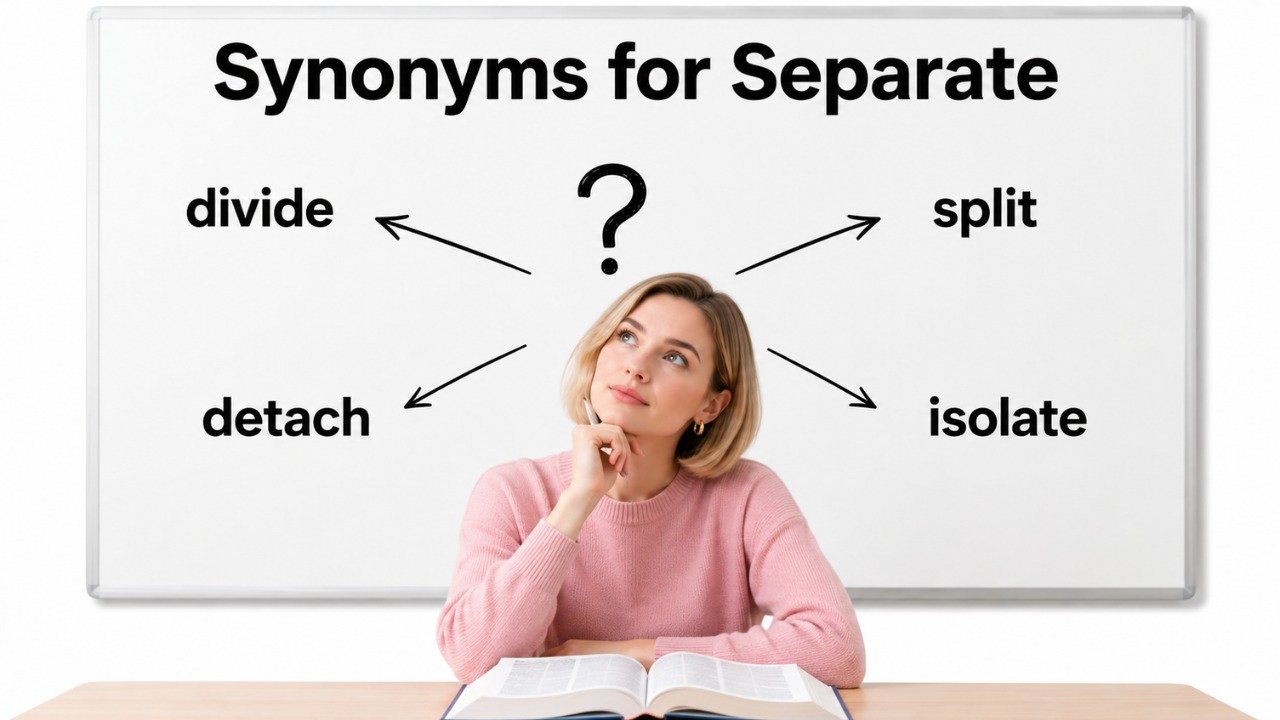
Quick Answer: The best synonyms for separate include distinct, divided, detached, independent, individual, isolated, apart, disconnected, split, and segregated. Among these synonyms for separate, distinct works best when emphasizing difference, divided suits something split into parts, detached describes something physically removed, and independent fits people or things that operate on their own. Use isolated for distance from others, individual for separate items or people, apart for physical position, and disconnected when a link or relationship has been broken.
Pronunciation and Word Details
Word: Separate.
Pronunciation: /ˈsep.ər.ət/ as an adjective and /ˈsep.ə.reɪt/ as a verb.
Part of Speech: Adjective and verb.
Meaning: As an adjective, separate means existing or kept apart from something else. As a verb, it means to divide, disconnect, or move things apart.
US Pronunciation:
UK Pronunciation:
What Does “Separate” Mean?
Separate means existing apart from something else or causing things to become divided.
The word can function as both an adjective and a verb, which makes its exact meaning depend on the sentence.
As an adjective, separate often describes people, objects, places, ideas, or groups that are not joined together.
Example: The children sleep in separate rooms.
Here, separate means different and physically apart.
As a verb, separate describes the action of dividing or moving things away from one another.
Example: Separate the white clothes from the colored clothes.
In this sentence, separate means to divide one group into different categories.
Separate can also describe differences in identity, responsibility, ownership, purpose, or organization.
Example: The two departments have separate responsibilities.
It may also refer to emotional, physical, social, or organizational distance.
Example: The fence separates the garden from the road.
Because separate has several related meanings, choosing the right synonym depends on whether you mean divided, different, independent, distant, disconnected, or removed.
Meaning, Tone, and Context of “Separate”
Separate is generally a neutral and flexible word. It is common in everyday conversation, professional writing, academic explanations, instructions, and technical descriptions.
Tone: Neutral, clear, and practical.
Formality: Suitable for both formal and informal contexts.
Conversational Use: Separate commonly describes people, rooms, objects, groups, or responsibilities that are kept apart.
Example: We ordered separate meals.
Professional Use: It can describe different departments, records, accounts, responsibilities, or processes.
Example: Each department maintains separate records.
Academic Use: Separate may describe different variables, categories, concepts, or groups.
Example: The study examined the two factors as separate variables.
Technical Use: It can describe components that are physically or functionally divided.
Example: The device contains separate control units.
Emotional Context: Separate can describe people who are no longer together or who live apart.
Example: The couple decided to live separately.
The word itself is usually neutral, but its emotional effect depends on context. A separate workspace sounds practical, while separate families may suggest distance or division.
When and How to Use “Separate”
For Physical Distance
Use separate when people or objects are positioned apart rather than together.
Example: The desks were placed in separate corners of the room.
For Different Groups
Separate works when people or things are divided into categories or sections.
Example: The documents were organized into separate folders.
For Different Identities
Use separate when two things are related but should be treated as distinct.
Example: Cost and quality are separate issues.
For Independent Operation
Separate can describe systems, businesses, accounts, or departments that function independently.
Example: The two offices have separate management teams.
For Dividing Objects
As a verb, separate means to divide one thing from another.
Example: Separate the damaged items from the usable ones.
For Removing Something
Use separate when one part is detached or removed from another.
Example: Carefully separate the paper from the backing.
For Personal Space
Separate is useful when describing individual rooms, areas, belongings, or responsibilities.
Example: Each employee has a separate storage space.
For Relationships
Separate can describe people who no longer live or function together.
Example: The partners agreed to separate after several years together.
Best Synonyms for Separate
Distinct: Clearly different from something else.
Example: The report contains three distinct sections.
Divided: Split into different parts or groups.
Example: The class was divided into smaller teams.
Detached: Removed or disconnected from something.
Example: The garage is detached from the main house.
Independent: Able to exist or operate without relying on another person or thing.
Example: Each unit functions as an independent system.
Individual: Belonging to or intended for one person or thing.
Example: Every student received an individual assignment.
Isolated: Located or kept far away from others.
Example: The cabin stood in an isolated area.
Apart: Positioned at a distance from something else.
Example: The chairs were placed several feet apart.
Disconnected: No longer connected physically or functionally.
Example: The damaged wire became disconnected from the circuit.
Split: Divided into two or more parts.
Example: The group split into two teams.
Segregated: Kept apart from another group or category.
Example: The materials were segregated according to type.
50 Synonyms for Separate with Short Meanings
- Distinct: Clearly different from something else.
- Divided: Split into different parts.
- Detached: Removed from a larger whole.
- Independent: Able to function on its own.
- Individual: Existing as a single unit.
- Isolated: Kept or located away from others.
- Apart: Positioned away from something else.
- Disconnected: No longer joined or linked.
- Split: Divided into parts or groups.
- Segregated: Kept apart from others.
- Different: Not the same as another thing.
- Disjoined: No longer joined together.
- Disunited: No longer connected as one group.
- Partitioned: Divided into sections.
- Severed: Completely cut or broken apart.
- Removed: Taken away from a position or group.
- Disassociated: No longer connected by relationship or association.
- Unconnected: Having no direct connection.
- Unrelated: Having no meaningful relationship.
- Disparate: Essentially different in type or character.
- Discrete: Individually separate and clearly defined.
- Autonomous: Able to operate independently.
- Self contained: Complete and independent within itself.
- Standalone: Able to function independently.
- Solo: Done or existing alone.
- Single: Existing as one individual unit.
- Respective: Belonging separately to each person or thing.
- Particular: Referring to one specific person or thing.
- Exclusive: Limited to one person, group, or purpose.
- Private: Intended for one person or limited group.
- Solitary: Existing or being alone.
- Remote: Located far from other places or people.
- Secluded: Sheltered or kept away from others.
- Withdrawn: Positioned or moved away from others.
- Distant: Far away in space or relationship.
- Detachedly: In a way that shows distance or independence.
- Sundered: Split or forced apart.
- Separated: Moved or kept apart.
- Dispersed: Spread apart over an area.
- Scattered: Distributed in different places.
- Sorted: Arranged into different groups.
- Classified: Divided according to categories.
- Distinguished: Recognized as different from something else.
- Differentiated: Made or recognized as different.
- Divorced: Separated from a former connection or relationship.
- Dissociated: Disconnected from an idea, person, or group.
- Sectioned: Divided into sections.
- Partitioned off: Divided from a larger space.
- Cut off: Separated from contact or connection.
- Set apart: Kept different, distant, or separate from others.
Read Also:
Synonyms for Encouraged

Synonyms for Separate by Context
When Separate Means Different
When separate means that two things should not be treated as the same, useful alternatives include distinct, different, discrete, disparate, individual, and particular.
Example With Separate: Cost and reliability are separate concerns.
Example With Distinct: Cost and reliability are distinct concerns.
Example With Different: Cost and reliability are different concerns.
Example With Discrete: The researcher treated each factor as a discrete variable.
When Separate Means Divided
When separate describes something divided into parts, choose divided, split, partitioned, sectioned, segregated, or sorted.
Example With Separate: The office has separate work areas.
Example With Partitioned: The office has partitioned work areas.
Example With Divided: The office is divided into several work areas.
Example With Sectioned: The storage room is sectioned according to product type.
When Separate Means Independent
When something exists or operates on its own, independent, autonomous, standalone, self contained, and individual are useful alternatives.
Example With Separate: The two businesses operate as separate companies.
Example With Independent: The two businesses operate as independent companies.
Example With Autonomous: Each division operates as an autonomous unit.
Example With Standalone: The application can function as a standalone system.
When Separate Means Physically Apart
When separate refers to physical distance, use apart, detached, isolated, distant, remote, or secluded.
Example With Separate: The guest house is separate from the main building.
Example With Detached: The guest house is detached from the main building.
Example With Apart: The two buildings stand several meters apart.
Example With Isolated: The cottage is isolated from nearby houses.
When Separate Means Disconnect
As a verb, separate can mean to detach, disconnect, sever, remove, disjoin, or dissociate.
Example With Separate: Separate the cable from the device.
Example With Disconnect: Disconnect the cable from the device.
Example With Detach: Detach the cable from the device.
Example With Remove: Remove the cable carefully from the device.
When Separate Means Sort Into Groups
When the action involves organizing items into categories, use sort, classify, divide, segregate, distinguish, or differentiate.
Example With Separate: Separate the documents by category.
Example With Sort: Sort the documents by category.
Example With Classify: Classify the documents according to subject.
Example With Divide: Divide the documents into relevant groups.
Another Word for Separate
Another word for separate is distinct when the meaning is different or clearly identifiable from something else. However, the best alternative depends on the sentence. Divided is better for parts, detached for physical removal, independent for separate operation, and apart for physical distance.
Original: The two problems are separate.
Better Option: The two problems are distinct.
Original: They work in separate departments.
Better Option: They work in independent departments.
Original: The garage is separate from the house.
Better Option: The garage is detached from the house.
Original: Keep the chairs separate.
Better Option: Keep the chairs apart.
When Not to Use “Separate”
Separate is useful, but another word can sometimes make the meaning more precise.
When You Mean Clearly Different
If the sentence focuses on difference rather than physical distance, distinct may communicate the idea more accurately.
Weak: These are two separate concepts with different meanings.
Better: These are two distinct concepts with different meanings.
When You Mean Physical Removal
Detached or removed may be more precise when one object has been taken away from another.
Weak: The handle became separate from the door.
Better: The handle became detached from the door.
When You Mean Independent Operation
Independent is usually clearer when describing people, businesses, organizations, or systems that function on their own.
Weak: The department is separate from the main organization in its operations.
Better: The department operates independently from the main organization.
When You Mean Distance
Apart often sounds more natural when describing physical spacing.
Weak: Place the chairs separate from each other.
Better: Place the chairs apart from each other.
When Repetition Makes Writing Awkward
Using separate repeatedly can make a paragraph sound mechanical.
Weak: Each separate team has a separate office and a separate schedule.
Better: Each individual team has its own office and an independent schedule.
When a More Specific Verb Is Available
As a verb, separate may be too general if the action is really sorting, cutting, detaching, or classifying.
Weak: Separate the files according to date.
Better: Sort the files according to date.
Words Commonly Confused With Separate
Separate vs Apart: Separate can be an adjective or verb, while apart is mainly an adverb or adjective describing distance or distinction. You can separate two objects, and afterward they are apart.
Separate vs Distinct: Separate emphasizes being apart or divided. Distinct emphasizes being clearly different or recognizable.
Separate vs Different: Different simply means not the same. Separate often adds the idea of independent identity, physical division, or distance.
Separate vs Detached: Detached usually means physically removed or disconnected from something. Separate has a broader meaning and can refer to physical, organizational, or conceptual division.
Separate vs Independent: Independent means able to function without outside control or support. Separate only means apart or distinct and does not always imply independence.
Separate vs Discrete: Discrete means individually separate and clearly defined, especially in formal, academic, mathematical, or technical contexts.
Separate vs Isolated: Isolated suggests greater distance or lack of contact. Something can be separate without being isolated.
Separate vs Segregated: Segregated means deliberately kept apart according to a group, type, category, or characteristic. Separate is more general and often more neutral.
Which Synonym Should You Choose?
Choose distinct when explaining that ideas, concepts, responsibilities, categories, or issues are clearly different.
Choose divided when something has been split into parts, sections, or groups.
Choose detached when an object has been physically removed or disconnected from another object.
Choose independent when a person, organization, system, or unit operates on its own.
Choose individual when referring to separate people, objects, tasks, or items one at a time.
Choose apart when describing physical spacing or distance in everyday language.
Choose isolated when emphasizing distance, lack of contact, or removal from others.
Choose disconnected when a physical, technical, emotional, or logical connection has been broken.
Choose segregated when items or groups are deliberately kept apart according to type or category.
Choose discrete in formal, academic, scientific, mathematical, or technical writing when elements are individually separate and clearly defined.
Choose sort or classify when separate is being used as an instruction for organizing items into categories.
Real Life Examples of “Separate” in Sentences
Original: The children have separate bedrooms.
Better Option: The children have individual bedrooms.
Original: Keep the raw ingredients separate from the cooked food.
Better Option: Keep the raw ingredients apart from the cooked food.
Original: The company created a separate division for research.
Better Option: The company created an independent division for research.
Original: These are separate questions and should be answered individually.
Better Option: These are distinct questions and should be answered individually.
Original: The garage is separate from the main house.
Better Option: The garage is detached from the main house.
Original: Separate the damaged products from the usable ones.
Better Option: Sort the damaged products away from the usable ones.
Original: The two systems use separate databases.
Better Option: The two systems use independent databases.
Original: The researchers studied the effects as separate variables.
Better Option: The researchers studied the effects as discrete variables.
Original: The village is separate from the surrounding communities.
Better Option: The village is isolated from the surrounding communities.
Original: They decided to separate the project into smaller stages.
Better Option: They decided to divide the project into smaller stages.
Synonym Groups and Usage Differences
Difference Group
Distinct, different, discrete, disparate, distinguished, and differentiated emphasize that things are not identical.
Use these words when separation is conceptual rather than physical.
Example: The report examines three distinct causes of the problem.
Division Group
Divided, split, partitioned, sectioned, segregated, and sorted describe something organized or broken into parts.
Example: The building was divided into several working areas.
Independence Group
Independent, autonomous, standalone, self contained, and individual emphasize the ability to exist or operate separately.
Example: Each unit functions as an independent system.
Physical Distance Group
Apart, detached, isolated, distant, secluded, and remote describe location or physical separation.
Example: The two houses stand far apart.
Disconnection Group
Disconnected, severed, detached, disjoined, dissociated, and cut off suggest that a former connection has been broken.
Example: The damaged section was disconnected from the power supply.
Organization Group
Sorted, classified, divided, segregated, differentiated, and sectioned work when items are separated according to type, purpose, or category.
Example: The samples were classified according to size.
Antonyms of Separate
The opposite of separate changes depending on whether separate means different, physically apart, disconnected, or divided.
Together: In the same place or group.
Combined: Joined to form one whole.
Connected: Joined physically or functionally.
United: Joined together as one group.
Attached: Physically joined to something.
Joined: Linked or brought together.
Integrated: Combined into a unified system or structure.
Merged: Joined together into one entity.
Collective: Shared or considered as a group.
Common: Shared by two or more people or things.
Unified: Made into a single coordinated whole.
Associated: Connected through a relationship.
Linked: Connected directly or indirectly.
Grouped: Arranged together as a collection.
Combined: Brought together instead of kept apart.
Comparison: Separate vs Related Words
Separate vs Distinct
Separate emphasizes being apart, while distinct emphasizes being clearly different.
Example With Separate: The departments have separate offices.
Example With Distinct: The departments have distinct responsibilities.
Separate vs Apart
Separate can describe a state or an action. Apart mainly describes physical or figurative distance.
Example With Separate: Keep the two materials separate.
Example With Apart: Keep the two materials apart.
Separate vs Independent
Separate means apart or distinct. Independent means able to function without relying on another person or thing.
Example With Separate: The company has a separate accounting department.
Example With Independent: The agency operates as an independent organization.
Separate vs Detached
Separate is broader, while detached usually emphasizes physical disconnection.
Example With Separate: The storage room is separate from the office.
Example With Detached: The garage is detached from the house.
Separate vs Isolated
Separate simply means apart. Isolated suggests greater distance, limited contact, or removal from surrounding people or things.
Example With Separate: The guests stayed in separate rooms.
Example With Isolated: The researchers worked in an isolated building.
Separate vs Discrete
Separate is common in general language. Discrete is more formal and often refers to individually defined elements or units.
Example With Separate: The project includes separate stages.
Example With Discrete: The analysis considers each stage as a discrete unit.
Separate vs Divided
Separate can describe things that were never joined. Divided usually suggests that one whole has been split into parts.
Example With Separate: The students used separate notebooks.
Example With Divided: The students were divided into four groups.
Common Phrases and Expressions With Separate
Separate Rooms: Different rooms used by different people or for different purposes.
Separate Ways: Different directions, plans, or paths taken by people.
Separate Issue: A matter that should be considered independently.
Separate Entity: A person, business, organization, or object treated as independent.
Separate Account: An account kept independently from another account.
Separate Entrance: An entrance different from the main or shared entrance.
Separate Section: An area or part divided from the rest.
Separate Category: A classification treated independently from other categories.
Separate Occasion: A different event or time.
Separate Fact From Opinion: Distinguish objective information from personal judgment.
Common Mistakes to Avoid
Confusing Separate With Different
Different means not the same, while separate often means physically, organizationally, or conceptually apart.
Mistake: These two colors are separate.
Better: These two colors are different.
Use separate only if the colors are being kept in different places, categories, or containers.
Using Separate When Apart Sounds More Natural
Apart often works better when describing physical distance.
Mistake: Keep the tables separate by three feet.
Better: Keep the tables three feet apart.
Confusing Separate With Independent
Something can be separate without being independent.
Mistake: The two storage rooms are independent.
Better: The two storage rooms are separate.
Independent suggests the ability to function without outside control or support.
Choosing Detached for Conceptual Differences
Detached generally refers to physical or emotional disconnection.
Mistake: These are detached topics.
Better: These are distinct topics.
Using Separate Repeatedly
Repeating the same adjective can make writing sound dull.
Mistake: The separate groups completed separate assignments in separate rooms.
Better: The individual groups completed different assignments in distinct rooms.
Using a General Verb Instead of a Precise One
Choose a more specific action when the sentence involves sorting, dividing, detaching, or classifying.
Mistake: Separate the files by topic.
Better: Classify the files by topic.
Confusing Separate and Discrete
Discrete means individually distinct and is especially useful in formal or technical contexts. It should not automatically replace separate in everyday sentences.
Unnatural: We booked discrete hotel rooms.
Better: We booked separate hotel rooms.
Conclusion
The best synonyms for separate depend on whether you mean different, divided, independent, physically apart, or disconnected. Distinct is ideal for clear differences, divided works for parts or groups, detached suits physical removal, and independent describes something that functions on its own. Apart is natural for distance, while isolated suggests stronger separation. When choosing among synonyms for separate, consider the exact relationship between the people, objects, ideas, or groups so your wording remains clear, natural, and precise.
FAQs About Synonyms for Separate
What Is the Best Synonym for Separate?
Distinct is one of the best general alternatives when separate means clearly different. For physical separation, apart or detached may be better.
What Is Another Word for Separate?
Common alternatives include distinct, divided, detached, independent, individual, apart, isolated, disconnected, and split.
What Is a Formal Synonym for Separate?
Distinct, discrete, independent, differentiated, autonomous, and segregated can work in formal contexts depending on the intended meaning.
What Is a Synonym for Keeping Things Separate?
Useful choices include divide, segregate, sort, classify, partition, distinguish, and keep apart.
Is Distinct the Same as Separate?
Not exactly. Distinct emphasizes a clear difference, while separate emphasizes being apart, divided, or treated independently.
What Is the Difference Between Separate and Apart?
Separate can function as an adjective or verb. Apart generally describes the condition of being at a distance from something else.
What Synonym for Separate Is Best in Academic Writing?
Distinct and discrete are useful when discussing concepts, variables, categories, or elements. Independent works when something operates or exists on its own.
