
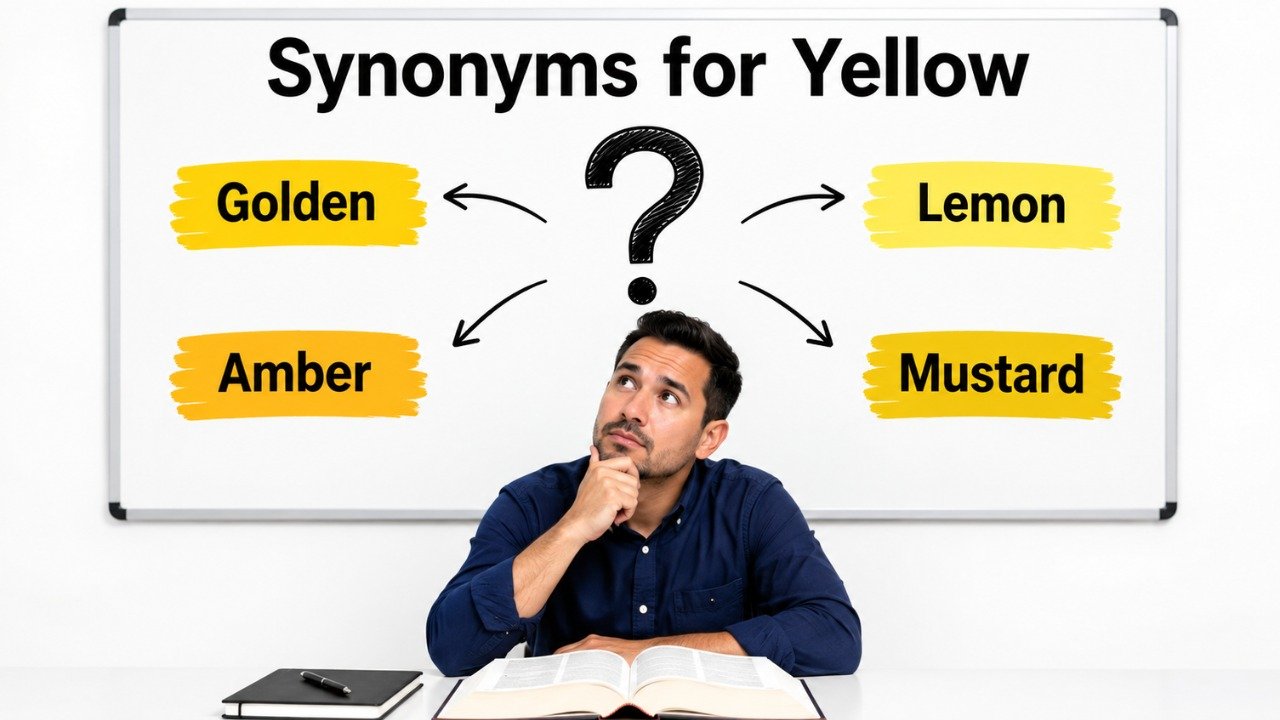
Quick Answer: Common synonyms for yellow include golden, amber, lemon, canary, saffron, mustard, ochre, flaxen, buttery, and goldenrod. The best choice depends on the exact shade and context. Golden works for rich warm yellow, lemon for bright fresh yellow, amber for deeper orange yellow, canary for vivid clear yellow, saffron for warm yellow orange, mustard for muted dark yellow, and ochre for earthy yellow. In figurative language, yellow can also mean cowardly, although that use is informal and can sound dated.
Pronunciation and Word Details
Word: Yellow.
Pronunciation: /ˈjeloʊ/
Part of Speech: Adjective, noun, and verb.
Meaning: A color between green and orange in the visible spectrum, often associated with sunlight, lemons, gold, and bright warmth.
US Pronunciation:
UK Pronunciation:
What Does “Yellow” Mean?
Yellow means having a bright color between green and orange.
As an adjective, yellow describes the color of an object.
Example: She placed yellow flowers beside the window.
As a noun, yellow refers to the color itself.
Example: Yellow adds warmth to the painting.
Yellow can also function as a verb meaning to become yellow or cause something to become yellow.
Example: The pages began to yellow with age.
In informal figurative language, yellow can mean cowardly or lacking courage.
Example: The character was unfairly described as yellow because he refused to fight.
The word can therefore describe color, aging, appearance, emotional associations, or behavior depending on context.
Meaning, Tone, and Context of “Yellow”
Yellow is usually a neutral color word. It is common in everyday conversation, descriptive writing, fashion, interior design, art, nature writing, science, and visual communication.
When used literally, yellow has no strongly formal or casual tone.
Example: The walls were painted a soft yellow.
More specific alternatives can create a clearer visual image. Golden suggests richness and warmth, while lemon suggests brightness and freshness.
Example: Golden light filled the room at sunset.
Example: The kitchen featured lemon colored accents.
In technical or artistic descriptions, terms such as ochre, amber, saffron, chartreuse, and goldenrod provide greater precision.
Yellow can also carry emotional associations with brightness, energy, warmth, caution, or attention depending on context.
Its figurative meaning of cowardly is informal and may sound old fashioned or insulting, so a direct word such as cowardly, timid, or fearful is usually clearer.
When and How to Use “Yellow”
For Basic Color Description
Use: Yellow is the clearest choice when the exact shade is not important.
Example: A yellow umbrella stood near the doorway.
For Bright Yellow Shades
Use: Lemon, canary, and sunny work well when the color is vivid and energetic.
Example: The room had bright canary curtains.
For Warm Golden Shades
Use: Golden, honey, amber, and saffron describe warmer yellows with brown or orange undertones.
Example: The field turned golden in the evening light.
For Earthy Yellow Shades
Use: Ochre and mustard are useful for deeper, softer, and more muted shades.
Example: She chose an ochre rug for the living room.
For Pale Yellow Shades
Use: Cream, butter, primrose, and straw can describe gentle or light yellow tones.
Example: The walls had a soft butter tone.
For Hair or Natural Coloring
Use: Flaxen and golden can describe pale or warm yellow blond coloring.
Example: The child had flaxen hair.
For Aging Materials
Use: Yellowed, faded, or discolored may be more accurate when paper, fabric, or another material changes color with age.
Example: The old document had yellowed pages.
For Figurative Cowardice
Use: Cowardly or timid is usually clearer than yellow when describing a lack of courage.
Example: The narrator called the decision cowardly rather than cautious.
Best Synonyms for Yellow
Golden: A rich, warm yellow resembling gold.
Example: Golden sunlight spread across the hills.
Amber: A deep yellow with noticeable orange or brown tones.
Example: Amber light glowed through the glass.
Lemon: A clear, vivid, slightly cool yellow.
Example: The lemon curtains brightened the room.
Canary: A strong, brilliant yellow.
Example: She wore a canary scarf with a dark coat.
Saffron: A warm yellow with orange undertones.
Example: Saffron fabric added warmth to the arrangement.
Mustard: A muted, deep yellow with brown undertones.
Example: Mustard cushions softened the neutral room.
Ochre: An earthy yellow with brown or golden tones.
Example: Ochre paint gave the wall a natural appearance.
Flaxen: A pale yellow or light golden shade, especially for hair.
Example: His flaxen hair shone in the afternoon light.
Buttery: A soft, creamy, warm yellow.
Example: The kitchen walls had a buttery finish.
Goldenrod: A rich, warm yellow associated with golden flowers.
Example: Goldenrod fabric brought depth to the color scheme.
50 Synonyms for Yellow with Short Meanings
- Golden: Rich warm yellow resembling gold.
- Amber: Deep yellow with orange or brown tones.
- Lemon: Bright clear yellow.
- Canary: Brilliant vivid yellow.
- Saffron: Warm yellow with orange undertones.
- Mustard: Muted deep yellow with brown tones.
- Ochre: Earthy yellow or golden brown.
- Flaxen: Pale golden yellow, especially for hair.
- Buttery: Soft creamy yellow.
- Goldenrod: Strong warm golden yellow.
- Primrose: Soft clear pale yellow.
- Straw: Light muted yellow resembling dried grass.
- Honey: Warm golden yellow with brown undertones.
- Maize: Medium warm yellow resembling corn.
- Daffodil: Bright fresh flower yellow.
- Sunflower: Strong cheerful golden yellow.
- Buttercup: Bright warm flower yellow.
- Cream: Very pale yellow with white tones.
- Ivory: Pale creamy yellow white.
- Champagne: Soft pale yellow with beige or golden tones.
- Gold: Metallic or rich deep yellow.
- Brass: Deep metallic yellow with brown tones.
- Wheat: Soft beige yellow resembling grain.
- Cornsilk: Very pale creamy yellow.
- Vanilla: Soft pale creamy yellow.
- Custard: Warm creamy yellow.
- Banana: Medium bright fruit yellow.
- Pineapple: Bright tropical yellow with golden warmth.
- Citrine: Clear golden yellow resembling the gemstone.
- Topaz: Golden yellow with warm brown or orange hints.
- Marigold: Deep vivid golden orange yellow.
- Dandelion: Bright natural flower yellow.
- Mimosa: Clear lively flower yellow.
- Jonquil: Bright golden flower yellow.
- Crocus: A warm yellow associated with certain crocus flowers.
- Chartreuse: Yellow green with a vivid appearance.
- Lime Yellow: Bright yellow with green undertones.
- Greenish Yellow: Yellow containing a noticeable green tone.
- Orange Yellow: Yellow containing a warm orange tone.
- Pale Yellow: Light and delicate yellow.
- Bright Yellow: Strong and highly visible yellow.
- Light Yellow: Yellow with a high amount of lightness.
- Deep Yellow: Strong darker yellow.
- Warm Yellow: Yellow with orange, gold, or brown undertones.
- Cool Yellow: Yellow with slight green undertones.
- Muted Yellow: Softened or less vivid yellow.
- Earthy Yellow: Natural muted yellow with brown undertones.
- Sunny: Bright, warm, cheerful yellow.
- Cowardly: Lacking courage, for the figurative sense of yellow.
- Timid: Fearful or lacking confidence, related to the figurative sense.
Read Also:
Synonyms for Bitch
Synonyms for Yellow by Context
When Yellow Means Bright and Vivid
Lemon, canary, daffodil, sunflower, buttercup, dandelion, and sunny work well for bright yellow shades.
Example: She painted the chair yellow.
Alternative: She painted the chair a vivid canary shade.
Lemon often appears slightly cooler, while sunflower and buttercup suggest warmer natural yellows.
When Yellow Means Warm and Golden
Golden, amber, honey, saffron, citrine, topaz, and goldenrod d
escribe warmer forms of yellow.
Example: Yellow light entered through the curtains.
Alternative: Golden light entered through the curtains.
Amber has more orange or brown in it than ordinary yellow, while golden suggests richness and warmth.
When Yellow Means Pale or Creamy
Butter, cream, cornsilk, vanilla, ivory, straw, and primrose are useful for soft yellow shades.
Example: The bedroom walls were pale yellow.
Alternative: The bedroom walls had a soft primrose tone.
Cream and ivory can become so pale that they appear close to white.
When Yellow Means Earthy or Muted
Mustard, ochre, wheat, straw, brass, and earthy yellow fit colors that are less bright and more natural.
Example: She selected a muted yellow fabric.
Alternative: She selected a mustard fabric.
Ochre works especially well in art, interiors, natural materials, and earthy color palettes.
When Yellow Has Green Undertones
Chartreuse, lime yellow, greenish yellow, and cool yellow describe yellow shades leaning toward green.
Example: The leaves had an unusual yellow shade.
Alternative: The leaves had a greenish yellow tone.
When Yellow Means Cowardly
Cowardly, timid, fearful, and fainthearted can replace the figurative meaning of yellow.
Example: The villain accused him of being yellow.
Alternative: The villain accused him of being cowardly.
The figurative sense can sound dated or insulting, so direct language is generally clearer.
Another Word for Yellow
Another word for yellow is golden when the color has a rich, warm appearance. However, the best alternative depends on the exact shade.
Use lemon for bright yellow, cream for pale yellow, mustard for muted yellow, and amber for a deeper orange yellow.
Original: Yellow light filled the room.
Better Option: Golden light filled the room.
Original: She chose a bright yellow scarf.
Better Option: She chose a canary scarf.
Original: The walls were painted a pale yellow.
Better Option: The walls were painted a soft primrose shade.
Original: The chair had a dark yellow fabric.
Better Option: The chair had mustard fabric.
When Not to Use “Yellow”
Yellow is useful when a general color description is enough, but it can sound vague when the exact shade matters.
Weak: The room had yellow walls.
Better: The room had warm buttery walls.
Avoid yellow when describing a color with strong orange or brown tones if a more precise word is available.
Weak: The lamp gave off dark yellow light.
Better: The lamp gave off amber light.
Do not use yellow repeatedly when describing several different shades.
Weak: The yellow flowers stood beside a yellow curtain under yellow light.
Better: The daffodil flowers stood beside a lemon curtain under golden light.
Use caution with the figurative sense meaning cowardly.
Weak: He was yellow because he refused the challenge.
Better: He was accused of being cowardly because he refused the challenge.
The second sentence is clearer and avoids an expression that may sound dated.
Words Commonly Confused With Yellow
Yellow vs Gold: Yellow is a basic color, while gold usually suggests a richer shade or metallic appearance.
Yellow vs Amber: Amber is darker and generally contains more orange or brown than standard yellow.
Yellow vs Lemon: Lemon is a brighter and often slightly cooler form of yellow.
Yellow vs Mustard: Mustard is darker, softer, and more muted than bright yellow.
Yellow vs Ochre: Ochre is an earthy yellow that usually contains brown or golden undertones.
Yellow vs Cream: Cream is much paler than ordinary yellow and contains a strong white component.
Yellow vs Chartreuse: Chartreuse lies between yellow and green and has a much stronger green quality.
Yellow vs Orange: Yellow and orange are separate colors. Orange is warmer and redder, while yellow is lighter and sits closer to green.
Which Synonym Should You Choose?
Choose golden in descriptive writing when you want warmth, richness, sunlight, or an elegant visual effect.
Choose lemon for a clear, bright yellow in everyday descriptions, fashion, decor, or creative writing.
Choose canary when you want to emphasize an especially vivid and noticeable yellow.
Choose amber for deeper yellow light, glass, eyes, liquids, or colors with orange and brown undertones.
Choose mustard for darker and more muted yellow in clothing, furnishings, and visual descriptions.
Choose ochre in art, design, nature writing, and formal descriptions of earthy yellow.
Choose cream, primrose, or buttery for soft and pale yellow tones.
Choose saffron when describing a rich warm yellow with a slight orange quality.
Choose flaxen when describing pale golden hair or similar natural coloring.
Choose cowardly or timid instead of yellow when the intended meaning is lack of courage and clarity matters.
Real Life Examples of “Yellow” in Sentences
Original: Yellow sunlight came through the window.
Better Option: Golden sunlight came through the window.
Original: She carried a bright yellow bag.
Better Option: She carried a canary bag.
Original: The walls were painted a soft yellow.
Better Option: The walls were painted a buttery shade.
Original: He selected a dark yellow jacket.
Better Option: He selected a mustard jacket.
Original: Yellow light glowed inside the lantern.
Better Option: Amber light glowed inside the lantern.
Original: The artist mixed an earthy yellow for the landscape.
Better Option: The artist mixed ochre for the landscape.
Original: Her hair had a pale yellow tone.
Better Option: Her hair had a flaxen tone.
Original: Yellow flowers covered the edge of the garden.
Better Option: Daffodil colored flowers covered the edge of the garden.
Original: The curtains had a warm yellow shade.
Better Option: The curtains had a saffron shade.
Original: The old paper became yellow over time.
Better Option: The old paper became discolored with a yellowed appearance over time.
Synonym Groups and Usage Differences
Bright Yellow Group
Lemon, canary, daffodil, dandelion, sunflower, buttercup, and sunny describe vivid yellows that attract attention.
These words are useful for flowers, clothing, decorations, painted objects, and cheerful visual descriptions.
Example: Canary curtains brought brightness to the room.
Golden Yellow Group
Golden, amber, honey, saffron, citrine, topaz, and goldenrod describe warmer yellow shades.
They often create a richer and softer visual effect than basic yellow.
Example: Golden leaves covered the garden path.
Pale Yellow Group
Cream, ivory, cornsilk, vanilla, primrose, butter, and straw represent lighter yellow shades.
These alternatives are useful when ordinary yellow sounds too strong.
Example: Soft primrose walls made the room feel light and calm.
Earthy Yellow Group
Mustard, ochre, wheat, brass, straw, and muted yellow describe natural or subdued yellow tones.
These shades work well for landscapes, fabrics, paints, and interior descriptions.
Example: An ochre blanket added an earthy tone to the room.
Green Yellow Group
Chartreuse, lime yellow, greenish yellow, and cool yellow contain visible green undertones.
Example: The new leaves had a bright chartreuse appearance.
Figurative Meaning Group
Cowardly, timid, fearful, and fainthearted relate to the informal figurative sense of yellow as lacking courage.
These alternatives communicate the intended meaning more directly.
Example: The accusation portrayed the character as cowardly.
Antonyms of Yellow
Yellow does not have a true dictionary antonym when it refers simply to a color. However, contrasting colors and opposite figurative meanings can be identified according to context.
Purple: A strong visual contrast to yellow and often treated as its complementary color in traditional color relationships.
Violet: A contrasting color positioned far from yellow in common color systems.
Blue: A cool color that strongly contrasts with warm yellow.
Colorless: Lacking noticeable color.
Achromatic: Without a strong hue, such as gray, black, or white.
For the figurative sense of yellow meaning cowardly, clearer opposites include the following.
Brave: Willing to face danger or difficulty.
Courageous: Showing courage in difficult situations.
Bold: Confident and willing to take risks.
Fearless: Showing little or no fear.
Valiant: Showing strong courage or determination.
Daring: Willing to face risk or danger.
Comparison: Yellow vs Related Words
Yellow vs Golden
Yellow is the broad basic color. Golden is warmer, richer, and often associated with sunlight or gold.
Example With Yellow: Yellow flowers lined the path.
Example With Golden: Golden sunlight covered the path.
Yellow vs Lemon
Yellow can cover many shades, while lemon specifically suggests a bright, clean, vivid yellow.
Example With Yellow: She painted the cabinet yellow.
Example With Lemon: She painted the cabinet a fresh lemon shade.
Yellow vs Amber
Yellow is generally brighter and clearer. Amber is deeper and contains orange or brown undertones.
Example With Yellow: The fabric was bright yellow.
Example With Amber: Amber light glowed through the glass.
Yellow vs Mustard
Yellow is broad and often bright. Mustard is muted, darker, and more earthy.
Example With Yellow: He chose a yellow sweater.
Example With Mustard: He chose a mustard sweater for the autumn outfit.
Yellow vs Ochre
Yellow is a general color term. Ochre is an earthy yellow with noticeable brown or golden qualities.
Example With Yellow: The artist added yellow to the landscape.
Example With Ochre: The artist used ochre to create an earthy landscape.
Yellow vs Cream
Yellow is more saturated, while cream is very pale and mixed visually with white.
Example With Yellow: The yellow wall looked bright.
Example With Cream: The cream wall created a softer appearance.
Yellow vs Chartreuse
Yellow is a basic warm color, while chartreuse has a noticeable green quality.
Example With Yellow: The petals were clear yellow.
Example With Chartreuse: The leaves had a vivid chartreuse color.
Common Phrases and Expressions With Yellow
Bright Yellow: A vivid and highly noticeable yellow.
Pale Yellow: A soft and lightly saturated yellow.
Golden Yellow: A rich yellow resembling gold.
Lemon Yellow: A bright, clean yellow resembling lemon peel.
Mustard Yellow: A deep muted yellow with brown undertones.
Canary Yellow: A brilliant and intense yellow.
Yellow Ochre: An earthy natural yellow pigment or shade.
Yellow Light: Light that appears yellow or golden.
Yellow Flowers: Flowers whose petals have a yellow coloring.
Yellow With Age: Becoming yellowish as a result of time, oxidation, or deterioration.
Common Mistakes to Avoid
A common mistake is treating every yellow shade as interchangeable. Lemon, mustard, amber, ochre, and cream create very different visual impressions.
Vague: She wore a yellow dress.
More Precise: She wore a soft saffron dress.
Avoid calling an orange yellow shade lemon. Lemon is generally bright and relatively clear, while saffron or amber may better describe warmer tones.
Do not confuse gold with ordinary yellow when metallic appearance matters.
Unclear: The frame had a yellow metallic finish.
Better: The frame had a gold metallic finish.
Avoid using cream for a vivid yellow. Cream is much lighter and closer to white.
Do not overuse shade names when simple yellow is sufficient. Precision should improve clarity rather than make a sentence unnecessarily complicated.
Be careful with yellow as a synonym for cowardly. The expression can sound dated, informal, or insulting.
Unclear: Everyone thought he was yellow.
Clearer: Everyone thought he was cowardly.
Another mistake is assuming that yellow has one exact antonym. Colors usually have contrasts or complementary relationships rather than true lexical opposites.
When writing about color, choose the word according to brightness, warmth, saturation, undertone, and purpose.
Conclusion
The best synonyms for yellow depend on the shade, tone, and sentence context. Golden and saffron suit warm yellow, lemon and canary describe vivid shades, cream and primrose work for pale tones, while mustard and ochre fit muted earthy colors. Amber is useful for deeper orange yellow, and flaxen often describes pale golden hair. Yellow can also mean cowardly in figurative language, although direct alternatives such as cowardly or timid are usually clearer. Precise color vocabulary makes descriptions more vivid and accurate.
FAQs About Synonyms for Yellow
What is the best synonym for yellow?
Golden is a strong general alternative for warm yellow. Lemon, canary, mustard, amber, and ochre are better when a specific shade is intended.
What is another word for bright yellow?
Canary, lemon, daffodil, dandelion, buttercup, and sunflower can all describe bright yellow shades.
What is another word for pale yellow?
Cream, primrose, cornsilk, vanilla, ivory, straw, and buttery are useful alternatives for pale yellow.
What is a synonym for dark yellow?
Mustard, ochre, amber, goldenrod, and brass can describe darker or deeper yellow tones.
What is a fancy word for yellow?
Saffron, ochre, citrine, goldenrod, amber, and flaxen can provide more specific or descriptive alternatives to yellow.
Does yellow mean cowardly?
Yellow can mean cowardly in informal figurative language. This usage may sound dated, so cowardly, timid, or fearful is often clearer.
What is the opposite of yellow?
Yellow has no exact lexical antonym as a color. Purple and violet provide strong visual contrast, while brave and courageous are opposites when yellow is used figuratively to mean cowardly.
